
DNA test for nutrition: Your guide to personalized health
A DNA test for nutrition takes a very close look at your genetic predispositions. It provides you with highly personalized insights into how your body reacts to fats, carbohydrates, and specific nutrients. Think of it as a biological instruction manual that allows you to tailor your diet precisely to your individual needs.
What a DNA test for nutrition really reveals
Imagine if your diet were no longer a constant guessing game. Instead of general diet rules, you'd have a personalized guide written directly into your genes. That's the basic idea behind a DNA test for nutrition – a fascinating field also known as nutrigenetics .
But what does that mean for you specifically? It's not about following a rigid "gene-based diet" that completely turns your life upside down. Rather, the test provides you with valuable insights that you can use as a starting point for a more conscious and smarter way of eating.
Your DNA as a personal instruction manual
You can think of your DNA as your body's operating system. Every person has a unique operating system with completely individual settings. A DNA test for nutrition essentially reads specific lines of code from this system and translates them into understandable information for you. It shows you which "software"—that is, which diet—might work best for you.
This involves analyzing specific genetic markers that, among other things, influence how your body reacts to different nutrients.
- Macronutrient metabolism: Do you tend to process fats or carbohydrates more efficiently? The answer can help you better balance your meals.
- Nutritional needs: Your genetic profile can provide clues as to whether you have a potentially increased need for certain vitamins or minerals, such as vitamin D or B12.
- Satiety and eating behavior: Some genes are related to how quickly you feel full or whether you have a tendency towards cravings.
This table shows you at a glance which areas of your health could be influenced by your genetic predisposition and what information a DNA test can provide.
Your genetic metabolic type and its possible effects
| Area | Possible genetic influence | What a DNA test can reveal |
|---|---|---|
| Weight management | Predisposition to obesity (e.g., through the FTO gene) | Tendencies towards storing fat or processing carbohydrates. |
| Energy level | Efficiency of energy conversion from macronutrients | Which mix of fats, proteins and carbohydrates gives you the most energy. |
| Muscle building & regeneration | Predisposition for endurance or strength sports | Which nutrient and training focus best suits your genetic profile. |
| Vitamin & mineral balance | Ability to absorb and utilize (e.g., vitamin B12, vitamin D, iron) | A possible increased need for certain micronutrients. |
| Intolerances | Lactose or gluten intolerance | Predispositions that could be behind digestive problems. |
| Detoxification & Stress | Ability to metabolize caffeine or react to salt | How sensitive your body is to certain stimulants or stressors. |
The findings from the test are therefore not rigid rules, but rather valuable puzzle pieces that help you to better understand the overall picture of your health and to take targeted action.
From hypothesis to targeted optimization
It's really important to understand that a DNA test reveals tendencies and predispositions, but it doesn't provide definitive truths. It presents scientifically based hypotheses about your body. For example, you might learn that you could be genetically predisposed to metabolizing caffeine slowly. This doesn't mean you can never drink coffee again, but rather that you could be more mindful of when and how much you consume.
A DNA test is not a prediction of fate, but a compass. It gives you a direction to better understand your body and to take targeted steps to manage your health.
These findings are especially powerful when you use them as a starting point for further steps. If your test indicates a predisposition to a nutrient deficiency, the next logical step is to check your current status. This is precisely where mybody-x blood tests come in, allowing you to validate such hypotheses and optimize your diet based on real measurements.
The link between genes and weight is also an intensively researched field. According to the Federal Statistical Office, around 53 percent of adults in Germany were overweight in 2017. Researchers assume that genetic factors play an important role here, with the FTO gene in particular being associated with the regulation of hunger. If you would like to learn more about the search for the "slimming gene," you can find further insights at spiegel.de .
Your journey from rehearsal to personal report
Are you wondering exactly how a DNA test for nutrition works? Many people imagine it to be complicated or even a little intimidating, but the opposite is true. The whole process is surprisingly straightforward. Come along, we'll guide you step by step through the entire process – from collecting the sample at home to receiving your very own report.
It all starts in the comfort of your own home. You'll receive a test kit with everything you need. It contains everything you need for a simple saliva sample – it's completely painless and takes just a few minutes. Afterwards, you securely package the sample, attach the enclosed return label, and take it to the post office. Shipping to a certified partner laboratory in Germany is, of course, free of charge.
From your saliva sample to genetic analysis
Once your sample arrives at the lab, the scientific part of the journey begins. First, your DNA is carefully isolated from the cells in your saliva sample. Think of it like panning for gold in rock: your pure genetic material is separated from all other components so it can be precisely analyzed.
Then the actual genetic analysis begins. Using state-of-the-art technology, experts examine precisely those sections of your DNA that play a crucial role in your metabolism and nutrient absorption. The focus here is on so-called SNPs (Single Nucleotide Polymorphisms) .
SNPs are tiny variations in your genetic code that make you unique. They can influence how your body reacts to fats, carbohydrates, or vitamins and provide crucial clues for your personalized recommendations.
Creating your individual report
The raw genetic data obtained in the lab would be virtually impossible for you to decipher. That's why the next step is crucial: translating this data into a clear and meaningful report. Experts analyze the results and present them in a way that provides you with clear, actionable insights for your everyday life.
After the analysis is complete, you will receive a digital report that clearly summarizes all the important information. This report contains detailed explanations of your genetic predispositions in various areas:
- Your metabolic type: Find out whether you naturally burn carbohydrates or fats more efficiently.
- Your nutritional needs: Discover if you have a genetic predisposition to an increased need for certain vitamins or minerals.
- Your sensitivities: Find out if your body is genetically predisposed to being more sensitive to things like caffeine or lactose.
This transparent and scientifically sound process ensures that you end up with real knowledge, not just data. If you'd like to delve even deeper into the lab analysis, you'll find more fascinating details in our article on step-by-step DNA analysis . This entire process gives you the confidence you need to take control of your diet and well-being.
The scientific opportunities and limitations of nutrigenetics
The idea of a diet perfectly tailored to your DNA sounds fascinating. But let's be honest: how much substance is really behind a DNA test for nutrition ? To answer this question fairly, we need to take a close look at the opportunities and limitations of nutrigenetics. The field of research is still young, but it's developing rapidly and has enormous potential.
Your genetic code is an incredibly valuable source of information. It provides you with important clues about your very personal predispositions – for example, how your body reacts to certain nutrients or whether you have a potentially increased need for certain vitamins. These insights are a fantastic starting point for a more conscious lifestyle.
But it's equally important to understand what a DNA test is not : It's not a prediction of fate, nor is it a magic formula for weight loss. Your genes are always just one piece of the puzzle.
More than just genes
Your health depends on countless factors that extend far beyond your DNA. Your lifestyle, your stress levels, the quality of your sleep, and especially the health of your gut play an equally crucial role in your well-being. Your genes indicate a predisposition, but your everyday behavior determines what becomes of it.
A DNA test for nutrition is therefore not a miracle diet, but a valuable tool for self-optimization. It provides you with scientifically sound hypotheses about your body. You can then specifically test and validate these in real life.
Think of your genetic results as a personalized map. It shows you possible routes and potential obstacles, but you have to walk the path yourself – with every conscious decision you make.
The process from your sample to your personal report, which provides you with these valuable hypotheses, is very straightforward.
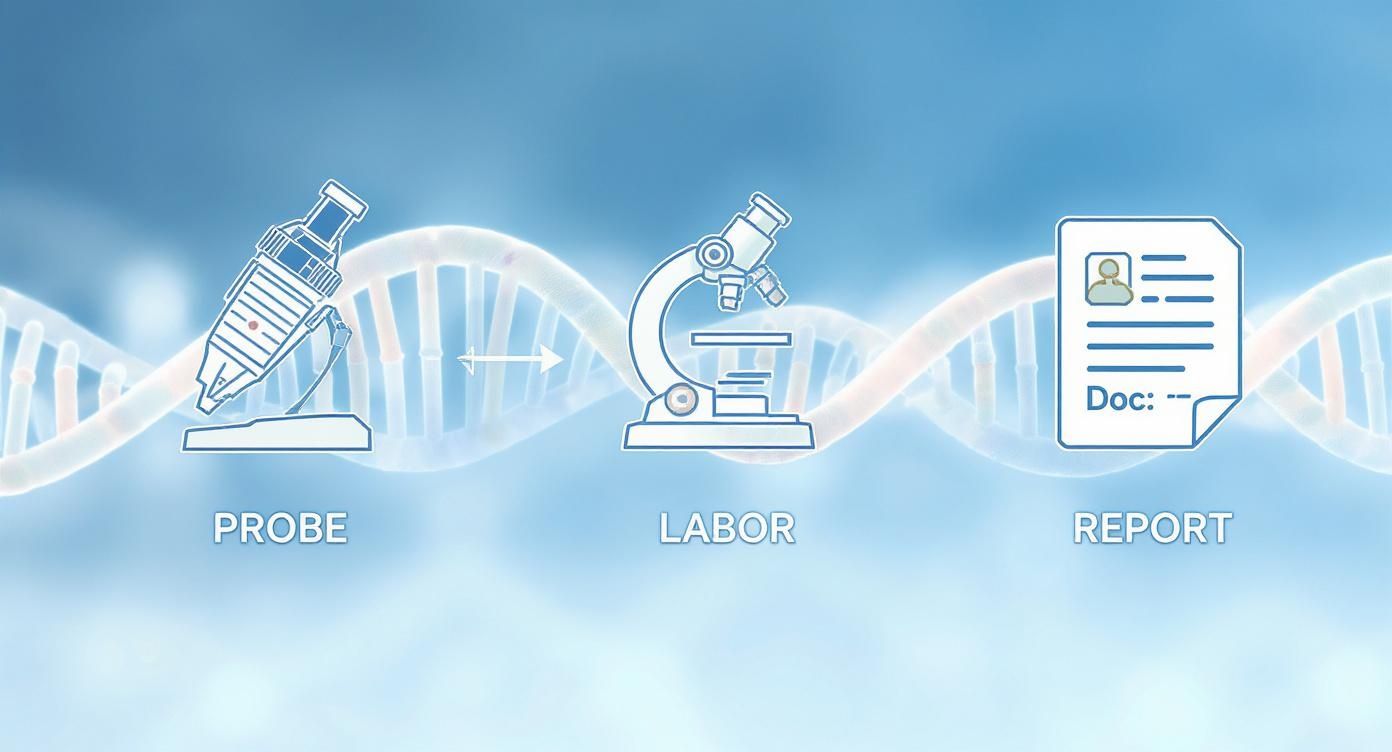
The entire process is designed to present complex genetic information in a way that you can understand and apply directly.
The comparison with reality
This is precisely where the true strength of a DNA test for nutrition lies: it prompts you to ask the right questions. For example, if your report indicates a predisposition to low vitamin D levels, that's a hypothesis. The logical next step? To test that hypothesis.
This brings us full circle to the self-tests from mybody-x . With a targeted nutrient test, you can measure your actual , current vitamin D status in your blood. This allows you to connect your genetic predisposition with your current state. Instead of guessing, you can precisely adjust your diet or supplementation.
- Genetic hypothesis: Your DNA test shows a tendency towards an increased need for omega-3 fatty acids.
- Real-world verification: A nutrient test from mybody-x measures your current Omega-3 to Omega-6 ratio.
- Targeted action: You adjust your diet based on solid data.
This approach combines the best of both worlds: the long-term tendencies from your DNA and a snapshot of your current health. Want to delve deeper into the fascinating world of genetics? Then read our article to find out what nutrigenetics is and how it influences our lives .
An honest assessment of the research findings
Despite the growing interest in personalized nutrition, the scientific evidence must be realistically assessed. DNA tests for metabolic analysis are extremely popular, but the research on their direct benefit for weight loss is still inconsistent. For example, a large study from Stanford University with 609 overweight participants showed no significant differences in weight loss success between a genetically tailored diet and a conventional diet.
Experts therefore emphasize that misinterpreting the results can do more harm than good. You can find the full study on the DNA diet and what metabolic analyses really reveal at spiegel.de .
This underscores our philosophy: A DNA test is not a magic bullet. However, it is a powerful catalyst for getting to know your body better and taking proactive, data-driven control of your health.
Here's how you can use your results in everyday life
You're finally holding your DNA report in your hands – a pretty exciting moment! But what now? This section is your personal guide to translating the valuable insights from your DNA test for nutrition directly into your everyday life and getting the most out of it for yourself.
Your report isn't a rigid instruction manual, but rather a collection of well-founded hypotheses about your body. Consider it the starting point for making your diet more conscious and targeted. We'll show you concrete examples of how to interpret your results and what practical steps you can take from them.

From genetic tendency to concrete action
Imagine your report shows a genetic predisposition to a slow caffeine metabolism. This is a very typical finding from a DNA test. What does that mean for you and your beloved morning coffee?
Quite simply: your body probably needs longer to get rid of caffeine. So instead of cutting out coffee completely, you could experiment a little:
- Adjust the timing: Perhaps drink your last coffee in the early afternoon instead of late afternoon to avoid disturbing your sleep.
- Pay attention to the amount: Perhaps one or two cups a day simply feel better than three or four. Watch for signals such as inner restlessness or nervousness.
- Discover alternatives: On some days, simply try decaffeinated coffee or a delicious herbal tea.
The idea is to use genetic information as a starting point to observe your body more closely and make conscious decisions.
Your personal nutrient compass
Another classic example: an indication of a potentially increased need for nutrients. Let's say your DNA test for nutrition suggests that you have a predisposition for an increased need for omega-3 fatty acids.
This is extremely valuable information! Instead of groping in the dark, you can now take targeted action:
- Optimize your shopping list: Consciously include foods rich in Omega-3 on your list. These include fatty fish like salmon or mackerel, but also plant-based sources such as flaxseeds, chia seeds, and walnuts.
- Meal planning: Actively integrate these foods into your week. A salmon fillet for dinner, chia seeds in your morning yogurt, or a handful of walnuts as a snack – these are simple but super effective adjustments.
- Preparation instructions: Use high-quality oils such as linseed oil or walnut oil for cold dishes (e.g. salad dressings) to preserve the valuable fatty acids.
Your genetic results are like a personalized shopping list for your well-being. They show you which "ingredients" your body potentially needs more of to function optimally.
These small but targeted changes can make a huge difference to your energy levels and overall health. For more detailed guidance on how to optimize your diet after your test results, we've compiled a comprehensive guide to nutrition after a DNA test .
The crucial step: validation through blood tests
The most important insight, however, is this: your DNA reveals a predisposition, not your current state. Just because you have a genetic tendency towards a vitamin D deficiency doesn't automatically mean you actually have one. Your lifestyle—how much time you spend in the sun—and your diet play at least as important a role.
This is where the crucial step comes into play that makes genetic analysis truly powerful: verifying your actual values in the here and now.
That's precisely what mybody-x blood tests were developed for. They are the perfect complement to your DNA test because they give you a crystal-clear picture of your current health status.
- Genetic hypothesis: Your DNA test shows a predisposition to a vitamin D deficiency.
- Real-world verification: A nutrient test from mybody-x measures your exact vitamin D level in your blood.
- Targeted action: Based on this specific value, you can precisely adjust your diet or supplementation according to your needs – not too much and not too little.
This two-step process is the key to a truly personalized health strategy. You combine long-term insights from your genetics with a precise snapshot from your blood. This way, you no longer make decisions based on guesswork, but on solid data about your own body.
Choosing the right provider for your DNA test
The market for DNA tests for nutritional purposes is growing rapidly – and quite frankly, it's easy to lose track. You're faced with a plethora of offers and wonder: Which one is right for me? Which provider can I entrust with my sensitive data?
Don't worry, you're not alone with these questions. To help you make an informed decision, we've put together a clear checklist. It's not about just taking any test. It's about finding the test that truly helps you and that you feel comfortable taking.
What matters in laboratory quality
The quality of your results depends entirely on the laboratory analyzing your sample. This is the crucial point. A key indicator of reliability is certification according to international standards. Make absolutely sure that the laboratory operates according to ISO standards . This isn't just unnecessary paperwork; it's your guarantee that all processes are standardized, controlled, and conducted to the highest scientific standards.
At mybody-x, we make no compromises. We work exclusively with ISO-certified partner laboratories directly in Germany. This not only ensures the precision of your genetic analysis but also gives you the assurance that your sample is handled under the strictest quality controls.
Data privacy first
Your genetic data is probably the most personal information we have about you. That's why protecting your privacy must be our top priority. A reputable provider will explain to you completely transparently how they handle your data – without complicated legalese.
Here are the most important points to keep an eye on:
- GDPR compliance: The provider must adhere to the strict European General Data Protection Regulation. This is the absolute basic requirement.
- Server location: Ideally, the servers should be located within the EU. This is the only way to ensure full GDPR protection.
- Anonymization: Your sample and your data should be processed anonymously or pseudonymously. This means that no direct link to you as an individual can be established.
- No data sales: Make sure your data is not sold to third parties, especially not to pharmaceutical companies or insurance companies.
Your genetic code belongs to you alone. A trustworthy partner will do everything to protect this sensitive information and give you full control over what happens to it.
Comprehensibility and feasibility of the results
A good DNA test for nutrition gives you more than just a dry list of complicated gene names. Its true value lies in what you can do with the results. You should receive a clear, understandable report that tells you not only what your genes show, but, more importantly, what that means for you .
Make sure the report contains concrete and actionable recommendations for your everyday life. Instead of abstract data, you need practical tips for your diet and lifestyle that you can try immediately. That's exactly where we at mybody-x come in: We translate the science into language you understand and give you the tools to really take action.
Costs and scope of services compared
The prices for a DNA test for nutritional analysis can vary considerably. It's worth taking a close look at what's actually included in the price. In Germany, the cost of DNA-based nutritional tests usually ranges between approximately €189 and €350 .
Professional associations and consumer protection organizations point out, however, that the integration of genetic data into nutritional counseling is still a relatively new field of research. If you would like to delve deeper into the current assessment, you can find further information at the Consumer Advice Center of North Rhine-Westphalia (NRW) .
Don't just compare the price, but also the scope of the analysis. How many genetic markers are examined? Which areas (metabolism, nutrients, intolerances) does the test cover? Is there personal consultation or support available for interpreting the results? A good decision is based on the overall package that best suits your goals.
Checklist for choosing your DNA test provider
To make your decision easier, we've summarized the most important points in a clear table. Use this table to objectively compare different providers and make the best choice for you and your data.
| criterion | What you should pay attention to | Why it's important |
|---|---|---|
| Laboratory quality | ISO certification of the laboratory (e.g., ISO 17025). Ideally, the laboratory should be located in Germany or the EU. | Ensures the accuracy and reliability of your results according to internationally recognized scientific standards. |
| Data protection | GDPR compliance, server location EU, clear privacy policy, anonymization of data, no sale to third parties. | Your genetic data is extremely sensitive. The highest security standards are essential to protect your privacy. |
| scientific rigor | Are the examined genetic markers and their relevance explained transparently? Are the recommendations based on current research? | Ensures that your recommendations are based on solid scientific findings, not vague assumptions. |
| Results processing | Plain language instead of technical jargon. Clear, actionable recommendations for nutrition and lifestyle. | The best test is useless if you don't understand what you're supposed to do. Its true value lies in its practical application. |
| Scope of analysis | How many and which gene variants are analyzed? Which areas (metabolism, vitamins, intolerances) are covered? | A broader analysis gives you a more comprehensive picture of your genetic predispositions and therefore more starting points. |
| Support & Advice | Does the provider offer support with questions about the results? Is there a personal consultation option? | Good support helps you to interpret the results correctly and integrate them into your daily life, so that you are not left alone. |
| Price-performance | Are the costs proportionate to the scope of the analysis and the services offered? Are there any hidden costs? | A fair price should be reflected in the overall package. Don't just compare the number, but the value you receive for it. |
Take your time to make this comparison. It's an important decision that can lay the foundation for a more conscious and healthier lifestyle. A reputable provider will make all this information transparent – because your trust and your health are at stake.
Your genetic code as an opportunity for a healthier life
A DNA test for nutrition is a fascinating tool on your journey to greater self-understanding and a healthier you. It's not a miracle cure that changes everything overnight, but rather a valuable and very personal compass that can point you in a clear direction. See it as the beginning of an exciting dialogue with your body.

Let's summarize the key points once more: The test provides valuable insights into your genetic predispositions. However, you should never consider these findings in isolation, but always within the context of your overall lifestyle – your exercise, your sleep, and your stress levels.
From genetics to targeted action
The crucial step is to use these new findings as an intelligent starting point. Your DNA report provides you with hypotheses, essentially a genetic map of potential characteristics. But a map only shows you the terrain, not where you actually are. To find that out, you need to assess your current state of health.
This brings us full circle to the self-tests from mybody-x . They are the perfect complement to your genetic analysis.
Your DNA shows you where to look. A blood test shows you what you'll find there. This combination is the key to a truly personalized health strategy.
Use your genetic clues to take targeted next steps. This way, you can take precise and effective control of your health yourself, instead of just following general advice.
The bridge between predisposition and reality
This approach connects your genetic blueprint with your actual current state. Here are a few concrete examples of what this looks like in practice:
-
Genetic indication: Your DNA test suggests a predisposition to an increased need for vitamin D.
-
Targeted check: With a nutrient test from mybody-x , you measure your current vitamin D level in your blood and receive an exact value.
-
Your action: You adjust your diet or sun exposure based on real data.
-
Genetic note: Your genes indicate a possible predisposition for hormonal fluctuations.
-
Targeted check: A hormone test from mybody-x gives you information about your current hormonal balance.
-
Your action: You can specifically adjust your lifestyle to naturally support your hormones.
By connecting these two levels, you transform genetic probabilities into concrete, data-driven actions. You no longer react to assumptions, but act on the basis of a deep understanding of your unique body.
Frequently asked questions about the DNA test for nutrition
You've now gained a deep insight into the world of DNA tests for nutrition , but perhaps a few specific questions are still swirling around in your head. That's perfectly understandable! Here we answer the most frequently asked questions to dispel any remaining uncertainties and provide complete clarity.
How reliable are the results of a DNA nutrition test?
Pure laboratory analysis, meaning the reading of your gene variants, is extremely precise these days. The real art – and the challenge – lies in the interpretation of this data. Nutrigenetics is a young science that is developing rapidly. Many connections between genes and nutrition are incredibly fascinating, but not yet fully understood.
Therefore, view your test results for what they are: scientifically sound trends, not hard and fast rules. They are a fantastic starting point for asking the right questions and conducting targeted further research. A blood test from mybody-x is the perfect complement to verify your actual nutrient status and to support genetic hypotheses with hard facts.
Can a DNA test specifically help me lose weight?
Yes, it can be an incredibly valuable tool on your journey. For example, if the test shows that you are genetically more sensitive to carbohydrates or fats, you have a clear indication of how to optimize your macronutrient distribution. It can also give you interesting insights into your natural satiety signals or your tendency towards emotional eating.
However, one thing is clear: the foundation for any successful weight loss remains a calorie deficit. The DNA test for nutrition provides you with a personalized blueprint for achieving this goal more effectively, sustainably, and in a way that is tailored to your unique body.
A DNA test doesn't override the laws of nutritional physics. But it gives you personalized guidance on how to use them more intelligently.
What happens to my genetic data after the test?
A crucial question you should definitely ask yourself. Reputable providers in Europe, like us, are subject to the strict General Data Protection Regulation (GDPR). This means your data must be processed and stored according to the highest security standards, usually in anonymized or pseudonymized form.
When choosing a provider, pay very close attention to their privacy policy. Where are the servers located (ideally within the EU)? How easily can you have your data deleted? Your genetic data is extremely sensitive and deserves the best possible protection – no ifs, ands, or buts.
Can a DNA test replace a doctor's visit or nutritional advice?
No, absolutely not. A DNA test for nutrition does not provide medical diagnoses and is never a substitute for professional medical or therapeutic advice. Consider it a powerful self-information tool that helps you ask the right questions about your body.
The results provide an ideal basis for discussing your health with a specialist or the perfect impetus for targeted self-tests – such as the blood tests from mybody-x . This allows you to gain a comprehensive understanding of your health and make truly informed decisions for your well-being.
Ready to compare the hypotheses from your genetics with concrete data from your blood? At mybody-x , you'll find the right nutrient, hormone, or intolerance test to take control of your health. Discover the perfect complement to your genetic knowledge now at https://mybody-x.com .


Share:
Metabolic analysis for weight loss: Your path to your desired weight
Genetic testing at home: Personalized health explained simply