

How to lose weight with a DNA analysis: Your genetic path to your ideal weight
Have you already tried countless diets, but the big success remains elusive? Or worse, does the yo-yo effect mercilessly strike back every time? Then you know the feeling of frustration all too well. A DNA analysis for weight loss could make the decisive difference here. Instead of relying on general rules, it uses an approach based on your unique genetic predisposition. This allows you to finally discover which nutrition and exercise strategy is truly right for you.
Why most diets are bound to fail
Do you sometimes feel lost in the jungle of diet trends? From low-carb diets and strict calorie counting to intermittent fasting—the promises sound wonderful, but reality often looks different. Many people find that a plan that works wonders for their best friend has little effect on them. This is no coincidence and has absolutely nothing to do with a lack of discipline.
The reason is actually quite simple: These “one-size-fits-all” approaches ignore the most important factor in the entire equation—you and your individual biology. Your body is not a standard model, but a highly complex system with a unique genetic blueprint. What is the perfect fuel for one person can make someone else’s engine sputter badly.
Your metabolism: A genetic fingerprint
Your metabolism—the way your body converts food into energy—is as individual as your fingerprint. And it is largely controlled by your genes. These small building blocks determine how efficiently you process fats, carbohydrates, and proteins, how your feeling of fullness is regulated, and even how your body responds to different types of exercise.
Your DNA is not your destiny, but your personal map. It shows you the most direct route to your goal by explaining which paths are ideal for you and which ones you should avoid.
While some people are genetically predisposed to burn carbohydrates effortlessly, others tend to store them much more quickly in unwanted fat deposits. Still others need more protein to maintain their muscles and feel truly full. This is exactly where traditional diets get it wrong, because they simply overlook these subtle yet crucial differences. Failure is often preprogrammed from the outset.
The following table illustrates how fundamentally the two approaches differ.
Comparison between traditional diets and DNA analysis
This table shows the fundamental differences between generic dieting approaches and a personalized nutrition strategy based on DNA analysis.
| Feature | Traditional diets | DNA analysis for weight loss |
|---|---|---|
| Approach | Generic (“one-size-fits-all”) | Personalized and individual |
| Basis | General rules and trends | Your unique genetic predisposition |
| Success rate | Often short-term, with a high risk of the yo-yo effect | Designed for long-term, sustainable success |
| Motivation | Based on sheer willpower | Based on understanding your own body |
| Focus | Abstinence and restriction | Optimization and targeted selection |
| Adjustment | Rigid rules for everyone | Flexible recommendations tailored to you |
As you can see, DNA analysis is not about following another complicated diet, but about finally understanding how your body works.
The science behind weight
The challenge of achieving and maintaining a healthy weight is widespread. In Germany, around 53 percent of adults are overweight, according to a study by the Federal Statistical Office. Another 16 percent are even considered obese. Humans have approximately 22,500 genes, and although we differ genetically by just 0.3 percent, these small variations have enormous effects. They influence how efficiently your body processes food and whether you are more susceptible to the dreaded yo-yo effect. You can read more about these fascinating connections in this informative article on diet and genetics.
A DNA analysis for weight loss deciphers precisely these genetic markers. Instead of continuing to feel in the dark and trying diets that simply do not suit your body, you receive a scientifically sound foundation. It helps you understand your past experiences and opens up a new, frustration-free perspective on your journey toward your ideal weight.
How a DNA analysis for your metabolism works
You are probably wondering how a DNA analysis for weight loss can unlock the hidden secrets of your body. The whole process is surprisingly simple and begins not in a state-of-the-art laboratory, but in the comfort of your own home. All that is needed is a simple saliva sample. You collect it with a cotton swab from inside your mouth—completely painlessly and in just a few minutes.
This sample contains your complete genetic blueprint. In the laboratory, it is then processed to isolate and examine precisely those sections of DNA that are relevant to your metabolism. This is where the real detective work begins at the molecular level.
Understanding the language of your genes
The key to understanding your metabolism lies in tiny variations within your DNA, known as SNPs (single-nucleotide polymorphisms). Think of your DNA as a gigantic book made up of billions of letters (the nucleotides A, T, C, and G). For most people, the text in this book is 99.9% identical.
Yet it is precisely these tiny differences, these 0.1%, that make us the unique individuals we are. An SNP is like a single typo at a very specific point in the text. This small difference can change the meaning of an entire sentence—or, in our case, influence the function of a gene.
These genetic variations are completely normal and make you who you are. However, some of these SNPs may cause your body to process certain nutrients differently, make you feel full later, or respond to exercise very differently from others. A DNA analysis essentially reads these “typos” and translates them into understandable information about your body.
The journey from frustrating diets to a sustainable, scientifically grounded solution can often be illustrated as follows:
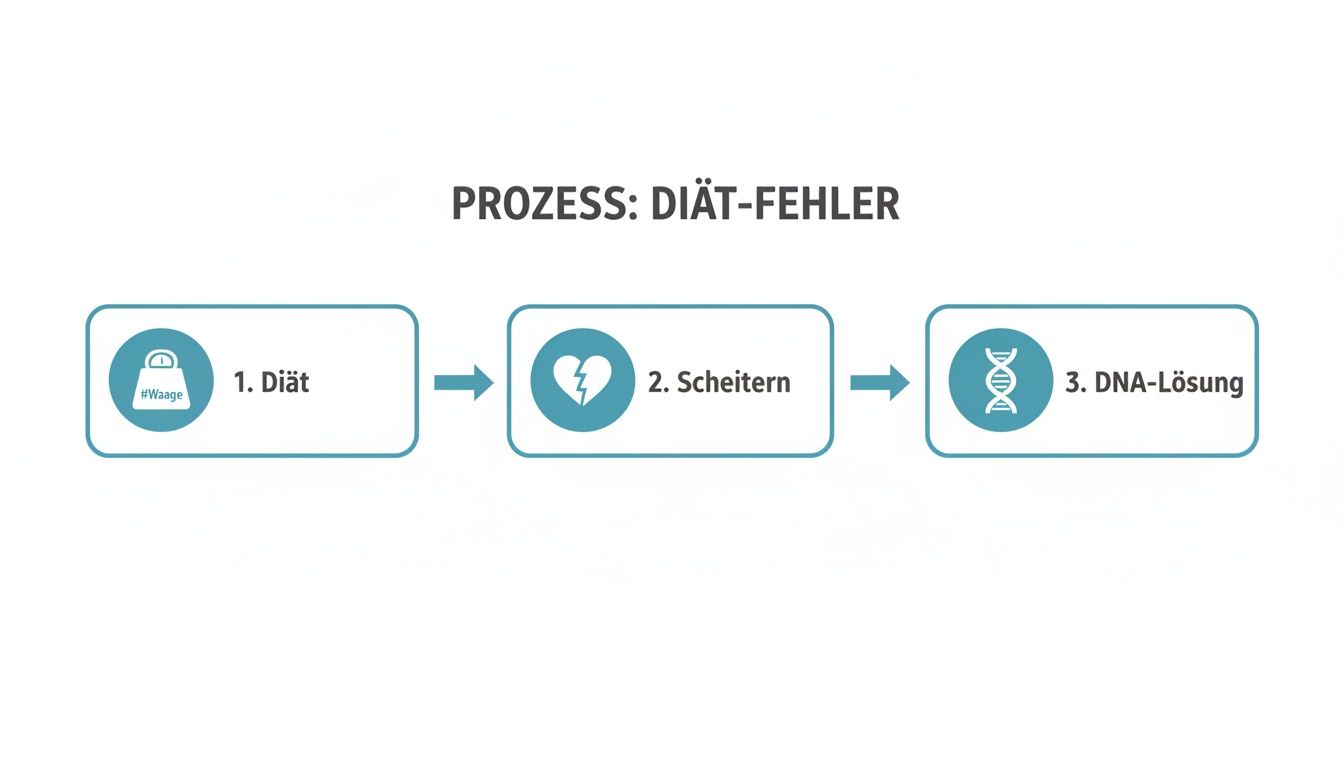
This graphic illustrates how the endless cycle of dieting and failure can finally be broken through a personalized strategy based on your DNA.
Which genes are relevant to your weight?
First of all: There is no single “slimming gene.” Rather, it is a complex interplay of different genes that influence your metabolism and weight. Reputable analyses therefore focus on well-researched genetic variants that have been scientifically proven to play a role.
These include, for example:
- Fat metabolism genes (e.g., APOA5, PPARG): These genes provide insight into how efficiently your body processes fats from food. Might you be more likely to store saturated fatty acids as fat reserves? If so, a low-carb diet with a high fat content would probably be less ideal for you.
- Appetite and satiety genes (e.g., FTO, LEPR): The FTO gene is often referred to as the “obesity gene.” Certain variants can cause you to feel hungrier, reach for high-calorie snacks more quickly, and simply experience a weaker sense of satiety. Once you know this about yourself, you can take targeted steps to counteract it.
- Muscle and exercise genes (e.g., ACTN3): Your genes also determine how your muscle fibers are composed. Are you more of an endurance type with slow-twitch muscle fibers or a strength type with fast-twitch fibers? This information helps you tailor your training for maximum effect.
What is important to understand is this: Your genes are not your destiny, but your predisposition. They are like your body's factory settings. With the right knowledge, however, you can optimize these settings and make the most of your individual predisposition.
A good results report translates this complex genetic data into clear, actionable recommendations. Instead of generic advice, you receive a personal blueprint to follow. For example, you learn which ratio of carbohydrates, fats, and proteins is ideal for you and which type of exercise will get you to your goal fastest. Our guide on understanding DNA metabolic analysis explains exactly how to interpret the results of such an analysis and use them to your advantage.
The analysis therefore shows you not only what you should do, but above all why it works for you specifically. This knowledge advantage is often the decisive motivator for staying on track long term and finally leaving the yo-yo effect behind.
How to use your genetic advantage in everyday life
A lengthy report full of genetic data is only useful when it makes your everyday life noticeably easier. The good news is that you don't have to be a scientist to use the insights from your DNA analysis for weight loss. The goal is to transform complex information into a clear, actionable plan.
Imagine finally receiving the instruction manual for your own body. Instead of continuing to stumble in the dark, unsure which foods are good for you and which type of exercise will really help you progress, you suddenly have concrete answers. That manual is precisely the decisive advantage your genes provide.

Discover your personal metabolic type
One of the key elements of DNA analysis is determining your metabolic type. It tells you how your body best processes the three main nutrients—carbohydrates, fats, and proteins. Although there are naturally individual nuances, clear tendencies often emerge.
Let’s take a look at the most common types:
- The carbohydrate type: Your body handles carbohydrates relatively well. Of course, this is not a free pass for pasta and white bread around the clock. But complex carbohydrates such as whole-grain products, potatoes, and legumes are a great source of energy for you.
- The protein type: Due to your genetics, you have a higher need for protein to feel full and protect your muscles. A protein-rich diet with lean meat, fish, eggs, quark, and plant-based sources such as lentils is ideal for you.
- The fat type: Your metabolism is geared toward drawing its energy primarily from fats. Healthy fats from avocados, nuts, seeds, and high-quality oils are the perfect fuel for you. You often benefit from cutting back somewhat on carbohydrates.
Good to know: Very few people are pure metabolic types. However, your analysis shows a clear tendency that you can use as a guide for your meals. It is not about rigid prohibitions, but about smart prioritization.
From theory to practice on your plate
What does this mean specifically for your shopping and daily meals? Let’s turn these insights into practical tips you can put into practice right away.
Does your DNA indicate a sluggish fat metabolism?
Your body may tend to store saturated fats particularly quickly as excess fat. But that is no reason to ban fats completely! Instead, you should focus on the right sources of fat.
- Choose: Unsaturated fatty acids from avocados, olive oil, flaxseed oil, nuts, and fatty fish such as salmon.
- Reduce: Hidden saturated fats in sausage, ready-made meals, and very high-fat dairy products.
Do you have a genetically higher protein requirement?
Do you often feel hungry even though you have just eaten? Your genes could be to blame. A higher protein requirement means you should deliberately focus on protein-rich building blocks.
- Include in every meal: A source of protein—for example, Greek yogurt for breakfast, chicken breast or chickpeas for lunch, and an omelet in the evening.
- Smart snacks: A handful of almonds or a protein shake can help curb hunger pangs.
The demand for precisely these kinds of personalized recommendations is enormous. A survey by the German Agricultural Society (DLG) found that 47 percent of people would eat better and more healthily if given individualized nutrition advice. This is exactly where a DNA analysis for weight loss comes in. It provides the scientific basis for this personalization by examining gene variants that regulate your metabolism. You can learn more about the background and growing importance of such analyses in this article about personalized nutrition.
Personalized training for maximum results
It’s not just your diet—your training can also be taken to the next level with knowledge from your DNA. Your genes can also provide clues as to whether you are more suited to endurance or strength.
- The endurance type: Your muscles are designed for long, moderate exertion. Activities such as jogging, cycling, swimming, or extended hikes are ideal for you to burn calories and get fit.
- The strength type: You primarily have fast-twitch muscle fibers that reach their full potential during short, intense bursts of activity. Weight training, HIIT (High-Intensity Interval Training), or sprints are highly effective for you to build muscle and increase your basal metabolic rate.
Here too, a combination is usually the best approach. But knowing where your genetic strengths lie helps you tailor your training more effectively. This allows you to avoid frustration and finally find the sport that truly suits you and delivers visible results. To optimally adapt your diet after taking a test, you can find a detailed guide to optimizing your diet based on your test results in our guide.
What a gene-based diet can and cannot do
A DNA analysis for weight loss is an incredibly powerful tool, no question. But it is not a magic wand that makes the pounds melt away overnight. It is absolutely crucial to approach it with the right expectations. So let’s take an honest look at what such an analysis can really do—and where its limits lie.
Your genes are something like your personal blueprint. They determine your predispositions—for example, whether your body prefers to store carbohydrates or fats as energy reserves. But this is not your unchangeable fate. Think of it more like a weather forecast: Your genetics may indicate a high chance of rain, but whether you get wet is up to you—by taking an umbrella with you.
Your genes are the map, not the journey
Your lifestyle remains the most important factor for your health and weight. Your daily choices regarding nutrition, exercise, sleep, and stress have tremendous power. The DNA analysis gives you the perfect map to guide you, however. It shows you the most direct route to your goal instead of sending you down detours or into dead ends.
A huge advantage often lies in the motivation that grows from this new understanding of your own body. Suddenly, it clicks why you feel completely exhausted after a large portion of pasta, while your friend is bursting with energy after eating it. This knowledge gives you the perseverance you need because you are no longer blindly following generic diet rules, but deliberately doing what works best for your body.
A genetic diet does not make decisions for you, but it makes them infinitely clearer. You no longer have to guess; instead, you act on the basis of facts that match your metabolism precisely.
A critical look at the science
Of course, there are also critics and studies that have reached different conclusions. One of the best known is Stanford University’s DIETFITS study. Researchers tested 609 overweight participants to determine whether a low-carb or low-fat diet tailored to their genetics would actually lead to better weight-loss results. At first glance, the result was sobering: No direct, measurable advantage in terms of weight loss alone could be identified.
And yet the personalized nutrition market is booming. Why? A DLG survey shows that 47 percent of people find tailored advice extremely motivating. So it is often less about the one magical “weight-loss gene” and more about the psychological effect and the personalized strategy that this knowledge makes possible.
What you can—and cannot—expect from an analysis
To set clear expectations, here is a straightforward overview of what a genetic diet can do for you—and what lies beyond its reach.
What a DNA analysis can do:
- It gives you clear direction: You discover which ratio of carbohydrates, fats, and proteins is ideal for you.
- It boosts your motivation: Understanding how your body works is often the strongest driving force there is.
- It optimizes your training: You learn whether you are genetically more of an endurance or strength type and can tailor your training accordingly.
- It helps prevent frustration: You finally understand why generic diets have failed for you and can break this cycle.
What it does not do:
- It is not a weight-loss machine: Implementing the recommendations is 100% up to you.
- It does not replace healthy habits: A balanced diet and regular exercise are and remain the foundation.
- It is not a free pass: Just because you may be a “carbohydrate type” does not mean you should eat unlimited amounts of sugar.
The greatest benefit of a DNA analysis for weight loss is therefore not necessarily faster weight loss, but a much more sustainable and conscious approach to your health. You learn to work with your body, not against it. Read more about the fascinating science behind it in our article What is nutrigenetics and how does it shape our lives.
How to find a reputable provider for your DNA analysis
Deciding to undergo a DNA analysis for weight loss is a huge step forward. At last, you want to understand how your body really works. But the genetic testing market is booming, and honestly, not every provider plays in the same league. To ensure that you end up not disappointed but genuinely wiser, choosing the right partner is absolutely essential.
Remember, this is about your most personal data—your genetic blueprint. You should not compromise on that. But how can you recognize a laboratory you can trust and an offering that stands up to scrutiny? We are giving you a checklist to help you separate the wheat from the chaff.

Quality features that make the difference
A truly good provider invests in three things: quality, science, and transparency. Be sure to look out for these points during your research, as they are a clear sign of high standards.
-
Certified specialist laboratory: This is the absolute foundation. Your sample must be analyzed in an accredited laboratory. An ISO certification (for example, ISO 17025) is the quality seal here. It guarantees that processes are standardized and that work is carried out using the latest technology.
-
Scientific foundation: A reputable provider does not make vague advertising promises but relies on scientifically validated genetic markers (SNPs). Look closely: Does the website transparently explain the scientific basis on which the analyses are conducted?
-
Clear and actionable reports: What good are pages of raw data? Absolutely none. A high-quality report translates complex results into clear language and gives you concrete, actionable recommendations for your everyday life—from a nutrition plan to the right type of exercise.
Data protection as the top priority
Your genetic data is extremely sensitive. Responsible handling of it is therefore non-negotiable. Unfortunately, not everyone takes this matter equally seriously.
Think of your DNA data as the master key to your body. You would never carelessly hand this key over to someone else. A reputable provider treats your data with exactly this level of care and protects it using the latest security standards.
You can trust a provider if they fully meet the following criteria:
-
GDPR compliance: The provider must clearly commit to complying with the European General Data Protection Regulation (GDPR). This is your guarantee that your data will be processed under the strictest laws.
-
Pseudonymization: This is a crucial protective measure. In the laboratory, your sample is separated from your personal data (name, address) and linked only to a neutral code. This means no one can directly trace the results back to you.
-
Guaranteed destruction of the sample: After the analysis, your biological sample must be properly destroyed—not stored for other purposes. Reputable providers explicitly guarantee this.
If you would like to delve deeper into the subject, you can find more information in our guide about where you can have a trustworthy metabolism analysis carried out.
Transparency and customer service
One final but no less important point: overall transparency. Does the website provide clear information about the process, costs, and scientific team? Is there customer service that not only receives your questions but also answers them competently? A provider like mybody-x.com, which relies on tested laboratory quality and transparent processes, creates the necessary trust for your personal health journey.
Your journey begins with understanding yourself
When we reach the end of our journey through the world of genes, one central insight remains: A DNA analysis for weight loss is not a miracle cure. But it is probably the most modern and personal compass you can use on your journey toward your ideal weight.
It won’t do the work for you, that’s clear. But it can point you in the right direction and save you countless frustrating detours.
Instead of blindly trying the next diet trend designed to work for everyone, you get a scientifically grounded blueprint created specifically for you and your body. This highly personal approach doesn’t make the fundamentals—namely, a balanced diet and regular exercise—unnecessary. But it gives them an entirely new level of effectiveness.
The blueprint for your success
You suddenly understand why previous attempts may simply have been destined to fail. Perhaps you struggled through a high-fat, low-carb diet even though your body is genetically predisposed to process fats only with difficulty. Or perhaps you spent hours exhausting yourself with cardio even though short, intense strength-training sessions would be much more effective for your muscle type.
A DNA analysis gives you not just a plan, but above all the “why.” And that understanding is the strongest motivator for finally breaking the cycle of dieting, frustration, and the yo-yo effect.
With this knowledge in hand, you have the right tool to do things differently—and, above all, better this time. You learn to make decisions that align with your biology instead of constantly fighting against it.
But the greatest benefit is the deep understanding you gain of yourself. This new clarity gives you back the control and self-confidence you lost along the way.
So if you’re ready to leave the endless cycle of dieting behind and take a path based on facts rather than assumptions, analyzing your DNA is the first crucial step. Your very personal journey doesn’t begin with deprivation, but with understanding yourself.
Your questions, our answers
Are you thinking about having a DNA analysis, but still have a few questions on your mind? That’s completely understandable—after all, this is a very personal topic. We’ve collected the most frequently asked questions and answer them here—openly and honestly, so you know exactly where you stand.
Does collecting the sample hurt?
No, absolutely not. For the analysis, we only need a simple saliva sample. You can collect it conveniently and painlessly at home using a cotton swab. It takes less than a minute.
Every test kit contains easy-to-follow instructions and everything you need. The entire process is designed to be so simple that anyone can complete it without any prior knowledge.
What happens to my genetic data?
Quite simply: Your data is safe with reputable providers such as mybody-x.com. Your trust is what matters most.
Your sample is immediately pseudonymized in the laboratory. This means it is separated from your personal data and assigned only a neutral code. This way, no one can directly link the sample back to you. Your genetic information is used exclusively for your personal report—nothing else. It will not be shared with third parties.
Once the analysis is complete, your biological sample will be properly and permanently destroyed. We guarantee this to ensure that your sensitive data is protected at all times.
How quickly will I lose weight with the DNA analysis?
The DNA analysis is your personal roadmap, but you are the one who begins the journey. It is not a crash diet that promises quick but unrealistic results. It is the starting point for a sustainable change in your lifestyle.
Many of our customers report feeling better in their bodies, having more energy, and seeing their first successes on the scales after just a few weeks. Truly decisive, long-term success comes when you gradually incorporate the recommendations into your everyday life and turn them into new, healthy habits.
Do I have to eat strictly according to my DNA for the rest of my life?
See your results as valuable guidance, not as a rigid set of rules that confines you. You will not be punished if you occasionally deviate from them—it is about balance, not perfection.
The real goal is to give you a deep understanding of what your body truly needs. It is not about forbidding you from doing things. Rather, it is meant to empower you to make conscious choices that suit you and develop a flexible, enjoyable way of eating that you can follow without feeling deprived.
Are you ready to take the first step and decipher the language of your body? With a scientifically based analysis from mybody-x.com, you will receive your personal blueprint for a healthier life and your sustainable ideal weight. Discover the potential hidden in your genes now at https://mybody-x.com.



Share now:
DNA test for weight loss as the key to a personalized genetic diet
DNA Metabolism Analysis: Your Path to Health and Well-Being