
DNA analysis of your metabolism: Your path to health and well-being
Have you already tried countless diets, but lasting success still seems out of reach? You are not alone. A DNA analysis for your metabolism can provide the decisive blueprint to finally understand how your body works and which nutrients it converts into energy most effectively.
Why conventional diets often fail
Imagine your metabolism as the engine of a unique sports car. Every engine is built differently and needs a very specific fuel to deliver its full performance. If you use the wrong fuel, it starts to sputter, loses power, or, in the worst case, breaks down completely. The same applies to your body.
Conventional diets treat all engines the same. They give you standard fuel—for example, low-carb or low-fat—and hope it suits you. It’s like trying to fuel a state-of-the-art race car with ordinary gasoline. It may run that way for a while, but it is never optimal.
Your genetic blueprint is the key
The reason these one-size-fits-all plans so often fail lies in your genetics. Your DNA determines whether your personal engine burns carbohydrates, fats, or proteins efficiently. It provides the blueprint for which “fuel mixture” is ideal for you to generate energy, build muscle, and lose fat.
A DNA analysis of your metabolism is like looking into your engine’s manual. It tells you in black and white what your body needs to perform at its best—without any frustrating guesswork.
The problem is widespread: Around 60 percent of adults in Germany are overweight, placing enormous strain on the metabolism. A groundbreaking study by Berlin’s Charité hospital in 2015 showed that even tiny genetic changes, such as those affecting the POMC gene (which is responsible for our feeling of satiety), can increase the risk of obesity in women by an impressive 44 percent.
The way out of the diet jungle
Instead of chasing the next fad diet that may have worked for someone else, you can take a scientifically sound approach. A DNA analysis for your metabolism provides precise, personalized answers.
- Your individual metabolic type: Find out whether you metabolize carbohydrates, fats, or proteins particularly well.
- No more yo-yo effect: When you give your body what it genetically needs, you avoid cravings and stay full and satisfied over the long term.
- More efficient training: Learn which type of exercise (endurance or strength) best suits your genetic potential for building muscle.
This table shows the key differences between a standard diet approach and a personalized strategy based on your unique DNA.
Conventional diet vs. gene-based nutrition compared
| Feature | Conventional diet | DNA-based nutrition |
|---|---|---|
| Approach | "One-size-fits-all," general rules | Individually tailored to your genes |
| Basis | Assumptions, trends, general studies | Your personal genetic predisposition |
| Success | Often short-term, with a high risk of the yo-yo effect | Sustainable because the body is optimally nourished |
| Motivation | Restriction and discipline take center stage | Understanding your own body creates motivation |
| Efficiency | Trial and error | Targeted nutrient intake for maximum results |
As you can see, it is no longer about blindly following rules, but about truly understanding your body and giving it exactly what it needs.
This personalized approach is the first step toward finally breaking the cycle of frustrating diets. You learn to understand your body’s signals and make decisions based on facts—not vague assumptions. If you would like to explore the topic in greater depth, also read our article about personalized nutrition.
How your genes control your metabolism
Imagine your DNA as a completely personal handbook for your body. Each of us carries this unique book within us, but most people have never learned how to read it. A DNA analysis for your metabolism is essentially the key that opens this book and helps you understand what is written on its pages.
The goal is to decipher the very specific instructions your body has followed since birth. These instructions control countless processes, from your hair color to the way you respond to certain foods.
Genes that influence your metabolism
This genetic handbook contains certain chapters that play a particularly important role in your metabolism. Researchers have now identified a whole range of genes whose small variations directly influence how efficiently you process nutrients.
Two of the best-known examples are the genes FTO and APOE.
- The FTO gene: It is often referred to as the “fat mass and obesity-associated gene.” It plays an important role in regulating appetite and feelings of fullness. Certain variants of this gene may cause you to feel hungry again sooner or simply take longer to feel full. This can naturally make weight control more difficult.
- The APOE gene: This gene is a key player in fat metabolism, particularly in transporting cholesterol in the blood. Depending on which variant you carry, your body processes saturated fats with varying degrees of efficiency, which can in turn affect your blood lipid levels.
But that is far from all. There are many other genetic markers that can provide insights. Some determine, for example, how sensitively your body reacts to carbohydrates—which is why you may feel either full of energy or completely sluggish after a serving of pasta. Others provide clues about your individual need for certain vitamins or your tendency toward oxidative stress after exercise.
It is important to understand: There are no “good” or “bad” genes. It is solely about knowing your personal predisposition. This allows you to adapt your lifestyle and work with your genetics instead of constantly fighting against them.
If you are even more interested in the fascinating science behind it, our article What Is Nutrigenetics and How Does It Shape Our Lives? explains the connections in detail.
From analysis to application
A DNA analysis therefore reads these crucial chapters in your personal handbook. It translates complex “gene-speak” into clear, understandable, and above all actionable recommendations for your everyday life. You learn not only what your genes say, but above all, what that means for you.
Instead of chasing generalized nutrition trends, you get a completely personalized roadmap. This plan shows you how best to fill your plate to achieve your goals—whether that means losing weight, having more energy, or improving athletic performance.
The following graphic illustrates this journey beautifully—from a standard diet to nutrition that is truly tailored to your genes.
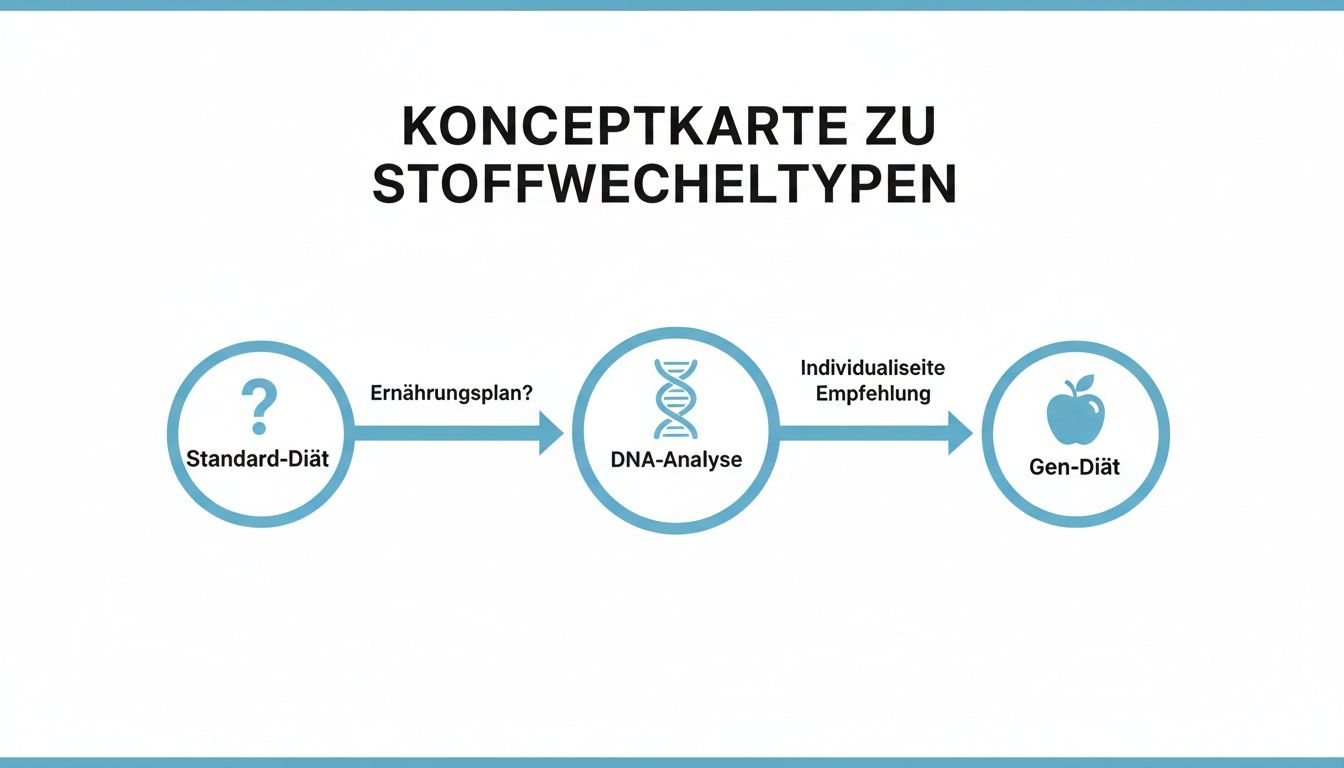
You can see immediately: DNA analysis is the crucial intermediate step. It takes you from the uncertainty of guessing with a standard diet to a targeted, gene-based nutrition strategy.
Think of it as a map. Your genes show you the terrain—where the mountains are steep and where the flat, easy paths run. DNA analysis is the compass that helps you find the best route through this terrain. You still have the freedom to choose your own path, but with the knowledge from the analysis, you can make more conscious and informed decisions about your health.
How your DNA analysis for metabolism works so simply
A genetic analysis may initially sound like a high-tech laboratory and complicated science, right? Almost as if you needed a white coat to do it. But don't worry: Today, the reality is much simpler and more straightforward than you might think. We guide you step by step through the entire process, which you can complete conveniently and securely from home.
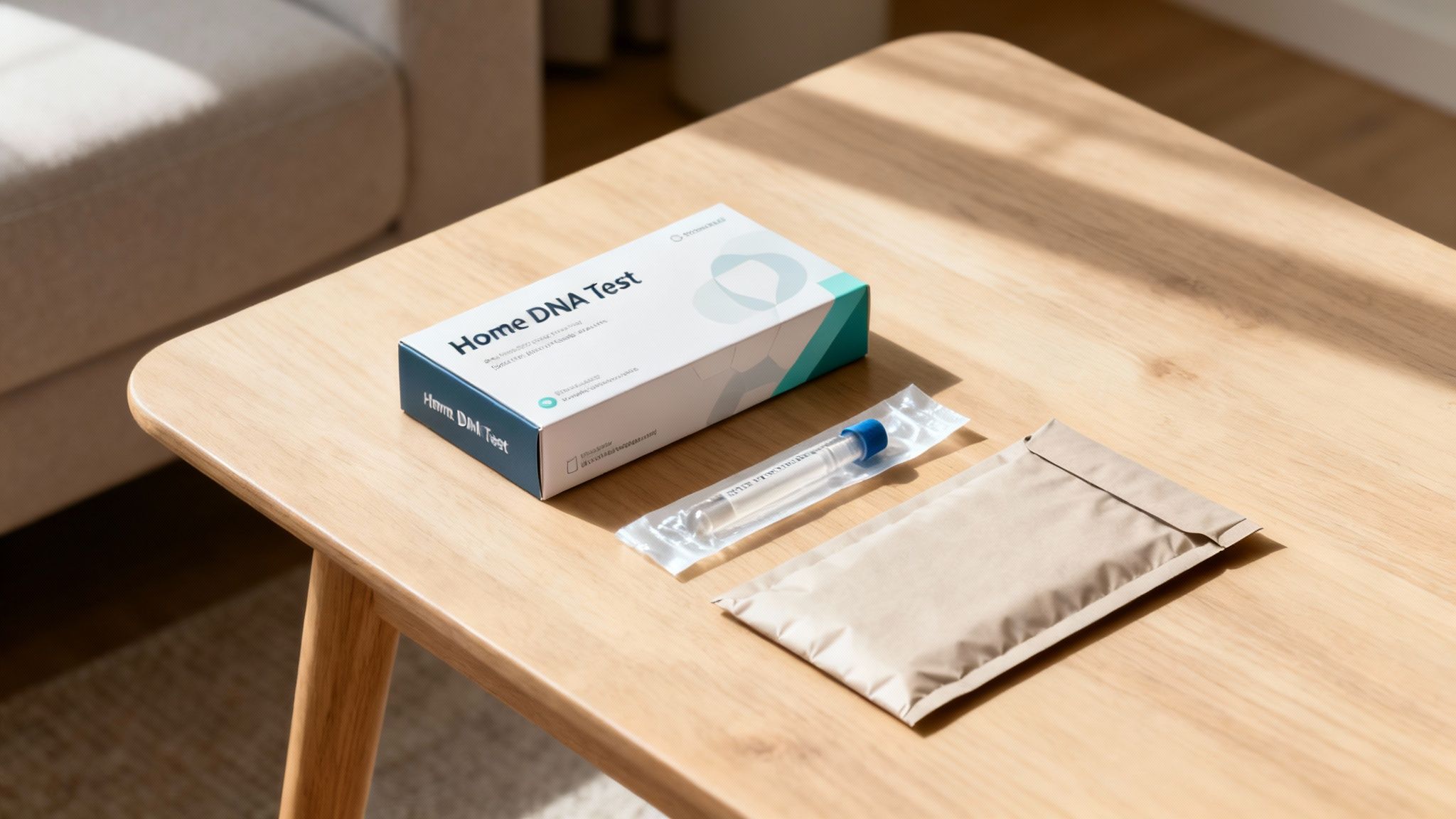
Everything you need for your DNA Metabolism Analysis comes directly to your home in the mybody-x test kit. It contains everything you need, explained clearly so you can get started right away—without any technical jargon.
Your path to providing a sample in three simple steps
The entire process is designed to be as simple as possible. You do not need a doctor's appointment, and no blood will be drawn. A simple saliva sample is all it takes to decode the valuable information in your DNA.
- Activate: First, register your test kit online using an individual code. This step is very important so that your sample can later be anonymously matched to your personal results report.
- Collect: Collecting the sample is incredibly easy. Simply use the enclosed cotton swab to take a swab from the inside of your cheek. It is completely painless and takes just a few seconds.
- Send: Then place the sample securely in the prepaid return envelope and take it to the post office. From there, we take over.
This simple process ensures that absolutely anyone can complete the test without difficulty, even without any prior knowledge.
Security and data protection are our top priority
We fully understand that your genetic data is extremely sensitive. That is precisely why we have developed a process that guarantees the highest security and data protection standards. Your trust is what matters most to us, and we do everything we can to protect it.
As soon as you activate your kit, your sample receives an anonymous code. This means the laboratory will never learn your name or any other personal data. This process is called pseudonymization—and it is a central component of our security concept.
Your data belongs to you—and you alone. We strictly adhere to the highest data protection standards under the GDPR. Your sample is used exclusively for the analysis you commissioned and is then securely and completely destroyed.
Our partner laboratory is certified according to ISO standards. This guarantees the highest scientific quality and precision in the analysis. You can therefore be completely sure that your results are based not only on the latest technology but are also produced under the strictest quality controls.
After a few weeks, you will receive a message informing you that your personal results report is available in your secure online account. This allows you to focus fully on the scientifically based insights—with the assurance that your data is protected at all times.
How to implement your results in everyday life
You are holding your personal results report in your hands—a real milestone on the path to greater well-being. But honestly? This is just the beginning. The most valuable insights from your DNA Metabolism Analysis only reach their full potential when you actively incorporate them into your everyday life. That's exactly what this section is for: your practical guide.
Don't view the results as a rigid set of rules, but as your personal compass. They show you how you can achieve a huge impact with small, targeted adjustments. It's about turning knowledge into concrete actions that feel good and genuinely bring you closer to your goals.

Understanding and using your metabolic type
A key part of your report is your individual metabolic type, also known as a meta type. Imagine that you are a “Meta Type Balance.” This means that your body handles proteins, fats, and carbohydrates quite well and can metabolize everything in a balanced way.
So what does this mean concretely for your plate? Not that you can eat everything indiscriminately. Rather, it gives you the freedom to structure your meal plan flexibly, as long as you pay attention to a good balance of macronutrients.
- Proteins: They are crucial for a long-lasting feeling of fullness and maintaining muscle mass. Include a good source of protein with every main meal—think fish, chicken, tofu, or legumes.
- Fats: Healthy fats are essential for you. Avocados, nuts, and high-quality olive oil provide long-lasting energy and are important for hormonal balance.
- Carbohydrates: Choose complex carbohydrates such as whole-grain products, quinoa, or sweet potatoes. They provide you with stable energy without sending your blood sugar levels on a roller coaster ride.
If your result instead identifies you as a carbohydrate-sensitive type, you would place greater emphasis on protein and fat and use carbohydrates more strategically, for example immediately after training.
Your meta-type is your personal guide to the optimal distribution of nutrients. It helps you put together meals that keep you full, provide you with energy, and prevent cravings.
Interest in these kinds of analyses is growing rapidly, as the biotechnology market in Germany is booming and personalized approaches are playing an increasingly important role. Direct-to-consumer tests that analyze genetic variants from a simple cheek swab are becoming increasingly popular. However, it is important to choose a reputable provider. The consumer advice center rightly points out that large-scale studies are often still lacking for blanket genetic diets. That is why transparent scientific methods and ISO-certified laboratories, such as those standard at mybody-x, are an absolute must and a clear mark of quality. Anyone who wants to delve deeper can find fascinating insights in the current industry report on biotechnology in Germany.
Tailoring your training to your muscle type
Your DNA not only reveals which fuel is best for your engine, but also which type of training will help you progress fastest. Your genetic makeup influences whether you tend more toward endurance or strength.
- Endurance type (slow-twitch muscle fibers): Your muscles are designed for long, steady exertion. Sports such as jogging, cycling, or swimming come naturally to you. You probably also recover quite quickly after these sessions.
- Strength/sprint type (fast-twitch muscle fibers): You are made for short, explosive bursts of power. Strength training, HIIT (High-Intensity Interval Training), or sprints are ideal for you to build muscle quickly and improve your performance.
This insight is worth its weight in gold. It helps you make your training more efficient and more enjoyable. Of course, this does not mean that an endurance type should avoid strength training—in fact, quite the opposite! But it shows you where your natural strengths lie and how you can structure your training week intelligently.
Practical application in everyday life
The key to success? Implement these new insights gradually and without pressure. No one expects you to completely turn your life upside down overnight.
Start small, with manageable changes.
- Plan one meal a day: At first, focus only on lunch or dinner. Try putting it together to match your recommended macronutrient distribution.
- Adjust one training session: Add one new workout per week that is especially suited to your genetic muscle type.
- Keep a simple journal: For one or two weeks, note how you feel after certain meals or workouts. This will greatly sharpen your awareness of your body's signals.
Over time, this becomes routine. You will notice yourself intuitively making the right decisions for you. If you are still looking for specific examples of how best to get started, take a look at our guide to changing your diet based on your test results.
What your DNA reveals about fitness and longevity
A metabolic analysis can do much more than just help you lose weight. It is your very own key to better fitness and—perhaps even more importantly—long-term health and vitality. After all, it is not just about getting older, but about aging healthily. And that is exactly what your genes can provide: invaluable insights.
You may know the feeling: You give it your all during training, but recovery takes forever, or you feel completely wiped out the next day. Here, too, looking at your DNA can provide clarity. Certain gene variants influence how quickly and efficiently your body recovers after physical exertion. With this knowledge, you can specifically adjust your training intensity and rest periods to avoid overtraining and prevent injuries.
Your shield against cellular stress
Another crucial factor for your fitness and longevity is how well your body copes with oxidative stress. It sounds complicated, but essentially describes an imbalance in the body caused by free radicals—aggressive molecules that can attack and damage your cells. Exercise, as well as environmental factors and stress, can fuel this process.
Your DNA determines how robust your body's own antioxidant defense system is. An analysis can reveal whether you have a genetic predisposition to increased oxidative stress.
Knowing your genetic predisposition to oxidative stress is a powerful tool. It enables you to enrich your diet with antioxidant-rich foods such as berries, green vegetables, or nuts and proactively protect your cells.
If you want to delve deeper into the topic and understand how you can positively influence aging processes at the cellular level, take a look at our article on the meaning of longevity.
Micronutrients—the key to more energy
Your genes also control how efficiently you absorb and utilize essential micronutrients. A classic example is vitamin D, which is crucial not only for strong bones, but also for your immune system and muscle strength. Some people have a genetically higher need or are less able to convert vitamin D into its active form.
- Vitamin D requirements: An analysis shows whether you belong to the group of people who should pay particular attention to getting an adequate intake.
- B vitamins: They are the engine of your energy metabolism. Genetic variants can influence how well you process, for example, folic acid.
- Iron and omega-3: Here too, your DNA provides indications of whether you have a genetically increased need to maintain your energy levels and cognitive performance.
This information is extremely valuable. Instead of taking random dietary supplements, you can optimize your intake in a targeted way—based on what your body actually needs.
A foundation for a long, vibrant life
In short: A DNA analysis for your metabolism is far more than just a nutrition plan. It is a comprehensive user manual for your body that combines fitness and longevity. You learn how to make your training more effective, protect your body from cellular stress, and provide it with the nutrients it needs for a long, powerful life.
You take your health into your own hands and make informed decisions based on your unique genetic predisposition. It’s about laying the foundation for a future in which you feel energized, strong, and full of zest for life.
Your genes are the compass, not your destiny
After all the information about genes, metabolism, and personalized recommendations, one question may arise: “So am I helplessly at the mercy of my DNA?” The answer is a clear and emphatic no. Think of your DNA as the blueprint for a house. But you are the architect who decides how that house is furnished, maintained, and brought to life.
A DNA analysis of your metabolism shows you your predispositions and potential. But it is never a final verdict. Your genetics does not seal your fate; instead, it gives you the knowledge you need to make conscious, smarter decisions for your health. The difference is like sailing without a map versus navigating with a precise compass.
The power of epigenetics
This is where an incredibly fascinating field of science comes into play: epigenetics. Think of your genes as a series of light switches. Epigenetics describes how your lifestyle—what you eat, how you exercise, and how you deal with stress—can flip these switches. So you can actively switch certain genes “on” or “off.”
This means that even if you have a genetic predisposition that, for example, promotes weight gain, you can simply switch this trigger “off” through a suitable lifestyle.
- Nutrition: A nutrient-rich diet tailored to your needs can activate genes that support fat burning.
- Exercise: Regular exercise can switch on the genes responsible for muscle growth and efficient energy metabolism.
- Stress management: Techniques such as meditation or simply getting enough sleep can downregulate genes associated with inflammatory processes and fat storage.
You are the architect of your life
That realization is incredibly liberating, isn’t it? It gives you back control and, with it, responsibility for your health. A DNA analysis is not a free pass or a cheap excuse, but a powerful tool for empowering yourself.
Your genetic results are not the end of the story, but the beginning of a new chapter. A chapter in which you play the leading role and determine the plot yourself—armed with knowledge about your own body.
See the recommendations in your report as a personal invitation to get to know your body better and finally work with it as a team. Use this knowledge as motivation to build habits that strengthen you and do you good in the long term.
At the end of the day, you are always the one who makes the decisions. You decide what ends up on your plate, whether you take the stairs instead of the elevator, and how you respond to a stressful day. Genetics points you in a direction, but you shape the journey yourself—step by step, every day anew.
Your questions, our answers
Looking into your own DNA naturally raises questions. That’s completely normal, after all, it’s a very personal topic. We’ve collected the most frequently asked questions for you and are giving you completely open and honest answers here, so you can feel confident and well informed.
How secure is my genetic data?
Your data is safe with us—this is not an empty promise, but the foundation of everything we do. Protecting your privacy is our absolute priority.
As soon as you activate your test kit, your sample is pseudonymized. This means it is assigned an anonymous code and is no longer linked to your name. The laboratory analyzing your sample will therefore never know who you are. We strictly comply with the General Data Protection Regulation (GDPR), and your sample is completely destroyed after the analysis. Your data will never be sold or misused for other purposes. We promise.
Can this analysis predict diseases?
A clear and emphatic no. Our DNA analysis is a lifestyle product that gives you fascinating insights into your predispositions relating to nutrition, exercise, and metabolism. It is explicitly not a medical or diagnostic test.
Our sole focus is helping you optimize your lifestyle and achieve your health goals. We do not make any statements about disease risks or provide diagnoses. Your doctor or therapist is and remains the right person to contact for that.
How long do I have to wait for my results?
Once your sample has arrived at our ISO-certified partner laboratory, the analysis usually takes between four and six weeks. This timeframe is necessary to guarantee scientifically precise, high-quality results—we don’t compromise on that.
As soon as your personal results report is ready, we’ll send you an email immediately. You can then conveniently view it in your secure online account.
Do I have to follow a strict plan for the rest of my life?
Absolutely not! Don’t view your results as a rigid set of rules, but rather as your personal compass. The recommendations are flexible guidelines that help you better understand your body and finally make decisions that truly benefit you.
It’s not about restrictions or deprivation, but about eating and living more mindfully. You’ll learn which foods give you the most energy and which meals keep you feeling full for longer. This compass will help you find your own balance—and shape your diet with renewed enjoyment and intuition.
Are you ready to learn the language of your body and take your health to the next level? At mybody-x, discover how a DNA analysis can guide you toward your ideal weight and greater energy.



Share now:
How weight loss works with DNA analysis: Your genetic path to your desired weight
Good and harmful gut bacteria—explained simply