

Celiac disease test: How to find out whether you are intolerant to gluten
Do you constantly have stomach pain, often feel tired, and wonder whether gluten might be the trigger? A test for celiac disease can finally give you clarity. The first step is usually a blood test at the doctor’s office to detect specific antibodies. There are also at-home self-tests that can provide an initial indication. This article guides you through the various options and helps you correctly interpret your symptoms.
Understanding and correctly interpreting celiac disease symptoms

Stomach pain, constant bloating, unexplained fatigue—when your body rebels, you can quickly feel confused and left alone. Maybe you know the feeling that something is wrong, but no one can find a clear answer. That is what happened to a close friend of mine for years. Her doctors dismissed her symptoms as stress until a targeted test for celiac disease finally revealed the truth: It was a clear autoimmune disease, not something she had imagined.
This story shows how important it is to listen to your body’s signals. You are not alone in these concerns. Many people go through a long ordeal before receiving the correct diagnosis.
The many faces of celiac disease
Celiac disease is much more than just a bit of stomach pain. The symptoms can affect your entire body and are often so varied that you may not immediately associate them with gluten. That is precisely what makes diagnosis such a challenge.
In fact, the prevalence of celiac disease in Germany was underestimated for a long time. While it was previously thought to affect one in 1,000 people, more recent data shows a prevalence of approximately 1 in 200 to 1 in 300. The truly alarming part: Estimates suggest that 80 to 90 percent of cases remain undiagnosed because very few people show the classic full picture with clear intestinal symptoms. If you would like to learn more about diagnosis, you can find reliable information from the German Allergy and Asthma Association.
An important tip: Under no circumstances should you stop eating gluten on your own before taking a test. For a reliable diagnosis, your body must be exposed to gluten so that the relevant antibodies can be detected in your blood. Avoiding gluten prematurely can distort the test results and prevent you from receiving the correct diagnosis.
Typical and atypical signs at a glance
To better assess your symptoms, it is helpful to know the most common ones. They can be broadly divided into two categories, although the boundaries are often fluid.
Here I have compiled an overview of the typical and less typical symptoms that you should keep an eye on.
Common signs that may indicate celiac disease
An overview of typical and atypical symptoms that you should take seriously.
| Symptom category | Possible symptoms |
|---|---|
| Classic gastrointestinal symptoms | Chronic diarrhea, bloating, abdominal pain, nausea and vomiting, and sometimes constipation. Children may also experience failure to thrive and a distended “drum belly.” |
| Atypical symptoms outside the digestive tract | Iron-deficiency anemia, chronic exhaustion (fatigue), unexplained weight loss, skin rashes (dermatitis herpetiformis), headaches and migraines, joint pain, or even neurological problems. |
If you recognize yourself in some of these points, it is all the more important to stay on track and get to the bottom of the cause. You can also find detailed information about the signs in our article on Celiac Disease and Gluten Intolerance.
An overview of the different testing methods
You suspect that you may have celiac disease and wonder: How can I finally get certainty? Don’t worry—even if the medical terms sound confusing at first, there are clear diagnostic pathways that will guide you step by step to an answer.
Imagine the path to a diagnosis as a detective story. Each examination method provides an important piece of the puzzle until, in the end, a clear and understandable picture emerges.
The blood test as the first decisive indication
The first and most important step is almost always a blood test (serology) performed by your doctor. Think of your body as a country that triggers a silent alarm during an attack—in this case, by gluten. When this alarm goes off, special “defense troops,” the antibodies, are sent into the blood. Your doctor looks for precisely these antibodies in a celiac disease test.
The most important markers to look for are:
- Transglutaminase IgA antibodies (tTG-IgA): This is the most reliable single marker. If this level is elevated, it is a very strong indication of celiac disease.
- Endomysial antibodies (EmA-IgA): This test is also highly accurate, but somewhat more complex. It is often used to confirm the result.
- Total IgA level: This value is checked to rule out a rare IgA deficiency that could distort the other test results.
In Germany, diagnosis relies heavily on these antibody tests because they are considered extremely sensitive and specific. This method has revolutionized the detection of the disease. Studies also show that women, at a ratio of 1.5:1 to 3:1, are significantly more frequently affected than men. If you would like to delve deeper into the background of celiac disease diagnostics, you can find further insights at drschaer.com.
The following infographic summarizes the key causes and risk factors that can trigger celiac disease.
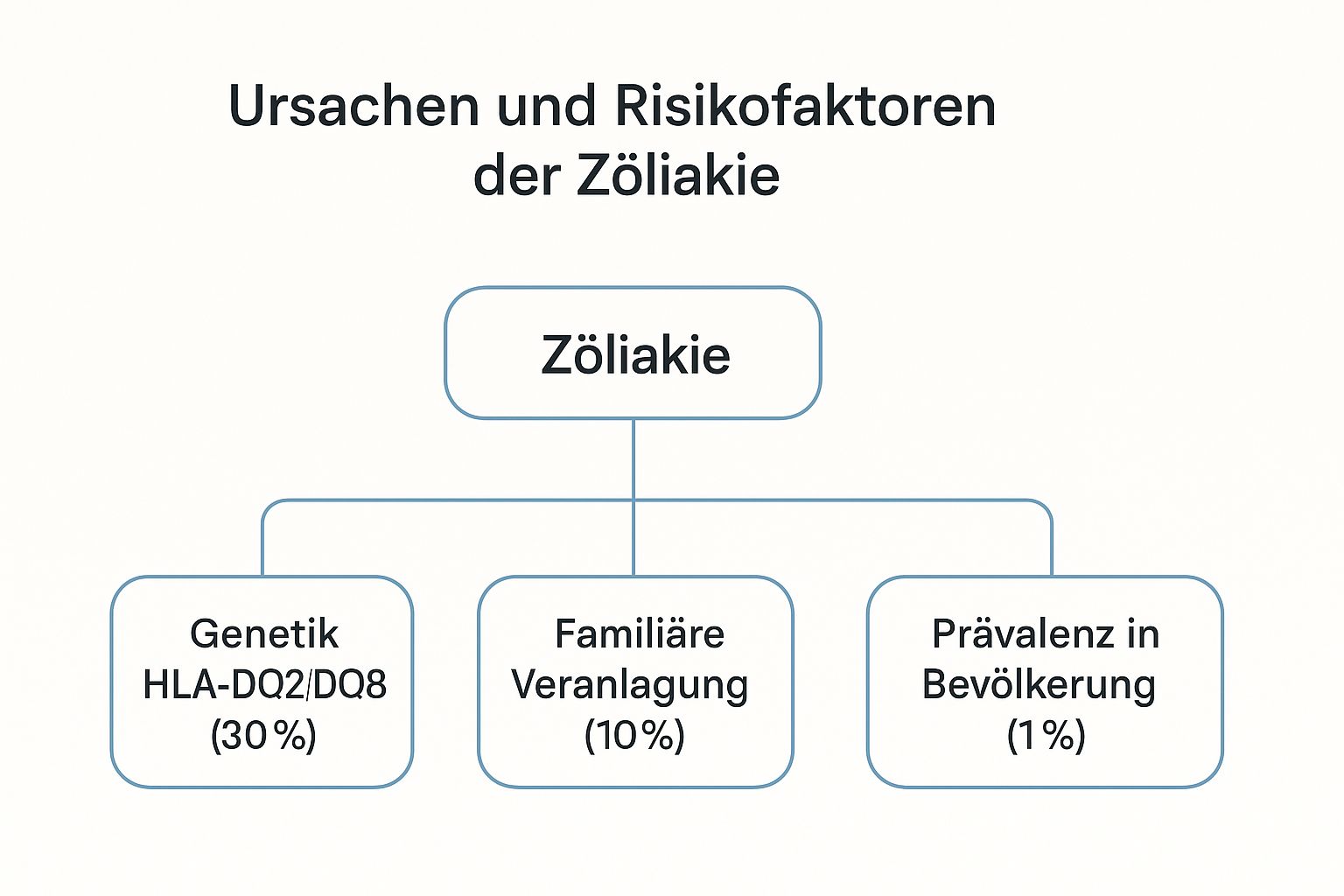
As you can see in the graphic, genetic predisposition is the greatest risk factor, even though the actual disease rate in the population is much lower. If you are still interested in the topic, take a look at our article about genetic causes of digestive problems.
The small-intestinal biopsy as the gold standard
If the blood test is positive and the antibody levels are significantly elevated, the next step to confirm the diagnosis is usually a small-intestinal biopsy. Although the thought of it may be somewhat unpleasant, this examination is considered the “gold standard”—the ultimate proof.
During a gastroscopy, the doctor takes tiny tissue samples from your small intestine. Under a microscope, they examine whether the intestinal villi—which are responsible for absorbing nutrients—have already been damaged or flattened by the inflammation. This confirmation definitively establishes the diagnosis.
The at-home celiac disease self-test

The idea of getting a quick and straightforward initial answer from home is tempting for many people. This is where celiac disease self-tests come in, which you can find online or at a pharmacy. They offer a simple way to investigate an initial suspicion without having to make a doctor's appointment right away.
But how does an at-home celiac disease test actually work? Essentially, it works much like the serological tests used at a doctor's office. These rapid tests also look for the typical antibodies in the blood, usually tTG-IgA antibodies. You prick your fingertip, place a drop of blood on the test cassette, and wait a few minutes for the result.
How reliable is the result?
Modern self-tests can achieve a fairly high level of accuracy—but only when carried out correctly. And that’s often where the catch lies. Small application errors can quickly make the result unusable. A self-test can give you a valuable initial indication, but it is never a substitute for a thorough medical diagnosis.
The advantages can be summarized quickly:
- Speed: You’ll have your result in just a few minutes.
- Discretion: You can carry out the test calmly and privately.
- Easy access: It lowers the barrier to addressing your symptoms in the first place.
However, there are also important limitations you should be aware of:
- Application errors: Incorrect handling can quickly lead to an incorrect result.
- No detailed analysis: The test only indicates “positive” or “negative”; it does not measure the exact concentration of antibodies—important information for the doctor.
- Lack of guidance: A result, whether positive or negative, raises questions. Only a medical professional can truly answer them.
Important note: You should never change your diet based solely on a self-test! A positive result must always be confirmed by a doctor. They will initiate further steps, such as a comprehensive blood analysis and possibly a biopsy. This is the only way to get a diagnosis you can rely on.
When is a self-test useful?
A home test can be a good idea if you’re looking for an initial, simple indication before going to the doctor’s office. It can give you the nudge you need to take your symptoms seriously and make an appointment.
If you would like to take this first step toward clarity, you could take a closer look at the mybody®x Celiac Disease Home Test, for example.
Always remember: A self-test is the beginning, not the end of the diagnostic process. It can point you in the right direction, but the final, confirmed diagnosis must always be made by a doctor.
Your path to a confirmed diagnosis from a doctor
A positive self-test or the persistent suspicion that gluten is behind your symptoms—that’s a crucial moment. But what happens now? Don’t worry, this step is the most important one on your journey toward greater well-being. We’ll guide you through it and show you what to expect at the doctor’s office.
The first appointment is primarily an opportunity for you to tell your story. Your doctor will ask you many questions to get a precise picture—this is called a medical history. Be prepared to describe as precisely as possible what symptoms you have, how long they have been occurring, and what they feel like. Every detail is an important piece of the puzzle, whether it concerns digestive problems, skin rashes, or constant fatigue.
The diagnostic process at the doctor's office
After the consultation, your doctor will very likely order a blood test. This test measures celiac disease-specific antibodies (such as tTG-IgA) in a laboratory. It is much more accurate and informative than a self-test because it measures not only whether the antibodies are present, but also their exact amount. A significantly elevated level is already a very reliable indication of celiac disease.
The absolutely most important advice: Continue eating a normal gluten-containing diet until the diagnosis is definitive! This may sound paradoxical if you suspect gluten is the culprit. But this is the only way your body can produce the antibodies the doctor is looking for. If you stop eating gluten too early, the test results could be distorted. This could prevent a clear diagnosis or unnecessarily prolong the process.
If the blood test confirms the suspicion, the next step is often a referral to a specialist in gastrointestinal diseases—a gastroenterologist. To definitively confirm the diagnosis, they will generally recommend a small-intestinal biopsy. Although the word may sound alarming, the examination itself is usually brief and straightforward.
To give you a better overview, we have directly compared the various methods.
Celiac disease testing methods compared directly
Here you can see a comparison of self-tests, blood tests, and biopsies, evaluated by reliability, effort, and what they ultimately really tell you.
| Test method | Reliability | Where is it performed? | Important note |
|---|---|---|---|
| Self-test | Moderate | At home | Serves only as an initial indication. A positive result must always be medically confirmed. |
| Blood test (serology) | High | Doctor's office / laboratory | The most important diagnostic step. It measures the exact antibody concentration and is highly reliable. |
| Small-intestinal biopsy | Very high (gold standard) | Specialist (gastroenterologist) | Provides definitive confirmation of the diagnosis by detecting the characteristic damage to the intestinal lining. |
This structured process is your best chance of getting a clear answer. It ensures that you receive the correct diagnosis and, consequently, the right treatment for your future. Stay patient and follow your doctor's instructions—it is the direct path to a symptom-free life.
A coeliac disease diagnosis—what matters now
The moment you receive the diagnosis of “coeliac disease” in black and white can initially feel like a slap in the face. That’s completely understandable. But look at it this way: This moment is your starting point for a new, symptom-free life. At last, you have a clear answer and can take control of your health yourself.
The only effective treatment is a consistently gluten-free diet. Sure, it sounds like a huge hurdle at first, but over time it becomes second nature. The first step is always the hardest, but you don’t have to take it alone.
Your new everyday life begins at the supermarket
Your first grocery shop after diagnosis is like an expedition into a new world. Suddenly, you’re scanning ingredient lists that you never gave a second glance before. It can be really overwhelming at first, but believe me, you’ll become an expert at reading labels in no time.
Here are your first steps for grocery shopping:
- Focus on what is naturally safe: Fruit, vegetables, meat, fish, eggs, and dairy products. They are the solid, gluten-free foundation of your diet.
- Look out for the gluten-free symbol: The crossed-out ear of wheat is your best friend. This seal is standardized throughout Europe and gives you the assurance that a product is genuinely gluten-free.
- Learn where gluten hides: It often lurks where you least expect it—in ready-made sauces, spice blends, processed meats, or even medications. The German Coeliac Society (DZG) or a good nutritional counseling service can provide lists to help you see things clearly.
Fortunately, the selection of gluten-free products has practically exploded in recent years. The gluten-free food market in Germany has experienced a real boom, making shopping much easier for you today. This growth shows that awareness in society is increasing. If you’re interested in the figures behind it, you can find fascinating insights into consumer habits on de.statista.com.
My personal tip: Take plenty of time for your first “new” grocery shop. Don’t rush out between two appointments when you’re stressed; think of it as an adventure of discovery. You’ll be amazed at how many brilliant alternatives are available today—from really good bread and pasta to cookies that actually taste great.
Find support and accept it, too
Changing your diet is not only a practical challenge but also an emotional one. It is perfectly okay to feel frustrated when, once again, all you can eat at a restaurant is a salad. Talk about it! Whether with friends, family, or a group of people in the same situation.
Especially during the first few months, consulting a certified nutritionist can be invaluable. They will not only provide you with practical shopping lists and recipes, but above all, the reassurance that you are doing everything correctly. Sharing experiences in self-help groups, for example through the DZG, is also incredibly valuable. You will see: Living a pleasurable life with celiac disease is not wishful thinking—it is absolutely achievable.
Frequently asked questions about testing for celiac disease
The path to a diagnosis can sometimes feel like a labyrinth and naturally raises many questions. You are absolutely not alone in this! Here, I have collected and clearly answered the most common and important questions about the test for celiac disease. Think of this section as your personal guide to quickly regaining clarity.
Do I need to fast for a celiac disease blood test?
No, this is one of the most common misconceptions. For the blood test that looks for specific celiac disease antibodies (such as tTG-IgA), you generally do not need to fast. What you eat or drink does not directly affect these levels.
Something else is much, much more important: In the weeks before the test, you must have continued to eat normally and, above all, consumed gluten. This may sound contradictory, but it is crucial. If you have already been avoiding gluten, your body stops producing the antibodies. The result would then be falsely negative—meaning your celiac disease could go undetected even though you have it.
What is the difference between celiac disease and gluten sensitivity?
This is one of the most important questions of all, because it often causes confusion. Think of it this way: Celiac disease is a clear-cut autoimmune disease. When exposed to gluten, your immune system mistakenly attacks your own small intestine. This reaction causes clear, detectable inflammation that damages the lining of the small intestine. You can even see this under a microscope.
Non-celiac gluten sensitivity (often also referred to as wheat sensitivity) is something different. Here, you do have symptoms very similar to those of celiac disease—abdominal pain, bloating, fatigue—but all diagnostic tests are negative. This means:
- The blood tests do not detect any celiac disease antibodies.
- In a small-intestinal biopsy, the intestinal villi are completely intact.
- A wheat allergy has also been ruled out.
Nevertheless, you feel dramatically better as soon as you avoid gluten. It is therefore a diagnosis of exclusion that confirms your symptoms are real, even if the cause is something other than celiac disease.
Does health insurance cover the test for celiac disease?
Yes, if your doctor has reasonable grounds for suspicion, the costs of the complete diagnostic workup are generally covered by statutory and private health insurers in Germany. Your doctor must identify symptoms that medically justify a test for celiac disease.
The services covered by health insurance then include:
- A detailed consultation with the doctor (medical history).
- The blood test to determine the antibody levels.
- A referral to a gastroenterologist (a specialist in gastrointestinal diseases).
- An upper endoscopy with tissue samples (biopsy), if the blood test was abnormal and the diagnosis needs to be confirmed.
Important to know: As a rule, you have to pay for self-tests purchased at a pharmacy or online yourself. The official, health-insurance-recognized diagnostic process always begins at a doctor’s office.
Can children also be tested for celiac disease?
Yes, absolutely! Celiac disease can occur at any age, including in toddlers as soon as gluten-containing complementary foods are introduced. In young children, the signs are often varied and not always clear. They range from classic stomach aches, a bloated abdomen, and failure to thrive to iron deficiency, noticeable behavioral changes, or even defects in the tooth enamel.
The diagnostic process is very similar to that for adults and begins with a blood test. Under current European guidelines, a biopsy may even be omitted in children and adolescents under certain conditions. This is the case when the antibody levels (tTG-IgA) are extremely high (more than 10 times the threshold) and a second antibody test (EMA-IgA) is also positive. Either way, the pediatrician is always the first and most important point of contact whenever celiac disease is suspected.
If you have any further questions, feel free to visit our general FAQ section. There you’ll find even more answers to health-related questions.
Are you ready to take the first step and get to the bottom of your health? At MYBODY Lab GmbH, we offer scientifically sound analyses to help you better understand your body. Discover our tests and start your journey toward greater well-being today at https://mybody-x.com.



Share now:
Vitamin B12 deficiency: which values are meaningful and when it becomes serious
At-home stool test: Your discreet path to better gut health