

Vitamin B12 deficiency: what the values reveal and when it becomes serious
The essentials at a glance
Vitamin B12 deficiency can rarely be diagnosed with certainty using a single blood value. The commonly used serum B12 value measures the total amount in the blood, not the amount your cells actually use. That is why specialist bodies recommend considering a status marker and a functional marker together. A single unremarkable value does not rule out a deficiency.
This article distinguishes three things that are often mixed up online: what institutions substantiate regarding prevalence and reference values, which symptoms require medical evaluation, and which claims about vitamin B12 are legally permissible at all. Every figure here is accompanied by the institution and year. Where no substantiated figure is available, that is stated as well.
You will first learn what a deficiency means biologically and how common it really is. This is followed by the symptoms, warning signs that require medical evaluation, and the testing question in two chapters. The later sections cover reference values, permitted claims, a comparison of the three markers, four steps for assessing your own results, and the limitations.
What to expect in this article
1. What vitamin B12 deficiency is and why it often goes unnoticed for a long time
2. How common vitamin B12 deficiency really is
3. Which symptoms suggest it and which suggest something else
4. When a vitamin B12 deficiency belongs in a doctor’s office
5. Why the serum B12 value alone is often not enough
6. Holo-TC and methylmalonic acid: what these values additionally show
7. Who has an increased risk of deficiency
8. What amounts the reference values specify
9. What may and may not be said about vitamin B12
10. The three markers compared directly
11. Four steps to a reliable assessment
12. What you can have tested at home on this topic
13. For whom testing is useful and for whom it is not
14. Limitations: what these values do not clarify
15. What matters in the end
Frequently asked questions
Sources
What vitamin B12 deficiency is and why it often goes unnoticed for a long time
Vitamin B12 is chemically called cobalamin, a group of cobalt-containing compounds that your body cannot produce itself. It must obtain them through food. The German Nutrition Society states that vitamin B12 occurs in significant amounts sufficient for adequate intake only in foods of animal origin (DGE, basis of derivation as of 2018).
A deficiency occurs when the body has less available to it over an extended period than it uses. This can have two causes: too little enters the body, or too little is absorbed. Both pathways lead to the same laboratory finding and require completely different consequences.
Key message
Vitamin B12 deficiency arises either from insufficient intake or impaired absorption in the digestive tract. The laboratory findings look similar in both cases, but the necessary response is different.
Why the body’s stores make the issue so slow to show up
Unlike most water-soluble vitamins, the body stores vitamin B12, mainly in the liver. These reserves last for months to years. That is precisely what makes the issue difficult to understand.
Someone who stops taking in vitamin B12 today will not notice it for a long time. Symptoms only appear once the reserves have been used up. There can therefore be years between the cause and the first symptom, and during that time hardly anyone looks for a connection.
This has a practical consequence for you. A change in diet or stomach surgery that took place several years ago can still explain a current test result. The time elapsed does not rule it out.
Intrinsic Factor and absorption in the small intestine
Vitamin B12 is not simply allowed through the intestinal wall. It needs a transport helper produced in the stomach lining called Intrinsic Factor—a protein that binds to the vitamin and carries it to the lower small intestine. Only there is the pair absorbed.
If this helper fails, even the best diet is of little use. That is exactly what happens with pernicious anaemia, an autoimmune disease in which the immune system attacks the stomach lining or Intrinsic Factor itself. The National Institutes of Health describe pernicious anaemia as the most common cause worldwide of clinically apparent vitamin B12 deficiency (NIH, Office of Dietary Supplements, as of 02.07.2025).
This distinction is why a self-test can be a starting point, but not the end of the process. A low level indicates that something is missing. It does not say why.
How common vitamin B12 deficiency really is
Expectations and the available evidence differ widely on this topic. Online, vitamin B12 deficiency appears to be a widespread phenomenon. The consumer advice centre takes a different view, stating that the available data show that most people receive enough vitamin B12 (Verbraucherzentrale, as of 04.12.2025).
For Germany, there are no figures on the frequency of a confirmed deficiency that could be substantiated in this article. Reliable prevalence figures come from the American population study NHANES. They describe a different population with different dietary habits and cannot be transferred on a one-to-one basis.
Proportions with vitamin B12 deficiency in the United States
3,6 %
of adults aged 19 and over have a vitamin B12 deficiency
3,7 %
the proportion in the group aged 60 and over is
3–43 %
Range among community-dwelling older adults, measured using the serum B12 level
Source: National Institutes of Health, Office of Dietary Supplements, as of July 2, 2025, based on the NHANES 2007–2018 population survey (USA)
The third figure is the most interesting. A range of 3 to 43 percent within the same group of people does not arise because the people are so different. It arises because the studies used different cutoffs for the serum B12 level.
The central difficulty of this topic is therefore already contained in the prevalence figure: Where the boundary between unremarkable and low is drawn has a greater impact on the result than the measured value itself.
People who know these figures approach a test result differently. A low value is not thereby less serious. It is simply less suitable for deciding on treatment by itself.
Which symptoms support this explanation and which point to something else
Vitamin B12 is particularly needed in two areas of the body: in the production of red blood cells and in the nervous system. Both areas can cause different symptoms, and both can occur independently of each other.
The clue from the blood count
If vitamin B12 is lacking, red blood cells can no longer mature normally. They become larger than usual, and their number decreases. The Institute for Quality and Efficiency in Health Care lists vitamin B12 or folate deficiency as the most common causes of enlarged red blood cells (IQWiG, as of March 20, 2025).
This becomes visible in the blood count through the mean corpuscular volume, abbreviated MCV—the measure of the average size of a red blood cell. For adults over 18, IQWiG gives a normal range of 80 to 96 femtoliters (IQWiG, as of March 20, 2025).
An elevated MCV is therefore a useful additional clue when a blood count is already available. It proves nothing. It only shifts the probability.
The clue from the nervous system
The second group of symptoms affects the nerves: tingling, numbness in the hands or feet, unsteadiness when walking, and problems with memory and concentration. These symptoms are why vitamin B12 deficiency is not treated as a wellness issue.
The sequence is crucial here—and surprises many people: Neurological symptoms can occur before anything shows up in the blood count. An unremarkable blood count is therefore no free pass.
What argues against a deficiency as the explanation
Fatigue alone is a weak argument. It is part of almost every symptom profile attributed online to a nutrient deficiency, and in most cases it has other causes: amount of sleep, thyroid function, iron status, infections, medications, and emotional stress.
People who eat a balanced diet containing animal products, have no stomach or intestinal disease, and take no long-term medication have a statistically low pretest probability. With this profile, it is worth checking the more common explanations first.
Conversely, when risk factors and neurological symptoms occur together, vitamin B12 moves to the forefront. The next chapter addresses this case with a clear message.
When vitamin B12 deficiency requires medical evaluation
This chapter deliberately comes before all questions about testing. With vitamin B12, there is a situation in which a self-test is the wrong sequence, and it can be summed up in one sentence.
The National Institutes of Health state regarding the neurological symptoms of vitamin B12 deficiency: “These neurological symptoms can occur without anemia, so early diagnosis and intervention is important to avoid irreversible damage.” In other words: These neurological symptoms can occur without anemia, which is why early diagnosis and early intervention are important to prevent permanent damage (NIH, Office of Dietary Supplements, as of 2025-07-02).
Neurological symptoms in suspected vitamin B12 deficiency require prompt medical evaluation. This applies regardless of whether a blood count is available or what its results show.
Seek medical evaluation
These signs belong in a medical practice, not in a self-test kit.
Tingling, numbness, or burning in the hands and feet
Especially when it occurs on both sides simultaneously and worsens over the course of weeks.
Unsteadiness when walking or in the dark
A changed gait and balance problems are neurological signs, not a training deficit.
Significant memory or concentration problems
Especially if they are new and becoming more pronounced over the course of weeks.
Abnormal blood count with enlarged red blood cells
An elevated MCV together with pallor, shortness of breath, or palpitations requires medical evaluation.
Known stomach or intestinal disease, or surgery on the digestive tract
Here, absorption itself is affected, and no at-home measurement can determine that.
Pregnancy, breastfeeding, and infants of vegan mothers
In these situations, care is medically supervised, not assessed independently.
This guidance applies without exception. No sentence follows that walks it back, nor any product that replaces it. A test measures a state; clinical practice clarifies a cause.
At the same time, the opposite direction is just as important. The vast majority of people with fatigue do not have a vitamin B12 deficiency, and anyone who does not recognize themselves in this list has no reason to worry. Anxiety is a poor guide on this subject because it leads to premature self-treatment.
Why the serum B12 level alone is often not enough
The most common laboratory value related to this topic is called serum vitamin B12. It measures the total amount of the vitamin in the liquid portion of the blood—in other words, everything circulating there bound to transport proteins. The National Institutes of Health describe it as the value typically used to assess vitamin B12 status (NIH, Office of Dietary Supplements, as of 02.07.2025).
The catch lies in the words “total amount.” Only a small portion of the circulating vitamin is bound to the transport protein that actually carries it into the cells. The rest is in transit but unavailable to the cell.
Documented source
“At least one status marker, e.g. serum vitamin B12, and one functional marker, such as MMA, should be measured.”
Verbraucherzentrale
Vitamin B12—for exhaustion and fatigue?, as of 04.12.2025
The Verbraucherzentrale states the underlying principle in the same section: conclusions about vitamin B12 status can be drawn only when several parameters are measured (Verbraucherzentrale, as of 04.12.2025). A status marker describes the stores, while a functional marker describes whether the metabolism can use them.
What an unremarkable serum level does not rule out
A serum level in the middle range does not reliably rule out a deficiency in the cells. Technically, this is called functional deficiency—that is, a situation in which enough vitamin circulates in the blood, but too little reaches the cells.
The reverse case also exists. A low serum level in someone without symptoms or risk factors is not yet an indication for treatment, but rather a reason to take a closer look.
Reference ranges depend on the laboratory, method, and age. For this reason, this article deliberately does not state numerical cutoff values: what matters is always the range shown on your own test report.
The most common measurement error occurs before the blood draw
Anyone already taking a vitamin B12 supplement is no longer measuring their nutritional status, but the effect of the supplement. The serum level rises with supplementation, even if uptake into the cells remains impaired.
Whether and for how long a supplement is paused before a measurement is decided by the treating practice. This article makes no recommendation on this because it depends on the reason for taking it, not on a general rule.
Holo-TC and methylmalonic acid: what these values additionally reveal
In addition to the serum value, the consumer advice center names three other measurements for vitamin B12 status: holotranscobalamin, methylmalonic acid, and homocysteine (consumer advice center, as of 04/12/2025). Two of them are particularly important in practice.
Holotranscobalamin: the portion that reaches the cells
Holotranscobalamin, or holo-TC for short, refers to vitamin B12 bound to the transport protein transcobalamin. Cells absorb the vitamin only in this form. The value therefore describes not the total amount, but the immediately available portion.
Because the supply of holo-TC is smaller than the total amount, this value responds earlier to limited availability. In the sequence of events, it comes before the serum value and well before the blood count.
Methylmalonic acid: the value that questions metabolism
Methylmalonic acid, abbreviated MMA, is an intermediate product of metabolism that can only be processed further with the help of vitamin B12. If the vitamin is lacking in the cells, MMA builds up and can be measured.
The National Institutes of Health describe the concentration of methylmalonic acid in serum as the most sensitive marker of vitamin B12 status (NIH, Office of Dietary Supplements, as of 07/02/2025). That is the real reason why a functional marker belongs in the assessment.
MMA also has a limitation. The level depends on kidney function because the kidneys excrete it. When kidney function is impaired, MMA may be elevated even without a vitamin B12 deficiency. Interpretation therefore requires consideration of kidney values, and that is something a medical practice can provide.
Fictional scenario for illustration
Example: Katrin, 41
Katrin has followed a predominantly plant-based diet for eight years and does not take a supplement. For the past six months, she has been sleeping poorly and losing her train of thought in the evenings. A blood count at her general practitioner's office is unremarkable, her serum B12 level is in the lower third of the reference range, and the discussion ends there for the time being. When tingling in the soles of her feet develops three months later, she goes back. This time, an additional functional marker is measured, and the practice considers the findings, diet, and symptoms together. The story shows neither a course of treatment nor an outcome, only the point at which a single value was no longer sufficient.
Who has an increased risk of deficiency
The consumer advice center identifies a manageable number of groups in which vitamin B12 deficiency occurs more frequently (consumer advice center, as of 04/12/2025). They can be organized into three broad categories: insufficient intake, impaired absorption, and increased consumption due to accompanying circumstances.
Too little intake from the diet
People who follow a vegan diet without supplementation come first, followed by vegetarians with low intake. This follows directly from the German Nutrition Society's statement that significant amounts occur only in animal-based foods (DGE, basis of derivation as of 2018).
This is not criticism of a dietary pattern. It is simply a consequence of how the vitamin is distributed in foods, and it has long been known and is easy to manage.
Impaired absorption in the stomach and intestines
The second group includes people with stomach diseases or chronic gastritis, people with chronic inflammatory bowel diseases, and people who take acid blockers for extended periods (consumer advice center, as of December 4, 2025).
The connection is the same as with intrinsic factor: without a functioning stomach, the vitamin cannot reach the place where it is absorbed. For this group, the cause is therefore not what is on the plate.
Age, medications, and comorbidities
The consumer advice center also names people over 65, people with type 1 diabetes or Hashimoto's thyroiditis, and people who take metformin. For the latter group, it states that approximately one in ten people is affected (consumer advice center, as of December 4, 2025).
The two autoimmune diseases are not on the list by chance. Anyone who has one of them faces an increased risk of developing others, including pernicious anemia.
Chapter at a glance
Three groups in particular have an increased risk of vitamin B12 deficiency: people who eat few or no animal-based foods, people with diseases of the stomach or intestines, and people over 65. Long-term medications such as acid blockers and metformin also contribute, as do autoimmune diseases such as type 1 diabetes and Hashimoto's thyroiditis. Anyone who belongs to none of these groups and has no nerve symptoms is statistically more likely to find the explanation for fatigue elsewhere.
What amounts the reference values specify
The German Nutrition Society provides an estimated value for an adequate intake of vitamin B12. For adolescents aged 15 and older and adults, it is 4.0 micrograms per day; for pregnant women, 4.5 micrograms; and for breastfeeding women, 5.5 micrograms per day (DGE, basis of derivation as of 2018).
An estimated value is explicitly not an individual's intake amount. It describes an intake that adequately supplies a population group on average, and it relates to total food intake.
There is a second figure for food supplements. The Verbraucherzentrale states that the German Federal Institute for Risk Assessment proposes a maximum amount of 25 micrograms per day in food supplements (Verbraucherzentrale, as of 04/12/2025).
This article cites reference values from institutions and deliberately makes no dosage recommendation of its own. How much vitamin B12 is appropriate in an individual case depends on the cause of the deficiency and is determined by a doctor.
What may and may not be said about vitamin B12
Not every statement that sounds scientifically plausible is permitted for food supplements. Only health claims that have been reviewed and authorized at European level are permitted. The relevant list is set out in Regulation (EU) No 432/2012.
Eight claims are authorized for vitamin B12. The following sentences are the authorized wording and are reproduced here unchanged (Regulation (EU) No 432/2012, list reproduced according to Verbraucherzentrale, as of 04/12/2025).
Authorized wording
The eight authorized claims for vitamin B12
“Vitamin B12 contributes to normal energy-yielding metabolism”
“Vitamin B12 contributes to the normal function of the nervous system”
“Vitamin B12 contributes to normal homocysteine metabolism”
“Vitamin B12 contributes to normal psychological function”
“Vitamin B12 contributes to normal red blood cell formation”
“Vitamin B12 contributes to the normal function of the immune system”
“Vitamin B12 contributes to the reduction of tiredness and fatigue”
“Vitamin B12 has a function in cell division”
What these eight statements have in common
Each of them describes a contribution to maintaining a normal function. None promises an improvement beyond normal, and none says anything about diseases. Anyone who reads the phrase “contributes to” is reading exactly that: a contribution, not an effect on demand.
The claims may also be used only if a food contains a minimum amount. The Verbraucherzentrale specifies 0.375 micrograms of vitamin B12 per 100 grams, corresponding to 15 percent of the nutrient reference value (Verbraucherzentrale, as of 04/12/2025).
What is not covered by the authorization
Anything that goes beyond these eight statements is not an authorized claim. This includes statements such as more energy, feeling more alert throughout the day, better sleep, stronger nerves, or a faster metabolism. They sound like the authorized statements but say something different.
The difference can be checked in one second. If the advertising claim contains the words “normal” or “reduction of tiredness and fatigue,” it stays within the approved framework. If it promises an increase or an improvement of symptoms, someone has gone beyond the authorization.
Under European law, a food supplement may not make a disease-related efficacy claim. A vitamin B12 deficiency requiring medical treatment is therefore not a matter for an advertising claim but for a medical practice.
The three markers in direct comparison
The following table compares the three measurements according to the same criteria. It deliberately contains no reference ranges because these depend on the laboratory, method, and age, while your own test result remains the authoritative source.
| Criterion | Total serum B12 | Holotranscobalamin | Methylmalonic acid (MMA) |
|---|---|---|---|
| What is measured | Total vitamin B12 in blood serum, bound to all transport proteins | Only the fraction bound to transcobalamin that cells can take up | A metabolic intermediate that accumulates without vitamin B12 |
| Type of marker | Status marker: describes the reserve | Status marker: describes the available fraction of the reserve | Functional marker: describes whether the metabolism is supplied |
| Strength | Widely available and the usual initial test (NIH, 2025) | Responds earlier than the total value because the available fraction is smaller | Considered the most sensitive marker of vitamin B12 status (NIH, 2025) |
| Weakness | An unremarkable result does not rule out a deficiency in the cells | Still describes what is offered, not the actual utilization | May be elevated with impaired kidney function even when no deficiency is present |
| Role according to the Verbraucherzentrale (2025) | Example of the status marker that should be measured | Listed as another measurement, without priority over the others | Example of the functional marker that should additionally be measured |
| Included in VitalCheck Complete | The product page lists B12 as one of 18 values (accessed 27 August 2026) | Not listed on the product page | Not listed on the product page |
The final row is the most honest part of this table. It says where a capillary blood test stands and where it does not, and the solution chapter returns to this point shortly.
A status marker describes the reserve, while a functional marker describes whether the metabolism can use it.
Four steps to a reliable assessment
For this topic, the order is more important than the choice of test. Following it prevents you from getting results you cannot interpret and helps you reach an answer more quickly.
Step 1
Write down symptoms and risk factors
Since when, how severe, and which of the risk groups from Chapter 7 applies to you. Two sentences are enough, but they should be written down.
Step 2
Check for warning signs
If any point from Chapter 4 applies, the process ends here and leads to a medical practice. Everything else comes afterward.
Step 3
Have the levels measured
A status marker provides the first indication. If symptoms persist despite an unremarkable result, a functional marker is also needed.
Step 4
Have the findings interpreted
A value becomes meaningful only in the context of symptoms, diet, and medical history. A medical practice handles this step.
These four steps can be read in any order, but they cannot be followed in any order. Step 2 comes before Step 3 because a test result does not change the fact that a neurological finding belongs with a doctor.
What you can have determined at home on this topic
mybody®x (MYBODY Lab GmbH) offers two products related to this topic, and they do two completely different things. One measures, the other supplements. Both are described here in terms of what they do and what they do not do.
The analyses are carried out in an ISO-certified laboratory in Germany, the samples are processed pseudonymously, and the transmission of results is encrypted. The certification applies to the laboratory, not to an individual kit.
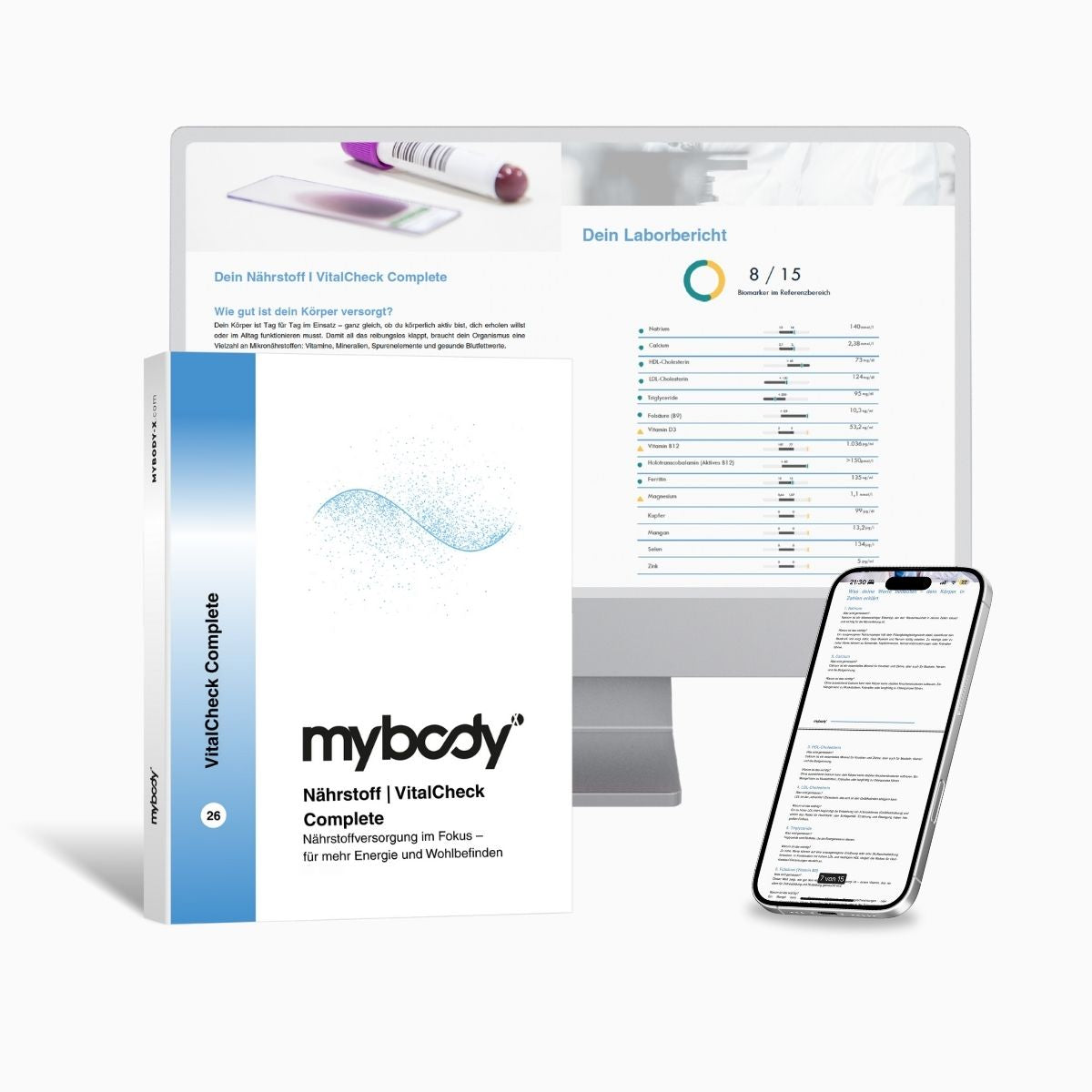
Capillary blood test
VitalCheck | Complete Nutrient & Mineral Test
The test determines 18 values from a blood sample that you collect yourself at home. Vitamin B12 is included, as are vitamin D3, folate, and ferritin, iron, and transferrin as a complete iron panel. What it does not do: The product page mentions neither holotranscobalamin nor methylmalonic acid (accessed on 27 August 2026). The B12 value should therefore be read as a status marker, not a functional marker. According to the Verbraucherzentrale’s information on testing, an unremarkable result does not rule out a deficiency in the cells. The test does not provide a diagnosis.
Laboratory analysis 3–5 working days after sample receipt
Product page information, accessed 27/08/2026
The second product is not a test but a food supplement. Such products are subject to advertising rules under European food law, which is why the following card states only what is authorized under Regulation (EU) No. 432/2012.

Food supplement
Vitamin B Complex | Energize
Seven B vitamins in micelle drops, including vitamin B12. Authorized wording under Regulation (EU) No. 432/2012: “Vitamin B12 contributes to normal energy-yielding metabolism,” “Vitamin B12 contributes to the normal functioning of the nervous system,” and “Vitamin B12 contributes to the reduction of tiredness and fatigue.” What it does not do: A food supplement does not treat a diagnosed deficiency and does not replace medical evaluation. It also does not replace a balanced and varied diet. This article deliberately does not specify a recommended intake.
No sample collection, no laboratory process
No laboratory analysis because it is not a test
Product page information, accessed 27/08/2026
This article explains which value actually says something in the case of vitamin B12 deficiency. If you are instead interested in the symptoms, the article on symptoms of vitamin B12 deficiency goes into greater depth, while the article on iron and vitamin B12 deficiency covers the combination of the two if iron deficiency is also a possibility.
Who should have a measurement and who should not
A home test for this issue is not a one-size-fits-all solution. It is suitable for one particular starting situation and explicitly unsuitable for another.
It makes sense for you if …
You have been following a predominantly plant-based diet for a long time and have never had your levels checked.
You want to know whether vitamin B12 could be a possible explanation for your symptoms at all before investigating further.
You want to assess your iron status and vitamin D as well as vitamin B12 because your symptoms could have several explanations.
You want to bring a number to your next appointment at your doctor’s practice.
Probably not if …
You already have neurological symptoms. In that case, a medical practice is the first step, not the second.
You are taking a vitamin B12 supplement. The status marker then measures intake rather than your nutritional status.
You have a known stomach or intestinal condition. The cause then lies in absorption, and no status marker can determine that.
You are looking for confirmation that a deficiency explains your fatigue. A test may disappoint this expectation—and that is exactly what it is designed to do.
Limitations: what these values cannot clarify
A laboratory value describes a state at a specific point in time. It therefore answers fewer questions than most people expect when they order a test kit.
The result does not identify the cause
Whether too little vitamin B12 is reaching the body or too little is being absorbed is not shown by any of the three markers. However, this distinction determines what happens next and requires a medical history, a list of medications, and, if necessary, further tests.
A capillary blood test does not cover everything
VitalCheck Complete lists B12 as one of 18 values. Holotranscobalamin and methylmalonic acid are not listed on the product page (accessed 27 August 2026). Anyone who wants to consider a status marker and a functional marker together, as recommended by the Verbraucherzentrale, gets only half of that from this test.
This is not a shortcoming of this product alone, but the usual limitation of a capillary blood test for home use. It still belongs here because an article that omits it creates a false expectation.
Reference ranges are not constants of nature
The range from 3 to 43 percent in the second chapter arose solely because studies used different cutoff values (NIH, Office of Dietary Supplements, as of 02 July 2025). A value just below or just above a cutoff therefore says less than the number suggests.
A dietary supplement is not a treatment
A supplement contributes to normal function; that is the authorized claim. A diagnosed vitamin B12 deficiency with symptoms is something else and requires medical care. Anyone who confuses these two levels loses time.
What ultimately matters
The practical takeaway from this article can be summed up in two rules. First: A single serum B12 value decides nothing, in either direction. Second: Nerve symptoms belong in a doctor’s office regardless of any laboratory value.
There is a third benefit that this article has not announced until now. Once you have read the eight authorized claims, you can recognize within seconds the next time you see an advertising claim whether it still falls within the tested scope. This check works for every vitamin, not just this one.
And something else changes when you know the prevalence figures. The expectation that persistent fatigue is caused by a vitamin B12 deficiency is rarely justified statistically. Those who know this will still investigate it, but they will not stop looking afterward.
At the beginning was the question of which value says something meaningful in the event of a vitamin B12 deficiency. The honest answer is: none on its own.
Frequently asked questions
Is a serum B12 value enough to rule out a vitamin B12 deficiency?
No. The serum value measures the total amount in the blood, not the proportion that the cells can absorb. The Verbraucherzentrale states: “At least one status marker, e.g. serum vitamin B12, and one functional marker, such as MMA, should be measured.” (Verbraucherzentrale, as of 04 December 2025). An unremarkable serum value therefore does not reliably rule out a functional deficiency in the cells.
When should a suspected vitamin B12 deficiency be taken to a doctor?
In cases of tingling or numbness in the hands and feet, unsteadiness when walking, new memory or concentration problems, an abnormal blood count with enlarged red blood cells, or known stomach or intestinal diseases. The National Institutes of Health point out that neurological symptoms can occur without anemia and that early evaluation is important to prevent permanent damage (NIH, Office of Dietary Supplements, as of 02.07.2025). During pregnancy and breastfeeding, nutritional care is medically supervised anyway.
What can be said about vitamin B12 at all?
Eight claims are permitted under Regulation (EU) No. 432/2012, including “Vitamin B12 contributes to normal energy-yielding metabolism,” “Vitamin B12 contributes to the normal function of the nervous system,” and “Vitamin B12 contributes to the reduction of tiredness and fatigue.” All eight describe a contribution to maintaining normal function. Claims of more energy, better sleep, or stronger nerves are not covered by these provisions.
Which B12 marker does VitalCheck Complete measure?
The product page lists B12 as one of 18 values and mentions neither holotranscobalamin nor methylmalonic acid (accessed 27.08.2026). The value is therefore a status marker, not a functional marker. For the combination of both described by the consumer advice center, the test provides one half, while the second comes from a medical practice.
How much vitamin B12 do the reference values specify per day?
The German Nutrition Society gives an estimated value for adequate intake of 4.0 micrograms per day for adolescents aged 15 and over and adults, 4.5 micrograms for pregnant women, and 5.5 micrograms for breastfeeding women (DGE, basis of derivation as of 2018). For food supplements, the German Federal Institute for Risk Assessment proposes a maximum amount of 25 micrograms per day (consumer advice center, as of 04.12.2025). A personal intake amount cannot be derived from this; that is the responsibility of a medical consultation.
Next step
First the status marker, then the consultation
If you have gone through the four steps and have not checked any item in the warning signs chapter, VitalCheck Complete provides 18 values from a capillary blood sample, including vitamin B12. What it does not cover regarding B12 status is listed further up in the product card. If you are instead concerned about the combination with iron deficiency, the second path will take you there.
VitalCheck | Nutrient & Mineral Test Iron and vitamin B12 togetherRead more
You might also be interested in
If the symptoms concern you more than the testing question.
When both values are present at the same time and the symptoms overlap.
Sources
- European Commission: Regulation (EU) No 432/2012 establishing a list of permitted other health claims made on foods (2012) – eur-lex.europa.eu
- Consumer Advice Centre: Vitamin B12 – For Exhaustion and Fatigue? (as of 04.12.2025) – verbraucherzentrale.de
- German Nutrition Society: Reference Values for Nutrient Intake, Vitamin B12 (derivation status 2018) – dge.de
- National Institutes of Health, Office of Dietary Supplements: Vitamin B12 – Fact Sheet for Health Professionals (as of 02.07.2025) – ods.od.nih.gov
The wording of the eight authorized health claims comes from the list in [1]; it is reproduced in the version cited by [2], as is the minimum amount of 0.375 micrograms per 100 grams. [2] also provides the institute's statement on measurement, the assessment of nutritional status, the list of risk groups including the information on metformin, and the maximum amount of 25 micrograms per day proposed by the German Federal Institute for Risk Assessment. The estimated values of 4.0, 4.5, and 5.5 micrograms per day, as well as the statement regarding its occurrence in foods of animal origin, come from [3]. The figures of 3.6 percent, 3.7 percent, and 3 to 43 percent, the classification of serum B12 and methylmalonic acid, the statement concerning permanent damage, and the information on pernicious anemia come from [4] and refer to the United States. The information on mean corpuscular volume, including the range of 80 to 96 femtoliters, comes from the Institute for Quality and Efficiency in Health Care (IQWiG, as of 20.03.2025); it is attributed in the main text to the institution and date and therefore does not appear in this list. Information on price, values, sample type, dosage form, and laboratory comes from mybody®x product pages, accessed on 27.08.2026; processing times follow the central specification for blood tests. All sources were accessed and reviewed on 27.08.2026.

mybody®x Editorial & Expert Team
Laboratory diagnostics Blood analysis interpretation Nutritional science Vitamins and micronutrients
This article was created by the mybody®x editorial and expert team. The team combines laboratory diagnostics, blood analysis interpretation, and nutritional science. Contributors are listed on the authors' page.
Published on 27.06.2025 · Last updated on 27.08.2026
The content is for general information and does not replace medical advice, diagnosis, or treatment. Reference ranges depend on the laboratory, method, and age; the information on your test report is always authoritative.




Share now:
Recognize the symptoms of vitamin B12 deficiency and take the right action
Celiac disease test: The path to clarity regarding gluten intolerance