
Lowering LDL Cholesterol: Your Practical Guide to Healthy Levels
An elevated LDL cholesterol level can initially feel like a cold shower, no question. But I mainly see it as one thing: a wake-up call and the perfect opportunity to take control of your heart health yourself. In this guide, I’ll spare you complicated diet rules and instead show you tried-and-tested strategies that really make a difference.
How to actively improve your cholesterol levels

We’ll talk about the power of the right foods to specifically lower your “bad” LDL cholesterol, exercise that feels good, and how to keep track of your progress in a meaningful way. From my own experience, I know that it’s the small but consistent changes that have the greatest long-term impact.
Think of this article as your personal roadmap—one that shows you how much you can influence your levels and well-being.
Let’s get started.
Why a low LDL level is so crucial
Perhaps your doctor has raised the issue, or you simply want to take preventive action. Regardless of why you’re here, one thing is crystal clear: Lowering LDL cholesterol is not a minor matter, but one of the most important levers for your long-term health.
Think of LDL cholesterol as a delivery service for fats in your blood. If too much of it is circulating, it can build up on the inner walls of your arteries. These deposits, also known as plaques, cause atherosclerosis—a gradual narrowing and hardening of the blood vessels.
The consequences can be serious, because this very process is the main cause of heart attacks and strokes. But the good news is that you have a great deal of control over stopping or even reversing it.
Modern medicine provides compelling evidence for this. Targeted reduction of LDL levels is now considered the causal factor in preventing cardiovascular disease. Large studies show that significantly lowering LDL can drastically reduce mortality. One analysis, for example, found that lowering LDL by approximately 80 mg/dL after a heart attack reduced overall mortality by about 65% within four years. You can find more information in the recommendations of the German Society for Lipidology.
Your personal roadmap to your goal
This guide is more than just a to-do list. It’s an invitation to better understand your body and take responsibility for your health. Remember: Every body responds differently. What works for one person may not work the same way for you.
These are the building blocks we will explore together:
- Build knowledge: We will dispel common myths and clarify what is really behind the lab results.
- Optimize your diet: You will learn which foods actively lower your LDL and how to incorporate them into your daily life in a delicious and simple way.
- Adjust your lifestyle: Exercise, stress management, and sleep are extremely powerful tools that we can deliberately use to our advantage.
- Measure progress: We will discuss which medical tests and analyses can help you stay on track and adjust your strategy if necessary.
I realized from my own experience that it is not about perfection. It is about starting and sticking with it. Every small step counts.
Cholesterol: Why it is not simply “good” or “bad”

Before we get into the specific steps, we need to clear up a widespread myth. Forget this simplistic black-and-white view of “good” and “bad” cholesterol. This idea is outdated, causes unnecessary panic, and distracts from what really matters.
Your body is a highly intelligent system and does not produce cholesterol to harm you. On the contrary, it is an essential building material. Every single cell membrane, important hormones such as testosterone and estrogen, and vitamin D all depend on cholesterol.
So the real problem is not cholesterol itself, but how it is transported through the body. To do this, the body packages it into small transport particles called lipoproteins: LDL (Low-Density Lipoprotein) and HDL (High-Density Lipoprotein).
LDL and HDL: More like a delivery service and garbage collection than opponents
It is best to think of LDL as a delivery service. Its job is to transport cholesterol from the liver to the cells where it is urgently needed. It only becomes problematic when too many delivery vans are on the road—in other words, when there is an excess of LDL. The excess cholesterol can then accumulate in artery walls and form the dreaded plaques.
And this is exactly where HDL comes in. It is your body’s garbage collection service. HDL collects excess cholesterol—including from artery walls—and transports it back to the liver, where it is broken down or recycled.
So our goal is not to wage war on LDL. Rather, it is to restore the natural balance between delivery and removal. Targeted lowering of LDL cholesterol is the most effective way to achieve this balance.
This knowledge is crucial. It eases your fears and gives you back control. You’re not fighting against your body; you’re helping it get back into balance.
A broader perspective: Triglycerides and lipoprotein(a)
A complete picture of your blood lipid levels goes beyond LDL and HDL. Two other values on your lab report are often key pieces of the puzzle that are closely linked to your LDL:
- Triglycerides: These are blood fats that your body uses as energy reserves. Elevated levels are often a direct warning sign of excessive consumption of sugar and rapidly digested carbohydrates. High triglyceride levels are an independent risk factor and further accelerate plaque formation.
- Lipoprotein(a) – Lp(a): This value is less well known, but extremely important. It is largely determined by genetics and acts like “sticky” LDL, which settles particularly easily in the walls of blood vessels. High Lp(a) is an independent and often underestimated risk factor for arteriosclerosis. Even though we cannot directly lower it through our lifestyle, it becomes all the more important to manage all other modifiable factors—above all LDL cholesterol—aggressively.
Taking a holistic view of your health is key. Understanding these connections forms the foundation for a healthy, long life. Learn more here about how to create an epigenetic lifestyle for your longevity.
When you know these values and their functions, you can make informed decisions and work with your doctor to take the right steps for your heart health. You see: it’s not about prohibitions, but about intelligently managing your health.
Use your diet as your most effective tool
Hearing that your cholesterol levels are elevated can initially throw you off balance. But it’s also a tremendous opportunity. Because the biggest and most effective lever for lowering your LDL cholesterol is right in front of you—on your plate. And the best part? It’s not about radical deprivation or complicated diet plans that no one can stick to in everyday life anyway.
Rather, it’s about making smart, conscious choices. You can specifically enrich your meal plan with foods that actively support your heart. I’ll show you how to put this into practice without having to turn your entire life upside down.
This graphic shows you at a glance what a cholesterol-conscious plate can look like. Packed with foods that actively lower your LDL. 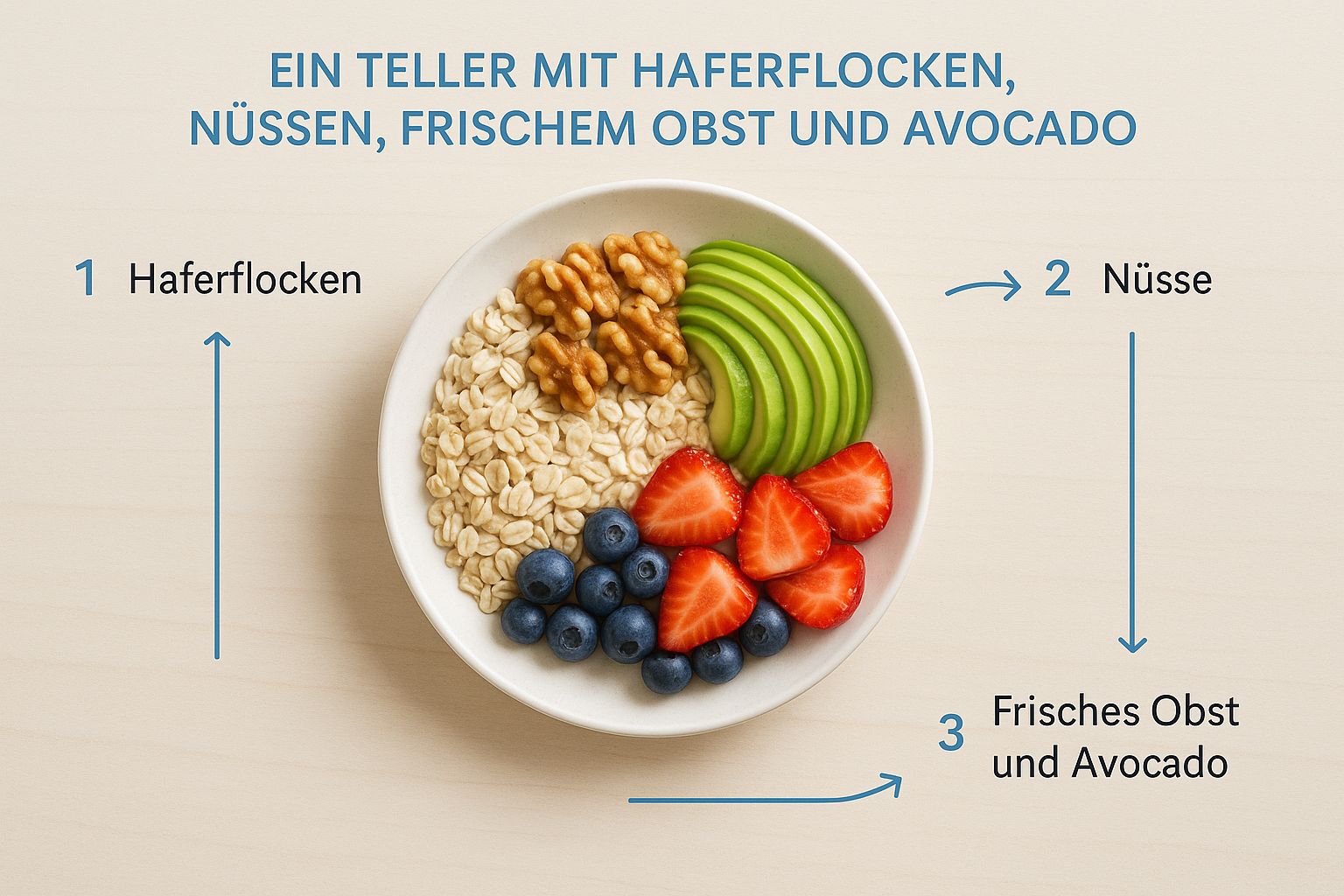 The principle is very simple: A balanced meal based on soluble fiber, healthy fats, and fresh, unprocessed ingredients is the foundation for healthy blood lipid levels.
Soluble fiber: your personal cholesterol magnet
Think of soluble fiber as a sponge traveling through your intestines. It has the remarkable ability to bind bile acids. Your body produces these bile acids from cholesterol.
When the bound bile acids are excreted, your body has to produce more—and to do so, it draws cholesterol from your blood. A simple but extremely effective mechanism for naturally lowering your LDL.
Here are the best sources that you can easily incorporate into your everyday life:
- Oatmeal: The ultimate classic. A bowl of porridge in the morning not only tastes good but also provides a substantial serving of beta-glucan. This soluble fiber has been proven to lower LDL cholesterol.
- Barley: Like oats, barley is packed with beta-glucan. You can use it as a side dish like rice, add it to soups, or make a delicious pearl barley risotto.
- Legumes: Lentils, beans, chickpeas, and peas are true powerhouses. They are not only rich in fiber but also in plant-based protein, and they keep you feeling full for a long time.
- Apples, citrus fruits & carrots: They contain pectin, another type of soluble fiber that is excellent for lowering cholesterol.
My tip for the easiest start: breakfast. If you start your day with oatmeal (porridge), a few berries, and a handful of nuts, you’ve already taken a huge step toward better heart health.
Healthy fats as natural anti-inflammatory agents
Fat is not your enemy—quite the opposite. It’s all about choosing the right fats. While saturated fats and trans fats (hidden in fast food, processed foods, and fatty pastries) can drive up your LDL, unsaturated fatty acids work like a balm for your blood vessels.
They help reduce inflammatory processes in the body, which are closely linked to the development of atherosclerosis. They can also stabilize or even slightly increase “good” HDL cholesterol.
Focus on these healthy fats:
- Avocados: They are packed with monounsaturated fatty acids. Perfect in salads, as a spread on bread, or as a creamy dip.
- Nuts and seeds: A handful of walnuts, almonds, flaxseeds, or chia seeds per day provides valuable omega-3 and omega-6 fatty acids.
- High-quality plant oils: Extra-virgin olive oil for cold dishes and good-quality rapeseed oil for frying are excellent sources of unsaturated fats.
Easy to put into practice and incredibly delicious—the following table gives you a few ideas for replacing unhealthy fats with heart-healthy alternatives.
Smart food swaps for your heart
This table shows you simple and delicious alternatives to foods that can negatively affect your LDL cholesterol. This makes it easier to change your eating habits in everyday life.
| Instead of (LDL-raising) | Choose instead (LDL-lowering) | Why it is a better choice |
|---|---|---|
| Butter on bread | Avocado or nut butter | Rich in unsaturated fats and fiber instead of saturated fats. |
| Sausage and fatty meat | Lentils, beans, tofu, lean poultry | Provides plant-based protein and fiber while reducing saturated fat. |
| Cream sauce | Sauce made with puréed vegetables or yogurt | Significantly fewer saturated fats and calories, more nutrients. |
| Chips and crackers | A handful of nuts or roasted chickpeas | Unsaturated fats and fiber that keep you feeling full for a long time. |
| Croissant or sweet pastries | Oatmeal porridge with fruit | Provides soluble fiber (beta-glucan), which binds cholesterol. |
Small changes like these add up and have a tremendous impact on your blood lipid levels, without making you feel deprived.
Phytosterols: nature’s natural cholesterol blockers
Another clever helper from the plant world: phytosterols. These are substances that are structurally very similar to human cholesterol. When you consume them with food, they compete with cholesterol in the intestine for absorption into the body.
They essentially occupy the available spots, so less cholesterol from food and bile enters the bloodstream. This effect is so well established that an intake of 2 g of phytosterols per day is recommended as a complementary measure to lower LDL cholesterol.
Phytosterols occur naturally in plant-based foods, but usually in relatively small amounts. Richer sources include:
- Plant oils (sunflower, sesame, soybean oil)
- Nuts and seeds
- Legumes
To reach the therapeutically effective dose of 2 grams per day, there are special foods enriched with phytosterols, such as margarine, yogurt, or milk drinks.
The combination of these three pillars—soluble fiber, healthy fats, and phytosterols—is an incredibly powerful team. Changing your diet in this way doesn’t mean you have to give up enjoyment. In our article on losing weight without giving up enjoyment, you’ll find many more practical tips that can also have a positive impact on your blood lipid levels.
Exercise and lifestyle: Your decisive levers
If you view your diet as the foundation for healthy cholesterol levels, then exercise and a mindful lifestyle are the supporting pillars. These two factors are your strongest allies for lowering LDL cholesterol and increasing protective HDL cholesterol.
The good news first: You don’t have to become a marathon runner overnight. Quite the opposite. It’s much more important to find activities you genuinely enjoy and that fit easily into your daily routine.
In my experience, consistency beats intensity. Moving regularly brings greater benefits than exhausting yourself completely once a week.
The perfect combination for your heart
It becomes truly effective when you combine endurance training with moderate strength training. Why both? Because they complement each other perfectly and have very different positive effects on your body.
- Endurance training: Regular exercise such as brisk walking, jogging, cycling, or swimming is the most direct way to increase your HDL cholesterol—practically the “waste disposal service” for your blood vessels. At the same time, it helps lower LDL and triglycerides.
- Strength training: Building muscle boosts your metabolism, even when you’re at rest. This means your body burns energy more efficiently, which has a positive impact on your blood lipid levels and weight. You don’t need to lift heavy weights—bodyweight exercises or light dumbbells are perfectly sufficient.
A practical tip: My personal breakthrough came when I stopped viewing exercise as a tedious obligation. I simply tried different things—from long walks with a podcast in my ears to short home workouts. Find out what works for you and stick with it.
A realistic and highly effective goal is 150 minutes of moderate exercise per week. That may sound like a lot, but it’s just under 22 minutes a day. You can do it!
Why stress worsens your cholesterol levels
A frequently underestimated factor is chronic stress. If you are constantly under pressure, your body releases more stress hormones such as cortisol. These can demonstrably worsen blood lipid levels. They promote inflammation and stimulate the liver to produce more cholesterol and triglycerides.
You may know this too: During stressful periods, we are more likely to reach for unhealthy food and neglect exercise. It’s a vicious cycle. So consciously managing stress isn’t a luxury but a central part of your strategy.
Here are some simple techniques that have helped me reduce the pressures of everyday life:
- Breathing exercises: Take a minute several times a day. Breathe in deeply through your nose for four seconds, hold your breath for four seconds, and then slowly exhale through your mouth for six seconds. This immediately calms your nervous system.
- Mindfulness moments: Pause briefly and focus on your senses. What do you see, hear, and feel right now? This brings you out of the carousel of thoughts and back into the present moment.
- Digital breaks: Consciously put your smartphone aside, especially before going to bed. The blue light and constant sensory overload are major sources of stress for our brains.
Two other key building blocks
In addition to exercise and stress management, there are two other habits that have a huge impact on your heart health and cholesterol levels.
1. Improve sleep quality Too little sleep disrupts your hormonal balance, increases stress, and can lead to weight gain—all factors that negatively affect LDL cholesterol.
How you can put this into practice:
- Aim for 7–8 hours per night.
- Establish a routine: Go to bed and get up at roughly the same time every day.
- Make sure your bedroom is dark, cool, and quiet.
2. Make quitting smoking a priority Smoking is pure poison for your blood vessels. It lowers protective HDL cholesterol and makes LDL cholesterol “stickier,” allowing it to attach more easily to artery walls. Quitting smoking is one of the most effective individual measures for your heart health.
If you also want to optimize your weight, which can have a strongly positive effect on your cholesterol levels, you’ll find valuable tips in our guide. Here we explain how healthy weight loss can really work without having to put yourself through unnecessary hardship.
A healthy lifestyle is not a sprint but a marathon. Every step counts. Every conscious decision to exercise, relax, and get good sleep is a direct gain for your heart.
Understanding Medical Tests and Treatment Options Correctly
To lower your LDL cholesterol successfully, you should not be left in the dark. You need clear data to measure your progress and make informed decisions. This is where regular medical tests come in—they are your personal navigation system on the road to better heart health.
When you start changing your diet and lifestyle, it is incredibly motivating to see that your efforts are really paying off. A blood test is the only way to assess this objectively.
More Than Just LDL—Which Values Really Matter
A standard blood lipid profile already gives you a good initial overview. In addition to LDL and HDL cholesterol, there are two other values in particular that are often overlooked but extremely important: triglycerides and the frequently overlooked lipoprotein(a).
- Triglycerides: This value is like an early warning system. It responds extremely quickly to changes in your diet, especially sugar and simple carbohydrates. If your triglycerides decrease, it is often the first clear sign that you are on the right track.
- Lipoprotein(a) or Lp(a): This value is genetically determined. That is why it is so important to have it measured at least once in your lifetime. However, an elevated level does not mean that you are powerless—quite the opposite: It becomes even more important to lower your LDL cholesterol aggressively to offset this inherited risk.
I realized in my own case how important it is not to consider these values in isolation. Together, they create an overall picture and tell a story about your metabolism and your very personal situation.
Important to know: Your doctor determines your personal target levels. These depend heavily on your individual risk profile—that is, whether you have additional risk factors such as high blood pressure, diabetes, or a family history.
The guidelines for lowering LDL in Germany set clear, risk-adjusted targets. For people at very low risk, for example, an LDL level below 116 mg/dl (3.0 mmol/l) is recommended. The principle is simple: The lower the LDL, the better. You can find more information on target levels for each risk group in the “LDL-Senken” initiative’s guidance.
When medication is a sensible addition
Sometimes diet and exercise alone are not enough to bring cholesterol levels into a safe range. And I want to make this absolutely clear: This is not a personal failure. Genetics often plays such a major role that even the healthiest lifestyle reaches its limits.
This is exactly where medications such as statins come in. They are among the best-researched and most effective means of significantly lowering LDL cholesterol and effectively protecting the blood vessels. Their purpose is to directly reduce cholesterol production in the liver.
You should always make the decision for or against medication together with your doctor. It is based on your overall risk, not just on a single lab value. If your risk of a heart attack or stroke is high, statins are often a necessary and highly sensible addition to your lifestyle changes.
They are not a replacement for this, but an additional safety net. Protecting your health over the long term is the top priority. This also includes making smart use of all available options. It is a central aspect of the path to a long and healthy life. Read more about the meaning of longevity and how you can actively shape it.
Your most frequently asked questions about LDL cholesterol
When you set out to improve your cholesterol levels, you almost always have the same questions as everyone else. That’s a good thing, because it shows that you’re taking your health seriously. Here, I answer the points that come up repeatedly in my consultations to resolve any remaining uncertainties.
How quickly will I see results from lowering LDL cholesterol?
This is probably the most common question—and the answer is: it depends. Your starting level and, above all, your consistency are crucial. Think of it as a marathon, not a sprint.
If you genuinely change your diet and exercise more, the first positive changes in your blood work can often be measured after just four to six weeks. A realistic 15–20% reduction in your LDL cholesterol is absolutely achievable within three months. Medications such as statins naturally work faster and can lower levels much more significantly within a few weeks, often by 30–50%.
But the most important thing is your patience. This is not about a quick fix, but about sustainably and permanently improving your heart health. Every small step counts along the way.
Do I have to give up meat and cheese completely for healthy levels?
No, in most cases, radical abstinence is neither necessary nor the goal. Rather, it is about making conscious choices and finding the right balance.
What you should reduce are highly processed products such as sausages, fatty baked goods, or ready-made meals. They are often packed with saturated fats and hidden trans fats that drive up your LDL. Lean, unprocessed meat, fish, and low-fat dairy products in moderation fit wonderfully into a heart-healthy diet plan.
The key is making a conscious swap: Whenever possible, replace saturated fats with beneficial unsaturated fats from olive oil, rapeseed oil, nuts, and avocados.
How do hormones affect my cholesterol levels?
Hormones are an often underestimated but extremely important factor in blood lipid levels. This connection is particularly clear in women: Before menopause, estrogen protects the blood vessels and generally contributes to better cholesterol levels. When this natural protective shield disappears after menopause, LDL cholesterol often rises.
But other hormonal factors also play a role:
- Underactive thyroid (hypothyroidism): When thyroid hormones are lacking, the entire metabolism slows down. This can also drive cholesterol levels upward.
- Stress hormones: If you are constantly under pressure, your body continuously releases cortisol. This can also negatively affect your blood lipids.
My advice is therefore crystal clear: If your values are abnormal, have your hormone balance and thyroid function medically evaluated as well. A hormone test can often uncover hidden causes and provide important pieces of the puzzle.
Do you want to know exactly how your hormones, metabolism, or nutrient levels are doing? MYBODY Lab GmbH offers scientifically sound analyses you can do at home. Use one of our tests to find out which individual factors influence your health and receive personalized recommendations that are truly right for you. Discover the right test for you now at mybody-x.com and take control of your well-being.

Share now:
What to do if your HDL cholesterol is too low?
Metabolic analysis: the four methods available and what they measure