

Genetic testing for weight loss: My honest experiences – Is it really worth it?
You've tried countless diets, counted calories, and sweated it out at the gym, but the scale just won't budge? Welcome to the club! I know that feeling all too well. I was at that exact point myself and wondered, "Could it be my genes?" This question prompted me to take a genetic weight-loss test a year ago. And my experience with the test completely changed my perspective on the topic.
In this article, I not only share my personal journey but also analyze the reports of six other individuals. We delve deep into the world of nutrigenomics and examine what a genetic test can truly achieve—and what is pure marketing. Forget exaggerated promises; here you'll find honest insights and realistic results.
This article aims to provide you with guidance. You'll learn what specific insights the tests yielded, what strategies were developed from them, and whether investing in your own genetic blueprint is truly worthwhile. Get ready for an authentic assessment that could change your perspective on weight loss forever.
1. DNA metabolic analysis: Your personal nutritional compass
A DNA-based metabolic analysis is often the first step, especially if you've already tried countless diets without lasting success. It examines your genetic variations that influence your basal metabolic rate, the processing of carbohydrates and fats, and your tendency to store fat. The goal is clear: a personalized weight-loss strategy tailored precisely to your body.

Instead of general diet rules, you'll receive guidance that explains how your body truly functions. For many, including myself, this was the personal starting point, and the insights were often surprising. Such an analysis goes beyond blanket recommendations and enables individually tailored nutrition plans. To delve deeper into the topic, you'll find valuable information here about personalized nutrition and supplementation strategies based on genetic data .
What do the experiences say?
The experiences with genetic weight loss tests show how crucial an individual approach can be. Many users report that they have finally understood why certain diets never worked for them.
- Sarah's experience: She struggled with her weight for years. Her genetic test revealed a clear genetic predisposition that favors a low-carb diet. With this targeted change, she lost 15 kg in just six months – without feeling like she was on a strict diet.
- Michael's experience: He had reached a classic weight-loss plateau. His genetic test showed that his body responded particularly well to strength training for metabolism activation. He shifted his focus from cardio to strength training and broke through the stagnation.
Actionable Takeaways: How to Use the Insights
A genetic test is not a magic wand, but a compass. Success depends on how you use the information.
- Use the results as a starting point: See the analysis as your personal user manual, not as an immutable law.
- Combine the data: Connect genetic insights with professional nutritional advice to create a tailor-made plan.
- Adaptation is key: Track your progress and adjust the recommendations if you find that something isn't working for you in everyday life.
- Choose reputable providers: Look for scientifically sound tests from established laboratories. If you'd like to learn more about the basics, read on here: What a DNA metabolic analysis is and how it works .
2. Genetic carbohydrate sensitivity: The low-carb myth put to the test
The question of whether a low-carb or high-carb diet is better for weight loss divides the fitness world. A genetic test for carbohydrate sensitivity gives you a personalized answer instead of relying on general recommendations. Genes such as AMY1 (responsible for the production of the carbohydrate-digesting enzyme amylase) and TCF7L2 (associated with blood sugar metabolism) are analyzed. The result shows whether your body is genetically predisposed to a high- or low-carbohydrate diet.

For many, this insight is a real game-changer, as it explains why strict low-carb diets either lead to fantastic results or complete lack of energy. It's not about demonizing carbohydrates, but about finding the right amount for your individual metabolism . This type of analysis is particularly valuable if you feel that your energy levels are heavily dependent on your carbohydrate intake.
What do the experiences say?
The experiences with genetic weight loss tests in this area are particularly insightful because they are directly related to daily energy levels. Users often report an "aha" moment when they adapt their diet to their genetic predisposition.
- Anna's experience: She often felt tired and bloated after carbohydrate-rich meals. Her genetic test confirmed a high carbohydrate sensitivity. With a targeted ketogenic diet, she not only lost weight but also reported a mental clarity she hadn't experienced in years.
- Thomas's experience: He was worried he would have to cut carbohydrates for his marathon training. However, his test revealed a high number of AMY1 gene copies – a predisposition to efficiently process carbohydrates. He incorporated a Mediterranean diet with complex carbohydrates and was able to improve his performance while simultaneously reducing body fat.
Actionable Takeaways: How to Use the Insights
A carbohydrate sensitivity test result is your individual roadmap for more energy and successful weight management.
- Start with moderate adjustments: Begin by gradually integrating the recommended carbohydrate amounts into your daily routine, rather than radically changing everything.
- Observe your body: Pay attention to how you feel after meals with different carbohydrate content. Do you feel energized or do you experience a slump in performance?
- Optimize the timing: If you respond well to carbohydrates, plan them specifically around your training sessions to maximize your performance and recovery.
- Work with experts: Discuss your results with a nutritionist who has experience in nutrigenetics to perfectly tailor the recommendations to your lifestyle.
3. Genetic profiling of fat storage: Why your body stores fat differently
Do you sometimes wonder why stubborn fat deposits seem to cling to certain areas of your body, while others effortlessly maintain a slim figure? The answer could lie in your genes. Genetic profiling of fat storage analyzes specific gene variants such as FTO, MC4R, and ADIPOQ. These genes not only control the predisposition to fat storage but also influence hunger and the risk of obesity.
This knowledge is a real game-changer. Instead of fighting against your body in frustration, you learn to understand its individual tendencies. The analysis explains why you might be more prone to belly fat or why your satiety signals are regulated differently. The goal is not to make you feel at the mercy of your genes, but to give you targeted tools to consciously manage your weaknesses.
What do the experiences say?
The experiences with genetic weight loss tests in this area are particularly insightful, as they often explain why general weight loss tips are ineffective. Many users report an "aha" moment that helped them fundamentally change their strategy.
- Maria's experience: She learned that she has a high-risk variant of the FTO gene, which explains her tendency to gain weight. Instead of panicking, she used this information as motivation. Through structured meal planning and avoiding uncontrolled snacking, she was able to successfully prevent further weight gain and stabilize her weight.
- Robert's experience: His genetic test revealed a variant in the MC4R gene that impaired his sense of satiety. He suddenly understood why he often ate beyond his hunger. With this knowledge, he integrated mindful eating into his daily life, ate more slowly, and learned to perceive his body's subtle satiety signals again.
Actionable Takeaways: How to Use the Insights
A genetic risk is not a judgment, but information. Your lifestyle has the greatest influence on whether a predisposition actually manifests.
- Use this knowledge to raise awareness: See the results as an opportunity to better understand your body's signals, not as an insurmountable obstacle.
- Focus on controllable factors: Regardless of what your genes say, a balanced diet and regular exercise are the most effective levers you have at your disposal.
- Implement preventive strategies: If you have an increased risk of fat storage, proactive measures such as regular strength training or a protein-rich diet can be particularly effective.
- Seek professional guidance: Get support from experts such as nutritionists or doctors to correctly interpret the results and develop a workable plan.
4. Sports genetic test: Your personal training guide
While nutrition is the most important factor in weight loss, the right training can make all the difference. A sports genetic test analyzes genetic variants (such as ACTN3, ACE, or PPARA) that influence how your body responds to different training stimuli. These include your muscle fiber type, endurance capacity, strength development, and even your recovery speed. The goal: no more guesswork at the gym, but a training plan that utilizes your genetic strengths.

For me personally, this realization was a true turning point. My test showed that my body responds much better to short, intense workouts than to hours of cardio on the cross-trainer, as is often generally recommended. It's about training smarter, not harder, and finding the sport that you not only enjoy but also that delivers the best results. To delve deeper into this topic, you can find more information here about how athletic success begins in your genes .
What do the experiences say?
The experiences with genetic weight loss tests in the field of sports often lead to an "aha" moment. Many users suddenly understand why they have made little progress despite regular training or why they constantly felt overwhelmed.
- Klaus's experience: He tried unsuccessfully to build muscle through heavy weight training. His genetic test revealed a clear predisposition for endurance sports. He switched to cycling and running and not only lost weight but also developed a completely new enjoyment of exercise.
- Petra's experience: She loved long runs, but often felt exhausted for days afterward. Her analysis revealed that she is a "power type" and responds much better to high-intensity interval training (HIIT). With short, intense workouts, she broke through her weight-loss plateau.
Actionable Takeaways: How to Use the Insights
A sports genetic test provides you with valuable data, but the sweat still comes from your own effort.
- Optimize, don't eliminate: Use the results to refine your training. If you're genetically predisposed to endurance training, it doesn't mean you should never do strength training again – but your focus could be on endurance sessions.
- Listen to your body: Genetics sets the direction, your body's signals set the pace. Pay attention to your recovery times, especially if the test suggests a slower recovery.
- Combine genetics with passion: The best training plan is the one you can stick to long-term. Find a balance between what your genes favor and what you truly enjoy.
- Search specifically for providers: Choose tests that specialize in sports genetics and give clear, actionable recommendations for training types and intensities.
5. Nutrient absorption genetic analysis: Your key to more energy and well-being
Did you know that not only what you eat, but also how well your body can utilize it, is crucial for weight loss success? A genetic analysis of nutrient absorption examines precisely this: It reveals how your body absorbs and processes vitamins, minerals, and macronutrients. This can be the decisive factor as to why you often feel tired despite a healthy diet or why your weight loss has stalled.
This type of test sheds light on genetic variants that influence, for example, vitamin D metabolism, the processing of B vitamins, or the absorption of minerals like magnesium. For many who struggle with diets and still battle fatigue or cravings, this analysis often provides the crucial "aha" moment. It's about optimizing your body's supply at the cellular level. If you'd like to delve deeper into the connections between genes and nutrient utilization, you can find further fascinating insights here:Learn more about the link between digestion and genes .
What do the experiences say?
The experiences with genetic weight loss tests in the field of nutritional analysis are often life-changing, as they explain symptoms that previously seemed inexplicable. Many users report a significant increase in their energy levels and improved overall health, which greatly facilitates weight loss.
- Sabine's experience: Despite a healthy diet and exercise, she constantly felt tired. Her genetic test revealed a genetically determined poor metabolism of vitamin D. Through targeted supplementation and more sunlight, not only did her energy improve, but her weight loss also restarted.
- Wolfgang's experience: He suffered from severe fatigue and difficulty concentrating during his diet. The test revealed a genetic variant that impaired his vitamin B12 absorption. After adjusting his diet and taking targeted supplements, he felt fitter and was able to successfully continue his diet.
Actionable Takeaways: How to Use the Insights
A genetic test for nutrient absorption provides you with a valuable map. Your task is to use it effectively.
- Confirm the results: Use the genetic evidence as a starting point and confirm a possible deficiency with a blood test at the doctor's office.
- Focus on food: Before resorting to supplements, try to meet your needs through nutrient-rich foods.
- Get professional help: Work with a doctor or nutritionist who is knowledgeable in nutrigenomics to create a safe and effective plan.
- Pay attention to your body: Observe closely how your energy levels, mood, and well-being change when you adjust your nutrient intake.
6. Genetic test for hormonal regulation: Understanding your metabolic control center
Hormones are the secret conductors of our bodies, controlling everything from appetite and stress to fat burning. A genetic test for hormonal regulation analyzes genetic variants that influence important hormones in weight management. These include leptin (satiety), ghrelin (hunger), cortisol (stress), and thyroid hormones (metabolic rate). The goal is to understand why your body might signal increased hunger, burn fat more slowly, or react more strongly to stress.
This type of analysis is particularly insightful if you feel your body is working against you despite a healthy diet and exercise. The results help you make targeted lifestyle adjustments that support your hormonal balance instead of fighting against it. For many who felt powerless, this was a crucial breakthrough in uncovering the true causes of their weight loss plateaus.
What do the experiences say?
The experiences with genetic weight loss tests in the area of hormonal regulation are often profound, as they explain behavioral patterns and bodily reactions that previously seemed inexplicable. Instead of blaming themselves, users suddenly understand the biological background.
- Christina's experience: She was constantly hungry, even after large meals. Her genetic test revealed a variant in the leptin receptor that weakens the satiety signal. Knowing this, she consciously introduced smaller, but more frequent meals and focused on high-fiber foods to mechanically support the feeling of fullness.
- Markus's experience: He gained weight quickly around his midsection, especially when stressed. Analysis revealed a genetically determined slower processing of cortisol. He specifically incorporated stress management techniques like meditation and ensured he got enough sleep, which visibly accelerated his weight loss. In addition to genetic predispositions, behavioral patterns also play a role. Learn how you can get a handle on stress eating .
Actionable Takeaways: How to Use the Insights
A hormonal genetic test provides the "why" answers. However, implementation requires a conscious adjustment of your daily routine.
- Compare results with blood test results: Combine genetic predispositions with a current hormone status (blood test) to obtain a complete picture.
- Use lifestyle as leverage: Focus on factors that positively influence hormones: sleep quality, stress management and the right nutrient intake (e.g. iodine and selenium for the thyroid).
- Pay attention to chronobiology: Adjust meal and sleep times to your genetic type to optimize hormone production in line with your natural rhythm.
- Consult an expert: For complex hormonal issues, especially in the area of the thyroid gland or in cases of severe stress, collaboration with an endocrinologist or a specialist physician is essential.
7. Comprehensive genetic lifestyle profile: The 360-degree picture of your predisposition
A comprehensive genetic lifestyle profile is, so to speak, the gold standard of DNA analysis. It goes far beyond a simple metabolic analysis, combining several pieces of the puzzle of your genetic predisposition into a complete picture. It considers not only metabolism, activity levels, and nutritional needs, but often also behavioral tendencies such as your satiety signals or your propensity for emotional eating. The goal is a holistic strategy that takes all aspects of your life into account.
The following concept overview shows how a complete genetic profile connects the core areas for successful weight management.
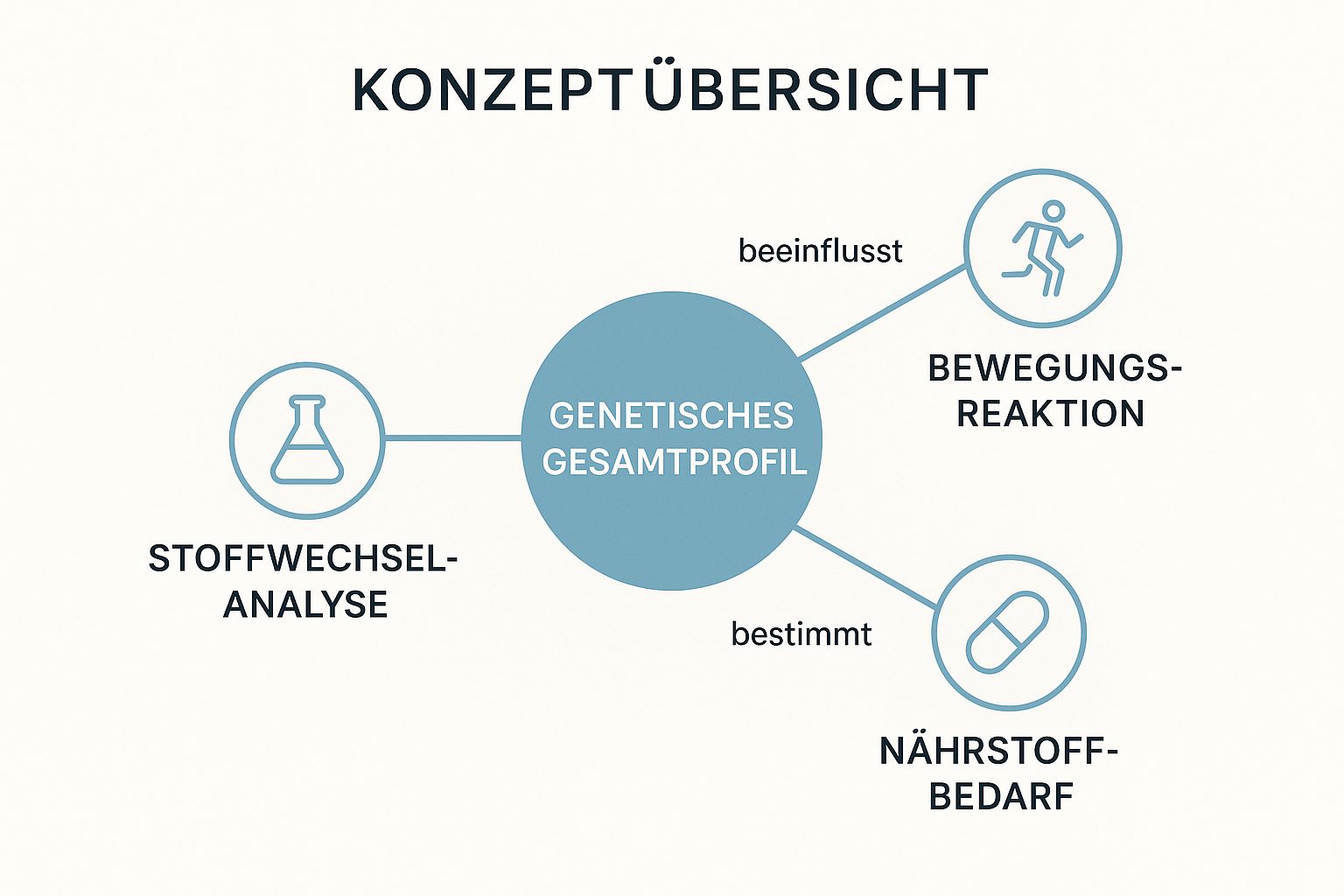
This illustration makes it clear that your success does not depend on a single factor, but on the interplay of your genetic predispositions in the areas of nutrition, exercise and nutrient supply.
What do the experiences say?
The experiences with weight loss genetic testing using such a comprehensive profile are often profound, as they reveal complex connections. Many users report an "aha moment" that helped them understand their previous failures and initiate lasting change.
- Stefan's experience: He combined the insights from his profile to completely change his lifestyle. The analysis showed him not only that a Mediterranean diet was ideal for him, but also that he had a genetic predisposition to fatigue more quickly during endurance sports. He switched to short, intense HIIT workouts and lost 25 kg over 12 months.
- Monika's experience: Her complex genetic profile finally explained why standard diets failed her. She had a low sensitivity to satiety hormones and, at the same time, an increased need for certain B vitamins. With this knowledge, she adjusted her meals and learned to eat more mindfully, which led to long-term weight stabilization.
Actionable Takeaways: How to Use the Insights
Creating a comprehensive profile can be overwhelming. The key is to proceed step by step and integrate the information intelligently.
- Focus on the basics: Start with the recommendations that promise the greatest impact, often in the areas of nutrition and metabolism.
- Consult experts: Work with certified nutritionists or doctors who have experience in genetics to correctly interpret the complex data.
- Integrate gradually: Don't try to change everything at once. Gradually incorporate new habits into your daily routine to stay motivated.
- Combine knowledge with practice: Use genetic insights to create a plan that truly suits you. Learn how to develop such a plan in the healthy weight loss tips on mybody-x.com .
Genetic weight loss tests: a 7-point comparison
| method | 🔄 Implementation complexity | 💡 Resource requirements | ⭐ Expected results | 📊 Ideal use cases | ⚡ Key Benefits |
|---|---|---|---|---|---|
| DNA-based metabolic analysis | Means – Genetic testing and counseling are needed | High – Costs for tests and experts | Personalized, sustainable weight loss | Individuals with unexplained diet success | Personalized recommendations, long shelf life |
| Genetic carbohydrate sensitivity test | Low to medium – focus on a few genes | Medium – Test and nutrition specialist | Clear nutritional guidance, improved energy utilization | People with uncertainty in carbohydrate utilization | Faster dietary adjustment |
| Genetic fat storage profiling | Method – Analysis of various risk genes | Resources – Testing costs and consultation | Identifies risk factors, preventive strategies | People at risk for weight gain | Early detection, motivation through scientific understanding |
| Genetic testing of the training response | Medium – specializing in sports genes | Medium – Tests + Training plan | Optimized training programs, improved training results | Athletes and fitness enthusiasts | Improved training adaptation and recovery planning |
| Genetic analysis of nutrient intake | Medium to high – comprehensive nutrient supply | Medium to high – testing and possible supplementation | Identification of deficiencies, improved energy use | People with symptoms of nutrient deficiency | Targeted supplementation and metabolic optimization |
| Genetic testing of hormone regulation | Medium to high – complex hormonal genetics | Medication – Test and, if necessary, hormone analyses | Explanation of hormonal influences on weight | People with weight problems and hormonal abnormalities | Meal adjustments, stress management |
| Comprehensive lifestyle genetic profile | Highly complex analysis and interpretation | Very high – expensive, experts required | Holistic, individual weight control | People who want comprehensive personalized strategies | Complete picture, holistic recommendations |
My conclusion: Is a genetic test the holy grail or expensive hocus-pocus?
Having navigated through the multifaceted experiences with genetic weight loss tests and my own journey, we come to the crucial question: Is the investment worthwhile? My answer, based on all these insights, is clear: A genetic test is neither a miracle cure nor hocus-pocus. It is a scientifically sound tool that can give you a decisive advantage if you are willing to use the information.
The biggest insight that runs through all the positive experiences is the immense power of personalization. Imagine stopping the guesswork and torturing yourself with generic diet tips that might not even work for your body. Instead, you receive a precise roadmap tailored to your unique genetic makeup. That's the core value of a genetic test. It takes the guesswork out of the equation.
Key findings at a glance
The analyzed experiences have shown that success does not depend solely on the test result, but on the consistent implementation of the strategies derived from it.
- There is no universal truth: What works for person A (e.g., a low-carb diet) may be ineffective for person B due to a different genetic predisposition. A test can reveal these individual differences.
- Efficiency instead of frustration: Instead of spending years trying out different diets and training plans, a genetic test provides you with a targeted shortcut. You'll find out whether your body responds better to endurance or strength training and how it metabolizes carbohydrates and fats.
- Motivation through understanding: Knowing why your body reacts in a certain way is an incredibly powerful motivator. It's the difference between blindly following rules and consciously working with your own body.
The most successful weight loss test experiences come from people who understand that the test is the starting point, not the destination. It provides the "what" and "why," but the "how" is still up to you. It's about using genetic insights as a foundation for sustainable lifestyle changes, not as an excuse.
Investing in a genetic test is worthwhile if you're prepared to actively use the information provided. If you view the results as your personal instruction manual and consistently integrate the recommendations into your daily life. The key is to choose a reputable provider who delivers not just raw data, but understandable and actionable recommendations. Ultimately, you are the one who lives the change – but with knowledge of your genes, you have the best possible compass to finally see the success you've long desired.
Are you ready to stop the guesswork and find your personal path? MYBODY Lab GmbH offers comprehensive, scientifically sound DNA analyses with clear recommendations that show you exactly what your body truly needs. Discover your genetic predisposition and start your journey to lasting success: MYBODY Lab GmbH .



Share:
Nutrigenetics for your personalized nutrition
Intolerance test at home: Find the cause of your symptoms