

The ferritin self-test provides an initial indication
The key points at a glance
A rapid test and a laboratory value do not answer the same question for ferritin. One checks a threshold; the other provides a number.
There is an understandable reason why three different numbers circulate for this value: they come from three different contexts and answer three different questions.
You will read the cited source verbatim, three common statements examined in a fact check, three documented facts, a comparison of both approaches, and a clear statement of what a rapid test cannot do.
What to expect in this article
1. What a rapid test answers
2. The documented source
3. How a ferritin rapid test works
4. Three statements in the fact check
5. Three numbers for the same value
6. Three documented facts
7. Why these numbers do not contradict each other
8. The key point in one sentence
9. What a rapid test does not provide
10. Rapid test and laboratory test compared
11. When each approach is appropriate
12. Who can use a rapid test as a starting point
13. What both approaches can show from capillary blood
14. Limitations: what both approaches leave open
15. What matters for this decision
Frequently asked questions
Sources
What a rapid test answers
The difference between an at-home rapid test and a laboratory result is more than the price and waiting time. The type of answer is different.
A rapid test answers a yes-or-no question: Is the value above or below a defined threshold? A laboratory result answers a where question: Where within a range does the value lie?
Both are useful, and both are different things. Anyone expecting one and receiving the other is dissatisfied, even though both tests did exactly what they were designed to do.
This article describes the difference, puts the numbers circulating for this value into context, and explains what a rapid test cannot do.
The documented source
The order of magnitude relevant to this value is stated in the medical literature, and it is stated there with two numbers.
Documented source
“In deficiency states, ferritin levels are generally low (< 50 mcg / l), and transferrin saturation is frequently < 20%.”
MSD Manual, professional edition
Iron deficiency, Johnson LE, complete review May 2025
Two phrases in this sentence are important: as a rule and frequently. Both indicate that these are typical cases, not calculation rules.
It is also important that the source names two values, not one. Ferritin appears there alongside transferrin saturation, and both are in a chapter that also lists the complete blood count.
A rapid test provides exactly one of these building blocks. This is not a criticism of the rapid test, but a description of its role.
How a ferritin rapid test works
The setup is simple and immediately explains what the test can do.
A drop of capillary blood is obtained from the fingertip and applied to a test cassette. After a few minutes, the strip displays a result. The mybody®x Iron Ferritin Self-Test (MYBODY Lab GmbH) gives a time of approximately 5 to 10 minutes and uses a threshold of 30 ng/ml (product page, accessed August 18, 2026).
The result is therefore not a number but a statement about a limit. The level is below or above it, and the strip says no more than that.
Anyone who wants to know whether their level is 28 or 12 cannot get that information from such a test. Both results would look the same on the strip.
Why this matters for tracking changes over time
This point determines what you can still do with the result six months from now.
A strip result cannot be compared with a later strip result unless the threshold is crossed in the meantime. As long as the same picture appears both times, it remains unclear whether anything has changed at all between the two points in time.
A laboratory result is different. Two dated values show a trend, and such a trend is particularly informative for ferritin because this value reflects a longer time span than the iron value.
So anyone who knows from the outset that they will want to compare results later is better served by laboratory testing. Anyone who first wants to know whether there is anything to compare at all is well served by the rapid test.
Three statements in a fact check
These three statements come up as soon as a rapid test is mentioned.
Checked against the evidence
Common
“A negative rapid test means that everything is fine.”
Substantiated
It means that the level is above the tested threshold. The MSD Manual generally gives ferritin levels below 50 mcg/l for deficiency states (Johnson, as of May 2025) and lists two additional tests alongside it.
Common
“A ferritin level within the reference range rules out a deficiency.”
Substantiated
IQWiG gives a range of 9 to 140 µg/l for women over 18 (as of March 20, 2025). A value of 40 would therefore be within the reference range while also below the figure the MSD Manual gives for deficiency states. The interpretation belongs in a medical practice.
Common
“A ferritin level alone is sufficient for assessment.”
Substantiated
More ferritin is present in the blood during inflammation, and elevated levels can indicate either iron overload or inflammation (IQWiG, as of March 20, 2025). Without an inflammation marker alongside it, this question remains unanswered.
Three numbers for the same value
Anyone who reads up on ferritin quickly comes across several numbers and does not know which one applies.
The first is the threshold of the rapid test. The Iron Ferritin Self-Test uses 30 ng/ml (product page, accessed August 18, 2026).
The second is the lower reference limit. IQWiG gives 9 to 140 µg/l for women over 18 and 18 to 360 µg/l for men over 18 (as of 20.03.2025).
The third is the diagnostic figure from the professional literature. The MSD Manual generally gives ferritin levels below 50 mcg/l for deficiency conditions (Johnson, as of May 2025).
So, three numbers, and none of them is wrong. Chapter 7 explains why they can appear side by side.
Three documented pieces of information
Three pieces of information from the reviewed sources and the product page. They provide context and do not constitute a diagnosis.
Documented information
30 ng/ml
is the threshold used by the iron ferritin self-test from mybody®x (product page, accessed 18.08.2026)
< 50 mcg/l
are the ferritin levels generally found in deficiency conditions, and transferrin saturation is often below 20% (MSD Manual, professional edition, Johnson, as of May 2025)
5–10 min.
is how long the result of a rapid test from capillary blood takes; a laboratory process, by contrast, requires kit shipping and analysis (product page, accessed 18.08.2026)
And as with any laboratory value, the reference range stated on your own report is the decisive one, because reference values may vary from one laboratory to another (IQWiG, as of 02.04.2025).
Why these numbers do not contradict one another
The reason is that the three numbers answer three different questions.
A reference range describes a distribution. IQWiG explains that reference ranges are usually established based on the measured values of many healthy people, with the limits set so that 95 percent fall within the range (as of 02.04.2025). It answers the question: How many healthy people fall here?
A diagnostic figure describes a finding. It answers the question: What range is found when a particular condition is present? That is a completely different question, and it can lead to a different number.
A test threshold describes a decision boundary. It answers the question: At what point should this test react so that it can serve as an indicator?
The same source also notes that 5 percent of people have results outside the reference range even though they are healthy, and that a single laboratory value is always only one component of an overall diagnosis (IQWiG, as of 02.04.2025).
The core in one sentence
At this point, the topic can be brought together.
A rapid test indicates whether it is worth looking further. It does not say what will be found.
This clearly defines its role, and it is by no means insignificant. Turning a question from unclear into well-founded is a real step.
What comes next is a different step, and it requires different means: a number with a reference range, additional values alongside it, and a conversation at a medical practice.
What a rapid test does not provide
This list needs to be stated explicitly because it rarely appears in advertising copy.
It does not provide a number. A result below a threshold does not indicate how far below the value lies, so there is no baseline for any later comparison.
It does not provide an inflammation marker. Because inflammation causes more ferritin to be present in the blood (IQWiG, as of 20 March 2025), a result above the threshold can also occur if inflammation raises the level.
It does not provide transferrin saturation or a complete blood count, meaning two of the three tests that the MSD Manual lists for diagnosis (Johnson, as of May 2025).
And it does not provide a diagnosis. This applies to every self-test, regardless of how accurately it measures.
Rapid test and laboratory test compared
The table compares both paths. It provides context and does not diagnose.
| Feature | Rapid home test | Laboratory test using capillary blood | What this means in practice |
|---|---|---|---|
| Type of result | Above or below a threshold of 30 ng/ml (product page, accessed 18 August 2026) | A number with the laboratory's reference range | Only the number can be compared again later. |
| Time until the result | Approximately 5 to 10 minutes (product page, accessed 18 August 2026) | Kit shipped within 1–3 business days, laboratory analysis completed within 3–5 business days after receipt of the sample | The rapid test is suited to an open question, while the laboratory test is suited to planning. |
| Additional values | No | The VitalCheck includes, among other things, iron, transferrin, and CRP from the same sample. | The inflammation caveat can only be checked with an additional marker. |
| What neither test can provide | No diagnosis, no complete blood count | No diagnosis, no complete blood count | In both cases, putting the results together remains a medical task. |
The last row is identical for both paths. It is the point at which the similarity is greater than the difference.
When each path is suitable
The table allows for a simple classification, and it has nothing to do with one option being better or worse.
The rapid test is suitable when there is an open question and it is not yet clear whether there is anything to clarify at all. It takes little time and provides an indication.
The laboratory route is suitable if this direction has already been established or if a baseline value is to be set for later. A number with a date can be referred to again in six months; a strip-test result cannot.
And both paths lead to the same next step. A medical practice decides what follows from the result, and this article does not provide instructions on what to do.
Who a rapid test is a starting point for
The comparison concerns whether a rapid test is the right first step for you.
Useful for you if …
If you have an open question and want an initial indication.
If you need a result at short notice and cannot plan for any waiting time.
You want to decide whether a more detailed report is worthwhile.
You know you will need a number afterward and see the rapid test as a first step.
Probably not if …
You need a number for later comparison. The strip does not provide one.
You want to check for possible inflammation. The adjacent marker is missing for that.
You are already undergoing evaluation. In that case, the practice that started it will guide you.
You expect a diagnosis. That is provided by a medical practice, not a self-test.
What both options can show using capillary blood
Both options use capillary blood from the fingertip and do not provide a diagnosis. They differ in what ultimately ends up on the table.

Rapid home test
Iron Ferritin Self-Test
Tests capillary blood to determine whether the ferritin level is below 30 ng/ml; result available after approximately 5 to 10 minutes. What the test does not provide: no number for later comparison, no inflammation marker, no transferrin saturation, no complete blood count, no diagnosis, and no substitute for a medical examination.
Product page information, accessed 18 August 2026
If you need a number with a reference range and the adjacent values, the laboratory option is unavoidable.
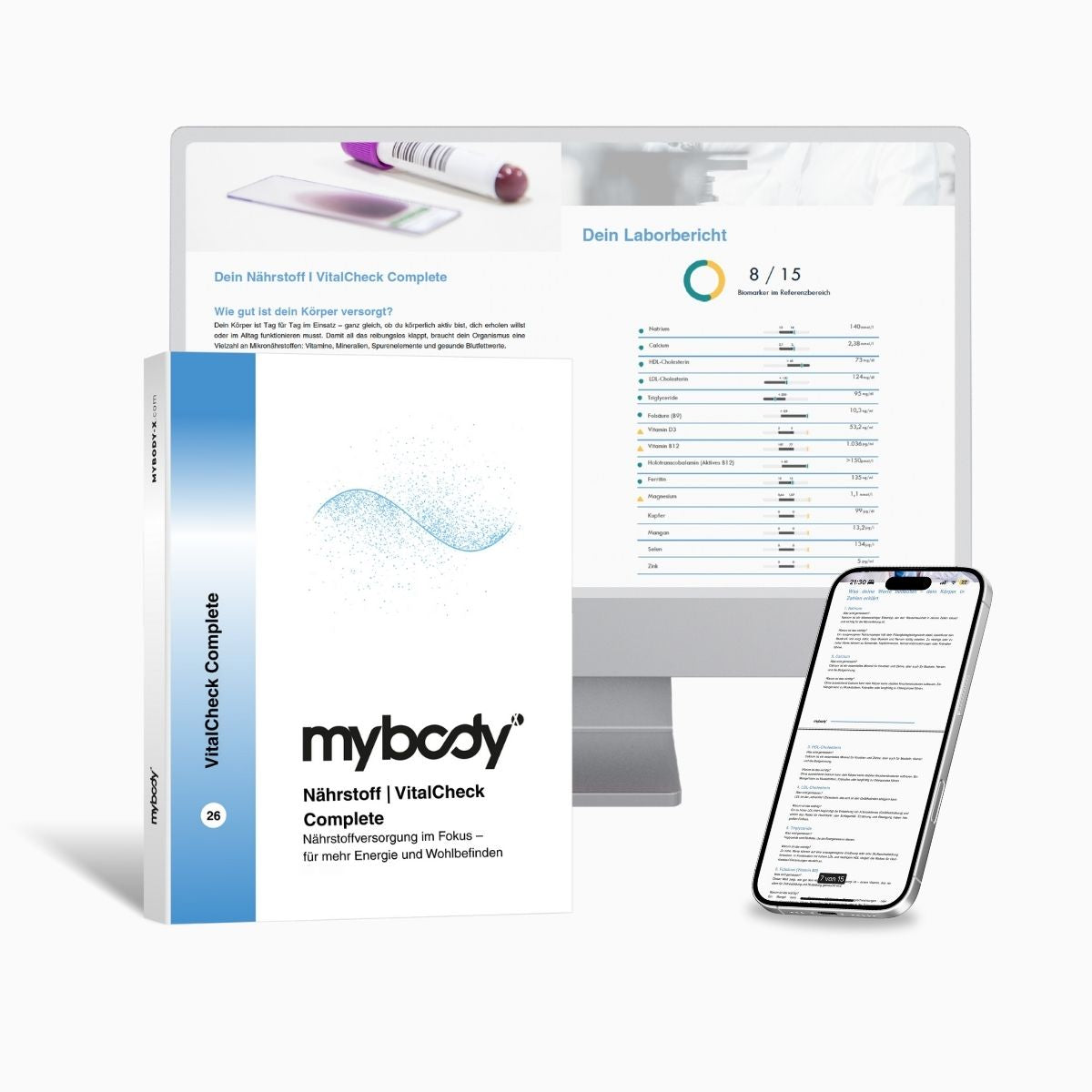
Capillary blood test
VitalCheck | Complete Nutrient & Mineral Test
Measures 18 values from the same sample, including ferritin, iron, transferrin, and CRP, as well as 25-OH vitamin D3, vitamin B12, folate, calcium, magnesium, phosphate, albumin, selenium, zinc, long-term blood sugar, and the cholesterol profile. What the test does not provide: no complete blood count, no diagnosis, no recommendation for a supplement, no dosage, and no substitute for a medical examination.
Laboratory analysis 3–5 business days after sample receipt
Product page information, accessed 18 August 2026
Chapter at a glance
A rapid test checks a threshold and gives you an indication within a few minutes. A laboratory test provides a number with a reference range and the adjacent values that can be used to check for possible inflammation. Neither one provides a diagnosis.
Limitations: what both options leave unanswered
The first limitation is scope. The MSD Manual lists three tests for diagnosis: a complete blood count, serum ferritin measurement, and transferrin saturation (Johnson, as of May 2025). Neither option provides a complete blood count.
The second boundary is inflammation. Ferritin levels in the blood are higher during inflammation, and elevated levels may indicate either iron overload or inflammation (IQWiG, as of March 20, 2025). The rapid test cannot assess this caveat.
The third boundary is interpretation. A disease usually cannot be inferred from a single laboratory value, and 5 percent of people fall outside the reference range even though they are healthy (IQWiG, as of March 20 and April 2, 2025).
The fourth boundary is diagnosis. All the assessments in this article provide context and do not constitute a diagnosis. A diagnosis is made in a medical practice based on several components, and no self-test can anticipate it.
What matters in this decision
If you take away just one thing from this article, let it be this: The two approaches do not compete; they answer different questions.
A rapid test checks within a few minutes whether a value is below a threshold—in the case of the Iron Ferritin Self-Test, 30 ng/ml. A laboratory test provides a numerical value with a reference range and the accompanying values that can be used to assess the inflammation caveat.
The fact that several figures are associated with this value is not a contradiction, but rather reflects the difference between a distribution, a finding, and a decision limit. In both cases, what follows from a result is determined by a medical professional.
Frequently asked questions
What exactly does a ferritin rapid test show?
It checks whether the ferritin level is below or above a specified threshold. The Iron Ferritin Self-Test uses 30 ng/ml and provides the result after approximately 5 to 10 minutes (product page, accessed August 18, 2026). It does not provide a numerical value or make a diagnosis.
Why are several ferritin figures in circulation?
Because they answer different questions. A reference range describes a distribution among healthy people; IQWiG gives a range of 9 to 140 µg/l for women over 18 (as of March 20, 2025). A diagnostic figure describes a finding; the MSD Manual generally gives values below 50 mcg/l for deficiency states (Johnson, as of May 2025). A test threshold describes a decision limit.
Is a rapid test sufficient for further evaluation?
No. The MSD Manual lists three tests to be considered together for diagnosis: a complete blood count, serum ferritin measurement, and transferrin saturation (Johnson, as of May 2025). A rapid test provides one component of this, while interpreting the results together is a medical professional’s task.
Can inflammation change the result?
IQWiG notes that ferritin levels in the blood are higher during inflammation and that elevated levels may indicate either iron overload or inflammation (as of March 20, 2025). A rapid test does not include an inflammation marker and therefore cannot assess this caveat.
When is the laboratory route worthwhile instead of the rapid test?
If you need a number for later comparison or want to see the neighboring values. A strip result cannot be used again in six months, but a dated number can. In both cases, what follows from a result is decided by a medical practice.
Next step
First the direction, then the number
The Iron-Ferritin Self-Test checks a threshold in just a few minutes. VitalCheck provides a number with a reference range and the neighboring values. Neither provides a diagnosis or replaces medical evaluation.
Go to the Iron-Ferritin Self-TestRead more
You might also be interested in
Why two values for the same element answer different questions.
The third value, which reads the other way around.
Sources
- MSD Manual, Professional Edition: Iron Deficiency, Johnson LE (fully reviewed May 2025) – msdmanuals.com
- Institute for Quality and Efficiency in Health Care (IQWiG): Ferritin, as of 20 March 2025 – gesundheitsinformation.de
- IQWiG: Understanding laboratory values correctly, as of 2 April 2025 – gesundheitsinformation.de
The verbatim quotation about ferritin levels in deficiency states and transferrin saturation, as well as the list of the three examinations, are taken from source [1]. The ferritin reference ranges and statements about inflammation are taken from [2]. The explanation of how reference ranges are established, the figures of 95 and 5 percent, and the sentence about being one component of an overall diagnosis are taken from [3]. The threshold of 30 ng/ml, the result time of approximately 5 to 10 minutes, and information about price, values, sample type, and laboratory are taken from mybody®x product pages, accessed on 18 August 2026; the processing times for the laboratory test follow the central requirements for blood tests. All sources were accessed and checked on 18 August 2026.

mybody®x Editorial & Expert Team
Laboratory diagnostics Blood analysis interpretation Nutritional science Nutrigenetics
This article was created by the mybody®x editorial and expert team. The team combines laboratory diagnostics, nutritional science, and the interpretation of blood analyses. The people involved are listed on the authors page.
Published on 18 August 2026 · Last updated on 18 August 2026
The content is intended for general information and does not replace medical advice, diagnosis, or treatment. Reference ranges depend on the laboratory, method, and age—the information on your report is always authoritative.




Share now:
Vitamin D in summer: levels don’t rise automatically
Why blood values respond slowly to changes