

Why blood values respond to changes with a delay
The essentials at a glance
People who make a change and test after four weeks are often disappointed. The reason is rarely the change and almost always the value.
Every laboratory value has its own timeline. Some change within a day, others take months, and one takes years according to the cited source.
You will read a fact check of three common statements, five values compared by response time, the cited source verbatim, three documented time periods, and why how you feel is a poor measure of time here.
What to expect in this article
1. The expectation after a change
2. Three statements in a fact check
3. Why values respond at different speeds
4. Five values and their timelines
5. What a result taken too early shows
6. The documented source
7. The special case of vitamin B12
8. The key point in one sentence
9. What fast-changing values reveal and what they do not
10. Three documented time periods
11. Why how you feel is a poor measure of time
12. For whom a follow-up test makes sense
13. What a capillary blood test can show here
14. Limitations: what this article leaves open
15. What matters about the timeline
Frequently asked questions
Sources
The expectation after a change
The process is almost always the same. Someone changes something, sticks with it for a few weeks, and then has it measured.
The result comes back and looks the same as before. The obvious conclusion is: It had no effect.
This conclusion is not valid for several values, and the reason has nothing to do with the change. It lies in the period that the respective value actually reflects.
This article describes these timelines. It does not claim that a particular change alters particular values, nor does it provide recommendations on diet, exercise, or supplements.
Three statements in a fact check
These three statements come up regularly when a test result returns after a change.
Checked against the evidence
Common
“After four weeks, you should be able to see something.”
Documented
It depends on the value. HbA1c levels reflect glucose control over the past 3 months (MSD Manual, professional edition, as of December 2025). After four weeks, this value essentially still reflects the period before that.
Common
“My value is better, so the change has worked.”
Documented
With values that fluctuate, this is premature. Even in healthy people, total cholesterol levels can vary by 10% and triglycerides by up to 25% within 24 hours (MSD Manual, as of December 2025).
Common
“I can tell for myself whether anything is happening.”
Documented
For some values, years pass between a change and its noticeable effect. Liver stores of vitamin B12 cover physiological needs for 3–5 years when intake is absent (MSD Manual, as of August 2024).
Why values react at different speeds
The difference between a fast-reacting value and a slow-reacting value lies in what the value actually measures.
A value that describes the concentration in the blood at that moment responds over hours. Iron is one example: it can fluctuate considerably over the course of the day and temporarily increases after you have eaten something (IQWiG, as of March 20, 2025).
A value that describes a store responds over weeks to months. IQWiG refers to ferritin as an iron store (as of March 20, 2025), and a store does not fill up overnight.
And a value that averages over a fixed period responds over exactly that period. For HbA1c, that period is three months.
Why an average behaves differently from a measurement
The third group deserves a closer look because it behaves differently from what most people expect.
A three-month average does not jump. If something changes as of today, then after four weeks the value contains about one-third new time and two-thirds old time. So it moves, but in a dampened way.
This leads to an uncomfortable transitional phase. The value has shifted slightly, but not enough to be reliably distinguished from natural variation.
This exact transitional phase is why repeating these values at short intervals rarely provides much additional insight. You are measuring a mixture and do not know which component has changed.
Five values and their timeline
The table organizes five values according to the time period they reflect. It provides context and is not a diagnosis.
| Value | Timeline | What the sources say about it | What an early result shows |
|---|---|---|---|
| Serum iron | Hours | Can fluctuate considerably over the course of the day and temporarily increases after a meal (IQWiG, as of March 20, 2025) | Above all, the conditions under which the sample was taken |
| Cholesterol profile | Days | Total cholesterol can vary by up to 10% and triglycerides by up to 25% within 24 hours in healthy people (MSD Manual, as of December 2025) | A change that can also occur without making any changes |
| Ferritin | Weeks to months | Ferritin is a protein that can bind iron and is referred to as an iron store (IQWiG, as of March 20, 2025) | Usually still reflects the initial state |
| HbA1c | 3 months | Reflects glucose control over the past 3 months (MSD Manual, as of December 2025) | Partly still reflects the period before the change |
| Vitamin B12 | Years | Liver stores cover physiological needs for 3–5 years when intake is absent (MSD Manual, as of August 2024) | Nothing about a change made in recent months |
Several orders of magnitude lie between the first and last lines. Nevertheless, both values often appear on the same test result and carry the same date.
What a test result taken too early shows
A test result taken too early is not wrong. It simply answers a different question from the one asked.
With a slow-changing value, it shows the previous state. It is an accurate measurement of a period that largely does not include the change being assessed.
With a variable value, it shows a change that would have occurred even without any change in routine. If triglycerides vary by up to 25 percent within 24 hours in healthy people, then a difference of this magnitude is not evidence of anything.
Both cases lead to false conclusions, but in opposite directions. One causes a change to be overlooked; the other makes one appear where there is none.
The documented source
The longest documented delay in this field appears in a single sentence and is hard to believe.
Documented source
“The liver’s vitamin B12 stores cover physiological requirements for 3–5 years when vitamin B12 intake is absent.”
MSD Manual, professional edition
Vitamin B12 deficiency, Johnson LE, fully reviewed August 2024
Three to five years is no longer a delay in the usual sense. It is a period during which no one would recognize a connection between cause and effect.
If someone changes something today that affects their intake of this vitamin, a test result one year later will not reliably show it. The body’s stores compensate for the change for that long.
This is also why well-being is a particularly poor indicator for this value. Chapter 11 returns to this point.
The special case of vitamin B12
This value deserves its own chapter because it takes the logic of the entire article to its extreme.
For all other values, the question is how long one has to wait. Here, the question is whether a comparison is possible at all within a manageable period.
The MSD Manual also states the following about this value: An inadequate intake of vitamin B12 is possible in vegans but otherwise unlikely (as of August 2024). Taken together, this gives a clear picture: The value is important in certain situations and unsuitable for assessing short-term changes.
What this means for interpreting a result: A B12 value belongs on a panel because it shows a status. It does not belong in a follow-up assessment over several weeks because it is simply too slow to respond for that.
The core in one sentence
This is where the topic can be brought together.
The change is not slow. The value is what is supposed to reflect it.
This distinction takes away some of the harshness of a test result. An unchanged value after eight weeks says nothing about whether making a change was worthwhile.
It says that eight weeks was too short for this value. That is a statement about the measurement method, not about the person who was measured.
What Fast-Changing Values Reveal—and What They Don’t
One might think of using fast-changing values for a simple check of success. That leads into the other trap.
A value that responds quickly responds to all kinds of things. Iron levels rise temporarily after a meal (IQWiG, as of March 20, 2025), and IQWiG generally notes: Iron levels alone have little significance because they fluctuate considerably over the course of a day.
The same applies to cholesterol. If total cholesterol in healthy people varies by 10 percent within 24 hours, then a 10 percent difference between two test results falls within the range of what happens normally.
Fast-changing values are therefore poorly suited to demonstrating a change. They are well suited to showing where you currently stand, and that is what they are intended for.
Three Documented Timeframes
Three pieces of information from the reviewed sources. They provide context and are not a diagnosis.
Documented Information
24 hours
are sufficient for a variation of 10% in total cholesterol and up to 25% in triglycerides—in healthy people (MSD Manual, professional edition, as of December 2025)
3 months
is the period reflected by HbA1c (MSD Manual, as of December 2025)
3–5 years
the liver’s vitamin B12 stores meet physiological needs when intake is absent (MSD Manual, as of August 2024)
And as with every laboratory value, what matters is the reference range stated on your own test result, because reference values can vary from one laboratory to another (IQWiG, as of April 2, 2025).
Why How You Feel Is a Poor Measure of Time
When a test result comes too early, many people fall back on how they feel. That is also problematic with these timescales.
Over a timescale of three to five years, there is no single moment when something changes. There is a gradual transition, and that transition becomes normal as it takes place.
The same applies in the other direction. If someone makes a change and feels better after three weeks, that does not provide evidence of a laboratory value reflecting a period of months.
This is not an argument against your own experience. It is an argument for not confusing it with a measurement that follows a different timeline.
Who a follow-up result makes sense for
The comparison concerns whether a second result after making a change would be useful to you.
Makes sense for you if …
You have a baseline value and enough time has passed since then for the value in question.
You know which value interests you and understand its time frame.
You want to bring a direction rather than a feeling to a discussion at the doctor’s office.
You have the test performed under conditions similar to those of the first test.
Probably not if …
The change was made only a few weeks ago, while the value reflects several months.
You are looking for proof that something worked. A laboratory value cannot provide that.
You do not have a baseline value. In that case, the second result is just another data point.
You expect a diagnosis. That is provided by a medical practice, not a self-test.
What a capillary blood test can show here
A capillary blood self-test does not provide a diagnosis or prove an effect. What it can do is record dated values so that a later comparison is possible.
VitalCheck from mybody®x (MYBODY Lab GmbH) measures values with very different time frames from the same sample, from HbA1c to vitamin B12. For tracking changes over time, it is important to know which value you are looking at and how much time has passed since the initial result.
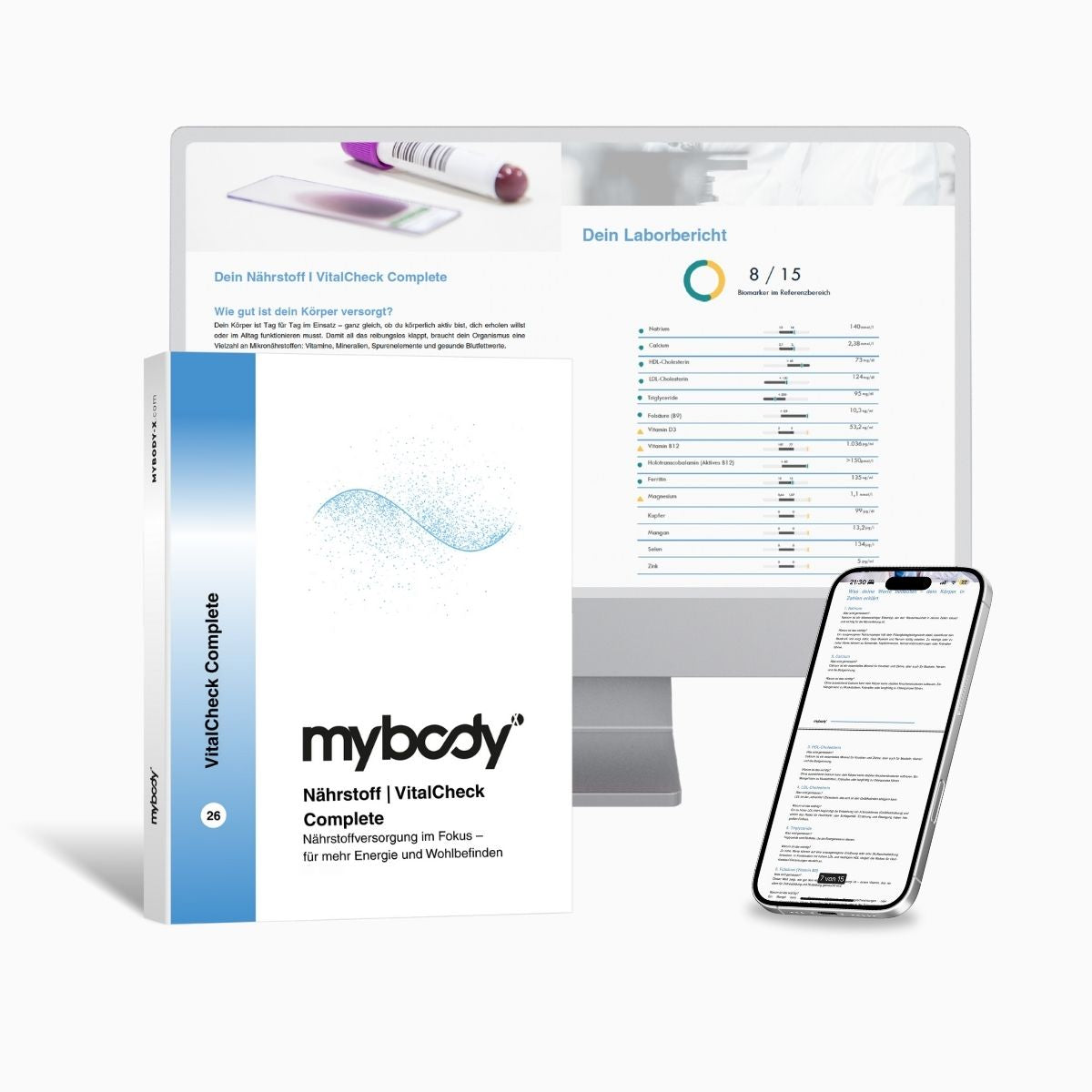
Capillary blood test
VitalCheck | Complete Nutrient & Mineral Test
Measures 18 values from the same sample, including HbA1c, a cholesterol profile, ferritin, iron, transferrin, vitamin B12, folic acid, 25-OH vitamin D3, calcium, magnesium, phosphate, albumin, selenium, zinc, and CRP. What the test does not do: It does not demonstrate the effect of a change, recommend a dietary approach, provide a diagnosis, or replace a medical examination.
Laboratory results within 3–5 business days after sample receipt
Product page information, accessed on 19 August 2026
Chapter at a glance
A capillary blood test records values with very different time frames, all bearing the same date. Whether a later comparison shows anything depends on the value and the time that has elapsed. It does not provide evidence of an effect.
Limitations: what this article leaves open
The first limitation concerns effects. This article says nothing about whether a particular change alters a particular value. It only describes the period represented by a value.
The second limitation is causality. Even if something has changed between two results, neither result shows the reason why. A medical practice can clarify this question.
The third limitation is the values themselves. Each value discussed in this article is subject to the caveats described in the respective individual articles.
The fourth limitation is diagnosis. All the explanations in this article provide context and do not constitute a diagnosis. A diagnosis is made in a medical practice based on several components, and no self-test can anticipate it.
What matters about the time scale
If you take only one thing away from this article, let it be this: An unchanged value after a few weeks is usually a statement about the value, not about you.
The time scales vary widely. The cholesterol profile can already vary noticeably within 24 hours in healthy people, HbA1c reflects three months, and the liver’s vitamin B12 stores cover the body’s needs for three to five years when intake is absent (MSD Manual, as of December 2025 and August 2024, respectively).
Once you know this, you will read a second result differently. Not as a verdict on a change, but as a measurement of a specific period. A medical practice decides what follows from it.
Frequently asked questions
How long does it take for a blood value to change?
That depends entirely on the value. Total cholesterol can vary by up to 10 percent within just 24 hours even in healthy people (MSD Manual, as of December 2025), HbA1c reflects three months (as of December 2025), and the liver’s vitamin B12 stores cover the body’s needs for three to five years (as of August 2024).
My value hasn’t changed after eight weeks. What does that mean?
For a slow-moving value, this initially means that eight weeks was too short a period for that value. HbA1c, for example, still partly reflects the period before that time. A medical practice can interpret what a result means in an individual case.
Can’t I just look at the values that change quickly?
That leads into the other trap. A value that responds quickly responds to many things. The IQWiG notes regarding iron levels that they have little significance on their own, because the levels fluctuate considerably over the course of a day (as of March 20, 2025). A difference between two results may therefore simply reflect the conditions under which the samples were taken.
Why don’t I notice anything myself?
Over long time scales, there is no single moment of change, but rather a gradual transition. For vitamin B12, the liver’s stores cover physiological needs for three to five years when intake is absent (MSD Manual, as of August 2024). On such time scales, how you feel is a late signal.
Does a better result prove that a change has worked?
No. A test report shows a number, not a reason. With fluctuating values, differences may also be within the range of natural variation—for total cholesterol, this can be up to 10 percent within 24 hours (MSD Manual, as of December 2025). Interpretation belongs in a medical practice.
Next step
Set the starting point
VitalCheck measures 18 values from capillary blood, all on the same date. It does not demonstrate effectiveness, recommend any particular diet, provide a diagnosis, or replace medical evaluation.
To VitalCheckRead more
You might also be interested in this
What lower limit can be derived from the timelines.
The slowest-moving value in this article, explained in detail.
Sources
- MSD Manual, Professional Edition: Vitamin B12 Deficiency, Johnson LE (last full review August 2024) – msdmanuals.com
- MSD Manual, Professional Edition: Diabetes Mellitus, Brutsaert EF (as of December 2025) – msdmanuals.com
- MSD Manual, Professional Edition: Dyslipidemia, Davidson MH and Altenburg A (as of December 2025) – msdmanuals.com
- Institute for Quality and Efficiency in Health Care (IQWiG): Iron, as of March 20, 2025 – gesundheitsinformation.de
- IQWiG: Ferritin, as of March 20, 2025 – gesundheitsinformation.de
- IQWiG: Understanding laboratory values correctly, as of April 2, 2025 – gesundheitsinformation.de
The verbatim quotation about vitamin B12 stores and the statement about insufficient intake are taken from source [1]. The information about the three-month period for HbA1c comes from [2]. The figures of 10 and 25 percent variation within 24 hours come from [3]. The statements about fluctuations in iron levels over the course of the day and after a meal come from [4]. The description of ferritin as an iron store comes from [5]. The explanation of the reference range comes from [6]. Information on price, values, sample type, and laboratory comes from the mybody®x product page, accessed on August 19, 2026; processing times follow the central specification for blood tests. All sources were accessed and reviewed on August 19, 2026.

mybody®x Editorial & Expert Team
Laboratory diagnostics Blood analysis interpretation Nutritional science Nutrigenetics
This article was created by mybody®x’s editorial and expert team. The team combines laboratory diagnostics, nutritional science, and the interpretation of blood analyses. Anyone involved is listed on the authors page.
Published on August 19, 2026 · Last updated on August 19, 2026
The content is for general information only and does not replace medical advice, diagnosis, or treatment. Reference ranges depend on the laboratory, method, and age; the information on your test report is always authoritative.




Share now:
The ferritin self-test provides an initial indication.
Before your first blood test: what you should know