

Vitamin D in summer: the level does not rise automatically
The essentials
It is documented that vitamin D levels rise in summer. IQWiG states this explicitly, and this article does not contradict it.
But the season is only one of several conditions. Age, sun protection, skin pigmentation, and time spent outdoors affect production in the skin, and none of them changes with the calendar.
You will read about four conditions compared, the cited source in its original wording, a fact check of three common statements, three documented facts, and a note on why the measurement date belongs on the test report.
What to expect in this article
1. The assumption that falls apart in June
2. What happens in the skin
3. Four conditions compared
4. Why the season is only one factor
5. The documented source
6. What a low value in summer might mean
7. Three statements in a fact check
8. The core point in one sentence
9. Which number appears on the test report
10. Three documented facts
11. Why the date belongs on the test report
12. Who might benefit from testing in summer
13. What a capillary blood test can show here
14. Limitations: what the value leaves unanswered
15. What matters about this value
Frequently asked questions
Sources
The assumption that falls apart in June
Vitamin D is considered a winter issue. It is written about in autumn, measured in spring, and from May onward the question disappears from people’s minds.
The assumption behind it is: Summer takes care of it by itself. Anyone who spends time outdoors has enough, and a result in July would be a mere formality.
There is some truth to this assumption, which is precisely why it persists. IQWiG notes that levels increase again in summer through production in the skin (as of November 15, 2023).
This article does not contradict that. It shows which conditions also matter and why no figure follows from a season alone.
What happens in the skin
The starting point is a distinctive feature of this vitamin. It is the only one that the body produces itself in significant amounts.
IQWiG writes: The body can produce vitamin D itself, with the help of the sun’s UV-B radiation in the skin (as of November 15, 2023). The MSD Manual puts the same thing more technically: Vitamin D3 is synthesized in the skin by sunlight (as of April 2025).
Because production takes place in the skin, it depends on everything between the sun and the skin, as well as anything that changes the skin itself. There are more factors than most people expect.
Regarding the amount, IQWiG gives an order of magnitude: leaving the face, hands, and arms uncovered and without sun protection in the sun for a few minutes about 2 to 3 times per week (as of November 15, 2023). This describes a habit, not a dosage, and this article does not turn it into a recommendation.
Four conditions compared
The table compares four conditions that affect production in the skin. It provides context and is not a diagnosis.
| Condition | What the sources say about this | Does it change in summer? | What follows from this |
|---|---|---|---|
| Season | In autumn and winter, the body cannot produce vitamin D because the sun is only low in the sky (IQWiG, as of November 15, 2023) | Yes, this is the one condition that changes with the calendar | Summer opens up the possibility—it does not determine the level |
| Age | Vitamin D levels may decrease with age because synthesis in the skin declines (MSD Manual, as of April 2025) | No | The same amount of time in the sun does not produce the same result for everyone |
| Sun protection | Using sunscreen reduces the synthesis of vitamin D (MSD Manual, as of April 2025) | Quite the opposite—the body uses more of it in summer | A sensible habit that has an effect of its own on this level |
| Skin pigmentation | Darker skin pigmentation also reduces the synthesis of vitamin D (MSD Manual, as of April 2025) | No | One more reason to know your own level instead of relying on the average |
Three of the four lines do not change with the calendar. The third even moves in the opposite direction in summer.
Why the season is only one of them
The difference between a possibility and an outcome is the whole point here.
In winter, according to the cited source, production is not possible in our latitudes because the sun is too low in the sky. Summer removes this barrier. What happens afterward depends on the remaining conditions.
One way to picture it: Winter is a closed door, and summer is an open one. The open door does not tell you whether someone goes through it or how often.
That is why this article’s claim is narrower than the widely used headline. It does not say that levels remain low in summer. It says that the month alone does not determine a number.
The documented source
The sentence that establishes the direction appears in a public source and is unambiguous.
Documented source
“However, vitamin D blood levels depend on the season: They naturally decrease in winter and increase again in summer as a result of vitamin D production in the skin.”
Institute for Quality and Efficiency in Health Care
IQWiG, gesundheitsinformation.de, Vitamin D deficiency, as of November 15, 2023
This quotation is included here deliberately, even though it contradicts the widely used headline on this topic. We are not arguing against a source, but with it.
What the sentence says: There is a seasonal change, and it goes upward in summer. What it does not say: how far upward, in whom, or from what baseline.
Only a measurement can answer these three questions precisely. And because the change is seasonal, every measurement needs a date.
What a low summer value can mean
Someone who gets tested in July and receives a low result is in a different situation from someone with the same result in February.
In February, an obvious explanation is on the table: The sun has been too low in the sky for months. In July, that explanation falls away, leaving the conditions shown in the table above.
This means that a summer measurement is more informative in substance than a winter measurement, and that is the point this article makes. It measures the level at the time when the season explains it the least.
This article does not say what follows from that. IQWiG states: However, low blood levels alone do not yet constitute vitamin D deficiency (as of November 15, 2023). The interpretation belongs in a medical practice.
Three statements fact-checked
You hear these three statements every year between May and September.
Checked against the available evidence
Commonly heard
“I don't need to get tested in summer.”
Documented
Levels rise in summer; this is documented (IQWiG, as of November 15, 2023). At the same time, age, sunscreen, and dark skin pigmentation reduce synthesis, and none of these conditions changes with the season (MSD Manual, as of April 2025).
Commonly heard
“A low value automatically means a deficiency.”
Documented
IQWiG writes: However, low blood levels alone do not yet constitute vitamin D deficiency (as of November 15, 2023). The same source cites the Robert Koch Institute's threshold below which vitamin D status is considered inadequate: below 12 nanograms per milliliter.
Commonly heard
“Taking it preventively can't hurt.”
Documented
The same source states that taking vitamin D without a specific reason—for example, in the form of dietary supplements—usually has no benefits (as of November 15, 2023).
The core in one sentence
At this point, the topic can be brought together.
Summer removes one possible explanation. That is why a summer measurement tells you more than a winter measurement.
This reverses the common logic. Not because everything is fine in summer, but because less is obscured by the season in summer.
A winter value and a summer value side by side are even more informative because they reveal the seasonal variation described by the source.
Which number appears on the report
A report does not list vitamin D, but a specific form of it—and there is a reason for that.
The MSD Manual describes 25(OH)D as the most important form in the bloodstream and notes that serum levels reflect the body's vitamin D stores and correlate better with symptoms than levels of other vitamin D metabolites (as of April 2025).
That is why the value on a laboratory report is usually called 25-OH vitamin D or 25-OH vitamin D3. It is the value for which comparative reference data are available.
Regarding the target values, the same source states: For maximum bone health, 25(OH)D target values should be above 20 to 24 ng/ml, namely about 50 to 60 nmol/l (as of April 2025). IQWiG cites the Robert Koch Institute's threshold for deficient vitamin D status as below 12 ng/ml (as of 15 November 2023). Both figures are shown here alongside their sources because they answer different questions.
Three documented details
Three details from the reviewed sources. They provide context and do not constitute a diagnosis.
Documented information
< 12 ng/ml
the Robert Koch Institute considers vitamin D status to be deficient (cited by IQWiG, as of 15 November 2023)
20–24 ng/ml
the MSD Manual refers to these as 25(OH)D target values for maximum bone health, namely about 50–60 nmol/l (as of April 2025)
2 seasons
the body cannot produce vitamin D here: In autumn and winter, the sun is only low in the sky (IQWiG, as of 15 November 2023)
The first two figures are far apart and nevertheless do not contradict each other. One marks a lower limit, while the other is a target range for a specific question.
And as with every laboratory value, the reference range given on your own report is decisive, because reference values can vary from one laboratory to another (IQWiG, as of 2 April 2025).
Why the date belongs on the report
For most laboratory values, the date is a formality. For this one, it is part of the result.
If levels naturally decrease in winter and increase again in summer (IQWiG, as of 15 November 2023), then a number without a month is incomplete. The same number means something different in February and August.
This leads to a practical rule for your personal records: Note the month for every vitamin D value, and later compare values from the same season whenever possible.
Anyone with two values from different seasons has not made a mistake. They have an additional comparison that makes the seasonal change visible instead of hiding it.
Who would benefit from a measurement in summer
The comparison concerns whether a measurement during the warmer half of the year would be useful to you.
It makes sense for you if …
So far, you have only had winter values and want a comparison point.
You work indoors a lot or consistently use sun protection.
You want to bring a dated number to a consultation at the practice.
You have been taking something for a while and never had a baseline value measured.
Probably not if …
You expect a single value to prove a deficiency. It does not.
You are looking for a dosing recommendation. This article does not provide one.
You are already undergoing assessment. In that case, follow the practice that started it.
You expect a diagnosis. That is provided by a medical practice, not a self-test.
What a capillary blood test can show here
There are two different ways to obtain this value, and they answer different questions. Neither provides a diagnosis.
The mybody®x self-test (MYBODY Lab GmbH) is a rapid test with results available after a few minutes. The laboratory route provides a value with a reference range and additional values from the same sample.
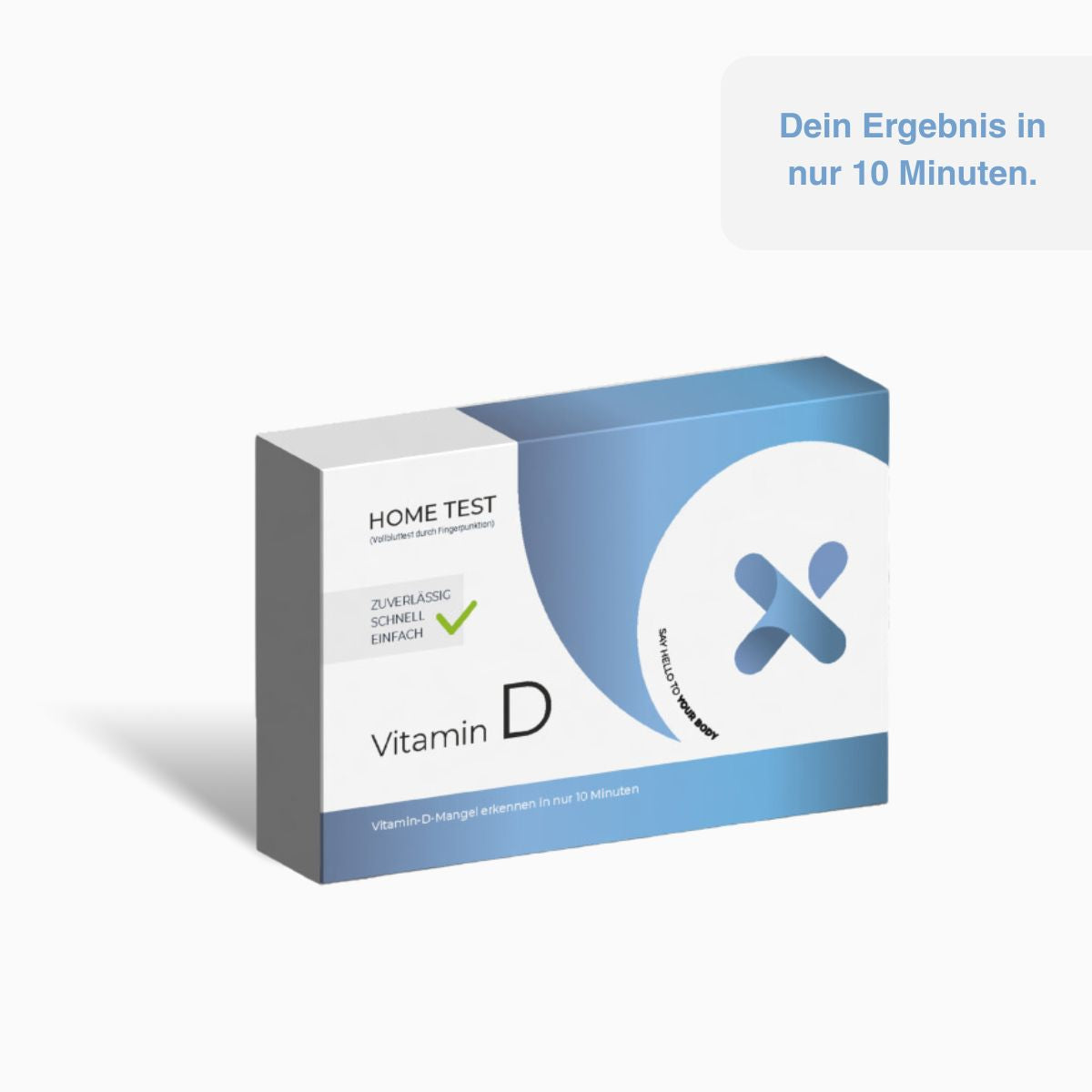
Rapid test for home use
Vitamin D self-test
Measures 25-hydroxyvitamin D from capillary blood via a finger prick, with results after approximately 5 to 10 minutes. What the test does not do: It does not provide a laboratory value with a reference range, a comparison value for later measurements, a diagnosis, or a substitute for a medical examination. The product page does not specify a separate numerical value for the result; the information in the enclosed instructions is authoritative.
Product page information, accessed August 18, 2026
Anyone who wants to view the value in context with other values and compare it later needs the laboratory route.
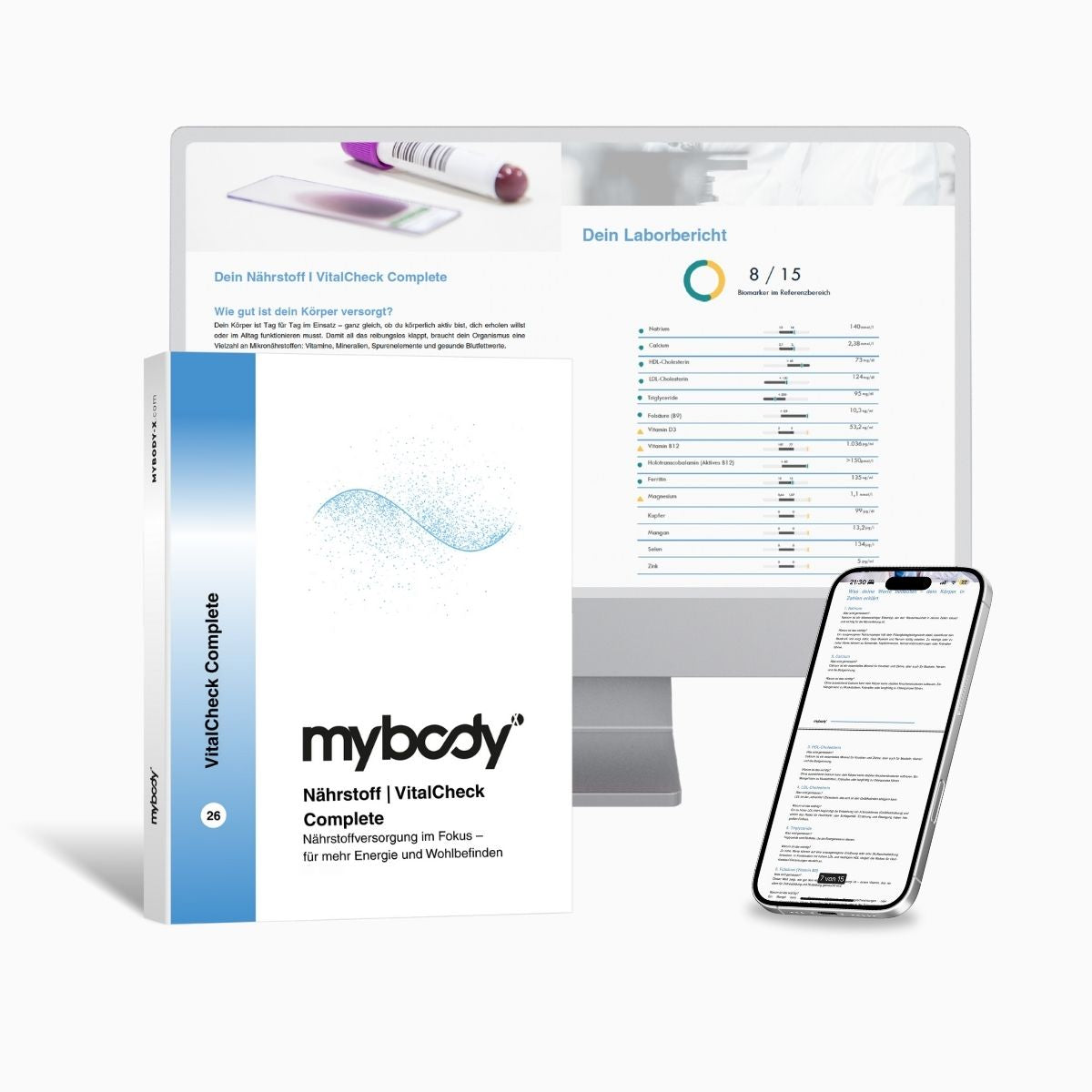
Capillary blood test
VitalCheck | Complete Nutrient & Mineral Test
Measures 18 values from the same sample, including 25-OH vitamin D3, calcium, magnesium, phosphate, albumin, ferritin, iron, transferrin, vitamin B12, folate, selenium, zinc, CRP, long-term blood sugar, as well as total cholesterol, HDL, LDL, and triglycerides. What the test does not do: It does not recommend a supplement, specify a dosage, provide a diagnosis, or replace a medical examination.
Laboratory results in 3–5 business days after sample receipt
Product page information, accessed August 18, 2026
Chapter at a glance
A rapid test provides quick guidance without a laboratory value, while a laboratory test provides a value with a reference range and additional values from the same sample. Neither provides a diagnosis, and both require the date because this value fluctuates seasonally.
Limitations: what the value leaves open
The first limitation is interpretation. IQWiG states: “Low blood levels alone do not constitute a vitamin D deficiency” (as of November 15, 2023).
The second limitation is the cause. A value does not indicate which of the conditions in the table is predominant in your case. Age, sun protection, pigmentation, and time spent outdoors are not shown separately.
The third limitation is the consequence. Whether and what follows from a test result is decided by a medical practice. The same source notes that taking supplements without a specific reason usually offers no benefits (as of November 15, 2023).
The fourth limitation is diagnosis. All the assessments in this article provide context and do not constitute a diagnosis. A diagnosis is made in a medical practice based on several factors, and no self-test can anticipate it.
What matters about this value
If you take away just one thing from this article, let it be this: Summer is a condition, not a guarantee.
The direction is well established. Levels naturally decrease in winter and rise again in summer through production in the skin (IQWiG, as of November 15, 2023). It is also well established that age, sunscreen, and dark skin pigmentation reduce synthesis (MSD Manual, as of April 2025), and none of these three conditions is governed by the calendar.
This leads to something unexpected: A measurement in summer says more than one in winter because the season then explains less. What follows from the number is decided by a medical practice, and according to the cited source, a low level alone does not constitute a deficiency.
Frequently asked questions
Does the vitamin D level rise on its own in summer?
The direction is well established. IQWiG writes that blood levels naturally decrease in winter and rise again in summer through production in the skin (as of November 15, 2023). How much they increase depends on conditions that do not change with the season: age, sunscreen, and skin pigmentation reduce synthesis (MSD Manual, as of April 2025).
At what level is vitamin D status considered inadequate?
IQWiG cites the Robert Koch Institute: Vitamin D status is inadequate when blood levels are below 12 nanograms per milliliter (as of November 15, 2023). However, the same source notes that low blood levels alone do not constitute vitamin D deficiency. The reference range on your own report is always decisive.
Which value is measured in the laboratory?
Usually, 25-OH vitamin D. The MSD Manual describes 25(OH)D as the most important form in the bloodstream and notes that serum levels reflect the body's vitamin D stores and correlate better with symptoms than levels of other vitamin D metabolites (as of April 2025).
Why does the date matter for the vitamin D level?
Because this value fluctuates seasonally. When levels decrease in winter and increase in summer (IQWiG, as of November 15, 2023), the same number means something different in February than in August. For comparisons over time, values from the same season are the most meaningful.
Is taking it worthwhile without a measurement?
The IQWiG states: Taking vitamin D without a specific reason, for example in the form of food supplements, usually offers no benefits (as of 15/11/2023). This article does not recommend for or against a supplement. A medical practice determines what follows from a test report.
Next step
Record the summer value
The VitalCheck measures 18 values from capillary blood, including 25-OH vitamin D3, providing a dated comparison point. It does not recommend a supplement, specify a dosage, make a diagnosis, or replace medical evaluation.
To the VitalCheckRead more
You might also be interested in this
Why three values from one sample do not measure the same thing.
The value shown next to vitamin D on the test report.
Sources
- Institute for Quality and Efficiency in Health Care (IQWiG): Vitamin D deficiency, as of 15/11/2023 – gesundheitsinformation.de
- MSD Manual, professional edition: Vitamin D deficiency and dependency, Johnson LE (fully reviewed August 2024, last updated April 2025) – msdmanuals.com
- IQWiG: Understanding laboratory values correctly, as of 02/04/2025 – gesundheitsinformation.de
The verbatim quotation about the season, the statements about production in the skin and the lack of production in autumn and winter, the information about the face, hands, and arms, the threshold of 12 ng/ml according to the Robert Koch Institute, the statement about low blood levels, and the statement about taking it without a specific reason come from source [1]. The statements about synthesis through sunlight, age, sunscreen, and skin pigmentation, the description of 25(OH)D as the most important form in the bloodstream, and the target values above 20 to 24 ng/ml come from [2]. The explanation of the reference range comes from [3]. Information on price, values, sample type, time to results, and laboratory comes from the mybody®x product pages, accessed on 18/08/2026; the processing times for the laboratory test follow the central guideline for blood tests. All sources were accessed and reviewed on 18/08/2026.

mybody®x editorial & specialist team
Laboratory diagnostics Blood analysis interpretation Nutritional science Nutrigenetics
This article was created by the mybody®x editorial and specialist team. The team combines laboratory diagnostics, nutritional science, and the interpretation of blood analyses. Those who contribute to it are listed on the authors page.
Published on 18/08/2026 · Last updated on 18/08/2026
The content is intended for general information and does not replace medical advice, diagnosis, or treatment. Reference ranges depend on the laboratory, method, and age—the information on your test report is always authoritative.




Share now:
Selenium and zinc: two values with a measurement problem
The ferritin self-test provides an initial indication.