
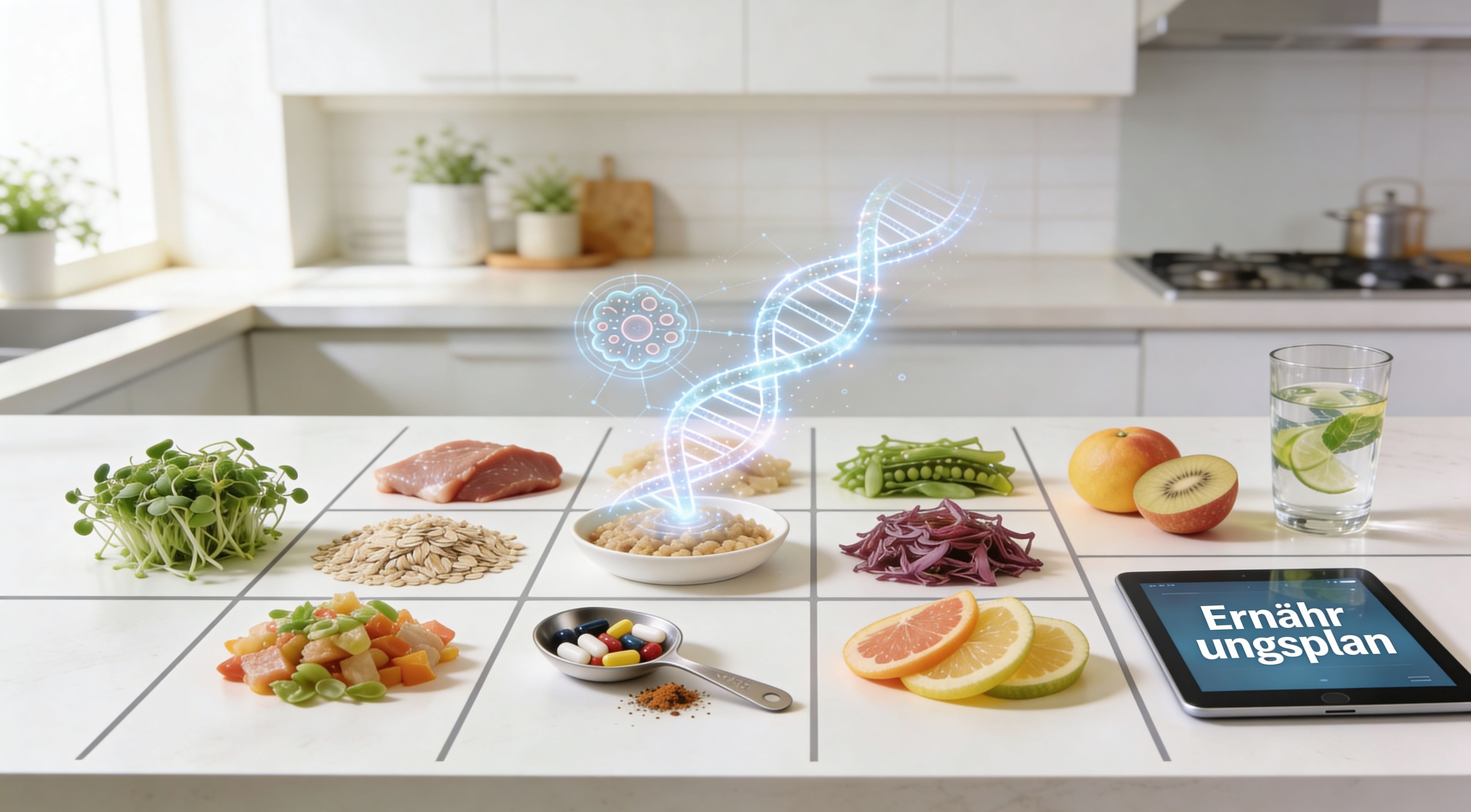
10 personal eating tips for your health
You have already tried countless diets, eat what you believe is healthy, and follow what is widely considered sensible. Yet your energy, digestion, weight, or satiety still fall short of your expectations. That is frustrating, but it is not a sign of a lack of discipline.
The key point is simple. Eating tips only work sustainably when they suit your body. Your DNA influences how you process carbohydrates, fats, and hunger signals. Your microbiome shapes digestion, bloating, and appetite. Blood tests show whether you are lacking something needed for energy, recovery, or hormonal balance.
Your everyday life also plays a role. In Germany, eating habits have changed dramatically. According to Statista's data on the development of per-capita consumption in Germany, per-capita bread consumption fell from about 80 kg in 1900 to around 50 kg in 2021, while consumption of oils and fats rose from 15 kg to more than 40 kg. More choice, greater calorie density, more temptation. That is exactly why blanket rules often achieve little.
If you want to stop guessing, you do not need another fad diet. You need clarity about yourself. That is exactly what the following 10 tips are based on. Direct, practical for everyday life, and clearly linked to data you can measure in your own body.
1. Personalized nutrition based on DNA metabolism tests

You eat the same breakfast as your partner or colleague and are hungry, tired, or bloated again two hours later. This is exactly where personalized nutrition becomes useful. A DNA metabolism test does not predict the future and does not replace blood tests. It gives you a reliable starting point for understanding how your body tends to process carbohydrates, fats, satiety, and energy utilization.
That is the difference between guessing and making targeted adjustments. In the end, nutrigenetics simply means using genetic clues to better tailor meals to your metabolism. Not complicated, just practical.
Because our nutritional environment has changed so much, standard rules are often no longer enough. Anyone who constantly alternates between cravings, energy slumps, and changing diet approaches needs data about their own body—not yet another general list of things to avoid.
How to use a DNA test effectively
A test is only useful if you derive clear decisions from the result. So don't look only at individual gene variants. What matters is what you change on your plate starting tomorrow.
How to proceed:
- Have a basic profile created: Check whether your body reacts more sensitively to carbohydrates, fat utilization, or satiety signals.
- Translate the result into meals: If your profile indicates weaker satiety, you need structured, predictable meals instead of spontaneous snacking.
- Track measurable responses: For 2 to 3 weeks, record your hunger, energy, digestion, and concentration after eating.
- Combine the data with blood values and the microbiome later: Only when considered together do they produce a truly personalized nutrition plan.
For example: If your DNA profile indicates less favorable carbohydrate processing, a sweet breakfast of juice, muesli, and bread is often not a good idea for you. In that case, starting with eggs, skyr, nuts, or a savory whole-grain breakfast usually works better because your blood sugar stays steadier and your appetite is less likely to spiral later.
Clear rule: Don’t use DNA data as a label, but as a decision-making aid. If your test fits your eating routine, meals become more predictable, satiety more reliable, and mistakes easier to avoid.
That is precisely where the value of such tests lies. You don’t get a rigid diet plan for everyone, but an initial personalized measurement. And that is often the moment when nutrition finally starts to make sense.
2. Optimal protein timing and amount based on genetics
Many people either eat too little protein or pack almost all of it into a single meal in the evening. Both are impractical. It makes more sense to spread protein throughout the day so that you stay fuller, support your muscles better, and are less likely to resort to snack-like alternatives.
If your DNA profile suggests more difficult satiety regulation or a greater need for stable meals, protein becomes even more important. This does not affect athletes only. When losing weight, too, a well-planned protein framework helps you because it makes decisions easier.
What a good protein day looks like
Don’t think about grams first. Think about meal structure. Every main meal should have a clear protein source. This could be quark, eggs, yogurt, tofu, fish, legumes, or a combination of these.
An everyday example:
- Breakfast with skyr, oats, and nuts
- Lunch with lentils, vegetables, and whole grains
- Snack with cottage cheese or unsweetened yogurt
- Dinner with fish, tofu, or eggs plus vegetables
How to tell that it works for you
You feel calmer between meals. Your appetite becomes more predictable. After training, you feel more stable and not depleted. Signals like these are often more valuable than rigid calorie counting.
Distribute protein consciously throughout the day. Your body benefits more from a clear structure than from a large late protein load.
If you do strength training, you can adjust the amount more precisely. If your focus is on weight management, protein primarily helps as a tool against cravings and uncontrolled eating.
3. Microbiome-optimized nutrition for gut health and weight management

If your stomach often feels tight, your digestion is irregular, or you are constantly hungry despite eating healthily, it is worth looking at your microbiome. Your gut bacteria influence how well you tolerate fiber, how full you feel, and how stable your digestion is.
The major shift in eating habits in Germany provides the background for this. According to the previously mentioned Statista dataset, fruit and vegetable consumption rose from under 50 kg to over 120 kg per year. More plant diversity is beneficial. At the same time, processed products dominate many people’s everyday diets, which can make it harder to maintain gut balance. A microbiome test helps you avoid simply eating more fiber blindly and instead choose the right kinds.
What usually helps your gut
Many people tolerate fiber poorly because they change too much too quickly. Proceed gradually. Increase plant-based foods slowly and observe how your stomach reacts.
Often helpful:
- Variety instead of monotony: Regularly rotate vegetables, legumes, herbs, nuts, and seeds.
- Use fermented foods consciously: Sauerkraut, kefir, tempeh, or miso can be beneficial if you tolerate them well.
- Include resistant starch: Cooked and cooled potatoes or rice may work well for some people.
- Check sugar and highly processed foods: Not dogmatically, but honestly. Many people quickly notice what upsets their stomach.
A realistic example
Someone may appear to eat healthily but almost always eat the same foods. Plenty of bread, a little salad, and fruit bars in between. Only an analysis reveals that more genuine plant diversity and better-chosen fibers would be beneficial. After that, a nervous stomach can become more reliable digestion.
The rule here is simple: not every healthy ingredient is automatically right for you. Good gut-friendly eating tips are always individual.
4. Nutrient-targeted supplementation based on deficiency tests
Supplements are not a substitute for good food. But a genuine deficiency cannot be fixed with a smoothie and a few almonds. If you are often tired, recover poorly, or have vague symptoms despite eating well, you need clarity instead of guesswork.
This is where blood tests make the difference. They show whether you really need support and what you should focus on. This saves money, avoids unnecessary products, and brings structure to your health routine.
Measure first, then supplement
The most important rule is simple. Don't indiscriminately take everything that is currently being marketed as beneficial. Test first. Then supplement selectively.
Pay attention to this order:
- Identify the gap: Have relevant nutrients tested if your symptoms or dietary pattern suggest it.
- Choose the right supplement: Not every form is equally well tolerated or practical.
- Take it appropriately: Some nutrients work better with meals, while others do not.
- Monitor the progress: Without follow-up testing, it remains unclear whether your strategy is working.
Why this is particularly important when changing your diet
Anyone who eats fewer animal products should not leave their nutrient status to chance. According to market data from the German Environment Agency on the nutrition sector, meat consumption in Germany fell by around 14 percent between 2018 and 2023 to 51.6 kg per person per year, but remains well above the German Nutrition Society's recommendation of around 15 kg per person per year. Eating less meat can make sense. At the same time, this makes it more important for some people to take a careful look at iron, B12, and other critical nutrients.
A good example is someone who starts eating more consciously plant-based but suddenly feels low on energy. The problem is not the dietary approach itself, but the lack of control over nutrient intake.
5. Intermittent fasting optimized through chronotype and genetics

Intermittent fasting can be helpful. But it can also create completely unnecessary stress if you choose the wrong window. If you are not hungry in the morning, having your first meal later may work well. If you tend to binge in the evening, that is often exactly the wrong strategy.
That is why you should not view fasting as a rigid system. Your sleep schedule, working hours, training, and sense of hunger determine whether it helps or harms you.
How to find the right eating window for you
Don't start with extremes. A moderate window is usually better in everyday life than a hard cut that you give up after a few days.
In practice, this means:
- Choose a calm starting window: For example, have breakfast later or eat dinner earlier.
- Monitor your performance: Do you stay focused, or do you become irritable and restless?
- Include a plan for training: An eating window should not sabotage your recovery.
- Do not use fasting as an excuse: The quality of your meals remains crucial.
A good fasting model makes your day easier. If you can think of nothing but food, it is not right for you.
Here is an everyday example. A person with an office job manages well without breakfast but loses all control in the evening. In that case, it is often wiser to set the eating window earlier and not move the largest meal to late evening.
6. Anti-inflammatory nutrition based on allergy and intolerance testing
Some symptoms may seem nonspecific but are very relevant in everyday life. Bloating after eating, pressure in the head, skin reactions, fatigue, or the feeling that meals burden you more than they nourish you. In that case, it is worth looking at actual triggers.
The key is not to keep eliminating more and more foods based on suspicion. If you avoid gluten, dairy, histamine, sugar, and legumes all at once without a plan, you can quickly end up with a diet that is unnecessarily complicated and one-sided.
How to proceed systematically
Tests and a symptom diary are the most useful combination here. The analysis provides direction. Your everyday life confirms what is truly relevant.
This approach is helpful:
- One trigger at a time: Do not eliminate everything at once.
- Record symptoms in writing: Digestion, skin, sleep, energy, headaches.
- Reintroduce foods systematically: This is the only way to identify what you actually do not tolerate well.
- Replace directly instead of simply banning: If cow’s milk causes problems, plan an alternative.
Why this also helps with weight loss
An inflamed or constantly irritated digestive tract makes healthy routines difficult. After eating, you feel heavy, unsatisfied, or bloated, and are then more likely to reach for readily available foods. When you reduce triggers, healthy eating often becomes noticeably easier.
A realistic example is someone who constantly feels tired after lunch and has a bloated stomach. After a targeted assessment, their diet does not become more restrictive, but simpler. Fewer symptoms, greater stability.
7. Hormone-synchronized nutrition for the menstrual cycle, menopause, and andropause
If you eat the same way all the time even though your body changes over the course of the month or with age, you are often working against yourself. Hormones affect hunger, water retention, sleep, mood, and how you feel during training. This applies to women with menstrual cycles as well as people going through menopause or andropause.
That’s why the same eating tips are not equally useful at every stage of life. On some days, you need more structure and satiety. On others, digestive comfort or recovery is more important.
Adjust your diet according to your phase
Women often benefit from tracking their cycle and diet in parallel. If you have more appetite during the second half of your cycle, do not interpret that as a lack of willpower. Instead, deliberately plan more filling meals rather than eating too little during the day and overeating in the evening.
Useful adjustments include:
- Eat more fiber and vegetables: Especially when you feel sluggish or bloated.
- Keep targeted minerals in mind: Magnesium, zinc, or vitamin D may be relevant depending on the situation.
- Bring more calm to your eating rhythm: Regular meals often help more than extreme restriction.
- Keep protein intake consistent: This is particularly helpful for satiety and muscle maintenance during hormonal changes.
A real-life example
A woman eats disciplinedly during the week but regularly loses control shortly before her period. The problem is not motivation but a failure to adapt to her needs. As soon as she eats somewhat more generously and strategically during this phase, her cycle no longer becomes an adversary in her nutrition.
The same principle applies during menopause or andropause. Here, data from hormone and nutrient tests can help you adjust your diet and lifestyle more calmly and purposefully.
8. Antioxidant- and phytonutrient-optimized nutrition for longevity
Longevity sounds like a big goal, but it starts small. What you put on your plate every day affects how well your body handles oxidative stress, inflammatory triggers, and the need for regeneration. You do not need an exotic miracle strategy for this, but rather more color variety and more deliberate choices.
This is especially useful if your DNA indicates greater sensitivity to inflammatory processes or stress responses. In that case, plant compounds are not just a nice side dish but a targeted lever.
Create a colorful default
Many people always eat the same three vegetables. That is better than nothing, but it leaves potential untapped. The more colorful and varied your diet, the broader the range of phytonutrients.
This is easy to incorporate into everyday life:
- Regularly include berries or other colorful fruit
- Choose dark green vegetables more often
- Use spices such as ginger, cinnamon, or turmeric
- Rotate nuts, herbs, and legumes instead of always eating the same ones
Eat in a way that makes your plate look like real food. Color variety is a simple form of prevention.
A typical example is someone who keeps their calorie intake under control but eats almost exclusively beige foods. As soon as more vegetable colors, herbs, and plant diversity are added, it often changes not only nutrient density but also the feeling of satiety.
9. Sports nutrition optimized through DNA and training-type analysis
Your training deserves appropriate nutrition. People who do strength training but eat chaotically during the day hinder recovery and body composition. Those who do a lot of endurance training and avoid carbohydrates indiscriminately often feel drained and unfocused.
A DNA-based look at your training type can help you set priorities more effectively. Some people respond more strongly to strength training, while others respond more strongly to endurance training. In practice, this does not mean you should do only one discipline. It means your nutrition plan should support your profile.
What you should consider around your training
The basic idea is simple. Before and after exertion, your body needs clear signals. It is not about perfection, but about timing and consistency.
Important levers include:
- Eat light, easily digestible food before training
- Plan protein and suitable carbohydrates after training
- Do not forget to stay hydrated
- Do not completely abandon structure on rest days
Eating out is often a stumbling block for active people
Especially when you train and have little time, it is easy to make spontaneous restaurant or to-go choices. This is not trivial. According to restaurant statistics and dining trends in 2024, 45 percent of guests eat out several times a week, while another 20 percent do so once a week. At the same time, it is noted in this context that meals eaten away from home can often be higher in energy. For training, weight management, and recovery, making smart choices in advance is therefore crucial.
A good example is the after-work athlete who ends up hungry at a snack bar after training. With a prepared snack or a few clear standard meals, you can avoid this exact gap.
10. Digital support, behavioral coaching, and multi-parameter tracking
Knowledge alone changes little. Implementation changes things. That is why many people do not fail because of a lack of information, but because they lack feedback. Digital support, a food diary, or coaching can help you recognize patterns instead of improvising anew every day.
This becomes especially powerful when you combine multiple data sources. DNA shows predisposition. The microbiome shows digestive patterns. Blood values show nutritional status. Your daily life shows what you can actually sustain.
Track what moves you forward
You do not need to measure every little thing. But a few metrics and observations can quickly bring structure to vague health goals.
Things worth tracking include:
- Satiety after meals
- Energy throughout the day
- Digestion and gut comfort
- Sleep quality
- Training performance and recovery
Costs can also influence your behavior
Nutrition is not just biology; it is also about daily life and budget. According to YouGov, regarding the reduction of VAT in the hospitality sector and ongoing price pressures, 72 percent of respondents still consider eating out too expensive. This can even be an advantage if you use the situation to your benefit and cook for yourself more often. With a personalized recipe approach, home cooking becomes easier, more predictable, and often more clearly manageable from a health perspective.
A realistic scenario. You cook three standard dishes during the week that fit your DNA results and daily routine instead of spontaneously ordering every evening. That is exactly how lasting progress is made.
10-point comparison: Personalized food tips
| Method | Implementation complexity 🔄 | Resource requirements ⚡ | Expected effectiveness ⭐ | Ideal use cases 💡 | Main benefits 📊 |
|---|---|---|---|---|---|
| Personalized nutrition based on DNA metabolism tests | 🔄 Medium–high (sample collection, bioinformatics, expert interpretation) | ⚡ Medium (test kit, laboratory, nutritional counseling) | ⭐ High for macro adjustments; moderate for the end result (lifestyle influence) | 💡 People with repeated dieting failures or a desire for precision | 📊 Targeted macro strategies, better adherence |
| Optimal protein timing & quantity based on genetics | 🔄 Medium (DNA analysis + meal planning) | ⚡ Low–medium (protein sources, consultation) | ⭐ High for satiety and muscle gain in people who train | 💡 Athletes, body composition goals, older people | 📊 Greater muscle retention, less hunger, better recovery |
| Microbiome-optimized nutrition for gut health & weight | 🔄 High (stool analysis, complex interpretation, long-term adjustments) | ⚡ Medium–high (sequencing, pre/probiotics, time) | ⭐ Medium–high for digestion & weight change; effects are delayed | 💡 Chronic digestive problems, recurring bloating, long-term modulation | 📊 Increased diversity, reduced inflammation, better micronutrient production |
| Nutrient-targeted supplementation based on deficiency tests | 🔄 Medium (blood tests, dosage planning, monitoring) | ⚡ Medium (laboratory costs, targeted supplements) | ⭐ High when a deficiency has been confirmed; rapid symptomatic improvement | 💡 Vegetarians/vegans, older people, clinical signs of deficiency | 📊 Avoiding unnecessary supplements, measurable improvements |
| Intermittent fasting optimized through chronotype & genetics | 🔄 Medium (chronotype analysis, behavioral training) | ⚡ Low–medium (tracking, possibly hormone tests) | ⭐ Moderate–high for weight & insulin; highly individual | 💡 People with flexible daily schedules or metabolic issues | 📊 Better insulin sensitivity, less meal planning, autophagy effects |
| Anti-inflammatory nutrition based on allergy/intolerance tests | 🔄 Moderate (IgE/IgG/histamine tests, elimination diet) | ⚡ Moderate (laboratory tests, replacement foods) | ⭐ High for acute symptom reduction (bloating, pain) | 💡 People with digestive issues or inflammatory symptoms | 📊 Rapid symptom reduction, often faster weight loss due to reduced water retention |
| Hormone-synchronized nutrition (cycle, menopause, andropause) | 🔄 High (time-dependent testing, professional interpretation) | ⚡ Moderate–high (hormone tests, tracking, specialized advice) | ⭐ Moderate–high for cycle-dependent optimization, particularly effective for women | 💡 Women with cycle problems, menopause, men with testosterone loss | 📊 Better cycle symptom control, optimized training/recovery |
| Antioxidant-/phytonutrient-optimized nutrition for longevity | 🔄 High (genetics + biomarkers, long-term intervention) | ⚡ Moderate–high (tests, high-quality foods, time) | ⭐ Potentially high in the long term; barely visible in the short term | 💡 People with a family history of risk or an interest in prevention/longevity | 📊 Prevention of chronic diseases, improved cell function over the years |
| Sports nutrition optimized through DNA & training type | 🔄 Moderate–high (genetics + performance diagnostics, trainer integration) | ⚡ Moderate–high (tests, coaching, supplements if needed) | ⭐ High for performance adaptation and targeted training management | 💡 Athletes, ambitious amateur athletes, high-performance sports programs | 📊 Faster performance gains, better periodization, injury prevention |
| Digital support, behavioral coaching & multi-parameter tracking | 🔄 Moderate (platform integration, coaching workflows) | ⚡ Moderate (app, coach, data storage) | ⭐ High for adherence and long-term success | 💡 Users with complex profiles (multi-omics) or a need for support | 📊 Higher compliance, faster iteration, and measurable progress |
Your individual nutrition plan The first step is the easiest
You quickly see what matters. Good eating tips are not a collection of pretty rules from the internet. They work when they fit your biology, your everyday life, and your goals. That is exactly why generic diets fail to get so many people to their goal.
Your body has been sending you signals for a long time. Cravings for specific meals. Fatigue after lunch. A bloated stomach despite eating healthily. Stagnation in weight loss even though you are making an effort. The question is not whether your body is reacting. The question is whether you are interpreting these reactions correctly.
With DNA data, microbiome information, and meaningful blood values, you get a much clearer foundation. Then it is no longer about guesswork but about decisions. More protein or not. A bigger breakfast or a smaller one. More fiber or a gradual increase first. Dairy products tolerated well or rather problematic. Answers like these make nutrition practical.
A sensible starting point is a DNA test for nutrition, especially if you have already tried many things and finally want to understand why some approaches work for you and others do not. The DNA test for nutrition with a personalized cookbook and recipe book is exactly suited to this point. It combines genetic analysis with concrete recipe and cooking ideas, turning analysis into everyday practice.
That is the real advantage of personalized nutrition. You do not have to become more perfect. You have to eat in a way that suits you better. When your plan fits you, the mental effort decreases. Grocery shopping becomes easier. Cooking becomes clearer. Decisions on the go become calmer.
Prevention also benefits from this. If you recognize earlier what your body needs more of or has difficulty processing, you can manage your diet more purposefully. This affects weight, energy, digestion, performance, and, in the long term, healthy aging as well. In this sense, personalized nutrition is not a fad. It is a pragmatic way to make health tangible.
It is also interesting to consider how much good data and clear processes can improve decision-making. The study on accelerating digital business processes shows, independently of nutrition, how valuable structured information is for better workflows. The same principle applies to your health.
If you want to get started, just do it. Don’t start with ten changes at once. Start with one reliable building block. Understand your body better and build your personal nutrition plan around it. MYBODY Lab GmbH is a relevant option if you want to approach nutrition based on data and from home.
If you no longer want to base your diet on guesswork but on real body data, take a look at the analyses from MYBODY Lab GmbH. The DNA test for nutrition, in particular, with its personalized cookbook and recipe book, can help you turn general food tips into a plan that fits your everyday life.



Share now:
L-Glutamine for Leaky Gut: Science & Effects 2026
DNA analysis costs: what you’re paying for when the sample remains the same