

Vitamin D foods: why the sun provides most of it
The essentials at a glance
With vitamin D, diet is secondary. With regular time spent outdoors, the body's own production in the skin contributes 80 to 90 percent of the supply. According to the DGE, food provides only 2 to 4 micrograms per day, while the estimated value is 20 micrograms when the body produces none of its own.
This article nevertheless lists foods with figures because, during the darker half of the year, they provide the only contribution through food. But it also clearly explains where that contribution ends—and that point comes much earlier than most lists suggest.
You will first read the figures on the supply situation, followed by an explanation of sunlight and diet, the question of supplementation, the table showing vitamin D content, and the limitations of self-testing. At the end, you will learn what changes between October and March.
What to expect in this article
1. How well Germany is supplied with vitamin D
2. Why the skin provides most of it
3. How much vitamin D you need per day
4. What changes between October and March
5. When symptoms belong in a doctor's office
6. Who is recommended to take a supplement
7. Why more can actually be harmful here
8. What a day rich in vitamin D looks like
9. Which foods provide how much vitamin D
10. How to find out where your level stands
11. Limitations: what a test cannot do
12. What you can change starting tomorrow
Frequently asked questions
Sources
How well Germany is supplied with vitamin D
Before looking at foods, it is worth examining the starting point. The Robert Koch Institute surveyed the vitamin D status of the adult population, and the result puts the entire discussion into perspective.
Vitamin D status of adults in Germany
30,2 %
inadequately supplied—women 29.7%, men 30.8%
38,4 %
adequately supplied—women 38.6%, men 38.3%
2 to 4 µg
provided by the diet on average per day—based on an estimated value of 20 µg
Sources: Robert Koch Institute, “Vitamin D Status in Germany,” Journal of Health Monitoring 2/2016; German Nutrition Society, 2025
What these figures mean—and what they do not
Around thirty percent with inadequate intake sounds dramatic and is often presented that way. However, the RKI also notes that vitamin D status varies considerably by season (2016). A measurement in February and one in July describe the same person differently.
The RKI also found a connection with socioeconomic status: people with low status were significantly more likely to have an inadequate intake (2016). This indicates how strongly living conditions play a role here, not just the diet.
Key takeaway
Vitamin D is the only nutrient in this series for which diet is not the main lever. Anyone who reads the list of foods and acts on it has addressed the smaller part of the issue.
Why the figures are so often exaggerated
Thirty percent deficient and around thirty-eight percent adequately supplied means that a third group lies between them, neither one nor the other. Anyone who cites only the first figure leaves out two-thirds of the survey.
The timing also matters. The figures come from a survey conducted throughout the year, and levels fluctuate seasonally. Some of the measurements classified as deficient therefore belong to the winter half of the year, when endogenous production is not occurring anyway.
This does not invalidate the figure. It simply means that it describes a snapshot of a population, not a statement about an individual person in August.
Why the skin provides most of it
This point determines everything that follows, and it appears in a single sentence from the DGE.
Documented source
“With regular time spent outdoors, under the living conditions customary in this country, the body’s own (endogenous) production in the skin contributes 80 to 90 percent to the supply of vitamin D.”
German Nutrition Society (DGE)
Frequently asked questions about vitamin D, as of September 30, 2025
The DGE explains this elsewhere in terms of food: Dietary intake is low because only a few foods contain vitamin D, especially fatty fish, eggs, and some edible mushrooms.
IQWiG quantifies how little sun is needed for this. Sufficient vitamin D is produced when, for example, the face, hands, and arms are exposed without covering or sunscreen about two to three times per week (2023).
Why this is not a call to sunbathe
Two to three times per week for the face, hands, and arms is a brief description, not a recommendation for prolonged sunbathing. Commuting to work, a lunch break outdoors, and a walk cover this during the summer half of the year.
People who remain indoors for work, avoid the sun for health reasons, or dress in clothing that covers their skin for cultural reasons do not have access to this route. For these groups, the question carries significantly more weight.
What this means for the question of food
If the skin contributes four-fifths to nine-tenths, then every change on the plate affects the small remainder. This is not a call to leave out fish, but a question of order.
Anyone who wants to do something during the winter half of the year can make only limited progress through their diet. Anyone who wants to do something during the summer half of the year usually does not need to change their diet at all, but simply needs to go outside regularly.
How much vitamin D you need per day
The DGE provides an estimated value for vitamin D, and this value has an unusual condition: it explicitly applies when no endogenous production takes place.
It is 20 micrograms per day for everyone aged one year and older, including pregnant and breastfeeding women and older adults. For infants up to twelve months, it is 10 micrograms. Converted, 20 micrograms equals 800 international units, because one microgram equals 40 units (DGE, basis of calculation as of 2012).
Why the gap between 4 and 20 is not a warning sign
According to the DGE, only 2 to 4 micrograms per day come from the diet (2025). Compared with an estimated value of 20, that looks like a huge gap, and this is precisely the calculation used to sell a great deal.
However, the estimated value applies in the absence of endogenous production. Anyone who regularly spends time outdoors obtains the remaining 80 to 90 percent through the skin. The gap is therefore real in mathematical terms and practically relevant only for part of the year and for people whose endogenous production is unavailable.
Why getting 20 micrograms from food alone is unrealistic
A look at the table below makes this tangible. To obtain 20 micrograms from food alone, you would need around 125 grams of salmon every day, or a corresponding amount of herring. Every day, all year round.
The DGE recommends one or two fish meals per week, not seven. The estimated value is therefore not intended as a shopping list; it describes the requirement in the event that skin production is unavailable.
That is precisely why the question shifts away from the meal plan for this nutrient. Anyone who wants to change something in winter should not change lunch, but clarify whether they belong to the groups for whom supplementation is intended.
What changes between October and March
The DGE is unequivocal on this point: Unlike in the summer months, the sunlight in Germany from October to March is not strong enough to ensure sufficient vitamin D production (2025).
IQWiG puts it even more succinctly: In Germany and other northern European countries, the body cannot produce vitamin D in winter (2023). Both statements concern a period of six months.
What the body lives on during this period
Vitamin D is fat-soluble and stored in the body. What is produced in summer therefore carries over to some extent into the darker half of the year. This is precisely what explains the seasonal fluctuations described by the RKI.
The consequence for the meal plan is simple. The foods in the table below are an extra source in summer. In winter, they are the only contribution that comes through food, and they remain small even then.
Why storage shifts the calculation
Vitamin D therefore behaves similarly to vitamin B12: both are stored, and both only provide feedback at a late stage as a result. The difference lies in the timescale. With B12, we are talking about years; with vitamin D, it is the months between two summers.
In practical terms, this means that the lowest level of the year typically occurs at the end of winter and the highest at the end of summer. Anyone who has measurements taken twice should therefore know which season they were taken in; otherwise, they are comparing apples and oranges.
When symptoms belong in a doctor’s office
These points should be medically evaluated
Chronic intestinal, kidney, or liver disease
IQWiG explicitly lists these groups as candidates for targeted supplementation (2023)
Nursing home residents or people who spend little time outdoors on a long-term basis
also mentioned by IQWiG because the body’s own production is largely absent there
People with dark skin types in northern latitudes
the IQWiG also identifies this group as one for whom supplementation may be considered
Infants in the first months of life
this group has its own supplementation requirement during the first 12 to 18 months, under medical supervision
Long-term use of high doses without monitoring
with this vitamin, too much is a risk in its own right; see Chapter 7
This list is not a diagnostic checklist. It identifies the points at which the question of vitamin D can no longer be answered through diet or a self-test alone.
Who is recommended to take a supplement
The DGE formulates a condition, not a general recommendation. It recommends taking a supplement only if targeted improvement of vitamin D status cannot be achieved through either diet or the body’s own production (2025).
Worth checking if …
you belong to one of the groups from Chapter 5 for whom IQWiG expressly mentions supplementation.
you spend almost no time outdoors during the winter half of the year and also get little sunlight in summer.
you want to know your level before taking anything. The test comes before the supplement.
Probably not if …
you regularly spend time outdoors during the summer half of the year. In that case, the DGE condition does not apply because the body’s own production is active.
you want to take high-dose supplements without monitoring. There is a documented upper limit for this vitamin; see the next chapter.
you hope it will improve symptoms for which no connection with your level has been shown.
Why more can actually be harmful here
For most nutrients in this series, too much is mainly expensive. With vitamin D, it is different because it is stored and not simply excreted.
The DGE specifies a tolerable total intake of 100 micrograms per day from age eleven onward and 50 micrograms for children up to age ten. For a sustained intake of more than 100 micrograms per day, it cites the formation of kidney stones or kidney calcification (2025).
IQWiG arrives at the same upper limit of 100 micrograms, or 4,000 international units, and cites an elevated blood calcium level, nausea, vomiting, and abdominal cramps as consequences of an overdose; in cases of severe overdose, kidney damage and cardiac arrhythmias (2023).
Chapter at a glance
The estimated value is 20 micrograms per day and applies in the absence of the body's own production. The tolerable upper limit is 100 micrograms from age eleven onward. The factor between the two figures is five, and above the upper limit, the DGE and IQWiG cite specific harms. Vitamin D is therefore the nutrient in this series for which measurement before supplementation makes the most sense.
Why the upper limit is rarely reached in everyday life
The upper limit of 100 micrograms is practically impossible to reach through food. Even the strongest item in the overview, herring at the upper end of its range, would provide 25 micrograms per 100 grams. One would have to eat four such servings in a day to reach the tolerable intake.
An overdose from the sun is also not expected because the body's own production limits itself. The upper limit is therefore almost exclusively a matter of supplements, and with those it is quickly reached by high-dose products.
That is why this article places measurement before supplementation, not afterward. For a nutrient with a documented upper limit, this is not a precautionary phrase but the sequence that prevents harm.
What a day with plenty of vitamin D looks like
Two examples, calculated using the DGE's values. They show how far one can get from food alone.
A good day, around 17 micrograms
An egg in the morning, whose yolk contributes around 1 microgram. At lunch, 100 grams of salmon with 16 micrograms. That puts around 17 micrograms on the list, and the estimated value of 20 is almost reached.
The catch is repeatability. The DGE recommends one or two fish meals per week, not every day. On the other five or six days, the calculation looks completely different.
An ordinary day, under 2 micrograms
A day without fish or eggs comes to nearly zero because no other commonly eaten food makes a significant contribution. That is precisely the explanation for the average value of 2 to 4 micrograms that the DGE gives for the population.
Anyone who places these two days side by side can see the real problem. It is not the choice of foods, but their number. There are simply too few foods to choose from.
What is still worthwhile in winter
These two days do not lead to a recommendation to eat fish every day. They lead to a smaller one: Anyone who already eats fish once or twice a week should choose salmon or herring rather than lean varieties during the darker half of the year.
The difference between salmon with 16 micrograms and a lean variety with no significant content amounts to nearly one daily estimated value per serving. This is the biggest individual decision that can be made on the plate in this regard.
How much vitamin D different foods provide
The following figures come from the DGE overview (2025) and are already given there per 100 grams. The third column compares them with the estimated value of 20 micrograms per day.
| Food | Vitamin D per 100 g | Note |
|---|---|---|
| Herring | 7.80 to 25.00 µg | The range is genuine and appears exactly this way in the source. At the upper end, one portion covers the estimated value; at the lower end, it covers a little over one-third. |
| Salmon | 16.00 µg | Covers four-fifths of the estimated value. The most reliable item in the table. |
| Chicken egg yolk | 5.60 µg | The yolk of an egg weighs around 18 g and therefore provides about 1 µg. |
| Mackerel | 4.00 µg | Significantly less than salmon and herring, although it is also an oily fish |
| Edible mushrooms | no value | The DGE lists some edible mushrooms as a source, but the sources reviewed provide no figure for them. |
| All other foods | insignificant | The DGE states that only a few foods contain vitamin D. Vegetables, fruit, grains, and meat contribute practically nothing. |
This is the shortest table in the entire series, and that is its main message. For iron, protein, and magnesium, a summary can easily fill fifteen rows. For vitamin D, four foods remain with documented figures.
Anyone who finds a list of twenty vitamin D foods should therefore check where the figures come from. Fortified products such as some margarines contain added vitamin D, which is a different category from naturally occurring vitamin D.
How to find out where your level stands
Because the level varies seasonally and because the upper limit for this vitamin is a real concern, measuring it sensibly comes before any decision. mybody®x (MYBODY Lab GmbH) offers two ways to do this, and they answer different questions.
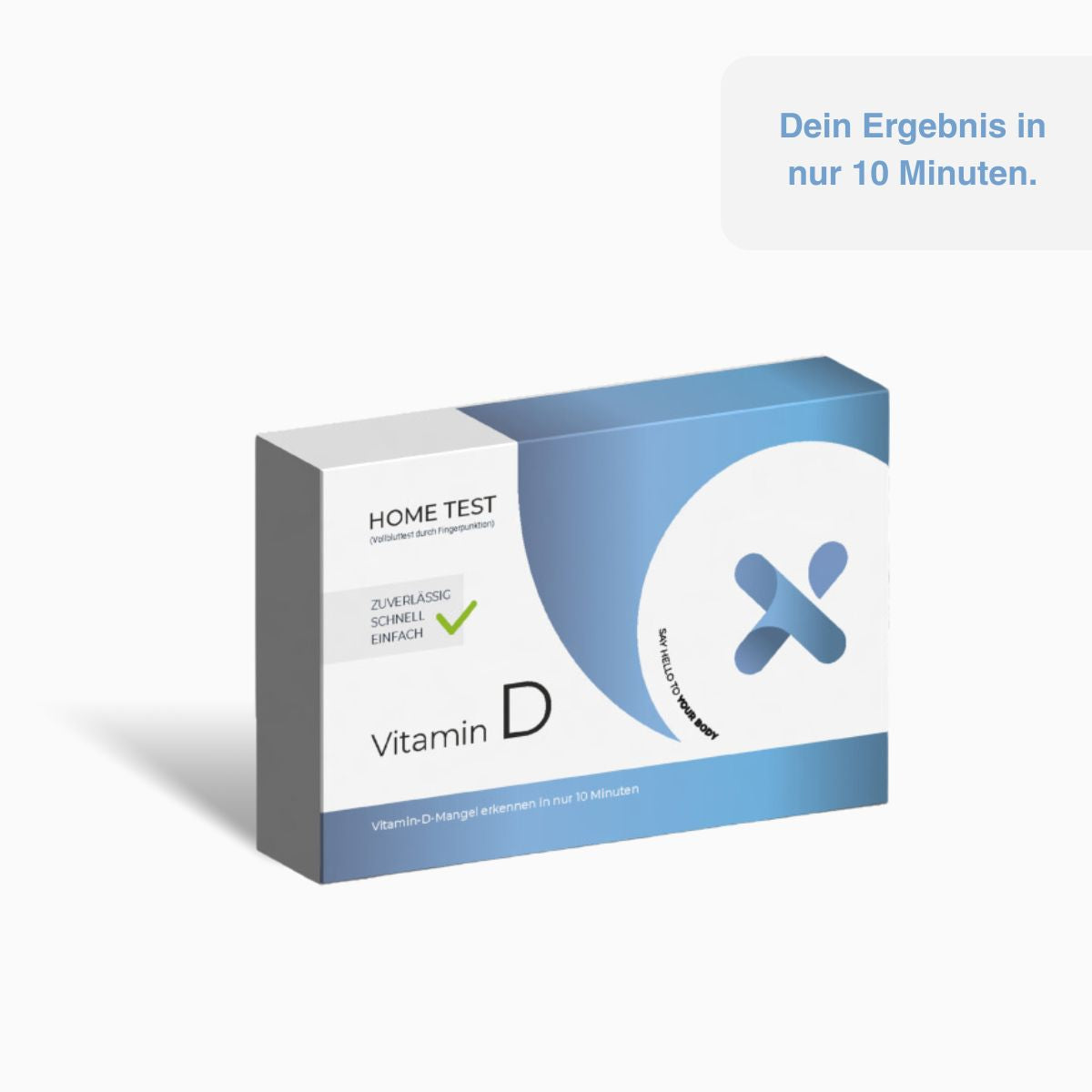
Rapid at-home test
Vitamin D self-test
Provides the result directly at home without laboratory testing. It offers an interpretation, not a laboratory finding, and measures only this one value. The laboratory’s ISO certification applies to laboratory analyses, not rapid tests.
Result in 5–10 minutes, no laboratory testing
Information from the product page, accessed 08/28/2026
Anyone who wants to interpret the value not in isolation but in context is better served by laboratory testing. Vitamin D is assessed alongside B12, folate, and iron status.
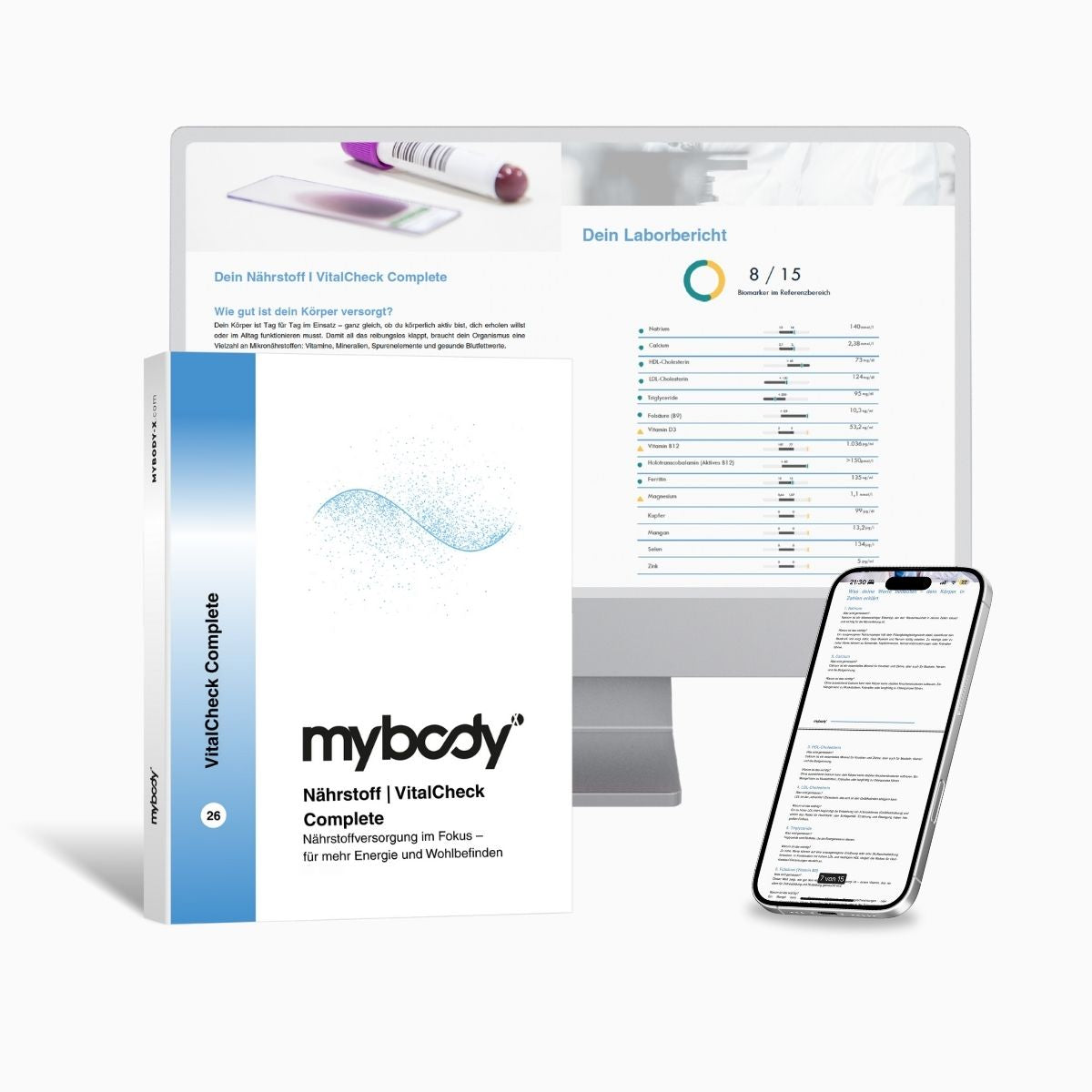
Capillary blood test
VitalCheck | Nutrient & Mineral Test Complete
Measures vitamin D3 together with B12, folate, iron status, magnesium, selenium, and zinc. According to the product page, it is a snapshot, not a diagnosis. Because vitamin D levels vary seasonally, a single measurement says little about the entire year.
Laboratory evaluation 3–5 business days after receipt of the sample
Information from the product page, accessed 08/28/2026
Which of the two options is appropriate, and when
The rapid test answers one specific question quickly and inexpensively: Where do I stand approximately? It is the right option when only this one value is of interest and the result is needed today.
The laboratory test answers a different question: How does this value compare with the others? This is useful when the question about vitamin D is actually prompted by general exhaustion, for which iron, B12, or folate may also be possibilities.
Both are self-tests, not medical diagnostics. Anyone with symptoms for which a cause is being sought is better served by an appointment than by using both tests together.
Limitations: what a test cannot do
For vitamin D, diet is secondary.
A single value describes one point in a year with major fluctuations. The RKI explicitly documents these fluctuations (2016). A measurement in March and one in August produce different pictures for the same person, even if nothing about their lifestyle has changed.
A test also does not indicate what is causing a low value. Little sunlight, little fish, an illness affecting absorption, or the season are all possible explanations. This distinction determines what to do next and belongs in a medical practice.
And one limitation concerns the table. The range for herring, from 7.80 to 25.00 micrograms, appears exactly that way in the source. It shows how much a single fish can vary depending on its origin, fishing area, and season. The amount on your plate may therefore differ considerably.
What this article deliberately does not claim
It does not claim any effect of vitamin D on exhaustion, mood, susceptibility to infections, or other symptoms. The sources reviewed here contain no statement about these relationships that an editorial team could cite.
It also does not specify any threshold values in nanomoles per liter below which a value is considered low. Such values depend on the laboratory and method, and what matters is always your own test result.
What remains is less spectacular than most texts on this subject: a documented supply situation, a documented upper limit, and a very short list of foods.
What you can change starting tomorrow
If you take away one action from this article, let it be this: During the warmer months, go outside briefly with your arms uncovered two to three times a week. That is the range specified by IQWiG, and it replaces any list of foods.
The reason is unremarkable. Of all the levers discussed in this text, this is the only one that accounts for 80 to 90 percent of supply. Everything on the plate affects the remaining ten to twenty percent.
The starting point was the question of which foods contain vitamin D. The most honest answer is: there are four with documented figures, and the most important source appears on no list because it hangs in the sky.
Frequently asked questions
Which foods contain vitamin D?
Only a few. The DGE primarily lists fatty fish, eggs, and some edible mushrooms. The figures documented are 7.80 to 25.00 micrograms per 100 grams for herring, 16.00 for salmon, 5.60 for chicken egg yolk, and 4.00 micrograms for mackerel (DGE, 2025). Vegetables, fruit, grains, and meat contribute virtually nothing. On average, only 2 to 4 micrograms per day come from the diet.
How much vitamin D do I need per day?
The DGE gives an estimated value of 20 micrograms per day for everyone aged one and over, including pregnant women, breastfeeding women, and older people. For infants up to twelve months, the amount is 10 micrograms. The condition is important: this value applies when there is no production by the body through the skin. Twenty micrograms correspond to 800 international units.
Is the sun in Germany sufficient?
In the summer half of the year, yes; in the winter half, no. The DGE states that sunlight in Germany from October to March is not strong enough to ensure sufficient production (2025). IQWiG puts it even more succinctly: In winter, the body cannot produce vitamin D here (2023). In summer, according to IQWiG, exposing uncovered arms, hands, and face without sunscreen two to three times a week is sufficient.
Can you take too much vitamin D?
Yes, and that distinguishes vitamin D from most other nutrients. The DGE specifies a tolerable total intake of 100 micrograms per day from age eleven and 50 micrograms for children up to age ten; with higher intake over an extended period, it cites the formation of kidney stones or kidney calcification (2025). IQWiG cites the same upper limit and lists elevated calcium levels, nausea, vomiting, and abdominal cramps as consequences; in cases of severe overdose, kidney damage and cardiac arrhythmias (2023).
Who should take a supplement?
The DGE makes its recommendation conditional: only if a targeted improvement cannot be achieved through diet or the body’s own production (2025). IQWiG names nursing-home residents, infants in their first twelve to eighteen months, people with dark skin, and people with chronic intestinal, kidney, or liver diseases as groups for whom supplementation may be considered (2023). For everyone else: measure first, then decide, and consult a doctor if in doubt.
Next step
Measure first, then supplement
Because vitamin D has a documented upper limit, the order matters more here than with other nutrients. Both paths provide a starting point; neither replaces medical evaluation.
View VitalCheck Complete Vitamin D self-testRead more
You might also be interested in
The second nutrient for which the list of sources is short and the selection makes the difference.
For comparison, a nutrient for which the plate really is the main lever.
Sources
- German Nutrition Society (DGE): Frequently asked questions about vitamin D (as of September 30, 2025) – dge.de
- German Nutrition Society (DGE): Reference values for vitamin D intake (basis for derivation as of 2012) – dge.de
- Institute for Quality and Efficiency in Health Care (IQWiG): How high is the vitamin D requirement and how can it be met? (as of 2023) – gesundheitsinformation.de
- Robert Koch Institute (RKI): Vitamin D status in Germany, Journal of Health Monitoring 2/2016 – rki.de
The verbatim quotation about the body’s own production, the information on the time of year, food content, the average intake of 2 to 4 micrograms, the tolerable upper intake level, and the condition for taking a supplement come from source [1]. The estimated value of 20 micrograms and the statement that only a few foods contain vitamin D come from [2]. The information on sun exposure, the upper limit in international units, the consequences of an overdose, and the groups that may benefit from supplementation come from [3]. The figures on nutritional status and seasonal fluctuations come from [4]. Information on prices, measured values, sample type, and laboratory comes from the mybody®x product pages, accessed on August 28, 2026; processing times follow the central specification. All sources were accessed and reviewed on August 28, 2026.

mybody®x Editorial & Expert Team
Laboratory diagnostics Nutritional science Blood analysis interpretation Nutrigenetics
This article was created by the mybody®x editorial and expert team. The team combines laboratory diagnostics, nutritional science, and the interpretation of blood analyses. The people involved can be found on the authors page.
Published on June 24, 2026 · Last updated on August 28, 2026
The content is for general information and does not replace medical advice, diagnosis, or treatment. Reference ranges depend on the laboratory, method, and age—the information on your test report is always decisive.




Share now:
Why am I not losing weight? The real reasons in 2026
Weight gain despite eating little: Find the causes