
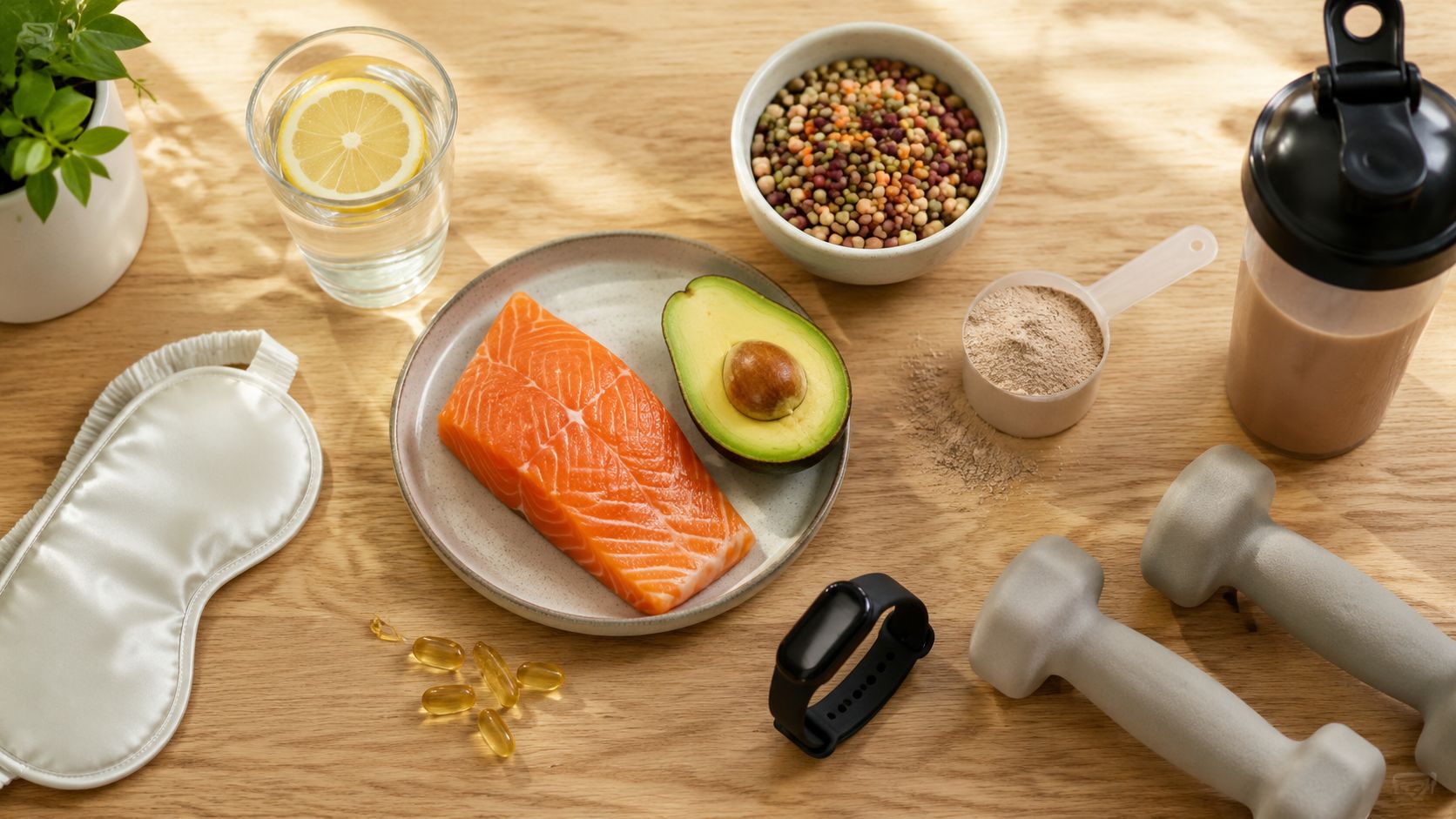
Stimulate fat metabolism: Successfully reach your desired weight
You pay attention to what you eat, make an effort in everyday life, and yet your body still feels as if it is standing still. The scale barely moves, your energy crashes after lunch, and online you read ten different tips that contradict one another. More protein. Fewer carbohydrates. Cold showers. Coffee. Intermittent fasting. Even more exercise.
This is exactly where many people lose their bearings. Not because they lack discipline, but because fat metabolism is often presented as some mysterious switch. Yet it is not a mystery. It is a biological system that responds to clear signals: movement, nutrition, sleep, stress, and whatever your body is currently lacking or has out of balance individually.
If you want to stimulate fat metabolism, you therefore do not need a radical solution. You need an understandable model. And then small steps that suit your everyday life and your body.
How to stimulate fat metabolism—but where do you start?
Many people start with the wrong question. They ask: “What trick will boost my metabolism?” A more helpful question is: “What conditions does my body need in order to reliably use fat as energy?”
Let’s take a typical example. Maybe you eat a “healthy” breakfast, sit a lot at work, collapse onto the sofa tired in the evening, and wonder why your energy level remains low. Then you try a strict diet, stick with it for a few days, and feel even more exhausted. The problem is often not a lack of willpower. The problem is that your body is responding to restriction, stress, or a lack of movement.
The first important thought
Your metabolism is not a fixed trait. It constantly responds to signals from your everyday life. If you eat regularly, get enough exercise, drink enough, and give your body time to recover, you send it different signals than with constant stress, lack of sleep, or continually restricting calories.
Many people do not have a “broken” metabolism. They have a body that has adapted to unfavorable conditions.
That is exactly the good news. What has adapted can often be influenced again.
What you can practically start with
The best place to start is not perfection, but an overview. Ask yourself about the past few days:
- How regularly do you actually eat: Do you skip meals and later get intense cravings?
- How much do you move in everyday life: Not just exercise, but also walking, taking the stairs, and standing.
- How rested do you feel in the morning: Do you wake up refreshed, or drag yourself through the day?
- How consistent is your energy level: Fairly stable, or marked by lows and cravings for snacks?
If you recognize several areas for improvement here, that is not a setback. It is a direction.
Not harder, but more targeted
Anyone who wants to boost their fat metabolism usually needs three things at the same time. First, enough stimulation through physical activity. Second, a diet that keeps you full and provides nutrients. Third, an eye on possible personal obstacles such as stress, sleep, or nutrient deficiencies.
That takes the pressure off. You do not have to change everything at once. Often, even a small change makes a difference. A higher-protein breakfast. Two short strength-training sessions per week. More water within reach. Going to bed an hour earlier. It may sound unremarkable, but these basics are precisely what influence whether your body tends to store energy or is more ready to release it.
What really determines your fat metabolism
The greatest confusion often comes from small tricks that are marketed as major solutions. Chili, cold showers, and individual “boosters” appear everywhere. The problem is that these ideas distract from the factors that really matter. According to nu3’s overview on boosting metabolism, the effects of such tricks are minor. More important are overall energy intake, physical activity, and sleep. An apparently slow metabolism is often more likely to result from eating too little, having too little muscle mass, or a lack of physical activity.

Fat burning is not a constant blaze
Your body constantly switches between different energy sources. After eating, it primarily processes what is currently available. During longer breaks, physical activity, or whenever more energy is needed overall, it also draws more heavily on stored reserves.
This means that fat burning is not a single moment, but an ongoing process. What matters is the conditions you create over days and weeks.
Anyone who wants to understand the basics more clearly will find what fat metabolism means a helpful supplement.
The five real levers
| Factor | Why it matters |
|---|---|
| Energy balance | Your body responds to whether you generally live in balance, in an energy surplus, or in a constant deficit. |
| Muscle mass | Muscles influence how much energy your body needs even at rest. |
| Hormones | Insulin, the thyroid, and stress hormones also influence how energy is stored and released. |
| Everyday habits | Sleep, physical activity, and the amount of time you spend sitting send daily signals to your metabolism. |
| Individual factors | Genetics, your stage of life, and possible deficiencies affect how your body responds. |
Why muscle mass is so often underestimated
Many people think of fat metabolism as nothing more than cardio. But muscle mass is more like the engine running in the background. More active muscle does not mean you will suddenly lose weight without effort. But your body becomes more resilient, capable, and metabolically active.
Key takeaway: It is not the food with the loudest promise that makes the difference. Your everyday routine does.
If targeted supplementation is appropriate in the case of a confirmed deficiency, a product such as Vitamin D3 K2 Complex | Shield may play a role. According to the product description, it combines D3 with K2 to support calcium utilization, bone health, and the immune system, and is intended especially for use after a DNA or blood test has confirmed a deficiency. The important point is not the product itself, but the sequence: measure first, then take appropriate action.
Nutrition as a driver of fat burning
You eat breakfast quickly, something comes up at lunchtime, the urge to snack becomes strong in the afternoon, and by evening you feel that your body is demanding everything at once. In a routine like this, “boosting fat metabolism” can quickly seem like a mystery. In reality, your food sends clear signals every day. It affects whether your blood sugar remains stable, how long you stay full, and whether your body can easily switch between available energy and stored reserves.
This is exactly where it helps not to look for isolated tricks, but for your personal obstacles. The most important question is often not, “Which food boosts everything?” A more useful question is, “What keeps throwing my day out of balance?” Common factors include too little protein, too little fiber, long gaps between meals, or meals that provide quick energy but little satiety.
One helpful principle from professional and consumer sources remains simple: The body needs more energy to digest protein than it does to digest fat or carbohydrates. There is a second point as well. Very strict diets often make everyday life unstable and make it harder to keep metabolism steady, as Biogena’s guide to boosting metabolism explains.

Protein provides structure
Protein works in the body like the stable framework of a house. It helps maintain muscle mass and often slows the rapid crash after a meal. This is relevant to fat metabolism because your body is less likely to experience intense hunger waves when its energy supply is more consistent.
In practical terms, this means including a clear source of protein in every main meal. Fish, tofu, skyr, eggs, legumes, or lean meat are simple examples. If your breakfast so far has mainly consisted of sweet pastries or just coffee, this is a good self-test: For three to four days, observe how long you stay full with a higher-protein breakfast and whether your urge to snack in the morning decreases.
Fiber makes energy more predictable
Fiber is not a fat-burning hack. It acts more like a speed limiter for your meal. It slows absorption, promotes satiety, and helps ensure that energy does not arrive too quickly and disappear again too quickly.
Especially if you often experience cravings, severe afternoon slumps, or the feeling that you never really get full despite eating, a second self-check is worthwhile. Look at a typical day and mark where genuinely fiber-rich foods appear. Oatmeal, beans, lentils, vegetables, berries, or whole-grain products are often missing from everyday meals more than you might think.
If your food only gives you a brief “boost,” the problem is often less about a lack of discipline and more about a meal that does not slow things down or provide enough satiety.
Healthy fats make meals more sustaining
Many people cut fat first. In the short term, that seems logical. In everyday life, however, this often makes meals less satisfying, and that is exactly when the constant search for something to eat begins later.
Healthy fats help make a meal feel complete. Nuts, seeds, olive oil, avocado, or fatty fish can help food keep you satisfied for longer. This is useful for fat metabolism because balanced meals usually lead to less snacking between meals, fewer blood sugar fluctuations, and less impulsive eating.
A simple plate often follows this pattern:
- Vegetables or salad for volume and nutrients
- A fiber-rich side dish such as whole grains, oats, or legumes
- A clear source of protein such as tofu, fish, eggs, or yogurt
- A small source of fat such as nuts, seeds, or high-quality oil
You can find more specific ideas in the article about foods that stimulate metabolism.
Drinking supports the system
Water does not regulate your fat metabolism on its own. However, too little fluid can make it harder to feel capable and clear-headed. Especially when you eat more fiber, you often quickly notice how much adequate drinking also influences satiety and digestion.
Here too, a quick reality check is more helpful than guessing. Are you really hungry, or have you been running on coffee, appointments, and too little water for hours? This small difference changes many food choices.
If there is a confirmed need due to fatigue or an unbalanced diet, Vitamin B Complex | Energize may also be a suitable option. According to the product description, it provides all 8 B vitamins for energy, the nervous system, and metabolism and is specifically intended for confirmed B deficiencies identified through a blood or DNA test.
Exercise that activates your fat cells
Many people try to address fat metabolism through diet alone. This works only to a limited extent. Exercise changes not only the number of calories burned on a given day, but also how your body provides and uses energy.
The most important point is not how hard you train. What matters is whether you train regularly. According to the NDR article on stimulating metabolism through diet and exercise, adults should achieve at least 150 minutes of moderate or 75 minutes of vigorous physical activity per week. As a realistic starting point, NDR recommends 3 training sessions of 30–45 minutes each. The combination of endurance and strength training is particularly effective because muscles influence your resting energy expenditure.

Why strength training changes more in the long term
Cardio is helpful. It trains your cardiovascular system and increases your energy expenditure during activity. Strength training works in a different way. It helps you maintain or build muscle. That is exactly what makes it so valuable for fat metabolism.
If you focus only on “burning calories,” you underestimate the long-term effect. More muscle also supports your body outside of training. That is why strength training is not an extra option for fitness enthusiasts, but one of the most sensible foundations for many adults.
A simple start without feeling overwhelmed
You do not have to go to the gym right away. A sensible start could look like this:
- Two strength sessions per week: Exercises using your own body weight, dumbbells, or machines
- Additional endurance: Brisk walking, cycling, or easy jogging
- More everyday movement: Walk for short trips, take phone calls standing up, and take brief activity breaks
The best training plan is the one you repeat next week.
If you want to adapt your training more individually to your metabolic type, the DNA Metabolic Analysis may provide an interesting data basis. According to the product description, it identifies genetically determined metabolic types, fat and carbohydrate utilization, and individual weight-related risks, and serves as a foundation for a personalized nutrition and training plan.
If you also want to work on endurance and resilience, the article on improving your VO2 max is a good next step.
The Invisible Helpers: Sleep, Stress, and Nutrients
You’re making an effort. During the week, you cook sensibly, stay active regularly, and yet your body seems to be stuck in place. In phases like these, it’s worth looking beyond food and exercise to the background factors that also influence fat metabolism.
Fat burning isn’t a switch you can simply flip. It’s more like a finely tuned system of hormones, the nervous system, recovery, and nutrient supply. If there’s a grain of sand in one part of the machinery, the rest often runs with the handbrake on. So this isn’t about more tricks, but about the fundamentals and the question: Where might your personal brakes be?
German-language health sources point out that issues such as stress, sleep, gut health, nutrient deficiencies, or even your stage of life are often overlooked when metabolism is sluggish. Shift work, ongoing strain, or perimenopause may also play a role, as AOK explains in its guide to naturally stimulating metabolism.
Sleep is your metabolism’s repair time
During sleep, your body does more than simply process the day. It also regulates signals for hunger, satiety, blood sugar, and recovery. If you sleep too little or restlessly, this fine-tuning becomes less precise. You often notice it in practical ways: more desire for quick energy, less patience while eating, and less motivation to move.
This matters for fat metabolism because when you’re sleep-deprived, your body is more likely to push for quick energy instead of calmly and flexibly drawing on its reserves. If you start the morning already exhausted, you’re more likely to reach for snacks, coffee with pastries, or large portions in the evening. This isn’t a lack of discipline, but an understandable response from a tired system.
A simple self-test is often more helpful than overthinking: Do you wake up feeling exhausted several days a week, take a long time to fall asleep, or wake up frequently during the night? Then sleep may be a real bottleneck.
Stress shifts the body’s priorities
Under stress, the body primarily wants one thing: to get you through the day. There is often less capacity left for fine metabolic regulation.
Short-term stress is normal. It becomes problematic when tension turns into a permanent state. Then appetite, recovery, sleep quality, and often decision-making in everyday life change. Some people eat irregularly and later experience intense cravings. Others eat on the go without really noticing when they’re full. Still others keep training but hardly recover.
That’s why fat loss often feels stubborn under chronic stress, even when the plan looks good on paper. The right question then isn’t immediately: What do I need to do even more intensely? Often more helpful is: Where can I reduce the strain so my body can respond better again?
Nutrients make energy usable in the first place
Calories provide energy. Micronutrients help your body process that energy. You can think of them as tools in a workshop. If too few are available, the workbench is still there, but many processes become slower, less precise, or more strenuous.
This does not mean that every bout of fatigue is immediately caused by a deficiency. But it explains why a healthy diet is about more than simply eating less or counting calories. If your body lacks certain building blocks, exhaustion, low resilience, or slow recovery can increase. Fat metabolism can then also become less flexible.
Typical signs that warrant a closer look:
- You are often tired, even though you eat regularly and get enough sleep
- You recover poorly after exercise or stressful days
- You have vague symptoms such as concentration problems, bloating, or low resilience
- Your everyday life feels low-energy, even though you are doing many things right
The key is to look at patterns rather than individual symptoms. Not every bout of exhaustion is an iron problem. Not every weight plateau is hormone-related. But when sleep problems, ongoing stress, and warning signs of nutrient gaps come together, stop guessing. Then it makes sense to take a targeted look and only afterward decide what to change.
That is precisely the calmer and often more effective strategy. Instead of doing even more at once, find the one or two brakes that are actually slowing down your fat metabolism.
Certainty instead of guesswork: When a test makes sense
You sleep more, pay attention to what you eat, and exercise regularly. Yet you still feel that your body is hitting the brakes. That is exactly when it is worth asking a different question instead of simply trying harder: Which adjustment is not quite right for you right now?
Fat metabolism works like an oven that only burns cleanly and consistently when several conditions are right. If it receives the wrong signals from hormones, lacks individual building blocks, or your digestive system reacts sensitively, general advice often only helps to a limited extent. It is the foundation. Data shows you where your personal roadblock might be.

Which test is right for which problem
| Observation | What could be behind it | Which test can help |
|---|---|---|
| Fatigue and low resilience | Nutrient gaps or unclear nutrient intake | A nutrient test can provide clues as to whether important building blocks are missing |
| Stubborn weight plus mood swings | Hormonal factors | A hormone test can make patterns more visible |
| Bloating or symptoms after eating | Individual triggers or intolerances | An intolerance test can help narrow down possible triggers |
| Many diets, little progress | Different responses to nutrition and training | A DNA-based test can help personalize strategies |
The purpose of such tests is not to label you. Their value lies in testing suspicions. For example, if you think carbohydrates are your problem, but your symptoms seem more related to lack of sleep, stress, or inadequate nutrient intake, a targeted test can often save time, frustration, and unnecessary experimentation.
Tests provide guidance, not a remote diagnosis
A self-test does not replace a medical diagnosis. However, it can help you turn vague suspicions into specific questions.
This is often the point at which things start to change. Instead of eliminating foods on a hunch or trying supplements at random, you can make more targeted decisions about what to address first and why. This is exactly where services such as mybody x Gesundheit come in, offering at-home self-tests in areas such as nutrient status, hormones, intolerances, and metabolism.
Three quick self-checks before taking a test
Before ordering anything, look for patterns in your everyday life. These questions will help you choose the right next step:
- Do your symptoms occur regularly or only during certain phases? Recurring patterns after eating, around your menstrual cycle, or during periods of stress often point you in a particular direction.
- Have you already worked on several fundamentals over the past few weeks? If your sleep, meal schedule, and physical activity are still very inconsistent, it’s worth focusing on greater consistency first.
- Are you trying to check a suspicion, or are you hoping for a quick, complete solution? Tests are most helpful when you have a clear question.
When you should seek medical advice
Some situations should be taken directly to a medical practice. This applies especially in the case of:
- severe, persistent exhaustion, when your daily life and ability to perform are significantly impaired
- noticeable symptoms, such as significant digestive problems, changes in your menstrual cycle, or other unexplained complaints
- rapid changes, when your weight, well-being, or physical resilience suddenly changes
Then seeking medical clarification is the safest approach. At-home tests can complement this, but they do not replace an examination.
If you want to stimulate your fat metabolism, you don’t need even more advice all at once. You need clarity about which obstacle is really affecting you right now. That clarity is what leads to small steps that are more likely to suit you—and therefore more likely to work.



Share now:
What Is Vitamin D For? Guide: Immune System, Energy & Bones
Why am I not losing weight? The real reasons in 2026