

Hormone status assessment: The key to greater well-being and quality of life
Determining your hormone levels is essentially a snapshot of your internal balance. Think of it like looking at your body's cockpit: it shows you the current concentrations of important hormones such as estrogen, progesterone, and cortisol. This allows you to uncover imbalances that may have been affecting your well-being for some time.
Your hormones are the secret conductors that control almost everything in the background – from your mood to your sleep.
Understanding your body as an orchestra
Imagine your body as a huge, perfectly tuned orchestra. In this orchestra, your hormones are the conductors. They give each individual instrument – that is, each organ and each bodily function – the right cue and the perfect tempo. They coordinate the melody of your mood, the volume of your energy, and the rhythm of your metabolism. When all the conductors are working in harmony, your body's symphony runs smoothly, and you feel energized, balanced, and simply good.
But what happens if even one conductor loses their rhythm? A tiny disruption can throw the entire concert into chaos. Suddenly you feel tired for no apparent reason, your mood swings wildly, or your weight changes even though you haven't altered your lifestyle at all. This is precisely where determining your hormone levels comes into play.
Symptoms are the wrong notes
Many everyday ailments are often the first "wrong notes" played by your inner orchestra. They are signals indicating that something is wrong. Perhaps you know one or two of these feelings all too well:
- Constant fatigue: You wake up exhausted in the morning, even though the clock tells you that you have slept enough.
- Unexplained weight gain: Despite healthy eating and exercise, the scale stubbornly moves in the wrong direction.
- Low mood and irritability: You often feel down for no reason or react more irritably than usual.
- Sleep problems: You have trouble falling asleep, wake up constantly during the night, or simply don't feel rested in the morning.
Ignoring these symptoms is like covering the ears of a violinist playing out of tune – it doesn't solve the underlying problem. A hormone test, on the other hand, is like taking a close look at the score. It helps you understand which conductor – that is, which hormone – is responsible for the disharmony.
A hormone test doesn't just look for problems. It gives you the opportunity to consciously recompose the melody of your well-being. It's about finding the cause, instead of just masking the symptoms.
With a home hormone test from mybody-x.com, you essentially take control of your own health. You don't have to wait weeks for a doctor's appointment to gain important initial insights. Instead, you can discreetly and conveniently take a sample from home and send it to our certified laboratory.
You'll receive an easy-to-understand report that shows you exactly where your body might need some support. This way, you not only gain valuable data, but above all, you regain control over your health. If you'd like to delve deeper into the topic, you can learn more in our article about the benefits of hormone analysis . This first step enables you to make targeted and informed decisions regarding your lifestyle, diet, and overall well-being.
An overview of the most important hormones and their functions
To understand what's behind your hormone levels , we need to take a closer look at the key players. Imagine your hormonal system as a perfectly tuned orchestra. Every musician – every hormone – has its own essential role. Only when they all play in harmony does the melody emerge that you experience as energy, balance, and health.
But this orchestra is complex. It's not enough to just listen to the first violin, because all the instruments influence each other. A single wrong note in one place can trigger a chain reaction that you then perceive as a symptom. That's precisely why a holistic view of the interplay is so crucial for your well-being.
The bosses for cycle and emotions
The most well-known hormones are probably the sex hormones. They not only regulate the female cycle, but also significantly determine general mood and vitality – in both women and men.
- Estrogen (more precisely: estradiol): This is your energy hormone, responsible for a positive mood and feminine curves. In the first half of the menstrual cycle, it ensures that the uterine lining builds up. A deficiency can manifest as dry skin or low mood, while an excess can cause water retention or irritability.
- Progesterone: Often referred to as the "rest hormone," it has a balancing and calming effect. It is particularly important in the second half of the menstrual cycle to prepare the body for a possible pregnancy and to ensure restful sleep. A deficiency often results in PMS, sleep disturbances, or inner restlessness.
The crucial factor here is the ratio between the two hormones. Many women suffer from so-called estrogen dominance . In this condition, there is a relative lack of progesterone – even if both values are within the normal range individually. This is precisely where a targeted measurement, such as that offered by the mybody®x hormone test, provides valuable insights.
The engine of your metabolism
Your thyroid gland is the powerhouse of your body, and its hormones are the fuel. They regulate your energy consumption, your body temperature, and even your digestion.
The key values are here:
- TSH (thyrotropin): This hormone is produced in the pituitary gland and is essentially the "commander" for the thyroid gland. A high TSH level often indicates that the thyroid gland needs more stimulation – an early sign of possible hypothyroidism.
- Free T3 (fT3) and free T4 (fT4): These are the actual thyroid hormones that are active in the body. T4 is the storage form, while T3 is the significantly more active variant. If these levels are too low, you often feel tired, lethargic, and gain weight more easily.
Awareness of the role of these hormones is growing. A Forsa survey shows that only 30% of women between the ages of 18 and 29 feel well-informed about thyroid hormones. At the same time, 69% of young women would like more information about hormones in general. You can read more about the survey results at aerztezeitung.de .
Your personal stress manager
Almost everyone knows cortisol as the classic stress hormone. In short bursts, it makes you efficient and alert. However, persistent stress leads to chronically elevated cortisol levels, and this can have far-reaching consequences.
Cortisol is not inherently bad – it's a survival hormone. The problem only arises when the body can no longer leave this "state of alarm".
A consistently high cortisol level can lead to sleep disorders, for example, because it suppresses its natural counterpart, melatonin (the sleep hormone). Cravings, weight gain around the abdomen, and a weakened immune system can also result. A mybody®x test helps you check your cortisol level and understand whether stress is a possible cause of your symptoms.
Taking a holistic view of all these hormones gives you a clear picture and is the first, crucial step to specifically restoring your inner balance.
To give you a quick overview, we have summarized the most important hormones and their typical symptoms in case of an imbalance in a table.
Overview of the most important hormones and their symptoms in case of imbalance
This table shows you at a glance which hormones are responsible for which bodily functions and which typical symptoms can occur in the case of a deficiency or excess.
| hormone | Main function | Typical symptoms of imbalance |
|---|---|---|
| estrogen | Energy, mood, cycle regulation, skin health | Deficiency: Dry skin, hot flashes, low mood. Excess: Water retention, irritability, breast tenderness. |
| progesterone | Balance, calming, sleep, pregnancy preparation | Deficiency: PMS, sleep disorders, anxiety, menstrual irregularities. |
| TSH | Control of thyroid activity | High: Signs of hypothyroidism (fatigue, weight gain). Low: Signs of hyperthyroidism (restlessness, weight loss). |
| fT3 / fT4 | Metabolism, energy, body temperature | Low: Fatigue, sensitivity to cold, constipation, hair loss. High: Rapid heartbeat, sweating, nervousness. |
| Cortisol | Stress response, energy supply, inflammation reduction | High: Sleep disturbances, weight gain around the abdomen, increased susceptibility to infections. Low: Exhaustion, low blood pressure. |
This overview clearly illustrates how closely everything is interconnected. A symptom like fatigue can have many causes – from the thyroid gland and cortisol levels to an imbalance of sex hormones. A comprehensive hormone test from mybody-x.com helps to address the issue precisely where it's needed.
How to find the right testing method for you
Blood, saliva, or urine? When it comes to determining your hormone levels , you might be facing this very question. Choosing the right method isn't just a minor detail, but the crucial foundation for truly meaningful results. Each sample type has its own specific strengths and weaknesses, depending on which hormone you want to examine more closely.
Imagine it like this: You want to measure the exact composition of the air in a room. For some gases, you need a sensor directly in the air (that would be the saliva test), for others you might need to analyze a dust sample from the floor (similar to a blood test). Both provide valuable data, but for different aspects. The same applies to testing methods for your hormone levels.
To help you keep track, this graphic shows how you can narrow down the possible causes starting from symptoms such as fatigue.
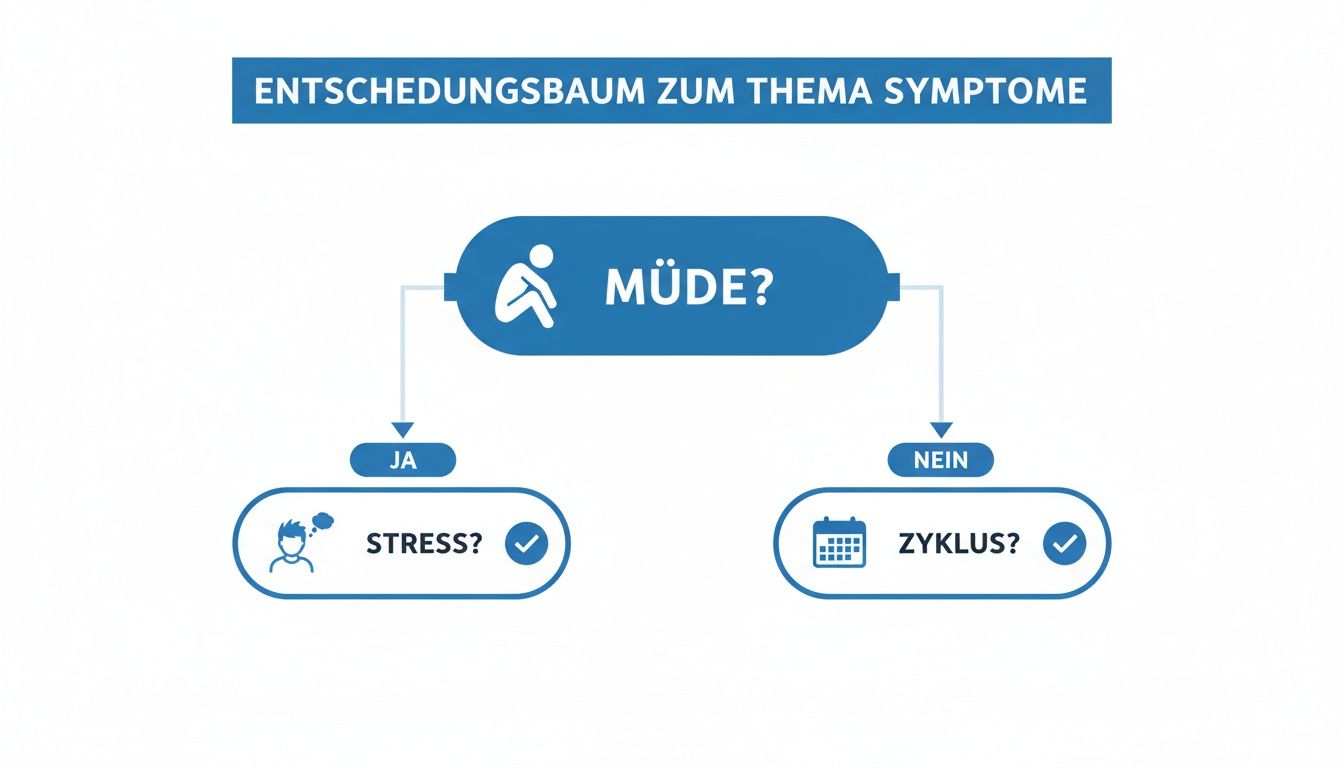
The decision tree makes it clear: A single symptom can often point to very different hormonal causes. That's precisely why choosing the right test is so incredibly important.
Blood test – the gold standard for many hormones
A blood test is the method of choice for many hormones, especially when it comes to bound hormones circulating in the blood.
The classic blood test, drawn from a vein at the doctor's office, measures the total concentration of hormones. This is extremely important for assessing thyroid function (TSH, fT3, fT4) or for hormones from the pituitary gland, such as FSH and LH. Here, the blood provides a very precise and comprehensive picture.
A modern and convenient alternative is the fingertip blood test, like the one used in the mybody-x.com at-home hormone tests . You simply take a few drops of blood yourself – it's easy and virtually painless. This method combines the accuracy of blood analysis with the convenience of doing everything discreetly at home. This way, you don't have to wait for a doctor's appointment and can take the sample at the biologically optimal time.
Saliva test – the specialist for active hormones
While the blood test provides a comprehensive picture, the saliva test specializes in free, biologically active hormones. Hormones such as estrogen, progesterone, and testosterone are fat-soluble and bind to transport proteins in the blood, much like a passenger in a taxi. Only a tiny fraction, approximately 2–5% , is "free" and can actually bind to cells to exert its effects.
A saliva test measures precisely this free fraction. This makes it particularly informative for assessing the balance of sex hormones, for example in cases of symptoms such as PMS, menstrual irregularities, or during menopause.
A saliva test is like a direct conversation with the hormones that are currently active. It doesn't show how many hormones are sitting in the "waiting room" (bound to proteins), but rather how many are actually fulfilling their function.
Another crucial advantage of the saliva test lies in the measurement of the daily cortisol profile. Since cortisol levels fluctuate significantly throughout the day, several measurements are necessary to obtain a meaningful picture of your stress level. This is much simpler and more practical with a saliva sample than with repeated blood draws.
Which method is suitable for which hormone?
To make your decision easier, we have compared the most common methods and their suitability for different hormones.
| method | Best suited for | Advantages | Disadvantages |
|---|---|---|---|
| Blood test (fingertip) | Thyroid hormones (TSH, fT3, fT4), total testosterone, DHEA-S | Precise, convenient from home, ideal for stable hormone levels | Primarily measures bound sex hormones, less informative for cortisol day profile. |
| Saliva test | Free cortisol, estradiol, progesterone, free testosterone, DHEA | Measures only bioactive hormones, painless, ideal for daily profiles | Not suitable for all hormones (e.g., thyroid), reimbursement by health insurance companies is rare. |
| Urine test | Hormone metabolites (breakdown products), cortisol over 24 hours | Provides insight into hormone metabolism over a longer period of time | Extensive data collection (usually over 24 hours), does not directly measure hormone levels |
The mybody-x.com tests specifically target the method that provides the most meaningful results for each hormone. We combine the precision of a fingertip blood test for important values like thyroid hormones with the accuracy of a saliva test for stress hormones like cortisol. This approach ensures you receive a reliable and comprehensive picture of your hormone status, allowing you to take targeted steps to improve your well-being.
This is how easy your mybody-x.com home hormone test works.
Are you thinking about having your hormone levels checked, but the idea of doing it at home makes you uneasy? Don't worry, it's much easier and simpler than you might think. We'll guide you step-by-step through the entire process – from ordering the test to receiving your personalized results report.
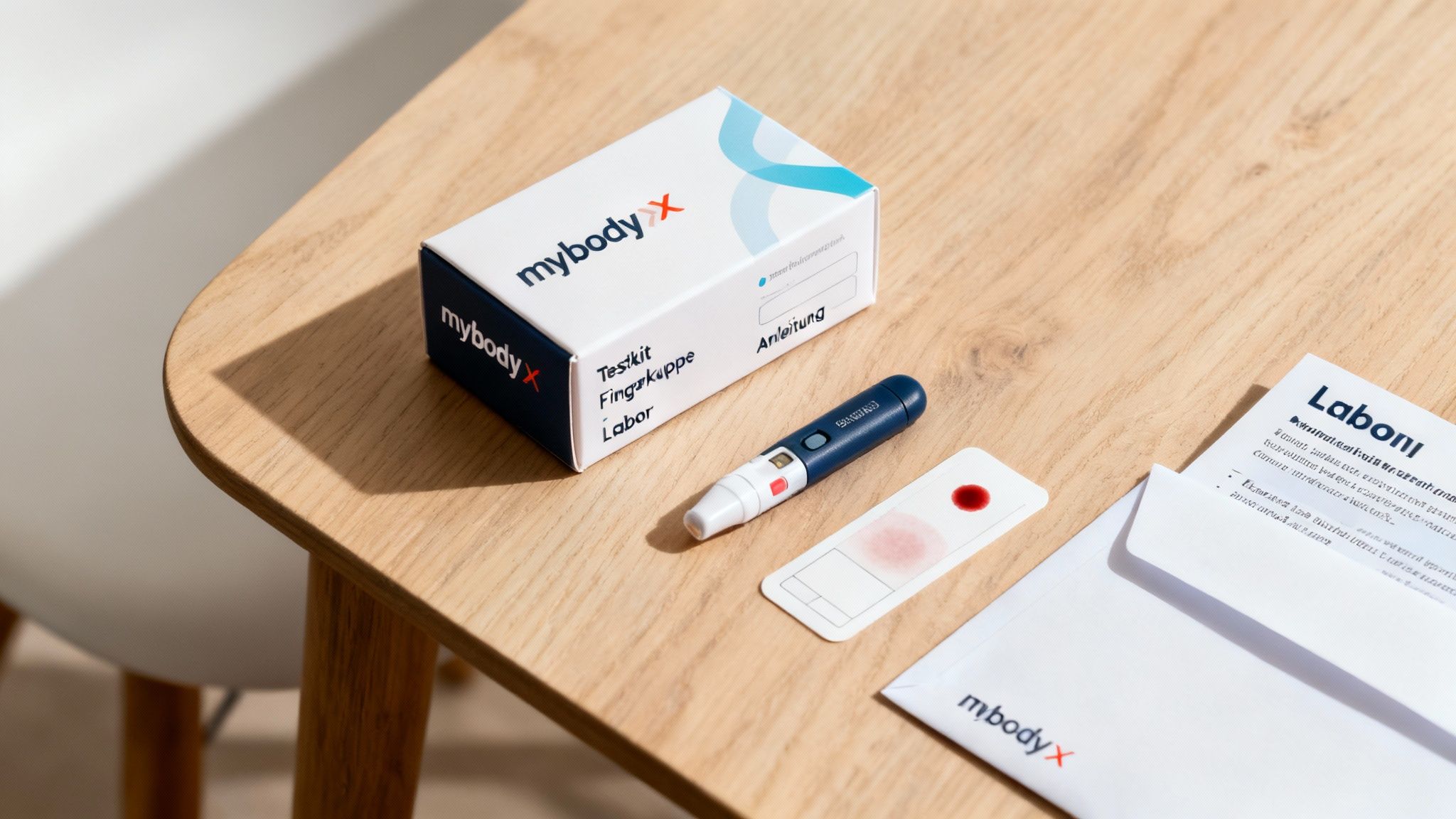
Our goal is to eliminate any uncertainty you may have. We want to show you how convenient and reliable it can be to determine your hormone levels from the comfort of your own home. You take control, are not tied to rigid doctor's appointments, and can take the sample exactly when it's the optimal time for you and your body.
Your path to success in four easy steps
The entire process with your mybody-x.com test kit has been designed so that you can perform it safely and easily yourself. It can essentially be divided into four clear phases:
- Order and prepare: Select the right test for you on our website. Your test kit will then be conveniently delivered to your home by mail. It contains everything you need for sample collection, including very easy-to-understand instructions.
- Taking a sample: Depending on the test you've chosen, you'll take a small blood sample from your fingertip. Thanks to the included lancets, this is quick, virtually painless, and completely hygienic. It's important that you follow the instructions, especially regarding the correct time in your cycle – this is the only way to get meaningful results.
- Activate and send your test: Before your sample is sent, activate your test kit online with your individual test ID. Then pack everything securely in the enclosed return envelope and send it free of charge to our ISO-certified partner laboratory in Germany.
- Receive and understand your results: As soon as the analysis is complete, you will receive a notification from us. Your personal results report will then be available in your secure online account. It clearly displays your values and explains what they mean in the context of the normal reference ranges.
You are not alone after the measurement. Your results report provides you not only with numbers, but also with concrete, actionable recommendations for diet and lifestyle, tailored to your individual values.
What happens after the sample is taken
As soon as your sample arrives at the lab, it will be analyzed by specialists. The data obtained will then be compiled into an easy-to-understand report for you. This will allow you to clearly interpret your hormone levels and recognize their connection to your well-being. You'll not only learn about your values, but also finally understand what they mean for you personally.
This easily accessible method for determining hormone levels is also gaining societal importance. In Germany, between 10 and 15% of women suffer from endometriosis, an estrogen-dependent disease. Furthermore, 47% of women are overweight, which also significantly impacts hormone balance. Standardized laboratory analyses, such as those offered by mybody-x.com, are therefore a crucial component for prevention and scientifically sound lifestyle adjustments.
By taking control of the process yourself, you strengthen your health literacy. You can also find a detailed overview of the exact procedure and other helpful tips in our comprehensive guide to at-home hormone testing .
What your result really means and what you can do now
You're holding your mybody-x.com report in your hands – a pivotal moment and the first step towards a better body image. But what do you do now with all those numbers and graphs? Don't worry, this section is your personal guide. Together, we'll translate the lab jargon into clear, understandable language and derive the right next steps for you.
First things first: Your result is not a final diagnosis, but a valuable snapshot of your inner balance. It's about recognizing patterns and understanding your body so well that you can support it effectively.
Interpreting the reference ranges correctly
Your report lists a reference range for each hormone. Think of this range like a marked lane on the highway. As long as your values are within these lines, everything is fine from a purely laboratory perspective.
But your well-being isn't a highway. It's much more personal. Sometimes you feel best when you're driving on the far right or left edge of the lane. A value that's just barely within the "normal" range might cause noticeable symptoms for you personally, while someone else has absolutely no problems with it.
Your results report is much more than a collection of numbers. It's the starting point for a deeper conversation with your own body. It shows you where you should listen more closely.
That's why it's so crucial to always consider your values in the context of your personal symptoms and lifestyle. And that's precisely where the reports from mybody-x.com come in: They not only provide you with the raw data, but also explain what these values mean and how they interact within the complex hormonal system.
Typical real-life case studies
To make this more tangible, let's look at a few typical scenarios that repeatedly occur when determining hormone levels :
-
Example 1: Low progesterone with normal estrogen. A classic symptom of PMS, inner restlessness, or sleep problems in the second half of the menstrual cycle. Even if both values are still within the reference range, the balance between them is disrupted. A modified diet with more zinc and vitamin B6, along with targeted stress management, could bring about initial, noticeable improvements.
-
Example 2: Elevated cortisol levels in the evening. Do you often feel "wired" in the evening and just can't wind down? High cortisol levels in the evening could be the reason, as they block the production of the sleep hormone melatonin. Relaxation exercises such as meditation or a conscious screen-free hour before bedtime can work wonders here.
These examples make it clear: It is not about staring at individual values in isolation, but about understanding the interplay of the entire hormonal orchestra.
Your next steps – in concrete terms
Your mybody-x.com report doesn't leave you to figure it out on your own. You'll receive concrete, scientifically sound recommendations tailored directly to your individual results. These typically cover three key areas:
- Nutrition: You will receive specific tips for foods that can naturally support your hormone balance.
- Lifestyle: Recommendations regarding sleep, exercise and stress management will help you regain your inner balance.
- Nutrients: Targeted recommendations for micronutrients can compensate for deficiencies that affect your hormone production.
If you want to delve deeper into how to adjust your diet based on test results, be sure to read our detailed guide on optimizing your diet after a test result .
Hormone levels often become a focus, especially for women between 40 and 50. In Germany, around 9 million women are going through menopause, and about 80% of them experience symptoms. A detailed hormone level analysis is an invaluable tool for distinguishing normal fluctuations from imbalances requiring treatment and for taking targeted action.
Equally important, however, is knowing when professional help is needed. If your values deviate significantly from the reference ranges or you are suffering from considerable symptoms, a consultation with a doctor or therapist is the only sensible next step. Your mybody-x.com results report provides the perfect basis for this consultation.
Everything you've always wanted to know about your hormone levels
Now for the practical stuff. You probably already have a few burning questions. Determining your hormone levels can often seem like a mystery at first, but don't worry – we'll shed some light on the subject so you feel confident and well-informed along the way.
When is the best time for a hormone test for women?
Timing is absolutely crucial here and depends entirely on your cycle and the hormones you want to analyze. For women with a regular cycle, we aim for the second half of the cycle, specifically days 19 to 21. Why then? Because this is when progesterone peaks, and the ratio to its counterpart, estrogen, is most informative.
Other values, such as thyroid hormones (TSH, fT3, fT4) or the stress hormone cortisol, do not follow the rhythm of your cycle. Cortisol is ideally measured first thing in the morning after waking up, as the level is naturally highest then.
Good to know: If you use hormonal contraception, such as the pill, or if your cycle is irregular, the timing doesn't matter. You can take the test at any time. However, the instructions included with your mybody-x.com test always provide a very specific recommendation tailored to your test.
Can men also have their hormone levels tested?
Absolutely! A balanced hormonal system is just as crucial for men's energy, libido, muscle growth, and mental strength as it is for women. Symptoms such as constant fatigue, lack of motivation, difficulty concentrating, or a decreased libido are often clear indications that something is out of balance.
In men, the focus is primarily on these hormones:
- Testosterone: The central male sex hormone that keeps the engine running for vitality and muscle strength.
- DHEA: An important precursor from which both testosterone and estrogens are formed.
- Cortisol: The stress hormone that also massively affects sleep and energy levels in men.
A targeted determination of hormone levels can provide men with valuable insights to actively manage their performance and general well-being and finally get to the bottom of the causes of their discomfort.
Can a home test from mybody-x.com replace a visit to the doctor?
A home test from mybody-x.com is an incredibly valuable tool that supports you on your journey to greater health literacy and self-responsibility. It provides you with lab-accurate insights into your body and gives you well-founded, personalized recommendations for action that you can start using immediately. However, it is not a substitute for a medical diagnosis or treatment.
Think of this test as a useful and modern addition to your healthcare. It helps you better understand your body, recognize connections, and optimally prepare for a consultation with your doctor or therapist. However, if you experience severe or persistent symptoms, or if your test results are significantly abnormal, it is essential to see a doctor.
Our tests are designed for preventative care and lifestyle optimization, not for treating diseases. They provide you with the data to make informed decisions about your health.
Are you ready to take control of your well-being and finally gain clarity about your inner balance? Discover the right hormone tests from mybody-x.com and start your journey to a better body image. Find the right test for you now at https://mybody-x.com .



Share:
Function of dietary supplements – Improved health through targeted nutrient intake
Your complete guide to the saliva test for hormones