
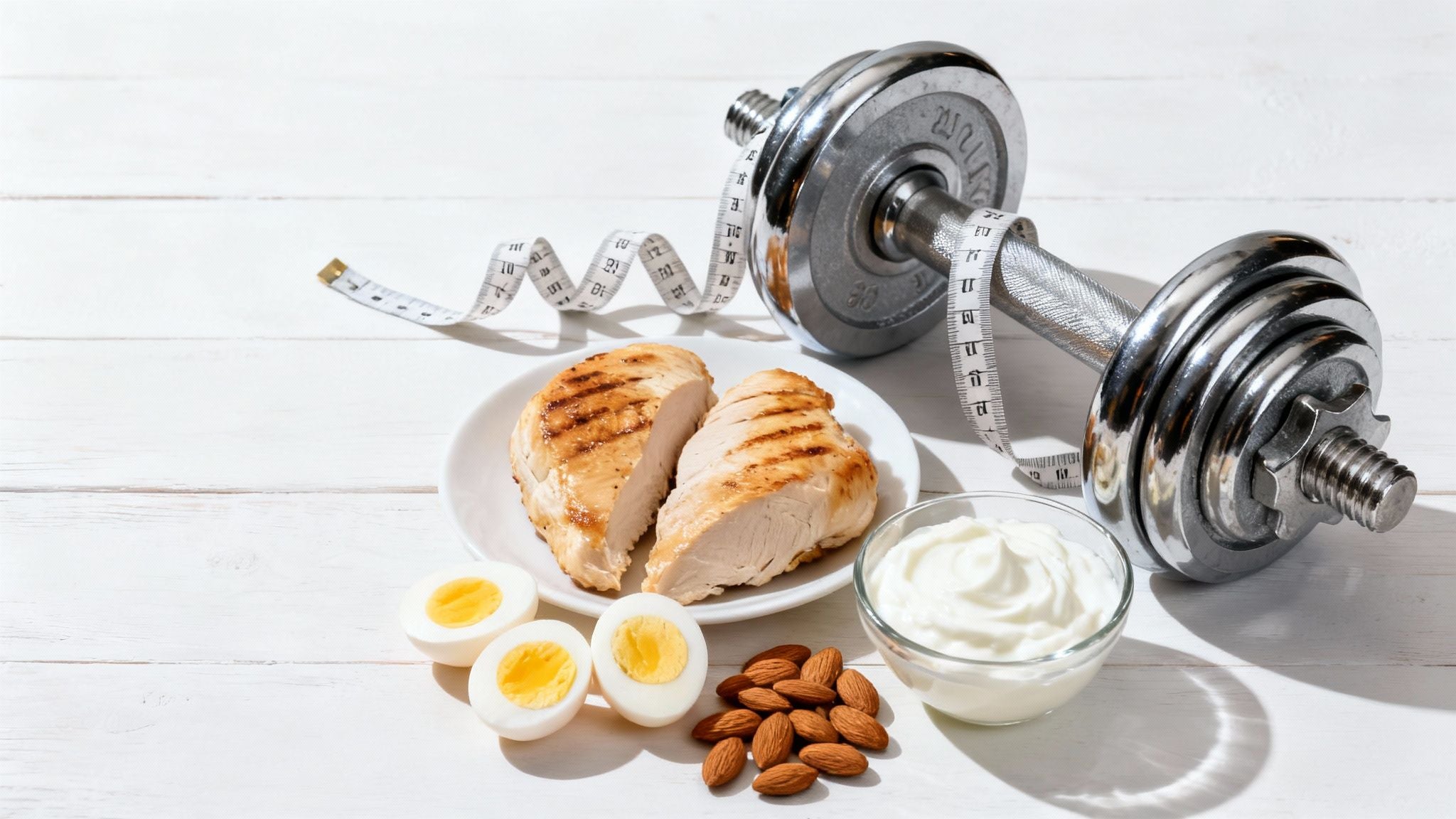
How much protein to build muscle: Discover your ideal amount
So you want to build muscle, but the jungle of protein myths is confusing you? Don't worry, the science is quite clear here. For most people who train regularly and push themselves, the optimal range is between 1.6 and 2.0 grams of protein per kilogram of body weight per day. More often doesn't mean more—at least not for your muscle growth.
How much protein is really needed to build muscle
If your goal is to build muscle, you can't avoid protein. Think of it as the building blocks for a house. After every hard workout, tiny tears develop in your muscle fibers. Protein provides the necessary amino acids—the bricks—to not only repair these tears but rebuild the muscles stronger and larger. Without enough building material, your project stalls.
But the question “How much is enough?” often causes confusion. Many people at the gym swear by the motto “more is better.” However, research paints a clearer picture. A comprehensive meta-analysis, also cited by German nutrition experts such as the DGE, comes to a fairly clear conclusion: Above around 1.6 g of protein per kg of body weight, there is hardly any significant additional benefit for muscle growth.
Interestingly, the average protein intake in Germany is already a solid 1.2 g/kg. So you probably aren't starting from zero.
The foundation of your protein intake
What does this mean for you? You don't need to drink huge amounts of shakes or eat nothing but chicken breast. It's about finding your personal sweet spot. Your training level, calorie intake, and even your age all play an important role.
This infographic clearly shows the difference between the normal maintenance requirement and what you should aim for to achieve real muscle growth.
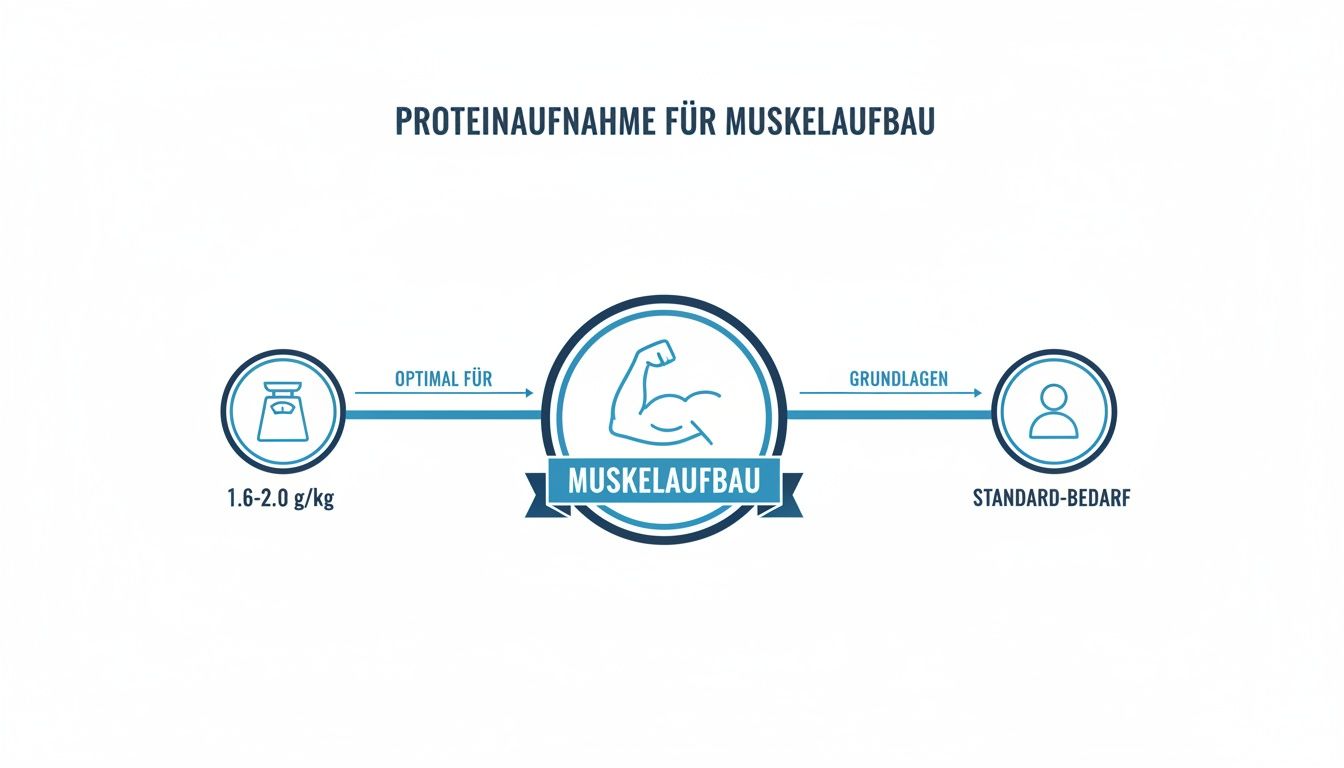
It is clear: To build muscle, we need to step things up deliberately to really stimulate muscle protein synthesis.
Your body is not a machine that operates according to a rigid plan. The guidelines given here are an excellent starting point. However, your individual genetics and metabolism can determine how well you utilize protein and whether you achieve the best results at the upper or lower end of the range.
To make getting started easier, we have summarized the most common recommendations in a clear table.
Your Daily Protein Requirement by Training Goal
This table shows the recommended amounts of protein in grams per kilogram of body weight, depending on your goals and training intensity.
| Training Goal & Level | Description | Recommended Protein Intake (g/kg) |
|---|---|---|
| Normal & Inactive | Maintaining basic functions, with no specific training goal. | 0.8–1.0 g/kg |
| Recreational Sports & Fitness | Regular, moderate activity for general fitness. | 1.2–1.5 g/kg |
| Muscle Gain (Beginner) | Strength training aimed at building muscle mass. | 1.6–1.8 g/kg |
| Muscle Gain (Advanced) | Intensive strength training, with a focus on maximum hypertrophy. | 1.8–2.0 g/kg |
| Diet & Muscle Preservation | Calorie deficit aimed at losing fat while protecting muscle. | 1.8–2.2 g/kg |
Use these figures as a starting point and observe how your body responds. Do you feel good, recover quickly, and make progress? Perfect. If not, a small adjustment may make all the difference.
Why Your Body Needs Protein to Build Muscle
To understand why the famous 1.6 to 2.0 grams of protein per kilogram of body weight is so often described as the gold standard for muscle growth, we need to take a look behind the scenes. A process takes place in your body that determines everything: muscle protein synthesis, or MPS for short.
Think of the whole process like a construction site. Every workout is the signal that new buildings—in other words, your muscles—should be constructed. You provide a stimulus that causes tiny tears in your muscle fibers. This is the starting signal for the construction work. MPS is ramped up to repair this damage and rebuild the fibers stronger and thicker. Protein supplies the essential building blocks for this: amino acids.
Muscle protein synthesis is the direct engine of your muscle growth. Without enough protein, this engine has no fuel—and the construction site comes to a standstill. Every protein-rich meal provides the material needed to drive growth forward.
The Engine of Your Muscle Growth
However, this engine only runs at full power when there is enough building material. If your protein intake is too low, your body simply cannot put the growth signals from training into action. The result? Your recovery slows down and muscle growth stalls.
That is precisely why it is so important to keep MPS going through a consistent supply of protein. Your body is in a constant cycle of muscle building (anabolism) and muscle breakdown (catabolism). Your goal is to promote the anabolic, or muscle-building, processes through smart training and the right diet.
Adequate protein intake ensures that the rate of muscle protein synthesis exceeds that of muscle breakdown. This positive balance ultimately leads to visible muscle growth.
Why more is not always better
The scientific evidence provides clear guidance here. A position paper supported, among others, by the German Nutrition Society (DGE), recommends an intake of 1.2 to 2.0 g/kg body weight for athletes with a high training load. An analysis in the journal Sports Medicine confirms that around 1.6 g/kg is a highly practical guideline, beyond which the additional benefit for muscle growth is only small. You can read more here: Optimal protein intake for muscle growth on zeitschrift-sportmedizin.de.
Your body can only use a limited amount of protein per meal for MPS anyway. Anything far beyond that is simply used for other purposes or burned as energy.
Special situations require adjustments
Your personal protein requirement is, of course, not set in stone. There are situations in which your body needs even more support:
- While in a calorie deficit: If you are currently dieting to reduce body fat, your body may use muscle protein as an energy source. A higher protein intake (up to 2.2 g/kg) counteracts this muscle loss and protects the muscle mass you have worked hard to build.
- As you get older: Older people tend to need slightly more protein to achieve the same muscle-building response as younger people. This helps counteract age-related muscle loss (sarcopenia).
- As a beginner to training: At the very beginning of your training journey, your body responds particularly strongly to new stimuli. An intake at the lower end of the recommended range (approx. 1.6 g/kg) is often already extremely effective.
Calculate your personal protein requirement with ease
Now let’s get practical! You know the general recommendations, but how much protein do you personally need to grow your muscles? Don’t worry, the calculation is easier than you might think. You only need two numbers: your current body weight and the appropriate factor from our guidelines.
The formula is as simple as it gets:
Your body weight (in kg) x recommended factor (in g/kg) = your daily protein requirement (in g)
With this result, you have a clear, practical number to work with. It is your daily target value to ensure that your muscles get exactly the building blocks they need to grow.
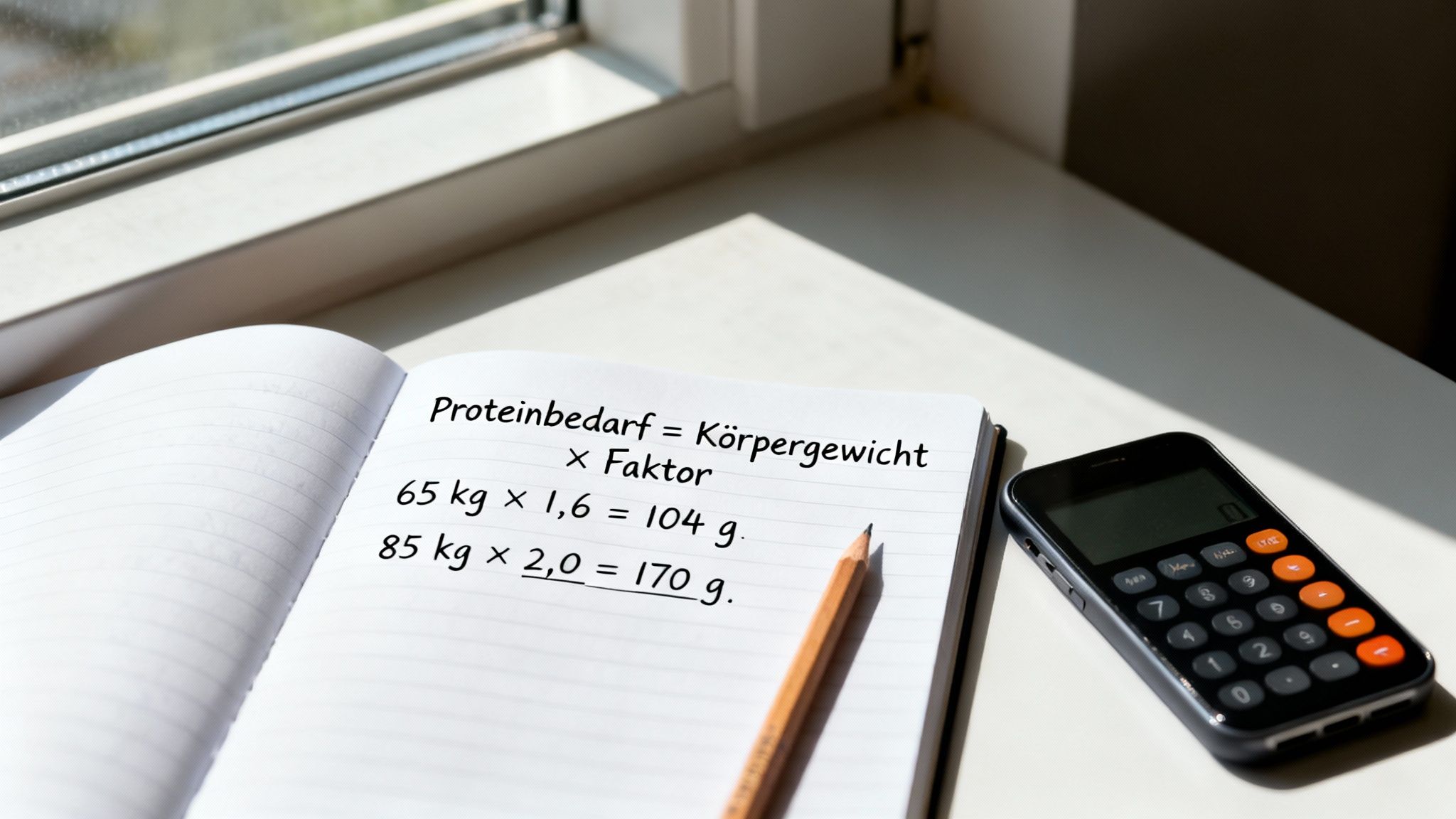
How to calculate it in practice
Let’s work through two specific examples so you can see how simple it is. Let’s take a woman with a moderate training routine and a man with ambitious goals.
See how different the requirements can be? Your weight and goals make the crucial difference. To make it even more tangible, here is a small table for you to calculate:
Example calculation of your daily protein requirement
This is how you calculate the daily protein requirement for a 65 kg person and an 85 kg person with different training goals.
| Person & goal | Body weight | Factor (g/kg) | Daily protein requirement (g) |
|---|---|---|---|
| Woman, general muscle building | 65 kg | 1.7 g/kg | 110,5 g |
| Man, ambitious muscle building | 85 kg | 2.0 g/kg | 170 g |
These examples show how individual the right amount of protein is. There is no one-size-fits-all solution—only your personal approach.
If you want to explore the topic in more depth, you’ll find many more valuable tips and background information in our detailed guide to daily protein requirements.
Meeting your daily protein needs
Okay, so now you have your target number. But how do you translate this value into actual meals on your plate? The best approach is to develop a feel for how much protein common foods contain.
Here are a few examples for guidance:
- 100 g chicken breast: approx. 25–30 g protein
- 150 g low-fat quark: approx. 18–20 g protein
- 3 large eggs: approx. 18–20 g protein
- 100 g lentils (cooked): approx. 9 g protein
- A protein shake (30 g powder): approx. 22–25 g protein
If you distribute these foods intelligently throughout the day, you can meet your personal needs in a targeted way without much effort.
When and which protein works best
You now know how much protein you need—but the total amount is only half the battle. To unlock your full muscle-building potential, it also matters when you eat your protein and which protein you choose.
So the question is not just “how much?” but also “how should it be distributed?” The answer is quite simple: evenly. Your body cannot process and store the entire daily amount all at once. To keep muscle protein synthesis, the building process, consistently elevated, it is ideal to divide your protein intake across 3 to 4 meals spaced a few hours apart.
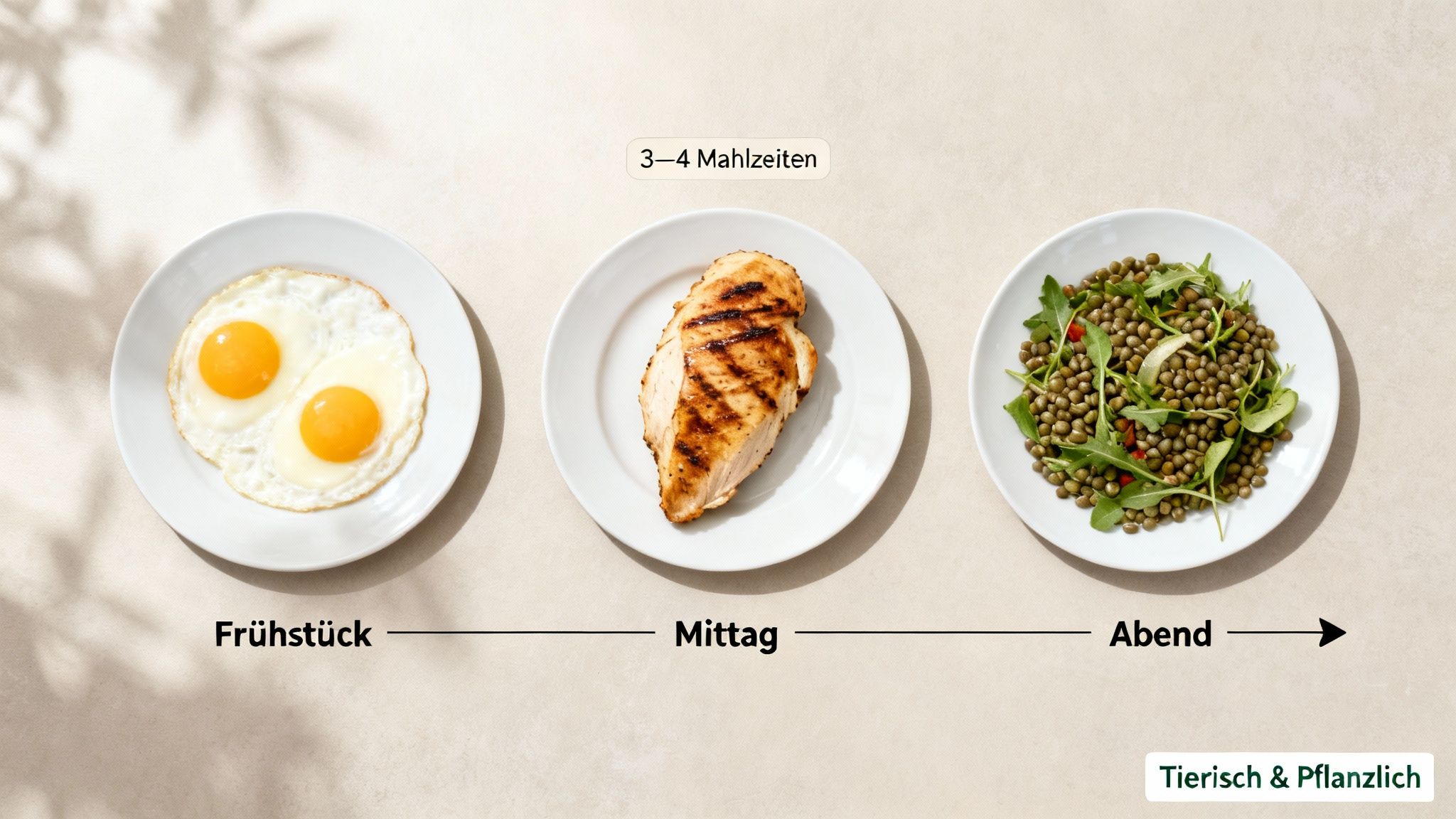
Each of these meals should contain around 20 to 40 grams of protein. This repeatedly gives your body the impulse to start repair and growth processes, rather than sending one huge signal only once a day that it cannot fully act on.
The anabolic window—a myth with a grain of truth
You may already have heard of the “anabolic window”—the idea that you have to down a protein shake immediately after training to avoid losing gains. The good news: This window is much larger than people think. Your total intake over the course of the day is far more important than getting the timing down to the exact minute.
A shake directly after training is convenient, but not essential. Much more important is that you eat a protein-rich meal within a few hours after your workout. That is completely sufficient to optimally support recovery.
The quality of your protein is crucial
Not all protein is the same. Quality is often measured by biological value. This value indicates how well your body can convert the protein absorbed from food into the body's own protein. Animal proteins from eggs, dairy products, or meat often come out on top because their amino acid profile is very similar to ours.
A particular superstar among the amino acids is leucine. Leucine is considered the main switch that directly activates muscle protein synthesis.
Protein sources with a high leucine content, such as whey protein, are particularly effective at stimulating muscle growth after training. That is why they are so popular among athletes.
But what if you follow a plant-based diet? Don’t worry—muscle growth works excellently on a fully vegan diet too. You just need to keep a few things in mind.
- Combine intelligently: Plant-based protein sources such as lentils, beans, or rice often do not contain all the essential amino acids in optimal amounts. No problem! By combining different sources (e.g., rice with beans), you can easily ensure a complete amino acid profile.
- Pay attention to the amount: Since plant-based proteins often contain slightly less leucine, it may make sense to increase the total amount slightly. This ensures that you create the same anabolic stimulus.
- Embrace variety: Quinoa, tofu, tempeh, hemp seeds, and pea protein are excellent plant-based sources that provide a broad range of nutrients. A well-planned and varied diet as an athlete is the key to success—whether or not it includes animal products.
How your metabolism affects your protein requirements
You follow the recommendations, meticulously count your macros, and give it everything you have in training—but the visible results are slow to appear? That is extremely frustrating. Most of the time, however, it is not due to a lack of discipline, but to your very personal biology. The general guidelines are a great starting point, but they overlook one crucial factor: you.
Your individual metabolism, your genes, and even the bacteria in your gut play a major role in determining how effectively your body can use the protein from your diet. While your training partner achieves top results with 1.6 g of protein per kilogram of body weight, your body may naturally need a little more to send the same anabolic signals for muscle growth.
Why standard recommendations are not always enough
Everyone is different. That may sound banal, but it is the absolute key to understanding your body. Some people are naturally what are known as “fast responders,” whose muscle protein synthesis is already running at full speed with a moderate protein intake. Others may need a higher proportion of the amino acid leucine or very specific protein sources to trigger the same growth stimulus.
Instead of fumbling in the dark and arbitrarily increasing your protein intake, you can find out precisely what your body really needs. Modern health analyses, such as a DNA metabolism test from mybody-x, provide precise insights into your genetic predisposition. You learn how your body responds to macronutrients such as protein and finally receive recommendations that are truly based on data—your data.
Your body is not a standard model. Your genetics partly determine whether you metabolize protein quickly or slowly and which sources are most effective for you. A personalized analysis can be the decisive step in breaking through a plateau.
Find your personal optimum
In fact, studies show that the majority of Germans are already well supplied with around 1.2 g of protein per kilogram of body weight and that amounts above 1.6 g/kg barely improve nitrogen balance. That is precisely why it is so important to find your individual optimum instead of blindly consuming more and more. Whether you perform best with 1.2 g/kg, 1.6 g/kg, or perhaps closer to 2.0 g/kg depends on your unique system.
A deeper understanding of how your body works is the foundation for lasting success. If you want to better understand the fundamentals of your engine, read our guide, Metabolism Explained Simply. With this knowledge, you can truly personalize your diet and reach your full potential.
Frequently asked questions about protein and muscle building
After all this information, you may still have one or two questions on your mind. That is completely normal! To wrap things up, let's clear up the most common uncertainties so you can start your nutrition strategy with complete confidence.
Is too much protein harmful to the kidneys?
The concern that high protein intake harms the kidneys persists. The good news: For the vast majority of healthy people, this fear is unfounded. Current scientific research clearly shows that a high-protein diet does not cause kidney damage in people with healthy kidneys. Your body is clever and simply adapts to the higher intake by excreting waste products more efficiently.
Caution is only necessary if you already have kidney disease. In that case, you should absolutely discuss your protein intake with a doctor. For everyone else, the following applies: The recommended 1.6 to 2.2 grams of protein per kilogram of body weight is a completely safe and effective range for building muscle.
Do I need to drink a protein shake right after training?
Ah, the famous “anabolic window”—the myth that you practically have to drink your shake in the changing room to avoid losing gains. The truth is more relaxed: Yes, your body is particularly receptive to nutrients after training, but this window is open for several hours, not just a few minutes.
Much more important than a perfectly timed shake is the total amount of protein you consume throughout the day. Instead, make sure your muscles receive a constant supply of building blocks. A shake is a very practical and quick option, but it isn’t essential. A wholesome, protein-rich meal works just as well.
Can you build muscle with purely plant-based protein?
Absolutely! Building muscle with a purely plant-based diet is not only possible, but has long been practiced by countless successful female and male athletes. The key lies in cleverly combining different plant-based sources. Animal products often naturally have a complete amino acid profile; with plant-based foods, you just need to think a little more strategically.
For example, combine legumes such as lentils or chickpeas with grains such as rice or quinoa. This ensures that your body gets all the essential amino acids it needs to build muscle. High-quality sources such as soy, hemp, or pea protein are also an excellent choice. Often, women’s protein requirements, as well as men’s, can be easily met entirely through plant-based foods with a little planning.
What happens if I consume too little protein?
Quite simply: A protein deficiency sabotages all your efforts in training. If you don’t provide your body with the necessary building blocks for repair and growth, muscle protein synthesis cannot operate at full capacity.
The result? Your recovery slows down, your muscle growth stalls, and in the worst case, your body even breaks down muscle mass because it has to get its energy from somewhere else. Sufficient protein intake is therefore not a nice recommendation, but the absolute foundation of your success.
Are you ready to move from general recommendations to a strategy tailored precisely to your body? At mybody-x.com, we analyze your individual metabolism and provide data-driven insights so you can unlock your full potential. Find out now what you’re really capable of: Discover your personal health analysis at mybody-x.com.



Share now:
How much does a DNA test cost: what’s included in the price and what isn’t
Metabolism Analysis Step-by-Step: How to Optimize Your Diet