
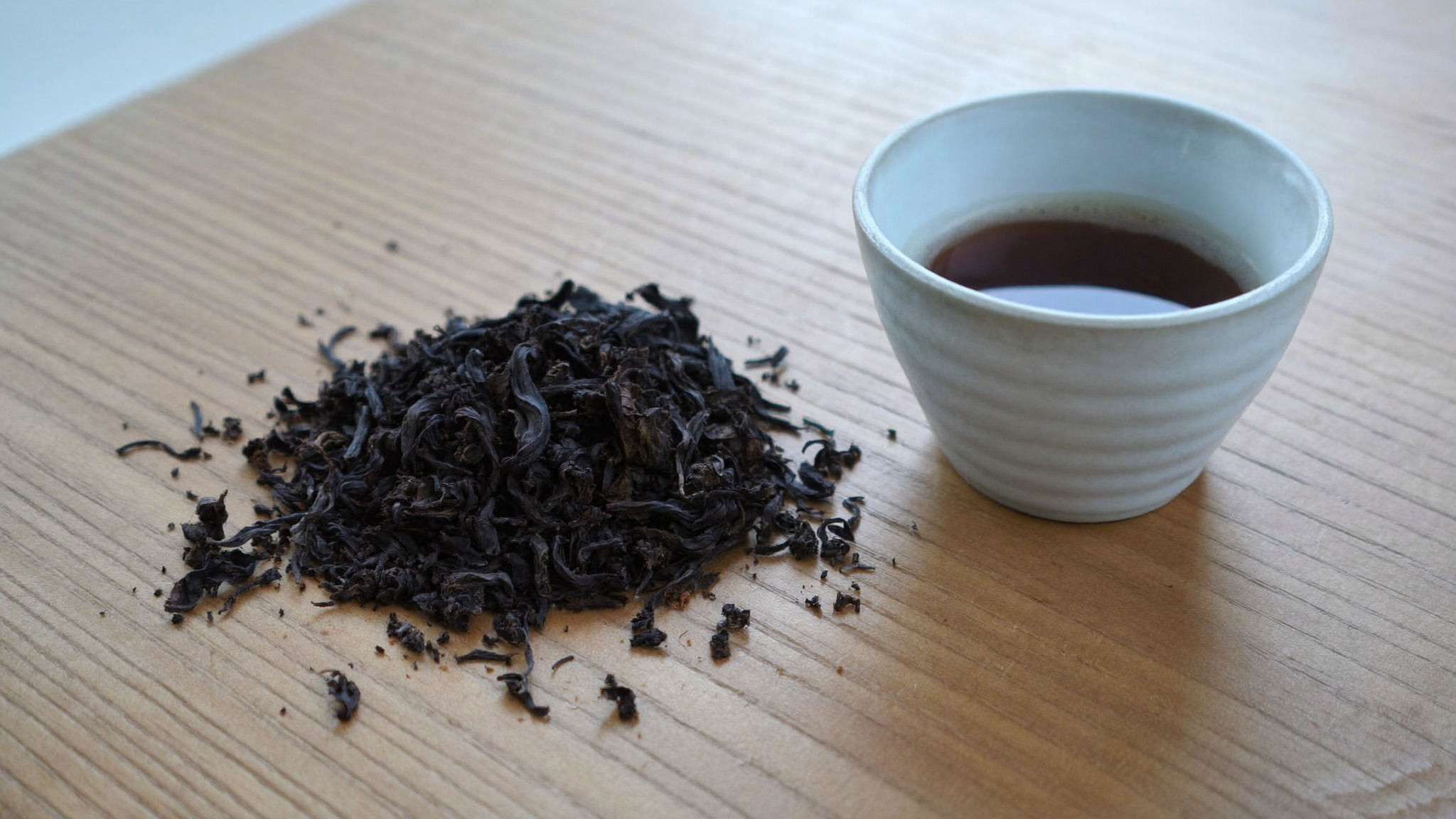
How much caffeine does black tea contain? The figures compared
The essentials at a glance
According to the German Federal Institute for Risk Assessment, a 200-milliliter cup of black tea contains 45 milligrams of caffeine. For comparison, the same source lists 90 milligrams for 200 milliliters of filter coffee. Black tea therefore contains half as much—not an insignificant amount, but clearly less than coffee in the same volume.
According to the BfR, healthy adults can safely consume up to 400 milligrams spread throughout the day, and up to 200 milligrams as a single dose. In terms of cups of black tea, that is just under nine and a little over four cups, respectively. For pregnant and breastfeeding women, the daily amount is halved to 200 milligrams.
This article puts the figures into context. It starts with the figure itself and the amounts considered safe. Then it compares black tea with coffee, espresso, and energy drinks, examines three common misconceptions, and explains why the figure may differ in your own cup. Finally, it looks at why two people can tolerate the same amount of caffeine so differently.
What to expect in this article
1. The figure and what is considered safe
2. Black tea compared with other beverages
3. How many cups that means in concrete terms
4. Three misconceptions about caffeine in tea
5. Why your cup may differ
6. Tea, filter coffee, and espresso side by side
7. Why people react so differently
8. What a DNA test does not tell you about this
9. What ultimately matters
Frequently asked questions
Sources
The figure and what is considered safe
In its information on caffeine, the German Federal Institute for Risk Assessment lists the caffeine content of common beverages. For a 200-milliliter cup of black tea, it gives a figure of 45 milligrams (as of January 5, 2026).
That answers the original question. More interesting is what the same source says about the amounts considered safe—because two different figures appear side by side, and confusing the two is the most common mistake when it comes to caffeine.
“
“For habitual consumption, an intake of up to 400 mg of caffeine spread throughout the day is considered safe for healthy adults.”
German Federal Institute for Risk Assessment (BfR)
Questions and answers about caffeine, as of 2026
Two figures, not one
In addition to the daily amount, the BfR specifies a second limit: Caffeine intakes of up to 200 milligrams as a single dose or within a short period are also considered safe for healthy adults—equivalent to 3 milligrams per kilogram of body weight (as of 2026).
The two figures describe different things. 400 milligrams is the upper limit for the entire day, spread out over time. 200 milligrams is the upper limit for a single occasion. Anyone who drinks 400 milligrams at once exceeds both limits.
Key point
According to the BfR, a 200-milliliter cup of black tea contains 45 milligrams of caffeine—half as much as a 200-milliliter cup of filter coffee, which contains 90 milligrams.
Why the distinction matters in practice
Anyone who remembers only the 400 milligrams can stay within the amount correctly and still come close to exceeding the second limit. The classic example is an afternoon when three cups of filter coffee are drunk in quick succession: 270 milligrams in a short time, while the daily total remains below 400.
This situation is less common with black tea because each serving provides only half as much. Four cups in a row amount to 180 milligrams and are therefore still below the single-dose limit.
In everyday life, the single-dose limit is therefore most likely to be exceeded not by tea or filter coffee, but by combining several strong beverages within a short time—for example, an energy drink with coffee or two espressos in a row followed by a latte. Such combinations go unnoticed because each drink seems unremarkable on its own.
A second scenario is the morning after a short night. Anyone who has slept poorly drinks their usual two cups closer together than usual and reaches for another one sooner. The daily amount stays the same, but the timing becomes more concentrated.
This is the tea's real advantage over coffee when the same amount is consumed: not that it is low in caffeine, but that the same total amount is distributed across more servings and therefore over a longer period.
Who different figures apply to
According to the BfR, the 400 milligrams applies to healthy adults. For pregnant and breastfeeding women, the same source considers an intake of up to 200 milligrams spread throughout the day to be safe—that is, half as much.
For children and adolescents, the BfR does not use a fixed number of milligrams, but body weight: 3 milligrams of caffeine per kilogram of body weight. For a child weighing 30 kilograms, that amounts to 90 milligrams—two cups of black tea.
What the limits mean—and what they do not
The BfR's wording must be read carefully. It states that the specified amounts are considered safe for health—not that exceeding them automatically causes harm.
The difference is between an assurance of safety and a danger threshold. Anyone who consumes 450 milligrams in one day has not exceeded a limit in the sense of a warning; they have merely moved outside the range for which safety was established.
The reverse is equally true: Staying below these values does not protect anyone from side effects. People who are sensitive to caffeine may become restless after just two cups of tea—the BfR figures are population averages, not individual tolerance limits.
For everyday life, this means that the figures serve as guidance, not as a free pass or a prohibition. Anyone who sleeps poorly or experiences palpitations has a reason to drink less, even if they are below 400 milligrams.
Black tea compared with other beverages
The comparison is easiest to understand directly. For four common beverages, the BfR gives the caffeine content of a typical serving.
Caffeine per serving in milligrams
Values from the German Federal Institute for Risk Assessment (BfR), as of 2026. The bar lengths correspond to the stated milligram values; serving sizes differ and are shown alongside each one.
Two observations are worth noting. First: Espresso and energy drinks are tied at 80 milligrams each—despite their very different serving sizes. A 60-milliliter espresso reaches the same value as a 250-milliliter energy drink.
That is the graphic’s central lesson: A bar says something only in conjunction with the serving size. Anyone who wants to rank beverages by strength must decide whether to compare them per serving or per milliliter—and the two rankings differ.
Per serving, filter coffee leads with 90 milligrams. Per milliliter, espresso leads by a clear margin. And when asking how much caffeine is consumed in a day, only the serving matters—people drink cups and glasses, not milliliters.
Second: At 45 milligrams, black tea is clearly at the lower end, but it is not a caffeine-free beverage. Anyone who switches from coffee to tea halves their intake for the same amount consumed—they do not eliminate it.
Anyone who genuinely wants to avoid caffeine must choose herbal or fruit tea. Black, green, and white tea all come from the same plant and therefore all contain caffeine—however, in the table used here, the BfR gives a value only for black tea.
Consequently, the reviewed material cannot answer whether green tea contains more or less caffeine than black tea. Estimating a figure would be worse than acknowledging the gap—and it is not needed for this article’s initial question anyway.
How many cups this means in concrete terms
Milligram amounts are difficult to grasp in everyday life. Converting them into cups makes the matter clearer—the following figures are derived directly from the BfR values.
Black tea, converted to the BfR limits
- ✓ One 200 ml cup: 45 mg – the BfR’s baseline value.
- ✓ Up to a single dose of 200 mg: just over four cups – consumed all at once or within a short period.
- ✓ Up to the daily amount of 400 mg: just under nine cups – spread throughout the day.
- ✓ Pregnant and breastfeeding women, up to 200 mg daily: just over four cups – spread throughout the day.
- ✓ Beware of mixing – anyone who also drinks coffee must add the two together.
Where else caffeine is hidden
In addition to coffee and tea, the BfR table explicitly lists energy drinks—one beverage that is rarely included in people’s own caffeine calculations. A 250-milliliter can provides 80 milligrams, nearly as much as two cups of black tea.
Anyone who drinks two energy drinks, two cups of filter coffee, and two cups of tea in one day reaches 430 milligrams—above the daily limit for healthy adults, even though none of the three drinks would have been notable on its own.
That is exactly why the BfR formulates the values as a total. The question is not how much tea is safe, but how much caffeine accumulates overall.
The last point is the most important and the one most often overlooked. The BfR values refer to total intake, not to a single drink. Two cups of filter coffee in the morning and three cups of tea in the afternoon add up to 315 milligrams—significantly more than either amount would suggest on its own.
In brief
According to the BfR, a 200-milliliter cup of black tea contains 45 milligrams of caffeine, while a cup of filter coffee of the same size contains 90 milligrams. For healthy adults, up to 400 milligrams spread throughout the day and up to 200 milligrams as a single dose are considered safe; for pregnant and breastfeeding women, the limit is up to 200 milligrams per day. What matters is the total from all caffeinated drinks, not the amount in any one drink.
A calculation example for a normal day
Two cups of filter coffee in the morning provide 180 milligrams. An espresso after lunch adds 80 milligrams, bringing the total to 260. Two cups of black tea in the afternoon contribute 90 milligrams—bringing the daily total to 350 milligrams.
That is below the daily limit of 400 milligrams and therefore seems unremarkable. The notable point comes elsewhere: Two cups of coffee in the morning total 180 milligrams, just below the single-dose limit of 200 when drunk shortly one after the other.
If you turn that into three cups, the 270 milligrams clearly exceed the single-dose limit—and with a daily total of 440 milligrams, also exceed the second limit. The jump from two to three cups in the morning is therefore greater than it feels.
For tea, the same picture looks less concerning: Nine cups spread throughout the day add up to 405 milligrams, but in practice it is difficult to drink four or more of them within a short period. The smaller serving size acts like a built-in brake.
Three misconceptions about caffeine in tea
Why your cup may differ
The BfR value of 45 milligrams refers to a 200-milliliter cup. It is a reference value for a typical beverage, not a measurement of your specific preparation.
Switching from coffee to tea halves caffeine intake—it does not eliminate it.
Three factors shift the result in practice. The first is the cup size: a large mug can quickly hold 300 or 350 milliliters instead of 200. The caffeine content increases proportionally, without anything about the tea changing.
The second is the amount of tea per cup, and the third is the steeping time. The extent to which these two change the caffeine content is not quantified in the source material used here—estimating a figure here would be worse than acknowledging the gap.
That is still sufficient in practice. Anyone who uses the BfR values as an approximate guide and takes their own cup size into account will be close enough to reality to calculate with them.
The mug is the real problem
Of the three factors, the size of the vessel is the only one that can be determined without effort—and also the one with the greatest effect. A classic teacup holds around 200 milliliters, while a typical mug holds 300 to 350.
This increases the caffeine content from 45 to around 68 to 79 milligrams per serving. The nearly nine cups up to the daily limit become five to six mugs. This is not a minor detail, but almost a halving of the number of servings.
If you want to know exactly, fill your mug with water once and measure the amount with a measuring jug. Divide this number by 200 and multiply it by 45 to calculate the caffeine content per mug. It is a one-time effort for a number that will remain accurate thereafter.
Tea, filter coffee, and espresso side by side
The following comparison combines the BfR values with the limits. The cup figures are calculated and rounded from the stated milligram values.
| Criterion | Black tea | Filter coffee | Espresso |
|---|---|---|---|
| Serving according to the BfR | 200 ml | 200 ml | 60 ml |
| Caffeine per serving | 45 mg | 90 mg | 80 mg |
| Servings up to the single dose of 200 mg | just over four | just over two | two and a half |
| Servings up to the daily amount of 400 mg | just under nine | just over four | five |
| Caffeine per 100 ml | 22.5 mg | 45 mg | around 133 mg |
Caffeine content and limits: German Federal Institute for Risk Assessment (BfR), as of 2026. Serving counts and values per 100 ml calculated and rounded from these figures.
The last line explains why espresso is considered particularly strong. At around 133 milligrams per 100 milliliters, it contains significantly more caffeine than filter coffee. But because the serving is small, the glass ultimately contains less than a cup of filter coffee.
What this means for switching
Anyone switching from coffee to tea to consume less caffeine should pay attention to two things. The first is the quantity: two cups of filter coffee correspond to four cups of tea. If you double the number of cups when switching, you have gained nothing.
The second factor is cup size. Tea is more often drunk from large mugs than filter coffee is from cups. Someone who switches from a 200-milliliter cup of coffee to a 350-milliliter mug of tea reduces their intake from 90 to around 79 milligrams—far less than comparing the values per 200 milliliters would suggest.
This is not a warning against switching, but a clarification. The halving applies to the same quantity—and that does not happen automatically in everyday life.
Why people react so differently
The BfR values apply to the population, not to individuals. Everyone knows people who drink an espresso in the evening and fall asleep immediately—and others for whom a cup of tea in the afternoon ruins the night.
Part of this difference is due to habituation. Someone who drinks several cups every day reacts differently from someone who does so rarely—this is the most obvious explanation and the one most often underestimated.
A second factor is timing. Caffeine in the late afternoon affects you differently from the same caffeine in the morning because it takes hours to break down and its effects extend into the evening. If you sleep poorly, the cause is often not the drink itself but the time of day.
A third factor is genetic predisposition. How quickly the body breaks down caffeine is partly determined by genetics. mybody®x (MYBODY Lab GmbH) provides a dedicated report on this in its DNA test.
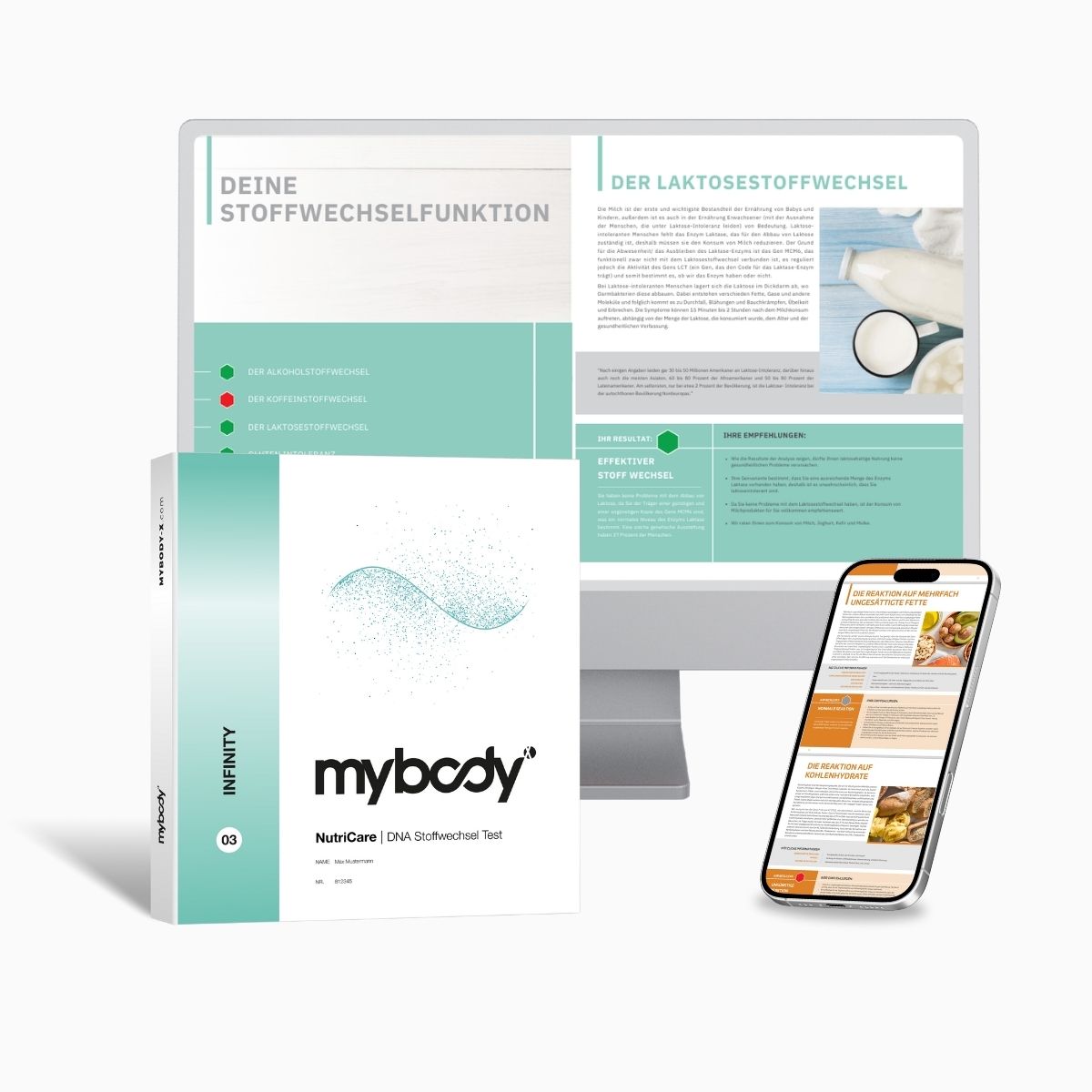
NutriCare | INFINITY DNA test
The “mybody® Metabolism Type” chapter includes a dedicated report on caffeine metabolism, alongside alcohol and lactose metabolism and gluten intolerance. A total of 54 reports based on more than 140 genetic variants. What the test does not do: It does not measure how much caffeine is currently in your blood, and it does not provide a diagnosis. It describes a predisposition—how you actually react also depends on habituation, sleep, and how you feel that day. Method: SNP genotyping with more than 700,000 SNPs; not whole-genome sequencing.
Price: €269.00 · Sample type: saliva sample · Processing time: Kit shipping 1–3 business days, laboratory analysis 15–25 business days after sample receipt · Laboratory: ISO-certified laboratory analysis in Germany
About NutriCare INFINITYA DNA test is a one-time test—the genetic predisposition does not change. That is the substantive difference from a blood test, which reflects your current status and is therefore repeated.
The self-experiment beats any guess
Before you have any testing done, there’s a free way to get clarity quickly. For two weeks, don’t consume any caffeine after 2 p.m.—neither tea, coffee, nor energy drinks—and note how you sleep.
If nothing changes, caffeine is probably not the issue affecting your sleep. If you sleep significantly better, you have your answer without a genetic analysis having to provide it.
What a DNA report adds beyond that is context: it explains why you react the way you do and places the observation within a larger picture. It does not replace the observation itself.
All prices and service details are current as of August 5, 2026. Prices and the scope of services may change; the applicable product page is always authoritative.
What a DNA test does not tell you
The first limitation is the most important: a DNA test does not change the BfR recommendations. The limits of 400 milligrams per day and 200 milligrams as a single dose apply regardless of what a genetic report says.
The second limitation concerns its relevance in everyday life. A predisposition describes a tendency, not a rule. Whether you fall asleep after an espresso at 6 p.m. also depends on how much you drank in the preceding days, how well you slept, and how stressful the day was.
The third limitation concerns the method. A DNA test is not a diagnostic procedure, does not predict illness, and does not replace a medical examination or consultation.
And there is a fourth point that honestly belongs here: for the question addressed in this article—how much caffeine black tea contains—you do not need a test. The answer is freely available from the BfR: 45 milligrams per 200 milliliters.
When caffeine should be discussed with a doctor
There are situations in which the general quantity guidelines are not the right benchmark and neither an article nor a test will help.
These include cardiac arrhythmias, high blood pressure, anxiety disorders, and persistent sleep problems. Caffeine may play a role in all these cases, and the appropriate amount is a medical decision, not a calculation based on cups.
The same applies if you take medication regularly. Interactions between caffeine and certain active ingredients are possible, and your pharmacy or treating practice can clarify whether they are relevant in your case.
During pregnancy, the BfR specifies 200 milligrams as a separate limit. This, too, does not replace a discussion with your attending doctor or midwife; it simply provides a framework for it.
What matters in the end
At 45 milligrams per 200 milliliters, black tea contains half as much caffeine as an equally sized cup of filtered coffee. That makes it the milder alternative, not a caffeine-free one.
In practice, two numbers and one rule matter: up to 400 milligrams over the course of a day, up to 200 milligrams at once—and add up everything that contains caffeine. If you combine coffee and tea, you reach the limits faster than either drink alone might suggest.
The second practical insight concerns cup size. A mug can easily hold one and a half times as much as a cup, so the caffeine content increases proportionally. Knowing your own cup size lets you calculate more accurately than any table can.
And the third point: The BfR values are population-level values. They indicate what is generally considered safe—not what you personally tolerate. If two cups of tea make you restless, that is a good reason to drink less, even if you are well below 400 milligrams.
Your specific next step: For one day, count how many cups and mugs you actually drink and note their size. Multiply the amounts by 45 for tea and 90 for filter coffee per 200 milliliters, and you’ll have your daily total in two minutes—and know whether this is even an issue for you.
Frequently asked questions
How much caffeine is in a cup of black tea?
The German Federal Institute for Risk Assessment states that 200 milliliters of black tea contain 45 milligrams of caffeine. For comparison, according to the BfR, the same amount of filter coffee contains 90 milligrams, a 60-milliliter espresso contains 80 milligrams, and a 250-milliliter energy drink also contains 80 milligrams. If you use a larger cup, you need to calculate accordingly.
How many cups of black tea can I drink per day?
According to the BfR, a caffeine intake of up to 400 milligrams spread throughout the day is considered safe for healthy adults—equivalent to just under nine 200-milliliter cups. Up to 200 milligrams is considered safe as a single dose, or just over four cups. It is important to add up all caffeinated beverages: Anyone who also drinks coffee will reach the limits much sooner.
Is black tea allowed during pregnancy?
The BfR considers an intake of up to 200 milligrams of caffeine spread throughout the day to be safe for pregnant and breastfeeding women—half the amount recommended for healthy adults. In terms of 200-milliliter cups of black tea, that is just over four cups. Here too, the total from all caffeinated beverages counts. For questions about an individual situation, the doctor or midwife providing care is the right person to contact.
Does espresso contain more caffeine than filter coffee?
Per milliliter, yes; per serving, no. The BfR lists 80 milligrams for a 60-milliliter espresso and 90 milligrams for 200 milliliters of filter coffee. Converted, that is around 133 milligrams per 100 milliliters for espresso compared with 45 milligrams for filter coffee. However, because an espresso serving is significantly smaller, a cup of filter coffee ultimately contains more caffeine.
Why do I tolerate caffeine differently from other people?
How quickly the body breaks down caffeine varies from person to person and is influenced in part by genetics. Tolerance also plays a role: People who regularly drink caffeinated beverages react differently from those who rarely do. A DNA test can describe a predisposition, but it does not measure the current caffeine level in the blood and does not replace medical advice. The BfR’s recommended amounts apply regardless.
If you’re interested in your predisposition
The BfR's quantity recommendations apply to everyone. How quickly your body breaks down caffeine is another question—the DNA test provides a separate report on this in the Metabolic Type chapter.
View NutriCare INFINITY Longevity ALL IN ONEYou might also be interested in this
→ Is coffee healthy? Your genes know the answer
The same question from the perspective of coffee, with a focus on its effects.
→ Fasting for a blood test: Is coffee really off-limits?
When caffeine can affect laboratory values and when it cannot.
Sources
- German Federal Institute for Risk Assessment (BfR): Questions and answers about caffeine and caffeinated foods, including energy drinks, status as of January 5, 2026 — bfr.bund.de
All caffeine amounts per serving, the single dose of 200 milligrams, the daily amount of 400 milligrams, the information for pregnant and breastfeeding women, and the value of 3 milligrams per kilogram of body weight for children and adolescents are based on source [1]. The conversions into cup quantities and the values per 100 milliliters are calculated and rounded from these figures; the calculation basis is provided below each graphic or table. Product information comes from the mybody®x product pages, accessed on August 5, 2026.

mybody®x Editorial & Expert Team
Nutrigenetics Metabolism Nutritional science
This article was created and professionally reviewed by the mybody®x Editorial and Expert Team. The team combines expertise in nutrigenetics, microbiome and gut science, blood test interpretation, nutritional science, and laboratory diagnostics.
Published on August 5, 2026 · Last updated on August 5, 2026
Medical notice: This article is intended for general information and does not replace medical advice, diagnosis, or treatment. The DNA analysis is intended for nutritional and lifestyle advice; it is not a diagnostic procedure, does not predict disease, and does not replace a medical examination or consultation.



Share now:
DNA Nutrition Test: What analyses are available and which of them are evidence-based
This metabolic test analyzes these genetic variations.