
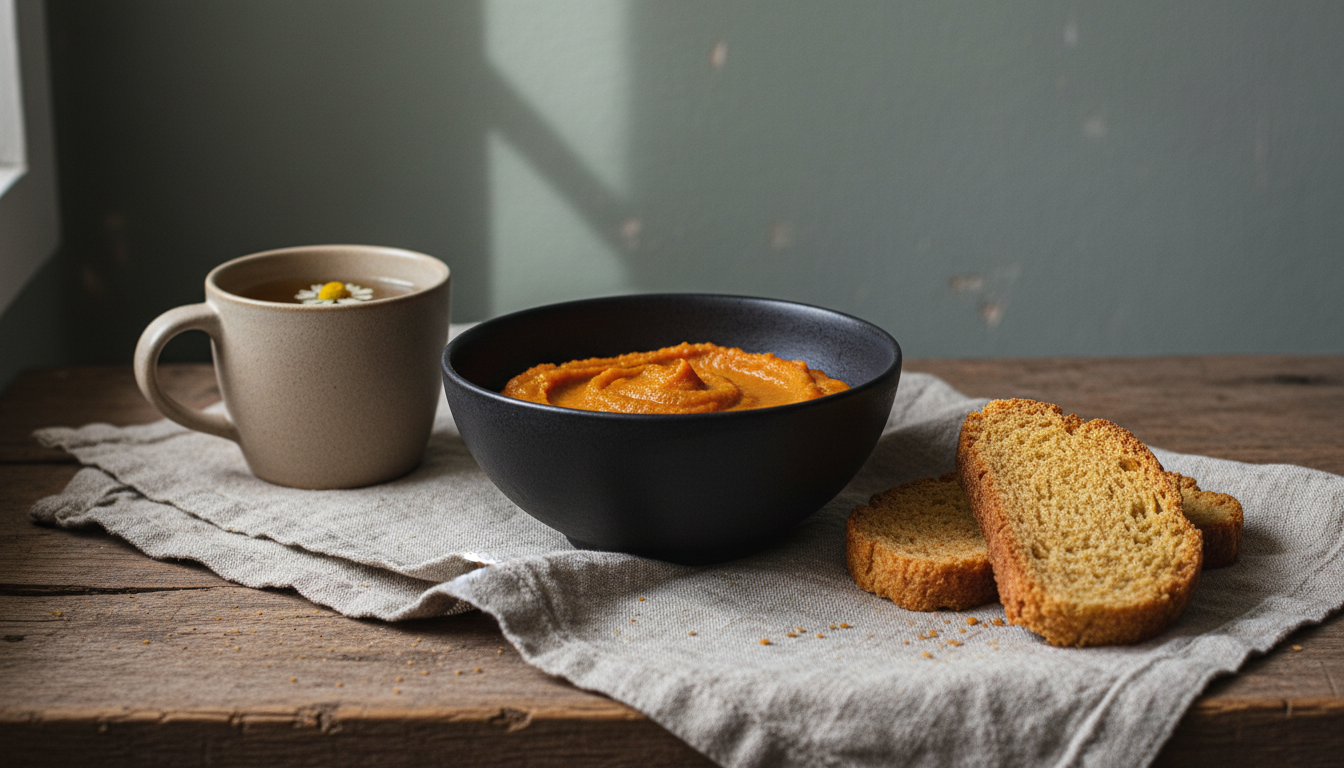
Bland diet: what belongs on the plate with gastrointestinal problems
The essentials at a glance
A bland diet means: low-fat, mildly seasoned, cooked rather than raw, in several small meals. Based on experience, the plate includes carrots, pumpkin, zucchini, rice, mashed potatoes, bananas, applesauce, crispbread, and day-old bread. This dietary approach is now known professionally as an adapted full diet, meaning a wholesome diet from which you leave out whatever is currently causing you discomfort.
The old lists of forbidden foods are outdated. There are no foods that are off-limits to everyone with an irritated stomach, and no diet that can end an infection. What is presented here is guidance: a list you can choose from, and a clear point beyond which food is no longer the right answer.
If it is acute, start with Chapter 3, which covers drinking fluids. If you want to know immediately what can be cooked, skip to the table in Chapter 5. The warning signs are deliberately placed beforehand, in Chapter 4.
What to expect in this article
1. What a bland diet means today
2. Adapted full diet: the term behind it
3. The acute phase: drink first, then eat
4. When food is not enough: warning signs
5. What belongs on the plate
6. How to prepare it
7. Returning to a normal diet
8. Is a bland diet right for your situation now?
9. When the stomach does not settle down
10. Limits: what a bland diet cannot do
11. What you can do now
Frequently asked questions
Sources
What a bland diet means today
You are looking for a bland diet because you feel sick, your stomach hurts, or someone in your household has been unable to keep anything down since yesterday. The question behind it is always the same: What can I cook now that will not make everything worse?
The short answer: low-fat, mild, cooked, in small portions. The longer answer requires four figures because they define the framework within which you are operating.
3×
Diarrhea is defined as passing very soft or watery stools at least three times within 24 hours. IQWiG, 2023
48 h
If there is no improvement after two days, see a doctor's office. IQWiG, 2023
several small ones
Several meals spread throughout the day instead of a few large ones. LEKuP information sheet, Fulda University of Applied Sciences, 2021
1,5 %
Fat content serves as a guide to choosing more easily digestible dairy products. LEKuP information sheet, 2021
What these figures do not show is just as important: a list of forbidden foods. It no longer exists, and it never worked well anyway.
Key message
A bland diet is not a diet with a list of forbidden foods, but a selection from what you eat anyway - adapted to what your stomach can currently tolerate.
Why the term still remains
In everyday language, it is still called a bland diet. The term is practical, everyone understands it immediately, and that is why it also appears here above the text. Technically, however, it has been replaced, and this change is more than just a renaming.
Adapted balanced diet: the term behind it
What used to be called a bland diet was later called a light balanced diet and is now known as an adapted balanced diet. The renaming in the Nutrition Therapy in Hospitals and Medical Practices guideline had a reason: Strict prohibition diets in the old style carry the risk of making the diet unbalanced - potentially leading to malnutrition. This is how Ernährungs Umschau described it in 2020, paraphrased.
Documented source
“a balanced diet in which individually intolerable foods that trigger symptoms such as a feeling of fullness, nausea, bloating, or diarrhea are avoided.”
German Nutrition Society
Notice on the revised DGE information resource on adapted balanced diets, 2025
Two words carry this sentence. Balanced means that, according to the German Nutrition Society, the diet provides all necessary nutrients in sufficient quantities and meets energy needs. Individual means: Your list is not my list.
The 2021 information sheet on an adapted balanced diet from Fulda University puts it unambiguously: “In general, the following applies: The tolerability of individual foods should be tested regularly and varies from person to person!” That is precisely why the table further down does not contain the word forbidden even once.
The second objection many people have at this point is justified: Isn't all of this just old-fashioned toast-and-tea advice? Partly, yes. Toast and carrot purée have not become wrong. What was wrong was the idea that one fixed list applies to everyone and that it has to be followed for weeks.
The acute phase: drink first, then eat
As long as it is acute, food is the second question. The first is fluids. Anyone with diarrhea loses fluids and electrolytes - mineral salts such as sodium and potassium that the body needs for fluid balance, nerves, and muscles. According to IQWiG in 2023, replacing this loss is the most important thing.
Practically speaking, this means drinking in small sips throughout the day instead of gulping down one large glass at once. In 2023, IQWiG recommended sweetened tea with salted crackers. Pharmacies sell ready-made rehydration solutions, that is, premeasured powders containing salts and glucose to be mixed with water. During this phase, it is better to avoid coffee, fruit juices, soft drinks, alcohol, and fatty foods.
When your appetite returns, start small. Rice, bananas, and rusks are generally well tolerated during this phase and are therefore also listed as examples by IQWiG. No pressure: If you do not feel like eating, keep drinking and wait. We have described the course of the first two days of acute diarrhea separately in What to Do About Diarrhea. This article focuses on what is on the plate.
At a glance: the acute phase
Drinking comes before eating. Sweetened tea and salted crackers are IQWiG’s recommendation for this phase. Portions remain small and intervals short. And if any of the warning signs from the next chapter appear, it is not the plate that needs attention but the doctor’s office.
When food is not enough: the warning signs
An irritated stomach is unpleasant and usually temporary. But there are signs where no cooking pot can help anymore. IQWiG clearly identifies them in 2023, and they are deliberately placed here before the food table.
Take this to the doctor’s office
No improvement after 48 hours
If nothing changes after two days, self-care has reached its limits.
High fever
Fever needs medical assessment, not waiting it out with tea.
Blood in the stool
Always a reason to call the same day.
Severe pain
Pain that no longer lets you sleep or get up is not a nutrition issue.
Dizziness and circulatory problems
An indication that fluid loss is putting strain on the circulation.
Two groups need attention sooner than the rest: infants and toddlers under one year old, as well as older people. Here, calling the doctor’s office is not an overreaction but the sensible first step.
If stomach problems persist for weeks or keep returning regularly, a bland diet is the wrong answer to an open question anyway. What may be behind recurring symptoms after eating is explained in Stomach Pain After Eating.
What belongs on the plate
Here is the list you have been waiting for. It is an overview of experiences based on the information sheet on adapted full diet, not a set of rules. On the left is what most people with an irritated gastrointestinal tract tolerate well; on the right is what more often causes discomfort. If your gut sees things differently, your gut is right.
| Group | Generally well tolerated | Generally less well tolerated | Preparation tip |
|---|---|---|---|
| Vegetables | Carrot, pumpkin, zucchini, fennel, cauliflower and broccoli florets, spinach | Cabbage vegetables, leeks, bell peppers, mushrooms, tomatoes, onions, legumes | Cooked or thoroughly chopped vegetables are sometimes better tolerated than raw vegetables. |
| Fruit | Apple, pear, banana, strawberry, melon, applesauce | Citrus fruits, stone fruits, dried fruit | Grated apple or applesauce instead of eating it whole. |
| Bread and baked goods | Toast, rusks, crispbread, day-old bread | Fresh, coarse-crumb breads, seeded breads, puff pastry | Bread and baked goods that are at least a day old are considered easier to digest than fresh products. |
| Grains | Rice, semolina, millet, pasta, porridge, fine oatmeal | Uncooked grains, fresh grain porridge | Cook until soft and serve without fat; prepare porridge with water instead of cream. |
| Potatoes and side dishes | Jacket potatoes, mashed potatoes, boiled potatoes | French fries, fried potatoes, chips | Steam or cook in water instead of frying or deep-frying. |
| Dairy products | Milk and dairy products with up to 1.5% fat (LEKuP information sheet, Fulda University of Applied Sciences, 2021) | High-fat varieties, cream, creamed quark | Check the label: The fat content matters more than the variety. |
Source of the table: Information sheet for the Adapted Full Diet, Fulda University of Applied Sciences, version 2, as of November 2021. The column headings reflect experience, and that is meant literally. Some people tolerate tomatoes without any problems but cannot tolerate oatmeal.
What is deliberately missing from this table are quantities and a daily plan. Both would pretend that your hunger can be planned. From the left column, choose what you feel like eating, and eat as much of it as you can tolerate.
How to prepare your food
How you prepare food often matters more than the ingredient. The same potato is different when steamed than when deep-fried, and the same vegetable is different raw than when braised.
In 2021, the Fulda University of Applied Sciences information sheet recommends: “Where possible, choose gentle cooking methods that are low in fat and browning compounds, e.g. steaming, braising, blanching, or cooking in foil.” Browning compounds are the substances that form when food is seared at high heat and create the dark crust - they add flavor, and the information sheet advises avoiding them during this phase.
Steam instead of fry
Steaming, braising, blanching, or cooking in foil require little fat and produce no browning compounds. LEKuP information sheet, Fulda University of Applied Sciences, as of 2021
Several small meals
Eating throughout the day is easier on the stomach than large portions with long breaks. LEKuP information sheet, Fulda University of Applied Sciences, as of 2021
Chopping helps
Cooked or thoroughly chopped vegetables are sometimes better tolerated than raw vegetables. LEKuP information sheet, Fulda University of Applied Sciences, as of 2021
For your doctor’s appointment
Write down what you ate and how you felt afterward. This list is preparation for a consultation at the doctor’s office, not a self-diagnosis.
One sentence sorts it all out. It’s not the list that decides, but your gut - the list only tells you where to start experimenting.
It's not the list that decides, but your stomach.
Back to a normal diet
A bland diet is not a permanent state. As soon as your appetite returns and the symptoms subside, your diet should be broadened again - that is the real essence of an adapted normal diet. It follows the recommendations for a normal diet and excludes only foods that you personally cannot tolerate.
In practice, this means adding one food at a time from the right-hand column and seeing how you tolerate it. One food, not three. If you bring everything back at once and then have symptoms, you won't know afterward what caused them.
Don't stick to rusks and rice any longer than is good for you. This is exactly what the history of the term warns against: restrictive diets in the old sense carry the risk of making the diet one-sided, and that risk grows with every week. What happens to the gut flora after you've gotten through a bout of diarrhea is covered in Building up gut flora after diarrhea.
Is a bland diet right for your situation now?
There are situations in which the mild selection on your plate is exactly right, and situations in which it masks a problem. The dividing line can be identified.
A bland diet is suitable now if …
you have an acute gastrointestinal infection and your appetite is slowly returning.
the days of diarrhea are over and you want to start eating again.
the stomach lining is irritated and fatty or spicy foods immediately trigger symptoms.
you want to test what you can tolerate again after a period of nausea.
Food alone isn't enough if …
one of the warning signs occurs: no improvement after 48 hours, high fever, blood in the stool, severe pain, dizziness, or circulatory problems.
the symptoms last for weeks or keep coming back at short intervals.
you lose weight unintentionally.
Children under one year old or older people lose a lot of fluid - then they should go straight to a doctor's office.
When your stomach won't settle down
Some people eat a bland diet for weeks and still don't get anywhere. At that point, the question is no longer about nutrition, but about the cause. One possible cause can be identified: Helicobacter pylori, a stomach bacterium associated with inflammation of the stomach lining. You can find out what else plays a role when the stomach lining is irritated in Gastritis: what helps quickly.
This is where mybody®x (MYBODY Lab GmbH) comes in, but with a clear limitation. A self-test does not tell you what to eat. It can give you a question to raise at a medical practice. We have described how to interpret such a test in Online Gastrointestinal Test.

Rapid home test
Gastrointestinal Health Self-Test
A physical test kit that uses a stool sample to indicate a possible reaction to Helicobacter pylori, the stomach bacterium associated with inflammation of the stomach lining. The result is available in approximately 10 to 15 minutes. What the test explicitly does not do: It does not tell you what to eat, it does not provide a diagnosis, and it does not replace a medical examination. It points to a question you can clarify at a medical practice.
Result in approximately 10 to 15 minutes
Limitations: what a bland diet cannot do
A bland diet does not end an infection or treat an illness. It takes some of the workload off the irritated digestive system while it sorts itself out. Anyone expecting more will be disappointed, while anyone expecting less may eat nothing at all for days.
The table also has limitations. There is no reliable percentage indicating how many people tolerate which food poorly when experiencing gastrointestinal symptoms - that is why there is none here. And a self-test remains an indicator, not a diagnosis. You can find more information about nutrition for persistent stomach pain in Nutrition for Stomach Pain.
What you can do now
If it is acute: drink, in small sips, with salt and sugar. When your appetite returns: rice, crispbread, banana, steamed carrot. When you feel better: add one food each day and observe.
And if you take just one thing away from this text, let it be this: The question at the beginning was what belongs on the plate. The most honest answer is that the table is only the starting point. Your own gut will write the rest over the next few days, one portion at a time.
Frequently asked questions
Is zwieback really helpful for stomach and intestinal problems?
Yes, zwieback remains one of the foods generally found to be well tolerated during the acute phase. In 2023, IQWiG named it alongside sweetened tea with salty crackers, rice, and bananas as an example of a cautious return to eating. The reason is unremarkable: it is low-fat, dry, mild, and provides carbohydrates without requiring much digestive work. Even so, tolerance is individual and must be tested regularly.
Can I eat dairy products, or is it better not to?
There is no blanket no. The information sheet on the Adapted Full Diet from Fulda University lists milk and dairy products with up to 1.5% fat (LEKuP information sheet, Fulda University, 2021) among the foods generally found to be well tolerated. The decisive factor is therefore less the type than the fat content: cream, creamed quark, and high-fat cheeses cause problems more often than low-fat yogurt. Anyone who tolerates dairy products poorly even when healthy should avoid them all the more during this phase.
How long should I eat a bland diet?
As long as your stomach needs it, and not one day longer out of habit. The adapted full diet is designed as a nutritionally complete diet from which individual poorly tolerated foods are excluded, not as a permanent diet with a fixed list. The background to this approach is the experience with the strict exclusion diets of previous decades: they carry the risk of an unbalanced diet, potentially leading to malnutrition, as Ernährungs Umschau explained in essence in 2020.
What about coffee, juice, and soft drinks?
In cases of acute diarrhea, these are among the drinks that are best avoided. In 2023, IQWiG listed coffee, fruit juices, soft drinks, alcohol, and fatty foods as things best left out during this phase. Sweetened tea, on the other hand, is explicitly recommended, together with salty crackers. If you do not want to give up your morning coffee, postpone it until the days after the acute phase.
Does all of this apply to my child too?
For older children, the same basic principles apply: small portions, gentle preparation, fluids before solid foods. For infants and children under one year of age, the situation is different because they lose fluids much faster than they can replace them by drinking. Here, calling the pediatrician's office belongs at the beginning, not the end. The same applies to older people with severe fluid loss and to all warning signs from Chapter 4.
Next step
When a bland diet alone does not help
If stomach complaints persist for weeks, an at-home rapid test may indicate a possible reaction to Helicobacter pylori. It does not tell you what to eat - it gives you a question to discuss at your next appointment.
View the Gastrointestinal Health Self-Test First, get an overview: Gastrointestinal test onlineRead more
You might also be interested in this
What happens during the first 48 hours when it is acute.
What is advisable and what is not in the following weeks.
Sources
- German Nutrition Society: Notice on the revised DGE information resource on the Adapted Full Diet (as of 2025) - dge.de
- Fulda University of Applied Sciences / MoDiVe: Information sheet on the Adapted Full Diet, Version 2 (as of November 2021) - hs-fulda.de
- Ernährungs Umschau: Light full diet is now called Adapted Full Diet (as of 2020) - ernaehrungs-umschau.de
- IQWiG / gesundheitsinformation.de: Diarrhea (as of 2023) - gesundheitsinformation.de
The definition of the adapted full diet and the quote in Chapter 2 are based on [1]. The food table, the recommendation to eat several small meals, and the information on cooking methods come from [2]. The history of the term in Chapters 2 and 7 is based on [3] in paraphrased form. Information on diarrhea, fluid loss, suitable drinks, and warning signs follows [4]. Product information for the Gastrointestinal Health Self-Test was checked against the mybody®x product pages on 09.09.2026.

mybody®x Editorial & Expert Team
Diet for gastrointestinal complaints Gut health
This text was prepared by the mybody®x editorial and expert team and cross-checked against the cited professional sources. Find out who is behind it on the authors page.
Published on 09.09.2026 · Last updated on 09.09.2026
The content is for general information and does not replace medical advice, diagnosis, or treatment. Reference ranges depend on the laboratory, method, and age - the information on your test report is always decisive.
Our products are not intended to diagnose, treat, cure, or prevent diseases.



Share now:
Mucus in stool: when it is harmless and when to see a doctor
Colon cleansing: what’s behind it and what has been proven