

Stomach pain after eating: Where it comes from and what you can do
The essentials at a glance
Stomach pain after eating is usually caused by the stomach and intestines reacting more strongly than they should to a meal—its quantity, fat content, speed of eating, or an individual ingredient. A functional disorder such as functional dyspepsia or irritable bowel syndrome is often behind it; an inflammatory disease is less common. Three things matter when assessing it: location, timing, and accompanying symptoms.
This guide puts the key symptom of pain after eating into context using documented statements from the Institute for Quality and Efficiency in Health Care (IQWiG) and the German Nutrition Society (DGE). It explains what the location in the upper or lower abdomen indicates, which timing patterns are typical, and where the line lies between a harmless reaction and a warning sign.
Read Chapter 2 if you are interested in the location, and Chapter 3 for the warning signs—this is the most important chapter in the entire article. Chapter 5 dispels three common assumptions, Chapter 6 describes everyday steps, and Chapter 9 compares the most common causes side by side.
What to expect in this article
2. Where does it hurt—and what does the location say about the cause?
3. Which warning signs should be evaluated by a doctor?
4. When does the pain occur after eating?
5. Which common assumptions are misleading?
6. What can you do yourself in everyday life?
7. What role does the gut flora play?
8. How mybody® can help
9. Which cause matches which pattern?
10. Putting it into perspective: What a microbiome test can—and cannot—do
11. Conclusion
Frequently asked questions
Sources
Why do I have stomach pain after eating?
Pain after eating occurs when the digestive process itself becomes a stimulus. The stomach expands, the muscles of the stomach and intestines work, digestive juices flow, and the contents move onward. If the nerves in these organs are more sensitive than usual, an otherwise normal process is perceived as pain.
This sensitivity is not imagined, nor is it a sign of weakness. It is a measurable change in how the digestive system responds to stimuli, for which medicine has its own diagnoses: functional dyspepsia and irritable bowel syndrome.
Three documented orders of magnitude from the digestive system show how common these functional complaints are.
Source: IQWiG, 2023 (irritable bowel syndrome) and 2026 (Crohn’s disease); DGE, as of 2021 (dietary fiber)
The relationship between these three figures is the real point. Functional symptoms affect a double-digit percentage of the population, while according to IQWiG (2026), chronic inflammatory bowel diseases occur at a rate of around 320 per 100,000 people. Symptoms after eating are therefore far more often harmless than dangerous.
What triggers can be behind a single meal?
Four characteristics of a meal place particular strain on the digestive system: a large portion, a high fat content, eating very quickly, and a high proportion of difficult-to-digest carbohydrates. They often act together rather than individually.
The difficult-to-digest carbohydrates include so-called FODMAPs, short-chain sugars, and sugar alcohols found in foods such as onions, legumes, wheat, and stone fruit. According to IQWiG (2023): “It is assumed that consuming FODMAPs causes more water to enter the intestines and can promote diarrhea.”
There is also a factor that has nothing to do with what is on your plate: tension. The stomach and intestines are closely connected to the nervous system, which is why the same meal may be tolerated differently on a hectic workday than at the weekend.
How does this article differ from the related articles?
This guide deals exclusively with the key symptom of pain after eating: location, the time between the meal and the pain, and a recurring pattern. If nausea is your main symptom instead, the appropriate Nausea after eating is the relevant article. If you are asking about nutrition for already diagnosed intestinal inflammation, you will find the explanation in Intestinal inflammation: what to eat?.
Where does it hurt—and what does the location say about the cause?
The location is the first useful clue. Symptoms in the upper abdomen, directly below the breastbone, point to the stomach itself; symptoms in the lower abdomen or shifting around the entire abdomen are more suggestive of the intestines.
For the upper abdomen, IQWiG (2025) describes two typical groups of symptoms for functional dyspepsia: “a feeling of fullness in the upper abdomen, nausea, and belching” and “pain and burning in the upper abdomen.” So if you feel full after small meals and sense pressure beneath the breastbone, your symptoms fit this pattern.
For the intestines, IQWiG (2023) cites “persistent abdominal or lower abdominal pain, cramps, and altered stools” as typical symptoms of irritable bowel syndrome. The altered stool is the key difference from functional dyspepsia.
Key point: According to IQWiG (2025), upper abdominal pain with a feeling of fullness, nausea, and belching is characteristic of functional dyspepsia. Lower abdominal pain together with altered bowel movements, on the other hand, fits irritable bowel syndrome, which according to IQWiG (2023) is estimated to affect 10 to 20 out of 100 people.
Why the quality of the pain provides additional clues
In addition to the location, it is worth looking at the type of pain. Burning in the upper abdomen that worsens when bending over or lying down points in a different direction than cramp-like waves that come and go.
Cramp-like pain typically results from movements of the intestinal muscles, while a dull feeling of tension is more likely caused by gas in the intestine.
Consistency is important: A one-off pain after an extravagant dinner is not a pattern. The picture only becomes meaningful when the same combination of location, timing, and pain quality recurs over several weeks.
Which warning signs require a visit to the doctor?
Certain accompanying signs immediately change the assessment: they argue against a functional cause and in favor of a condition that requires examination. The Institute for Quality and Efficiency in Health Care explicitly identifies them.
“
“Additional symptoms such as significant weight loss, blood in the stool, fever, or paleness are more suggestive of another intestinal disease.”
Institute for Quality and Efficiency in Health Care (IQWiG)
gesundheitsinformation.de, “Irritable bowel syndrome,” as of 22 February 2023
IQWiG (2023) is even more explicit about blood in the stool in the same passage: “Blood in the stool should always be medically examined to determine the cause.” This applies regardless of how severe the pain is and whether it is related to eating.
These signs require medical evaluation
- ✓ Significant, unintentional weight loss – a sign explicitly identified by IQWiG (2023) of another intestinal disease.
- ✓ Blood in the stool – according to IQWiG (2023), this should always be medically evaluated, regardless of the amount or color.
- ✓ Fever or noticeable paleness – both are warning signs identified by IQWiG (2023).
- ✓ Persistent vomiting – if you repeatedly cannot keep food down, this is not a dietary issue.
- ✓ Symptoms that wake you at night – functional symptoms usually follow the daily rhythm.
- ✓ Sudden, very severe pain – prompt medical attention is important here; do not wait or rely on a self-test.
This list has a single purpose: to point you in the right direction early on. No self-test, dietary change, or advice article can replace an examination if any of these signs are present.
At the same time, reassurance is also important so that the picture is complete. IQWiG (2023) writes about irritable bowel syndrome: “Irritable bowel syndrome is not dangerous. Most people affected have a mild form that they can manage well without treatment.”
IQWiG (2025) similarly classifies functional dyspepsia: “Functional dyspepsia is not dangerous, but it can be burdensome and long-lasting.” Taken together, these two statements create a realistic expectation – burdensome, yes, but generally not threatening.
When does the pain occur after eating?
The time between the meal and the onset of pain is the second major clue. It reveals which part of the digestive tract is currently involved – the stomach works first, the small intestine somewhat later, and the large intestine last.
If the pain starts while you are still sitting at the table or shortly afterward, the stomach is usually where things are happening. This is consistent with fullness, early satiety, and belching, which IQWiG (2025) identifies as key symptoms of functional dyspepsia.
If the symptoms do not appear until a considerable time later and occur together with bloating or changes in stool, the intestines are more likely to be involved. This fits the picture IQWiG (2023) describes for irritable bowel syndrome and the presumed effect of FODMAPs on the water content in the intestines.
A third pattern is just as informative: pain that is largely unrelated to eating, wakes you at night, or remains constant for weeks. This pattern should be medically evaluated rather than managed through diet.
Recognizing this pattern in the first place requires systematic observation. Four steps are enough.
Rule out warning signs
According to IQWiG (2023), weight loss, blood in the stool, fever, or paleness point to another intestinal disease – in that case, see a doctor first.
Record patterns
Keep a record for two to four weeks: what you ate, when the pain occurred, where it was located, and what accompanied it.
Check the obvious factors
First change portion size, fat content, eating speed, and stress level – only then consider individual foods.
Have it medically assessed
Take the notes with you to your appointment. For functional dyspepsia, IQWiG (2025) lists “adjusting the diet, getting more exercise, and using individually tailored medication” as the first steps.
Key message: The time between a meal and the onset of pain helps narrow down the affected region: upper abdominal discomfort that starts early points to the stomach, while lower abdominal discomfort that begins later, together with changes in stool, points to the intestines. Pain that is unrelated to eating or that wakes you at night should be medically evaluated.
Which common assumptions are misleading?
Three assumptions about stomach pain after eating circulate that sound plausible at first glance but often lead in the wrong direction in practice. All three can be put into context using statements from IQWiG (2023).
These three points lead to one common conclusion: fewer ready-made programs, more personal observation.
A fourth point concerns probiotics, which are widely debated. Regarding tolerability, IQWiG (2023) states: “In general, probiotics are well tolerated: only mild side effects such as flatulence occur rarely.” Good tolerability, however, is not evidence of effectiveness—if you try probiotics, you should view it as an experiment with an uncertain outcome.
What can you do yourself in everyday life?
The most effective steps concern not individual foods but the way you eat. Smaller portions, chewing for longer, eating at a slower pace, and reducing the fat content of main meals ease the burden on the stomach without requiring anything to be eliminated.
For functional dyspepsia, IQWiG (2025) identifies “adjusting the diet, getting more exercise, and individually tailored medication” as initial approaches. The order is noteworthy: diet and exercise come before medication.
Exercise is the most commonly underestimated factor here. A 20-minute walk after eating costs nothing, has no side effects, and can be incorporated into almost any daily routine.
How to narrow down individual triggers effectively
If the basics are in place and the symptoms persist, the next step is to look for individual triggers. This only works systematically: eliminate one food or food group for several days, then deliberately reintroduce it and record the reaction.
It is not the individual food that matters, but the pattern over several weeks. A single episode of stomach pain after eating onions proves nothing—but the same reaction after the third controlled trial does.
It is not the individual food that matters, but the pattern over several weeks.
If lactose intolerance is suspected, there is one important distinction: A hydrogen breath test is the medical standard—not a self-test at home and not a microbiome test. Anyone with this suspicion should raise it directly during a medical consultation.
The role fiber plays in everyday life
Fiber directly affects the processes discussed here. The German Nutrition Society (as of 2021) describes it as follows: “Fiber—also known as dietary fiber—affects the transit time of food through the stomach and intestines, the volume and consistency of stool, and the frequency of bowel movements.”
The German Nutrition Society (DGE) guideline (as of 2021) recommends that adults consume at least 30 g of fiber per day. According to the DGE (as of 2021), increased fiber intake also has “protective effects against cardiovascular disease, type 2 diabetes, obesity, high blood pressure, colon and breast cancer, as well as the risk of mortality.”
For sensitive people, how you implement it matters more than the number. A sudden increase from very little to 30 g per day often initially worsens bloating—gradually increasing it over several weeks and drinking enough fluids is the more tolerable approach.
What role does the gut flora play in this?
The gut flora—the totality of bacteria in the intestine—is one of several factors discussed in connection with functional symptoms. It is explicitly not the sole explanation, but it does regularly appear in research into the causes.
The German Institute for Quality and Efficiency in Health Care (IQWiG) (2023) summarizes the state of research on irritable bowel syndrome as follows: “Among other things, it is suspected that hypersensitive intestinal nerves, disturbances of the intestinal muscles, changes in the gut flora, and inflammation of the intestinal wall could play a role.”
Two words in this statement are crucial: “suspected” and “could.” The gut flora is a plausible contributor, not a proven trigger—and certainly not a switch that could simply be flipped.
What a microbiome analysis shows—and what it does not
A microbiome analysis examines a stool sample to determine which bacteria are present and in what proportions. The result describes a snapshot of the composition, not a disease or the cause of your pain.
Such an analysis is useful as a supplement once warning signs have been ruled out, the basics are already in place, and you want to take a more structured approach to your diet. It is not useful as a first step in the case of acute or unclear symptoms.
The opposite is just as important: An unremarkable microbiome result does not rule out any disease. Anyone with warning signs needs a medical examination – even if the laboratory report looks reassuring.
In brief
The gut microbiome is one of several suspected factors in irritable bowel syndrome – according to IQWiG (2023), other factors include hypersensitive intestinal nerves, disturbances of the intestinal muscles, and inflammation of the intestinal wall. A microbiome analysis shows the composition of intestinal bacteria at a specific point in time, but it does not provide a diagnosis or, on its own, explain stomach pain after eating. It can be useful as a supplementary measure after warning signs have been ruled out, but not as the first step for acute symptoms.
How mybody® can help
For this purpose, mybody® (MYBODY Lab GmbH) offers two gut flora analyses based on a stool sample, which differ in the level of detail in their reports. Both are evaluated in an ISO-certified laboratory, and data processing complies with ISO 27001 and the GDPR.
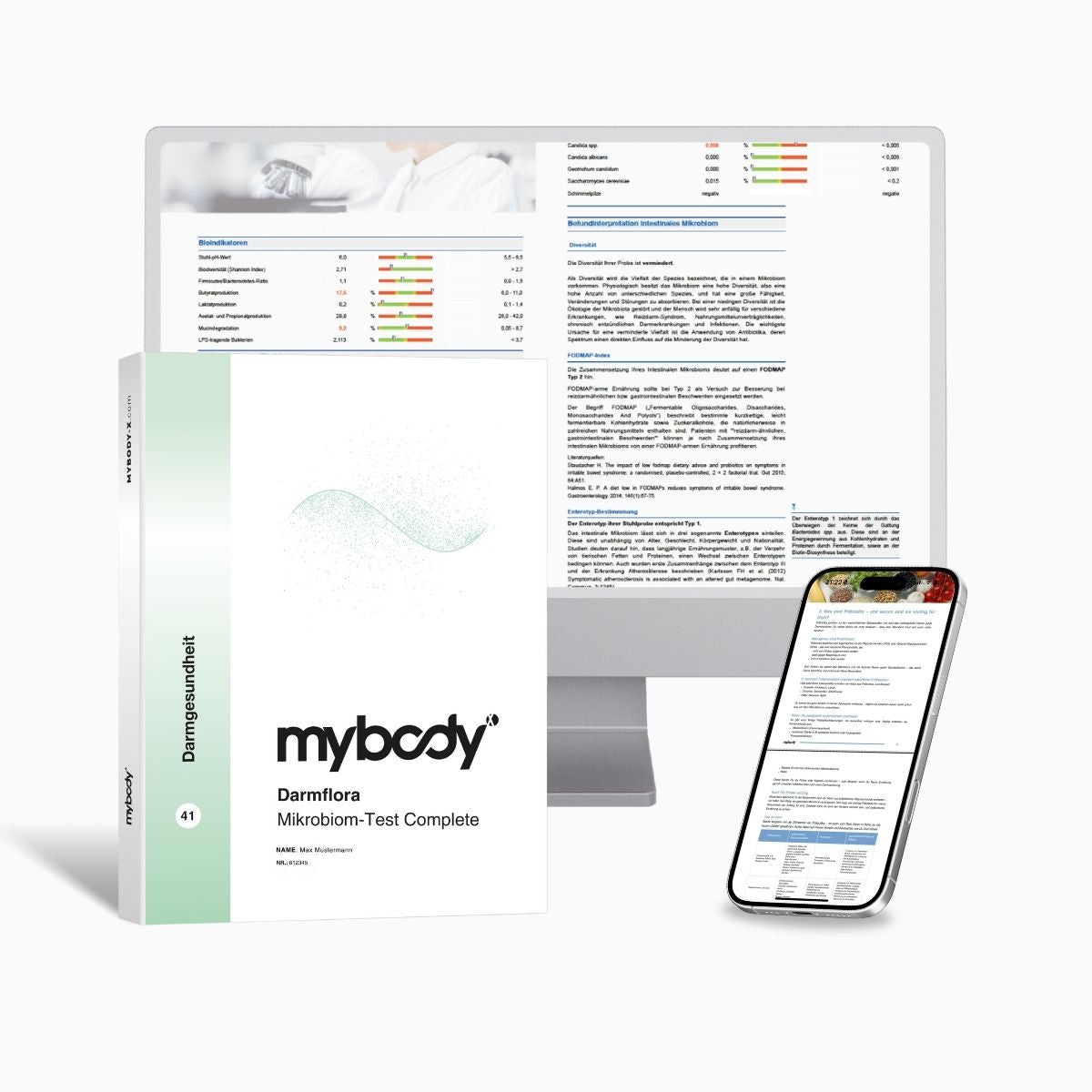
Gut Flora MICROBIOME Test Complete
The Complete test uses DNA sequencing of a stool sample to determine more than 1,500 bacterial species and summarizes the results in a report of around 15 pages. It includes, among other things, bacterial diversity, the ratio of beneficial and potentially harmful microorganisms, indications of dysbiosis, a FODMAP index, enterotype classification, and information related to digestion and diet.
It explicitly does not include a diagnosis: The test does not detect inflammatory bowel disease, tumors, infections, or celiac disease. It does not identify the cause of your stomach pain and does not replace a medical examination.
Price: €189.00 (instead of €219.00) · Sample type: Stool sample · Processing time: approx. 20–25 business days after the sample is received · Laboratory: ISO-certified laboratory analysis, ISO 27001
Go to the Complete MICROBIOME testThose who do not need the scope of the Complete report will find a more affordable entry point in the Basic version, with the same sample type, laboratory, and processing time.
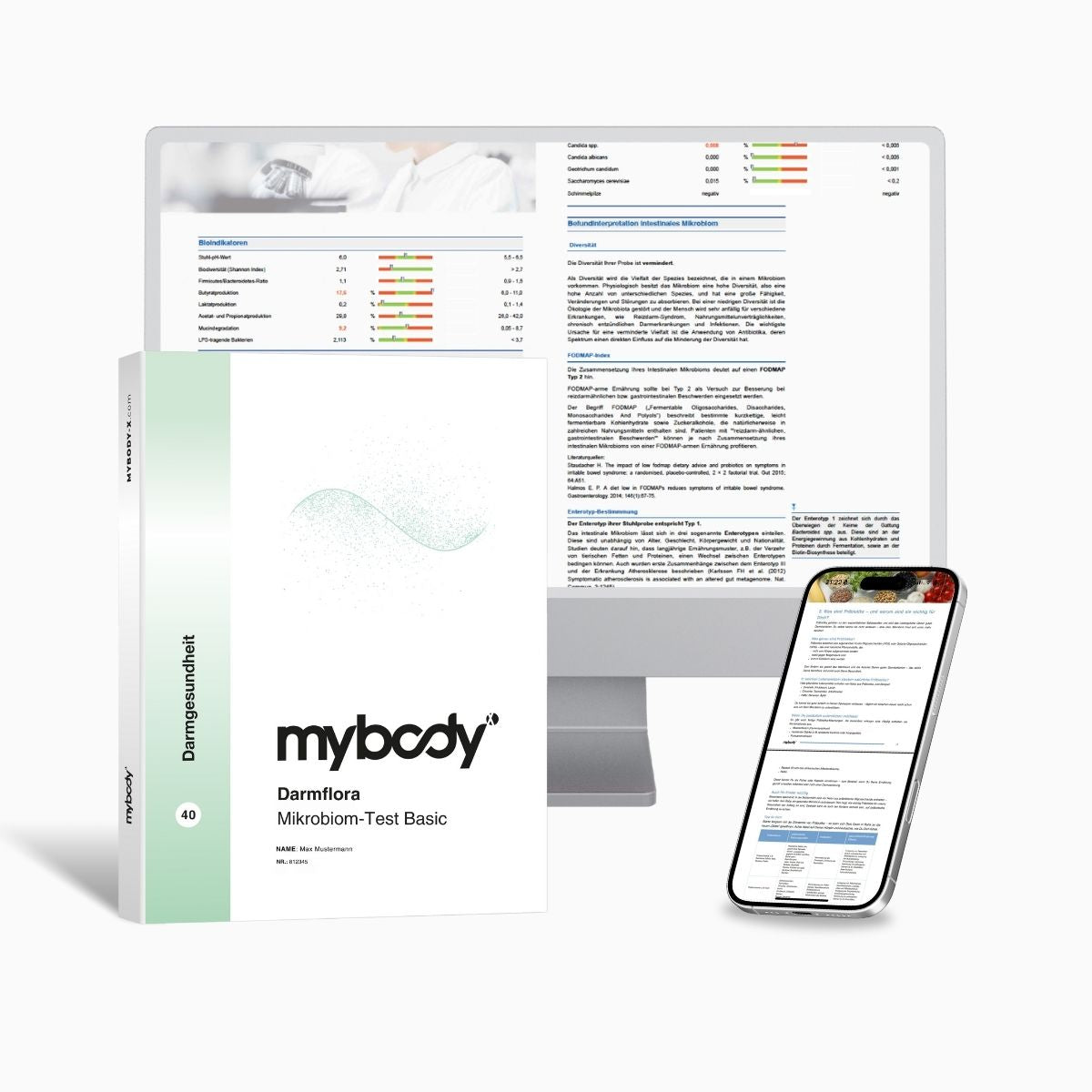
Gut Flora MICROBIOME Test Basic
The Basic version examines the composition of the gut microbiome, the ratio of beneficial and potentially harmful bacteria, the gut environment based on the pH level, fungal colonization, and indications of dysbiosis. The report is also around 15 pages long.
The FODMAP index, enterotype determination, and sequencing of more than 1,500 bacterial species are not included—these features are reserved for the Complete test. The Basic version does not provide a diagnosis either.
Price: €139.00 · Sample type: Stool sample · Processing time: approx. 20–25 business days after receipt of the sample · Laboratory: ISO-certified laboratory analysis, ISO 27001
To the MICROBIOME Basic testPrices as of July 28, 2026. Prices, report scope, and processing times may change—the linked mybody® product page (MYBODY Lab GmbH) is always authoritative.
The article The Most Reliable Microbiome Tests for Your Gut Flora explains in detail what you should look for when choosing a provider. The article Gut Flora Tests: Microbiome Analysis Meets Practical Recommendations for Action describes how to turn a laboratory report into concrete steps.
Which cause matches which pattern?
The following overview compares the three conditions that are most commonly considered when recurring pain occurs after eating—using the same four criteria. It includes only information for which a named source with a publication year is available.
| Criterion | Functional dyspepsia | Irritable bowel syndrome | Inflammatory bowel disease (Crohn’s disease) |
|---|---|---|---|
| Where does it hurt? | Upper abdomen: “pain and burning in the upper abdomen” (IQWiG, 2025) | Abdomen and lower abdomen: “persistent abdominal or lower abdominal pain, cramps” (IQWiG, 2023) | Abdominal pain during a flare-up, with the location depending on the affected section of the intestine (IQWiG, 2026) |
| When after eating? | Early, often during or immediately after the meal, with early satiety | Some time after the meal, often together with bloating and an urge to have a bowel movement | Occurring in episodes and largely independent of the individual meal |
| Typical accompanying symptoms | “A feeling of fullness in the upper abdomen, nausea, and belching” (IQWiG, 2025) | Changed stool, alternating between diarrhea and constipation (IQWiG, 2023) | “Abdominal pain and diarrhea” during an acute flare-up (IQWiG, 2026) |
| Need to be evaluated? | Yes, when it occurs for the first time or persists for a longer period. “Functional dyspepsia is not dangerous, but it can be burdensome and long-lasting.” (IQWiG, 2025) | Yes, for context. “Irritable bowel syndrome is not dangerous.” An estimated 10 to 20 out of 100 people are affected (IQWiG, 2023) | Always seek medical advice. An estimated 320 out of 100,000 people are affected in Europe; 3 to 6 out of 100,000 develop the disease each year (IQWiG, 2026) |
The table reveals a pattern: Functional dyspepsia and irritable bowel syndrome are closely linked to individual meals, whereas chronic inflammatory bowel disease follows its own relapsing course. This distinction is precisely the most practically useful clue in everyday life.
Lactose intolerance is not included in the table because, strictly speaking, it is not a disease of the intestine but an enzyme deficiency. It is investigated using a hydrogen breath test—the medical standard for this question. Self-classifying based on the overview does not replace a diagnosis, but it can help you describe your pattern during a medical consultation.
Putting it into perspective: What a microbiome test can—and cannot—do
A microbiome test is not a diagnostic procedure. It describes the composition of the intestinal bacteria in a stool sample—and its limitations follow directly from this.
First, a microbiome test does not detect disease. It cannot diagnose or rule out chronic inflammatory bowel disease, an ulcer, an infection, celiac disease, or a tumor.
Second, it does not identify the cause of your pain. IQWiG (2023) explicitly lists the gut microbiota as one of several suspected factors in irritable bowel syndrome—alongside hypersensitive intestinal nerves, disorders of the intestinal muscles, and inflammation of the intestinal wall.
Third, no test result replaces the steps from Chapter 6. Portion size, eating speed, fat content, physical activity, and gradually approaching the recommended fiber intake of 30 g per day (DGE, as of 2021) remain the foundation.
Fourth, if you have already been diagnosed with chronic inflammatory bowel disease, no dietary approach replaces medical treatment. Diet can relieve symptoms, but it cannot cure the disease.
And fifth, medical evaluation takes priority. If you experience weight loss, blood in the stool, fever, paleness, persistent vomiting, or nighttime symptoms, a doctor’s office is the first step—not a self-test or an elimination diet.
Conclusion
Stomach pain after eating can be categorized using three questions: Where does it hurt, when after the meal does the pain occur, and what accompanies it? These three answers create the pattern that allows for a sensible next step.
The figures put things into perspective: According to IQWiG estimates (2023), 10 to 20 out of 100 people have irritable bowel syndrome, while in Europe an estimated 320 out of 100,000 people have Crohn’s disease, according to IQWiG (2026). Functional symptoms are therefore by far the more common explanation—and IQWiG (2023) explicitly states that irritable bowel syndrome is not dangerous.
Specifically, this means eating smaller portions, reducing the fat content of main meals, eating more slowly, moving around after eating, and gradually increasing fiber intake toward the DGE guideline value of 30 g per day (as of 2021). These steps cost nothing and are the starting point for any improvement.
If warning signs such as weight loss, blood in the stool, fever or paleness occur, follow one simple rule: see a doctor first. If these signs have been ruled out and you want to approach your diet in a more structured way, an analysis of the gut microbiota may provide additional guidance—as a supplement, not a diagnosis.
Frequently asked questions about stomach pain after eating
Why do I have stomach pain after every meal?
If pain occurs after almost every meal, this suggests increased sensitivity of the digestive system rather than a single food. Common explanations include functional dyspepsia with “pain and burning in the upper abdomen” or irritable bowel syndrome with “persistent abdominal or lower abdominal pain, cramps, and changes in stool” (IQWiG, 2025 and 2023, respectively). If symptoms occur with every meal for several weeks, they should be medically evaluated.
When is stomach pain after eating dangerous?
The accompanying symptoms are decisive. IQWiG (2023) states: “Additional symptoms such as significant weight loss, blood in the stool, fever or paleness are more suggestive of another intestinal disease.” Persistent vomiting, symptoms at night, and sudden, very severe pain also require medical attention. Blood in the stool should always be investigated, according to IQWiG (2023).
What does the location of the pain say about its cause?
Upper abdominal symptoms point to the stomach: In 2025, IQWiG described functional dyspepsia as causing “a feeling of fullness in the upper abdomen, nausea and belching” as well as “pain and burning in the upper abdomen.” Symptoms in the lower abdomen or pain that shifts around the abdomen are more suggestive of the intestines; according to IQWiG (2023), irritable bowel syndrome is also accompanied by changes in stool. The location alone cannot replace a medical examination.
Can a microbiome test explain my stomach pain?
No. A microbiome test shows the composition of gut bacteria in a stool sample, but it does not diagnose a condition or identify its cause. In 2023, IQWiG listed changes in the gut microbiota in irritable bowel syndrome as one of several suspected factors, alongside hypersensitive intestinal nerves, disorders of the intestinal muscles, and inflammation of the intestinal wall. An unremarkable result also does not rule out illness.
What helps quickly with stomach pain after eating?
In the short term, simple measures are usually most helpful: stay upright instead of lying down, apply warmth to your abdomen, breathe calmly, and take a short walk. For the next few meals, smaller portions, less fat, and eating more slowly are the obvious levers. For functional dyspepsia, IQWiG (2025) lists “adjusting your diet, getting more exercise, and individually tailored medication” as first steps—medication should be prescribed and adjusted by a doctor.
Would you like to have your gut flora assessed?
The Complete gut flora MICROBIOME test identifies over 1,500 bacterial species from a stool sample using DNA sequencing and provides a report of around 15 pages with a FODMAP index and enterotype determination. Results are available approximately 20–25 business days after the sample is received. The test does not provide a diagnosis and does not replace a medical examination if warning signs are present.
Go to the Complete MICROBIOME test All gut health testsYou might also be interested in
→ The most reliable microbiome tests for your gut flora
How to recognize a reliable gut flora analysis—and which criteria really matter.
→ Gut flora tests: microbiome analysis meets practical recommendations for action
How a laboratory report becomes concrete steps for everyday life.
→ Gut encyclopedia: all bacteria and markers of your gut flora
Reference work with over 6,000 microbiome biomarkers—from protective bacteria and fiber-degrading bacteria to the key figures in the report.
Sources
- Institute for Quality and Efficiency in Health Care (IQWiG): Irritable bowel syndrome (as of February 22, 2023)
- Institute for Quality and Efficiency in Health Care (IQWiG): What helps with irritable bowel syndrome—and what doesn't? (as of February 22, 2023)
- Institute for Quality and Efficiency in Health Care (IQWiG): What can help with functional dyspepsia? (as of September 17, 2025)
- Institute for Quality and Efficiency in Health Care (IQWiG): Crohn’s disease (as of March 4, 2026)
- German Nutrition Society (DGE): Reference Values for Fiber (as of 2021)
The institute’s quotation on warning signs, the information on the frequency of irritable bowel syndrome, and the description of typical symptoms are based on [1]. The statements on FODMAPs, the risk of malnutrition, fiber supplements, individual variation in reactions to foods, and probiotic tolerance come from [2]. The information on functional dyspepsia and initial treatment steps comes from [3], the figures on Crohn’s disease from [4], and the recommended fiber intake levels from [5]. All other statements mentioned in the text are attributed directly at the relevant point to the institution and year. All product information on mybody® (MYBODY Lab GmbH) comes from the official product pages at mybody-x.com (as of July 28, 2026).

mybody® Editorial & Specialist Team
Gut health Microbiome Digestive complaints Nutritional science Laboratory diagnostics
This article was created and medically reviewed by the mybody® editorial and specialist team at MYBODY Lab GmbH. The team combines expertise in nutritional science, microbiome and gut science, laboratory diagnostics, blood analysis interpretation, and nutrigenetics. Learn more about the people behind it on the mybody® authors’ page.
Published on July 28, 2026 · Last updated on July 28, 2026
Medical notice: This article is intended for general information and does not replace medical advice, diagnosis, or treatment. Self-tests provide indications, not diagnoses. If you experience significant weight loss, blood in your stool, fever, paleness, persistent vomiting, nighttime symptoms, or sudden severe abdominal pain, please consult a doctor immediately. If you take medication, are pregnant, or are breastfeeding, discuss dietary changes and food supplements with a doctor beforehand.




Share now:
Intestinal inflammation: What to eat—and what is better to avoid?
Stimulate digestion: What actually works—and what is merely claimed