

Probiotics: Understanding their effects and using them strategically for gut health
TL;DR:
- Probiotics are living microorganisms whose effects are strain-specific and dose-dependent.
- They are particularly helpful for antibiotic-associated diarrhea, IBS, and leaky gut, but require individual selection.
- A microbiome analysis before taking probiotics improves effectiveness and helps avoid risks in special circumstances.
Millions of people in Switzerland take probiotic capsules or eat probiotic yogurts every day without knowing exactly which bacterial strains they need or whether these products are suitable for their situation at all. Current research paints a nuanced picture: Probiotics can help significantly with certain conditions, but they are by no means suitable for everyone or every situation. In this article, you will learn what probiotics actually do in the gut, when the evidence clearly supports their use, where the limits lie, and how an individual microbiome analysis can provide a sound basis for your decision.
Table of contents
- Probiotics basics: What you need to know
- Mechanisms of action: How probiotics act in the gut
- Scientific evidence: When probiotics really help
- Personalization: How microbiome analysis improves your probiotic choice
- Limitations and risks: What you should know critically
- Perspective: Why choosing the right probiotic matters more than the product
- Your next steps toward better gut health
- Frequently asked questions
Key findings
| Point | Details |
|---|---|
| Scientific benefits | Probiotics have clearly demonstrated benefits for specific intestinal problems such as antibiotic-associated diarrhea. |
| Personalized recommendations | Microbiome analysis is crucial for choosing and dosing probiotics correctly. |
| Regulatory limitations | Only a few probiotic claims are officially approved, and advertising claims are often not evidence-based. |
| Risks and alternatives | With a healthy diet, probiotics are often unnecessary; fermented foods offer similar benefits. |
| Practical tips | A short trial period and individual adjustment maximize the health benefits. |
Probiotics basics: What you need to know
Before you can decide whether probiotics are right for you—and which ones—you need a clear understanding of what these products actually are and how they differ from one another.
Probiotics are living microorganisms such as Lactobacillus, Bifidobacterium, and Saccharomyces boulardii that, when consumed in sufficient quantities, provide a health benefit, particularly for gut health. This definition comes from the International Scientific Association for Probiotics and Prebiotics (ISAPP), as well as the FAO and WHO, and is now the scientific standard.
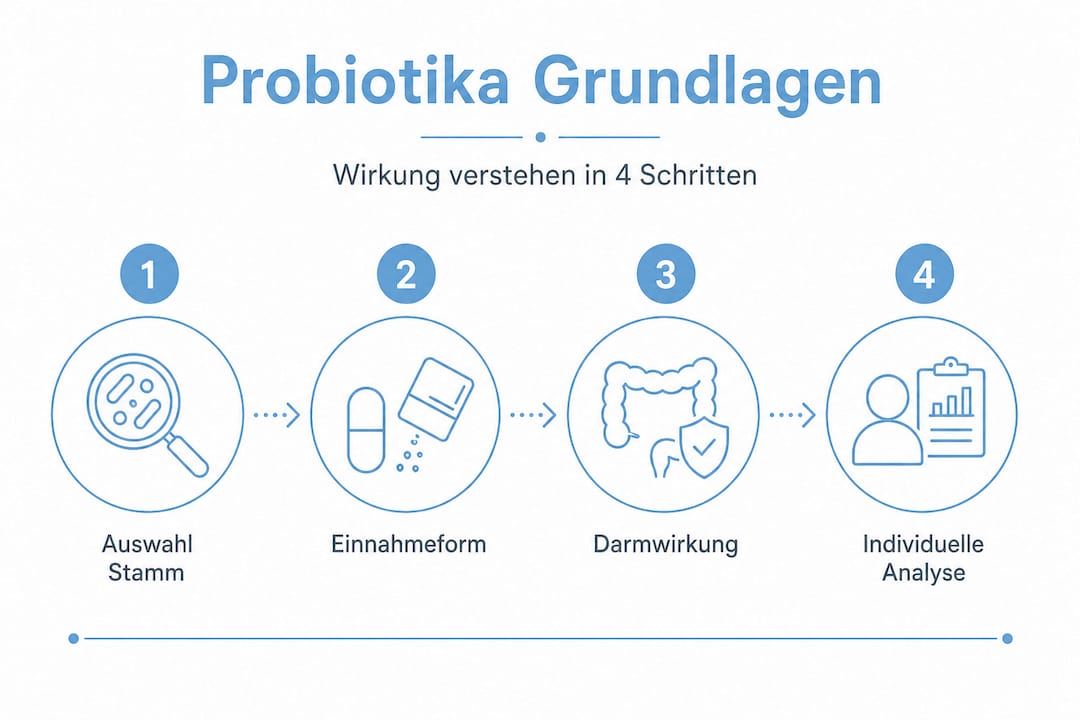
A key point that many people overlook: Not all probiotics are the same. Their effects are strain-specific. This means that Lactobacillus rhamnosus GG has different effects from Lactobacillus acidophilus, even though both belong to the genus Lactobacillus. Buying a product simply labeled “probiotic” without knowing which strain it contains is like taking a medication without knowing its active ingredient.
The most important bacterial genera in clinically tested probiotics are:
- Lactobacillus strains (e.g., L. rhamnosus GG, L. acidophilus, L. plantarum): Particularly well studied for diarrheal diseases, irritable bowel syndrome, and vaginal flora
- Bifidobacterium strains (e.g., B. longum, B. infantis, B. breve): Important for colon health, immune modulation, and in infants
- Saccharomyces boulardii: A yeast, not a bacterium, particularly effective for antibiotic-associated diarrhea and travelers' diarrhea
- Streptococcus thermophilus: Commonly found in fermented dairy products, it supports lactose digestion
Important to know: The number of live microorganisms (CFUs, colony-forming units) is crucial. Products with fewer than 1 billion CFUs have shown no measurable effects in most studies. Clinically relevant doses are usually 10 billion CFUs or more per daily dose.
The dosage form also plays a role. Gastro-resistant capsules protect the sensitive bacteria from stomach acid and significantly increase their survival rate until they reach the small intestine. Powders or simple capsules without a protective coating often lose a large proportion of their live cultures before they even reach their site of action.
Mechanisms of action: How probiotics act in the gut
Now that we have clarified what probiotics are, you will learn how these microorganisms work in the gut. Understanding these mechanisms will help you choose the right product for your specific needs.
The main mechanisms of probiotics include competing with pathogens for nutrients and binding sites, producing short-chain fatty acids as energy for the intestinal lining, strengthening the gut barrier through so-called tight junctions, modulating the immune system (around 70 percent of immune cells are located in the gut), and influencing the gut-brain axis through messenger substances such as serotonin and dopamine.
Here is an overview of the five key mechanisms of action:
-
Competition with pathogens: Probiotic bacteria occupy receptors on the intestinal wall that would otherwise be used by harmful germs. They also produce antimicrobial substances such as bacteriocins, which inhibit the growth of pathogens.
-
Production of short-chain fatty acids (SCFAs): When probiotics ferment dietary fiber, butyrate, propionate, and acetate are produced. Butyrate is the most important energy source for intestinal lining cells and actively protects against inflammation.
-
Strengthening the gut barrier: The intestinal wall is only one cell layer thick. Tight junctions are protein complexes that hold these cells together and prevent undigested food components or bacteria from entering the bloodstream. Probiotics promote the production of these proteins.
-
Immunomodulation: Probiotics train the gut-associated immune system (GALT). They stimulate regulatory T cells, which dampen excessive immune reactions, while simultaneously activating defenses against genuine pathogens.
-
Impact on the gut-brain axis: Through the vagus nerve and the production of neurotransmitters such as serotonin (around 90 percent of the body's serotonin is produced in the gut), probiotics influence mood, stress responses, and cognitive functions.
| Mechanism | Strains involved | Clinical relevance |
|---|---|---|
| Competition with pathogens | S. boulardii, L. rhamnosus GG | High for diarrhea |
| SCFA production | Bifidobacterium spp., L. plantarum | High for inflammation |
| Tight junction strengthening | L. rhamnosus, B. longum | Moderate to high for leaky gut |
| Immunomodulation | Multi-species combinations | High for IBS and allergies |
| Gut-brain axis | L. helveticus, B. longum | Moderate for stress and anxiety |
Pro tip: If you want to use probiotics specifically to support the intestinal barrier, look for products that explicitly combine L. rhamnosus and B. longum. This combination has shown measurable improvements in tight junction integrity in several controlled studies.
An often underestimated aspect is the time dimension. Probiotics do not permanently alter the microbiome while you are taking them. Once you stop, the microbiome returns to its original state within weeks. This means that without simultaneous dietary adjustments, the effect is limited and temporary.
Scientific evidence: When probiotics really help
Following the mechanisms, we will now examine the scientific data on the most important use cases. This is where solid evidence is separated from marketing claims.
The strongest evidence exists for three areas. In antibiotic-associated diarrhea, specific strains such as L. rhamnosus GG and S. boulardii reduce the risk by 40 to 60 percent, with a relative risk of 0.46 to 0.71 in controlled studies. In irritable bowel syndrome (IBS), meta-analyses of 82 randomized controlled trials show a significant reduction in abdominal pain and bloating. And in cases of increased intestinal permeability (leaky gut), a meta-analysis demonstrates a reduction in the zonulin marker of SMD -0.49, as well as a decrease in lipopolysaccharides of SMD -0.54.

| Use case | Level of evidence | Recommended strains | Effect size |
|---|---|---|---|
| Antibiotic-associated diarrhea | High (meta-analyses) | L. rhamnosus GG, S. boulardii | RR 0.46 to 0.71 |
| Irritable bowel syndrome (IBS) | Moderate to high | Multi-species, B. infantis | Significant symptom reduction |
| Leaky gut / zonulin | Medium | L. rhamnosus, B. longum | SMD -0.49 |
| Traveler’s diarrhea | Medium | S. boulardii | Reduction by 20 to 30% |
| Lactose digestion | High (EFSA-recognized) | S. thermophilus, L. bulgaricus | Clearly measurable |
What the numbers mean: A relative risk of 0.46 for antibiotic-associated diarrhea means that people who took the probiotic developed diarrhea only half as often as the control group. This is a clinically meaningful effect, not a marginal improvement.
The evidence is less convincing for general “immune support,” weight loss, or skin problems. These applications are frequently advertised but are not supported by consistent research findings.
Important: The dose-response relationship is real. Studies with fewer than 1 billion CFU show little effect. Clinically effective studies typically use 10 to 100 billion CFU daily. When buying, check the exact strain designation and the CFU count at the expiration date, not just the manufacturing date.
Another critical point is strain specificity. The results of a study with L. rhamnosus GG cannot be applied to another Lactobacillus product. Anyone who buys a probiotic that lists only “Lactobacillus” without specifying the exact strain does not know whether they are getting the clinically tested product or an ineffective variant.
Personalization: How microbiome analysis improves your probiotic choice
Once it is clear when and how probiotics work, you will learn how personalized approaches can sustainably improve your gut health. Most people skip this step, yet it is the decisive one.
Every microbiome is unique. Two people with similar symptoms may have completely different dysbioses, meaning imbalances in their gut flora. Without knowing which bacteria are missing or present in excess, choosing a probiotic is largely guesswork. A microbiome analysis before taking probiotics gives you the basis for a targeted decision.
Here are the four steps to a personalized probiotic strategy:
-
Conduct a microbiome analysis: A laboratory stool sample shows you which bacterial genera and strains are present in your gut, which are missing, and whether dysbiosis is present. Swiss laboratories such as mybody® Lab GmbH offer ISO-certified analyses that you can conveniently start at home.
-
Identify the dysbiosis pattern: Is there a lack of Bifidobacterium? Are short-chain fatty acid producers missing? Is overall diversity low? This information determines which strains are relevant for you.
-
Derive a strain-specific recommendation: Based on the analysis, select strains specifically to fill your particular gap. This is more efficient and safer than using a broad-spectrum probiotic without knowing your baseline condition.
-
Follow-up after 8 to 12 weeks: A second analysis shows whether the intervention has worked and whether adjustments are needed.
Pro tip: If you conduct a microbiome test at home, make sure not to collect the sample immediately after a course of antibiotics or major dietary changes. The result will then not reflect your normal state but rather a temporary exceptional state.
A particularly important warning concerns two specific situations. In SIBO (small intestinal bacterial overgrowth, meaning an excessive buildup of bacteria in the small intestine), probiotics can worsen symptoms because they further increase the already excessive bacterial population. If the intestinal lining is inflamed, for example during an active flare-up of Crohn’s disease, probiotics should only be used after preparation and in consultation with a doctor. An analysis identifies these risk situations before you begin taking them.
The instructions for a properly conducted microbiome test make the difference between a meaningful result and one that raises more questions than it answers.
Limitations and risks: What you should know critically
To conclude the informational sections, we focus on critical perspectives and risks. Taking probiotics uncritically risks not only wasting money but, in rare cases, also causing genuine disadvantages.
The regulatory situation in Europe is clear: The European Food Safety Authority (EFSA) has approved very few health-related claims for probiotics. Only support for lactose digestion by specific bacterial strains is authorized as a health claim. All other promises, such as “boosts the immune system” or “improves overall gut health,” are not substantiated from a regulatory perspective and technically may not be advertised this way in the EU.
An overview of the key critical points:
- Many advertising claims are unsubstantiated: Claims about weight loss, improved skin, or general vitality lack a consistent evidence base.
- Probiotics are not suitable for everyone: In immunocompromised people, meaning those with weakened immune systems due to illnesses or medications, live bacteria can cause serious infections.
- SIBO and inflamed mucosa: As already mentioned, probiotics can cause harm rather than help in these situations.
- Quality differences are enormous: Many products already contain significantly fewer live microorganisms than stated when purchased because storage and transport kill the bacteria.
- Fermented foods as an alternative: Sauerkraut, kefir, kimchi, and yogurt can provide effects similar to those of many commercial probiotics as part of a healthy diet, often at a fraction of the price.
A sober assessment: With a balanced, fiber-rich diet that includes enough fermented foods, most healthy people do not need probiotic supplements. The function of microbiome analysis is precisely to answer this question for you personally, rather than giving a blanket yes or no.
Fiber is particularly important in this context. It is food for the gut bacteria you already have (prebiotics) and promotes the production of short-chain fatty acids more effectively than many probiotic supplements. Anyone who consumes 30 to 40 grams of fiber daily from vegetables, legumes, and whole grains gives their gut bacteria what they truly need.
Perspective: Why choosing the right probiotic matters more than the product
Every day, we see people investing a great deal of energy in choosing the “best” probiotic while skipping the crucial step: understanding what their gut actually needs. It is like buying medication without knowing what illness you have.
The uncomfortable truth is this: The most expensive multi-species probiotic is of little use if your dysbiosis has an entirely different underlying cause, such as chronic sleep deprivation, persistent stress, or a diet too low in fiber. Probiotics cannot solve these underlying problems. They are a tool, not a cure-all.
What we repeatedly observe in practice: People who first understand the science behind microbiome analysis and then understand their individual baseline make significantly better decisions. Not because they spend more money, but because they act more strategically.
Another point that is often overlooked in public discussion: Multi-species probiotics are not automatically better than single-strain products. For specific indications such as antibiotic-associated diarrhea, a single, well-researched strain like S. boulardii is often more effective than a mixture of ten strains, most of which have no evidence for this use case.
Our recommendation, based on experience with more than 11,300 customers: Start with an analysis. Use the step-by-step guide to microbiome testing to understand the process clearly. And view probiotics as a targeted, time-limited intervention, not a permanent solution. The foundation is always your diet: plenty of vegetables, legumes, fermented foods, and sufficient sleep. Probiotics can make a real difference on this foundation. Without it, their effects quickly fade.
Your next steps toward better gut health
If, after reading this article, you would like to know which probiotics are personally suitable for you, the first step is a thorough analysis of your microbiome. mybody® Lab GmbH offers ISO-certified microbiome analyses that you can conveniently start at home: collect a stool sample, send it in, and receive a detailed, personalized report. The report contains specific recommendations for strains, dosages, and dietary adjustments tailored to your individual results. With free shipping on orders over 49 euros, personal consultation, and a money-back guarantee if no results are achieved, getting started is straightforward and risk-free. Start now at mybody-x.com and make your probiotic decision based on real data, not marketing promises.
Frequently asked questions
Who can benefit from probiotics according to the latest studies?
Probiotics have been shown to help with antibiotic-associated diarrhea, reducing the risk by 40 to 60 percent, as well as with irritable bowel syndrome and, following an individual analysis of the gut flora, confirmed dysbiosis.
Are probiotics necessary with a healthy diet?
For most people, probiotics are not necessary when following a high-fiber diet with fermented foods, as sauerkraut, kefir, and yogurt have similar effects on the gut flora.
How long should you take probiotics, and at what dosage?
Experts recommend taking probiotics for 4 to 8 weeks, with at least 10 billion CFU daily, preferably using multi-species strains, when there is a specific need such as antibiotic therapy or IBS.
When should you avoid probiotics?
People with immunosuppression, SIBO, or inflamed intestinal mucosa are advised against taking probiotics without medical supervision, as live bacteria can pose risks to immunocompromised individuals and worsen symptoms in people with SIBO.


Share now:
Loose stools cause: Find the answer!
Eat your way to a healthy gut: Your plan for greater well-being