
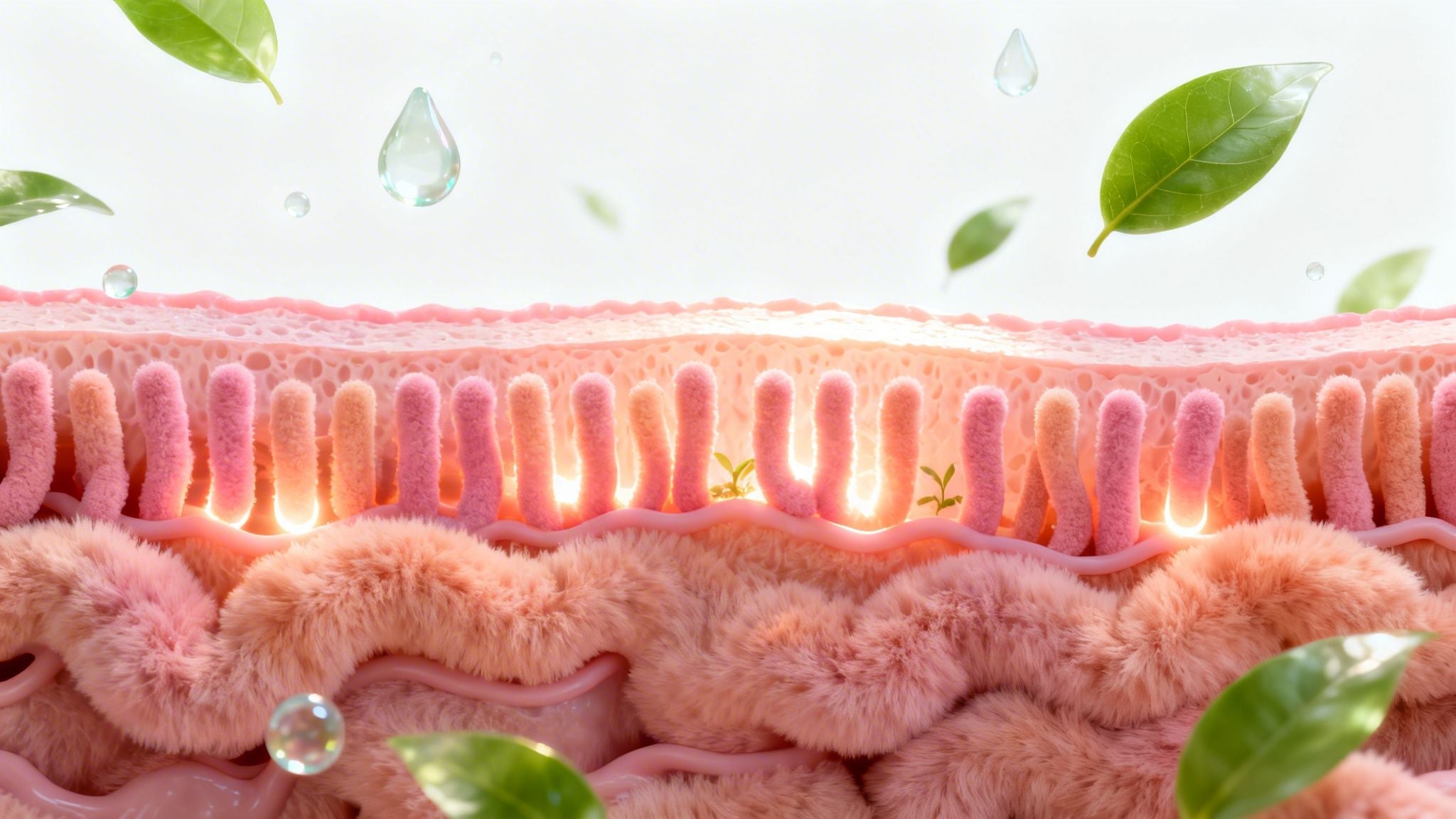
Rebuilding the intestinal lining for your health
Rebuilding the intestinal lining involves much more than digestion. It means deliberately strengthening your innermost protective layer through nutrition, nutrients, and a mindful lifestyle. This lays the foundation for your overall vitality, a strong immune system, and your daily well-being.
The foundation of your health: Why everything revolves around your intestinal lining
Think of your intestinal lining as a highly intelligent and extremely selective bouncer. It stands at the most important boundary in your body: the boundary between what ends up in your intestine and your bloodstream. This ultra-thin layer is the true foundation of your health—it helps determine your energy, your skin, and how resilient you are against infections.
Its main task is rigorous border control. It checks everything that arrives and lets through only what benefits your body: vitamins, minerals, and properly broken-down nutrients. At the same time, it keeps out anything that could cause harm—pathogens, toxins, and undigested food particles. It is your personal bodyguard, working around the clock for you.

When the bouncer is overwhelmed
But what happens when this inner protective barrier suddenly develops gaps? When the bouncer is overwhelmed and no longer thoroughly checks every guest? Then a chain reaction can start that you feel throughout your entire body. Perhaps you know the feeling:
- You are constantly tired, even though you have actually had enough sleep.
- Your stomach is unsettled, and you suffer from bloating or unexplained digestive problems.
- Your skin is acting up and is prone to blemishes or rashes that simply will not go away.
- You feel like you catch every infection that is going around.
These symptoms are not imagined. They are often your body's first, subtle warning signals, showing you: Your intestinal barrier urgently needs support.
A targeted intestinal lining rebuild is therefore not a short-lived trend, but one of the most important measures for your long-term health. It is about finally addressing the root cause of your symptoms instead of constantly fighting only the symptoms.
The good news is: You are not helplessly at the mercy of this condition. You can actively repair and strengthen this important protective barrier. By correctly interpreting your body's signals and providing it with the right building blocks, you can support its regeneration. The importance of this barrier is so fundamental that we have dedicated a separate article to it. If you would like to explore the topic in more depth, you can learn more here about the central role of the intestinal barrier in your health.
The Fascinating Architecture of Your Intestinal Barrier
Come with us on a little journey inside your body. We are now going to look at the ingenious structure that protects and nourishes you from within: your intestinal mucosa. Forget the image of a smooth tube. Instead, imagine your intestinal wall as an infinitely long, artistically folded velvet carpet.
This “carpet” is a true masterpiece of nature, designed with a single goal: to create as much surface area as possible. Why? To extract the maximum amount of nutrients for you from every bite of food.
A Masterpiece of Surface Area Enhancement
If this inner carpet were spread out completely, it would cover an area of 30 to 40 square meters. That is roughly the size of a small apartment! This enormous surface area is created by an ingenious three-stage folding system.
First, the intestine itself is folded into large, ring-shaped folds (the folds of Kerckring). Countless tiny, finger-like projections sit on these folds—these are the famous villi. And when you look even more closely, you discover that each individual villus is covered with a fine fuzz known as the brush border, made up of microvilli.
You can picture it like this:
- The large folds: They triple the surface area.
- The villi on the folds: They increase the surface area tenfold once again.
- The microvilli on the villi: They provide the final twentyfold increase in surface area.
This ingenious system, which you can also read about in this article on intestinal anatomy and its functions, ensures that not a single valuable nutrient molecule is lost. Everything is absorbed efficiently.
More Than Just a Covering
But the intestinal mucosa is far more than just a huge absorptive surface. It consists of several layers with highly specialized cells that all work together perfectly. At the very top is a thick layer of mucus (the mucus layer). It acts like a protective film that traps harmful substances and ensures that everything glides smoothly.
Directly beneath it lies the actual cell layer. This is where the heavy lifters are found: the cells that absorb nutrients (enterocytes), as well as cells that produce important hormones for your feeling of fullness or defensive substances for your immune system.
What is truly fascinating is the speed: This entire layer of cells completely renews itself about every three to five days. This constant development of the intestinal lining makes it extremely capable of regeneration, but also highly sensitive to disruption.
Once you understand how complex yet delicate this architecture is, it also becomes clear why even minor disruptions can have far-reaching consequences. Every defect in this system not only hinders the absorption of nutrients but also weakens your most important protective barrier against invaders.
When the protective wall develops gaps (leaky gut)
Your intestinal lining is incredibly resilient and a true marvel of regeneration, but it is not indestructible. In the hectic rhythm of everyday life, many invisible attackers can undermine your inner protective wall and make it fragile over time.
Usually, it is not a single trigger but a combination of several factors that eventually causes the situation to boil over. Chronic stress is one of the biggest enemies of your gut. It puts the body in a constant state of alert, directly weakening the barrier function. A diet rich in sugar, highly processed foods, and unhealthy fats is just as harmful—it essentially feeds the wrong bacteria and fuels inflammation.
Certain medications, such as antibiotics, can also seriously disrupt this delicate balance. They not only kill pathogens but unfortunately often destroy the beneficial bacteria that are so important for the development of the intestinal lining. Environmental toxins and often unrecognized food intolerances also constantly irritate the intestinal wall.
The zipper that slowly opens
When these stresses become too much, it can lead to what is known as “leaky gut syndrome”—which means “permeable intestine.” It is best to imagine the tight connections between your intestinal cells (the tight junctions) as a sturdy zipper.
When healthy, this zipper is tightly closed. Nothing passes through uncontrollably. With leaky gut syndrome, however, these connections loosen—the zipper slowly opens and tiny gaps form.
These leaky spots now allow incompletely digested food particles, bacterial fragments, and toxins to enter your bloodstream. Your immune system naturally recognizes these invaders immediately, sounds the alarm, and launches a defensive response. If this happens repeatedly, it leads to chronic, “silent” inflammation throughout the body.
Symptoms of a leaky gut barrier
The consequences of a damaged intestinal barrier are incredibly diverse and are often not associated with the gut at all. In addition to obvious digestive problems such as bloating, diarrhea, or constipation, you should therefore also pay attention to subtler signals from your body.
The following graphic shows the ingenious, multi-level structure of your intestinal surface: from the large fold to the tiny microvilli responsible for nutrient absorption.

This enormous surface area created by this clever architecture is essential for your health, but at the same time, it also makes your gut vulnerable to damage.
Common signs of leaky gut may include:
- Skin problems such as acne, eczema, or rosacea
- Difficulty concentrating and “brain fog”
- Constant fatigue and unexplained exhaustion
- Joint pain and muscle pain
- A high susceptibility to infections because your immune system is overloaded
- Food intolerances that suddenly develop
If you recognize these symptoms in yourself, it is a strong signal that your gut needs support. If you would like to learn more about the background and connections, you can find out more in our article on leaky gut syndrome.
How to find out the causes of your symptoms
A good gut feeling is important, but when it comes to your health, hard data provide the decisive clarity. If you suspect that your intestinal barrier is no longer intact and that rebuilding your intestinal lining is necessary, fortunately, you no longer have to feel your way in the dark. Today, there are smart ways to gain certainty—quite simply from home.
Instead of trying out various remedies and diets at random, you can identify the causes in a targeted way. Modern self-tests from mybody-x help you understand what is really going on in your body and give you back control.
Check your body with at-home tests
The first and most important step is to identify your very personal weak points. Three areas are particularly revealing: nutrient deficiencies, unnoticed reactions your body has to everyday foods, and the composition of your gut bacteria.
All of these factors have a direct, massive impact on the health of your intestinal wall. This is exactly where mybody-x’s tests come in, giving you a clear picture.
-
Food intolerance test: Often, seemingly harmless foods are the ones that keep your immune system activated day after day without you realizing it, contributing to chronic, low-grade inflammation in the intestinal wall. A blood test can uncover these reactions and show you which foods you should temporarily avoid to give your intestinal lining the much-needed break it needs to regenerate.
-
Nutrient test: Your intestinal cells need specific building blocks to renew themselves and form a strong barrier. A test can clearly show whether you are lacking important vitamins or minerals that are essential for repairing the intestinal lining.
-
Hormone test: Hormones such as cortisol (our stress hormone) have a direct impact on your gut health. An imbalance can weaken the gut barrier. A test reveals whether your hormone levels are balanced or whether they could be contributing to your symptoms.
These tests provide the crucial pieces of the puzzle. Instead of continuing to guess, they give you a sound basis for a plan that is truly tailored to you and specifically supports the regeneration of your intestinal lining.
With the results in hand, you will finally know where to start. You can precisely adjust your diet, correct nutrient deficiencies, or take targeted steps to reduce stress. This data-driven approach is the most effective way to regain control of your gut health. Learn more about how to find the right answers for your gut in our guide to testing your gut health.
mybody-x tests for your gut health
An overview of relevant self-tests to help you identify the causes of your symptoms and support your gut health in a targeted way.
| Test type | What is analyzed? | What does the test reveal? |
|---|---|---|
| Food intolerance test | IgG4 antibody reactions to a wide variety of foods. | Identifies foods that may burden your immune system and contribute to low-grade inflammation in the intestinal wall. |
| Nutrient test | Essential vitamins (e.g., vitamin D) and minerals (e.g., zinc) that are vital for the gut barrier. | Identifies specific deficiencies that hinder the regeneration of the intestinal lining and should be addressed in a targeted way. |
| Hormone test (e.g., cortisol) | The concentration of hormones in saliva or blood. | Reveals whether stress or hormonal imbalances are negatively affecting your gut health. |
| Gut flora test | The composition of your microbiome (bacterial diversity and distribution), pH level, and digestive residues. | Shows whether an imbalance (dysbiosis) is present, whether protective bacteria are missing, or whether harmful microbes have spread. |
These tests are not a medical diagnosis, but valuable tools for investigating the causes. The results provide a sound basis for taking targeted action or preparing for a conversation with your doctor or therapist.
How to rebuild your intestinal lining in 4 steps

Now that you understand what is happening in your gut, we come to the most important part: putting it into practice. Rebuilding your intestinal lining is not rocket science but a very targeted process. We provide you with a clear roadmap based on four essential pillars.
Think of it as your personal regeneration program—a kind of instruction manual for giving your inner protective barrier exactly what it needs to become strong and resilient again.
Step 1: Feed your intestinal cells (not the inflammation)
Your diet is by far the most powerful lever you have. Every single meal is a decision: Are you feeding your hardworking intestinal cells or fueling low-grade irritation? It is about consciously choosing foods that actively support the healing process.
Focus on a truly “gut-friendly” diet:
- Fiber-rich vegetables and fruit: They are the absolute favorite food of your beneficial gut bacteria, which in turn protect your intestinal lining. At first, steamed vegetables are often much easier to tolerate than raw ones.
- Fermented foods: Sauerkraut, kimchi, plain yogurt, or kefir provide live bacterial cultures (probiotics). These little helpers restore balance to your gut flora.
- Healthy fats: Omega-3 fatty acids—for example, from fatty fish such as salmon and mackerel, flaxseed oil, or chia seeds—have been proven to reduce inflammation and help repair cell walls.
- High-quality protein: Collagen from a good bone broth or protein from lean meat and fish provides essential amino acids. These are the building blocks your body uses to create new, healthy intestinal cells.
It is just as important to consistently avoid known troublemakers. These include, above all, sugar, highly processed products, trans fats, and excessive alcohol consumption. All of them fan the flames of inflammation. A mybody-x intolerance test helps you identify your personal trigger foods.
Step 2: Replenish your nutrient stores intentionally
Your intestinal lining renews itself at an astonishing pace—on average, about every 3 to 5 days. This ongoing formation of the intestinal lining requires your body to receive a constant supply of specific micronutrients. As you can read in this fascinating article about the intestinal mucosa, this rapid cell renewal is precisely what makes the intestinal wall extremely vulnerable to nutrient deficiencies.
If these “repair building blocks” are missing, the entire healing process can grind to a halt. The most important nutrients for a stable intestinal barrier include:
- L-Glutamine: This amino acid is the primary energy source for your intestinal cells. It could be described as the “super fuel” for regeneration.
- Zinc: This trace element is essential for cell division and the repair of tight junctions—the “zipper” that holds your intestinal cells together.
- Vitamin A: It is urgently needed to form the protective mucus layer and support the function of the gut's own immune system.
- Vitamin D: Plays a crucial role in regulating inflammation in the gut and strengthens barrier function.
A mybody-x nutrient test is an invaluable tool here. It shows you in black and white whether you are deficient in these critical nutrients. This allows you to replenish your stores in a targeted way instead of just groping in the dark.
Step 3: Master your stress—your gut is listening too
The connection between your head and your gut—the famous gut-brain axis—is not a one-way street. Chronic stress directly affects digestion and has been shown to weaken the intestinal barrier. Intelligent stress management is therefore not a luxury, but a central building block in the formation of the intestinal lining.
Choose techniques that truly suit you and that you can easily incorporate into your daily routine:
- Breathing exercises: Just 5 minutes of deep, conscious breathing can immediately calm your overstimulated nervous system.
- Meditation or mindfulness: Short daily sessions help you reduce mental noise and escape the carousel of thoughts.
- Walks in nature: Spending time in green spaces has been shown to lower the stress hormone cortisol. A short walk in the woods can often work wonders. A mybody-x hormone test can show you whether your cortisol level is out of balance.
Step 4: Optimize the conditions of your lifestyle
The best diet and the most expensive nutrients cannot reach their full potential if the basics are not right. Two often underestimated but absolutely crucial factors are sleep and exercise.
Restful sleep is the most important regeneration phase for your entire body. While you sleep, repair processes operate at full speed—and this applies especially to your intestinal lining. Try to get 7-9 hours of high-quality sleep per night.
Moderate exercise promotes circulation, gently stimulates bowel activity, and supports the diversity of your microbiome. However, avoid extreme training, as it can put additional stress on the body. Regular, gentle activities such as yoga, swimming, or cycling are ideal here.
Your most frequently asked questions about rebuilding the intestinal lining
Here, we have gathered the most important questions we keep receiving about rebuilding the intestinal lining. We’ll briefly and clearly shed light on everything from the duration of regeneration to the role of probiotics. This way, you’ll quickly get the answers to what concerns you most.
How long does it really take to rebuild the intestinal lining?
This is probably the one question everyone is dying to know. And the honest answer is: it depends entirely on you and your starting point. Although the cells in your intestinal lining renew themselves at a rapid pace within just a few days, fully restoring a weakened barrier is a marathon, not a sprint.
The entire process often takes several weeks, sometimes even months. How quickly it happens depends on several key factors:
- Cause and extent of the damage: A short-term strain, such as a course of antibiotics, usually heals faster than a barrier that has suffered for years due to chronic stress and an unhealthy diet.
- Your consistency: How consistently you change your diet, reduce stress, and adapt your lifestyle is the biggest factor determining the speed of regeneration.
- Your personal constitution: Every metabolism and immune system works differently and responds at its own pace.
Your most important companion on this journey is patience. Every small but consistent step is a major gain for your gut health.
What is the difference between probiotics and prebiotics?
The two terms sound similar and are often lumped together, but they describe two completely different concepts that complement each other perfectly when it comes to rebuilding your intestinal lining. It’s best to think of it like tending a garden.
Probiotics are essentially the “new, beneficial seedlings” that you plant in your garden. They are living, beneficial bacteria that you can consume through foods such as yogurt, kefir, or sauerkraut, as well as specifically through dietary supplements. They help restore the balance of your gut flora.
Prebiotics, on the other hand, are the “high-quality fertilizer” for the good plants already growing in your garden. They are indigestible fibers, for example from chicory, onions, leeks, or cooled potatoes. They serve as food for your beneficial gut bacteria, specifically stimulating their growth and activity.
The ideal solution is therefore a smart combination of both. A mybody-x gut microbiome test can show you in black and white whether you have a microbiome imbalance that requires targeted support with probiotics.
Do I need dietary supplements, or is a healthy diet enough?
A nutrient-rich, anti-inflammatory diet is and always will be the firm foundation. You cannot do without it. However, especially when the intestinal lining is severely irritated or proven nutrient deficiencies exist, certain supplements can significantly accelerate the regeneration process.
Simply think of them as highly specialized “construction workers” for your intestinal wall:
- L-Glutamine is like fuel for your intestinal cells, providing them directly with the energy needed for repair work.
- Zinc is essential for securely resealing the “zippers” between cells (the tight junctions).
- Omega-3 fatty acids help regulate excessive inflammation in the gut.
A mybody-x nutrient test gives you clarity about whether and which of these construction workers you are actually lacking. This allows you to replenish them specifically instead of supplementing indiscriminately.
When should I see a doctor about my gut problems?
Self-tests and lifestyle adjustments are valuable tools for taking your health into your own hands. But there are clear limits beyond which self-help must stop.
You should definitely see a doctor if you suffer from the following symptoms:
- Severe or sudden cramping pain
- Blood in your stool (whether visibly red or black)
- Unexplained weight loss
- Persistent fever and a strong feeling of illness
These warning signs require professional medical evaluation to rule out serious illnesses. The tests from mybody-x are intended for guidance, prevention, and optimization, but never replace a medical diagnosis or treatment.
Are you ready to get to the root of your symptoms and take your health into your own hands? The tests from mybody-x provide the data-based foundation for your individual path to greater well-being. Discover now how you can sustainably improve your gut health with precise analyses and targeted recommendations.



Share now:
Microbial Testing: Benefits for Your Gut Health
Stool Microbiome Test: What Your Gut Really Reveals