

Gut-cleansing diet plan: Make the switch step by step over four weeks
The essentials at a glance
A dietary plan for gut cleansing consists of gradually switching to more fiber, greater plant-based variety, and a regular meal schedule—not undergoing a cleanse. The German Nutrition Society (DGE) recommends that adults consume at least 30 grams of fiber per day (as of 2021). Four weeks are enough to get there.
“Gut cleansing” is not a medically defined term. What is supported by evidence is not the cleanse, but the lasting eating pattern behind it. This article therefore separates what can be supported by sources from what is merely claimed—and turns it into a weekly plan without a list of forbidden foods and without supplements.
The chapters follow the plan’s progression: first, clarifying the term and comparing the three approaches offered, then Weeks 1 through 4 as separate chapters, followed by the warning signs that belong in a doctor’s office and an honest assessment of the plan’s limitations. If you only want the plan, skip straight to Week 1.
What to expect in this article
1. What does “gut cleansing” mean—and what is supported by evidence?
2. Which three approaches are offered—and how strong is the evidence?
3. Week 1: Taking stock and making a gentle start
4. Week 2: Gradually increasing fiber
5. Week 3: Variety and fermented foods
6. Week 4: Establishing a routine and evaluating it honestly
7. Which warning signs belong in a doctor’s office?
8. What a microbiome test can—and cannot—do
9. Putting it into perspective: the limits of this plan
10. Conclusion
Frequently asked questions
Sources
Taking stock and making a gentle start
For seven days, you record what you eat and how your gut responds—and initially change only breakfast.
Gradually increasing fiber
Legumes, whole grains, and vegetables are added in small steps—moving toward the DGE guideline of at least 30 grams per day.
Variety and fermented foods
Instead of always having the same three types of vegetables, you add variety to your plate, along with small portions of fermented foods.
Establishing and evaluating a routine
Regular meals, a realistic everyday plan—and an honest comparison with your notes from Week 1.
What does “gut cleansing” mean—and what is supported by evidence?
“Gut cleansing” is not a medically defined term and does not describe a standardized procedure. It is used for very different things: supplement regimens, elimination diets, and simply changing one’s diet. Of these, the last is the one primarily supported by evidence.
Because the term is so vague, it is worth asking a question whenever you read any guide: Is it selling a time-limited cleanse, or describing an eating pattern that will still work a year from now? This plan is deliberately the latter.
Why the gut does not need “renovation” in the literal sense
The colon is home to a dense bacterial community that feeds on what the small intestine has not absorbed—especially indigestible carbohydrates from plant-based foods. This community is not renewed through cleansing, but through what regularly reaches it. That is why consistency matters more than intensity.
What the German Nutrition Society (DGE) says about fiber
According to the reference values of the German Nutrition Society (DGE, as of 2021), the guideline for adults is at least 30 grams of fiber per day. This is the only firm target of this dietary plan—everything else is the way to get there.
In the same reference values, the DGE states that increased fiber intake has protective effects against cardiovascular disease, type 2 diabetes, obesity, high blood pressure, colon and breast cancer, as well as the risk of death (DGE, 2021). Fiber also affects the transit time of food, the amount and consistency of stool, and the frequency of bowel movements. These effects are linked to the diet, not to a product or a limited treatment period.
Key message: What is supported by evidence is not a gut reset as a treatment course, but a permanently high-fiber, plant-focused diet—the DGE gives a guideline of at least 30 grams of fiber per day (as of 2021).
What this article covers—and what it does not
This article is the structured four-week plan: concrete, practical, step by step. If, on the other hand, you want to know what should be on your plate in the case of diagnosed intestinal inflammation, the relevant article is What to eat with intestinal inflammation? is the right place to start. If you are looking for short-term help with sluggish digestion, you will find it in Stimulating digestion. This is exclusively about a deliberate buildup over several weeks.
What are the three approaches offered as a gut reset—and how strong is the evidence?
The term “gut reset” essentially refers to three approaches: a long-term high-fiber diet, a FODMAP elimination phase, and taking supplements. They differ not only in the effort involved, but above all in how well supported they are by evidence.
The following overview compares the three approaches according to the same five criteria. The evidence references are taken from the DGE reference values (2021) and IQWiG health information (2023).
| Criterion | Permanently high-fiber diet | FODMAP elimination phase | Probiotic and fiber supplements |
|---|---|---|---|
| What does it involve? | Daily intake from vegetables, legumes, whole grains, fruit, and seeds is increased permanently. | Certain carbohydrates are temporarily eliminated and then reintroduced individually. | Bacterial cultures or isolated fiber are taken as additional supplements. |
| What has been established? | DGE (2021): Reference value of at least 30 g/day; protective effects include those against cardiovascular disease, type 2 diabetes, and colorectal cancer. | IQWiG (2023): It is suspected that consuming FODMAPs causes more water to enter the intestines and promotes diarrhea. | IQWiG (2023): It has not been established that additional fiber supplements help. Probiotics are generally well tolerated. |
| How long? | Permanent. The four-week buildup is only the beginning. | Limited in time, followed by reintroduction. Not a permanent diet. | Usually promoted as a course lasting several weeks. |
| Is professional guidance necessary? | Generally not—but it is advisable in the case of existing intestinal diseases. | Yes. Without a nutrition professional, it is difficult to carry out the elimination phase properly. | Not essential, but it does not replace medical evaluation of symptoms. |
| Risks | Bloating and a feeling of fullness if intake is increased too quickly. | IQWiG (2023): Risk of malnutrition because it becomes difficult to consume enough vitamins and minerals. | IQWiG (2023): Only mild side effects such as bloating are reported rarely—but there are costs without proven additional benefits. |
Why a permanently high-fiber diet forms the foundation
A permanently high-fiber diet is the only one of the three approaches for which the DGE describes a specific reference value and broad health benefits (DGE, 2021). It costs nothing apart from meal planning and can be continued for as long as desired.
The disadvantage is the slow pace: anyone expecting an immediately noticeable turnaround will be disappointed. In return, this approach does not involve a list of prohibited foods—and therefore begins with a week of observation before anything is increased at all.
When a FODMAP elimination phase should even be considered
A FODMAP elimination phase is not a starting tool but an approach for people with pronounced irritable bowel symptoms. According to IQWiG (2023), it is suspected that consuming FODMAPs causes more water to enter the intestines and promotes diarrhea.
IQWiG explicitly points out the risk of malnutrition with this form of diet because it becomes difficult to consume enough vitamins and minerals (IQWiG, 2023). A FODMAP phase should therefore be undertaken with professional guidance and never as part of a self-designed four-week plan.
What supplements have to do with this plan—namely, nothing
Regarding fiber supplements, IQWiG (2023) clearly states that their benefits have not been proven. Regarding probiotics, the same source notes that they are generally well tolerated and only rarely cause mild side effects such as bloating—a statement about tolerability, not effectiveness. For a dietary plan, this means: supplements are not prohibited; they are simply not part of it.
Week 1: How do you start by taking stock instead of giving things up?
Week 1 hardly changes what you eat—it makes your starting point visible. Without a baseline, it is impossible to assess at the end of the four weeks whether anything has changed.
A seven-day symptom diary
For seven days, note three things: what you eat, when you eat, and how your abdomen reacts in the hours afterward. Two brief notes per meal are enough; a complete food diary with quantities would probably have been abandoned after three days anyway. The notes also show whether your symptoms are actually related to food or are more closely linked to certain days and situations.
According to IQWiG (2023), an estimated 10 to 20 out of 100 people have irritable bowel syndrome; typical symptoms include “persistent abdominal or lower abdominal pain, cramps, and altered stool.” If your diary shows this pattern, it is a reason to talk to a doctor—not to follow a more restrictive diet.
Check for warning signs before changing anything
Before a dietary plan makes sense, it must be established that there is no underlying cause requiring treatment. IQWiG (2023) puts it this way: “Additional symptoms such as significant weight loss, blood in the stool, fever, or paleness are more likely to indicate another intestinal disease.”
According to IQWiG (2023), blood in the stool should generally be medically evaluated to determine its cause. This evaluation is not a precautionary measure that can be postponed until “after the program.”
The only change this week: breakfast
In week 1, change just one meal—the most predictable one: breakfast. Oatmeal with plain yogurt and fruit, or a slice of whole-grain bread instead of white-flour bread, is enough—nothing else changes this week.
The practical reason for this restraint is simple: if you change all three meals at once, you will often experience bloating and then be unable to determine what caused it.
Your Week 1 checklist
- ✓ Document for seven days – meal, time, and the stomach’s reaction, each in bullet points.
- ✓ Check for warning signs – significant weight loss, blood in the stool, fever, or paleness should be assessed by a doctor (IQWiG, 2023).
- ✓ Change only breakfast – choose one high-fiber option and have the same one for seven days.
- ✓ Increase your fluid intake accordingly – fiber binds water; without sufficient fluids, stools become firmer rather than softer.
- ✓ Do not eliminate anything – in Week 1, you add foods rather than banning them.
Week 2: How can you increase fiber without your stomach rebelling?
In Week 2, a second meal is added—and the increase happens in small steps rather than all at once. The goal remains the DGE guideline value of at least 30 grams of fiber per day (DGE, 2021), not the most spectacular weekly success possible.
Where fiber can realistically come from in everyday life
The most productive everyday sources are legumes such as lentils, chickpeas, and beans; whole-grain products such as oats, whole-grain pasta, and whole-grain bread; as well as vegetables, fruit with the skin on, and seeds such as flaxseed. If you spread these five groups throughout the day, you do not need a nutrition table.
In practical terms, for Week 2 this means: have one serving of legumes on three to four days, choose whole-grain pasta and rice, add a spoonful of flaxseed to your muesli, and include a vegetable component with every hot meal. These are four simple actions, not a new way of cooking.
Fluid intake is important: fiber binds water in the gut—if you increase your intake without drinking more, you are more likely to experience firmer stools rather than relief.
Why bloating can be normal during this phase
If your stomach feels tight after two days of lentil soup, this is not a sign of intolerance but a typical adaptation reaction to more fermentable material in the large intestine. It usually subsides when the increase is gradual enough.
The practical consequence is to take half a step back rather than quit: use a smaller portion, cook legumes thoroughly, or take a day off.
Key message: Fiber is increased over weeks, not overnight—accompanied by sufficient fluids because fiber binds water in the gut.
The overarching process surrounding the four weeks
The weekly plan is embedded in a larger process that begins before Week 1 and continues after Week 4. These four stages determine whether a change becomes a habit.
Document symptoms for two weeks
Only notes from at least two weeks make it possible to distinguish whether symptoms are linked to individual foods, meal intervals, or nothing identifiable.
Check for warning signs and seek medical evaluation
Significant weight loss, blood in the stool, fever, or paleness are more suggestive of another intestinal disease, according to IQWiG (2023), and should be medically evaluated before making any dietary changes.
Change your diet gradually instead of radically
One meal per week, plus more fluids: The four-week plan in this article is exactly this step, without an elimination diet and without supplements.
Assess honestly after six to eight weeks
Only after this period is it worth comparing your experience with the notes from the beginning—and deciding whether the change is sufficient or whether medical evaluation is needed.
Week 3: Why is variety more important than the amount of any one type?
In week 3, the focus is no longer on more, but on different. The bacterial community in the colon processes different plant components differently—if you always eat the same three vegetables, you always feed the same selection of bacteria.
Organizing plant-based variety in practice
The simplest lever is your shopping list: with each shop, pick up two plant-based foods that did not appear in your week 1 diary—a different legume, a winter vegetable, or a grain such as barley or millet.
Variety can also be created without buying anything new: herbs, nuts, seeds, and spices count too. A tablespoon of mixed seeds sprinkled over a salad broadens the range of foods on the plate without any extra effort.
Keep the same routine as in week 2. The third meal—usually dinner—will now also be changed, so that by the end of the week all three main meals contain a plant-based source of fiber.
Fermented foods instead of probiotic capsules
Fermented foods such as sauerkraut, plain yogurt, kefir, or kimchi are the practical everyday way to consume live cultures through food. They are part of a varied diet—and are not intended as remedies.
Regarding probiotics, IQWiG (2023) states that they are generally well tolerated and only rarely cause mild side effects such as bloating. This is a statement about tolerability and explicitly not evidence that supplements could replace dietary changes.
In week 3, the same caution applies as with fiber: start small. One or two tablespoons of sauerkraut or a small glass of kefir per day are enough to get started; anyone who eats larger quantities right away can easily mistake the adjustment response for an intolerance. If you are specifically looking for live cultures, check when shopping that the product has not been pasteurized.
In brief
In the third week of a dietary plan for gut health, the focus is on variety rather than quantity: as many different plant-based foods as possible spread throughout the week, supplemented with small portions of fermented foods such as sauerkraut, plain yogurt, or kefir. Supplements are not necessary for this: In 2023, the Institute for Quality and Efficiency in Health Care (IQWiG) described probiotics as generally well tolerated, but this does not constitute a statement about their effectiveness. Introducing new foods in small portions makes it easier to identify what does not agree with you.
Week 4: How do you establish the routine – and how do you assess it honestly?
Week 4 adds nothing new. It ensures that the dietary change can withstand everyday life involving appointments, travel, and restaurant visits.
Set meals and a realistic weekly plan
Choose three or four set dishes that you know how to prepare, that are rich in fiber, and that you can cook without thinking. A lentil stew, a vegetable stir-fry with whole grains, roasted vegetables with chickpeas – that is all you need.
Also plan a meal-prep day: Cooked legumes, cooked grains, and chopped vegetables keep for several days in the refrigerator and determine on stressful evenings whether you stick to the plan.
Why there should be no supplement at the end
After four weeks, the temptation is strong to secure what you have achieved with a powder or capsule. At precisely this point, the evidence is clear – and it argues against supplementation.
“
“It has not been established that additional fiber supplements help.”
Institute for Quality and Efficiency in Health Care (IQWiG)
“What helps with irritable bowel syndrome – and what doesn’t?”, gesundheitsinformation.de, 2023
This statement is why this dietary plan contains no supplement: The benefits described by the DGE (2021) come from legumes, whole-grain products, and vegetables.
The honest assessment after six to eight weeks
Compare your notes from Week 1 with what you observe now: Have the frequency and consistency of your bowel movements changed? Have bloating episodes become less frequent? Are there meals that reliably trigger symptoms?
An honest assessment includes a null result. If nothing has improved after six to eight weeks of consistent changes, that is not a reason to make the diet more restrictive, but a reason to seek medical evaluation.
What remains after the four weeks
- ✓ Fiber at every main meal – as a way to reach the DGE guideline value of at least 30 grams per day (DGE, 2021).
- ✓ Plant-based variety throughout the week – different vegetables, legumes, grains, nuts, and seeds instead of the same three varieties.
- ✓ Small portions of fermented foods – as part of your diet, not as a treatment.
- ✓ Drink enough—fiber binds water, and the two go together.
- ✓ One batch-cooking day per week—cooked legumes and grains in the refrigerator make the plan practical for everyday life.
Which warning signs belong in the doctor’s office rather than in the dietary plan?
A dietary plan is not a diagnostic procedure—and warning signs are not a reason to wait. Certain symptoms require medical evaluation, regardless of how disciplined you are with your diet.
The four signs explicitly named by IQWiG
According to IQWiG (2023), “additional symptoms such as significant weight loss, blood in the stool, fever, or pallor are more likely to indicate another bowel disease.” These four signs are the clearest indication that trying to manage the issue through diet is not the right next step.
According to IQWiG (2023), blood in the stool should always be medically examined to determine the cause—even if it occurs only once.
A dietary plan is not a diagnostic procedure—and warning signs are not a reason to wait.
Chronic inflammatory bowel diseases are less common, but real
An estimated 320 out of 100,000 people in Europe have Crohn’s disease, and approximately 3 to 6 out of 100,000 people are newly diagnosed each year (IQWiG, 2026). The condition is therefore significantly less common than irritable bowel syndrome, which according to IQWiG (2023) affects an estimated 10 to 20 out of 100 people.
During an acute Crohn’s disease flare-up, IQWiG (2026) reports that the main symptoms are abdominal pain and diarrhea. Anyone who has these symptoms for a prolonged period needs diagnostic evaluation—not a stricter dietary plan.
At the same time, there is reassurance: Irritable bowel syndrome is not dangerous, and most people affected manage well with a mild form. That is precisely why seeking clarification is worthwhile—in many cases, it ends the uncertainty.
What can a microbiome test do during a dietary change—and what can’t it do?
A microbiome analysis shows a snapshot of the bacterial composition in the stool. It provides a starting point for the change and a comparison value for later—but it is not a diagnosis and does not replace a medical examination.
An analysis is not necessary for the plan: The DGE guideline value of at least 30 grams of fiber per day (DGE, 2021) applies regardless of which bacteria appear in the report.
Useful for you if …
… you are documenting the change over several weeks anyway and want to record a baseline value.
… you have already been medically evaluated and have no acute warning signs.
… you see it as a snapshot providing additional information and do not expect a diagnosis from it.
Probably not, if …
… you have acute warning signs such as significant weight loss, blood in the stool, fever, or paleness—these require a visit to the doctor, not a self-test.
… you have already been diagnosed with chronic inflammatory bowel disease—its treatment belongs in the hands of a doctor.
… you expect a diagnosis or a ready-made treatment plan—microbiome analysis provides neither.
How mybody® (MYBODY Lab GmbH) performs microbiome analysis
mybody® (MYBODY Lab GmbH) offers gut flora analysis using a stool sample collected at home, analyzed in an ISO-certified laboratory in accordance with ISO 27001 and GDPR requirements. There are two options, which differ in the scope of the analysis.
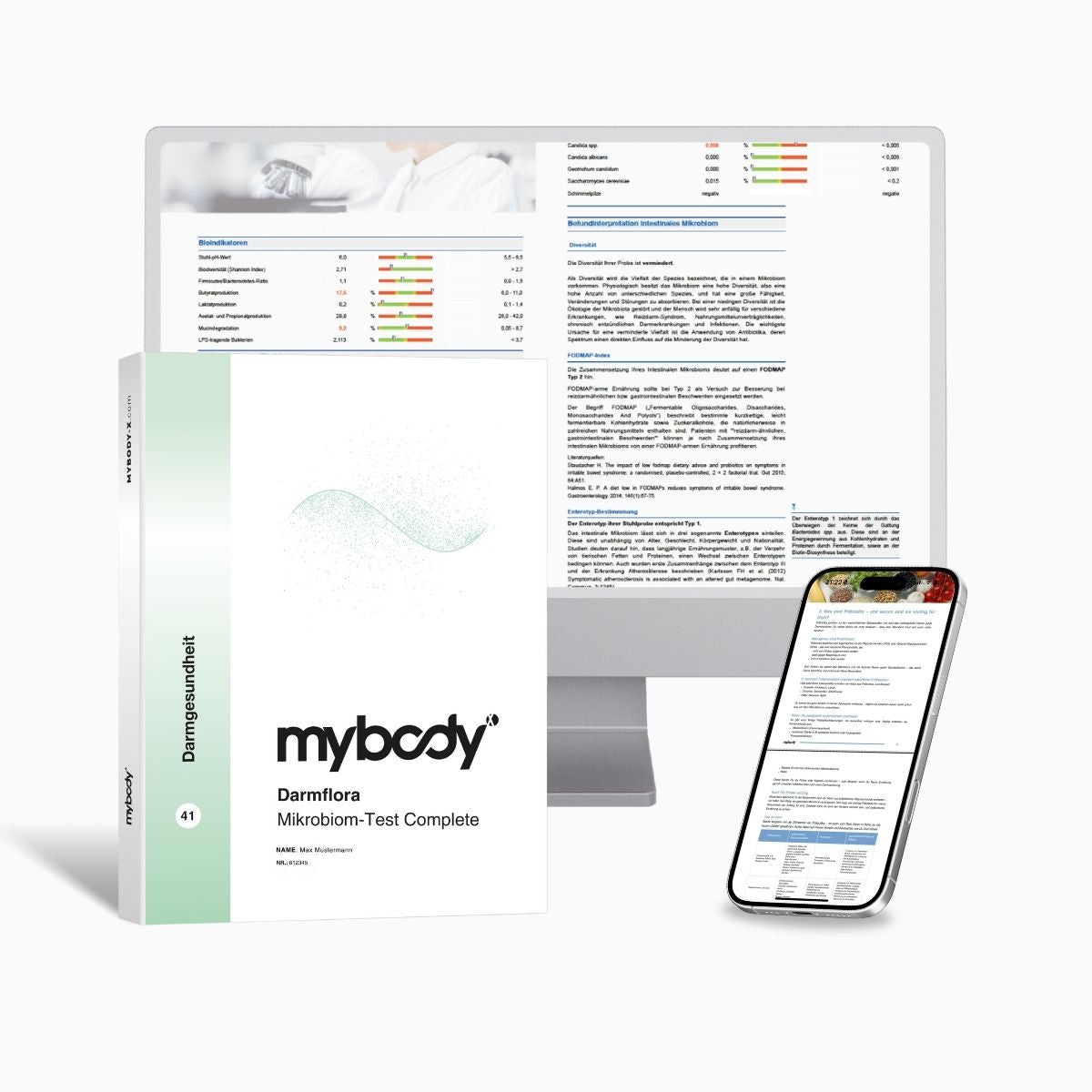
Gut Flora MICROBIOME Test Complete
The comprehensive option uses DNA sequencing to identify more than 1,500 bacterial species and summarizes the results in a report of around 15 pages—with bacterial diversity, the ratio of protective to problematic microorganisms, indications of dysbiosis, a FODMAP index, and enterotype determination. The test is not a diagnostic procedure: it does not detect chronic inflammatory bowel disease, tumors, infections, or celiac disease, and it does not replace a medical examination.
Price: €189.00 (instead of €219.00) · Sample type: Stool sample · Processing time: approx. 20–25 business days after sample receipt · Laboratory: ISO-certified laboratory analysis, ISO 27001, GDPR-compliant
For the Complete Microbiome TestFor getting started, the smaller option is often sufficient. It answers the basic question about composition but does not include a FODMAP index or enterotype determination.
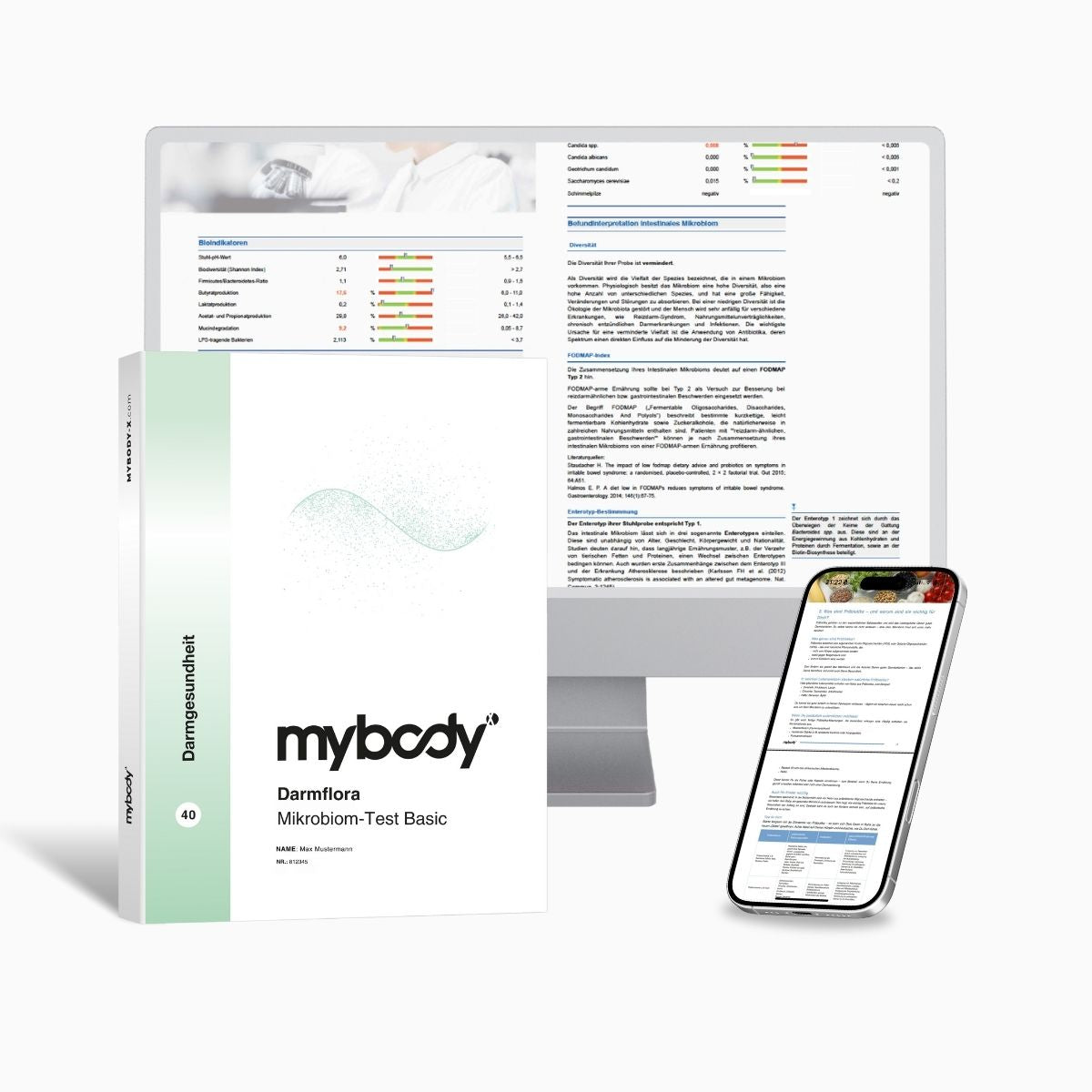
Gut Flora MICROBIOME Test Basic
The more affordable entry-level option examines the composition of the gut flora, the ratio of protective to potentially harmful bacteria, the intestinal environment based on pH levels, possible fungal colonization, and indications of dysbiosis—also summarized in a report of around 15 pages. This option also does not provide a diagnosis, include a FODMAP index, or determine an enterotype, and it does not replace medical evaluation of symptoms.
Price: €139.00 · Sample type: Stool sample · Processing time: approx. 20–25 business days after sample receipt · Laboratory: ISO-certified laboratory analysis, ISO 27001
For the Basic Microbiome TestAll price and service details are as of July 28, 2026. Prices and processing times may change; the relevant product page always governs.
What are the limits of this diet plan?
This plan is a dietary change, not a treatment. It may relieve symptoms and increase daily fiber intake toward the DGE guideline (DGE, 2021), but it cannot cure anything.
For chronic inflammatory bowel disease, diet does not replace treatment
For Crohn’s disease, IQWiG (2026) does not describe any diet that has been proven to influence existing chronic inflammatory bowel disease. As a preventive measure, it describes a diet “with plenty of vegetables and as few animal products and highly processed foods as possible”—this is consistent with the direction of this plan, but is explicitly not a treatment.
Anyone with an established diagnosis should discuss any dietary change with their treating medical practice.
Individual reactions cannot be predicted
There is no diet plan that works the same way for everyone. Which foods are well tolerated varies from person to person—that is precisely why week 1 focuses on keeping a diary rather than a list of prohibited foods. Nor is it possible to predict how quickly anything will change.
What this plan deliberately does not include
The plan includes no elimination diet, fasting, detoxification, or supplement regimen. It does not promise weight loss, a cure, or a “cleansed” digestive system, because the available source material provides no basis for such claims.
It also does not replace diagnostic testing. If symptoms persist for weeks or warning signs appear, the next step is to see a doctor—not to move on to the next stage of the diet plan.
Conclusion
A diet plan for intestinal cleansing does not work because it is called a “cleanse,” but because it permanently increases daily fiber intake and plant diversity. The DGE guideline of at least 30 grams of fiber per day (as of 2021) is the only target you need.
The process takes four weeks: document your habits and change your breakfast, then gradually increase your intake, add variety and fermented foods, and finally establish a regular routine. Supplements are unnecessary—according to IQWiG (2023), the effectiveness of additional fiber supplements has not been demonstrated.
In concrete terms, this means: Start this week with seven days of notes and a high-fiber breakfast. At the same time, check for warning signs—significant weight loss, blood in the stool, fever, or paleness should be evaluated by a doctor, according to IQWiG (2023). And honestly assess what has actually changed after six to eight weeks.
Frequently asked questions
What exactly is intestinal cleansing?
“Gut cleansing” is not a medically defined term and does not refer to a standardized procedure. In practice, it can mean very different things: supplement regimens, elimination diets, or a high-fiber dietary change. The last of these is supported by the strongest evidence: the German Nutrition Society recommends at least 30 grams of fiber per day for adults (DGE, 2021).
How much fiber per day is beneficial?
The German Nutrition Society recommends, in its reference values, at least 30 grams of fiber per day for adults (DGE, as of 2021). According to the DGE, increased fiber intake has protective effects against cardiovascular disease, type 2 diabetes, obesity, high blood pressure, colon and breast cancer, and the risk of death. Intake should be increased gradually and accompanied by sufficient fluids.
Do I need fiber supplements to improve my gut health?
No. The Institute for Quality and Efficiency in Health Care states explicitly: “It has not been established that additional fiber supplements help.” (IQWiG, 2023). The proven benefit comes from the diet itself—from legumes, whole-grain products, vegetables, fruit, and seeds. Supplements are therefore not part of this plan.
When should I see a doctor about abdominal symptoms?
According to IQWiG (2023), “additional symptoms such as significant weight loss, blood in the stool, fever, or paleness are more likely to indicate another intestinal disease.” Blood in the stool should always be examined by a doctor to clarify the cause. If nothing has improved after six to eight weeks of consistent dietary changes, medical evaluation is also the more sensible next step than adopting an even stricter diet.
What does a microbiome test show—and what doesn’t it show?
A microbiome analysis from a stool sample provides a snapshot of the bacterial composition. The Darmflora MIKROBIOM-Test Complete from mybody® (MYBODY Lab GmbH) uses DNA sequencing to identify more than 1,500 bacterial species and provides a report of around 15 pages. The test is not a diagnostic procedure: it does not detect inflammatory bowel disease, tumors, infections, or celiac disease and does not replace a medical examination.
Know your starting point before making changes
If you are documenting the four weeks anyway, you can also record the composition of your own gut flora as an additional snapshot—as a supplement to the diary, not as a substitute for medical evaluation.
View the Microbiome Test Complete All gut tests at a glanceYou might also be interested in
→ The Most Reliable Microbiome Tests for Your Gut Flora
What matters in a gut flora analysis and what information a reliable evaluation includes.
→ Gut flora tests: microbiome analysis meets practical recommendations for action
How to turn test results into concrete steps for everyday life.
→ Gut encyclopedia: all bacteria and markers in your gut flora
Reference work with more than 6,000 microbiome biomarkers—from protective bacteria and fiber degraders to the metrics in your report.
Sources
- German Nutrition Society (DGE): Dietary fiber reference values (as of 2021) — dge.de
- IQWiG / gesundheitsinformation.de: What helps with irritable bowel syndrome—and what doesn’t? (2023) — gesundheitsinformation.de
- IQWiG / gesundheitsinformation.de: Irritable bowel syndrome (2023) — gesundheitsinformation.de
- IQWiG / gesundheitsinformation.de: Crohn’s disease (2026) — gesundheitsinformation.de
The guideline of at least 30 grams of dietary fiber per day and the described protective effects of increased fiber intake are based on [1]. The statements on fiber supplements, probiotics, and the FODMAP diet, including the risk of malnutrition, are based on [2]. The frequency and typical symptoms of irritable bowel syndrome, as well as the warning signs of significant weight loss, blood in the stool, fever, or pallor, are based on [3]. The frequency, flare-up symptoms, and information on nutrition in Crohn’s disease are based on [4]. Product information comes from the mybody® product pages, accessed on July 28, 2026. All other studies mentioned in the text are cited directly at the relevant point with the authors, journal, and year.

mybody® Editorial & Expert Team
Gut health Microbiome Dietary fiber Nutritional science
This article was created and medically reviewed by the mybody® Editorial and Expert Team. The team brings together expertise in nutrigenetics, microbiome and gut science, blood test interpretation, nutritional science, and laboratory diagnostics.
Published on July 28, 2026 · Last updated on July 28, 2026
Medical notice: This article is for general information only and does not replace medical advice, diagnosis, or treatment. A nutrition plan is not a therapy: Persistent abdominal discomfort, significant weight loss, blood in the stool, fever, or pallor should be evaluated by a doctor. A microbiome analysis does not constitute a diagnosis.




Share now:
Bowel Sounds: What Your Stomach Is Telling You—and When to Take Them Seriously
Stomach pain: causes, warning signs, and what helps in everyday life