

Intestinal sounds: What your stomach is telling you—and when to take them seriously
The essentials at a glance
Intestinal sounds occur when the intestinal muscles push gas and liquid through the intestines. They are generally a sign of normal digestive activity, not a disease sign—even when they are loud. They should only be taken seriously when warning signs are also present: significant weight loss, blood in the stool, fever, or pallor.
This explanatory article describes how intestinal sounds arise in the body, what types there are, why they are louder in some people than in others, and when the combination of symptoms makes medical evaluation advisable. Every statement is supported by an institution and year, and anything that has not been substantiated is also identified as such here.
Read chapters 1 and 2 if you want to know what is normal, chapter 3 for the warning signs, chapters 4 and 6 for information on diet, irritable bowel syndrome, and the gut microbiome, chapters 5 and 8 for what cannot be substantiated in practice, chapter 7 for practical steps, and chapter 9 for an overview of the individual types.
What to expect in this article
2. Which intestinal sounds are normal?
3. When are intestinal sounds a warning sign?
4. What role do diet and fiber play?
5. What is there to the common assumptions about intestinal sounds?
6. What role do irritable bowel syndrome, irritable stomach, and the gut microbiome play?
7. What can help in everyday life when intestinal sounds are bothersome?
8. What has not been proven about intestinal sounds?
9. What types of intestinal sounds are there?
10. How mybody® can help
11. Putting it into perspective: What a microbiome test can—and cannot—do
12. Conclusion
Frequently asked questions
You might also be interested in
Sources
What are intestinal sounds—and how do they arise?
Intestinal sounds occur when the intestinal muscles move gas and liquid through the digestive tract. The medical term for this is borborygmus. Intestinal sounds are therefore an acoustic by-product of digestion—not a disease sign in their own right.
The intestine is a muscular tube. Ring-shaped muscles contract in waves and move its contents onward. This movement is called peristalsis and continues around the clock, regardless of whether you have just eaten.
Peristalsis becomes audible whenever gas and liquid are pushed through a section of intestine at the same time. Liquid alone produces hardly any sound, and gas alone produces just as little—the characteristic gurgling and rumbling only result from the mixture of both.
Where does intestinal gas come from?
Gas in the intestines comes from two main sources: swallowed air while eating, drinking, and speaking, as well as gases produced when bacteria break down undigested food components in the large intestine.
The second pathway explains why some meals cause more sounds than others. Carbohydrates that the small intestine does not fully absorb reach the large intestine, where bacteria ferment them—producing gas.
The Institute for Quality and Efficiency in Health Care (IQWiG, 2023) describes this mechanism for the group of FODMAPs, meaning certain short-chain carbohydrates: “It is suspected that consuming FODMAPs causes more water to enter the intestines and promotes diarrhea.” More water and more gas in the intestines mean more audible movement.
Why are bowel sounds louder in some people?
How loudly bowel sounds are heard externally depends less on the intestinal activity itself than on the surrounding conditions: a largely empty intestine dampens sound less than a full one, a thin abdominal wall less than a substantial one, and a quiet room less than a noisy environment.
That is why volume says little about the condition of the intestines: a sound that stands out in a quiet meeting would have gone unnoticed in a busy restaurant.
How often bowel sounds occur in everyday life has not been recorded in reliable figures—any figure would be an estimate. By contrast, the diseases that many people first think of when sounds persist can be quantified. These figures clearly support staying calm.
Source: IQWiG, “Irritable bowel syndrome” (as of 22 February 2023) and “Crohn’s disease” (as of 4 March 2026)
Which bowel sounds are normal?
Practically any bowel sound that occurs without other symptoms is normal. Gurgling, rumbling, growling, and occasional whistling are part of normal digestive activity and do not require assessment on their own.
Frequency is not a criterion either. The digestive tract works day and night; being audible while it does so is normal, not exceptional.
What matters is not the sound, but what accompanies it. Only together with persistent pain, altered stools, or one of the warning signs from Chapter 3 does a sound become a finding that requires medical assessment.
Key point: Bowel sounds alone are not a sign of illness; they indicate that the intestines are working. Neither their volume nor their frequency says anything about a disease. They only become meaningful in combination with accompanying symptoms.
Why does the stomach growl when you are hungry?
The familiar sound of a growling stomach does not occur because the stomach is empty, but because it continues to work nonetheless. Even between meals, waves of muscle contractions move through the stomach and small intestine, transporting remnants onward.
Because there is little food in the digestive tract during this phase, while air and digestive juices continue to move through it, there is less dampening; the same movement therefore sounds much louder than after a meal.
Hunger growling is therefore a sign of a normally functioning, currently empty digestive tract—not an indication of a deficiency or a disorder.
Why does it get louder again after eating?
After a meal, activity increases throughout the digestive tract: the stomach empties into the small intestine in portions, while space is made farther along. Sounds during the first few hours after eating are therefore to be expected.
Sounds that occur much later often have a different source: food components that the small intestine did not absorb reach the large intestine and are fermented there. Legumes, cruciferous vegetables, and whole-grain products are typical examples.
Diet plays a role here too—but, as Chapter 4 explains, with an important limitation: Fewer bowel sounds are not automatically a healthier goal.
How does this article differ from the related articles?
This explanatory article focuses exclusively on the phenomenon of bowel sounds: how they arise, what is normal, and when medical evaluation is necessary. If nausea is your main concern, Nausea after eating is the relevant article. If the issue is abdominal pain and pressure, Continue with Stomach pain after eating. And if intestinal inflammation has already been diagnosed, Nausea after eating is the relevant article. If the issue is abdominal pain and pressure, Intestinal inflammation: What to eat? for information about diet. The most reliable microbiome tests for your gut flora explains how the gut flora can be examined in the first place.
When are bowel sounds a warning sign?
Bowel sounds alone are not a warning sign—regardless of how loud or how frequently they occur. They become a warning sign only when accompanied by certain symptoms, and these accompanying symptoms are clearly defined.
IQWiG writes about irritable bowel syndrome (as of 2023): “Additional symptoms such as significant weight loss, blood in the stool, fever, or pallor are more likely to indicate another intestinal disease.”
For one particular sign, IQWiG (2023) is especially clear: “Blood in the stool should always be medically examined to clarify the cause.” This also applies if it has occurred only once.
These accompanying signs should be medically evaluated
- ✓ Significant, unintentional weight loss – without changes in diet or physical activity (IQWiG, 2023).
- ✓ Blood in the stool – according to IQWiG (2023), should always be medically evaluated, even if it occurs only once.
- ✓ Fever – argues against a purely functional cause (IQWiG, 2023).
- ✓ Pallor – may indicate anemia (IQWiG, 2023).
- ✓ Persistent vomiting – repeatedly being unable to keep meals down is no longer a dietary issue.
There are also two situations in which a doctor's office should likewise be the first step: nighttime symptoms that wake you from sleep and sudden, severe abdominal pain.
A clearly changed pattern also warrants evaluation: new, persistent pain, permanently altered bowel movements, or symptoms that do not subside over several weeks. The argument here is not the sound itself, but the change.
An honest assessment must also include the opposite perspective. Persistent abdominal discomfort accompanied by loud bowel sounds is most often caused by irritable bowel syndrome—and IQWiG (as of 2023) is explicitly reassuring about this. The following statement refers to irritable bowel syndrome as a diagnosis, not to bowel sounds in general:
“
“Irritable bowel syndrome is not dangerous. Most people affected have a mild form that they can manage well without treatment.”
Institute for Quality and Efficiency in Health Care (IQWiG)
“Irritable bowel syndrome,” dated February 22, 2023
Both halves of this chapter belong together: The warning signs mark the point at which self-observation ends. As long as none of them are present, audible bowel sounds are generally no cause for concern.
What role do diet and fiber play?
Diet directly affects bowel sounds because it determines how much gas is produced in the colon and how quickly the intestinal contents move. It is therefore the most effective lever—and also the one where the obvious conclusion is wrong.
The German Nutrition Society (DGE, as of 2021) describes the connection as follows: “Fiber—also known as dietary fiber—influences the transit time of food through the stomach and intestines, the amount and consistency of stool, and the frequency of bowel movements.”
Fiber therefore increases activity in the gut—and consequently tends to cause more bowel sounds. Anyone who reduces their fiber intake for this reason is treating a harmless symptom while simultaneously forgoing a nutrient with proven benefits.
How much fiber is beneficial?
The DGE (as of 2021) recommends that adults consume at least 30 g of fiber per day. This figure refers to foods such as vegetables, fruit, legumes, and whole-grain products, not to a supplement.
The reason for this recommendation lies outside digestion. According to the DGE (as of 2021), “increased fiber intake has protective effects against cardiovascular disease, type 2 diabetes, obesity, high blood pressure, colorectal and breast cancer, as well as the risk of death.”
The pace of the dietary change is important in practice: anyone who greatly increases their fiber intake within a few days is likely to trigger exactly the bloating and noises they wanted to avoid. A gradual increase over several weeks, accompanied by sufficient fluids, is the more tolerable approach.
Which foods cause more bowel sounds?
Foods that produce gas include, above all, nutrients that the small intestine does not fully absorb and that are therefore fermented in the large intestine—including the short-chain carbohydrates known to experts as FODMAPs.
How strongly individual foods affect people varies from person to person. Regarding nutrition for irritable bowel symptoms, IQWiG (2023) states: “However, how people react to certain foods is highly individual.” This does not support a universally applicable list of foods to avoid.
The way you eat also matters: eating hurriedly, drinking carbonated beverages, and chewing gum introduce additional air into the digestive tract.
What truth is there to the common assumptions about bowel sounds?
A number of persistent assumptions circulate about the gut, even though the evidence contradicts them. Three of them come up particularly often in connection with bowel sounds.
All three assumptions are based on the same line of reasoning: an audible intestine is a problem that must be fixed. That premise does not hold—an active intestine makes sounds, and this is not a disorder requiring treatment.
What role do irritable bowel syndrome, functional dyspepsia, and the gut microbiome play?
When loud bowel sounds occur together with abdominal symptoms for weeks, irritable bowel syndrome is the most common explanation. According to IQWiG (2023), estimates suggest that about 10 to 20 out of 100 people have irritable bowel syndrome.
IQWiG (2023) lists “persistent abdominal or lower abdominal pain, cramps, and altered stools” among the typical symptoms. Sounds alone are therefore not sufficient for this diagnosis—they are, at most, an accompanying phenomenon.
What is known about the causes of irritable bowel syndrome?
The mechanisms have not yet been fully clarified. IQWiG (2023) states: “Among other things, it is suspected that hypersensitive intestinal nerves, disorders of the intestinal muscles, changes in the gut microbiome, and inflammation of the intestinal wall could play a role.”
The word “suspected” is central to the statement. Hypersensitive intestinal nerves explain why the same intestinal movement goes barely noticed by one person but is perceived as unpleasant by another—without anything abnormal having changed in the intestine itself.
How does functional dyspepsia differ from this?
Functional dyspepsia—known colloquially as an “irritable stomach”—affects the upper abdomen rather than the intestines. IQWiG (as of 2025) lists “a feeling of fullness in the upper abdomen, nausea, and belching” as well as “pain and burning in the upper abdomen” as the main symptoms.
As initial steps for functional dyspepsia, IQWiG (as of 2025) describes “adjusting the diet, getting more exercise, and individually tailored medication.” The order is noteworthy: diet and exercise come before medication.
Do bowel sounds reveal anything about the gut microbiome?
The volume or type of sounds provides no indication of the composition of the gut microbiome. No such connection has been established, and no one can determine a bacterial pattern from a gurgle.
It has only been established that intestinal bacteria ferment undigested food components, producing gas in the process. Only a laboratory analysis of a stool sample can show which bacteria are present and in what proportions.
And even such an analysis does not answer the question of causes. According to IQWiG (2023), the role of the gut microbiota in functional complaints is explicitly “suspected”—it is a plausible contributing factor, not a proven cause.
In brief
When loud bowel sounds occur together with persistent abdominal complaints, irritable bowel syndrome is the most common explanation: According to estimates by the Institute for Quality and Efficiency in Health Care (IQWiG, 2023), 10 to 20 out of 100 people have irritable bowel syndrome. The causes have not been conclusively established; IQWiG lists hypersensitive intestinal nerves, impaired intestinal muscle function, changes in the gut microbiota, and inflammation of the intestinal wall as suspected mechanisms. The sound itself can indicate neither a diagnosis nor the state of the gut microbiota—for that, a medical examination or laboratory analysis is needed.
What helps in everyday life when bowel sounds are bothersome?
If bowel sounds interfere with everyday life, four approaches can help: swallow less air while eating, increase fiber cautiously rather than abruptly, record your own pattern for several weeks, and move around after eating.
None of these steps requires a new diet, a supplement, or a cleanse. They only change how a meal you were already planning is structured and what happens afterward.
Eat more slowly
Chew thoroughly, do not talk with your mouth full, and reduce carbonated drinks and chewing gum—this reduces the amount of air swallowed.
Increase fiber slowly
Gradually work toward the at least 30 g per day cited by the DGE (2021)—through food and with sufficient fluids.
Write down patterns
For two to four weeks, note when the sounds occur, what you have eaten, and whether pain or changes in bowel movements occur.
Move instead of lying down
The IQWiG (2025) explicitly lists more physical activity as one of the first steps for functional dyspepsia—a short walk is enough.
What matters is the expectation with which you approach these steps. The goal is not a silent gut—that would not be a sign of health. The goal is to identify the triggers that bother you most in everyday life.
A noisy gut is first and foremost a working gut—not a diseased one.
A noisy gut is first and foremost a working gut—not a diseased one.
There is no reliable information on how long a single episode of loud bowel sounds lasts. Anyone who gives a number is estimating—which is why there is no number here.
What has not been established about bowel sounds?
There is a large market of promises surrounding digestive complaints. Evidence is lacking for several of the most heavily advertised measures—and an honest explanatory article should say so just as clearly as it should explain what works.
Probiotics: Well tolerated, but no proven effect
The evidence regarding the tolerability of probiotics is comparatively clear. IQWiG (2023) writes: “In general, probiotics are well tolerated: Mild side effects such as flatulence occur only rarely.”
However, being well tolerated is not the same as being effective. This statement cannot be used to promise an effect against bowel sounds—anyone trying a supplement should treat it as an experiment with an uncertain outcome.
Low-FODMAP diet only for a limited time and with supervision
A low-FODMAP diet is often recommended for irritable bowel symptoms because it targets gas production. IQWiG (2023) describes the presumed mechanism, but in the same breath points out the risk: “However, there is a risk of malnutrition because it becomes difficult to consume enough vitamins and minerals.”
A low-FODMAP diet is therefore not a long-term self-experiment against bowel sounds, but a time-limited, professionally supervised measure followed by the gradual reintroduction of foods.
No diet replaces treatment for inflammatory bowel disease
For chronic inflammatory bowel disease, medical treatment comes first. The IQWiG overview of Crohn’s disease (as of 2026) does not name any diet that has been proven to influence an existing disease.
For preventive purposes, it describes a diet “with plenty of vegetables and as few animal products and highly processed foods as possible.” This is expressly not intended as treatment for an existing disease.
Regarding symptoms during a flare-up, IQWiG (2026) states: “During an acute Crohn’s disease flare-up, abdominal pain and diarrhea occur above all.” Bowel sounds are a peripheral phenomenon here, not the main symptom.
Key message: According to IQWiG (2023), there is no evidence that additional fiber supplements help; according to the German Nutrition Society (DGEinfo 3/2018), there is no scientific evidence for detoxification and detox diets. According to IQWiG (2023), probiotics are considered well tolerated, but this is not a statement about their effectiveness. According to IQWiG (2023), a low-FODMAP diet carries a risk of malnutrition and should be professionally supervised.
What types of bowel sounds are there?
Bowel sounds can be classified according to what accompanies them and when they occur. Four constellations account for most cases—from the completely harmless to those that warrant a visit to a doctor’s office.
The following overview compares these four constellations according to the same four criteria. It does not replace a diagnosis, but it helps put your own observations into context.
| Criterion | Hunger growling with an empty intestine | Sounds after a meal | Sounds associated with functional symptoms | Sounds together with warning signs |
|---|---|---|---|---|
| What does it sound like / when does it occur? | Deep growling and rumbling several hours after the last meal, often especially clearly audible when at rest | Gurgling and splashing during and in the hours after eating; later sounds arise from fermentation in the large intestine | Alternately loud, recurring over weeks and months, often more noticeable in phases and barely noticeable in between | Not linked to individual meals; during an acute Crohn’s disease flare, it “mainly causes abdominal pain and diarrhea” (IQWiG, 2026) |
| Typical accompanying signs | Feeling hungry, with no other symptoms | Bloating and flatulence that subside on their own | With irritable bowel syndrome, “persistent abdominal or lower abdominal pain, cramps, and altered stools” (IQWiG, 2023); with functional dyspepsia, “upper abdominal fullness, nausea, and belching” (IQWiG, 2025) | “Significant weight loss, blood in the stool, fever, or paleness” (IQWiG, 2023), as well as persistent vomiting or nighttime symptoms |
| Common triggers | Long gaps between meals; a small amount of chyme dampens the sounds less | Swallowed air, carbonated drinks, gas-producing foods; according to IQWiG (2023), FODMAPs probably cause “more water to enter the intestine” | Not definitively established; IQWiG (2023) suggests hypersensitive intestinal nerves, disorders of the intestinal muscles, changes in the gut flora, and inflammation of the intestinal wall as possible causes | Must be medically evaluated; according to IQWiG (2023), the warning signs “are more likely to indicate another intestinal disease” |
| Harmless or should it be evaluated? | Harmless, no evaluation necessary | Harmless as long as no warning signs occur | Have it medically assessed; according to IQWiG (2023), irritable bowel syndrome is “not dangerous,” and the diagnosis is made by ruling out other causes | Always have it evaluated; “blood in the stool should always be medically examined” (IQWiG, 2023) |
The overview reveals a pattern: The more clearly the sounds are linked to hunger or a single meal, the more likely the explanation is harmless. The more independently they occur and the more accompanying symptoms appear, the more important medical evaluation becomes.
How mybody® can help
No one needs to test bowel sounds themselves—they are a normal digestive phenomenon. Anyone who wants to know what their gut flora is made up of after a medical evaluation can have it analyzed in a laboratory.
mybody® (MYBODY Lab GmbH) offers an analysis based on a stool sample. It describes the current state and explicitly does not constitute a diagnosis—this qualification is deliberately placed before the product details.
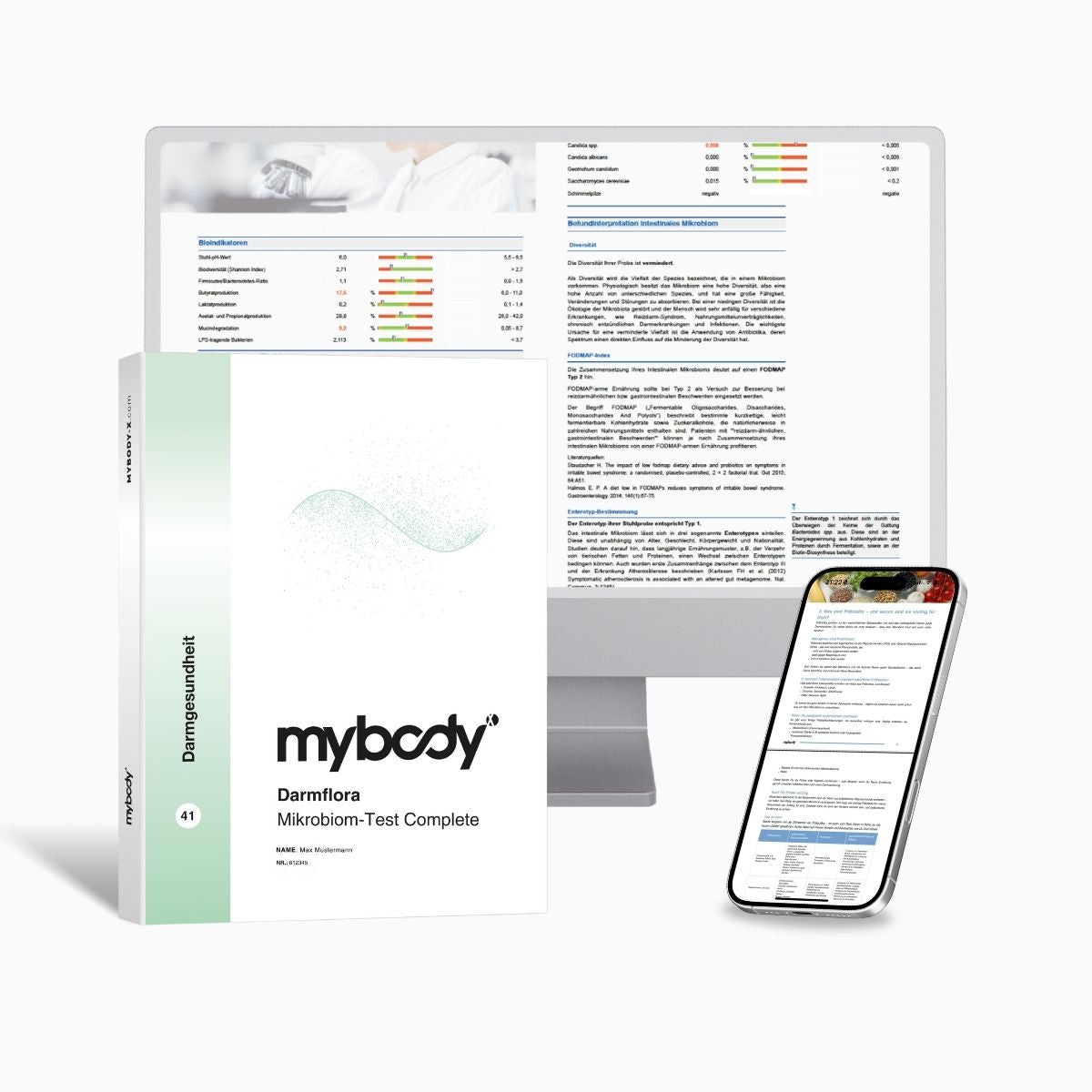
Darmflora MIKROBIOM-Test Complete
The Darmflora MIKROBIOM-Test Complete analyzes more than 1,500 bacterial species from a stool sample using DNA sequencing and summarizes the results in around 15 pages—with bacterial diversity, the ratio of protective to potentially problematic microbes, indications of dysbiosis, information relating to digestion and nutrition, as well as a FODMAP index and enterotype determination. It explicitly does not include a diagnosis: The test does not explain individual bowel sounds, detect inflammatory bowel disease, a tumor, an infection, or celiac disease, and it does not replace medical evaluation when warning signs are present.
Price: €189.00 (instead of €219.00) · Sample type: Stool sample · Processing time: approx. 20–25 business days after receipt of the sample · Laboratory: ISO-certified laboratory analysis, ISO 27001
Go to the Complete MICROBIOME testPrices as of July 28, 2026. Prices, report scope, and processing times may change—the linked product page is authoritative.
For context: mybody® works with an ISO-certified partner laboratory, processes samples in pseudonymized form and in compliance with the GDPR, and transmits data using SSL encryption. You can find out what to look for when choosing a microbiome analysis in Gut flora tests: Microbiome analysis meets practical recommendations for action.
Context: What a microbiome test can—and cannot—do
A microbiome test describes a snapshot of the bacteria in your gut. With regard to bowel sounds, its limitations are considerable—and they should be stated openly.
First, a microbiome test is not a diagnostic procedure. It does not detect inflammatory bowel disease, a tumor, an infection, or celiac disease. Anyone who wants to clarify one of these issues needs a medical examination.
Second, no finding explains a single sound. Why your stomach was loud on a particular afternoon cannot be deduced from a list of bacteria—only your own observations over several weeks can provide insight.
Third, the role of the gut microbiota in functional complaints has not been proven. The IQWiG (2023) explicitly refers to it as a hypothesis when mentioning changes in the gut microbiota alongside hypersensitive intestinal nerves and disturbances of the intestinal muscles.
Fourth, mybody® has no standalone test product for lactose or fructose intolerance. For both conditions, the H2 breath test is the medical standard—this route leads through a doctor’s office.
And fifth, medical evaluation takes priority. In cases of marked weight loss, blood in the stool, fever, pallor, persistent vomiting, nighttime symptoms, or sudden severe pain, the first step is a doctor’s office—not a self-test.
Conclusion
Bowel sounds are a normal byproduct of digestion. They occur when the intestinal muscles move gas and liquid onward and, on their own, say nothing about a disease—neither their volume nor their frequency.
The figures support this reassurance. According to IQWiG estimates (2023), 10 to 20 out of 100 people have irritable bowel syndrome, which IQWiG says “is not dangerous”; chronic inflammatory bowel diseases are much rarer, with an estimated 320 out of 100,000 people in Europe having Crohn’s disease (IQWiG, 2026).
In practical terms: Eat more slowly, reduce swallowed air, gradually increase your fiber intake toward the at least 30 g per day recommended by the DGE (as of 2021)—through foods rather than supplements—and move around after eating instead of lying down.
And draw the line early: Marked weight loss, blood in the stool, fever, pallor, or persistent vomiting should be evaluated at a doctor’s office. Once the symptoms have been medically assessed, an analysis of the gut microbiome may be a supplement—but it cannot explain an individual sound.
Frequently asked questions about bowel sounds
Are loud bowel sounds dangerous?
As a rule, they are not. Loud bowel sounds show that the intestinal muscles are moving gas and liquid. The volume depends largely on how full the intestines are and how quiet the surroundings are. Sounds only become a warning sign when accompanied by symptoms such as marked weight loss, blood in the stool, fever, or pallor (IQWiG, 2023).
How do bowel sounds develop in the first place?
Ring-shaped muscles move the intestinal contents onward in waves. The sounds become audible when gas and liquid are pushed through an intestinal loop at the same time. The gas comes from swallowed air and from the bacterial breakdown of undigested food components in the large intestine. The technical term for the sound is borborygmus.
When should I see a doctor about bowel sounds?
Immediately if warning signs appear. IQWiG (2023) lists “marked weight loss, blood in the stool, fever, or pallor” as indications that “are more likely to point to another intestinal disease,” and states: “Blood in the stool should always be medically examined.” Persistent vomiting, nighttime symptoms, and sudden severe pain should also be medically evaluated.
Can intestinal sounds be caused by irritable bowel syndrome?
Sounds can be an accompanying phenomenon, but they are not a diagnostic criterion. The IQWiG (2023) lists “persistent abdominal or lower abdominal pain, cramps, and altered stool” as typical symptoms. Estimates suggest that 10 to 20 out of 100 people have irritable bowel syndrome; according to the IQWiG, it is “not dangerous.”
Does a microbiome test show where my intestinal sounds come from?
No. A microbiome test describes the composition of the gut flora from a stool sample. It does not provide a diagnosis, explain a single sound, or detect inflammatory bowel disease, a tumor, an infection, or celiac disease. If warning signs are present, medical evaluation takes priority.
Do you want to know how your gut flora is composed?
The Complete gut flora MICROBIOME test analyzes over 1,500 bacterial species from a stool sample using DNA sequencing, including a FODMAP index and enterotype determination. Results are available approximately 20–25 working days after the sample is received. The test shows a current snapshot—not a diagnosis and not an explanation for a single intestinal sound.
Go to the Complete MICROBIOME test View all gut health testsYou might also be interested in
→ The most reliable microbiome tests for your gut flora
How to assess the quality of a gut flora analysis.
→ Gut flora tests: microbiome analysis meets practical recommendations for action
What can be inferred from a microbiome report in everyday life.
→ Gut dictionary: all bacteria and markers in your gut flora
Reference work with over 6,000 microbiome biomarkers—from protective bacteria and fiber degraders to the key metrics in the report.
Sources
- Institute for Quality and Efficiency in Health Care (IQWiG): Irritable bowel syndrome (as of February 22, 2023)
- IQWiG: What helps with irritable bowel syndrome—and what doesn’t? (as of February 22, 2023)
- IQWiG: What can help with an irritable stomach? (as of September 17, 2025)
- IQWiG: Crohn’s disease (as of March 4, 2026)
- German Nutrition Society (DGE): Reference values for dietary fiber (as of 2021)
- German Nutrition Society (DGE): Detox diets, DGEinfo 3/2018
The information on irritable bowel syndrome, its suspected mechanisms, and warning signs is based on [1]; the statements on FODMAPs, fiber supplements, probiotics, and individual reactions to foods are based on [2]; the information on irritable stomach syndrome is based on [3]; the figures and statements on Crohn’s disease are based on [4]; the recommended fiber intake levels and their effects are based on [5]; and the assessment of detoxification and detox diets is based on [6]. All other sources cited in the text are identified directly at the relevant point with the institution and year. All product information about mybody® (MYBODY Lab GmbH) comes from the official product pages at mybody-x.com (as of July 28, 2026).

mybody® Editorial & Expert Team
Gut health Bowel sounds Microbiome Digestion Nutritional science Laboratory diagnostics
This article was created and medically reviewed by the mybody® editorial and expert team at MYBODY Lab GmbH. The team combines expertise in microbiome and gut science, nutritional science, laboratory diagnostics, and nutrigenetics. Learn more about the people behind it on the mybody® authors’ page.
Published on July 28, 2026 · Last updated on July 28, 2026
Medical advice: This article is intended for general information and does not replace medical advice, diagnosis, or treatment. Self-tests provide indications, not diagnoses. If you experience significant weight loss, blood in your stool, fever, paleness, persistent vomiting, nighttime symptoms, or sudden severe abdominal pain, please consult a doctor. If you take medication, are pregnant, or are breastfeeding, discuss dietary changes with a doctor beforehand.




Share now:
Pressure in the abdomen: What’s behind it and when you should have it checked out
Gut health nutrition plan: Make the change step by step over four weeks