

Low progesterone symptoms: Finally understand and take action
Do you often feel tired, easily irritable, or simply not yourself anymore? A hormonal imbalance, where insufficient progesterone triggers the symptoms, could be the culprit. Many women attribute unexplained mood swings, sleep problems, or an irregular cycle to everyday stress, even though a progesterone deficiency is often the true cause.
When inner balance is lacking

Progesterone is often called the "feel-good hormone" for good reason. In the second half of the menstrual cycle, it promotes inner calm, deep, restful sleep, and prepares the body for a possible pregnancy. However, if this important hormone becomes imbalanced, it can noticeably affect your overall quality of life.
Suddenly you might feel constantly tense, your breasts might be uncomfortably tender before your period, or you might be retaining water. These signs are more than just annoying side effects – they are important signals from your body that you should take seriously.
The typical signs at a glance
Many women are unsure whether their symptoms are truly due to hormones. This table will help you quickly determine if your symptoms could indicate a deficiency.
Common early signs of a progesterone deficiency
| Symptom area | Typical signs |
|---|---|
| Cycle & Period | Irregular or shortened cycles, spotting, severe PMS symptoms (breast tenderness, bloating), severe period pain |
| Mood & Psyche | Mood swings, irritability, anxiety, depressive moods, the feeling of being "beside oneself" |
| Sleep & Energy | Difficulty falling asleep or staying asleep, night sweats, constant tiredness and exhaustion |
| Physical well-being | Water retention (edema), weight gain (especially around the abdomen), headaches or migraines, hair loss, loss of libido |
| fertility | Difficulty conceiving, early miscarriages |
Do you recognize yourself in some of these points? This is a strong indication that your progesterone levels may be out of balance.
The hidden cause of many ailments
A condition known as luteal phase deficiency, in which the body produces too little progesterone, is one of the most common causes of menstrual irregularities and infertility in Germany. Studies indicate that approximately 10–15% of women between the ages of 20 and 40 are affected.
Particularly common are shortened cycles, occurring in around 60% of those affected, and severe PMS symptoms such as breast tenderness and mood swings, which affect up to 40% of women every month. If you would like to delve deeper into the background and diagnosis, you can find more information at netdoktor.de .
With mybody® you gain in-depth insights into your women's health – from hormones and nutrients to your metabolism. This helps you understand what your body truly needs to feel well, balanced, and healthy in everyday life.
This article guides you step-by-step through the world of progesterone. You'll learn how to correctly interpret your body's signals and how a simple mybody® hormone test can give you the clarity you need. This will allow you to regain control over your hormonal health and actively take charge of your well-being.
Understanding the role of progesterone in your body
Imagine your hormonal system as a finely tuned orchestra. Each hormone has its own melody, but progesterone is like the conductor, setting the pace, especially in the second half of your cycle. It ensures that everything plays together harmoniously and that you feel completely well.
Progesterone's most well-known function is preparing the body for a potential pregnancy. After ovulation, it ensures that the uterine lining builds up optimally – like a cozy nest for a fertilized egg. A deficiency can disrupt this crucial preparation.
More than just a pregnancy hormone
But progesterone can do much more. It's a true feel-good hormone that has a direct influence on your mood and overall well-being.
- Your natural calming agent: Progesterone has a relaxing effect on the nervous system. It helps you to be more relaxed, reduce tension, and unwind better in the evening. Good sleep? Progesterone plays a role here too.
- The counterpart to estrogen: Estrogen gives you energy and power in the first half of your cycle. Progesterone is its balancing partner in the second half. It prevents estrogen from becoming dominant, thus preventing typical PMS symptoms such as water retention or breast tenderness.
The balance between estrogen and progesterone is key to a smooth menstrual cycle. If progesterone levels are too low, estrogen dominance occurs – the cause of many of the unpleasant symptoms you may be experiencing.
This delicate balance is crucial for your physical and mental well-being. A progesterone deficiency can severely disrupt this interplay and trigger a whole cascade of symptoms. If you'd like to delve deeper into how your cycle works, check out our article on the menstrual cycle .
Understanding what progesterone does in your body is the first step to identifying the causes of your symptoms. With this knowledge, you can better interpret your body's signals and specifically seek solutions to restore your hormonal balance.
Progesterone deficiency: Recognizing the typical symptoms
Your body is constantly communicating with you, but in the hustle and bustle of everyday life, we easily miss its signals. So, if you're wondering whether the discomfort you've been experiencing lately might be typical symptoms of low progesterone , you've come to the right place. Let's work together to decipher what's behind the most common signs, so you can better understand your body.
Many women are all too familiar with the symptoms of a progesterone deficiency, but often struggle to identify the cause. The symptoms are as varied as we are ourselves, ranging from physical problems to an emotional rollercoaster that can severely impact quality of life.
Menstrual irregularities and PMS as early warning signs
One of the clearest signals of a hormonal imbalance is your menstrual cycle. A progesterone deficiency is usually quite evident here.
- Shortened luteal phase: The time after ovulation, the luteal phase, should ideally last 12 to 14 days. If it suddenly only lasts 10 days or less , this is a strong indication.
- Spotting: Do you repeatedly notice light, brownish bleeding a few days before your actual period starts? That's also a classic.
- Extreme PMS: The days leading up to your period become a real ordeal. Instead of mild mood swings, you struggle with severe breast tenderness, painful bloating, food cravings, and irritability that scares even you.
All of this indicates that the delicate balance between estrogen and progesterone has been disrupted. In the second half of the cycle, estrogen then takes over – this is also known as estrogen dominance.
Emotional and psychological rollercoaster ride
Did you know that progesterone is often called the "feel-good hormone"? It acts like a natural calming agent for our nervous system. If it's lacking, we immediately notice it in our emotional state.
A progesterone deficiency can make you feel like you're constantly on edge. The hormone's relaxing, balancing effect is missing, which often manifests as inner restlessness, anxiety, and a significantly lower stress tolerance.
Perhaps you're familiar with this: Suddenly, little things drive you up the wall, you feel anxious for no reason, or you're prone to depressive moods. You feel like you're not yourself anymore, you're constantly tense, and you find it hard to relax in the evenings.
Physical ailments and sleepless nights
A progesterone deficiency isn't just noticeable in your menstrual cycle or emotionally. Your whole body can react to it.
- Sleep problems: Is falling asleep a struggle, do you wake up constantly during the night, or do you feel completely exhausted in the morning? The calming effect of progesterone is crucial for deep, restful sleep. Without it, the nights remain restless.
- Water retention: Do your rings no longer fit, are your favorite jeans too tight, or have you noticed cellulite on your legs? Progesterone has a natural diuretic effect. A deficiency can therefore lead to unwelcome swelling.
- Unexplained weight gain: Is the scale climbing slowly but steadily, even though you haven't changed anything about your diet or exercise? Stubborn belly fat, in particular, could be a sign.
- Skin problems: Hormonal imbalances often manifest on the skin, for example through suddenly appearing blemishes or acne.
Especially during menopause, which affects around 9 million women in Germany, the declining progesterone level plays a crucial role. During this phase, the body reduces hormone production, which often exacerbates symptoms such as sleep disturbances and irritability. In fact, 70–80% of menopausal women suffer from sleep problems – and the cause is frequently a direct result of the deficiency of calming progesterone. You can learn more about the background of this life phase on the website of the Bavarian State Ministry of Health and Care .
What really causes a progesterone deficiency
A progesterone deficiency rarely appears out of the blue. It's usually the gradual result of various factors interacting over a longer period. If you notice symptoms of low progesterone , it's worth taking a closer look – because only by understanding the causes can you take targeted action.
A drop in progesterone levels is often a completely natural occurrence during certain phases of life. In perimenopause, the years leading up to the final menstrual period, the ovaries gradually reduce their activity. Ovulation becomes less frequent or ceases altogether. The problem is that without ovulation, there is no corpus luteum – and the corpus luteum is our primary producer of progesterone.
Overview of the most common triggers
Besides the normal, age-related changes, there are a whole host of other disruptive factors that can throw your hormonal balance off.
- Anovulatory cycles: This sounds complicated, but it simply means that no ovulation occurs in a given cycle. Without ovulation, there is no corpus luteum and therefore no progesterone.
- Luteal insufficiency: In this condition, ovulation occurs, but the corpus luteum is too weak or fails prematurely. It simply does not produce enough progesterone to fulfill its functions.
- Thyroid dysfunction: The thyroid gland is like the conductor of our hormonal orchestra. If it malfunctions, for example in the case of hypothyroidism, the entire system is thrown out of whack – including progesterone production.
- Nutrient deficiencies: Your body can't create hormones out of thin air. It needs building blocks like vitamin B6, zinc, and magnesium . If these essential components are lacking, hormone production slows down considerably.
Stress, the invisible hormone robber
One factor we often underestimate is chronic stress . During stressful times, our body switches into survival mode. Its top priority is then the production of the stress hormone cortisol. And here's the catch: The precursor to cortisol is the same as to progesterone – the molecule pregnenolone.
When you're under constant stress, your body makes a decision: it redirects available building blocks to produce more cortisol. Essentially, it "steals" the material that was actually intended for your progesterone. Experts also call this phenomenon "pregnenolone steal."
This also explains why many women suddenly suffer from severe PMS or menstrual irregularities during particularly stressful periods in their lives. If you want to delve deeper into this topic, check out our article on the symptoms of high cortisol .
When metabolism disrupts hormones
Sometimes the root of the problem lies in metabolism. Polycystic ovary syndrome (PCOS) affects 5–10% of all women of childbearing age in Germany. Typical symptoms include an excess of male hormones and a lack of ovulation – a direct cause of progesterone deficiency. Additionally, PCOS is often accompanied by insulin resistance, which can increase the risk of diabetes by up to 50% and further strain the hormonal system. You can read more about this connection at Fertilly .
As you can see, the causes are as diverse as we women ourselves. Therefore, a precise analysis of your hormone levels is the first and most important step to finding the right solution for you and restoring your balance.
Here's how to find out what's going on with your hormones.
Do you recognize yourself in the typical symptoms of low progesterone ? Then the next logical step is to finally get some clarity. Guessing won't get you anywhere, but a targeted measurement of your hormone levels will. Only then can you truly find out if a deficiency is behind your symptoms.
For a meaningful result, however, the timing is crucial. Because progesterone plays a dominant role in the second half of the cycle, the test must be performed precisely then – ideally about five to seven days after ovulation . This is the moment when it becomes clear whether your corpus luteum is producing enough progesterone for you.
The modern way: Easily measure your progesterone level at home
Previously, a visit to the doctor's office was the only way to have your hormone levels checked. Fortunately, today it's much easier and more discreet: with an at-home hormone test. With mybody®, you can conveniently integrate this important step into your daily routine, completely without waiting times or appointment pressure.
The process is deliberately kept simple so you can get started right away:
- Simple sample collection: A small, virtually painless prick of the finger is all it takes. You can then take a few drops of blood yourself at home.
- Shipping to a specialist laboratory: You send your sample free of charge to our certified German partner laboratory. There it will be analyzed by experts.
- Easy-to-understand results report: You will receive your personal report within a few days. This report not only provides your exact measurements but also translates them into clear, understandable language.
The following infographic shows you what causes a hormonal imbalance can be – things a test can reveal.
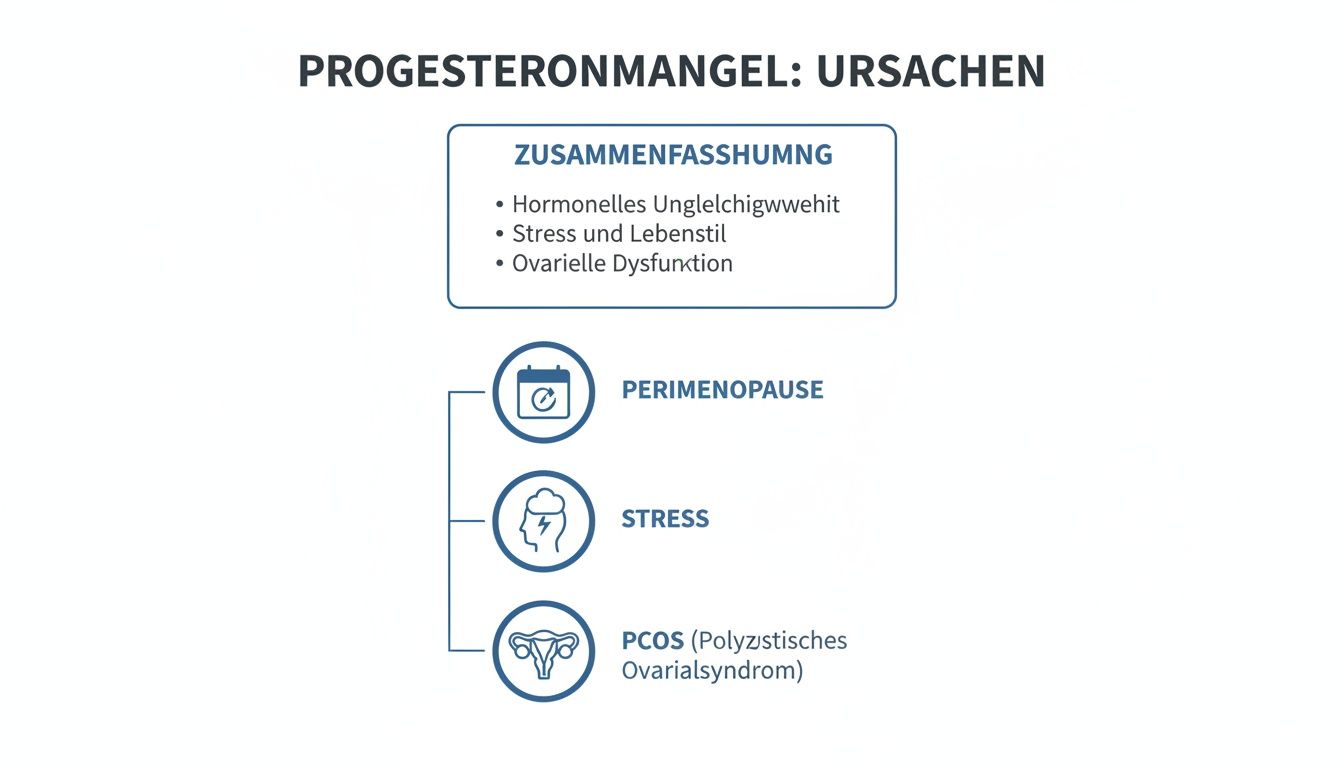
As you can see, natural life phases such as perimenopause, but also chronic stress or PCOS can really mess up your hormonal balance.
Comparison of test methods for your progesterone level
This table shows you at a glance the advantages of the mybody® self-test compared to a traditional doctor's visit.
| feature | Visit to the doctor's office | mybody® self-test for home use |
|---|---|---|
| Time required | Appointment scheduling, waiting time, directions | Approximately 15 minutes from home |
| flexibility | Bound to fixed consultation hours | Can be done anytime , to suit your cycle. |
| discretion | Disclosure of complaints in the waiting room/practice | 100% anonymous and discreet |
| Results processing | Often only lab results without detailed explanation. | Comprehensive report with clear explanations |
| Recommendations for action | Depending on medical advice | Specific, personalized tips for nutrition & lifestyle |
The self-test therefore not only gives you flexibility, but also the tools to directly understand your results and react to them.
More than just numbers: Understand what your body is trying to tell you.
Our goal is not to leave you with just your lab results. Your mybody® results report goes a crucial step further: Based on your individual values, it provides you with concrete and practical recommendations for everyday life . You'll learn how to adjust your diet, optimize your lifestyle, and specifically support your body with nutrients to restore your hormonal balance.
A self-test gives you back control. You act proactively, discreetly, and save valuable time. It's the first, crucial step towards taking charge of your health and understanding the causes of your symptoms.
You take responsibility for your well-being and finally gain the clarity you need to take the right steps. If you'd like to learn more about the different options, read on in our article about how to have your hormone levels tested .
Your path to greater hormonal balance
Once you finally have clarity about your hormone levels through a test, the guesswork is over. Instead, you can take targeted action and actively support your body in finding its way back to its natural balance. Often, it's just small but consistent adjustments in your daily routine that make a huge difference and noticeably alleviate the typical symptoms of low progesterone .
Your personalized results report from mybody® provides you with tailored recommendations precisely aligned with your individual values. The following strategies offer an excellent foundation for you to immediately begin promoting your hormonal well-being.
Nutrition as the foundation for your hormones
Your hormones don't just appear out of thin air. They need specific building blocks from food to be produced and function properly. A progesterone-friendly diet is therefore the first and most important step.
Focus on these nutrient heroes:
- Healthy fats: They are the direct precursor for hormone production. Therefore, include plenty of avocados, nuts (especially walnuts), seeds (such as flax and chia seeds), and high-quality oils in your diet.
- Vitamin B6: This vitamin is a key player in regulating hormone activity. You can find it in abundance in chickpeas, lentils, bananas, and whole grain products.
- Zinc: Essential for ovulation and the function of the corpus luteum, which produces progesterone. Pumpkin seeds, rolled oats, and cashew nuts are excellent sources of zinc.
- Magnesium: This "relaxation mineral" not only helps reduce stress but is also involved in hundreds of biochemical reactions – including hormone production. So, reach for green leafy vegetables, almonds, and dark chocolate more often.
Adjust your lifestyle and reduce stress
Chronic stress is one of the biggest enemies of healthy progesterone levels. If your body constantly has to produce the stress hormone cortisol, it simply has fewer resources left to produce progesterone.
Effective stress management isn't just a nice option; it's an absolute necessity for your hormonal health. Find out what helps you personally to calm down – whether it's yoga, meditation, walks in nature, or simple breathing exercises.
The right type of exercise also plays an important role. While intense training can be great in the first half of your cycle, gentler activities are often a better choice in the second, progesterone-dominated phase. Think Pilates, swimming, or moderate strength training. This way, you won't put your body under any additional stress.
If you'd like to delve deeper into how to specifically support your hormones, you'll find many more tips in our guide on how to naturally regulate your hormones . This way, you can find the path that best suits you and your body to restore balance.
Take control of your women's health now
The symptoms of low progesterone can really turn your daily life upside down – but you don't have to just accept it. The most important thing on your path to greater well-being is realizing that understanding is the first step to improvement. Instead of continuing to wonder why you don't feel energetic, balanced, and simply good, you can take action now.
Interpreting your body's signals correctly is key. But to be truly sure what's going on, you need reliable data. That's precisely where the mybody® hormone test comes in. It gives you the clarity you need to understand the causes of your symptoms and finally take targeted action. The guesswork is over.
With mybody® you gain in-depth insights into your women's health – from hormones and nutrients to your metabolism. This helps you understand what your body truly needs to feel well, balanced, and healthy in everyday life.
It's time to take control of your well-being again. Find out what your body needs so it can return to its natural balance. Start your journey to more energy, inner peace, and a better quality of life today. Your body will thank you.
Take control of your health. Discover the blood tests from mybody® and find out what your body really needs to regain balance. Learn more here and start your journey to greater well-being .



Share:
Gain clarity with a home vitamin and mineral test.
Self-monitoring of blood values: A guide to optimal health