
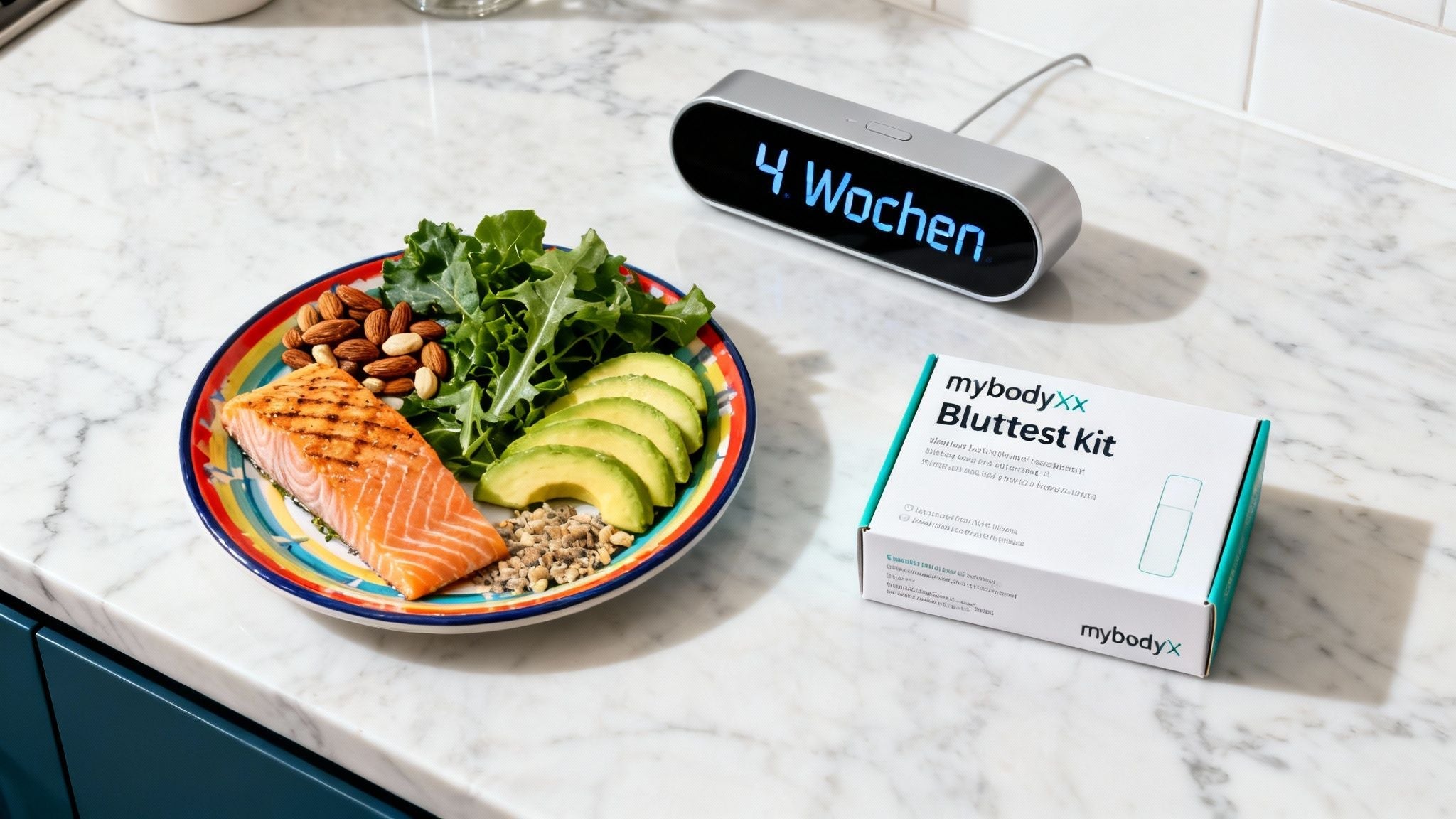
How quickly can triglycerides be lowered? The timeline
The essentials at a glance
The question has two answers because it refers to two different things. The measured level changes within hours: a meal rich in fat or sugar raises it, which is why you should go eight hours without eating before the blood draw (IQWiG, 2025). The underlying risk factor changes more slowly, and none of the institutions reviewed gives a number of weeks for it.
This article clearly distinguishes between the two levels. It names the measures that a German institution explicitly recommends and states wherever evidence-based timing information is lacking. An estimated figure would be the worse mistake here because it creates an expectation that no one can fulfill.
First, you will read what the level actually indicates. Then come the two time frames and the signs that belong in a medical practice rather than the kitchen. Next are the causes, a comparison of the four recommended starting points, the role of measurement conditions, and three common misconceptions. The final section explains how you can actually notice a change and the limitations of a measurement.
What to expect in this article
1. What a triglyceride level actually indicates
2. How quickly the level actually changes
3. When the level does not belong in the kitchen but in a medical practice
4. What drives a triglyceride level upward
5. The four recommended starting points compared
6. Why a single measurement says little
7. Three sentences about triglycerides and what remains of them
8. The starting points in everyday life, considered individually
9. The figures that are truly established for this level
10. Where you can have your triglyceride level measured
11. How you can actually notice a change
12. Who home testing is suitable for—and who it is not
13. Limitations: what a blood test does not clarify about this level
14. What matters when asking about the pace of change
Frequently asked questions
Sources
What a triglyceride level actually indicates
Triglycerides are the storage form of fat—the form in which the body transports and stores energy. They can be measured in the blood, and this measurement produces a figure in milligrams per deciliter or millimoles per liter.
For adults over 18, the Institute for Quality and Efficiency in Health Care gives a reference range of below 150 mg/dl, equivalent to 1.7 mmol/l (IQWiG, 2025). This figure applies equally to women and men.
Key message
A triglyceride level describes a condition at the time of blood collection, not a disease. For adults over 18, the reference range is a level below 150 mg/dl or 1.7 mmol/l (IQWiG, 2025).
Why the level is a risk factor, not a prediction
An elevated triglyceride level is a risk factor, not a diagnosis. It indicates that a value lies outside a statistical range. What this means for an individual depends on other information: age, blood pressure, smoking status, blood sugar, and the other blood lipids.
IQWiG explicitly puts this value into context. According to this source, triglycerides can influence the risk of cardiovascular disease, but play a subordinate role in determining risk (IQWiG, 2025). This is a considerably more cautious statement than those found in many guide texts.
For you, this has a practical consequence. A single elevated triglyceride result in a report is a reason to have a conversation, not a cause for alarm. A medical practice provides the assessment because that is where the other relevant information comes together.
How common abnormal blood lipid levels are in Germany
Based on the German Health Update Study, Scheidt-Nave and co-authors report in the Federal Health Gazette that a lipid metabolism disorder as defined by the study was present in 64.5 percent of men and 65.7 percent of women aged 18 to 79 (2013).
This figure covers all lipid metabolism disorders, not triglycerides alone. It is therefore useful for indicating the order of magnitude, but not as a statement about your own level. The reviewed source material contains no current figure from a German institution on the prevalence of isolated elevated triglycerides.
How quickly the level actually changes
The question of speed can be answered once two things are distinguished: the measured number and the condition it is intended to describe. They change at different speeds, and that is exactly where most answers online fall short.
Documented source
“It is important not to eat anything and to drink only still water during the 8 hours before the blood sample is taken. A meal—in particular one containing a lot of fat or sugar—can raise the level.”
Institute for Quality and Efficiency in Health Care (IQWiG)
Triglycerides, gesundheitsinformation.de, updated March 20, 2025
This sentence contains the fastest documented time frame on the subject. A single meal is enough to raise the measured number. Conversely, this means that eight hours without food are enough to bring it back to the level suitable for comparison.
The hourly timescale is a measurement condition, not a success
Anyone who fasts the evening before and gets a lower result in the morning than last time has not changed anything. They have merely measured under different conditions. This distinction may sound pedantic, but it is the most common reason for misinterpreting blood lipid levels.
The opposite is equally true. A value measured after a late dinner may appear elevated even though nothing abnormal is happening in the metabolism. Here, the measurement conditions produce a number that no one can interpret.
That is why every serious consideration of your own triglyceride value begins not with an intervention but with an accurate measurement. Everything else depends on two numbers having been obtained under the same conditions.
Why there is no number of weeks here
For the second level—the condition behind the number—IQWiG names five measures: exercising more, drinking less alcohol, losing excess weight, eating a more balanced diet, and not smoking (2025). The source does not state after how many weeks this would show up in a test result.
The second reviewed page from the same institution on elevated blood lipid levels also contains no such time frame (IQWiG, 2025). Therefore, the source material used provides no documented period for the effect of lifestyle changes on triglycerides.
A number could appear here. It would appear in many other texts, and it would be estimated. With a laboratory value, an estimated number is the worse error because it creates a deadline against which you will later measure yourself.
When the value does not belong in the kitchen but in a medical practice
Before turning to diet and exercise, it is worth checking the following list. If any of these points applies to you, the next step is an appointment at a medical practice, not searching for the right recipe.
The reason is stated in the same source as the reference range. According to IQWiG, extremely high triglyceride values can lead to acute inflammation of the pancreas (2025). This is the point at which everyday measures are no longer sufficient.
These points belong in a medical practice
A value far above the reference range
According to IQWiG (2025), extremely high values can trigger acute inflammation of the pancreas. This magnitude is not something to negotiate in the kitchen
Severe upper abdominal pain
especially when accompanied by nausea or vomiting and radiating to the back. This requires immediate medical evaluation, not waiting
A known disease as a possible underlying cause
IQWiG (2025) names diabetes, gout, an underactive thyroid, and chronic liver and kidney diseases, among others, as possible causes of elevated values
Medications that may affect the value
Hormonal contraceptives, beta blockers, and corticosteroids are mentioned (IQWiG, 2025). No medication should be stopped independently for this reason
Abnormal values in your own family
A genetic predisposition is documented as a cause: familial hypertriglyceridemia (IQWiG, 2025). It does not follow from lifestyle
A value that has not changed for months
even though you have actually changed your alcohol consumption, diet, physical activity, and weight. Then the cause is probably something else
This list is not a diagnostic framework and does not replace an examination. It marks the point at which changing your diet would be the wrong answer to the right question.
Two points stand on their own: severe upper abdominal pain and a value far above the reference range. Both require evaluation, without waiting and without a second sign.
Many people researching this topic already have test results in hand. What they lack is context, not a promise. If you recognize yourself in this, an appointment with a specific question will help more than yet another search.
What drives a triglyceride level up
IQWiG lists the possible causes of elevated triglycerides in three separate groups (2025). This distinction matters because it determines whether your own behavior is the right starting point at all.
The group you can change yourself
The first group includes little physical activity, an unbalanced diet, too much alcohol, smoking, and severe obesity (IQWiG, 2025). These are five points, and all five appear again on the other side—that is, among the measures recommended by the same source.
This symmetry is the real core of the issue. What raises the value also lowers it in the opposite direction. What the source does not say is how much and how quickly this happens in any one person.
The group where the kitchen cannot make a difference
The second group consists of medical conditions. IQWiG names diabetes, gout, hypothyroidism, and chronic liver and kidney diseases (2025). If one of these is present, it is the starting point—not the meal plan.
Medications also play a role. Hormonal contraceptives, beta blockers, and corticosteroids are listed as possible influencing factors (IQWiG, 2025). For you, this does not mean stopping a medication, but bringing it up at your next appointment.
This group explains many frustrating outcomes. Someone who works on their diet for months while untreated hypothyroidism is running in the background gets no corresponding improvement in their test results.
The group beyond your own control
The third group is genetic predisposition. IQWiG lists it as familial hypertriglyceridemia, meaning an inherited tendency toward elevated triglycerides (2025). A late pregnancy appears in the same list as a temporary condition.
A predisposition is not a fixed outcome, but it shifts the standard. Someone who has one assesses an unchanged value after three months differently from someone whose value depends solely on lifestyle.
The four recommended starting points at a glance
For elevated triglycerides, IQWiG recommends more exercise, less alcohol, losing excess weight, a more balanced diet, and not smoking (2025). The following table compares the four approaches for which the question of how quickly it takes effect even arises.
| Criterion | Less alcohol | Less free sugar | Lose weight | More exercise |
|---|---|---|---|---|
| Supported as a measure by | IQWiG (2025), explicitly recommended | IQWiG (2025) on “a more balanced diet”; sugar limit according to DAG, DDG, and DGE (2018) | IQWiG (2025), explicitly recommended | IQWiG (2025), explicitly recommended |
| Documented time frame until an effect occurs | No documented time frame in the source material used | No documented time frame in the source material used | No documented time frame in the source material used | No documented time frame in the source material used |
| Affects the measurement immediately | No, the fasting rule concerns food and drinks on the previous evening | Yes, a sugar-rich meal raises the measured value (IQWiG, 2025) | No, weight does not change over the course of hours | No, a single training session is not a measurement condition |
| It leads nowhere when | the level is linked to a disease or medication | only table sugar is replaced, while the total amount remains unchanged | weight is already within the normal range | a familial predisposition substantially determines the level |
| What it does not achieve | It does not reduce any risk linked to other factors | It does not replace medical evaluation of an abnormal finding | It says nothing about how far the level decreases | It does not change genetic predisposition |
The second line is the most honest line in this article. Four measures that a German institution explicitly recommends, and none of them comes with documented information on how many weeks it takes. Anyone who reads such a figure should ask where it comes from.
The third line also explains why the question of how quickly it changes is asked so often. With a single point, it really is a matter of hours, and that point concerns the measurement, not the metabolism.
Why a single measurement says little
A triglyceride level depends heavily on the circumstances of the blood draw. Therefore, the question of how quickly it decreases cannot be answered without a second question: What exactly is it being compared with?
Fasting means eight hours and still water
IQWiG defines the condition narrowly: do not eat anything for eight hours before the blood draw and drink only still water (2025). Coffee with milk does not meet this requirement, nor does juice.
This condition is more strictly relevant for triglycerides than for many other blood values because the source explicitly states that a meal causes the increase. What exactly fasting means and why is described in detail elsewhere: What does fasting mean before a blood test?.
There is a simple rule for comparing two measurements. Both should be taken after the same fasting period and at a similar time of day. Unusual physical exertion the day before is also not appropriate; otherwise, you are comparing conditions rather than values.
Why you need the baseline value first
Anyone who makes changes first and measures for the first time afterward has no point of comparison. In the end, they do not know whether their level has fallen or was never elevated. This is the most common avoidable mistake on this topic.
The order is therefore: measure first, then make changes. The second measurement is taken under the same conditions as the first. An initial value costs nothing beyond an appointment or a sample, and without it, every later number is an isolated observation.
If your test results include other blood lipids in addition to triglycerides, it is worth looking at the relationship. Why the non-HDL level often says more than a single number is explained in the article What Is Non-HDL Cholesterol.
Three statements about triglycerides and what remains of them
The following three statements appear in many informational texts on this topic. All three sound plausible, and all three withstand scrutiny only partially.
Checked against the evidence
Commonly believed
“Don’t eat anything the day before, and the level will be fine again.”
Supported by evidence
Fasting before a blood draw is a measurement condition, not an outcome. According to IQWiG (2025), going eight hours without food is a prerequisite for making the level comparable at all. A low level produced in this way does not describe a change.
Commonly believed
“Triglycerides come from the fat on your plate.”
Supported by evidence
IQWiG (2025) explicitly identifies fat and sugar as factors influencing a meal. The consensus paper by DAG, DDG, and DGE (2018) cites an increase in blood triglycerides as one of the reasons for deriving an upper limit for sugar intake. Sugar therefore belongs on the list as well.
Commonly believed
“Two weeks of exercise, and the level will be within the normal range.”
Supported by evidence
More physical activity appears on the IQWiG (2025) recommendation list. No timeframe is given there, and neither does the institution’s second reviewed page. The two-week timeframe comes from none of the sources used.
Anyone looking for a quick timeline has a reasonable concern. They want to know whether the effort is worthwhile before taking it on. This question is valid, but it is not answered by a calendar; it is answered by a second measurement.
The practical starting points, considered individually
The IQWiG recommendation list is short and unremarkable. It only becomes interesting when each point is examined for what it means in everyday life and where the evidence ends.
Alcohol: the clearest association
Excessive alcohol consumption is among the causes of elevated triglycerides, while reducing alcohol consumption is among the recommended measures (IQWiG, 2025). This is the clearest association of all the points because the same source identifies both directions.
In practical terms, anyone who wants to monitor their level should record their alcohol consumption in the weeks before the measurement. Without this record, it is impossible to determine later what caused a change.
The reviewed sources do not indicate how much a given reduction achieves. They specify the direction, not the dose-response relationship.
Free sugars: the point with the most specific figure
Free sugars are added sugar and the sugar in honey, syrup, and fruit juice. The German Obesity Society, the German Diabetes Association, and the German Nutrition Society jointly recommend a maximum intake of less than ten percent of total energy intake (2018).
Based on an estimated total energy intake of 2,000 kilocalories per day, this recommendation corresponds to no more than 50 grams of free sugars daily (DAG, DDG and DGE, 2018). This is the most specific figure in this article for an everyday measure.
The same paper cites an increase in blood triglycerides as one of the reasons used to derive international upper limits for sugar intake. The link between sugar and this blood fat is therefore not merely plausible, but documented in a paper by German professional societies.
Weight: the point with the longest time horizon
Losing excess weight is one of the recommended measures, and severe overweight is listed among the causes (IQWiG, 2025). Here too, the source identifies both directions.
The difference from the other points lies in the time horizon. Body weight changes over months, not days. Those who choose this approach should only retest meaningfully once their weight has actually shifted.
This is exactly where many self-experiments fail. They retest after two weeks and stop because nothing has changed. Yet the prerequisite for a change had not even occurred by that point.
Physical activity and quitting smoking: the two remaining points
More physical activity and quitting smoking complete the IQWiG list (2025). Neither acts through the measurement conditions, but rather through the underlying condition.
There is one rarely stated restriction regarding physical activity. A single intensive workout shortly before the blood test is an unusual strain and therefore does not belong in the preparation for a comparative measurement.
The figures that are actually documented for this value
Three figures underpin this topic. They come from two sources and are documented with the institution and year. Each answers a different sub-question.
Documented figures
150 mg/dl
Below this value is the reference range for women and men over 18, corresponding to 1.7 mmol/l
8 hours
no food before the blood test, only still water. A meal high in fat or sugar can raise the level
50 g
free sugars per day as the upper limit for an estimated intake of 2,000 kilocalories, that is, less than ten percent of energy
Sources: Institute for Quality and Efficiency in Health Care (IQWiG), Triglycerides, as of 2025 · German Obesity Society, German Diabetes Association, and German Nutrition Society, Quantitative Recommendation for Sugar Intake in Germany, December 2018
What stands out is what is missing from this series. The target value and the measurement conditions are documented, along with an upper limit for sugar intake. The source material used does not provide a documented time frame after which a changed lifestyle will show up in the results.
This is not a gap in the article, but the status of the sources reviewed. Anyone working with this replaces the missing time frame with something more reliable: two of their own measurements taken under the same conditions.
Where you can have your triglyceride level measured
The usual route is through a medical practice, and that remains the right choice if a finding is abnormal. For a baseline measurement and for monitoring under the same conditions, there are also capillary blood tests: a few drops of blood are taken from the fingertip at home and analyzed in a laboratory.
Two tests from mybody®x (MYBODY Lab GmbH) include triglycerides. Both are broad health checks rather than tests focused solely on blood lipids, which is both an advantage and a limitation: You get the value alongside other markers, but you also pay for measurements you may not currently need.
First, the limitation that applies to both. Neither test provides a diagnosis, identifies the cause of an elevated level, nor predicts how the level will develop. They provide a number with an interpretation that you can take to a medical consultation.

Capillary blood test
Men’s Wellness Check
The product page lists triglycerides in the section on the heart and lipid metabolism, together with total cholesterol, HDL, LDL, lipoprotein, and homocysteine. It also includes hormone, liver, kidney, and blood glucose measurements. What the test does not do: It does not provide a diagnosis or identify the cause of an elevated level. It does not replace medical interpretation. No number of markers is given here deliberately because the product page contained two different figures on 08/27/2026.
Laboratory analysis 3–5 business days after sample receipt
Product page information, accessed 27 August 2026

Capillary blood test
Women’s Wellness Check
18 values from a blood sample. The lipid profile includes cholesterol, HDL, LDL, and triglycerides, along with a thyroid profile covering TSH, fT3, and fT4, as well as ferritin, vitamin B12, and vitamin D3. What the test does not do: According to the product page, it does not measure cycle hormones. It does not provide a diagnosis, nor does it identify the cause of an elevated blood lipid level.
Laboratory analysis 3–5 business days after sample receipt
Product page information, accessed 27 August 2026
For the question of how quickly things change, one aspect of both tests is particularly relevant: they can be carried out twice under the same conditions. That is precisely the prerequisite for detecting a change at all.
If your level was already elevated and you are looking for specific everyday steps, the article Triglycerides too high: what to do is a suitable supplement. This article answers the question of the timeline; that one addresses the question of what to do.
Chapter at a glance
Triglycerides can be measured in a medical practice and at home using capillary blood. Both tests presented here cost €169.00 (as of 27 August 2026; subject to change), use capillary blood, and include triglycerides in the lipid profile. Neither provides a diagnosis or identifies a cause. Their value for this question lies in the fact that a measurement can be repeated under the same conditions.
How to notice a change at all
Up to this point, the focus has been on causes and the available evidence. Now it is about the approach that allows you to detect anything in yourself at all. The following four steps prepare you for a conversation in a medical practice; they do not replace it.
Record the baseline
Eight hours without food and only still water. Also note the time of day; otherwise there will be nothing to compare later.
Change one thing
If you change four things at once, you will not know afterward which of them had an effect. Note what you changed.
Allow enough time to pass
There is no evidence-based recommendation for the interval. If you measure again after a week, you are primarily measuring the testing conditions.
Measure again under the same conditions
The same fasting period and a similar time of day as the first time. Only then are two numbers comparable.
The order is not a coincidence. If you change things first and measure afterward, you end up with a number that has no reference point. If you measure first, you have a baseline against which you can compare everything else.
The third step is the most inconvenient because it requires patience for which there is no fixed number. It is still the most important. Measuring too early does not produce a result, but rather a random product of the time of day and the last meal.
Who home testing is suitable for—and who it is not
Makes sense for you if …
you need a baseline before changing anything about your alcohol consumption, sugar intake, physical activity, or weight.
your last lab report was some time ago and you want to know where your value stands today compared with it.
you want to view triglycerides in the context of other blood values rather than as an isolated number.
you have been medically evaluated, nothing requiring treatment was found, and you want to track your own change.
Probably not if …
one of the points from Chapter 3 applies to you. Then making an appointment is the right order, not taking the test.
you expect a diagnosis or an explanation. A value describes a condition; it does not explain it.
you only changed something a few days ago. In that case, you are not yet measuring the change, but the conditions.
your values are already being monitored by a doctor and medications are involved. In that case, the monitoring should remain with the same doctor.
Limitations: what a blood test cannot clarify about this value
A triglyceride value describes a snapshot. It says nothing about how it came about or what will happen next. This limitation is not a formality, but the core of the question about the pace.
The second limitation concerns attribution. The report does not show whether an elevated value is due to alcohol, diet, a medication, an illness, or genetic predisposition. Distinguishing between these requires a medical practice and further examinations.
The third limitation is the most important. A test result is not a prediction. It does not say whether an event will occur, nor whether a measure will work for you. It provides a starting point for a decision that is made elsewhere.
There is also a technical limitation. Reference ranges depend on the laboratory, method, and age. The information on your own lab report is always authoritative, not the figures from an article.
And one caveat concerning this article: The two tests presented are also broad health checkups. If you are only interested in your blood lipids, you are paying for values you did not ask about. That is not an argument against testing, but an argument for making a deliberate choice.
What matters when asking about the pace
If you take away one action from this article, let it be this: Have a baseline measured under controlled conditions before changing anything. Eight hours without food and only still water, with the time of day noted.
The reason is unspectacular. Without a baseline, every later number remains an isolated observation, and that is exactly how the time frames circulating online arise. With a baseline, you no longer need someone else’s time frame because you can see your own change.
The question at the outset was how quickly triglycerides can be lowered. The most honest answer is this: The measured number changes within hours, while the underlying condition takes longer. None of the reviewed sources says how much longer. That is less than the search query hoped for. And it is worth more than a deadline that no one can substantiate.
Frequently asked questions
How quickly can triglycerides be lowered?
That depends on what is meant. The measured value responds within hours: A meal high in fat or sugar can raise it, which is why fasting for eight hours before the blood draw is recommended (IQWiG, 2025). For the underlying condition, the same source recommends more exercise, less alcohol, weight loss, a more balanced diet, and quitting smoking, but gives no time frame. The reviewed source material provides no substantiated figure in weeks.
When should an elevated triglyceride level be evaluated by a doctor?
When the value is far above the reference range and when there is severe upper abdominal pain. Likewise, whenever an illness or medication may be involved. According to IQWiG (2025), extremely high triglyceride levels can cause acute inflammation of the pancreas. A family history should also be discussed, because an inherited predisposition has been documented. In these cases, a self-test is the wrong first step.
Do I really need to fast for the measurement?
Yes, for a comparable value. IQWiG (2025) specifies eight hours without food and only still water as conditions, because a meal can raise the value. Coffee with milk or juice does not meet these conditions. Anyone comparing two measurements should also keep the time of day similar and avoid unusual physical exertion the day before.
What can a home blood test for triglycerides not do?
It does not diagnose anything or identify a cause. According to the product page, the Men’s Wellness Check and the Women’s Wellness Check include triglycerides in the lipid metabolism profile and provide a number with context. Whether an elevated value is linked to lifestyle, medication, illness, or genetic predisposition can only be determined through a medical examination. No test predicts how the condition will progress.
Does eating less sugar help with elevated triglycerides?
Sugar is one of the influencing factors. IQWiG (2025) identifies fat and sugar as components of a meal that can raise the measured value. The consensus paper by DAG, DDG, and DGE (2018) cites an increase in blood triglycerides as one of the reasons for deriving upper limits for sugar intake; it recommends less than ten percent of total energy, meaning no more than 50 grams of free sugars at 2,000 kilocalories. The sources do not specify how strongly this affects an individual person.
Next step
A baseline rather than a deadline
Anyone who wants to know how their result is developing needs two measurements taken under the same conditions. Both health checks include triglycerides in the lipid metabolism profile and use capillary blood. They do not replace medical evaluation.
Men’s Wellness Check Women’s Wellness CheckRead more
You might also be interested in
For information on the specific measures to take once the test result is available.
For reference on what is permitted in the hours before a blood draw and what can distort the result.
Sources
- Institute for Quality and Efficiency in Health Care (IQWiG): Triglycerides (updated March 20, 2025) – gesundheitsinformation.de
- Institute for Quality and Efficiency in Health Care (IQWiG): Elevated Cholesterol Levels (updated August 6, 2025) – gesundheitsinformation.de
- German Obesity Society, German Diabetes Association, and German Nutrition Society: Quantitative Recommendation for Sugar Intake in Germany (December 2018) – dge.de
The reference range, fasting requirement, verbatim quotation, list of causes, list of measures, and note about acute inflammation of the pancreas are taken from source [1]. The classification that triglycerides play a secondary role in risk assessment, as well as the finding that it contains no time frame for lifestyle changes, is based on [2]. The sugar recommendation and the information about the increase in blood triglycerides come from [3]. The prevalence figures for lipid metabolism disorders come from an analysis by Scheidt-Nave and co-authors in the Bundesgesundheitsblatt based on the Study on the Health of Adults in Germany (2013); it is attributed in the body text with the authorship, specialist journal, and year and is therefore not included in this list. Information on price, sample type, marker range, and product names comes from the mybody®x product pages, accessed on August 27, 2026; processing times follow the central guideline for blood tests. All sources were accessed and reviewed on August 27, 2026.

mybody®x Editorial & Expert Team
Blood analysis interpretation Laboratory diagnostics Nutritional science Nutrigenetics
This article was created by the mybody®x editorial and expert team. The team combines laboratory diagnostics with the interpretation of blood analyses. Anyone involved can be found on the authors page.
Published on December 20, 2025 · Last updated on August 27, 2026
The content is for general information and does not replace medical advice, diagnosis, or treatment. Reference ranges depend on the laboratory, method, and age; the information on your test report is always authoritative.




Share now:
Triglycerides too high—what to do: lower levels quickly and naturally
Silent inflammation symptoms you should know about