

What intolerances are there, and how can you identify them?
Do you often feel tired or bloated, or struggle with skin problems without knowing why? An undiagnosed food intolerance is often the cause. The most common suspects are lactose, fructose, histamine, and gluten, but the list of possible triggers is much longer.
Understanding symptoms: An initial overview

This may sound familiar: You eat something completely ordinary and feel unwell hours later, have a rumbling stomach, or simply feel exhausted. Such complaints are widespread, but finding the exact culprit often feels like detective work.
The term “intolerance” is a kind of umbrella term. However, it is important to understand that this is not a classic allergy.
The crucial difference: With an intolerance, your body cannot process a particular substance properly, often because an enzyme is missing. The symptoms usually develop gradually and depend on the amount consumed. An allergy, on the other hand, is an immediate and severe overreaction of your immune system.
That is exactly what makes the search for the cause so tricky. While the reaction to a glass of milk with lactose intolerance can still be relatively clear, the symptoms of other intolerances are often much subtler and do not appear until hours or even days later.
The most common intolerances at a glance
To give you an initial overview, we have summarized the most common intolerances, their triggers, and typical symptoms in a table.
| Type of intolerance | Main triggers | Typical symptoms |
|---|---|---|
| Lactose intolerance | Lactose (in dairy products) | Bloating, abdominal cramps, diarrhea |
| Fructose malabsorption | Fructose (in fruit, honey, etc.) | Feeling of fullness, bloated stomach, nausea |
| Histamine intolerance | Histamine (in cheese, wine, cured meats) | Headaches, skin redness, gastrointestinal problems |
| Gluten/wheat sensitivity | Gluten (in grains such as wheat and spelt) | Fatigue, “brain fog,” joint pain, bloating |
This table is intended as a starting point, but the world of intolerances is far more complex and individual.
Diverse causes and symptoms
The list of potential triggers is long and extends far beyond the usual suspects. From certain types of fruit and grains to additives—your body can react to many things. The symptoms are just as varied:
- Digestive issues: Bloating, stomach pain, diarrhea, or constipation are the classic symptoms.
- Chronic fatigue: A constant feeling of exhaustion that doesn’t go away even after getting enough sleep.
- Skin problems: Unexplained rashes, acne, itching, or eczema can be a warning sign.
- Headaches and migraines: Sometimes certain foods, such as histamine-rich foods, are the hidden trigger.
And you’re not alone. Studies show that around 21% of adults in Germany struggle with a food allergy or intolerance.
The good news is that you don’t have to feel your way in the dark. A targeted blood test, such as the mybody-x intolerance test, can finally give you clarity. It analyzes your body’s reaction to a wide range of foods and gives you a solid basis for adjusting your diet and reclaiming your well-being. In our article, you can learn more about how to identify intolerances.
The most common intolerances explained in detail

Okay, now that you have a rough idea of what intolerances are, let’s get into the details. We’ll look at the four “usual suspects” that make life difficult for many people. It’s really important to understand what’s actually happening in your body. Only then can you correctly interpret the signals and finally find a solution.
We’re now going to take a close look at exactly what goes wrong in the body when you simply can’t tolerate certain foods. Often, it’s just a tiny detail—such as a missing enzyme—that causes all the trouble. This knowledge is the basis for finally being able to eat carefree again.
Lactose intolerance – the classic among intolerances
Almost everyone has heard of lactose intolerance. You’ve probably heard someone complain of stomach rumbling after a milky coffee. The reason is actually quite simple: the digestive enzyme lactase is missing.
Think of lactase as a small pair of scissors that breaks down the milk sugar (lactose) in the intestines into its individual components so the body can use them. If these scissors are missing or blunt, the undigested milk sugar travels on to the large intestine.
The intestinal bacteria then pounce on it and start a fermentation process. The result is the typical symptoms:
- Bloating and nasty abdominal distension
- Unpleasant abdominal cramps
- Diarrhea that often occurs shortly after eating
Lactose intolerance is actually the most common food intolerance in Germany, affecting up to 15% of people. Because the enzyme lactase is missing or does not work properly, the stomach rebels after consuming dairy products.
Fructose malabsorption – when fruit suddenly becomes a problem
Fruit is healthy, right? Not for everyone. For some people, the fruit sugar (fructose) becomes a real challenge. With fructose malabsorption, the small intestine is overwhelmed and can absorb fruit sugar only in small amounts. A special transport protein that is supposed to transfer fructose into the bloodstream simply cannot keep up.
As with lactose, excess fructose ends up in the large intestine, where it is broken down by bacteria. You already know the consequences: bloating, abdominal pain, and diarrhea. The tricky part? Fructose is not only found in fruit—it is also hidden as a sweetener in countless processed foods.
It is important to know that this is not about avoiding fruit completely. The key is to find your personal tolerance threshold. Small amounts of fructose are often better tolerated, especially when combined with fats or proteins.
Histamine intolerance – the invisible troublemaker
Headaches after a glass of red wine? Red spots on your face after a piece of aged cheese? This could be a sign of histamine intolerance. The problem is not with the food itself, but with your body’s inability to properly break down the messenger substance histamine.
Normally, the enzyme diamine oxidase (DAO) in the intestines takes care of breaking down excess histamine. However, with histamine intolerance, this enzyme is not active enough. Histamine levels in the body rise and trigger reactions that can look remarkably similar to an allergy:
- Sudden headaches or migraines
- Skin rash, itching, and facial redness (flushing)
- A runny or blocked nose
- Rapid heartbeat and dizziness
- Digestive symptoms such as cramps and diarrhea
Because histamine is found in so many foods—especially products that have been aged or stored for a long time—tracking down the cause is often a real exercise in patience. You can also find out more about how to recognize and self-test for lactose intolerance with us—this is often a first step in identifying the cause of digestive problems.
Non-celiac gluten sensitivity – when wheat simply makes you tired
Many people are sensitive to gluten but do not have the autoimmune disease celiac disease. This phenomenon has a name: non-celiac gluten sensitivity (NCGS). After eating wheat, spelt, or rye, those affected experience various symptoms.
Unlike celiac disease, the intestinal lining is not damaged here. However, the symptoms are often diffuse and extend far beyond the abdomen, which makes diagnosis so tricky.
Many people complain of very nonspecific problems:
- Chronic fatigue and the feeling of being completely drained.
- “Brain fog”, meaning concentration and memory problems.
- Headaches and aching limbs.
These four examples show how varied the causes and symptoms can be. So if you ask what types of intolerances there are, you can see that the answer is complex. A mybody-x blood test can provide you with valuable initial clues. It measures your immune system’s reaction (IgG4 antibodies) to many different foods and can help you identify the triggers.
Why an allergy is not an intolerance
You have probably heard this before: Someone says, “I’m allergic to milk,” but actually means lactose intolerance. In everyday life, these terms are often lumped together, but the difference is huge when it comes to your health and finding the right solution. It is crucial to understand that your body takes completely different pathways in these two reactions.
You can think of an allergy and an intolerance as two completely different alarm systems in the body. In the end, both may cause symptoms, but their triggers, internal processes, and above all the speed of the reaction are fundamentally different. Knowing this difference is the first and most important step toward correctly interpreting your symptoms and finally finding the right solution.
The allergy: an immediate immune system reaction
Think of your immune system during a genuine food allergy as an overzealous and extremely sensitive alarm system. Even the smallest amount of a particular substance—for example, a tiny peanut crumb—is mistakenly classified as a dangerous intruder.
The alarm system sounds the alarm immediately and with full force. Your body then releases large amounts of messenger substances such as histamine and produces special antibodies, the so-called immunoglobulins E (IgE). These IgE antibodies trigger an immediate and severe chain reaction.
That is why the typical symptoms of an allergy usually appear within minutes to a maximum of two hours and can be really severe:
- Skin reactions: A sudden rash, hives (urticaria), or severe itching.
- Swelling: Particularly around the lips, tongue, and throat, which can quickly lead to shortness of breath.
- Respiratory problems: Sneezing, a runny nose, coughing, or even asthma attacks.
- Gastrointestinal symptoms: Acute nausea, vomiting, or severe cramps.
- Circulatory reactions: In the worst case, anaphylactic shock can occur—a truly life-threatening situation.
With an allergy, even tiny traces of the trigger can be enough to cause a severe reaction. It is a clear and unmistakable defensive response by your immune system, which attacks a harmless substance as an enemy.
Intolerance: a delayed metabolic reaction
An intolerance is a completely different matter. Here, the immune system is not the main player; it is your metabolism—more precisely, your digestion. Think of your digestive tract as a factory designed to process certain components. With an intolerance, however, this factory is missing an important tool, usually a specific enzyme.
The classic example is lactose intolerance, in which the enzyme lactase is missing to break down lactose. The undigested substance then moves on into the intestine and causes trouble there. The reaction is clearly dose-dependent: A small sip of milk may be tolerated, but a whole glass causes symptoms.
Unlike an allergy, symptoms often do not appear until much later—sometimes only after several hours or even up to 72 hours later. That is exactly what makes finding the culprit so incredibly difficult. The symptoms are usually less dramatic, but often chronic and highly distressing: bloating, stomach pain, diarrhea, as well as fatigue or headaches. You can also find more details about the difference between an allergy and an intolerance in our further article.
The immune system can also play a role in certain intolerances, but in a different way. In these cases, IgG4 antibodies are often produced. This reaction is also delayed and much subtler than the IgE explosion seen with an allergy. The mybody-x intolerance test analyzes precisely these IgG4 antibodies to provide you with indications of the possible triggers of your chronic symptoms and finally give you clarity.
How to test for intolerances reliably
A vague suspicion, constant guesswork—this has to stop. If you suspect that certain foods simply don’t agree with you, you finally want certainty. But which route leads to the answer fastest and most reliably? There are various methods for finding out whether, and which, intolerances affect you personally.
The journey toward clarity often begins with traditional approaches in which you become the detective yourself. It quickly becomes clear, however, that this requires a great deal of patience and discipline. Fortunately, modern testing methods offer a precise and convenient alternative for getting straight to the heart of the problem.
The classic approach: Symptom diary and elimination diet
A tried-and-tested first step is to keep a symptom diary. Over several weeks, you record exactly what you eat and drink—and how you feel afterward. The goal is to identify patterns: Do the headaches always occur after eating a cheese sandwich? Does your stomach reliably start rumbling after a latte?
This method sharpens your awareness of your body’s reactions, but it also has its pitfalls. Because symptoms often appear only hours or even days later, correctly identifying the cause becomes a real challenge.
This is usually followed by an elimination diet. For a while, you consistently avoid all foods you suspect may be causing your symptoms. If your symptoms improve, you reintroduce the foods one at a time, leaving enough time between them to identify the culprit.
The challenge: An elimination diet is time-consuming, severely restricts your daily life, and is quite prone to errors. Hidden ingredients in processed foods or combinations of different foods make it difficult to draw truly clear conclusions.
Modern diagnostics: When you want quick answers
Fortunately, there are now more precise and, above all, faster methods for identifying food intolerances. They save you weeks of guesswork and provide solid data as the basis for changing your diet.
Breath tests at the doctor’s office If you suspect lactose or fructose intolerance, H2 breath tests are a common method. You drink a special test solution containing milk sugar or fruit sugar and then breathe into a device at set intervals. It measures the hydrogen content (H2) in your breath, which is produced when intestinal bacteria break down the undigested sugar.
At-home blood tests A much more comprehensive and convenient option is a blood test that analyzes your immune system’s response to a wide range of foods. It focuses on what are known as IgG4 antibodies. An elevated concentration of these antibodies can be an important indication that your body is reacting to certain food components with a silent immune response.
This infographic helps you better understand the fundamental difference between an immediate reaction (more likely an allergy) and a delayed reaction (more likely an intolerance).
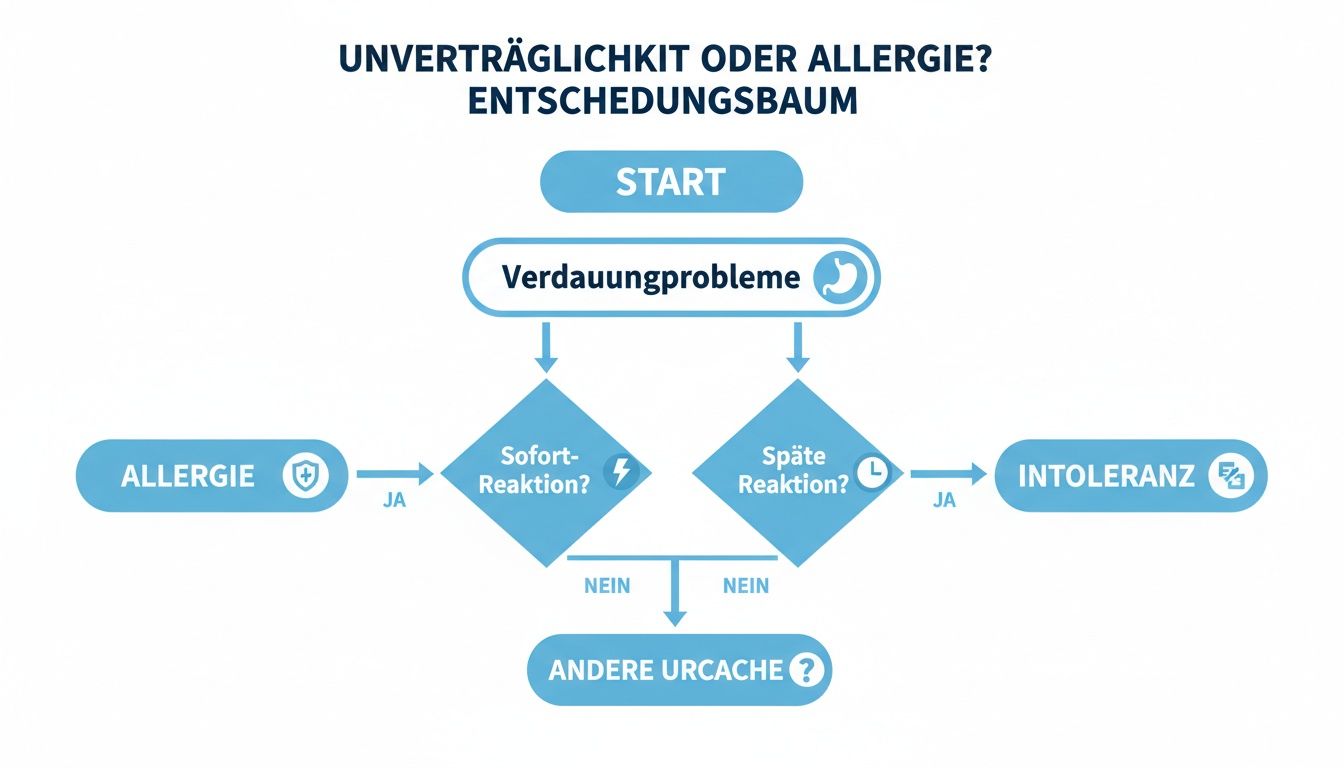
The decision tree makes it clear: If symptoms occur after a delay, they are more likely to indicate an intolerance, while immediate, severe reactions are typical of an allergy.
Your guide to certainty: The mybody-x intolerance test
This is exactly where our mybody-x intolerance test comes in. We developed it to make your journey toward greater well-being as easy as possible. Instead of spending months trying to figure things out, you receive clear, scientifically sound results delivered directly to your home.
It's that simple:
- Order the test: You can conveniently order your test kit online and have it delivered to your home.
- Collect your sample: Using a small lancet, you painlessly collect a few drops of blood from your fingertip. Don't worry—a detailed guide takes you through the process step by step.
- Free return shipping: You send your sample in the enclosed return envelope to our ISO 15189-certified specialist laboratory in Germany.
- Laboratory analysis: Our experts analyze your blood sample for IgG4 reactions to a large number of foods.
- Easy-to-understand results report: After just a few days, you will receive your personal results report. It clearly and comprehensibly shows which foods your body may have reacted to.
What makes this test so valuable are the specific recommendations for action. You not only find out which foods you should avoid for the time being, but also receive tips for delicious alternatives. This turns a vague feeling into a clear plan. Learn more about how to test for food intolerance in our detailed guide.
Many people are unaware that their daily symptoms may be caused by an intolerance. A Statista survey found that although 82% of Germans report having no intolerance, the remaining 18% struggle with symptoms that often go undetected. A test can finally shed light on the situation and help you gradually regain your quality of life.
What to do after the diagnosis? Your 3-phase plan
Okay, you have your diagnosis – congratulations on taking the first important step! But what now? Now the truly exciting part begins: putting it into practice in everyday life. You finally know which foods are causing problems for your body. But the goal isn’t to give up everything. Quite the opposite. It’s about discovering a new way of enjoying food that makes you feel good and gives you energy.
Think of it as a three-step project. Each phase has a clear goal and brings you a little closer to feeling your best.
Phase 1: The elimination phase – Give your body a break
The process begins with the so-called elimination phase. For around four to six weeks, you avoid all foods for which your mybody-x intolerance test showed a clear reaction. The purpose? To give your digestive system a genuine break.
Think of your gut as an overworked muscle. It needs rest to recover and regenerate. By removing the culprits from your diet for a while, you give it exactly that chance. Many people already feel a huge improvement at this stage – whether in their digestion, their skin, or simply their overall energy level.
Phase 2: The test phase – Time for detective work
Once your body has recovered, the test phase begins. Now you will find out where your personal tolerance threshold lies. After all, an intolerance is rarely a lifelong “all-or-nothing” verdict.
And this is the best way to proceed:
- Only one food at a time: Reintroduce only one of the foods you have avoided so far at a time. That way, you’ll know exactly what your body is reacting to.
- Start small: Begin with a tiny portion and observe yourself and your body very closely over the next three days.
- Increase slowly: Everything fine? Great! Then you can gradually increase the amount until you find your personal comfort limit.
This step is incredibly valuable. You may find that a splash of milk in your coffee is absolutely no problem, while a whole glass is. It’s about getting to know your individual rules.
Patience and mindfulness are your best friends here. Be sure to continue keeping a symptom diary. This will help you learn to interpret your body’s signals more and more accurately and develop a genuine sense of your needs.
Phase 3: The long-term diet – Your personal path
Everything you learned during the test phase now becomes part of your long-term diet. You know what is good for you, what you can enjoy in moderation, and what you may be better off avoiding. Instead of rigid prohibitions, you develop a flexible and pleasurable way of eating that truly suits you.
Practical tips that make a difference
It takes a little preparation at first, but with a few clever tricks, it will quickly become routine.
- Become an ingredient detective: Make it a habit to check the ingredients list whenever you shop. Lactose, gluten & co. are often hidden where you least expect them—in sausages, ready-made sauces, or even spice blends.
- Discover the alternatives: The market for substitute products is now enormous. Try different types of plant-based milk, gluten-free pasta, or low-histamine cheeses. You will be amazed at how many delicious treasures there are to discover.
- Cook for yourself: When you cook for yourself, you have complete control. It is the easiest way to avoid hidden problem ingredients while putting fresh, nutritious dishes on the table.
In the end, it is a matter of mindset. Don't see the change as a restriction, but as an opportunity to finally give your body what it truly needs. It is your path to a better quality of life and a completely new feeling in your body.
Your most frequently asked questions about intolerances
To wrap up, we want to answer a few questions we receive again and again. Here you will find specific answers to the typical uncertainties that can genuinely help you in everyday life.
Can intolerances simply appear and then disappear again?
Yes, absolutely. Unlike many allergies, which often last a lifetime, intolerances can develop over time or even improve again. After all, your body is not a rigid system—it is constantly adapting to new circumstances.
There are a few typical triggers that can set something like this off:
- Changes in the gut microbiome: A course of antibiotics can throw your gut flora so far out of balance that temporary lactose intolerance suddenly develops.
- Chronic stress: Anyone who is constantly under pressure risks a weakened gut barrier and poorer digestion. This makes the body more sensitive to certain foods.
- Hormonal fluctuations: Phases such as pregnancy or menopause can also have a significant impact and affect your tolerances.
The good news is that, just as they can appear, they can also go away again. A targeted change in diet and strengthening your gut health can work wonders and ensure that, after a while, you can tolerate certain foods much better again. So your tolerance threshold is not set in stone—you can actively influence it.
What role does the gut play in all of this?
The gut is the absolute control center when it comes to intolerances. It plays the leading role in almost all of them. Many intolerances originate there directly, for example because an important digestive enzyme is missing. In lactose intolerance, it is the enzyme lactase; in histamine intolerance, the enzyme DAO often does not function properly.
Another crucial factor is the condition of your intestinal lining. When this protective barrier has gaps—often referred to as “leaky gut”—incompletely digested food components can enter the bloodstream.
And that is exactly where your immune system sounds the alarm and treats them as foreign bodies. This defensive response leads to the formation of IgG4 antibodies—precisely the markers we analyze with the mybody-x intolerance test to provide you with targeted indications of possible troublemakers.
A healthy microbiome and an intact intestinal barrier are therefore essential for good digestion. Strengthening your gut in a targeted way is often the most important step toward getting your symptoms under control in the long term.
Why is a blood test often more helpful than an elimination diet?
An elimination diet, in which you avoid suspected foods for a certain period, is a well-known tool. But honestly: it requires iron discipline and is often little more than guesswork. The biggest problem is delayed reactions. If symptoms do not appear until 48 or 72 hours later, it is almost impossible to identify the true culprit. On top of that, there are all the hidden ingredients in processed foods, which make your detective work a real challenge.
A blood test for IgG4 antibodies gives you a decisive advantage here: you get a data-based, broad overview of possible triggers. Instead of groping in the dark for weeks or months and cutting out entire food groups such as dairy or grains indiscriminately, you receive a clear, personalized roadmap.
The mybody-x intolerance test analyzes how your body reacts to a wide range of foods. The result saves you the tedious guesswork and gives you an efficient starting point for changing your diet. This allows you to focus immediately on the foods that are truly relevant to you, without unnecessarily giving up valuable sources of nutrients.
Do you suspect that an intolerance is behind your symptoms and finally want some clarity? The mybody-x at-home blood test provides clear answers and a personalized plan to help you adjust your diet in a targeted way. Find out now what is really good for you: https://mybody-x.com



Share now:
HbA1c level too high: uncover the causes and lower blood sugar
Omega-3 deficiency symptoms in women: Recognize, understand, and take targeted action