

How long does it take for vitamin D to work? Blood levels and how you feel
The essentials at a glance
The question can only be answered by breaking it down into two questions. There are figures for the blood level: According to the BfR, the half-life of 25-OH vitamin D measured in the blood is 10 to 40 days; in a treated deficiency, physicians check again after about 4 to 6 weeks according to the IQWiG; and it usually takes about three months for the stores to be replenished.
There is not a single timeframe for how you feel—not from the DGE, not from the BfR, not from the IQWiG, and not from the RKI. This is not a research gap; it has a reason: These institutions see no benefit at all from taking it in people without a confirmed deficiency.
This is particularly clear in a common situation: The primary care guideline “Fatigue” states that vitamin D deficiency is not correlated with increased fatigue. Anyone waiting for an effect because of exhaustion is, according to this body of evidence, waiting for something that is not described there.
What to expect in this article
1. Why the question breaks down into two questions
2. The timeframes that actually exist
3. The course after starting, in four steps
4. Why there is no figure for how you feel
5. How long the sun needs for this
6. Three misconceptions about how long it takes to work
7. Daily or as a high single dose
8. When and how often to get tested
9. What ultimately matters
Frequently asked questions
Sources
Why the question breaks down into two questions
“How long does it take for vitamin D to work?” sounds like one question. In fact, it is two, and they have very different answers: How long does it take for the blood level to change—and how long does it take before I notice anything?
There is reliable information on the first question. The institutions are silent on the second, and this silence is the more interesting piece of information. It is not because no one has looked into it.
“
“Taking vitamin D without a specific reason—for example, in the form of dietary supplements—usually has no benefits.”
Institute for Quality and Efficiency in Health Care (IQWiG)
Vitamin D deficiency, as of 2023
Anyone who takes this sentence seriously understands the silence regarding the second question. Where no benefit is identified, there is also no point at which it begins. The institutions comment on laboratory values and documented effects—not on subjective experience.
This sets the structure of the article. First, the figures that exist. Then, the gap that exists. And in between, the question of whether taking it is justified in your case at all.
First, some context to ground the topic: According to the DGE, vitamin D occupies a special position among vitamins because, unlike other vitamins, it can be produced from the body’s own precursors. It is therefore less a nutrient one supplies than one produced under suitable conditions—and that changes the entire question of how long it takes to have an effect.
Because when something is produced by the body itself, the conditions over a period of weeks matter less than any single dose. That is precisely why the figures in this article are given in weeks and months, not hours.
The time frames that actually exist
Three figures from two institutions define the timeline. They all refer to the blood level or to the treatment of a confirmed deficiency.
Sources: German Federal Institute for Risk Assessment (BfR), Opinion No. 031/2025 · Institute for Quality and Efficiency in Health Care (IQWiG), Vitamin D Deficiency, as of 2023. The information refers to the treatment of a medically diagnosed deficiency, not to taking it without a specific reason.
The half-life explains why nothing changes quickly here. A substance with a half-life of 10 to 40 days takes weeks to months to reach a new equilibrium under a new daily intake. Anyone who measures again after three days is essentially measuring the baseline value.
The range of 10 to 40 days is itself informative. It shows how differently the progression can unfold between two people—after six weeks, there may have been substantial change in one person and little in another. A fixed number of weeks after which “it works” would therefore be unreliable.
The contrast with another figure cited by the BfR is notable: Cholecalciferol itself has a half-life of about 20 hours after ingestion. Following a bolus dose, its concentration rises steeply within a day and then quickly falls again. The substance you swallow therefore disappears rapidly—the value being measured changes slowly.
The BfR clearly describes the difference between the forms of intake: Unlike high single doses, daily vitamin D doses lead to a gradual and continuous increase in 25-OH-D levels without major fluctuations. “Gradual” is the key word here—and it is not a shortcoming of the approach, but its purpose.
The progression after starting in four steps
The following sequence describes what happens after medically justified intake begins. The order is mandatory, and the embedded figures come from the sources cited.
Before that: the reason
The starting point is not the intake, but the reason for it. The DGE recommends supplements only when inadequate supply has been demonstrated and when this cannot be changed through diet or the body’s own production. Without this step, the question of how long the effect takes is meaningless.
The first few weeks: the level rises slowly
With daily intake, the 25-OH-D level rises gradually and continuously, according to the BfR, without major fluctuations. No sudden jump is expected here—and it would not be a good sign either. Based on the available sources, nothing should be expected at the level of well-being during this phase.
After 4 to 6 weeks: the first check
In treated deficiency, according to IQWiG, the doctor checks blood levels of parathyroid hormone and alkaline phosphatase after about 4 to 6 weeks. This is the first point at which a measurement says anything at all; earlier, it would be a snapshot without a trend.
After about three months: the stores are replenished
According to IQWiG, vitamin D and calcium continue to be taken until the stores are replenished—which usually takes about three months. This is the most robust time frame for the topic as a whole, and it explicitly concerns treated deficiency.
What stands out about this sequence is that all four steps are managed by a doctor. The reason is established, the dose determined, the check scheduled, and the end decided. There is no place for self-directed intake in this sequence—and accordingly, no time frame either.
In brief
There are reliable time frames for the vitamin D blood level: According to the Federal Institute for Risk Assessment, measured 25-OH vitamin D has a half-life of 10 to 40 days; with daily intake, the level rises gradually and continuously. In medically treated deficiency, IQWiG states that levels are checked after about 4 to 6 weeks, and it usually takes about three months for the stores to be replenished. By contrast, none of the German institutions reviewed gives a time frame for a noticeable effect on well-being.
Why there is no figure for well-being
This gap is notable enough to spell out: None of the institutions reviewed—DGE, BfR, RKI, IQWiG, BZfE, Verbraucherzentrale—gives a time frame for when taking vitamin D begins to make a noticeable difference in well-being. Neither for fatigue nor for mood, energy, or muscle strength in everyday life.
The reason can be deduced from the same sources. IQWiG states that vitamin D supplements do not protect against diseases such as cardiovascular disease, diabetes mellitus, cancer, or depression in people with suboptimal levels. The BfR puts it more generally: Based on the current scientific evidence, there is no justification for a general recommendation to take vitamin D-containing supplements to prevent disease.
The special case of fatigue
This becomes particularly clear in one situation, which is also the most common reason people turn to vitamin D. The DEGAM S3 guideline for general practitioners, “Fatigue,” states that vitamin D deficiency is not correlated with increased fatigue. Consequently, vitamin D is not included in the basic laboratory testing recommended by this guideline.
This seems to conflict with a statement by IQWiG, which lists fatigue as a possible indication of a deficiency—alongside bone or joint pain, muscle pain, and muscle weakness. The contradiction disappears when you consider the direction of the relationship: A severe deficiency can cause fatigue. Conversely, however, fatigue is not a reason to test vitamin D levels or take a supplement.
For you, this means: If you have been taking a supplement for four weeks and do not feel more alert, according to these sources, that is not a sign that the dose was too low or the period too short. It is the expected course.
This information is inconvenient, but it protects against a chain of events that can otherwise easily get started: after four weeks without an effect, the dose is increased; after eight weeks, it is increased again; and eventually, you end up in a range for which the BfR explicitly identifies risks. Knowing that there is no time frame at all for improved well-being lets you break out of this chain early.
In this case, the more sensible approach is to reverse the direction: do not check the dose, but question the assumption. If fatigue was the reason, investigating that fatigue will get you further than adjusting a supplement that, according to current guidelines, is not intended to address it.
What is actually supported by evidence
There is evidence of benefits—but they concern bones, muscles, and falls, not how you feel during the day. For older people, the DGE states that adequate provision can reduce the risk of falls, bone fractures, loss of strength, declines in mobility and balance, and premature death.
There is exactly one time frame for this effect: the DGE describes the effect on the risk of falls as becoming significant after just a few months. This is the only time frame for a clinical effect found in the sources reviewed—and it comes from the study context, not from an observation in everyday life.
More specifically, the DGE cites the following figures: Higher-dose supplementation reduced the risk of falls by 19 percent, achieving blood concentrations of at least 60 nmol/l reduced it by 23 percent, and a 20 percent reduction is reported for nonvertebral fractures. These are effects that no one notices in themselves—they emerge in groups over periods of time.
That is precisely the core of the answer to the question in the title. The established effects of vitamin D are statistical in nature. An individual does not notice that their risk of falling has decreased—they simply do not fall. An effect that cannot be felt also has no point at which one begins to feel it.
The assessment regarding the immune system is inconsistent and therefore cannot serve as a basis for specifying a timeframe either. The BfR does describe an association between low vitamin D levels and increased susceptibility to infections, but regarding the benefits of supplements for respiratory infections, it notes that the evidence remains mixed when meta-analyses are taken into account.
How long the sun needs for this
For the far more important pathway, there are surprisingly specific figures. The BfR states that for approximately half the year, it is sufficient to expose about one-quarter of the body’s surface—face, hands, and parts of the arms and legs—to the sun several times a week for 5 to 25 minutes, depending on skin type and season.
Five to 25 minutes is remarkably little time considering that, according to the DGE, the body’s own production accounts for 80 to 90 percent of vitamin D supply with regular time spent outdoors. Diet contributes only 10 to 20 percent; a normal diet provides just 2 to 4 micrograms per day.
The qualification “approximately half the year” is important. The institutions’ figures for the exact period differ slightly—March to October, April to October, or, conversely, the statement that sunlight from October to March is insufficient. They all agree on the general timeframe: the summer half-year.
This leads to a point about timing that is easy to overlook. Someone who starts taking a supplement in November is working against the season; someone who spends more time outdoors in April is working with it. This is not an argument against a justified supplement, but it explains why the same effort has different effects at different times.
The storage system as a built-in buffer
Because vitamin D is fat-soluble, the BfR says it can be stored very effectively in the body—its main storage sites are fatty and muscle tissue. The DGE also mentions smaller amounts in the liver. This is why vitamin D levels do not fluctuate from week to week.
IQWiG describes the function of this storage as follows: Vitamin D stores filled from March to October normally help carry the body through the winter months. However, none of the institutions specifies exactly how many weeks such a supply lasts—here too, a figure is unavailable.
This buffer has two implications for the timeline. It means that taking a dose does not have an immediate effect—but also that missing a day does not matter. Anyone who puts themselves under pressure because they missed the preparation twice greatly overestimates the system’s sensitivity.
Three misconceptions about how long it takes to work
Assumptions surrounding this topic lead to impatient or risky approaches. Three of them can be clearly dispelled.
Daily or as a high single dose
This question determines the timeline more than any other—and the institutions’ answer is unequivocal. According to the BfR, high bolus doses cause a rapid increase in 25-OH-D levels, which can reach values above 75 nmol/l in the first few weeks, depending on the initial level and dose.
| Criterion | Low daily dose | High single dose (bolus) |
|---|---|---|
| Course of the blood level | Gradual and continuous increase without major fluctuations | Rapid increase, potentially exceeding 75 nmol/l in the first few weeks |
| BfR recommendation | Recommended – if needed, take a lower-dose preparation daily | Not recommended – high-dose bolus doses should be avoided |
| Observed risks | No separate ones mentioned in the source material used | In studies, increased falls and fractures; monthly doses were also associated with an increased risk of falls |
| Guidance on the amount | Up to about 20 µg (800 IU) per day | Tolerable total intake for adults: 100 µg (4,000 IU) per day—applies to all sources combined |
| Effect on well-being | No time information in the source material used | No time information in the source material used |
Information according to the German Federal Institute for Risk Assessment (BfR), Opinion No. 031/2025 and Vitamin D FAQ, as of 2025. The last line remains explicitly labeled as blank in both columns because the source material used provides no information on it.
But faster is not better here. The BfR writes: In clinical studies involving high-dose bolus doses administered once a year, the vitamin D group was reported to have more falls and fractures than the control group; monthly high-dose bolus administration also led to an increased risk of falls compared with lower doses. The conclusion: High-dose bolus doses should be avoided.
For the amount, the BfR provides guidance: People who take supplements should choose products containing up to about 20 micrograms of vitamin D—that is, 800 International Units—per day. The tolerable total intake for adults is 100 micrograms, or 4,000 International Units, per day.
This also answers the impatience often underlying the initial question. The slow approach is not the cautious version of the fast one—it is the recommended approach, while the fast one is the approach advised against.
The BfR also specifies how quickly too much can become unpleasant: In the event of an overdose, clinical symptoms can appear after a short time—within days to weeks. These include fatigue, muscle weakness, nausea, cardiac arrhythmias, and weight loss.
The first of these side effects deserves a moment’s attention. Fatigue is present at the beginning of the vitamin D story for many people—and it is also present at the end in cases of overdose. Anyone who takes high-dose supplements because of exhaustion and then feels worse should take that as a reason to talk to a doctor, not to increase the dose further.
And because the half-life works in the other direction here as well: an excessively high level also persists for a long time. The BfR attributes this precisely to the long half-life. An error in this direction therefore does not correct itself overnight.
When and how often to get tested
For people without a specific reason, the short answer is: not at all. According to IQWiG, regular monitoring of vitamin D blood levels is not necessary—without a specific reason, it offers no health benefits. The DGE states this as a condition: testing should be performed only if there is reasonable suspicion of a deficiency or in people at risk.
According to the DGE, these at-risk groups include people who spend very little time outdoors or go outside only with their bodies completely covered, older people, infants, and people with dark skin. In older age, the skin's ability to produce vitamin D may be reduced to less than half.
If testing is performed, it should be done with sufficient time after starting supplementation—because of the 10- to 40-day half-life, a measurement after just a few days says little. For monitoring during medically justified supplementation, the BfR does not specify a fixed frequency, but states that serum levels should be monitored regularly alongside higher doses.
Another point relevant to comparability is that, according to the RKI, vitamin D status is subject to strong seasonal fluctuations, so a comparison between a February and a July value says little about the effect of supplementation. Anyone wanting to assess progress should ideally compare values from the same season—or account for the season as a factor.

Vitamin D self-test
Tests 25-hydroxyvitamin D from capillary blood and provides the result at home. What the test does not do: It provides no exact numerical value, but rather a threshold result—so it is not intended for monitoring progress over several months. It does not provide a diagnosis, and a low result does not yet constitute a deficiency according to the IQWiG definition. Without a specific reason, IQWiG and the DGE advise against testing.
Price: €14.50 · Sample type: Capillary blood · Processing time: Result in 5–10 minutes · Laboratory: no laboratory processing, evaluated at home
To the vitamin D self-testAnyone who needs a numerical value—for example, to track progress over three months—will not get what they need from a rapid test and requires a laboratory analysis.
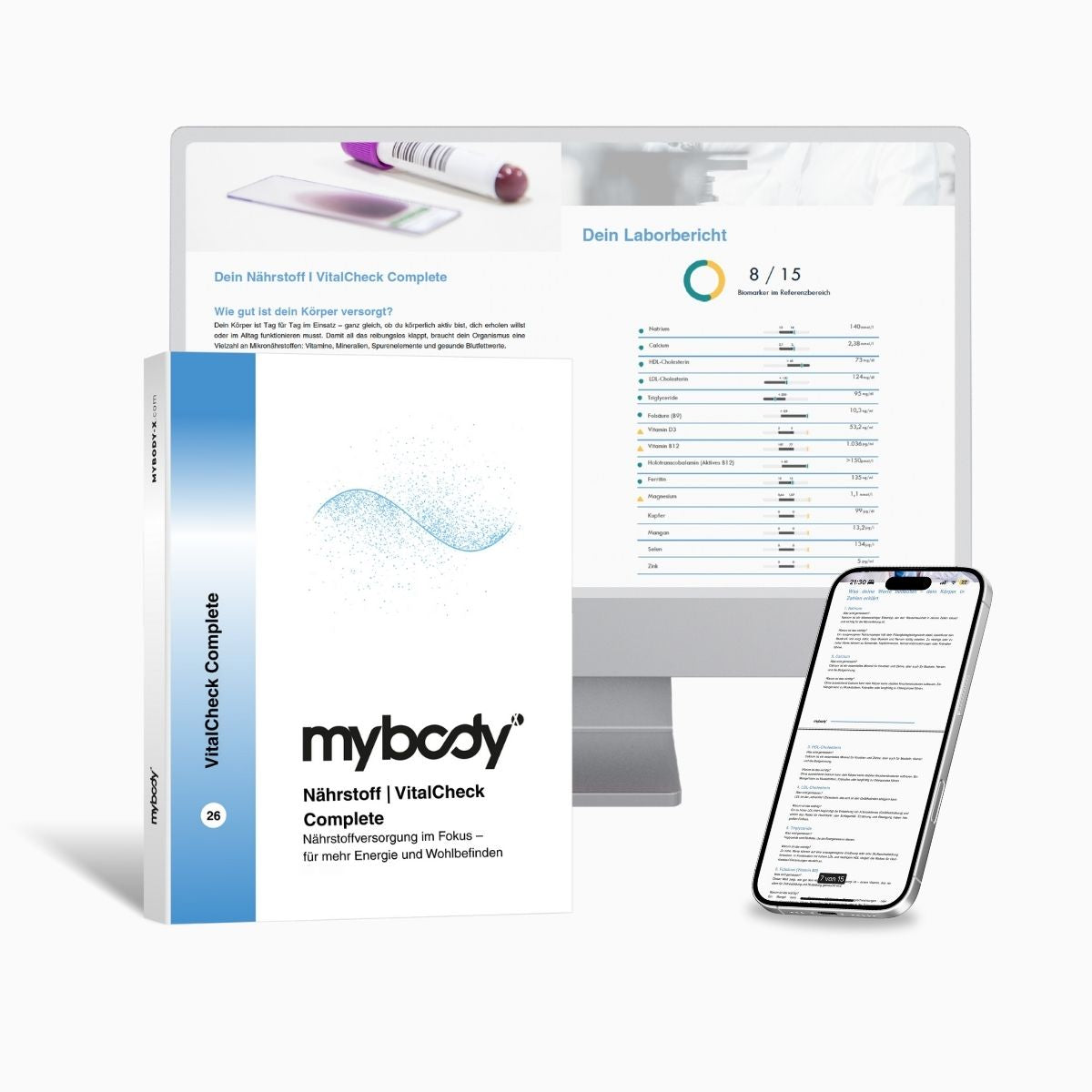
Nutrient | VitalCheck Complete
Determines 15 biomarkers from capillary blood, including 25-OH vitamin D3 as a laboratory value, along with vitamin B12, transcobalamin, folic acid, ferritin, calcium, zinc, selenium, and magnesium. What the test does not do: It measures neither parathyroid hormone nor alkaline phosphatase—that is, not the values that IQWiG recommends monitoring after 4 to 6 weeks in cases of treated deficiency. It does not provide a diagnosis and does not replace medical supervision of treatment.
Price: €169.00 (instead of €199.00) · Sample type: Capillary blood · Processing time: Kit shipping 1–3 business days, laboratory analysis 3–5 business days after receipt of the sample · Laboratory: ISO-certified laboratory analysis in Germany
About the VitalCheck Complete nutrient testAll price and service information is current as of August 5, 2026. Prices and the scope of services may change; the relevant product page always applies.
What matters in the end
The honest answer to the question in the title has two parts. A daily intake affects blood levels over weeks to months—the level is checked after 4 to 6 weeks in cases of treated deficiency, and the stores are replenished after about three months. No German professional institution gives a time frame for an effect on well-being because it sees no benefit in people without a deficiency.
Keeping this distinction in mind helps you avoid two mistakes: testing too soon and having the wrong expectations. Both lead to the same result—the impression that “nothing is happening”—and neither has anything to do with the dose.
Your specific next step: First check whether there is any reason to take action at all. If you belong to a risk group or a deficiency has been diagnosed, supplementation should be discussed with a doctor, including follow-up appointments. If you do not, the more effective step is not reaching for a bottle but spending the 5 to 25 minutes outdoors recommended by the BfR—several times a week during the summer half of the year.
Frequently asked questions
How long does it take for vitamin D to work?
That depends on what is meant. For blood levels, the BfR states that measured 25-OH vitamin D has a half-life of 10 to 40 days; with daily intake, the level rises gradually and continuously. In cases of treated deficiency, IQWiG recommends checking the level after about 4 to 6 weeks; it usually takes around three months for the body’s stores to be replenished. None of the institutions reviewed gives a time frame for a noticeable effect on well-being.
Can I tell when vitamin D is working?
There is no statement on this from a German professional institution. Proven effects concern bones, muscles, and the risk of falls in older people—not how you feel during the day. IQWiG also states that vitamin D supplements do not protect against cardiovascular disease, diabetes, cancer, or depression in people with suboptimal levels.
Does vitamin D help with fatigue?
The DEGAM S3 guideline on “Fatigue” for general practitioners states that vitamin D deficiency is not correlated with increased fatigue (as of 2022). Vitamin D is also not part of the recommended basic laboratory testing. Although IQWiG lists fatigue as a possible indication of severe deficiency, fatigue alone is not a reason to measure vitamin D levels or take a supplement.
Does a high single dose work faster?
The blood level rises faster, but the BfR explicitly advises against it. Studies using high-dose bolus administration have reported increased falls and fractures; even monthly administration was associated with an increased risk of falls. A lower-dose preparation taken daily is recommended, with up to approximately 20 micrograms (800 IU) per day as a guide.
How long do I need to spend in the sun to get enough vitamin D?
The BfR states: for roughly half the year, expose around one-quarter of the body's surface area—face, hands, and parts of the arms and legs—to the sun for 5 to 25 minutes several times a week, depending on skin type and season. With regular time spent outdoors, according to the DGE, the body's own production contributes 80 to 90 percent of vitamin D supply.
First the reason, then the test
Without a specific reason, IQWiG and the DGE advise against testing vitamin D levels. If you belong to a risk group or are receiving medical treatment, a laboratory value is a more reliable basis than information about a threshold.
View VitalCheck Complete Vitamin D self-testYou might also be interested in
→ Addressing vitamin D deficiency: What actually helps
When a deficiency has been identified and the question is what to do, not the timeline.
→ Vitamin D deficiency and fatigue: What is connected and what is not
For the most common reason behind this question, discussed in more detail.
Sources
- Institute for Quality and Efficiency in Health Care (IQWiG): Vitamin D deficiency and How high is the vitamin D requirement and how can it be met?, status as of 2023 — gesundheitsinformation.de
- German Federal Institute for Risk Assessment (BfR): Opinion No. 031/2025 on high single doses of vitamin D and selected questions and answers about vitamin D, status as of 2025 — bfr.bund.de
- German Nutrition Society (DGE): Vitamin D FAQ, 2025 edition, and Vitamin D reference values — dge.de
- German Society for General Practice and Family Medicine (DEGAM): S3 Guideline “Tiredness,” AWMF Registry No. 053-002, 2022 edition — register.awmf.org
- Robert Koch Institute (RKI): Vitamin D Status in Germany, Journal of Health Monitoring 2/2016 — rki.de
The follow-up after 4 to 6 weeks, the approximately three months needed to replenish stores, the quotation about the lack of benefit without a specific indication, the statements regarding cardiovascular disease, diabetes, cancer, and depression, the definition of deficiency, and the claim that regular monitoring is unnecessary are taken from source [1]. The half-life of 10 to 40 days, the gradual increase with daily supplementation, all statements regarding bolus doses and the risk of falls, the maximum amounts of 20 and 100 micrograms, and the 5 to 25 minutes of sun exposure are taken from source [2]. The proportions of 80 to 90 and 10 to 20 percent, the 2 to 4 micrograms from food, the risk groups, the conditions for supplementation, the statement regarding falls and bone fractures in older people, and the statement that the risk of falls becomes “significant after a few months” are taken from source [3]. The sentence stating that vitamin D deficiency is not correlated with increased tiredness and the composition of the basic laboratory diagnostics are taken from source [4]. Source [5] provides the assessment of the supply situation. None of the five sources specifies when taking a supplement begins to have a noticeable effect on well-being; the article therefore deliberately provides no such information and explicitly identifies this gap. Product details are taken from the mybody®x product pages, accessed on August 5, 2026.

mybody®x Editorial & Expert Team
Blood values Micronutrients Laboratory diagnostics
This article was created and medically reviewed by the mybody®x editorial and expert team. The team combines expertise in nutrigenetics, microbiome and gut science, blood test interpretation, nutritional science, and laboratory diagnostics.
Published on August 5, 2026 · Last updated on August 5, 2026
Medical notice: This article is intended for general information and does not replace medical advice, diagnosis, or treatment. Vitamin D supplements should be taken in consultation with a doctor, especially at higher doses; the BfR expressly advises against high-dose bolus doses. Persistent tiredness or exhaustion should be assessed by a general practitioner.




Share now:
Meeting your daily vitamin B12 requirement: the amount and how to achieve it
Fatigue, lack of motivation, listlessness, irritability: what’s behind them