


Constantly tired and run-down: common causes and rare ones
ca. 26 Minuten
The key points
Constant fatigue almost never has just one cause. Most often, it’s due to too little or poor-quality sleep, prolonged strain, or a medication. Much less often, it’s caused by iron deficiency, vitamin B12 deficiency, or an underactive thyroid. A blood test can show whether one of these levels may be involved. It can’t answer why someone is tired.
This article ranks causes by how common they are, not by how alarming they seem. It starts with everyday reasons, because they explain most cases, and then points out when fatigue should be assessed by a doctor. Whenever an organization gives a figure, it’s listed here along with the name and year. If no figure is available, that’s stated too.
First, you’ll read why fatigue is so hard to pin down. Then come the warning signs, sleep as the most common explanation, the three nutrients and the thyroid, an overview of all the groups of causes, and two weeks of observation to prepare for a conversation with your doctor. The article ends with the limitations.
What to expect in this article
1. Why constant fatigue is so hard to pin down
2. When fatigue warrants a visit to the doctor
3. Sleep: the most common explanation
4. Iron, vitamin B12, and vitamin D: what a blood test shows
5. The thyroid: why TSH is measured first
6. The overview: how to identify each cause
7. Daily life, mood, and medication: causes that don’t show up in lab results
8. Observe for two weeks before getting tested
9. What a blood test can and can’t show here
10. Who should get a blood test and who shouldn’t
11. Limitations: what blood tests can’t tell you about fatigue
12. What you can change this week
Frequently asked questions
Sources
Why constant fatigue is so hard to pin down
Fatigue isn’t a diagnosis, but a description. It can result from many different processes, which is why searching for a single cause so often leads nowhere.
The body signals a mismatch through fatigue: more is being used up than replenished, or recovery isn’t keeping pace with the strain. This signal doesn’t tell you what’s causing it in any particular case. A sleep deficit feels just like an iron deficiency, and both feel like a week with too many appointments.
Multiple causes can also be at work at the same time and reinforce each other. Someone who sleeps poorly eats less regularly. Someone who eats less regularly gets less iron. Someone who gets less iron sleeps worse. In retrospect, it’s rarely possible to say where this chain began.
Three documented figures
around one third
of people have trouble falling or staying asleep (IQWiG, 2024)
5 to 10%
of people in Europe have an iron deficiency (IQWiG, 2023)
5 out of 100
People in countries like Germany have an underactive thyroid (IQWiG, 2024)
These three figures put things in perspective. Sleep problems affect many times more people than iron deficiency or an underactive thyroid. If you think of a rare lab value first when you’re tired, statistically you’re looking in the least likely place.
Key takeaway
Fatigue is a result, not a cause. So the sensible order is to rule out the common explanations first, then check for the rare ones, not the other way around.
The difference between tired and exhausted
In everyday life, both words are used in the same way, but they aren’t the same when it comes to figuring out what’s going on. Fatigue improves with sleep. Exhaustion doesn’t: if you wake up just as drained after eight hours as you were when you went to bed, you’re describing something else.
This distinction is the most useful question you can ask yourself. It costs nothing, requires no test, and separates two groups of causes.
If your energy returns after a free weekend, the cause is more likely to be part of everyday life. If it’s been gone for weeks, regardless of how much you sleep, it’s worth checking values you can’t feel.
Why people have often already seen a doctor
Many people researching this topic have already seen a doctor. Their basic blood count was unremarkable, but their symptoms persisted. That doesn’t mean they’re imagining it: it means the obvious values were checked and others weren’t.
A standard blood count includes neither ferritin nor vitamin B12, neither vitamin D nor free thyroid hormones. It isn’t wrong; it’s just more limited than many people assume. If you know what’s missing, you can ask specifically about it at your next appointment.
When fatigue calls for a doctor’s visit
This chapter is deliberately placed before all the causes. An article that puts the warning signs at the end misses exactly the reader they are meant for.
These symptoms should be evaluated by a doctor
Fatigue together with unintended weight loss
If your weight drops without any change in your eating or activity
Fever, night sweats, or swollen lymph nodes
For several weeks, with no apparent infection
Shortness of breath or a racing heart during activities that used to be easy
Climbing stairs, carrying shopping bags, a brisk walk
Noticeable paleness or visible blood in the stool
either could indicate blood loss that explains the tiredness
Persistent low mood or loss of pleasure
for more than two weeks, especially when nothing brings you pleasure anymore
Falling asleep during the day in situations that require attention
at the wheel, in conversation, at work - this is no longer sleep deprivation
This list is no substitute for an examination, and it isn’t a diagnostic checklist. It marks the point at which reading further would be the wrong response to the right question.
When exhaustion persists after an infection
If exhaustion after an infection gets worse rather than better even with mild exertion, it should be checked by a doctor. ME/CFS may be the cause, a chronic condition that often begins after an infection (IQWiG, 2023).
The name stands for Myalgic Encephalomyelitis / Chronic Fatigue Syndrome. Its defining feature is post-exertional malaise (PEM), also called exercise intolerance: symptoms can worsen after physical or mental activity, and depending on the severity, even a short walk or a conversation can be enough to trigger it. The worsening sometimes begins only one or two days later and can last for days, weeks, or even longer (IQWiG, 2023).
There is no test that can directly diagnose ME/CFS; careful examinations are needed to make the diagnosis. Persistent exhaustion can have many different causes, and ME/CFS is a relatively rare one. Estimates based on international studies suggest that around 2 to 4 out of every 1,000 people in Germany have the condition, but the exact number is unknown (IQWiG, 2023).
If you’ve been exhausted since an infection and find that even small efforts make your symptoms worse for days, mention this exact observation at your primary care appointment. Note what effort made you feel worse and how long the setback lasted.
For everything else, the order is reversed: observe first, then measure, then talk. That’s exactly what the rest of this article is designed for.
Sleep: the explanation that most often applies
The most common cause of tiredness is also the least remarkable. It still gets overlooked because most people consider their sleep sufficient as long as they spend a typical number of hours in bed.
The Institute for Quality and Efficiency in Health Care (IQWiG) recommends around seven hours of sleep per night for adults, and only about six for people over 80 (2024). So the need isn’t fixed; it decreases with age.
But what matters isn’t just the duration; it’s whether the sleep is restorative. The IQWiG draws the line between poor sleep and a sleep disorder using a criterion that can be checked:
Documented source
“Anyone who sleeps so poorly that their quality of life is affected for at least three nights a week and for more than a month has a sleep disorder.”
Institute for Quality and Efficiency in Health Care (IQWiG)
Sleep problems and sleep disorders (insomnia), as of 2024
The statement gives two figures that can be checked: three or more nights a week and more than a month. If both apply to you, you’ve already found the most likely explanation for your tiredness, without a single lab test.
According to the same institute, about 6 out of 100 people in Germany have a sleep disorder in this sense (2024). By contrast, around a third have trouble falling or staying asleep.
When enough sleep still isn’t enough
There’s one particularly overlooked case: eight hours in bed, yet still no energy in the morning. Common reasons include breathing pauses during sleep, restless legs, or sleep disrupted by waking repeatedly during the night.
This is usually more noticeable to someone else: anyone sleeping next to a person who snores loudly and irregularly and has pauses in their breathing is more likely to notice it than the person affected. This observation should be discussed with a doctor, because it calls for an examination, not a dietary supplement.
Genetics also plays a role here. How quickly someone metabolizes caffeine and how much it disrupts their sleep in the evening are partly determined by their genetic makeup. You can read about how this works in Genes and Sleep – this article focuses on causes that can be identified in blood tests.
Two habits that shorten sleep without you noticing
Alcohol in the evening makes it easier to fall asleep and worsens the second half of the night. Sleep becomes lighter, waking becomes more frequent, and you don’t feel rested in the morning, even if you got enough hours. If you regularly drink in the evening, this could explain it, and you don’t need a lab test to find out.
With caffeine, timing matters more than quantity. Coffee at four in the afternoon affects many people well into the night, and exactly how long its effects last varies considerably from person to person. To test this, move your last cup to the morning for two weeks and compare your notes.
Both points sound like generalities, yet they’re rarely checked. The reason is the same as with medication: something that’s been part of the routine for years isn’t suspected as a cause.
Iron, vitamin B12 and vitamin D: what a blood test shows
Three nutrients come up regularly in connection with fatigue. They aren’t the most common causes, but they can be measured - which explains their prominence online.
Iron: the value with the strongest evidence
According to IQWiG, adults have about 3 to 5 grams of iron in their bodies (2023). In Europe, 5 to 10 percent of people have iron deficiency, and 2 to 5 percent have iron-deficiency anemia. Women before menopause are affected more often than men.
The institute lists fatigue and unusual exhaustion after exertion among the symptoms of more severe iron deficiency, along with pale skin, difficulty concentrating, headaches, brittle nails and hair loss (2023). If you notice several of these at once, you have a concrete reason to get tested.
The same source briefly explains how iron deficiency is diagnosed: Doctors diagnose iron deficiency with a blood test (IQWiG, 2023). A single result is rarely enough - ferritin, iron and transferrin only provide a complete picture together, because ferritin can be high during inflammation even when iron stores are empty.
Vitamin B12: groups with increased needs
Vitamin B12 is found almost exclusively in animal-based foods. That means people who eat vegan, have been vegetarian for a long time, or take certain stomach medications are at higher risk of inadequate intake.
The liver’s stores last a long time, often several years. That’s why a B12 deficiency develops gradually and is rarely linked to a clear event. If you changed your diet three years ago, you may no longer think of it when symptoms appear today.
Vitamin D: expectations exceed the evidence
Vitamin D is the most frequently mentioned and least substantiated explanation for fatigue. Low levels are common in the winter months and can be measured reliably. But that alone cannot tell you whether it explains someone’s fatigue.
The honest approach is to follow a sequence: measure the level because it helps put things in context, not because it provides the answer. If you check it on its own and skip everything else, you haven’t answered the question; you’ve just narrowed it.
Why taking supplements without getting tested is the worse choice
The obvious thought is: instead of getting tested, I’ll just take a supplement and see if I feel better. That sounds practical, but it has three drawbacks that are rarely considered.
First, starting supplementation changes the value you want to measure later. If you take iron for three months and then have your ferritin measured, you are measuring the supplementation, not the original state. After that, it is no longer possible to answer whether there was a deficiency in the first place.
Second, the three nutrients are not interchangeable. A vitamin D supplement does nothing for iron deficiency, and iron does nothing for an underactive thyroid. Taking the wrong thing on a hunch wastes time and can lead you to rule out the actual cause.
Third, iron is not a harmless substance that you can take as a precaution. Taking it without a confirmed deficiency should be medically supervised. Testing is therefore not the more complicated route, but the shorter one.
The thyroid: why TSH is measured first
The thyroid controls how quickly metabolism works. When it slows down, everything slows down - and people usually describe that as fatigue.
IQWiG lists weakness and fatigue, lack of energy and apathy, as well as skin changes and constipation among the symptoms of an underactive thyroid (2024). In countries like Germany, around 5 in 100 people have an underactive thyroid.
TSH is a control signal, not a thyroid hormone
TSH is not produced in the thyroid, but in the pituitary gland. It signals the thyroid to produce more. IQWiG describes the mechanism this way: As soon as the thyroid becomes less active, the pituitary gland responds by increasing TSH production to stimulate the thyroid more strongly (2024).
This explains the logic behind the test. An elevated TSH level in the blood can be a sign of an underactive thyroid (IQWiG, 2024) - and because this signal changes before the hormones themselves do, often only TSH is measured at first.
What fT3 and fT4 show in addition
fT3 and fT4 are the free thyroid hormones, meaning the portion that can actually have an effect. If they are too low, this may indicate an underactive thyroid; if they are elevated, that points more toward an overactive thyroid (IQWiG, 2024).
For interpreting results, this means that TSH indicates something is wrong. fT3 and fT4 show how severe it is. A test result with all three values is therefore more informative than one with TSH alone, even though TSH is enough for the first step.
A point raised in every discussion of test results, yet rarely understood: reference ranges depend on the lab, method, and age. Two labs can interpret the same value differently without either being wrong.
The borderline case most fiercely debated
There is a pattern that affects many people with fatigue: the TSH level is elevated, but thyroid hormone levels are still within the normal range. Medically, this is called subclinical hypothyroidism, and it usually causes no symptoms.
According to IQWiG, each year 2 to 5 out of 100 people with subclinical hypothyroidism develop hypothyroidism with symptoms (2024). For the others, the result remains abnormal but has no clinical significance.
This leads to an uncomfortable insight: a mildly elevated TSH level usually does not explain existing fatigue. Whether and when it should be treated is a matter of medical judgment, not a question that a test result alone can answer.
Overview: how to recognize each cause
The following table compares five cause groups across the same three criteria. It provides guidance, not a diagnosis: each row first shows how the group can be recognized in everyday life, then whether and how it can be measured, and finally what makes sense to do next.
| Cause group | How it can be recognized in everyday life | Whether it can be measured | What makes sense to do next |
|---|---|---|---|
| sleep | less sleep than needed, frequent waking, snoring with pauses in breathing; energy returns on days off | not in the blood; identified through a sleep diary or a sleep lab study | record sleep times for two weeks before testing |
| iron status | pale skin, difficulty concentrating, brittle nails, hair loss; often with heavy periods or a low-meat diet | yes, measure ferritin, iron and transferrin together - a single value is not enough | have it measured and have a doctor interpret the result; do not take supplements just in case |
| thyroid | lack of motivation, feeling cold, dry skin, constipation, weight gain without a change in diet | yes, starting with TSH; fT3 and fT4 show how much function is affected | have TSH measured; if the result is abnormal, seek medical evaluation |
| vitamin levels | gradual onset without a clear event; increased risk with a vegan diet, in winter and with increasing age | yes, for vitamin B12, vitamin D3 and folic acid - all three are snapshots | measure together with iron status, not one after another |
| stress, mood, medications | persistent pressure for weeks, loss of pleasure, recently started medication; no recovery over the weekend | no - no blood test captures this; the patient information leaflet and a conversation can help clarify things | Have medications reviewed; seek medical help if low mood persists |
There are no reliable figures from a German institution on how often each of these groups is actually the cause of persistent fatigue. That is why this table gives no percentages, just the order: the most common explanation first.
Daily life, mood, and medication: causes with no lab result
The last row of the table is the most uncomfortable because it does not give you a result you can print out. It is still the explanation for many cases.
The package leaflet as the first place to look
Fatigue is one of the most common side effects of all. It is listed in the package leaflets for many blood pressure medications, allergy medications, antidepressants, and painkillers, and often starts weeks after the first dose.
The test costs nothing: When did the fatigue start, and what changed in the four weeks before it began? Comparing these two dates may reveal a connection or rule one out. Even so, medication should only be stopped or changed under a doctor's supervision.
When exhaustion is a mood
Persistent low mood causes fatigue that is physically noticeable. The difference from fatigue due to lack of sleep is that sleep does not help, and something else usually comes along with it: interest and enjoyment decline, often before the fatigue becomes noticeable.
This cause cannot be measured away, and it does not lessen just because a blood test is normal. If you suspect this may be affecting you, a conversation will do more for you than another test.
The ongoing strain no one counts as strain
Caring for a relative, a toddler who sleeps poorly at night, moving house, a change at work: None of these show up in test results, and they are rarely cited as causes because they are considered normal.
But normal does not mean harmless. When you get less recovery than strain over a period of months, you become tired - and no nutrient can change that.
Chapter at a glance
Three causes of fatigue do not show up in any blood test: a medication, low mood, and ongoing strain that is taken for granted as normal. Together, they are more common than all the lab values discussed in this article. If you have not checked for them before getting tested, you risk normal results with no change in how you feel - and that is exactly the experience many people have when they open this article.
Observe for two weeks before getting tested
The following four steps prepare you for a conversation with your doctor; they do not replace it. They explicitly do not apply to the signs in Chapter 2: if you have weight loss, shortness of breath, blood in your stool, or persistent low mood, make an appointment at the beginning, not at the end of the two weeks.
Note your sleep times
When you went to bed, when you woke up, and how often you were awake during the night. Two numbers per day are enough.
Rate your energy during the day
Rate your energy from 1 to 10, morning and afternoon. No explanation or judgment.
List medications
List everything you take regularly, with the start date. Include non-prescription supplements, too.
Take your notes to the appointment
Fourteen lines on paper make the medical history-taking quicker and take the place of relying on memory.
The value of these two weeks lies less in the result than in the clarity they provide. By writing things down, you can see on the fourteenth day whether the fatigue was truly constant or absent on certain days—and which days those were.
The notes also help during the conversation itself. When asked how long this has been going on, a note with fourteen entries is a better answer than a guess.
What a blood test can and can’t show here
It’s worth being clear about one thing here: A blood test can show whether a nutrient deficiency or thyroid level is contributing to fatigue. It cannot show why someone is tired. That requires a conversation with a medical professional, not a test result or an article.
Testing makes sense in a specific situation: the symptoms have persisted for weeks, the everyday explanations in Chapter 7 have been considered, and one piece of data is missing. For more details on which values are measured, see Testing for nutrient deficiencies; this article focuses on how to make sense of fatigue.
Two tests from mybody®x (MYBODY Lab GmbH) cover the values discussed in this article. They differ in their focus.
Capillary blood test
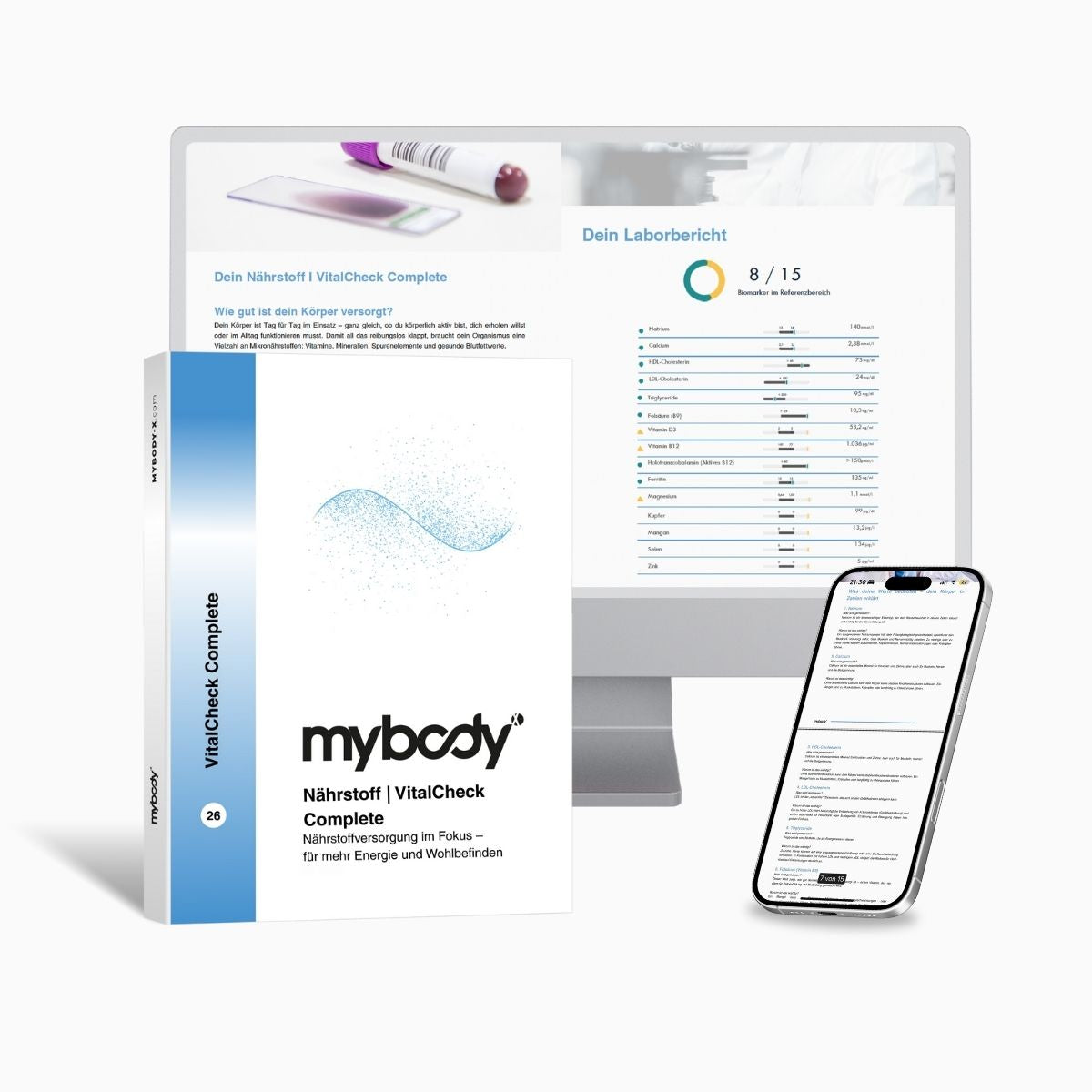
VitalCheck | Complete Nutrient & Mineral Test
Measures vitamin D3, B12 and folic acid, as well as iron status based on ferritin, iron and transferrin, along with calcium, magnesium, phosphate, selenium, zinc, cholesterol, long-term blood sugar and CRP. What the test does not measure: thyroid levels, electrolytes or heavy metals. It provides a snapshot, not a diagnosis—a result outside the normal range means it’s worth taking a second look.
Lab analysis 3–5 business days after the sample arrives

Capillary blood test
Women’s Wellness Check | Women’s Health Test
Includes the full thyroid profile of TSH, fT3 and fT4, plus ferritin, vitamin B12 and vitamin D3, as well as cortisol, prolactin, SHBG and organ markers - 18 values from one blood sample. What the test doesn’t do: it doesn’t measure cycle hormones, and it provides a single cortisol value at the time the sample is taken, not a daily profile. The results are a basis for a discussion, not a diagnosis.
Lab analysis 3–5 business days after the sample arrives
A blood test shows whether a nutrient deficiency is a factor. It doesn’t show why someone is tired.
Who should get a blood test and who shouldn’t
A test isn’t the answer to every kind of fatigue. It answers a specific question, and the two columns below distinguish between the cases.
Worthwhile for you, if …
the fatigue has lasted for weeks, you’ve checked the everyday explanations, and one data point is missing.
only a complete blood count was done at your last appointment, without ferritin, B12 or thyroid levels.
you want to change your diet and track how things progress with one measurement beforehand and another afterward.
Probably not, if …
you notice one of the signs from Chapter 2. In that case, an appointment is the right next step, not a test.
you’ve been getting too little sleep for four nights. The answer is in your calendar, not the lab.
you’re expecting a diagnosis. The results provide values, not a disease label.
Limits: what blood test results can’t tell you about fatigue
A lab result is a clue, not a diagnosis of a person. The IQWiG puts it succinctly in its guide to lab results: a single lab result alone is usually not enough to conclude that someone has a disease (2025). This is doubly true of fatigue, because there is no fixed link between a result and a symptom.
Two people with the same ferritin level can feel completely different. Conversely, some people feel severely exhausted despite unremarkable results. Neither is a contradiction; both are normal.
The data also has limitations. Institutions provide specific prevalence figures for sleep disorders, iron deficiency, and an underactive thyroid. There is no comparable figure from a German institution for how often each cause is behind constant fatigue. That is why this article does not include one.
And the tests have the limitation stated on the product cards: they provide a snapshot. A result today says nothing about what it was three months ago - and fatigue develops over months, not in a single day.
What you can change this week
If you take just one action from this article, make it this: for fourteen days, write down your sleep times and alongside them a number from 1 to 10 for your energy in the afternoon. Two lines a day, nothing more.
The reason is straightforward. Most questions about fatigue are resolved once the connection between night and afternoon becomes clear. What remains is something you can discuss with a doctor - with a written record instead of an estimate.
It started with the question of what lies behind constant fatigue. The most honest answer is: usually several things at once, and rarely what people look for first. That is exactly why the order matters.
Frequently asked questions
Why am I constantly tired and drained even though I get enough sleep?
Spending enough time in bed does not mean you are getting enough rest. Common reasons include fragmented sleep, pauses in breathing at night, or daytime demands that use up more energy than sleep restores. Only after that should measurable causes such as iron deficiency or an underactive thyroid be considered. The IQWiG says adults need around seven hours of sleep (2024) - individual needs may vary.
Which blood tests should I get if I have persistent fatigue?
It makes sense to check iron levels using ferritin, iron, and transferrin together, as well as vitamin B12, vitamin D3, folic acid, and TSH. A complete blood count does not include any of these values. Ferritin alone is not enough because it can be high during inflammation even when iron stores are depleted. A doctor will decide which tests are needed in your specific case based on your symptoms.
When should constant fatigue be checked by a doctor?
Immediately if you also experience weight loss without changing your diet, a fever lasting weeks, shortness of breath with light exertion, noticeable paleness, blood in your stool, or persistent low mood. Likewise, if you fall asleep during the day in situations that require attention. Without these signs, monitoring things for two weeks is the more sensible first step.
Can an at-home test find the cause of my fatigue?
No. A blood test shows whether a nutrient deficiency or thyroid levels are involved. It doesn’t show why someone is tired, and it doesn’t measure sleep quality or medication effects or low mood—three causes that together are more common than all lab results. An abnormal result is a reason to talk with a doctor, not a diagnosis.
How are the thyroid and fatigue connected?
The thyroid sets the pace of metabolism. When it’s underactive, IQWiG lists symptoms including weakness and fatigue, lack of drive, and apathy (2024). In countries such as Germany, about 5 out of 100 people have an underactive thyroid. TSH is measured first because dysfunction is especially detectable early on; fT3 and fT4 then show how much thyroid function is affected.
Next step
Observe first, then measure
If everyday explanations have been ruled out after two weeks and one data point is missing, a blood test provides values that aren’t included in a complete blood count. It doesn’t replace a medical evaluation.
VitalCheck Complete Women’s Wellness CheckRead more
You might also be interested in
Which values are measured, how samples are collected, and what the results mean.
The genetic side: caffeine metabolism, sleep patterns, and what a DNA analysis reveals.
Sources
- Institute for Quality and Efficiency in Health Care (IQWiG): Sleep problems and sleep disorders (insomnia) (as of 2024) – gesundheitsinformation.de
- Institute for Quality and Efficiency in Health Care (IQWiG): Iron deficiency and iron-deficiency anemia (as of 2023) – gesundheitsinformation.de
- Institute for Quality and Efficiency in Health Care (IQWiG): Underactive thyroid (hypothyroidism) (as of 2024) – gesundheitsinformation.de
- Institute for Quality and Efficiency in Health Care (IQWiG): Understanding thyroid tests (as of 2024), Creatinine clearance (as of 2025), and ME/CFS (myalgic encephalomyelitis / chronic fatigue syndrome) (as of 2023) – gesundheitsinformation.de
The direct quotation defining a sleep disorder comes from source [1], as do the information on sleep requirements by age and the frequency of sleep problems. All figures on iron and iron deficiency, as well as the list of symptoms, come from [2]. The prevalence of hypothyroidism, the list of symptoms, and the description of the TSH mechanism come from [3]. The statements about why TSH is measured first and what fT3 and fT4 add come from [4]; it also states that a single lab value alone is usually not enough to infer a disease. This statement comes from the creatinine clearance guide, where it is formulated generally for lab values. Information on the price, sample type, and scope of analysis of the tests mentioned comes from mybody®x product pages, accessed on 28.08.2026; processing times follow the central guideline for blood tests. All sources were accessed and reviewed on 28.08.2026.
The information on ME/CFS and exertion intolerance in the chapter on medical evaluation comes from source [4] (ME/CFS guide), accessed on 17.10.2026.

mybody®x Editorial & Expert Team
Blood test interpretation Laboratory diagnostics Nutritional science Nutrigenetics
This article was created by the mybody®x editorial and expert team. The team brings together expertise in blood test interpretation, laboratory diagnostics, and nutritional science. You can find out who contributes on the authors page.
Published on 15.01.2026 · Last updated on 17.10.2026
The information is for general purposes and is not a substitute for medical advice, diagnosis, or treatment. Reference ranges depend on the laboratory, method, and age – the information on your test result is always authoritative.


