

Get your testosterone tested: Easily and discreetly from home
Do you often feel completely drained without really knowing why? Many people blame everyday stress, but sometimes the cause lies deeper. An balanced testosterone level is the key to energy, well-being, and zest for life—and that has long since ceased to concern only men. A simple test from mybody-x can finally give you clarity and help you take charge of your health again.
Why your testosterone level really matters

Testosterone still has a reputation as the pure “male hormone,” but this view is far too narrow. In reality, it plays a central role in countless bodily functions in both sexes. It influences your mood, energy levels, muscle mass, and even bone density.
If you feel like you're going through life with the handbrake constantly on, your hormone balance may be out of sync. Instead of simply pushing the symptoms aside, it's worth taking a closer look.
More than just muscles and libido
The role of testosterone extends far beyond the bedroom and the gym. An optimal level is the foundation of your overall vitality. Think of it as the conductor of a large orchestra: when it loses the beat, nothing sounds harmonious anymore. Your body works in much the same way.
A healthy testosterone level supports you with:
- Energy and motivation: It is the spark that gets you out of bed in the morning and carries you through the day.
- Cognitive performance: Concentration and a sharp memory are closely linked to this hormone.
- Emotional balance: A deficiency can lead to irritability, mood swings, or even depressive episodes.
- Physical fitness: It helps keep body fat in check and strengthens the bones.
As you can see, an imbalance can make itself felt in many ways and noticeably limit your quality of life.
Take symptoms seriously, but don't panic
Of course, fluctuating testosterone levels, especially with increasing age, are a completely natural process. Not every period of fatigue immediately indicates a dramatic deficiency.
Nevertheless, you should listen to your body's signals. Persistent lack of drive, unexplained weight gain, or a significant decrease in libido are good reasons to take action and get to the bottom of things.
Studies from Germany show that around 30 to 40 percent of men between the ages of 60 and 70 have low testosterone levels. However, “only” 15 to 20 percent of them experience specific symptoms. This highlights how important an accurate analysis is, rather than simply making assumptions.
Instead of groping in the dark, a blood test provides concrete data. With a hormone test from mybody-x, you can conveniently check your levels at home—without waiting rooms or appointment-related stress. This gives you valuable insights and enables you to make informed decisions about your health. If you would like to explore the topic in greater depth, read more in our health portal about the function of testosterone in the body.
Signs of testosterone deficiency: Listen to your body
Your body is constantly sending signals—you just have to learn how to interpret them. Testosterone deficiency rarely appears overnight. Usually, the changes are gradual and quickly attributed to stress or aging.
To help you better assess whether something is out of balance, we have divided the typical signs into three areas: physical, emotional, and sexual changes. This is intended to help you reflect on your situation without immediately panicking. The aim is to raise awareness—and take action if you recognize yourself in several of these points.
Physical signs you should look out for
Your body can show you in many ways that your hormonal balance is disrupted. These symptoms often develop so gradually that they are easy to overlook or dismiss as normal.
See if any of the following sounds familiar:
- Less muscle mass and strength: Do you find training more difficult than before? Do your muscles look less defined despite exercising? Testosterone is, after all, key to building muscle.
- More body fat, especially around the abdomen: A declining testosterone level can slow down your metabolism and promote fat storage, particularly around the abdomen. Suddenly, you have a “muffin top,” even though you eat as usual.
- Constant tiredness and exhaustion: Do you often feel completely drained by the afternoon, even though you have had enough sleep? This deep exhaustion, which does not go away even after breaks, is a clear warning sign.
- Hair loss (on the body): Sure, hair loss on the head is often genetic. But if your body or facial hair (beard, chest) is also becoming thinner, this could indicate a low testosterone level.
These signs are more than just cosmetic problems. They are direct indications that something is changing in your metabolism.
Emotional and mental roller coaster
Testosterone affects not only the body but also the mind. A deficiency can feel as though you’re constantly driving with the handbrake on mentally.
Many people describe it as feeling like their “inner engine” is sputtering. The desire to pursue hobbies, work, or spend time with friends disappears, and a general lack of drive sets in.
Do these emotional changes sound familiar?
- Lack of drive and motivational slump: Tasks that used to excite you suddenly feel like a huge mountain to climb.
- Mood swings and irritability: You lose your temper more quickly over minor things and are often in a bad mood for no apparent reason.
- Concentration problems and “brain fog”: Do you find it difficult to focus? Do you no longer feel as clear-headed as usual?
- Decreasing self-confidence: The combination of physical and mental changes can seriously undermine your self-esteem and make you feel insecure.
These mental symptoms in particular can severely limit your quality of life. Since hormones and the mind are so closely connected, it makes perfect sense to have your hormone levels tested when you notice signs like these, so you can finally have some clarity.
Changes in sex and libido
One of the best-known areas affected by testosterone is sexual health. For many people, changes in this area are often the first reason to have their levels checked.
The symptoms can look very different:
- Reduced sex drive (loss of libido): Your interest in sex noticeably wanes. Spontaneous sexual thoughts or fantasies become rare.
- Erection problems: It becomes more difficult to get or maintain an erection. This may be a sign, especially if morning erections suddenly stop occurring.
- Less ejaculate: The amount of seminal fluid during orgasm may noticeably decrease.
Even though these topics are often taboo, it’s important to see them for what they are: medical symptoms, just like headaches or back pain, and an important indication of your hormonal health. If you notice one or more of these signs in yourself, a mybody-x testosterone test is a logical and absolutely worthwhile first step.
What your testosterone level really means

There it is: your laboratory report. A sheet full of numbers, abbreviations, and reference ranges. At first, it can feel quite overwhelming—we know many people feel that way. But don't worry, we'll shed light on the subject and translate the technical jargon for you.
Your result is much more than just a number—it provides a direct insight into your hormonal health. If you understand what these values mean, you can draw the right conclusions and take control of your well-being yourself.
Total Testosterone vs. Free Testosterone
When you read your report, you will come across two key terms: total testosterone and free testosterone. The difference is huge, because only a tiny fraction of your testosterone is actually biologically active and can do its job in the body.
Think of total testosterone as a company's entire vehicle fleet. However, a large proportion of these vehicles is already bound to proteins such as SHBG (sex hormone-binding globulin) and albumin—they are, so to speak, “loaded” and reserved for other tasks.
Free testosterone is the small but crucial part of the fleet: the unburdened, immediately deployable vehicles. Only this free testosterone can attach to your cells and perform its important tasks—from building muscle and regulating your mood to controlling your libido. That is why it is so important not only to know your total level, but also to understand how much of it is actually available to your body.
The Importance of Reference Values and Age
A testosterone level never stands alone. It must always be considered in the context of your age and the corresponding reference ranges. Your body is not a machine, and your hormone levels naturally change throughout your life.
It is perfectly normal for testosterone levels to gradually decline over the years. A level that is excellent for a 25-year-old may be well within the normal range for a 65-year-old. That is why laboratories use age-specific reference values.
In Germany, the general reference range for men is roughly between 1.93 and 8.36 ng/ml. However, the specific values for your age group are crucial for a truly meaningful assessment. For men aged 20 to 29, the range is 3.1 to 8.3 ng/ml, while for men aged 70 to 89, it is 1.7 to 4.9 ng/ml. If you want to explore the age-appropriate interpretation of laboratory values in greater depth, you can find insightful information about testosterone levels here.
The following table gives you a good overview of how the reference ranges shift with age.
Age-specific testosterone reference values for men
This table shows the average reference ranges for total testosterone (in ng/ml) by age group, illustrating the natural decline in hormone levels over the course of life.
| Age group | Lower reference value (ng/ml) | Upper reference value (ng/ml) |
|---|---|---|
| 20–29 years | 3,1 | 8,3 |
| 30–39 years | 2,7 | 7,8 |
| 40–49 years | 2,5 | 7,1 |
| 50–59 years | 2,2 | 6,5 |
| 60–69 years | 2,0 | 5,6 |
| 70+ years | 1,7 | 4,9 |
These figures provide useful guidance, but remember: it’s not just about the numbers on paper.
It is important to understand that a value just above the lower limit is not automatically “good.” What always matters is how you feel and whether symptoms are present. Your personal well-being is the most important benchmark.
Why the timing of the measurement is crucial
Your testosterone level dances to the rhythm of your internal clock. It follows a clear daily pattern known as the circadian rhythm. It reaches its peak between 8 and 10 a.m. and then steadily declines throughout the day.
What does this mean for you? A measurement taken in the afternoon would produce a distorted, artificially low result. To obtain a truly meaningful value, you must always collect the blood sample in the morning. Only then are the results comparable.
A single measurement is also always just a snapshot. Poor sleep, stress, or alcohol the previous evening can temporarily lower the value. For borderline results, it is therefore often smart to take a second follow-up measurement after some time. This ensures that the result is not merely a random fluctuation.
With a mybody-x hormone self-test, you have complete control and can collect the sample conveniently at the optimal time—without appointment stress or waiting rooms.
How the at-home hormone test works
No more overcrowded waiting rooms, rigid appointments, or the feeling that you’re simply handing over responsibility for your health. If you finally want clarity about your testosterone levels, you can do it conveniently, discreetly, and with complete reliability from home today. A self-test is the modern solution for anyone who wants to integrate health measurements effortlessly into everyday life.
Let us show you just how easy the mybody-x hormone test really is. You’ll be surprised at how quickly you take control and finally have solid data about your body in your hands.
Your path to clarity in just a few steps
The entire process is designed to remove any uncertainty. From ordering and collecting the sample to receiving your personal result, you’ll feel safe and fully supported.
It all starts with the simple process of ordering your test kit. As soon as it arrives, you’ll find everything you need to collect the sample inside—clearly labeled and accompanied by instructions anyone can understand. You don’t have to be a medical professional to do this.
The process is very straightforward: collect the sample, activate the test online, and then send everything to our certified laboratory in the enclosed return envelope. The experts will take care of the rest.
Your result is more than just a number. It’s your personal starting point for understanding your body better and making targeted improvements. You’re taking back control.
Once the analysis is complete, we’ll send you a notification. You can then view your results discreetly and securely in your personal online area—whenever and wherever you want.
Collecting the sample—painless and easy
Okay, the thought of drawing your own blood may not sound appealing at first. But don’t worry: Collecting a small blood sample from your fingertip is really quick, barely hurts, and requires only a few drops. With our tips, you’re sure to manage it.
Good preparation is half the battle:
- Warm up your hands: Simply hold them under warm water for a few minutes or shake them vigorously. Good circulation is essential for a successful sample collection.
- Choose the right finger: The middle or ring finger of your non-dominant hand is best. The sides of the fingertip are usually less sensitive.
- Stay relaxed: Take one deep breath. The small prick from the lancet is barely noticeable and over immediately.
After disinfecting the area, place the lancet against it and press it firmly. Then gently massage your finger from bottom to top so that the drops of blood flow into the sample tube. It’s important to fill the tube up to the mark so that the laboratory analysis is accurate.
This infographic gives you another overview of the entire process—from the first symptoms you notice to the follow-up check later on, to see whether your measures are actually making a difference.
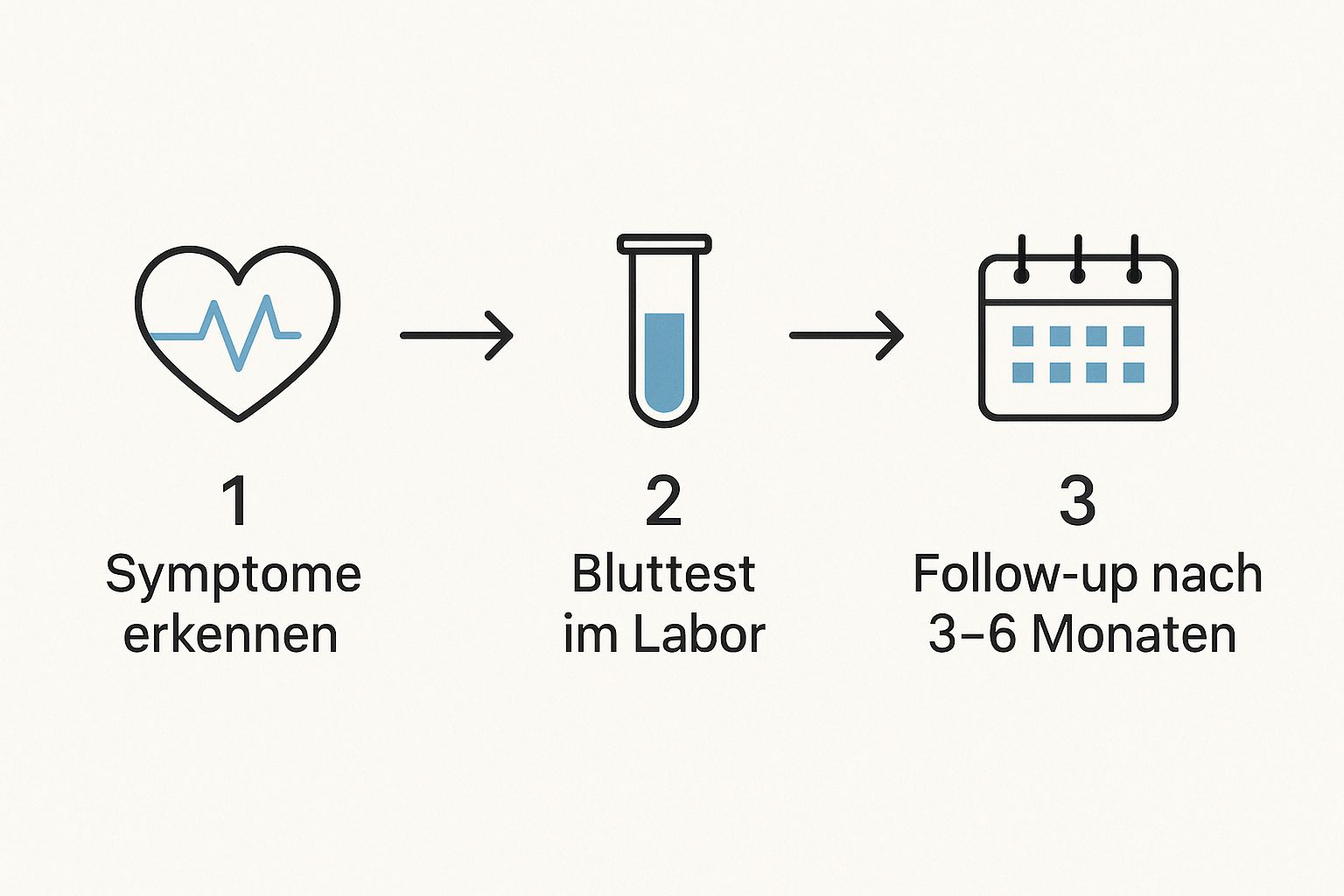
You can see that a test isn’t a one-time thing, but part of a cycle that helps you actively manage your health. It begins with self-observation and leads to regular checkups.
Return shipment and analysis in a professional laboratory
Once the sample is in the tube, pack it securely in the prepaid return envelope provided. You only need to drop it in the nearest mailbox. It really couldn’t be easier.
Your sample goes directly to one of our ISO-certified partner laboratories in Germany. State-of-the-art analysis technology is used here to determine your levels with absolute precision. The accuracy is at the same high level as a blood analysis performed by a doctor.
Your data is, of course, transmitted digitally and strictly in accordance with the requirements of the GDPR. Your privacy and the security of your health data are our absolute priority. You can rest assured that your information is in the best possible hands with us.
The analysis itself usually takes just a few business days. We know you’re waiting for your result, and we’ll keep you up to date by email. If you’d like to learn more about which hormone levels can be tested, take a look at our guide on hormone testing. That way, you’ll be perfectly prepared when your result arrives.
Your result is here—what now?

The moment of truth has arrived: You’re holding your test result in your hands. The first step is complete, but the real journey is only just beginning. The numbers on the paper are more than just data—they are your personal starting point.
Your result is a valuable snapshot of your hormonal situation. It gives you the foundation to finally make targeted, and above all informed, decisions for your well-being. Depending on where your level falls, there are different—but always clear—next steps.
Scenario 1: Your level is in the optimal range
Congratulations! This is the best confirmation that your body is in balance and that you’re already doing a lot of things right. See this result as motivation to maintain your healthy lifestyle and perhaps even fine-tune it further.
Your body is sending you a clear message: Your current habits around nutrition, exercise, and stress management are paying off. That’s the perfect motivation to keep going.
What matters now:
- Consistency is everything: Just keep it up. Your balanced diet and regular exercise are the foundation of your hormonal health.
- Regular check-ups: A good result today is no guarantee forever. It’s worth taking another test in 6 to 12 months to make sure everything remains in the green range.
- Deepen your knowledge: Take the opportunity to learn even more about your body. It never hurts to know how to regulate your hormones naturally so you can stay fit in the long term.
An optimal result is not a free pass, but a reward for your efforts. It shows that you’re on the right track—keep it up!
Scenario 2: Your result is borderline
A borderline result is no reason to panic, but it is a clear wake-up call. Your body is telling you that its balance has started to falter slightly. It’s time to adjust a few things. See it as an opportunity to take proactive countermeasures before a genuine deficiency develops.
Here’s where you can take concrete action now:
- Adjust your diet: Focus on nutrient-rich foods. Healthy fats from avocados and nuts, zinc from pumpkin seeds, and sufficient vitamin D are essential for testosterone production.
- Optimize your training: Strength training is a powerful natural booster. Focus on compound exercises such as squats and deadlifts. But be careful: Don’t overdo it. Too much training can have the opposite effect.
- Reduce stress: Chronic stress is testosterone’s natural enemy. It raises the stress hormone cortisol, which directly lowers your testosterone level. Find a relaxation method that works for you—whether meditation, walks in nature, or a hobby.
- Prioritize sleep: Your body produces most of its testosterone while you sleep. Make sure you get 7–9 hours of high-quality sleep per night. This is non-negotiable.
These measures are often enough to bring your result back into the green range. It’s best to check again after three to six months with another mybody-x test.
Scenario 3: Your result is significantly too low
A low result can be unsettling at first. But above all, it gives you one thing: clarity. You now have a tangible, data-based indication that you should by no means ignore. This result is the perfect basis for an informed conversation with a doctor you trust.
It is important to understand that testosterone production is a complex process. Men produce around 7 mg per day, which is approximately ten times as much as women. Since the level fluctuates significantly throughout the day, a morning measurement—just as you take with the mybody-x test—is crucial.
What you should do now:
- Make a doctor’s appointment: Take your report with you to the appointment. It will help your doctor quickly and accurately assess your situation.
- Investigate the causes: Together, you can get to the bottom of the causes. Sometimes, entirely different health issues are behind them and need to be treated first.
- Discuss treatment options: Your doctor will discuss possible treatment approaches with you. These can range from targeted lifestyle changes to medical treatments.
Your mybody-x self-test result gives you the power to speak with your doctor on equal footing. You do not come with a vague suspicion, but with a specific value. That is the crucial first step toward taking charge of your health actively and independently.
Still have questions? We have the answers!
Finally, we want to answer a few questions that come up again and again in our daily work. They are intended to help clear up any remaining uncertainties so that you can make a safe and well-informed decision about your health.
Are home tests just as reliable as a test at the doctor’s office?
In short: Yes, absolutely. A mybody-x blood test provides an analysis that is just as precise as a blood draw at a medical practice. The key difference is not the quality, but your comfort.
Your sample is processed in exactly the same certified German specialist laboratories that countless medical practices also work with. The entire process is standardized according to the strictest quality controls in compliance with the ISO standard. The only difference is where the sample is collected: you can do it comfortably at home instead of flipping through a magazine in the waiting room. The result is a laboratory report of medical quality—with maximum discretion and flexibility for you.
Does a testosterone level test make sense for women too?
Absolutely. Although testosterone is often considered a “male hormone,” it is just as important for the female body—only in significantly smaller amounts. It has a major impact on bone density, muscle strength, libido, and your overall energy level.
Symptoms such as constant fatigue, lack of motivation, low libido, or difficulty concentrating can also indicate a hormonal imbalance in women. A test can provide valuable pieces of the puzzle to help identify the cause of the discomfort.
Important to know: Not only a deficiency but also excess testosterone can cause problems in women, such as hair loss or blemished skin. A test provides clarity in both directions.
How much will the test cost?
There are no surprises with us. The cost of a self-test is completely transparent and covers the entire package. This means the price of the mybody-x hormone test includes everything: delivery of the test kit, the complete laboratory analysis, and digital access to your detailed results report. Hidden additional costs? Not with us.
For comparison: You often have to pay privately for a measurement at the doctor’s office as a purely preventive service (IGeL), and the costs can vary considerably depending on the practice and laboratory.
Does health insurance cover the costs?
Statutory health insurance providers generally only cover the costs if there is a justified medical suspicion. This means your doctor must already have identified clear symptoms that warrant such an examination.
A test taken purely out of curiosity, to optimize your lifestyle, or as a preventive measure is generally not covered by health insurance. The mybody-x self-test is a direct and straightforward alternative, allowing you to check your levels independently and without waiting.
How quickly will I receive my result?
We know you are waiting for your results—which is why speed and transparency are our top priorities. Once you have placed your sample in the enclosed envelope and taken it to the post office, everything moves quickly.
Once the sample arrives at our partner laboratory, it is analyzed immediately. You can usually access your result securely and discreetly in your personal online account after just a few business days. As soon as your report is ready, we will notify you immediately by email. This way, you always stay up to date and quickly get the clarity you are looking for.
Are you ready to take the first step toward more energy and well-being? With mybody-x, you get more than just a test—you gain clear insight into your hormonal health, simply, discreetly, and based on sound science.



Share now:
Nutrient analysis for your optimal health
Constantly tired? Which vitamins are you really lacking and how to find out