

Nutrient analysis for your optimal health
Think of a nutrient analysis as a detailed inventory of your body. Instead of simply guessing what you might be lacking, you finally get clarity. The analysis shows you in black and white which essential vitamins, minerals, and trace elements are actually reaching your blood—and where there may be an issue.
What a nutrient analysis reveals about you
Does this sound familiar? You try to eat healthily, but still often feel tired, unfocused, or simply not quite at your best. The cause is often hidden: an imbalanced nutrient supply. Your body is a highly complex system that needs countless micronutrients every day to function smoothly.
A nutrient analysis is like an honest look under the hood. It provides you with precise data and finally answers the key questions about your well-being:
- Your energy level: Could low iron or vitamin B12 levels be the reason for your constant fatigue?
- Your immune system: Are you getting enough vitamin D and zinc to fend off colds and infections?
- Your mental clarity: Could you be lacking omega-3 fatty acids that are affecting your concentration?
- Skin & hair: Could a lack of biotin or selenium be the reason your skin and hair aren’t as healthy as you’d like?
No more guesswork: make targeted decisions
The greatest advantage of a nutrient analysis is that it gives you a genuine basis for making decisions. Instead of blindly taking random supplements because a friend recommends them or you read about them online, you can finally take targeted action. You can see exactly where a deficiency exists and tailor your diet or supplementation accordingly.
A nutrient analysis replaces guesswork with knowledge. It is the first and most important step toward taking responsibility for your own health and giving your body exactly what it truly needs.
This data-driven approach not only saves you money, but also protects you from potentially overdosing on certain nutrients, which can be harmful as well. It’s about finding a balance that is perfectly tailored to you and your individual needs.
Your path to greater well-being with myBody-X
This is exactly where the myBody-X nutrient tests come in. We make it easy for you to conveniently check your nutrient status from home. With just a few drops of blood from your fingertip, you receive laboratory-accurate results of your levels. This gives you the perfect foundation for consciously optimizing your diet, lifestyle, and supplementation and gaining a better understanding of your body.
If you would like to delve even deeper into the subject, our article, what exactly a nutrient is and the important role it plays in your body, has the answers.
Why you should check your nutrient status regularly
Imagine being able to detect a nutrient deficiency long before it becomes noticeable through bothersome symptoms such as hair loss, brittle nails, or frequent infections. That is precisely the decisive advantage of regular nutrient analysis.
Your body is not a rigid structure but a dynamic system that constantly responds to internal and external influences. Your personal nutrient requirements are therefore not fixed—they are constantly changing and depend on many factors:
- Stress levels: Chronic stress is a real nutrient drain. It can significantly increase your need for important B vitamins and magnesium.
- Physical activity: Those who train intensively use up more minerals. Iron, zinc, and magnesium in particular are essential for muscle recovery and energy production.
- Dietary changes: Switching to a vegetarian or vegan diet is a major adjustment for the body. Levels such as vitamin B12 require special attention here.
- Seasons: Especially during the dark winter months, most people in Germany see their vitamin D levels plummet.
A one-off blood test is a great snapshot that gives you an initial overview. But only through continuous monitoring can you truly stay in control. A blood test from myBody-X enables you to act proactively instead of merely reacting to existing problems.
From reacting to taking action
Anyone who regularly monitors their nutrient status actively takes responsibility for their own health. Instead of waiting until a deficiency becomes noticeable through reduced performance or discomfort, you can take countermeasures early and identify trends before they develop into real problems.
This proactive approach empowers you to adjust your diet and lifestyle in a highly targeted way. You get to know your body better and better and understand how it responds to changes.
Regular nutrient analysis is your personal early-warning system. It turns vague assumptions about your health into tangible data and enables you to manage your vitality in a targeted way over the long term.
The benefits of continuous monitoring
Regular tests give you one thing above all: certainty and clarity. You can see in black and white whether your measures are paying off. Has the dietary change really improved your iron levels? Is the summer sun enough to replenish your vitamin D stores?
A continuous nutrient analysis, such as the one made simple by myBody-X’s at-home test, provides you with the answers. It’s about not leaving your health to chance, but managing it on a solid, scientific basis. This ensures that your body is always optimally supplied and equipped to meet the challenges of everyday life. Would you like to know more about how you can test for a nutrient deficiency? You’ll find all the important information in our guide.
Common nutrient deficiencies and their subtle signs

Do you actually eat healthily, pay attention to vegetables, and still somehow lack energy? You’re not alone. Many people in Germany have nutrient deficiencies without even realizing it, because the initial signs are often so inconspicuous that they are easy to overlook.
Your body is a master at compensating for small deficiencies for quite some time. But eventually, it sends you subtle signals that we quickly dismiss in the hectic pace of everyday life as normal fatigue or stress. Yet these quiet cries for help can point to a deeper imbalance.
The subtle signals from your body
A genuine nutrient deficiency rarely develops overnight. It is more often a gradual process that manifests through a whole chain of symptoms that, at first glance, often seem completely unrelated.
Here are some of the most common deficiencies and their often-overlooked warning signs:
- Vitamin D deficiency: Do you often feel down in winter and catch colds constantly? This could indicate a deficiency in the “sunshine vitamin.” It is absolutely crucial for your immune system and mood.
- Iron deficiency: Persistent fatigue, pale skin, difficulty concentrating, or even hair loss can indicate depleted iron stores. Women, athletes, and vegetarians are especially likely to struggle with this.
- Vitamin B12 deficiency: A strange tingling in your hands and feet, memory lapses, or unexplained exhaustion? These are classic signs of a vitamin B12 deficiency, which is particularly significant with a vegan diet.
- Iodine deficiency: Do you often feel a lump in your throat, feel constantly tired, or gain weight for no apparent reason? This may indicate an iodine deficiency that impairs your thyroid function.
These symptoms are your body’s language. A precise nutrient analysis helps you decipher this language and uncover the true cause of your discomfort. Instead of merely treating symptoms, a blood test gives you the opportunity to address the problem at its root.
Common nutrient deficiencies and their typical signs
This table provides a quick overview of the most common nutrient deficiencies, their typical symptoms, and risk groups.
| Nutrient | Typical symptoms | Possible risk groups |
|---|---|---|
| Iron | Fatigue, pale skin, hair loss, difficulty concentrating | Women of childbearing age, vegetarians/vegans, athletes |
| Vitamin D | Susceptibility to infections, depressive moods, bone pain | People with little sun exposure, older people, people with dark skin |
| Vitamin B12 | Tingling in the hands/feet, fatigue, memory problems | Vegans, older people, people with gastrointestinal disorders |
| Magnesium | Muscle cramps, nervousness, sleep disturbances, headaches | Athletes, people under chronic stress, diabetics |
| Iodine | Fatigue, weight gain, sensitivity to cold, dry skin | People who eat little fish/seafood, vegans |
| Zinc | Poor wound healing, hair loss, weakened immune system | Vegetarians/vegans, people with chronic intestinal diseases |
As you can see, the signs are often nonspecific. That makes it all the more important to investigate more closely if you suspect a deficiency rather than simply guess.
Why a “healthy” diet is sometimes not enough
It is a widespread misconception that a normal diet automatically protects against every deficiency. Unfortunately, reality looks different. Official studies such as the German National Nutrition Survey II (NVS II) clearly show that a large proportion of the population in Germany is significantly undersupplied, especially with vitamin D and iodine.
At the same time, the study makes it clear that 66% of men and 51% of women are overweight—proof that the quantity of food says nothing about its quality.
Factors such as chronic stress, intense physical activity, or the declining nutrient density of many heavily processed foods can quickly lead to your individual needs exceeding what you can obtain through your diet. Read more about the various warning signs in our article on symptoms of nutrient deficiencies.
The myBody-X Blood Test as Your Personal Guide
This is exactly where the myBody-X Nutrient Test comes in. It gives you a simple and absolutely reliable way to finally gain clarity about your nutritional status. Instead of feeling your way in the dark and trying random dietary supplements on a whim, you get a sound, data-based foundation for your decisions.
When you regularly check your nutrient levels, you learn to interpret your body's signals correctly. This allows you to optimally adapt your diet and lifestyle to your needs. It is the most important first step toward taking control of your well-being and unlocking your full energy.
Your myBody-X Analysis Explained Step by Step
Blood test—does the phrase immediately make you think of crowded waiting rooms and complicated appointments? We'll show you that there's another way. We developed your myBody-X Nutrient Analysis for home use so that it can be effortlessly integrated into your everyday life.
Come along as we guide you transparently through the entire process: from ordering your kit to receiving your personal results report. You'll see how easy it can be today to gain deep insight into your nutrient levels.
How to start your analysis so easily
The first step is also the easiest. You order your myBody-X Nutrient Analysis Kit conveniently online, and just a few days later, a small, discreet box arrives in your mailbox. Inside, you'll find everything you need for your analysis.
Don't worry, you don't need to be a medical professional. Your test kit includes detailed yet easy-to-understand instructions to guide you safely through the process. Everything is clearly labeled and perfectly prepared—so no questions remain unanswered.
Collecting the sample – pain-free and quick
The centerpiece of the process is a tiny blood sample. And don't worry, it's neither painful nor complicated. With the enclosed lancets, a small, barely noticeable prick in your fingertip is all it takes. You'll then have the few drops of blood we need.
Simply place this in the sample tube. The entire process takes just a few minutes and can easily be completed at the kitchen table. Then pack everything securely in the prepared return envelope.
Your test kit contains everything you need to send your sample back safely and free of charge to our certified German specialist laboratory. This way, you can be sure that your sample will arrive quickly and professionally exactly where it belongs.
Laboratory analysis and your personal report
As soon as your sample arrives, our experts take over. Your blood is professionally analyzed in a laboratory in Germany certified to the highest quality standards. State-of-the-art technologies are used to determine your nutrient levels with maximum precision.
Once the analysis is complete, we’ll send you an email. You can then easily and securely access your personal results report in your protected online account. Your report is clearly structured and explains in plain language what your values mean for you and your health.
The following graphic shows you the journey of your sample—from a small prick to valuable insights into your well-being.
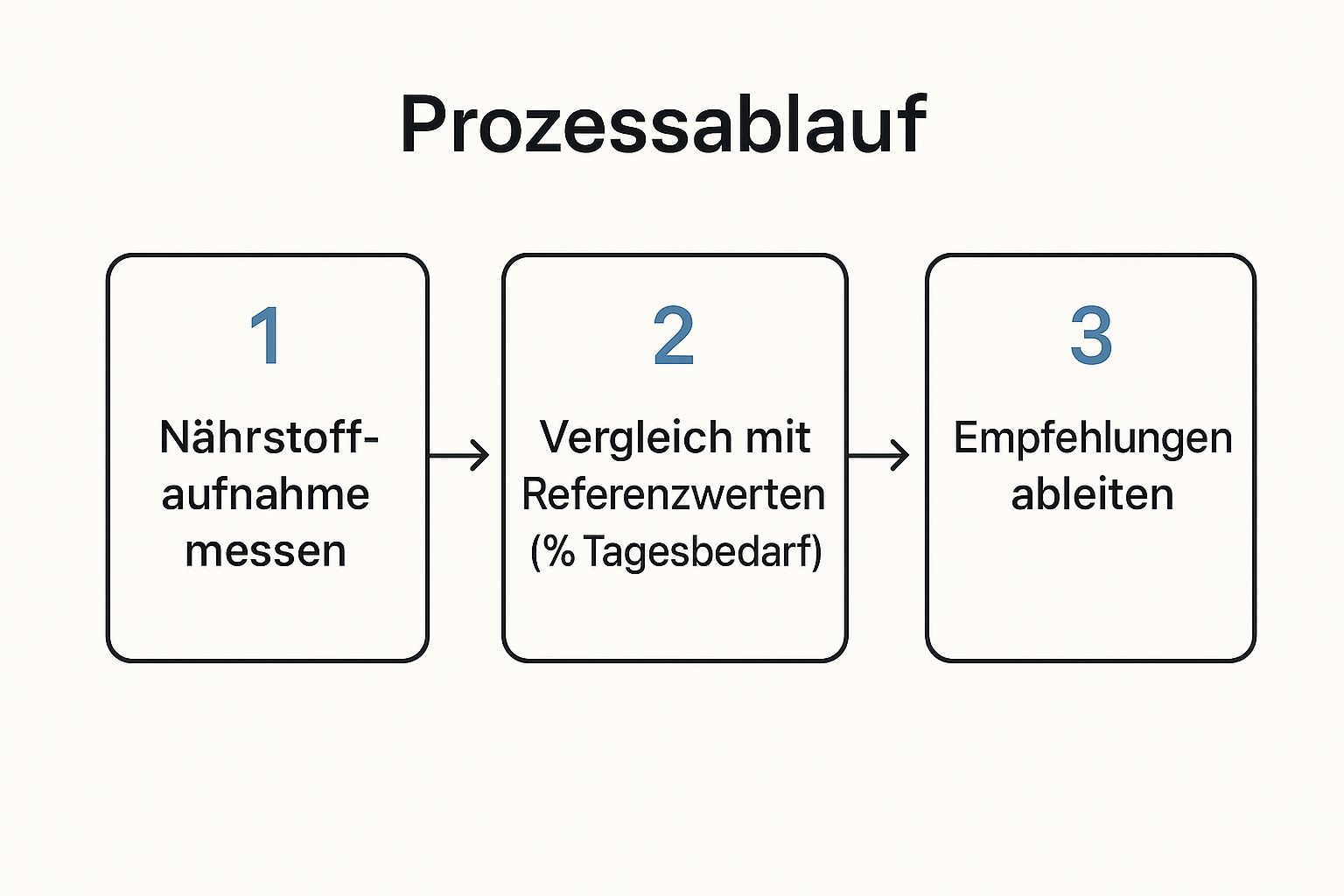
As you can see, it’s not just about measuring values. It’s about putting them into a meaningful context and giving you specific, actionable recommendations.
The entire process is designed to give you maximum control with minimal effort. If you’d like to review the process in detail, you’ll find a comprehensive overview under the process – how it works. With myBody-X, checking your nutrient levels is easier than ever, allowing you to take an active, evidence-based approach to managing your health.
From results to a clear plan: How to put your analysis into practice

There it is: your myBody-X results report. A document packed with valuable data about your body. At first glance, the many numbers and technical terms may seem a little intimidating. But don’t worry—this is exactly where our journey together begins.
This report is not simply a collection of laboratory results. Instead, think of it as a personal treasure map showing you the way to greater well-being, energy, and health. Let’s learn together how to read this map and turn your data into a concrete, actionable plan for your everyday life.
Interpreting your values correctly: What do the numbers really tell you?
The first step is understanding what your report says. In your myBody-X analysis, you’ll find your personal value for each nutrient analyzed. Right next to it, you’ll see the reference range—the range that indicates an optimal nutritional status.
You can think of it like a traffic light: green, yellow, and red. At a glance, they show you where everything is on track, where you should take a closer look, and where urgent action may be needed. We explain clearly what each individual value means so you can immediately assess your nutritional status.
But pure data is only half the story. The true strength of your nutrient analysis only becomes clear when you know what to do next.
A results report is not an endpoint, but a starting point. It gives you the scientific foundation to take targeted and effective measures for your health, instead of continuing to grope around in the dark.
Concrete recommendations that fit into your life
Based on your individual values, we provide you with concrete, practical recommendations for everyday life. The goal is not to turn your life upside down, but to optimize your diet, lifestyle and—if necessary—supplementation in a targeted way.
- Adjust your diet: We show you which foods are particularly rich in the nutrients you are deficient in. You will also get practical tips and recipe ideas for incorporating these foods into your diet in a tasty and simple way.
- Optimize your lifestyle: Sometimes, the cause of a deficiency is also hidden in your lifestyle. We provide guidance on whether, for example, more targeted relaxation during periods of stress or a small adjustment to your training plan could be beneficial.
- Targeted supplementation: When a deficiency is difficult to correct through diet alone, dietary supplements can provide useful support. We explain when this is the case and what you should be sure to consider when choosing them.
The market for dietary supplements is huge and continues to grow. In 2023, products promising energy—such as specific vitamins and minerals—were the leaders in new product launches in Germany. Interestingly, women turn to these products more often than men. The reasons why someone does not take supplements have also shifted: In the past, it was often the belief that they were already eating healthily enough. Today, financial considerations play a larger role. All of this shows how important it is to base supplement use on a sound nutrient analysis, rather than relying solely on trends or assumptions. If you would like to explore market developments in greater depth, you can learn more about current trends in dietary supplements.
Your personal roadmap to sustainable success
The recommendations from your myBody-X report are your very own roadmap. They help you finally bridge the gap between knowledge and action. Instead of feeling overwhelmed by general health tips, you get a clear strategy tailored specifically to you.
Set realistic goals. Start with small but consistent changes. Often, simply replacing one meal or deliberately adding a single nutrient can make a noticeable difference.
The key to long-term success? Staying consistent! A nutrient analysis is a dynamic tool. Repeat the test after a few months. This way, you can see the success of your measures in black and white and adjust your plan if necessary. This is the best way to ensure that your body is continuously optimally nourished and that you truly achieve your health goals sustainably.
Your questions about nutrient analysis
Do you still have a few questions on your mind or feel unsure about certain details? That is completely normal. To ensure you are well informed and can make a confident decision for your health, we answer the most frequently asked questions about nutrient analysis here.
How often should I have a nutrient analysis?
There is no one-size-fits-all answer, because the ideal frequency depends largely on your lifestyle, your goals, and how you feel in your body. But we can give you clear points of reference.
As a general rule of thumb, we recommend checking important nutrients such as vitamin D, iron, or B12 every 6 to 12 months. This gives you a good sense of how your body changes over the seasons or with consistent habits.
In some situations, however, a shorter interval can make perfect sense:
- When you are highly active: Whether during intense exercise, stressful periods, or high mental strain—your body uses more nutrients. In this case, testing every 3 to 6 months may be useful to replenish your stores in good time.
- When changing your diet: Have you recently gone vegan or vegetarian? Then it is smart to check critical nutrients such as vitamin B12, iron, or iodine more frequently at first, so that deficiencies do not arise in the first place.
- To monitor progress: Have you identified a deficiency and taken targeted action? Great! A repeat test after around three months will show you in black and white whether your measures are bearing fruit.
The myBody-X nutrient test is designed precisely for this—you can repeat it flexibly whenever you feel it is right. This allows you to stay in control and optimize your nutritional care sustainably, instead of getting just a one-time snapshot.
Is the home test just as reliable as a test at the doctor's office?
We hear this question often, and the answer is a clear yes. The myBody-X nutrient test delivers the same accuracy and reliability as a blood analysis at a doctor's office. The only difference is the convenience and the way the sample is collected—not the quality of the laboratory analysis.
We use the capillary blood method. This means you collect a few drops of blood with a small, nearly painless prick to your fingertip. This method is scientifically well established and delivers results just as precise as blood drawn from a vein.
Your sample is analyzed exclusively in an ISO 15189-certified specialized laboratory in Germany. These are the same laboratories that work for medical practices and clinics and follow the highest scientific standards. So you receive a result with genuine laboratory quality.
The biggest advantage for you is the simplicity. You save yourself a trip to the doctor and the waiting time, and you can easily fit the test into your daily routine from the comfort of your home.
Who can benefit most from a nutrient analysis?
In fact, a nutrient analysis is a powerful tool for anyone who wants to take control of their health. However, there are certain groups for whom checking their levels is particularly informative because they either have higher requirements or a greater risk of deficiencies.
This applies especially if you:
- Have nonspecific symptoms: Constantly tired, unable to concentrate, experiencing hair loss, brittle nails, or frequent infections? An analysis can uncover the hidden cause.
- Are athletic and active: Anyone who trains regularly uses more minerals such as magnesium and iron. A test helps you specifically improve your performance and recovery.
- Follow a specific diet: With a vegetarian or vegan diet, you should keep an eye on vitamin B12, iron, iodine, and zinc. Regular checks give you the reassurance you need.
- Are trying to conceive, pregnant, or breastfeeding: During these phases, your body—and your child’s—needs significantly more nutrients.
- Are under constant stress: Stress is a real “nutrient thief.” B vitamins and magnesium in particular are then used up more quickly.
- Simply want to take preventive action: Why wait until symptoms appear? An analysis allows you to act proactively and safeguard your vitality in the long term.
Ultimately, it’s about making informed decisions for your body. Instead of guessing, a nutrient analysis from myBody-X provides the facts you need to specifically improve your well-being.
Are you ready to finally gain clarity about your nutrient levels and take your health to the next level? With the myBody-X blood test, you receive a scientifically sound analysis and a clear plan for your well-being.



Share now:
TSH Thyroid Levels: Your Guide to Thyroid Health
Get your testosterone levels tested—easily and discreetly from home