
Protein requirements in old age: how much protein matters from age 65
The most important points at a glance
From age 65, the German Nutrition Society gives an estimated intake of 1.0 grams of protein per kilogram of body weight per day; for ages 19 to under 65, the figure is 0.8 grams (DGE, 2017). At 70 kilograms, that means 70 grams instead of 56 grams. The calculation is simple: your weight in kilograms multiplied by 1.0.
As clear as this figure looks, it does not stand alone. The European Food Safety Authority gives 0.83 grams per kilogram for the same age group (EFSA, 2012). This article presents both figures, explains the difference, and converts them into grams per day.
The calculation is in Chapter 4, and the comparison of the reference values is in Chapter 5. If you want to know how to tell in everyday life whether you are reaching the amount, skip to Chapter 6.
What to expect in this article
1. Why protein requirements change from age 65
2. How much protein matters from age 65: the reference values
3. Why the DGE and EFSA differ
4. How to calculate your protein requirements
5. Which reference value applies to you
6. How to tell whether you are reaching the target
7. What an amino acid test does and does not show
8. Where these figures no longer apply
9. What you can change starting tomorrow
Frequently asked questions
Sources
Why protein requirements change from age 65
There is a birthday at which a dietary recommendation changes without anything about the person having changed. At 65, the estimated protein intake in the German reference values rises from 0.8 to 1.0 grams per kilogram of body weight per day (DGE, 2017). The lower figure applied the day before, and the higher figure the day after.
The jump is a simplification, not a biological event. Behind it is a change that takes place over years: body composition shifts, the proportion of fat-free mass decreases, and the proportion of fat increases. In its overview on the nutrition of older people, the DGE explicitly describes this shift as a characteristic of aging, not a disease (DGE, 2023).
There is a technical term for the severe loss of muscle mass and muscle strength in old age: sarcopenia. It describes a condition diagnosed by a medical practice, not a label for every older person. What matters for this article is only this: For people with sarcopenia, the same DGE overview specifies a higher intake of 1.2 to 1.5 grams of high-quality protein per kilogram of body weight (DGE, 2023). Whether such a condition is present is determined by an examination, not by an online calculator.
There is also a practical everyday problem that has nothing to do with requirements but everything to do with intake: Energy needs decrease. For older people with a PAL value of 1.4, meaning a predominantly sedentary lifestyle, the DGE gives approximately 1,700 kilocalories per day for women and 2,100 for men (DGE, 2023). Less energy means smaller portions in practice. But protein needs do not decrease along with them; they actually increase.
The question most people arrive here with
Hardly anyone searches for the term protein requirement because they are interested in nutrition science. Usually, there is a more specific observation behind it: Shopping is harder than it was five years ago, the stairs take more effort, and food tastes less appealing. And somewhere, they picked up the idea that older people need more protein.
That is correct when measured against the reference values. Something else is still decisive, though: Without a figure that fits your body, the statement remains merely a feeling. That is why this article starts with the values from the professional organizations and ends by asking how you can tell in everyday life whether you are reaching them.
How much protein matters from age 65 onward: the reference values
Three figures shape the entire discussion. They use the same unit, grams of protein per kilogram of body weight per day, and come from two institutions that both work reliably.
Grams of protein per kilogram of body weight per day
0,8 g
Estimated value for adults aged 19 to under 65 (DGE, 2017)
1,0 g
Estimated value for adults aged 65 and over (DGE, 2017)
0,83 g
Reference value for all adults, explicitly including older adults (EFSA, 2012)
Sources: DGE, Reference Values for Protein, 2017 · EFSA, Population Reference Intakes for Protein, 2012
The first two figures come from the same table and describe the same nutrient. The difference between them is why this article exists: From age 65 onward, the amount is set 25 percent higher than before.
The third figure comes from Parma. In 2012, the responsible EFSA panel derived a reference value of 0.83 grams per kilogram of body weight per day for adults and explicitly placed older adults in the same group (EFSA, 2012). Anyone who compares the two values side by side has two answers for the same person.
In addition to the values per kilogram, the DGE overview on the nutrition of older people also gives total daily amounts: 57 grams of protein per day for women and 67 grams for men (DGE, 2023). These figures refer to a reference weight, not your weight. For a 75-kilogram woman, calculating her own requirement is therefore more accurate than relying on the blanket figure.
Why DGE and EFSA differ
Two professional societies, the same age group, different figures. At first, this seems like a contradiction that someone would need to resolve. In fact, the DGE resolves it itself, in a sentence that appears on its own reference-value page.
Documented source
“These are estimates; the protein requirement of older adults cannot be determined with the desired accuracy, and therefore no recommended intake can be derived.”
German Nutrition Society (DGE)
Reference Values for Nutrient Intake, Protein, Derivation 2017
This is a remarkable degree of openness. The DGE does not say: This is how much protein older people need. It says: This is how much we estimate, and the evidence is not sufficient for a reliable recommendation. Anyone familiar with the sentence reads the 1.0 grams differently from someone who has seen only the number.
EFSA arrives at its figure by a different route. Its reference value of 0.83 grams per kilogram comes from nitrogen balance studies in adults, and in 2012 the responsible panel saw no sufficient reason to specify a separate, higher value for older people (EFSA, 2012). Thus, both institutions are not assessing different data, but rather the same uncertain situation with different degrees of caution.
Key takeaway
For the same age group, two reference values stand side by side: 1.0 grams per kilogram of body weight (DGE, 2017) and 0.83 grams (EFSA, 2012). At 70 kilograms, that amounts to 70 versus around 58 grams a day. The gap is not a calculation error, but a differently cautious assessment of the same body of evidence.
A third voice completes the picture. In the same DGE overview on the nutrition of older people, an assessment is presented that goes beyond both values: Expert groups from several European societies consider a protein intake of 1.0 to 1.2 grams per kilogram of body weight to be optimal (DGE, 2023). This is not an official DGE recommendation, but an expert opinion reproduced there. That is exactly how it should be read.
The objection is understandable: Why use three numbers when you are looking for one? Because the range itself is the information. It tells you that 58 grams a day is not wrong and 84 grams is not excessive if you weigh 70 kilograms. Anyone who knows this range does not have to wait for the one right number, but can stay within a documented corridor.
How to calculate your protein requirement
The calculation itself requires neither a calculator nor an app. It consists of a multiplication and a division, and both can be done in your head.
The calculation in three steps
Step 1
Determine your weight
In the morning, after getting up, without shoes. A single measurement is sufficient; day-to-day fluctuations of one kilogram do not affect the calculation.
Step 2
Multiply by the reference value
Multiply kilograms by 1.0 to obtain the DGE estimate from age 65 onward in grams per day (DGE, 2017). At 68 kilograms, that is 68 grams.
Step 3
Distribute across meals
Divide the daily amount by the number of your main meals. 68 grams divided among three meals comes to around 23 grams per meal.
Three examples make the scale easier to understand. Someone weighing 60 kilograms reaches 60 grams per day using the DGE estimate. At 70 kilograms, it is 70 grams; at 80 kilograms, 80 grams. All three values refer to the estimate of 1.0 grams per kilogram from age 65 onward (DGE, 2017).
Calculating the same three people using the EFSA reference value shifts the result downward: around 50, around 58, and around 66 grams (EFSA, 2012). At 70 kilograms, the difference is about twelve grams per day. That is roughly the amount found in a large cup of plain yogurt or a small serving of lentils.
Which weight to use when the scale does not tell the whole story
The reference values are based on body weight. In cases of severe overweight, this produces a number that primarily includes fat tissue, even though protein requirements depend on lean mass. With significant underweight, the opposite is true.
More precisely: In these cases, it is not the calculation that is wrong, but the input value that is uncertain. If you are far from a normal weight, it is better to discuss the appropriate reference value with your general practitioner or a nutrition professional rather than estimate it. This is not an excuse, but the more honest answer.
Anyone who wants to look up the general formula regardless of age can find it in the article Daily protein requirements. This article focuses on the age group 65 and over and on which reference value applies to it.
Which reference value applies to you
Three reference values, the same criteria, one calculation example using 70 kilograms. The table also includes the line that is usually missing from guides: what the respective value explicitly is not.
| Criterion | DGE estimate from age 65 | EFSA reference value | Assessment by European expert groups |
|---|---|---|---|
| Value per kilogram | 1.0 g per day | 0.83 g per day | 1.0 to 1.2 g per day |
| Applies to | adults aged 65 and over | all adults, explicitly including older people | older people |
| Source and status | German Nutrition Society, derivation 2017 | European Food Safety Authority, 2012 | expert opinion reproduced in a DGE overview, 2023 |
| Calculation example for 70 kg | 70 g per day | around 58 g per day | 70 to 84 g per day |
| What the figure is not | not a recommended intake—the DGE explicitly identifies it as an estimate | not an age-specific figure, but a value for all adults | not an official position of the DGE, but an assessment cited there |
The table is best read from right to left. The expert-group assessment marks the upper end of the range, the DGE estimate lies at its lower edge, and the EFSA figure is below it. Anyone following the DGE estimate is therefore neither at the edge nor in an extreme range.
In practice, this means that the DGE estimate of 1.0 grams per kilogram is the most useful guideline for Germany because it applies here, explicitly identifies the age group, and acknowledges its own uncertainty. The other two figures are not counterarguments, but rather the framework in which it belongs.
What this article does not cover
Protein requirements arise in several contexts, each covered in its own article. This article focuses exclusively on the age group 65 and over and the question of which figure applies to it.
The general calculation without reference to age is provided in the article Daily protein requirements. The difference between the sexes is discussed in Protein requirements for women. Anyone aged 60 or over who wants to lose weight while keeping an eye on their weight will find the relevant context in Losing weight after 60—that article focuses on weight, while this one focuses on nutritional adequacy. The amount for targeted muscle building is covered in How much protein for muscle building, while overall nutrition in later life, far beyond protein, is described in Nutrition in later life.
How to tell whether you are reaching the target
A target number is of little use as long as no one knows where they stand. Your needs are determined not at the calculator, but at the breakfast table. That is why every assessment begins not with the question of the target, but with the question of the current situation.
Your needs are determined not at the calculator, but at the breakfast table.
The simplest tool for this is a three-day log, including one weekend day. Record not the calorie count, but only which protein-containing component appeared in each meal: quark, yogurt or cheese, eggs, fish, meat, legumes, nuts. After three days, count how many meals did without such a component—that is your finding.
The second consideration is distribution. For many people, most of their protein is consumed at dinner, while breakfast consists of bread with jam and coffee. Mathematically, the daily total may still add up. In practice, fitting in three moderate portions is easier than having one large portion.
The DGE provides a framework for choosing foods that does not require a nutrition table: legumes at least once a week and a small handful of nuts every day, fish once or twice a week, milk and dairy products every day, and, if meat and sausages are included, no more than 300 grams per week (DGE, as of 2024). Following this framework covers a large part of protein needs without weighing anything.
One point that regularly gets overlooked when discussing protein is fluid intake. The DGE recommends around 1.5 liters a day, preferably water or other calorie-free beverages (DGE, as of 2024); for older adults, it specifies at least six 200-milliliter glasses (DGE, 2023). Anyone increasing their protein intake should therefore make sure not to lose sight of drinking enough.
Chapter at a glance
Monitoring protein needs begins with a three-day log recording only which protein-containing component appeared in each meal. The second consideration is how it is distributed throughout the day, because fitting in three moderate portions is easier than having one large portion in the evening. The DGE’s food recommendations (as of 2024) are sufficient as a framework for choosing foods; a nutrition table is not necessary.
What an amino acid test shows—and what it does not
This is where the question regularly arises as to whether protein intake can be measured. The honest answer requires a distinction: amino acids in the blood can be measured—that is, the building blocks into which protein is broken down. What cannot be measured from this is how much protein you ate yesterday.
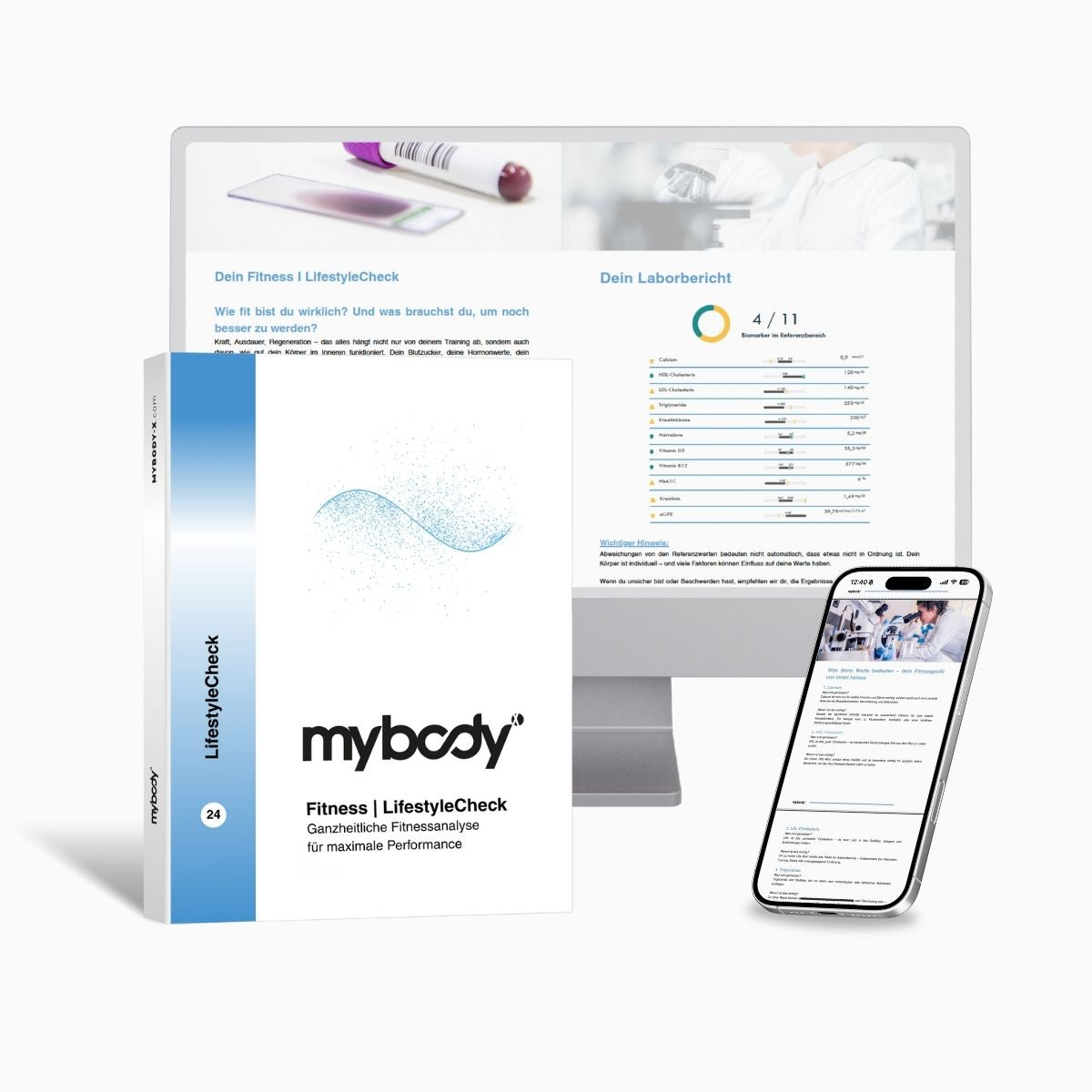
At mybody®x (MYBODY Lab GmbH), the PerformanceCheck maps this metabolism. It measures 22 values from amino acid metabolism, including all nine essential amino acids—that is, those the body cannot produce itself—as well as glutamine, arginine, taurine, and the two urea cycle values ornithine and citrulline (information from the product page, accessed 27 August 2026).
Capillary Blood Test
PerformanceCheck | Amino Acid Test
22 values from amino acid metabolism, including all nine essential amino acids. What the test does not do: It does not tell you how much protein you should eat, and it replaces neither the calculation using the reference value nor a food diary. The values also fluctuate significantly depending on the last meal—the fasting requirement in the instructions must be followed.
Laboratory analysis 3–5 business days after receipt of the sample
Information from the product page, accessed 27 August 2026
The limitation belongs in the same place as the offer, not at the end. An amino acid profile is a snapshot of metabolism. It does not answer the question addressed in this article—how many grams of protein should be on your plate; that question is answered by the calculation in Chapter 4. If you are looking for a measure of your intake, you need a food diary, not a blood draw.
What the test is still useful for: It provides 22 values and an interpretation of them as a starting point for a conversation—with your primary care doctor or a nutrition professional. If you have had little appetite for months or eat exclusively plant-based, you can go into this conversation with numbers rather than an impression. Further capillary blood analyses are available in the blood tests collection.
Useful for you if …
you eat predominantly or exclusively plant-based and want to know where your amino acid metabolism currently stands.
your food diary shows that several meals a day contain no protein-rich component, and you want to support this with numbers.
you are looking for a starting point for a conversation at your doctor’s office or with a nutrition professional.
Probably not if …
you want to find out whether you are eating enough protein. For that, a food diary is the right tool, not a blood test.
if you are unintentionally losing weight, have difficulty swallowing, or have been noticeably weaker for weeks. These symptoms should first be assessed by a doctor.
you have kidney disease. In that case, your protein intake will be coordinated with your healthcare provider anyway, and self-measurement does not change that.
Where these numbers stop
The most important caveat is already stated in the DGE quotation: These are estimates, and protein requirements for older adults cannot be determined with the desired degree of accuracy (DGE, 2017). A number derived in this way is guidance for groups, not a prescription for an individual.
Second caveat: Protein is not the only critical nutrient at this stage of life. For older people, the DGE lists, among other things, 20 micrograms of vitamin D and 1,000 milligrams of calcium per day (DGE, 2023). Focusing only on protein addresses one part while overlooking the rest.
Third caveat, and the most important in practice: If you have kidney disease, discuss any increase in protein intake with your healthcare provider before implementing it. The same applies in cases of unintentional weight loss, persistent weakness, or difficulty swallowing. These signs require an examination, not a dietary tip.
And one caveat concerning our own offering: No test of this kind measures the amount of protein on your plate. An amino acid profile shows the metabolism at the time the sample was taken, nothing more. Anyone who promises otherwise is selling a result the method cannot provide.
What you can change starting tomorrow
It began with a birthday on which a recommendation changes without anything about the person changing. That is precisely why turning 65 is a useful occasion: It forces you to do a calculation that no one had previously made.
This calculation takes one minute. Multiply your weight in kilograms by 1.0 to get the daily amount in grams according to the DGE estimate for people aged 65 and over (DGE, 2017); divide that by the number of your main meals to get the portion size. What comes next is not a change in diet, but a sorting exercise: Which meal of your day has so far contained no protein component?
One thought that didn’t fit into any of the chapters above belongs here. At 70 kilograms, the three reference values differ by around 26 grams per day. This range is greater than the difference most people make between a good and a bad day of eating. So switching from 0.83 to 1.0 grams changes your everyday life less than the discussion about the right number might suggest.
If you’re unsure whether a measurement is actually right for your question: The consultation costs nothing, and it won’t try to sell you anything.
Frequently asked questions
How do I calculate my protein requirement as I age?
Body weight in kilograms multiplied by 1.0 gives the daily amount in grams. This corresponds to the DGE estimate for adults aged 65 and over (DGE, 2017). At 70 kilograms, that is 70 grams of protein per day, distributed across the main meals—around 23 grams per meal.
Why does protein requirement increase after age 65?
In the German reference values, the estimate increases from 0.8 to 1.0 grams per kilogram of body weight (DGE, 2017). The background is the change in body composition with age: the proportion of fat-free mass decreases while the fat proportion increases (DGE, 2023). The increase at 65 is a simplification of the reference values, not a biological event on that birthday.
Why do the DGE and EFSA cite different values?
The DGE uses 1.0 grams per kilogram for people aged 65 and over (DGE, 2017), while EFSA uses 0.83 grams for all adults, including older adults (EFSA, 2012). Both assess the same uncertain body of evidence, with the DGE taking the more cautious upward approach. It explicitly describes its figure as an estimate, not as a recommended intake.
How many grams of protein per day do women and men aged 65 and over need?
As ready-made daily amounts, the DGE gives 57 grams for women and 67 grams for men aged 65 and over (DGE, 2023). These values refer to a reference weight. If you weigh significantly more or less, it is better to calculate using your own weight.
Can a blood test show whether I eat enough protein?
No. An amino acid test reflects amino acid metabolism at the time of sampling, not your intake over the course of the week. A three-day food diary shows whether you are reaching your target. The test provides figures for a consultation with a healthcare professional, not an answer to the quantity question.
Next step
If you want to put numbers to your metabolism
The PerformanceCheck measures 22 values from amino acid metabolism in capillary blood. It does not answer the quantity question; that remains the responsibility of the calculation in Chapter 4. However, it provides a starting point for the next conversation.
Go to the PerformanceCheck View all blood testsRead more
You might also be interested in this
The general formula without reference to age, explained step by step.
That concerns weight during this stage of life; here, the focus is on nutritional intake.
Sources
- German Nutrition Society (DGE): Reference Values for Nutrient Intake – Protein (derived in 2017) – dge.de
- European Food Safety Authority (EFSA): EFSA Sets Population Reference Intakes for Protein (09.02.2012) – efsa.europa.eu
- German Nutrition Society (DGE): Body Composition and Critical Nutrients in Old Age (DGEwissen 9.2023) – dge.de
- German Nutrition Society (DGE): DGE Recommendations – Eating and Drinking Well (as of 30.04.2024) – dge.de
The verbatim quotation regarding the estimated values, as well as the values of 0.8 and 1.0 grams per kilogram of body weight, come from [1]. The reference value of 0.83 grams per kilogram and the classification of older adults in the same group come from [2]. The information on changes in body composition, the daily amounts of 57 and 67 grams, the cited expert opinion of 1.0 to 1.2 grams, the value of 1.2 to 1.5 grams for sarcopenia, and the information on vitamin D, calcium, energy requirements, and fluid intake come from [3]; the assessment by European expert groups reproduced there is identified as such in the text and not presented as an institutional position of the DGE. The food-related recommendations on legumes, nuts, fish, meat, and fluid intake come from [4]. All four sources were accessed and checked live on 27.08.2026. Information on price, sample type, measurement scope, and laboratory comes from the mybody®x product page, accessed on 27.08.2026; processing times follow the central specification for each test type.

mybody®x Editorial & Expert Team
Nutritional science Blood analysis interpretation Laboratory diagnostics
This article was created by the mybody®x editorial and expert team. The team combines nutritional science, blood analysis interpretation, and laboratory diagnostics. The people who contribute to it are listed on the authors page.
Published on 27.08.2026 · Last updated on 27.08.2026
The content is intended for general information and does not replace medical advice, diagnosis, or treatment. Reference ranges depend on the laboratory, method, and age; the information on your test result is always authoritative.




Share now:
Lose Weight Without Losing Muscle: What Matters in a Calorie Deficit
Getting your hormones tested by your general practitioner: the process at the practice