

Losing weight without muscle loss: what matters in a calorie deficit
The essentials at a glance
When you lose weight, you do not lose only fat. Muscle mass also decreases with your weight—and because muscles account for most of your resting energy expenditure, every kilogram of muscle you lose makes losing weight a little harder.
This article explains what actually happens in a calorie deficit, which two misconceptions cause the most harm, how to recognize when your nutrient supply is becoming inadequate, and which measurements reveal it.
This is not about which weight-loss method is right—but about making sure none of them costs you the substance you want to keep.
What to expect in this article
1. Why the scale answers the wrong question
2. What is actually lost when you lose weight
3. Two misconceptions that get in the way
4. How to tell that your nutrient supply is becoming inadequate
5. Three ways to check this
6. What a nutrient check covers
7. Is a measurement worthwhile for you?
8. What you should keep
Frequently asked questions
Sources
Why the scale answers the wrong question
The scale knows only one number, and it does not tell you what that number is made of. Two kilograms less could be two kilograms of fat. It could also be water, intestinal contents, muscle—or a mixture of all of them. The display is the same in every case.
That is precisely the problem with many attempts to lose weight. They are measured by a number that does not distinguish between what you want to lose and what you should keep. If you look only at that number, you rate a fast week more highly than a slow one—even though the fast week often cost you more than the slow one.
Then there are expectations about the scale of the change. Many people set goals far beyond what experts recommend: According to the Institute for Quality and Efficiency in Health Care, doctors recommend losing 5 to 10% of your starting weight within 6 to 12 months, depending on your initial weight (IQWiG, 2022). If you aim to lose twice as much in a quarter of the time, you reach the point at which the body starts saving energy elsewhere.
Why the first few days look so good
Almost every change begins with a success: In the first few days, the number on the scale drops noticeably, often by several kilograms. It feels like a good start, yet most of it is something other than fat loss.
The body stores carbohydrates as glycogen, and every gram of it binds water. When someone reduces their carbohydrate intake, these stores are emptied—and the bound water goes with them. In addition, the contents of the digestive tract also decrease with smaller portions. Both are real and measurable and say nothing about fat tissue.
This mechanism explains two things at once. First, why short diets seem so convincing. Second, why the weight often returns just as quickly after the diet ends, without anyone having eaten more than before—the stores simply fill up again.
This article therefore turns the question around. Not: How can I get the number down faster? But: What needs to be preserved so that the result lasts?
What is actually lost during weight loss
The body does not cover an energy deficit exclusively from fat tissue. It also draws on protein structures, which are found primarily in muscle. IQWiG describes this connection in its guide to severe overweight: Regaining weight after losing it is usually harder than losing weight itself because metabolism, hormone balance, and the nervous system are geared toward keeping the body in balance. It goes on to say that weight loss also reduces muscle mass—and as a result, the body needs less energy (IQWiG, 2022).
What this means in practice becomes clear when looking at energy expenditure. According to the same institution, a person’s resting metabolic rate depends primarily on the proportion of muscle mass in their body weight (IQWiG, 2022)—and resting metabolic rate accounts for about 70% of total calorie needs. Every kilogram of muscle mass lost therefore reduces exactly the component that accounts for the largest share of your energy expenditure.
Key message
Anyone who loses muscle mass lowers their own energy expenditure—and afterward has to make do with fewer calories to maintain the same weight. Muscle loss therefore comes at a double cost: once now and once after the diet.
The converse is actually the good news of this chapter: it is not about a large number at all. IQWiG puts it unusually clearly:
Documented source
“Even a weight loss of just a few kilograms can have a positive effect on health.”
Institute for Quality and Efficiency in Health Care (IQWiG)
Severe overweight (obesity), as of August 24, 2022
So just a few kilograms are enough to make a difference. That removes the main reason for a pace that costs substance. If you do not need to lose twenty kilograms in three months, you do not need to eat as though you do.
What preserves muscle in a calorie deficit
Two levers determine how large the muscle component of weight loss will be, and both are unspectacular. The first is the pace: The larger the daily deficit, the less the body can replenish from fat tissue—and the more it takes from elsewhere.
The second is resistance training. The body is reluctant to break down muscle that is being used; muscle that is merely carried around costs energy without providing anything in return. That does not have to mean a gym. Stairs, shopping bags, a resistance band at home—the important thing is that the muscles are challenged at all, not how impressive it looks.
There is also the question of what the 5 to 10% is calculated from in the first place. At 90 kilograms, that is 4.5 to 9 kilograms—spread over 6 to 12 months, or a good half-kilogram per month. This scale seems modest compared with advertising promises. It is the reason some people keep their results.
Two misconceptions that get in the way
Two beliefs come up particularly often on this topic. Both sound plausible, and both lead in the wrong direction.
Common belief vs. evidence-based
Common belief
“Losing weight faster is simply the same path taken in less time.”
Evidence-based
It is a different path. Weight loss also involves a loss of muscle mass, and the body subsequently needs less energy (IQWiG, 2022). The larger the deficit, the greater the share that does not come from fat tissue.
Common belief
“Anyone who exercises automatically needs significantly more protein.”
Evidence-based
The German Nutrition Society states that adults who engage in recreational sports do not need an increased protein intake (DGE, 2017). The reference value is 0.8 grams per kilogram of body weight per day, or 1.0 grams from age 65 onward.
The second point is often misunderstood, so here is the clarification: The reference value applies to normal intake, not to a weight-loss phase. When you are in a calorie deficit, the absolute amount matters less than whether you still reach it at all—because people who eat less overall usually also eat less protein without noticing.
In practice, this means the goal is not to eat more protein than usual, but not less. Anyone who halves their portions also halves the amount of protein in them. That is exactly when a weight-loss phase starts to take a toll on muscle.
Work it out for yourself—it takes a minute: 0.8 grams multiplied by your body weight in kilograms gives the daily amount in grams. At 70 kilograms, that is 56 grams—roughly the amount in one serving of quark, one egg, and a handful of lentils combined. The question is not whether that is a lot. The question is whether it still appears in your reduced day.
And one more point about the first misconception, because it is often left out: There are situations in which a very restrictive start is used under professional supervision. According to IQWiG (2022), formula-based programs led to greater weight loss of around 10 to 15 kilograms. The difference lies in the supervision: Someone monitors nutritional intake. Anyone who tries to achieve the same pace alone suffers the disadvantage without the benefit.
How to tell that your intake is becoming inadequate
The same applies to everything else found in food. Anyone who eats less also takes in fewer vitamins, minerals, and trace elements—and the more one-sided the plan, the larger the gap. Some nutrient deficiencies become apparent quickly, while others take months.
The signs are nonspecific, and that is where the difficulty lies. Fatigue, trouble concentrating, feeling cold, brittle nails, hair loss, declining exercise performance—all of these are often attributed to the diet itself. Eating very little is tiring, after all. Sometimes that is true. Sometimes there is an underlying gap that could be closed.
Three nutrients are particularly relevant here. Iron, because a weight-loss phase often involves eating less meat and because women already lose iron regularly during their menstrual cycle. Vitamin B12, because it is found almost exclusively in animal-based foods and plant-focused diets have a well-known weak spot here. Vitamin D, because the body produces it mainly through the skin rather than from food—a diet does not change that, but winter does.
Why women are affected more often
When it comes to iron, two factors come together for women of childbearing age. Iron is regularly lost during the menstrual cycle and must be replenished through food—and it is precisely this amount of food that decreases during a weight-loss phase. Anyone who also reduces their meat intake cuts back on the richest source first.
This is not a reason for concern, but a reason to pay attention. It does not mean that a weight-loss phase is unsuitable for women. It means that the question of iron status arises more readily here than for someone who has neither regular losses nor cut their portions in half.
The limit of this list is important: it does not replace medical evaluation. Anyone who remains persistently exhausted, loses hair, or can no longer cope with exertion should see a doctor—regardless of whether they are currently dieting. A self-test is a starting point for that conversation, not a substitute for it.
Chapter at a glance
When you eat less, you also take in fewer nutrients. Signs of inadequate intake—fatigue, feeling cold, declining stamina—are usually attributed to the diet itself and therefore overlooked. Iron, vitamin B12, and vitamin D are particularly often affected. Persistent symptoms should be medically evaluated.
The difference between strenuous and concerning
A change in routine can feel strenuous. In the first few weeks, hunger between meals, a slight low mood, and less desire to exercise are normal—the body is adjusting to something new, and changing habits takes energy.
Four observations stand out. When exhaustion increases over weeks instead of easing. When exertion leaves you unable to cope even though it was previously effortless, such as climbing stairs or grocery shopping. When you feel cold all the time even though it is not cold. When your period stops or changes significantly.
None of these observations proves a deficiency on its own. But all four are reasons to investigate rather than carry on and hope. And anyone who writes them down instead of simply enduring them has something concrete to bring to the next conversation.
Three ways to check
Whether your nutritional intake is adequate during a period of weight loss can be assessed in three ways. The table places them side by side using the same criteria, with an honest line about what each one cannot do.
| Criterion | Observe yourself | Measure levels | Get medical clarification |
|---|---|---|---|
| What it addresses | to energy, sleep, strength during training, and how you feel in everyday life | to iron, vitamin, and mineral levels from a blood sample | to symptoms assessed by someone who can ask follow-up questions |
| What it costs | nothing except attention and notes | a one-time payment, plus a 3–5 business-day wait for the results | an appointment and the effort of making it |
| When it is appropriate | always, as the basis for everything that follows | when the observation shows something and you want to know whether there are numbers behind it | for persistent symptoms—then first, regardless of everything else |
| What it does not do | does not distinguish between dieting effort and a genuine deficiency | does not diagnose, measure muscle mass, or replace an appointment | does not spare you the observation that makes the conversation useful |
What is deliberately missing from the table is a fourth column for taking supplements based on guesswork. Supplementing without testing will, at best, solve a problem you did not have—and, at worst, conceal one with a different cause. With iron, there is the added point that taking it without findings is not harmless; it belongs under medical supervision.
The order matters more than the selection. Column one costs nothing and belongs at the beginning; column two answers whether there is a number behind an observation; column three is not the last step when symptoms occur, but the first. Anyone who reverses this and starts with testing ends up with numbers without context.
Which values a nutrient check covers
For the middle ground, mybody®x (MYBODY Lab GmbH) offers VitalCheck. It covers exactly the areas that may become deficient during a weight-loss phase: iron status; vitamins D3, B12 and folic acid; and minerals and trace elements such as magnesium, zinc and selenium (product page information, accessed August 27, 2026).
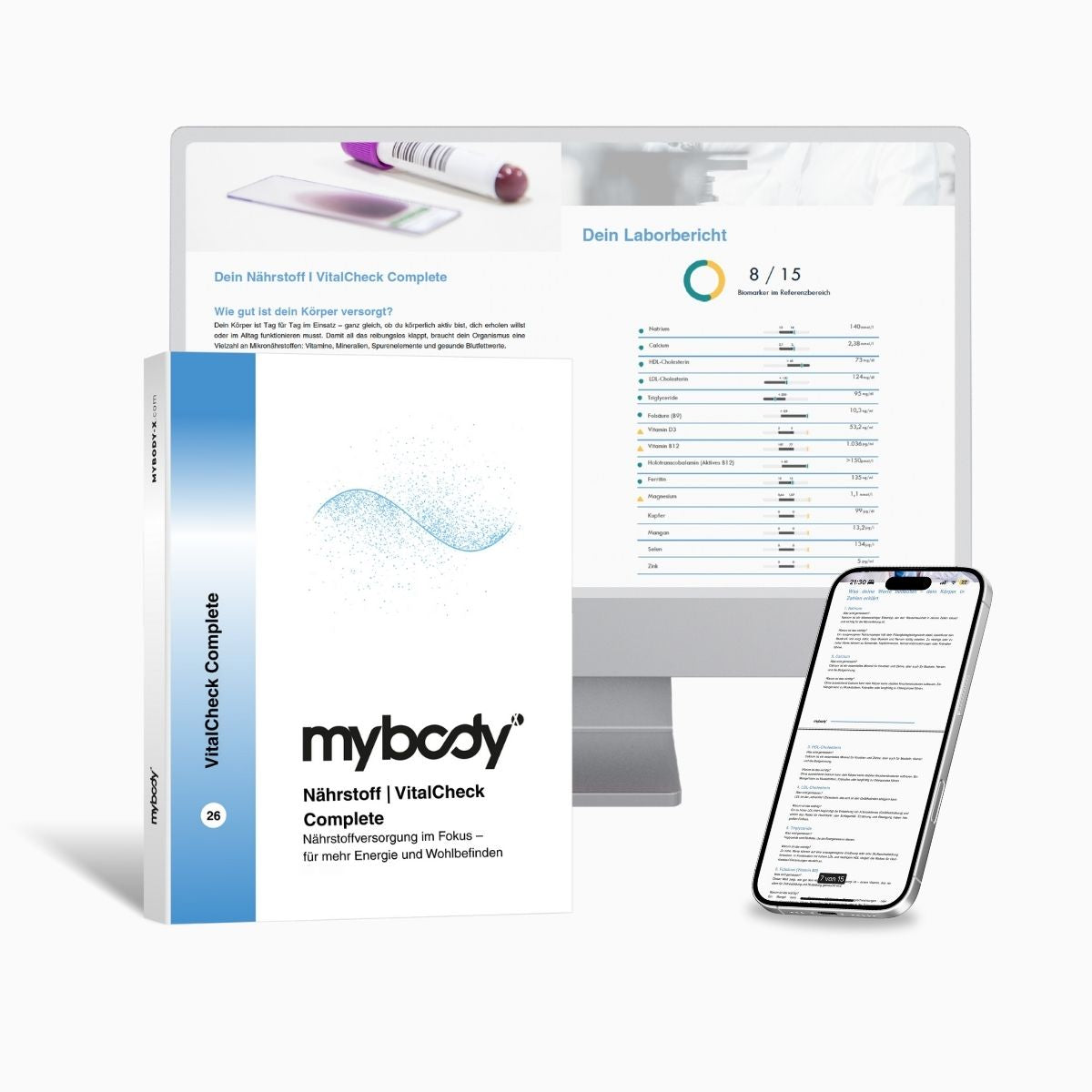
Capillary blood test
VitalCheck | Nutrient & Mineral Test Complete
18 values, including ferritin, iron and transferrin, 25-OH vitamin D3, vitamin B12, folic acid, magnesium, zinc and selenium. What the test does not do: It does not measure muscle mass, provide a diagnosis or say how much weight you will lose.
Laboratory results available 3–5 business days after sample receipt
Product page information, accessed August 27, 2026
One detail is worth mentioning because it is often overlooked when it comes to iron: The test does not stop at ferritin but also measures iron and transferrin. A single ferritin value may be higher during inflammation than the actual iron status would suggest—only when considered together with the other values does the picture become reliable.
Two other values deserve attention in this context, although they are rarely associated with weight loss. Albumin is a protein in the blood and is used, among other things, to assess protein metabolism. CRP indicates inflammatory activity—this is the value that can distort a ferritin result and therefore belongs alongside it.
What the individual values mean is explained by the Biomarker Lexicon with 67 explained blood values. And the distinction is an important part of it: A nutrient check is not a weight-loss test. It says nothing about how your metabolism is predisposed – that is what DNA analysis is for, and what it can do is explained in the article Losing Weight with a DNA Test.
Is a measurement worthwhile for you?
Not every weight-loss phase requires a blood test. The comparison honestly answers when it adds value and when it merely produces numbers.
Makes sense for you if …
you have been in a calorie deficit for months and notice that your energy and ability to cope with exertion are declining.
you are eating significantly less or a more limited range of foods than before, for example without meat or with heavily reduced portions.
you want a baseline value that you can measure again after a few months.
Probably not, if …
you are hoping for information about your muscle mass. No blood value measures that.
you have significant symptoms. Those belong in a doctor's office first, not in a self-test.
you have only just started. After two weeks of making changes, nothing worth measuring will have emerged yet.
If you recognize yourself on the right, that is not a rejection of the topic, only of the timing. Observing costs nothing, and in three months the situation may look different.
One thing can be said regardless of the decision: A single measurement tells you less than two. If you measure at the beginning of a longer-term change and then again after a few months, you see a trend rather than a snapshot – and that is precisely the more interesting information.
What you should keep
It started with the scales and their one number. What this article offers instead is not a second number, but a question: What is the loss made up of? As long as the answer is predominantly fat, things are working. As soon as muscle makes up a larger proportion, the diet is working against its own goal.
Two sentences are enough to remember. Even a few kilograms already make a difference (IQWiG, 2022) – that takes the pressure off the pace. And: Whoever reduces their portions also reduces everything in them – which explains why protein and nutrients become an issue in a calorie deficit, without anyone having done anything wrong.
What follows from this is unremarkable and therefore rarely read: a pace you can sustain for six months, enough protein in smaller portions, a stimulus for your muscles, and a look at nutritional status when observation gives reason to do so. That is the entire list. It sells poorly, but lasts longer than four weeks.
For next week specifically: Look at how much protein is in your meals since you started eating less. Don’t calculate—just look. If you notice that the source is often missing, you have already found the lever to pull.
And if you are unsure whether your fatigue is caused by the diet or something else: The consultation costs nothing, and it will not try to sell you anything.
Frequently asked questions
Do you always lose muscle when losing weight?
Some muscle loss is part of the process. The IQWiG (2022) describes how weight loss also leads to a reduction in muscle mass, which means the body needs less energy. You can influence how large this share is through the pace of weight loss, protein intake, and whether the muscles continue to be challenged.
How much protein do I need when losing weight?
The DGE reference value (2017) for adults is 0.8 grams per kilogram of body weight per day, and 1.0 grams from age 65 onward. It applies to normal nutritional needs. When in a calorie deficit, the point is less to eat more and more to avoid falling below this amount despite smaller portions.
Which nutrients are often in short supply when losing weight?
Iron, vitamin B12, and vitamin D are mentioned most often. Iron and B12 because both are strongly associated with animal-based foods, and during a weight-loss phase there is often less of them on the plate. Vitamin D plays a special role: the body produces it mainly through the skin, not through food.
Can a blood test show whether I am losing muscle?
No. Muscle mass is not determined through blood values. A nutrient check shows something else: whether your supply of iron, vitamins, and minerals is adequate during the weight-loss phase. This is a prerequisite for your body to cope well—but it is not a measurement of muscle mass.
When should a weight-loss phase be medically supervised?
As soon as symptoms appear that do not go away: persistent exhaustion, hair loss, palpitations, dizziness, or missed periods. The same applies if you have existing medical conditions or take medications whose dosage depends on your weight. In these cases, medical evaluation is the first step, not the last.
Next step
If you want to know whether your nutritional supply is adequate
The VitalCheck measures 18 values from capillary blood, including the complete iron status as well as vitamins D3 and B12. The Biomarker Lexicon explains what each number means, value by value.
Go to VitalCheck Go to the Biomarker LexiconRead more
You might also be interested in
Eight approaches and the evidence behind them—which one is right for which starting point.
If nothing changes despite making adjustments, it is worth checking your thyroid.
Sources
- Institute for Quality and Efficiency in Health Care (IQWiG): Severe overweight (obesity) (as of 24 August 2022) – gesundheitsinformation.de
- Institute for Quality and Efficiency in Health Care (IQWiG): Causes of obesity (as of 24 August 2022) – gesundheitsinformation.de
- German Nutrition Society (DGE): Reference values for protein (2017 edition) – dge.de
The verbatim quotation on the effect of losing a few kilograms, the information on the decline in muscle mass during weight loss, the recommendation of 5 to 10% over 6 to 12 months, and the information on programs using formula diets come from [1]; the sentence about muscle loss begins in the original with a reference word and was therefore reproduced with attribution rather than quoted verbatim. The information that resting metabolic rate depends primarily on the proportion of muscle mass, as well as the approximately 70% share of calorie requirements, comes from [2]. The reference values for protein and the statement about recreational athletes come from [3]. All three sources were accessed and checked live on 27 August 2026. Information on price, markers, sample type, and laboratory comes from the mybody®x product page, accessed on 27 August 2026; processing times follow the central specification for each test type.

mybody®x Editorial & Subject-Matter Team
Blood analysis interpretation Nutritional science Laboratory diagnostics
This article was created by the mybody®x editorial and subject-matter team. The team combines expertise in interpreting blood analyses, nutritional science, and laboratory diagnostics. Everyone who contributes to it is listed on the authors page.
Published on 27 August 2026 · Last updated on 27 August 2026
The content is for general information and does not replace medical advice, diagnosis, or treatment. Reference ranges depend on the laboratory, method, and age—the information on your report is always authoritative.




Share now:
Estrogen and progesterone: why the ratio matters
Protein needs in old age: how much protein matters after 65