

Sudden muscle weakness: which signs require an immediate emergency call
The essentials at a glance
Sudden muscle weakness can be a sign of an emergency. If the weakness occurs on one side, if speech or vision problems occur, if one corner of the mouth droops, if breathing or swallowing difficulties are present, or if the weakness rises upward from the legs, call 112. Do not wait. Do not observe. Do not test yourself. These signs speak for themselves, which is why they come first.
This article provides context and directs you onward. It does not offer a symptom-to-cause mapping that could be used to construct a self-diagnosis, and it does not replace an examination. A blood test is the wrong approach for acute weakness; it answers a different question, and only after a doctor has established that there is no emergency.
You will first read about the signs that require an emergency call, followed by the FAST test and the time factor. Next come the question of what the word “sudden” actually means, why a self-test is not appropriate here, and the three diagnostic approaches compared. The second part covers ascending weakness with breathing involvement, the special case of potassium, then the question of blood tests, their limitations, and what you can record before an appointment.
What to expect in this article
1. These signs require an immediate call to 112
2. The FAST test: three steps anyone can do
3. Why the time factor determines the outcome
4. What “sudden” means and why the word is misleading
5. Why a self-test is not appropriate in this situation
6. The three diagnostic approaches compared
7. Ascending weakness, breathing and swallowing difficulties
8. Potassium: why severe derangement requires hospitalization
9. What a blood test answers once an emergency has been ruled out
10. Limitations: what these tests cannot clarify
11. Who a blood test is suitable for afterward and who it is not
12. What you can record before your appointment
13. What matters in the end
14. Frequently asked questions
15. Sources
These signs require an immediate call to 112
This chapter comes first because its order can determine the outcome. Anyone who notices the following signs in themselves or someone else is not facing a question about the cause, but a question of time. The answer is the same in every case: emergency number 112.
Call 112 immediately
Six signs that cannot wait
The weakness affects only one side of the body
An arm, a leg, or one side of the face no longer obeys, while the other side functions normally. The Institute for Quality and Efficiency in Health Care describes this as characteristic of a stroke: Usually, only one side of the body is affected, so, for example, the right arm and right leg can no longer be moved properly (IQWiG, 2026).
One corner of the mouth droops
When smiling, one side of the face moves less than the other. This is not a cosmetic finding but a neurological sign.
Speech is halting, slurred, or not understood
Words are missing, sentences trail off, the voice sounds slurred, or spoken sentences are no longer understood. Even if it lasted only a minute, it warrants an emergency call.
Visual disturbance, double vision, or loss of part of the visual field
Part of the field of vision is missing, or the image is double or blurred. The German Stroke Support Foundation lists visual disturbances, speech disturbances, one-sided paralysis, dizziness with unsteady walking, and a previously unknown, very severe headache as signs of a stroke (accessed 2026).
Shortness of breath or difficulty swallowing
If the weakness reaches the muscles involved in breathing or swallowing, the muscles that keep the body alive are affected. This sign is serious regardless of how severe the weakness is in the arms and legs.
The weakness moves upward from the legs
First the feet, then the lower legs, then the thighs, over the course of hours to days. This pattern of progression belongs in the hands of a doctor, immediately. The reason is explained in Chapter 7.
And if a sign disappears again
The emergency call is still the right thing to do. A sign that disappears after ten minutes is not a sign that has resolved itself.
The instruction to act does not come from a guidebook, but from the institution that, on behalf of the Federal Joint Committee, produces health information for the general public. It is brief and leaves no room for discretion.
Documented source
“A stroke is an emergency that must be treated immediately. Whenever a stroke is suspected, it is important to call emergency services quickly (emergency number 112).”
Institute for Quality and Efficiency in Health Care (IQWiG)
gesundheitsinformation.de, topic “Stroke,” updated August 5, 2026
The sentence contains the word suspicion, not certainty. That describes the threshold at which calling emergency services is the right thing to do: it is suspicion, not proof. Anyone who waits until they are certain waits too long, because certainty cannot be established from the outside in this situation.
Key message
The threshold for calling emergency services is suspicion, not proof. A self-test, a glass of water, and waiting half an hour do not change this threshold; they only move the clock forward.
What you do at this moment
Sit or lie down in a safe place. Call 112 or have someone call it. Do not get behind the wheel yourself or drive to a doctor’s office on your own. Note the time when the weakness began, or the last time it was definitely not present. This one time is among the most important pieces of information at the hospital, and it is lost if no one records it.
Anyone who calls emergency services briefly describes what they see: since when, which side, and what additional signs. The dispatch center then decides, not the caller. That is exactly the relief that matters in this situation. It is not your job to interpret the situation.
The FAST test: three checks anyone can perform
The FAST test is not a diagnostic procedure. It is a mnemonic aid for laypeople that can be used to check three of the most important signs in less than a minute. The German Stroke Foundation describes it using four letters, and the fourth is the decisive one.
Ask for a smile
If one corner of the mouth droops, according to the German Stroke Foundation, this indicates paralysis on one side of the body. One side of the face is always compared with the other.
Both arms forward
Stretch both arms forward and turn the palms upward. According to the foundation, in the event of paralysis, both arms may not be able to be raised; one arm drops or rotates.
Repeat a simple sentence
If this is not possible or the voice sounds slurred, the foundation says that a speech disorder is probably present. A short everyday sentence is entirely sufficient.
Call 112 immediately
The German Stroke Foundation states this step without qualification: do not hesitate; call 112 immediately. The fourth letter is where the test proves its value.
A negative FAST test rules nothing out. It checks three signs out of several, and it is designed for situations in which someone is standing nearby and needs to act quickly. Anyone who notices sudden weakness in themselves and finds all three checks unremarkable has not thereby received a clean bill of health. The other signs from Chapter 1 still apply unchanged.
The test has a second function that is rarely discussed. It gives relatives a language. Anyone who can say on the phone that the left arm is dropping and that the sentence could not be repeated conveys an observation rather than a feeling. This shortens every conversation with the emergency dispatch center.
Why the time factor determines the outcome
The treatment methods that can still influence the course of a stroke are subject to a time window. IQWiG writes that these methods are suitable only for the first few hours after the symptoms begin, and concludes from this that it is so important to get to a hospital quickly in the event of a stroke (IQWiG, 2026). This identifies the core of the issue: It is not the diagnosis that is in short supply, but time.
What this means in everyday life can be seen from the figures the same source gives for the course of the illness. They do not describe your case, and they do not say what condition you have. They describe what this illness is about.
Order of magnitude, not an individual case
3 out of 100
People have a stroke at some point in their lives. Most people affected are over 60 years old.
40 out of 100
People who survive a stroke are left with more severe lasting impairments.
7 out of 100
Those affected have another stroke within the first year. That is why the evaluation does not end with discharge.
Source: Institute for Quality and Efficiency in Health Care (IQWiG), gesundheitsinformation.de, 2026
The third figure explains why a sign that disappears on its own is not a resolved sign. If a proportion of those affected experience a second event in the first year, then the first event is the reason to look for the cause. This investigation takes place in a hospital, not at the kitchen table.
Why people wait anyway
The most common reason is not misjudging the sign, but consideration for others. No one wants to call an ambulance unnecessarily. This restraint is understandable, and here it is the greatest risk. Emergency medical services exist precisely for cases in which someone on the outside cannot determine how serious it is.
The second reason is an explanation that is quickly at hand. A tiring day, not drinking enough, sleeping poorly, not eating enough. Such explanations are convenient because they postpone taking action. They cannot be verified in this situation, and an unverifiable explanation is not a basis for a decision.
What “suddenly” means and why the word is misleading
The word “suddenly” is used for two different experiences. One is a change of state within seconds to hours: It was still working just now, and now it no longer is. The other is a shift in attention: The weakness has been there for days or weeks, but today it was noticed for the first time because a familiar movement failed.
These two meanings lead to different courses of action, which is why it is worth asking which one is meant. This can usually be answered by thinking back to a specific time when the movement was definitely still working. Anyone who can name that time to the exact hour is dealing with a change of state. Anyone who can only say that it was still better three weeks ago is dealing with a progression.
Key message
This distinction changes nothing about the signs from Chapter 1. If one of them occurs, call emergency services, regardless of whether the weakness has been present for an hour or for three weeks.
Weakness is not fatigue and not muscle soreness
It is worth distinguishing three sensations that are all described with the word “weak” in everyday life. Fatigue is a condition affecting the whole person: movement is possible; it simply feels strenuous. Muscle soreness and muscle tension are painful conditions: movement is possible, but it hurts. True loss of strength is different: movement is no longer possible. The glass slips from the hand, the leg buckles, or the arm can no longer be raised above shoulder height.
This distinction is not a matter of verbal nitpicking. It is the information with which a medical consultation begins, and only the affected person can provide it. Bringing it along considerably shortens the path to the right examination.
Distribution: one side, both sides, one region of the body
The second piece of information that matters is the distribution. Does the weakness affect one side of the body, both legs, the muscles closer to the body at the shoulders and hips, or the hands and feet? No one can determine this from the outside either, and this too belongs in a conversation, not in a self-assessment. This article deliberately does not offer a list linking a distribution pattern to a disease, because such a list would inevitably become a self-diagnosis tool and, in that role, would do more harm than good.
Why a self-test is not sufficient in this situation
An at-home blood test has a process, and that process takes time. The kit is ordered and arrives within a few business days. The sample is collected, packaged, and mailed. It travels by post to a laboratory. There it is analyzed, and then a report is prepared. From the moment someone notices sudden weakness to the moment a number appears on the screen, about a week passes in total.
A blood test sent by mail cannot answer a question that needs to be answered within an hour.
There is a second point, unrelated to the duration. A blood test measures substances in the blood. It does not measure blood flow to the brain, the conductivity of a nerve, or transmission between a nerve and a muscle. Other procedures are needed to answer the questions that must be clarified first in the case of acute weakness, and they are available in a clinic, not in an envelope.
An unremarkable lab result can actually be harmful in this situation because it provides reassurance without addressing the real question. That is precisely the point at which a test changes from a useful aid into an obstacle. Anyone who knows their own results and therefore postpones an appointment has lost rather than gained something from the test.
These home remedies do not clarify anything either
Eating a banana, taking a magnesium supplement, drinking something sweet, lying down for half an hour, and then checking again whether the strength has returned. All these actions feel like doing something, but in this situation they only waste time. A temporary fluctuation in strength does not change the combination of signs that is currently present.
Comparing grip strength between the left and right hands is also not a test. It may confirm a difference between the sides that one has already noticed, but it cannot rule it out because grip strength is not the same as strength in the entire arm. Anyone who notices a difference is experiencing a sign from Chapter 1.
Comparing the three evaluation pathways
There are three pathways for evaluation in this topic, and they differ not in their thoroughness but in their area of responsibility. The following table presents them side by side. It does not assign symptoms to causes and does not help with self-diagnosis. It answers only one question: Which question should be directed to whom?
| Criterion | Emergency number 112 | Doctor’s office, prompt appointment | Laboratory values from capillary blood |
|---|---|---|---|
| When this pathway applies | for every sign from Chapter 1, including if it is only suspected and even if it has improved again | in the event of new, unexplained loss of strength without the signs from Chapter 1 | only once a doctor has clarified that there is no emergency and a care-related question remains open |
| Who decides | the emergency dispatch center and then the emergency response team | Doctor after an examination | you yourself, which is why this is the only one of the three pathways that requires a preliminary decision |
| Time until the result | Minutes to hours | Days to weeks, depending on the appointment and further diagnostic testing | about one week: kit shipping takes 1 to 3 business days, plus postal transit and 3 to 5 business days for laboratory analysis after the sample arrives |
| What this pathway clarifies | whether an acute disorder is present that requires immediate treatment | which examination is appropriate next, and arranges it | the supply of individual minerals, trace elements, or nutrients at the time the sample was taken |
| What this pathway does not clarify | long-term causes; further evaluation follows for this purpose | nothing that an emergency call can clarify; an appointment in three weeks does not replace a single minute | Blood circulation, nerve conduction, muscle function, acute disorders of any kind |
| Cost | not a question the affected person needs to clarify before calling | Standard care; the practice determines the scope and billing | Self-pay service; at mybody®x, €139.00 for the BalanceCheck and €169.00 for the VitalCheck Complete (as of 27 August 2026) |
The last line of the third column is deliberately placed there rather than higher up. In this context, price is the least important piece of information, and it only becomes relevant once the two columns to its left have been dealt with.
The second line is noteworthy. In the first two pathways, someone with appropriate training decides whether and what should be examined. In the third pathway, you decide for yourself which values are measured, thereby making a selection in advance. That is why this pathway comes last: making a selection presupposes that the question has already been clarified.
Ascending weakness, breathing and swallowing difficulties
One course deserves separate mention because it differs from the signs in Chapter 1 and nevertheless requires the same action. This refers to weakness that begins in the legs and spreads upward over the course of hours to days, usually on both sides at the same time. This pattern may indicate Guillain-Barré syndrome, a condition in which the immune system attacks the peripheral nerves.
Why this course is taken so seriously is stated in the current guideline of the German Society for Neurology on the treatment of immune-mediated neuropathies. It states verbatim that patients with Guillain-Barré syndrome should be treated in a hospital with access to intensive care because of the risk of respiratory insufficiency and cardiac arrhythmias (German Society for Neurology, AWMF registry number 030/130, version dated October 1, 2025).
Two words in this sentence explain why assessing this by mail is inappropriate here. Respiratory insufficiency means that the breathing muscles may also be affected. Cardiac arrhythmias mean that control of the heartbeat may also be affected. Both are reasons for monitoring, and monitoring is, by definition, something that happens continuously, not once a week.
What to rely on in this situation
The rule is the same as in Chapter 1; only the observation is different. If the weakness continues to move upward over the course of hours, if climbing stairs is more difficult today than yesterday, if swallowing becomes difficult, or if you become short of breath while speaking, call emergency services. In this situation, there is no reason to wait for an appointment, and there is no value you need to have measured first.
What is explicitly not stated here: a list of features that could be used to distinguish one condition from the other. That distinction is made through a neurological examination, often supplemented by nerve conduction studies and an examination of the cerebrospinal fluid. It cannot be made at the kitchen table, and trying to do so costs precisely the time at issue here.
Potassium: why a severe imbalance belongs in the hospital
Potassium is the mineral that appears most often in guides to muscle weakness, and it is also the one where downplaying the risks can be most costly. Together with sodium, potassium controls the electrical excitability of nerve and muscle cells. This includes the heart muscle.
The U.S. National Library of Medicine's consumer health information describes muscle weakness and muscle cramps as possible symptoms of a low potassium level. It is more explicit about the heart, stating that a severe drop in blood potassium can lead to abnormal heart rhythms, especially in people with heart disease, and that a very low potassium level can even lead to cardiac arrest (MedlinePlus, U.S. National Library of Medicine, updated May 19, 2025).
This clarifies the role of this value in this article. A potassium value is not a wellness parameter that you casually check when you happen to feel weak. A severe imbalance is a clinical event requiring its own treatment, and it is measured where it can also be treated. Anyone experiencing acute, pronounced weakness and thinking about potassium is thinking of the right substance but the wrong way to test it.
Why potassium sent through the mail is particularly problematic
There is a second reason why a potassium value from a mailed-in capillary blood sample does not answer the acute question, and it lies in the sample itself. When red blood cells are damaged, their contents leak into the fluid. The Institute of Clinical Chemistry and Laboratory Medicine at Freiburg University Medical Center explains in its preanalytical guidance that hemolysis can be caused by improper collection and incorrect storage and leads to an increase in potassium and a number of enzymes in plasma or serum, including LDH and GOT (Freiburg University Medical Center, accessed August 27, 2026).
The direction of this distortion is the crucial information. A damaged sample produces a potassium value that is too high, not one that is shifted randomly. A process involving self-collection, unrefrigerated shipping, and several days in transit is therefore not suitable for assessing an acute potassium disturbance. We have examined how strongly individual values are affected by the journey between fingertip and laboratory in our article on experiences with at-home blood tests.
This leaves a narrow but genuine role for a potassium value from a home test. It provides an indication of nutritional status over a longer period and is useful for recurring symptoms without the signs described in Chapter 1. It is not a measure of an acute situation, and we state that here even though the value is included in one of our own tests.
Chapter at a glance
Potassium controls the excitability of nerve, muscle, and cardiac muscle cells. According to the U.S. National Library of Medicine (2025), a severe drop in potassium levels can cause cardiac arrhythmias, and a very low level can even cause cardiac arrest. Severe potassium disturbances are therefore clinical events and are measured where they are also treated. A potassium value from a submitted capillary blood sample may be falsely elevated when red blood cells are damaged, making it unsuitable for assessing an acute situation.
What a blood test answers once an emergency has been ruled out
This chapter comes ninth, and that is intentional. A blood test is the wrong approach for acute muscle weakness. It is appropriate only for the question that follows: when a doctor has examined you and established that there is no emergency, and when a cause such as an electrolyte or nutrient deficiency is then under consideration. Only in this situation is testing a sensible step, and even then it contributes to a conversation rather than providing an answer on its own.
mybody®x (MYBODY Lab GmbH) offers two capillary blood tests for this purpose, which answer different questions. One covers electrolytes and trace elements; the other addresses the broader question of nutritional status. Both cards state the scope, the price, and what the tests do not do.
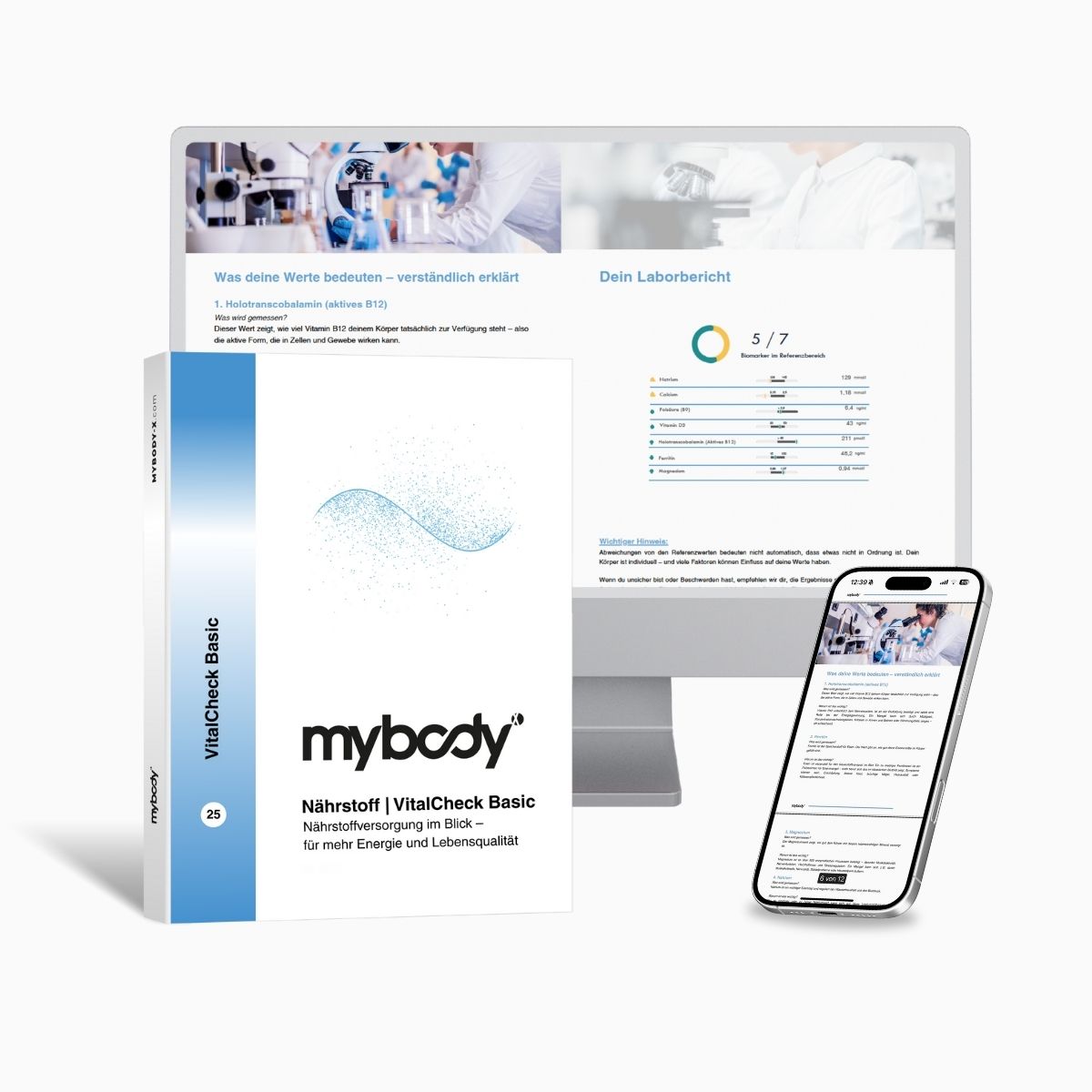
Capillary blood test
BalanceCheck | Electrolytes & Minerals Test
15 values from a capillary blood sample: the five electrolytes potassium, sodium, calcium, magnesium, and phosphorus; the trace elements selenium, zinc, chromium, copper, manganese, and molybdenum; and the heavy metals lead, cadmium, nickel, and mercury. What the test does not do: It does not assess an acute situation and does not replace emergency diagnostics. For the potassium value, the information in Chapter 8 about the submitted sample also applies. The product page does not disclose whether magnesium is measured from serum or whole blood; a normal serum value does not rule out a deficiency in the tissue.
Laboratory analysis within 3–5 business days after receipt of the sample
Information from the product page, accessed 27 August 2026
The second test answers a different question. It does not include a complete electrolyte measurement, but it does cover vitamins, iron status, and several metabolic markers. Anyone who wants to assess gradually increasing fatigue and declining strength over several weeks will find a broader approach here.
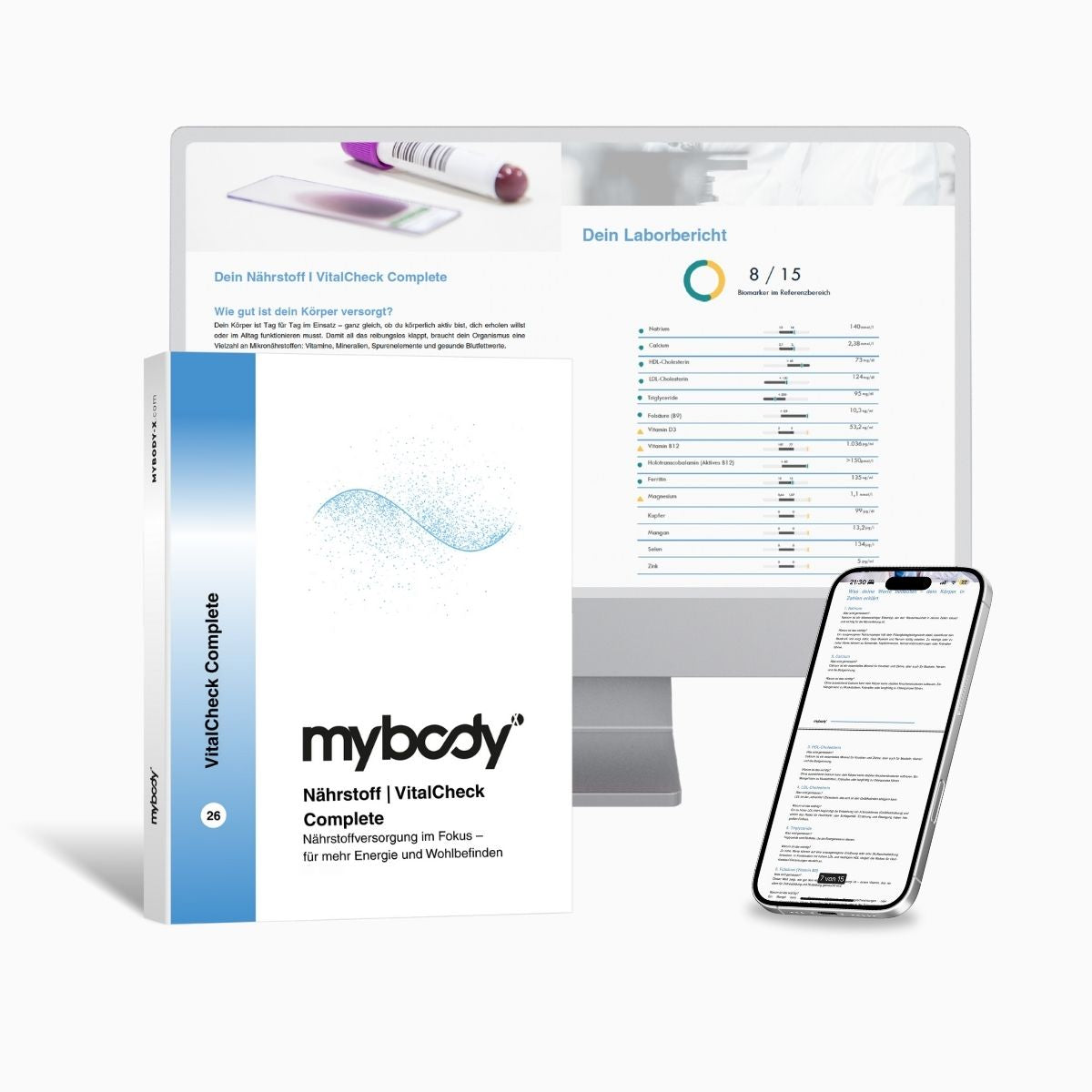
Capillary blood test
VitalCheck | Complete Nutrient & Mineral Test
18 values from a capillary blood sample: 25-OH vitamin D3, vitamin B12, folic acid, ferritin, iron, transferrin, calcium, magnesium, phosphate, selenium, zinc, total cholesterol, HDL and LDL cholesterol, triglycerides, long-term blood sugar, CRP, and albumin. What the test does not provide: potassium is not included, nor are heavy metals, and thyroid values are not measured. It does not assess an acute situation and does not replace emergency diagnostics.
Laboratory analysis within 3–5 business days after receipt of the sample
Information from the product page, accessed 27 August 2026
Two contradictions on the product pages themselves belong here because otherwise no one would notice them. First, the BalanceCheck page states three to five business days after receipt of the sample in one place and four to eight business days elsewhere. The binding specification for blood tests, which is also shown in the cards above, is: kit dispatch within 1 to 3 business days, laboratory analysis within 3 to 5 business days after receipt of the sample. Second, the VitalCheck product description says electrolytes are not included, but lists calcium, magnesium, and phosphate. The correct information is: potassium and sodium are not included; the other three are. We correct this here instead of repeating the incorrect information.
There is approved wording regarding magnesium’s role in nerve and muscle function, as well as many statements that are not approved. Where this boundary lies is explained in our article on magnesium for the nerves. The order outlined in this article applies there too: first rule out an emergency, then consider nutritional status.
Limitations: what these tests cannot clarify
Four limitations remain, even when the sample is collected carefully and reaches the laboratory quickly. They lie in the procedure, not in its execution, and no larger test panel can eliminate them.
The first limitation concerns scope. A blood test measures substance concentrations. It measures neither nerve conduction nor transmission at the connection between a nerve and a muscle, nor blood flow to the brain. These are precisely the three areas that need to be clarified first when a reduction in strength appears suddenly, and each requires its own medical examination.
The second limitation is that it is only a snapshot. A blood value describes the day the sample was taken. It does not describe a trend, and a single value cannot show which way things are moving. For questions where the trend matters, a second measurement under the same conditions is more informative than a single measurement, however accurate it may be.
The third limitation is the reference range. A value outside the range does not automatically indicate a disease, and a value within the range does not rule one out. Reference ranges describe where the middle 95 percent of a comparison group lie, and they depend on the laboratory, method, and age. The information on your own report is always decisive.
The fourth limitation concerns what is missing from both tests. Thyroid values are not included in either panel. The BalanceCheck does not measure vitamins, and the VitalCheck measures neither potassium nor sodium. If you are testing because of a specific question, check beforehand whether the relevant value is even on the list. If it is not, the test is the wrong one for that question, even if it includes many other values.
Who a blood test is suitable for and who it is not
The decision depends less on the price than on the question to be answered and on what happened beforehand. In this article, the right-hand column is the more important of the two.
Makes sense for you if …
a medical examination has taken place, an emergency has been ruled out, and the question of electrolytes or nutritional status remains unresolved.
the symptoms recur or are gradually worsening, and none of the signs from Chapter 1 is present.
you want to establish a baseline so you can measure again under the same conditions in six to twelve months.
Probably not if …
the weakness is occurring right now or one of the signs from Chapter 1 is present. In that case, call 112, and a test is the wrong course of action.
you are looking for a diagnosis. A blood test measures values; attributing a value to a disease is a medical service, not a laboratory service.
you take anticoagulants, have a blood-clotting disorder, or do not feel confident taking the sample yourself. In that case, venous sampling is the simpler option, not the more complicated one.
The first point in the right-hand column is the only one in this article that applies without qualification. All the other points on both sides are considerations. This one is a rule.
What you can keep track of until the appointment
If the signs from Chapter 1 are not present and an appointment is scheduled, there is preparation that makes the appointment shorter and more effective. It costs nothing and replaces nothing. It consists of writing down four pieces of information that would otherwise have to be reconstructed during the conversation.
The first piece of information is the timing. When was the reduction in strength first noticed, and when was it definitely not present yet? Two dates are sufficient. If you no longer know them exactly, write down what you are using to date it, such as a particular grocery trip or a staircase that had not been an issue before.
The second piece of information is the distribution. Which area of the body is affected, one side or both, closer to the shoulders and hips or rather in the hands and feet. Here too, your own observation is sufficient, without interpretation.
The third piece of information is the movement you can no longer perform. A concrete example says more than any adjective: a full glass of water, the second floor, the lid of a screw-top jar, standing up from a deep armchair without armrests. These examples can be verified and repeated in four weeks.
The fourth piece of information is a complete list of everything you take. Prescription medications, over-the-counter remedies, and dietary supplements all belong on it, including those that seem self-evident. Events in recent weeks that affected your fluid and salt balance should be included as well, such as a gastrointestinal infection, very heavy sweating, or a highly one-sided diet.
What does not belong on this note is a guess about the cause. It is well-intentioned but steers the conversation in one direction before the examination has taken place. The four pieces of information above are observations, and observations are what is needed.
What matters in the end
At the beginning of this article, there was a list of signs and a number. Both appear at the end as well, and nothing in between has weakened their significance. One-sided weakness, a drooping corner of the mouth, speech or vision problems, difficulty breathing or swallowing, weakness rising from the legs: in all these cases, 112 is the first and only step.
What this article also provides is an order of steps. First, have someone trained rule out an emergency. Then, if a care-related question remains, take the measurement. This order cannot be reversed, because taking a measurement requires a selection, and a selection requires a question that no one has yet examined.
The final new thought is different, and it concerns what happens after the emergency. An event that ends well is a reason to look for its cause, not a reason to forget about it. The figure from Chapter 3, according to which 7 out of 100 affected people experience a second event within one year, belongs precisely here. The evaluation does not end with discharge, and follow-up care is the part that the affected person can control.
The specific next step is therefore not placing an order but making a note. Write down the four details from Chapter 12 on a piece of paper and take it to your next appointment. And if you are still unsure afterward which value is relevant to your question: The consultation costs nothing, and it is not trying to sell you anything.
Frequently asked questions
When is sudden muscle weakness an emergency?
Call 112 if the weakness affects only one side of the body, if one corner of the mouth is drooping, if a speech or visual disturbance occurs, if there is shortness of breath or difficulty swallowing, or if the weakness rises upward from the legs. This also applies if a sign has temporarily disappeared. Regarding stroke, IQWiG states: “A stroke is an emergency that must be treated immediately. Whenever a stroke is suspected, it is important to call the emergency services quickly (emergency number 112).” (IQWiG, updated August 5, 2026). The threshold is suspicion, not proof.
How does the FAST test work when a stroke is suspected?
Face: ask the person to smile; according to the German Stroke Foundation, a drooping corner of the mouth indicates one-sided paralysis. Arms: ask the person to stretch both arms forward with the palms facing upward; with paralysis, one arm sinks or rotates. Speech: ask the person to repeat a simple sentence; if they cannot do so or their speech sounds slurred, they probably have a speech disorder. Time: call 112 immediately. An unremarkable FAST test rules nothing out because it checks three signs among several.
Can a blood test help with sudden muscle weakness?
In cases of acute weakness, a blood test is the wrong approach. About a week passes between ordering the test and receiving the results, and a blood test measures neither blood flow nor nerve conduction nor transmission between the nerve and muscle. Testing becomes useful only afterward: once a doctor has determined that there is no emergency and when a cause such as an electrolyte or nutrient deficiency is being considered. Even then, the result contributes to a discussion with a doctor; it is not a diagnosis.
What does a low potassium level mean for muscles and the heart?
Potassium controls the electrical excitability of nerve, muscle, and cardiac muscle cells. The U.S. National Library of Medicine lists muscle weakness and muscle cramps as possible symptoms of low potassium levels and states that a severe drop can trigger cardiac arrhythmias, while a very low level can even cause cardiac arrest (MedlinePlus, updated May 19, 2025). A severe potassium disorder is therefore a clinical event and is measured and treated there, not via the mail.
Which values are included in BalanceCheck and VitalCheck Complete, and which are not?
The BalanceCheck from mybody®x measures 15 values: potassium, sodium, calcium, magnesium, and phosphorus, along with selenium, zinc, chromium, copper, manganese, molybdenum, lead, cadmium, nickel, and mercury; it costs €139.00 (as of August 27, 2026). VitalCheck Complete measures 18 values related to vitamins, iron status, and metabolism and costs €169.00 (as of August 27, 2026); potassium, sodium, and heavy metals are not included. Neither test includes thyroid values. Neither assesses an acute condition.
Next step
Medical evaluation first, then measurement
If an emergency has been ruled out and the question of electrolytes and minerals remains open, BalanceCheck is the shortest route to an answer. If this evaluation is still pending, this is the wrong path. Anyone who wants to know beforehand how reliable a blood test from a fingertip actually is can read the assessment of it.
View BalanceCheck How reliable is an at-home blood test?Read more
You might also be interested in this
In case the question of magnesium remains open after medical evaluation and you want to know what claim is permitted about it.
The assessment of which sources of error between fingertip and laboratory are documented and which of them are within your control.
Sources
- Institute for Quality and Efficiency in Health Care (IQWiG): Health information “Stroke,” updated on August 5, 2026 – gesundheitsinformation.de
- German Stroke Foundation: FAST test and stroke symptoms (accessed on August 27, 2026) – schlaganfall-hilfe.de
- German Society for Neurology: S2e guideline “Treatment of Immune-Mediated Neuropathies,” AWMF registry number 030/130, version dated 1 October 2025 – dgn.org
- U.S. National Library of Medicine: MedlinePlus, “Low potassium level,” updated on 19 May 2025 – medlineplus.gov
The institute's quotation regarding the emergency number, the description of the one-sided presentation, the stated treatment time window, and the three figures 3 out of 100, 40 out of 100, and 7 out of 100 are taken from [1]. The verbatim instructions regarding Face, Arms, Speech, and Time, as well as the list of stroke symptoms, are taken from [2]. The sentence about inpatient treatment of Guillain-Barré syndrome due to the risk of respiratory insufficiency and cardiac arrhythmias is taken from [3]. The information on muscle weakness, muscle cramps, cardiac arrhythmias, and cardiac arrest in the event of low potassium levels is taken from [4]. The information that hemolysis can result from improper collection and incorrect storage and leads to an increase in potassium and the enzymes LDH and GOT in plasma or serum is taken from the preanalytical guidance of the Institute of Clinical Chemistry and Laboratory Medicine at University Hospital Freiburg and is attributed in the main text with the institution and access date; it is therefore not included in this list. Information on price, marker scope, sample type, and laboratory comes from the mybody®x product pages, accessed on 27 August 2026; processing times follow the central specification for blood tests. The two contradictions on the product pages are explicitly identified in the text. All sources were accessed and checked on 27 August 2026.

mybody®x Editorial & Specialist Team
Laboratory diagnostics Blood analysis interpretation Electrolyte and mineral balance Nutritional science
This article was created by the mybody®x editorial and specialist team. The team combines laboratory diagnostics, blood analysis interpretation, and nutritional science. Those who contributed to it are listed on the authors page.
Published on 19 June 2026 · Last updated on 27 August 2026
The content is intended for general information and does not replace medical advice, diagnosis, or treatment. In the event of sudden muscle weakness affecting one side, speech or vision impairment, a drooping corner of the mouth, breathing or swallowing difficulties, or weakness ascending from the legs, call emergency services at 112. Reference ranges depend on the laboratory, method, and age; the information on your test report is always authoritative.




Share now:
Dried blood test: The procedure and steps explained simply
Vitamin D Deficiency Acne: Causes & Treatment