
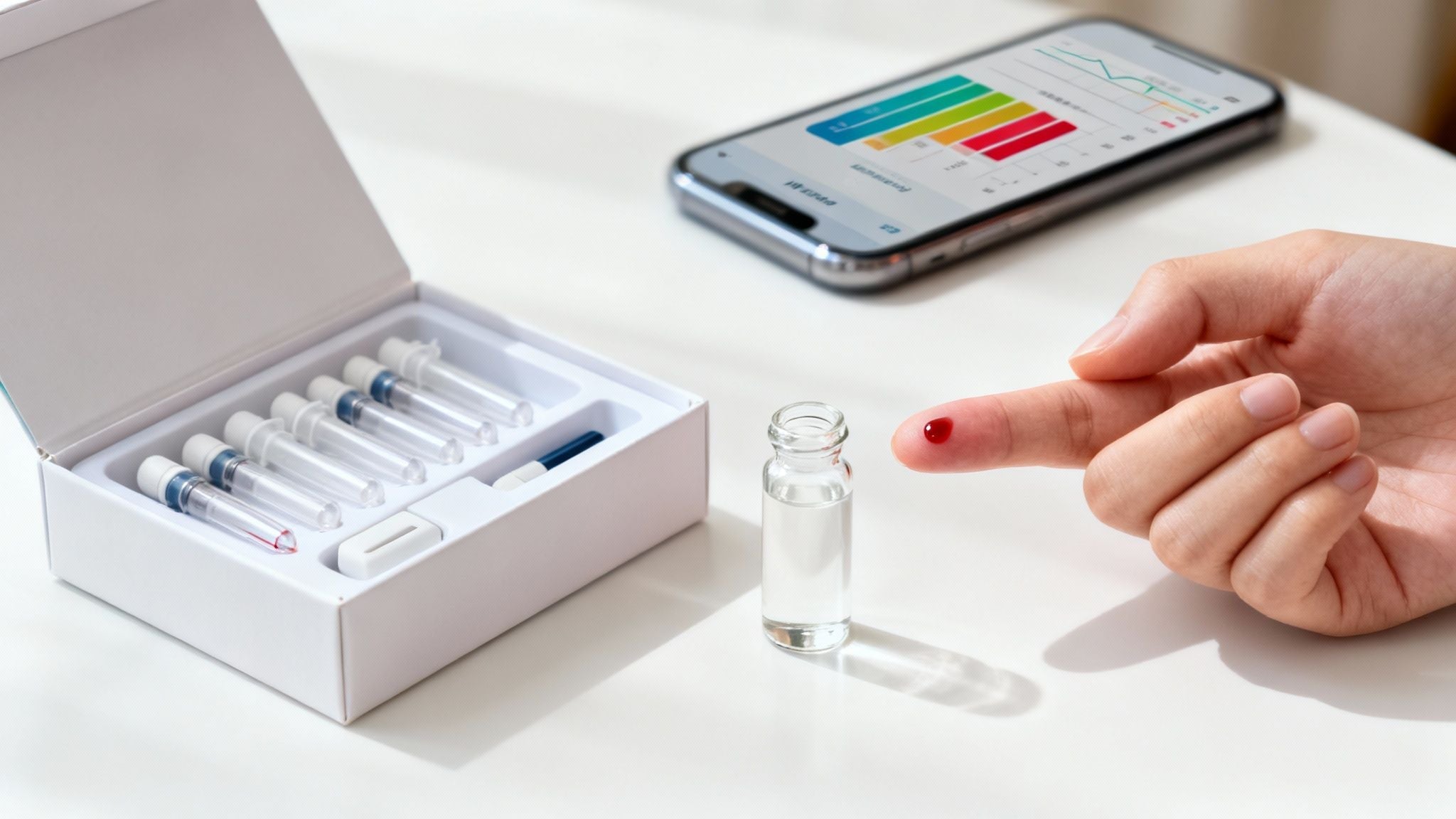
At-home blood test experiences: what can actually be verified
The essentials at a glance
Anyone looking for experiences with an at-home blood test wants to know whether the numbers are ultimately accurate. The reliable answer lies not with the laboratory but beforehand: capillary blood from a fingertip is not the same as venous blood, and most errors occur in the minutes between the finger prick and the mailbox. Those minutes are in your hands.
This article contains no customer testimonials. No names, no quotations, no before-and-after figures. Personal accounts of at-home tests can neither be recalculated nor verified, and a text that conceals the method's sources of error is advertising. Instead, this article presents what professional societies and peer-reviewed studies establish about capillary blood collection.
You will first read why personal accounts are so difficult to verify on this topic, followed by the position of laboratory medicine. Next come the procedure, the difference between capillary and venous blood, the documented preanalytical sources of error, and three common assumptions. The second part covers what you can influence yourself, a derived process, the test scope, the decision in question, and the limitations.
What to expect in this article
1. Why personal accounts of at-home blood tests are difficult to verify
2. What laboratory medicine requires and why that is inconvenient
3. How an at-home blood test actually works
4. Capillary blood is not venous blood
5. The documented preanalytical sources of error
6. Three assumptions about at-home blood tests put to the fact check
7. How to recognize a reputable provider
8. How much of the error rate is in your hands
9. What a typical process looks like, derived rather than narrated
10. What the VitalCheck Complete covers and what it does not
11. How a result becomes an experience
12. Who benefits from an at-home blood test and who does not
13. Limitations: what an at-home blood test cannot clarify
14. What ultimately matters
15. Frequently asked questions
16. Sources
Why personal accounts of at-home blood tests are difficult to verify
A personal account of a blood test describes two things at once, and almost never separates them. One is the experience: What did the finger prick feel like, how understandable was the report, and how long did it take? The other is measurement accuracy. Anyone can report on the experience. No one who knows only their own result can report on measurement accuracy.
The reason is simple: a single result has no comparison value. Anyone who receives a ferritin value of 28 micrograms per liter does not know what the same sample would have shown in venous blood. Without this second value, nothing can be said about accuracy, either positively or negatively.
There is also a selection effect that cannot be argued away. People who get an abnormal result and then change something talk about it. People who get unremarkable results rarely do. And those who submitted an unusable sample talk about it most often of all. The sum of these three groups does not produce a picture of reality, but a picture of how inclined people are to tell their stories.
Key message
A single personal account cannot prove the accuracy of a blood test because the author lacks a comparison value from venous blood.
What Can Be Examined Instead
The procedure is verifiable. There are studies that measured capillary blood and venous blood from the same person side by side. There are guidelines describing how a fingertip is punctured and what can go wrong in the process. And there are analyses of the phase of a laboratory process in which errors occur. These three bodies of evidence replace the personal accounts that cannot be recalculated.
That is exactly what this article is built on. Wherever a figure appears, the institution or authorship and the year are listed alongside it. Where no figure is available, that is also stated. It is less convenient than a collection of stars, but it is verifiable.
What Laboratory Medicine Demands—and Why That Is Inconvenient
The relevant professional society in Germany is the German Society for Clinical Chemistry and Laboratory Medicine. Its position paper on a national strategic plan for laboratory medicine contains a sentence that is inconvenient for home tests, and it appears here because it is relevant to the topic.
Documented source
“Regardless of the location of testing (pharmacy, community doctor, hospital), the same standards for personnel and technology must be applied and monitored.”
German Society for Clinical Chemistry and Laboratory Medicine
Position paper “National Strategic Plan for Laboratory Medicine,” Section 4 “Quality Assurance and Innovation,” 2024
Read the parenthetical statement again. Pharmacy, community doctor, hospital. The kitchen table is not included. When the professional society refers to the “location of testing,” it means places with trained personnel, while a home test moves precisely that part of the process to a place without trained personnel, where most errors occur.
The contradiction remains, even if it cannot be resolved. What can be resolved is the question of which part of the process is affected. The analysis itself takes place in a specialist laboratory and is subject there to the same controls as any submitted sample. What takes place at the kitchen table is sample collection. And that is precisely where the documented sources of error in this article lie.
A provider who leaves out this sentence sells more easily. A provider who writes it down gives you the opportunity to improve your own sample collection. That is the difference between a review and a guide.
How a home blood test actually works
The process is essentially the same with all providers because it follows the sample’s journey. Four stages, two of which are in your hands and two of which are not. The order is not arbitrary: each stage limits what is still possible in the next.
The kit arrives at your home
The kit contains a lancet, collection container, disinfectant wipe, instructions, and a prepared return envelope. At mybody®x, kit shipping takes 1 to 3 business days. Nothing happens during this time that affects the result.
The sample is collected at the kitchen table
Prick the side of the fingertip, let the blood drip, and fill the container to the mark. This section takes just a few minutes and determines most of the later quality. It is the only part you control yourself.
The journey to the laboratory
The sample travels in an envelope that is neither refrigerated nor temperature-controlled. The duration and temperature of this journey are the second major factors, and you have control over them only in part. The day you mail it also plays a role.
Analysis and results
In the laboratory, the measurement is carried out under the same controls as for any submitted sample. At mybody®x, laboratory analysis takes 3 to 5 business days after the sample arrives. The laboratory can no longer improve the quality the sample arrives with.
Detailed instructions for the second step, including the individual actions and typical mistakes, can be found in our article on blood collection at home. This article evaluates the procedure; that one explains how to perform it.
Capillary blood is not venous blood
This is the sentence missing from most personal accounts. Capillary blood from the fingertip is a mixture: it comes from the smallest arteries, the smallest veins, and the capillaries between them, and depending on the collection technique, it contains some tissue fluid. Venous blood from a vein in the arm is not this mixture.
In practice, this does not mean that capillary blood is inferior. It means that the two sample types can produce different values for individual measurements, and that a result always belongs to the type of sample from which it was obtained. In 2021, a working group led by Jankowski compared 59 sample pairs from 56 hospitalized patients in the American Journal of Clinical Pathology. Of the eight basic parameters examined, six were comparable; significant differences between capillary and venous blood were found for potassium and bicarbonate (Jankowski et al., American Journal of Clinical Pathology, 2021).
| Criterion | Capillary blood from a fingertip | Venous blood from the arm vein |
|---|---|---|
| Composition | a mixture of arterial and venous blood, plus a varying proportion of tissue fluid | pure venous blood without admixture of tissue fluid |
| Who collects the sample | you yourself, once, without practice | trained personnel, several times a day, with practice |
| Typical sample volume | a few hundred microliters, collected drop by drop | several milliliters collected at once, tubes with a defined fill volume |
| Documented value differences | Potassium and bicarbonate differed significantly; six of the eight basic values were comparable (Jankowski and colleagues, 2021) | Reference method on which most reference ranges are based |
| Time until measurement | Postal transit taking from one to several days, without cooling; temperature cannot be controlled | Courier route or in-house laboratory, with time and temperature documented |
| Repeat testing when the sample is unusable | new kit, new mail journey, delay of several days | second collection often possible on the same day |
The final line is described most often in personal accounts and explained least often. If a sample cannot be analyzed, a home test costs not ten minutes but another week. This is not a measurement problem but a process problem. It nevertheless explains a large share of the frustration described online.
The documented sources of preanalytical errors
Preanalytics is the technical term for everything that happens before measurement: preparation, collection, storage, and transport. It sounds like a minor detail, but it is the opposite. An analysis of around 40 million individual results from approximately 11 million samples processed by a U.S. university laboratory between January 2022 and May 2023 reached a clear conclusion: 97.0 percent of all documented laboratory errors occurred in the preanalytical phase (Lin, Spies, Zaydman, and Farnsworth, Clinical Chemistry, 2024).
The most common individual causes in this analysis were hemolyzed samples, insufficient sample volume, clotted samples, data-entry errors, and lack of cooling. Four of these five causes can occur just as easily with a home test as in a clinic, and three of them arise where you are.
Key message
The vast majority of all laboratory errors occur not during measurement, but beforehand, in the preanalytical phase.
Too little blood: the most common reason for discontinuation
A container that is filled only halfway is not a half-usable sample. It is usually no sample at all. In the previously mentioned 2021 study by Jankowski and colleagues, 14 percent of capillary samples were rejected—that is, 10 out of 69; among the first 30 patients, the rate was as high as 30 percent. In 15 percent of cases, or 9 out of 59 collections, multiple punctures were required.
These figures come from a clinical setting with trained personnel. They are not a direct benchmark for the kitchen table, and they nevertheless show something important: the quantity is the bottleneck, not the technique behind it. The learning curve is also noteworthy, as the rejection rate fell from 30 to 14 percent during the study.
Squeezing the fingertip: the diluted sample
When too little blood comes out, most people squeeze. It is the obvious reflex, and it is the costliest mistake in the entire procedure. In its guideline on blood collection, in the chapter on capillary puncture, the World Health Organization states verbatim: “Avoid squeezing the finger or heel too tightly because this dilutes the specimen with tissue fluid (plasma)” (WHO, 2010). In other words, squeezing too hard dilutes the sample with tissue fluid.
A diluted sample does not produce an error message. It produces values that are too low without anyone noticing. That is precisely what makes this error more dangerous than an insufficient quantity, because an insufficient quantity is noticed in the laboratory.
Hemolysis: when red blood cells burst
Hemolysis refers to the destruction of red blood cells, causing their contents to enter the fluid. The same WHO guideline also warns against this in a separate sentence: “Avoid excessive massaging or squeezing of fingers because this will cause haemolysis and impede blood flow” (WHO, 2010). Excessive massaging and squeezing therefore cause hemolysis while also impeding blood flow.
What hemolysis does can be measured. In its preanalytical guidance, the central laboratory of Frankfurt University Hospital describes how hemolysis can increase the concentration of potassium and the activity of the enzymes LDH and GOT. A hemolyzed potassium result is therefore not a random error in an arbitrary direction, but a systematically elevated value.
In the 2021 study by Jankowski and colleagues, the capillary samples were significantly more hemolyzed than the venous comparison samples, by an average of 163 units on the hemolysis index. The authors draw a sharp conclusion from this and write that substantial preanalytical sources of error should deter clinicians and laboratories from accepting fingerstick samples except under extreme circumstances. This statement applies to emergency and intensive care in hospitals, where the data came from.
Transport time and temperature
The fourth factor is the only one that nobody can fully control. A sample in a return envelope may spend hours to days in a mailbox, in a vehicle, and in a distribution center. In the same preanalytical guidance, the central laboratory of Frankfurt University Hospital explicitly identifies excessive cooling or warming, as well as excessive shaking of the sample, as causes of hemolysis.
This leads to a practical rule that is not advertising but logistics: The day you mail the sample also matters. A sample placed in the mailbox on Friday afternoon spends the weekend in transit. A sample mailed on Monday morning reaches the laboratory fastest. Summer heat and winter frost extend this calculation further.
Three assumptions about at-home blood tests: a fact check
The following three statements appear in forums, reviews, and product descriptions. All three are common, and all three can be checked against documented sources.
Assumption and supporting evidence
Common
"One drop of blood is enough; in the end, the result is the same as at the doctor's office."
Verified
Bond and Richards-Kortum measured six successive drops from the same puncture and found fluctuations several times greater than those in venous blood. Only from 60 to 100 microliters onward did the values remain within the device's variability (American Journal of Clinical Pathology, 2015).
Common
"If not enough blood comes out, forceful pressing helps."
Verified
In its blood-draw guideline, the World Health Organization expressly advises against this because pressing too hard dilutes the sample with tissue fluid, while excessive massaging causes hemolysis (WHO, 2010).
Common
"A laboratory error happens in the laboratory."
Verified
In an analysis of around 40 million individual results, 97.0 percent of all documented errors occurred in the preanalytical phase, that is, in everything before the measurement (Lin, Spies, Zaydman and Farnsworth, Clinical Chemistry, 2024).
The first assumption has the greatest consequences because it sounds so reasonable. Bond and Richards-Kortum examined it in eleven volunteers using a hematology analyzer and in seven others using a hemoglobinometer. Hemoglobin, leukocytes, and platelets fluctuated considerably more between successive drops from the same puncture than in venous blood. Their concluding sentence states that these data suggest caution when using measurements from a single drop of finger-prick blood.
For you as the user, this leads to something very concrete. A test kit that requires several hundred microliters does not require that amount for the laboratory's convenience. It requires it because the measurement only becomes stable above a certain quantity.
How to recognize a reputable provider
The previous sections yield criteria that have nothing to do with stars and nothing to do with design. They all concern what the provider says about the limits of its own procedure.
Checklist
Five points you can clarify before buying
The required blood volume is stated somewhere
A provider that states and explains the required sample volume has understood the issue of sample quantity. A provider that talks about a single drop has not.
The instructions warn against squeezing
This notice costs sales because it makes the test sound more complicated. That is precisely why it is a mark of quality.
Shipping and analysis are listed separately
A single total conceals how much of the time is spent in transit. At mybody®x, it is 1 to 3 business days for kit shipping and 3 to 5 business days for laboratory analysis after the sample arrives.
The marker list is complete and names each marker
Anyone who advertises only a number makes it impossible to check whether the marker you are buying the test for is included at all.
It states what the test cannot do
A blood test provides a snapshot, not a diagnosis. Where this sentence is missing, something more is usually missing too.
The fourth point can be demonstrated with an example of our own. VitalCheck Complete tests 18 markers, and vitamin B6 is not one of them. Anyone looking for a vitamin B6 deficiency based on a suspicion would be poorly advised to choose this test; the context is explained in our article on the symptoms of vitamin B6 deficiency. This gap belongs where you read it before buying.
How much of the error rate is within your control
The most interesting finding of this article is also the most encouraging. A home blood test does not measure less accurately. It measures under conditions that you create yourself. And conditions can be improved, whereas measurement methods cannot.
A home blood test does not measure less accurately. It measures under conditions that you create yourself.
Warmth before pricking
A cold hand will not produce blood. Run warm water over your hands, then let your arm hang down for a few seconds before pricking. These two steps replace the squeezing that the 2010 WHO guideline expressly prohibits, and they take less than a minute.
Prick the side, not the center
The side of the fingertip is better supplied with blood and less sensitive than the center of the fingertip. Regarding the lancing depth, the 2010 WHO guideline specifies an upper limit of 2.4 millimeters for adults and a usual lancet length of 2.2 millimeters. These values are preset in the kits; they are not settings for you to adjust.
Wipe away the first drop
The first drop contains the highest proportion of tissue fluid and residual disinfectant. It is wiped away, and only the second drop goes into the container. This is stated in most instructions, yet it is still the step skipped most often.
Choosing the posting day
Early in the week rather than late Friday, indoors rather than in a car's glove compartment, shade rather than sun. Transport is the only source of error that can still have an effect after the finger prick, and the time of posting is the only lever you have over it.
What a typical course looks like, derived rather than narrated
What follows is not one particular person's account. It is a course of events derived from the process described above, the documented processing times, and the scope of the report. None of the information comes from customer feedback, and it contains no result that anyone has achieved.
Little happens in the first few days. The kit arrives within one to three business days, and then usually sits around for a while because collecting the sample requires a calm morning. This delay is the first point at which experiences diverge: some report a week, others three, and the difference is not due to the provider.
Most of the quality is determined on the morning of the sample collection. Anyone with a warm hand who wipes away the first drop and fills the container in one go has completed the test before they can think about it. Anyone with a cold hand applies pressure. Both scenarios are common, and both create completely different narratives about the same product.
The point at which expectations shift
Between dropping off the sample and receiving the results are the postal journey and 3 to 5 business days of laboratory analysis after the sample arrives. During this time, expectations grow, and they grow in a particular direction: toward an explanation. Someone who took the test because of persistent fatigue is not waiting for 18 numbers, but for a reason.
For many people, the first response to the results is disappointment, and it has an understandable reason. Anyone expecting a diagnosis finds measurement values with reference ranges. Anyone expecting instructions finds interpretations. This is not a weakness of the analysis, but a consequence of what a blood test can actually be.
After a few weeks, it becomes clear whether anything follows from the results. For some, they sit in a drawer; for others, they become the basis for a conversation with a doctor that would have taken a different course without the numbers. What happens during this time depends less on the results than on what someone does with them.
What the VitalCheck Complete covers and what it does not
mybody®x (MYBODY Lab GmbH) offers a capillary blood test for assessing nutritional status, covering 18 values. The card below lists its scope, price, and gaps. It appears after the chapter on sources of error rather than before it, because a product is an answer to a question, not a substitute for one.
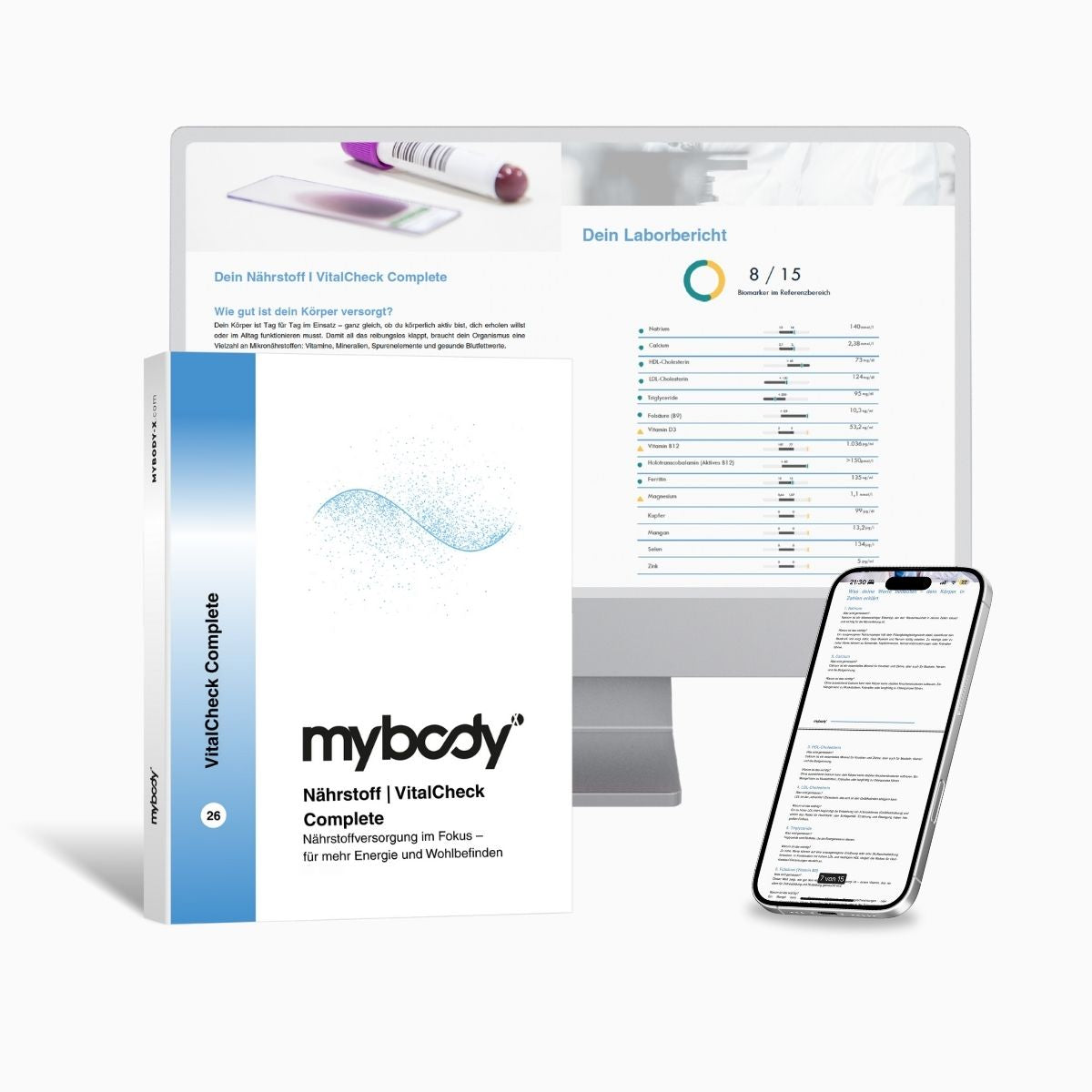
Blood test from capillary blood
VitalCheck | Complete Nutrient & Mineral Test
18 values from a capillary blood sample: 25-OH vitamin D3, vitamin B12, folic acid, ferritin, iron, transferrin, calcium, magnesium, phosphate, selenium, zinc, total cholesterol, HDL and LDL cholesterol, triglycerides, HbA1c, CRP, and albumin. What the test does not provide: Vitamin B6 is not included, nor are electrolytes or heavy metals. It provides a snapshot, not a diagnosis; an abnormal result should be medically assessed.
Laboratory analysis 3–5 business days after sample receipt
Information from the product page, accessed August 27, 2026
Two limitations should be clearly stated. First, this test does not measure hormones; anyone with a hormone-related question can find the relevant information in our article on the at-home hormone test, while the question of the cost of a doctor-ordered blood count is answered in the article on the cost of a complete blood count. Second, everything stated above about hemolysis also applies to potassium; potassium is therefore not included in this test.
Chapter at a glance
The VitalCheck Complete from mybody®x costs €169.00 (as of August 27, 2026) and covers 18 values from capillary blood, including vitamin D3, vitamin B12, folic acid, and the complete iron status comprising ferritin, iron, and transferrin. Vitamin B6, electrolytes, and heavy metals are not included. Kit shipping takes 1 to 3 business days, and laboratory analysis takes 3 to 5 business days after the sample is received. The test provides a snapshot of nutritional status, not a diagnosis.
How a test report becomes an experience
A test report consists of numbers and reference ranges. An experience only emerges through what happens afterward. Between the two lies a step that hardly any user review describes, even though it determines satisfaction.
Reference ranges depend on the laboratory, method, and age. Two laboratories may classify the same value differently without either one measuring incorrectly. Anyone who compares their result with the reference range from another report is comparing two standards, not two results.
The second step is to put the result in a temporal context. A blood value describes the condition on the day of collection. It does not describe the course over time, and a single value cannot show a trend. That is why repeating the test after six to twelve months is more informative than a single measurement, however precise it may be.
The third step is to see a doctor if a value is abnormal. A home test is a starting point for this, not a preliminary decision. Having a result in hand changes the conversation because it clarifies the question you bring to it.
Who benefits from a home blood test and who does not
The decision depends less on the price than on the question you want answered. For some questions, a capillary blood test is the shortest route; for others, the longest.
Makes sense for you if …
you have a healthcare question that your doctor's visit did not address, such as about vitamin D, vitamin B12, or iron status.
you want to record a baseline for comparison in six to twelve months and can keep the conditions the same next time.
you are prepared to collect the sample carefully: warm hands, discard the first drop, fill the container completely, and mail it early in the week.
Probably not if …
you have acute symptoms. Shortness of breath, severe pain, sudden weakness, or bleeding belong in a doctor's office or clinic—today, not in a week.
you are seeking a diagnosis. A blood test measures; assigning a value to a disease is a medical service, not a laboratory service.
you take anticoagulants, have a blood-clotting disorder, or do not feel confident collecting the sample yourself. In that case, venous collection is the simpler option, not the more cumbersome one.
The right-hand column is meant seriously. An provider whose exclusion list consists only of softened benefits does not have an exclusion list. The first point on it is the most important, because a home test always introduces a waiting period that is the wrong investment when symptoms are acute.
Limitations: what a home blood test cannot clarify
Four limitations remain, even if collection is perfect and the sample reaches the laboratory quickly. They lie in the method, not in its execution.
The first limitation is that it is only a snapshot. A blood value describes one day. Values such as ferritin also respond to inflammation, which is why a single ferritin value can be misleading when inflammation is present at the same time. VitalCheck Complete therefore measures ferritin, iron, and transferrin together.
The second limitation is the sample type itself. For hemolysis-sensitive measurements such as potassium, capillary blood sent by mail is the poorer starting point, which is precisely why such values are not included in a reputable home test. An omission can be a mark of quality.
The third limitation is interpretation. A value outside the reference range does not automatically indicate a disease, and a value within the range does not rule one out. Reference ranges describe where the middle 95 percent of a comparison group lie, not where health begins.
Key message
A reference range describes a distribution in a comparison group, not the boundary between health and illness.
The fourth limitation is comparison over time. Anyone having the same value measured again in a year should use the same sample type, the same laboratory, and preferably the same time of day. Otherwise, the second test measures not the change but the differences in the conditions.
What ultimately matters
At the beginning was the question of whether people’s experiences with home blood tests are useful. The answer is: of little value as reviews, but a rich source of information. Almost everything that goes wrong in these reports goes wrong at the same point, and that point lies between the finger prick and the mailbox.
That is the message you will not find in any star rating. The laboratory does not determine the quality of your result; the ten minutes beforehand do. A warm hand, a wiped first drop, a fully filled container, and an early mailing day make more difference than switching providers ever will.
The specific next step is therefore not a purchase, but a question: Which single value do you want to know, and why? If the answer is written on a piece of paper, it takes two minutes to check whether a test actually includes that value. If it is not listed, every test is the wrong one.
And if you are unsure which value relates to your question: The consultation is free, and it will not try to sell you anything.
Frequently asked questions
Are home blood tests as accurate as those done by a doctor?
The laboratory analysis is carried out under the same controls as any submitted sample. The difference lies in the sample: capillary blood from the fingertip is a mixture of arterial and venous blood with a fluctuating amount of tissue fluid. In a study by Jankowski and colleagues (American Journal of Clinical Pathology, 2021), six of eight basic values were comparable with venous blood, while potassium and bicarbonate differed significantly. Accuracy therefore depends above all on the collection process.
What is the most common mistake when collecting blood at home?
Squeezing the fingertip when too little blood comes out. In its 2010 guideline on blood sampling, the World Health Organization explicitly advises against this because pressing too hard dilutes the sample with tissue fluid, while excessive massaging causes hemolysis. The better approach is to warm the hand before the prick: warm your hands under warm water and briefly let your arm hang down.
Is one drop of blood enough for a home test?
No. Bond and Richards-Kortum examined six consecutive drops from the same puncture and found significantly greater variation in hemoglobin, leukocytes, and platelets than in venous blood; only from 60 to 100 microliters onward did the values remain within the instruments’ variability (American Journal of Clinical Pathology, 2015). That is why test kits require a fill volume rather than a drop count.
What happens if my sample cannot be analyzed in the laboratory?
It is then rejected and must be repeated, which can take several days with a home test. How often this occurs is shown by a clinical study: 14 percent of the capillary samples were rejected there, or 10 out of 69 (Jankowski et al., American Journal of Clinical Pathology, 2021). The most common reasons are insufficient volume and hemolysis, both of which can be significantly reduced through proper collection technique.
Which values does VitalCheck Complete cover, and which does it not?
mybody®x’s VitalCheck Complete measures 18 values from capillary blood, including 25-OH vitamin D3, vitamin B12, folic acid, ferritin, iron, transferrin, calcium, magnesium, phosphate, selenium, zinc, blood lipids, long-term blood sugar, CRP, and albumin. Vitamin B6 is not included, nor are electrolytes and heavy metals, and hormones are not measured. The price is €169.00 (as of August 27, 2026).
Next step
The question comes first, then the test
If your question concerns the supply of vitamins, iron, and minerals, VitalCheck Complete is the quickest way to get there. If you want to read about the collection steps first, the instructions are the better starting point.
VitalCheck | View Complete Blood collection instructionsRead more
You might also be interested in
For when you are less interested in evaluating the procedure than in the individual steps at the kitchen table.
The classification of which values a medical blood count includes and when health insurance covers it.
Sources
- World Health Organization: WHO Guidelines on Drawing Blood: Best Practices in Phlebotomy, Chapter 7 “Capillary sampling” (2010) – ncbi.nlm.nih.gov
- German Society for Clinical Chemistry and Laboratory Medicine: Position Paper “National Strategy Plan for Laboratory Medicine” (2024) – dgkl.de
- Lin Y, Spies NC, Zaydman MA, Farnsworth CW: Pre-analytical Phase Errors Constitute the Vast Majority of Errors in Clinical Laboratory Testing. Clinical Chemistry, 2024 – academic.oup.com
- University Hospital Frankfurt, Central Laboratory: Preanalytical Information, section “Sample Assessment” (accessed on 27/08/2026) – unimedizin-ffm.de
The two verbatim warnings against squeezing and massaging the fingertip, as well as the information on a maximum puncture depth of 2.4 millimeters and the usual lancet length of 2.2 millimeters, are taken from [1]. The institute’s quotation on consistent standards regardless of where testing takes place is taken from [2]. The figure of 97.0 percent of preanalytical errors, the population of around 40 million individual results from approximately 11 million samples, and the ranking of the causes of errors are taken from [3]. The information that hemolysis can increase potassium, LDH, and GOT levels and is caused by excessive cooling, heating, or shaking is taken from [4]. The figures comparing capillary and venous blood—that is, 59 sample pairs from 56 patients, 14 percent rejected samples, 15 percent multiple punctures, and the deviations in potassium and bicarbonate—come from a study by Jankowski and colleagues in the American Journal of Clinical Pathology (2021); the figures on variation between consecutive drops and the lower limit of 60 to 100 microliters come from a study by Bond and Richards-Kortum in the same journal (2015). Both are attributed in the main text with the authors, journal, and year and are therefore not included in this list. Information on price, marker range, sample type, and laboratory comes from the mybody®x product page, accessed on 27/08/2026; processing times follow the central guideline for blood tests. All sources were accessed and checked on 27/08/2026.

mybody®x Editorial & Expert Team
Laboratory Diagnostics Preanalytics Blood Analysis Interpretation Nutritional Science
This article was created by the mybody®x editorial and expert team. The team brings together laboratory diagnostics, blood analysis interpretation, and nutritional science. Those who contribute to it are listed on the authors page.
Published on 17/01/2026 · Last updated on 27/08/2026
The content is intended for general information and does not replace medical advice, diagnosis, or treatment. Reference ranges depend on the laboratory, method, and age; the information on your test report is always authoritative.




Share now:
7 Steps: Blood Test Checklist for Your Health
Understand the DNA Slim Test and lose weight successfully