

Magnesium for nerves: what is proven and what the blood test shows
The essentials at a glance
For magnesium and the nervous system, there is exactly one sentence that the European Union has reviewed and authorized: “Magnesium contributes to the normal functioning of the nervous system.” It describes a contribution to maintaining normal function. It does not say that magnesium calms you, reduces stress, or relieves nervousness. That is precisely where the line lies, and advertising constantly crosses it.
The second point that should be made early is this: A blood magnesium measurement captures a very small part of the picture. Less than one percent of the body’s magnesium is in the fluid outside the cells, while the vast majority is stored in bones and tissue (Blancquaert, Vervaet and Derave, Nutrients, 2019). A measurement can therefore tell you less than the question about the nerves might suggest.
You will first read the authorized wording in the original, followed by the limitations of blood magnesium levels and the dividing line between an authorized claim and an advertising promise. Next come magnesium’s role in the nervous system, the reference values in figures, signs of a low intake, a comparison of testing methods, and four common statements fact-checked. The final section covers nutrition, four steps for assessing your own situation, what a home measurement can do, and its limitations.
What to expect in this article
1. What is actually authorized for magnesium and nerves
2. Why a blood magnesium level shows less than you expect
3. Where the line lies between an authorized claim and an advertising promise
4. What magnesium does in the nervous system—and what does not follow from this
5. How much magnesium the reference values specify
6. What may indicate a low intake—and what may not
7. Serum, whole blood, and urine: what each measurement answers
8. Four statements about magnesium and nerves fact-checked
9. Where magnesium actually comes from in everyday life
10. Four steps to help you assess the question for yourself
11. What you can have measured at home for this question
12. Limitations: what a magnesium level cannot answer
13. For whom a measurement makes sense—and for whom it does not
14. What ultimately matters
Frequently asked questions
Sources
What is actually authorized for magnesium and nerves
In Europe, anyone who claims on packaging or in a text that a nutrient benefits health cannot formulate this freely. Regulation (EC) No 1924/2006 on nutrition and health claims requires such statements to be reviewed and authorized in advance. The sentences that have passed this review are listed in Regulation (EU) No 432/2012.
Several claims are listed there for magnesium. Four of them are most frequently used in connection with the search term “magnesium for nerves.” They read as follows in the authorized wording, unchanged and without additions:
Authorized wording under Regulation (EU) No 432/2012
“Magnesium contributes to the normal function of the nervous system.”
“Magnesium contributes to normal muscle function.”
“Magnesium contributes to the reduction of tiredness and fatigue.”
“Magnesium contributes to normal psychological function.”
These four statements may be used in this form if the food meets the requirements for being a source of magnesium. They may be paraphrased as long as their meaning is retained. What they may not do is expand their claim.
The crucial element in all four statements is the word “normal”. An authorised claim concerns a contribution to maintaining normal function. An improvement beyond normal is not authorised, nor is an effect on a particular complaint. The regulation describes physiology, not therapy.
Key takeaway
The authorised statement “Magnesium contributes to the normal function of the nervous system” describes a contribution to maintaining normal function. It does not claim that magnesium reduces nervousness, tension, or stress.
Why the list is longer than most texts suggest
In addition to the four statements above, the list includes further authorised claims for magnesium. These include its contribution to electrolyte balance, normal energy-yielding metabolism, normal protein synthesis, the maintenance of normal bones and teeth, and the statement that magnesium has a role in cell division.
This breadth is itself informative. A mineral that is involved in so many processes is not a specialised remedy for a single complaint. It is a building block that many processes in the body need at the same time. Anyone marketing it as a solution for a symptom diminishes it while exaggerating its effects.
Why a blood magnesium level shows less than you expect
Anyone wondering whether they are deficient in magnesium first thinks of having a blood test. That is understandable and correct for many values. With magnesium, however, this measurement has a specific limitation that must be considered before anything else.
Less than one percent of the body’s magnesium is found in the fluid outside the cells (Blancquaert, Vervaet and Derave, Nutrients, 2019). By far the largest share is bound in bones, muscles, and other tissues. A blood sample cannot reach those stores.
The same review states verbatim: “total serum magnesium concentration is not necessarily a good reflection of total body magnesium status.” In other words: Serum magnesium concentration does not necessarily accurately reflect the body’s total magnesium stores. Blancquaert, Vervaet, and Derave compiled this evidence in 2019 in the specialist journal Nutrients.
This leads to an uncomfortable consequence for every measurement, including those from our own product range: A value within the reference range does not rule out an inadequate supply in the tissues. This is also stated on the BalanceCheck product page, not out of modesty, but because it is true.
Key takeaway
A magnesium value within the reference range does not prove adequate status. It proves that the body is maintaining the concentration in the blood at that moment—if necessary, drawing on its stores.
What the value is actually useful for
The honest answer is: It is more useful in one direction than the other. A clearly abnormal value is a reliable signal and should be assessed by a doctor. An unremarkable value, on the other hand, is weaker information because it does not rule out a deficiency in the tissue.
For looking for the cause of tension or sleep problems, this means: The measurement can rule out or confirm one possible clue, but it cannot answer the question on its own. Anyone who approaches it with that expectation will be disappointed—and regardless of who sells the test.
How far the serum level can diverge from the tissue stores, and what other testing methods exist, is a separate topic. It is covered in detail in Magnesium deficiency despite normal blood levels and in Magnesium in serum and whole blood. This article stays focused on the question of the nerves; anyone looking for the role of magnesium in connection with the stress hormone cortisol will find it in Lowering cortisol with magnesium.
Where the line lies between an authorized claim and an advertising promise
The four authorized statements from the first chapter sound restrained. That is precisely why they are rarely used in practice in this form. What they become on packaging, in advertisements, and in advice articles regularly goes beyond them.
Documented source
“Magnesium contributes to the normal function of the nervous system.”
European Commission
Regulation (EU) No 432/2012, Annex – List of permitted health claims made on foods, 2012
Alongside this sentence, there is a second language in practice that is not authorized anywhere. It works with images: magnesium as a brake, a bouncer, a natural calming agent. These images are catchy, and they are why many people expect a capsule to do something that the authorization does not support.
Four formulations that go beyond the authorization
“Magnesium for stress.” Not covered. No authorized wording mentions stress. The existing claims refer to the normal function of the nervous system and normal psychological function. Both are statements about physiological processes, not about a stressful situation and coping with it.
“Magnesium calms the nerves.” Not covered. “Calms” describes a change of state from restless to calm. The approved wording describes a contribution to maintaining the normal state. The difference is not a matter of linguistic nuance but the core of the assessment that preceded approval of these claims.
“Magnesium helps with anxiety and inner restlessness.” Not covered and additionally problematic. Anxiety disorders are a condition with clinical significance. Claiming that a nutrient helps against them is no longer a health claim but a statement about disease. Such a claim is not permissible for foods.
“Magnesium helps you fall asleep.” Not covered. Sleep does not appear in the list of approved claims for magnesium. What does appear is its contribution to reducing tiredness and fatigue—which is essentially the opposite in meaning and describes daytime tiredness, not nighttime sleep.
In its magnesium guide (as of 18.02.2026), the consumer advice center points to exactly this pattern: The approved claim regarding normal psychological function is frequently expanded in advertising into a statement about mental illnesses, and that is not permissible. The mechanism is always the same. A substantiated claim is used as a door opener, and something else then passes through the door.
What magnesium does in the nervous system—and what does not follow from it
There is no dispute that magnesium is needed in the nervous system. It is involved in numerous enzymatic processes and contributes to the transmission of signals between nerves and muscles. It also plays a role in the cell’s energy metabolism. That is precisely why the approved claim exists at all.
But this description does not provide a direct route to an effect on well-being. Between “is involved in a process” and “improves a symptom” lies a burden of proof that has not been met for magnesium in relation to nervousness, tension, or sleep problems. Otherwise, corresponding claims would appear on the list.
The almost universal error in reasoning behind this
The conclusion usually goes like this: Magnesium is needed for nerve function, so more magnesium means better nerves. This conclusion holds in cases of actual deficiency and falls apart beyond that point. If intake is sufficient, additional intake does not improve function—it can only eliminate a deficiency that does not exist.
That is why the approved claims contain the word “normal.” They describe what is necessary to maintain normal function, not what happens when someone takes more of it. Once you understand this difference, you read every magnesium advertisement differently.
Why this is not a rejection of magnesium
A nutrient whose contribution to the normal function of the nervous system has been officially assessed and confirmed is in a better position than most substances on the same shelf. Approval is a mark of quality, not a consolation prize.
What is disputed here is not the role of magnesium. What is disputed is the leap from that role to a promise about how you will feel. The role is well established. The promise is not.
How much magnesium the reference values specify
Reference values are not a recommendation for one individual to take a specific amount. They describe the intake considered sufficient, based on the current derivation, to meet the needs of nearly all healthy people in an age group. What is right for you is not decided by a table, but by your doctor.
Magnesium in milligrams per day
350 mg
Reference value for intake for adult men (German Nutrition Society, derivation as of 2021)
300 mg
Reference value for intake for adult women (German Nutrition Society, derivation as of 2021)
250 mg
Recommended maximum daily dose in food supplements (Federal Institute for Risk Assessment, as reported by the Verbraucherzentrale, as of 18 February 2026)
Source: German Nutrition Society, magnesium reference values, derivation as of 2021; Verbraucherzentrale, as of 18 February 2026
In deriving its reference values for magnesium, the European Food Safety Authority arrives at the same order of magnitude. It sets an adequate intake of 350 milligrams per day for adult men and 300 milligrams per day for adult women (EFSA, 2015). Two independent derivations, one result—that makes the figures robust.
The third figure is the most interesting
The 250 milligrams are not a recommended intake, but an upper limit for food supplements. It is below the reference value because the diet already supplies the larger share and because high single doses from supplements act differently from magnesium in food consumed throughout the day.
The consumer advice centre tested magnesium-containing food supplements and concluded that 57 percent of the products examined exceed this amount (Verbraucherzentrale, as of 18 February 2026). More than one in two preparations in the test therefore exceeds the recommendation against which it should be measured.
We are deliberately not giving our own dosage recommendation here. What amount makes sense in which situation depends on kidney function, medications, and pre-existing conditions. That is a medical conversation, not a paragraph of advice.
What a low intake may show—and what it may not
Regarding frequency, it is worth looking at the assessment by the consumer advice centre. Its guide to magnesium states: “Magnesium deficiency is actually rare in Germany.” (Verbraucherzentrale, as of 18 February 2026). This statement runs counter to the impression conveyed by search results on the subject.
That is therefore the most important sentence for setting expectations. Someone who is tense, sleeps poorly and has calf cramps at night is looking for an explanation—and magnesium is the explanation offered most quickly. Statistically, it is rarely the right one.
Why symptom lists are of little help here
The symptoms that circulate online as signs of magnesium deficiency have one thing in common: they are nonspecific. Fatigue, irritability, tension, sleep problems and muscle twitching occur with a long list of causes, from sleep deprivation and thyroid dysfunction to iron deficiency.
A list of nonspecific symptoms therefore cannot support a diagnosis. It can only prompt someone to ask the question in the first place. Anyone who reaches for a supplement after seeing such a list has tried one option, not investigated one.
Which situations actually change the requirement
There are situations in which the question of magnesium status is objectively justified. These include persistent losses through the digestive tract, a consistently unbalanced diet, certain kidney diseases, and taking medications that increase excretion or inhibit absorption.
In these cases, the question belongs in a doctor's office, not in a self-test. The reason is not caution, but sequence: if an illness or medication is the cause, a test result does not change that. It describes a consequence and leaves the cause untouched.
Serum, whole blood and urine: what each measurement answers
When a blood sample shows only a small part of the picture, the question naturally arises as to what the alternatives can do. Three methods are regularly mentioned for magnesium. They answer different questions, and none of them replaces the others.
| Criterion | Magnesium in serum | Magnesium in whole blood | Magnesium in urine |
|---|---|---|---|
| What is measured | The concentration in the liquid part of the blood, that is, outside the cells | The concentration in the entire sample, including the proportion in blood cells | The amount excreted through the kidneys |
| Share of the body's stores | Less than one percent is outside the cells (Blancquaert, Vervaet and Derave, Nutrients, 2019) | Also captures the proportion in blood cells, but not the proportion in bones and muscles | Not a share of the body's stores, but an indication of excretion |
| What the measurement is intended for | Identify clear deviations that require medical assessment | A second perspective on the same mineral, not intended to replace serum testing | The question of whether the body loses or retains magnesium |
| For testing at home | Magnesium is one of the 15 values in BalanceCheck measured from capillary blood | The product page does not specify which blood fraction the value is determined from | Not included in the range and not part of BalanceCheck |
| The limit | An unremarkable value does not rule out marginal tissue magnesium status | No substantiated information on its informative value in the source material used | Interpretable only in a medical context, not as an isolated value |
Two rows in this table contain open entries, and they are deliberately left that way. The sources reviewed for this article contain no reliable figure for the informative value of whole-blood testing, and the BalanceCheck product page does not disclose which blood fraction the magnesium value comes from. Filling a cell with an estimate would be more convenient—and wrong.
Four statements about magnesium and nerves: a fact check
The following four statements come up again and again when magnesium and nerves are discussed. They were not invented for the purpose of refuting them—they appear, in this or similar forms, in advice articles, product descriptions, and the questions people enter into search engines.
Widespread versus substantiated
Widespread
“Magnesium is the nervous system’s natural tranquilizer.”
Substantiated
The only authorized wording is “Magnesium contributes to normal nervous system function” (Regulation (EU) No. 432/2012). This does not imply a calming effect, nor is one authorized anywhere.
Widespread
“Magnesium deficiency is widespread in Germany.”
Substantiated
In its magnesium guide, the consumer advice centre writes: “Magnesium deficiency is rare in Germany, however.” (consumer advice centre, as of February 18, 2026).
Widespread
“A normal blood value proves that there is enough magnesium.”
Substantiated
Less than one percent of the body’s magnesium is located outside the cells; serum concentration does not necessarily reflect total stores well (Blancquaert, Vervaet and Derave, Nutrients, 2019).
Widespread
“The more, the better; the body simply excretes excess magnesium.”
Substantiated
The German Federal Institute for Risk Assessment recommends a maximum daily dose of 250 milligrams from food supplements; 57 percent of the products examined exceed that amount (consumer advice centre, as of February 18, 2026). There would be no upper limit if the quantity had no consequences.
What these four statements have in common is striking. Each makes the issue simpler than it is, and each leads to the same action: reaching for the capsule. That is no coincidence, but the result of a market in which the simpler story sells better.
Where magnesium actually comes from in everyday life
The reference values of the German Nutrition Society—350 milligrams for men and 300 milligrams for women (derivation status: 2021)—refer to total intake, not supplements. For most people, by far the largest share comes from their normal diet.
Magnesium is found mainly in plant-based foods with a dense structure: whole-grain products, legumes, nuts and seeds, and green leafy vegetables. Mineral water also contributes, providing significant amounts depending on the source, as stated on the label.
Why the label on mineral water provides the most practical information
The magnesium content of foods varies with the variety, soil, and preparation. For mineral water, the amount is stated in milligrams per liter on the bottle, and you know how much of it you drink. This is the only point in everyday life at which intake can be tracked without estimation.
If you want to know roughly where you stand, this approach will take you further than an app with stored average values. Not because the water provides particularly much, but because in this one case the figure can be verified.
What is lost during cooking
Magnesium is water-soluble. If you cook vegetables in plenty of water and pour the water away, you also pour away some of the mineral. Steaming, brief cooking, and using the cooking water in soups or sauces retain more of it in the food.
This is a small adjustment, and it is not presented here as a solution. But it is the only measure in this chapter that costs nothing and has no side effects.
Four steps to help you sort out the question for yourself
Up to this point, the focus has been on approval, supporting evidence, and measurement. Now it is about the order in which you narrow down the question for yourself. The following four steps prepare you for a conversation with a doctor; they do not replace it.
Record symptoms for two weeks
What exactly, when, and for how long. Without evaluation or changes. Only the pattern shows whether there is one at all.
Review your medications
Some medications affect the absorption or excretion of minerals. Take the list to a conversation with your doctor, not to a search engine.
Roughly estimate your intake
Whole grains, legumes, nuts, green vegetables, and the magnesium content of your mineral water. The label provides the only verifiable figure.
Measure only afterward
A value without the three preceding steps is a number without context. With them, it becomes a building block for interpretation.
The sequence is the actual content of this chapter. If you measure first and think afterward, you have a number but no question. If you clarify the question first, you will know what to do with the result.
What you can have measured at home for this question
Magnesium is rarely measured on its own. It interacts with other electrolytes, and a single value is harder to interpret than a series of values. That is why mybody®x (MYBODY Lab GmbH) includes magnesium in a test that measures several values together.
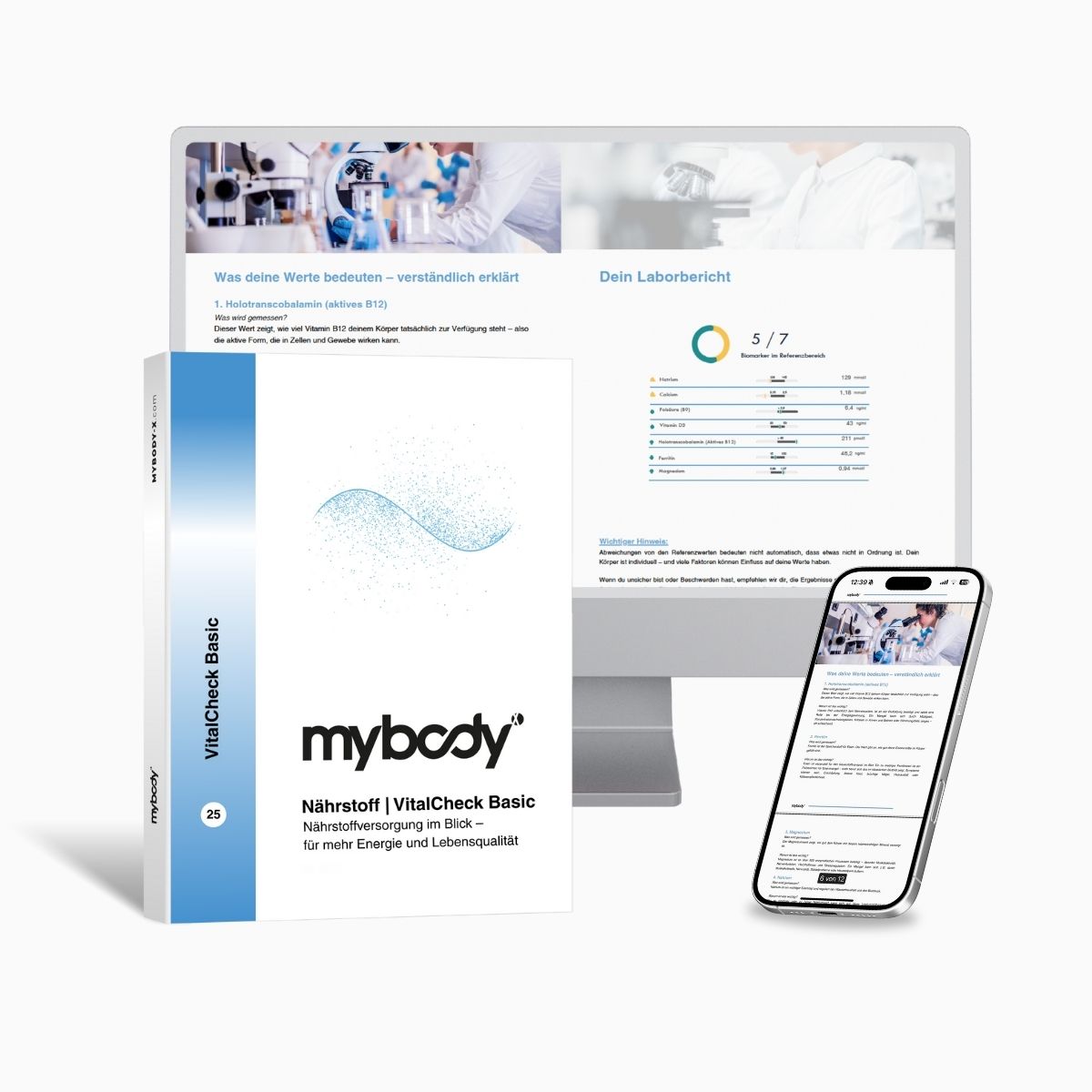
Capillary blood test
BalanceCheck | Electrolyte & Mineral Test
Determines 15 values: the five electrolytes potassium, sodium, calcium, magnesium, and phosphorus, six trace elements, and four heavy metals. Magnesium is one of them. What the test does not do: The product page itself states that an unremarkable magnesium result does not rule out a deficiency in the tissues. It also does not disclose which blood fraction is used to determine the magnesium result. The test measures and interprets; it does not provide a diagnosis or replace medical evaluation.
Laboratory analysis 3–5 business days after sample receipt
Product-page information without a location, accessed 27 August 2026
Why the other 14 results here are worth more than the one
If the magnesium result alone says little, the question arises of what the measurement is actually good for. The answer lies in the panel. The body keeps potassium, sodium, calcium, and phosphorus in the blood within narrow limits. Abnormalities are less common there than with magnesium—and precisely for that reason, they are informative when they occur.
This is supplemented by six trace elements and four heavy metals. The practical value of such a panel lies less in confirming a suspicion than in ruling out several alternatives. Being able to safely rule out one possibility is often worth more than another hypothesis when symptoms are nonspecific.
Anyone who only wants to know whether they are deficient in magnesium therefore gets more here than they were looking for—and less certainty about magnesium itself than they had hoped for. Both points need to be said together.
Limitations: what a magnesium result cannot answer
This chapter does not come at the end because it would be unimportant. It is here because everything before it only gains its proper framework through it. Three questions remain open, even when the result is available.
First: The result says nothing about your nerves. It says something about a concentration in your blood at the time the sample was taken. Whether your tension, sleep quality, or irritability is related to it is neither proven nor disproven by this. Establishing that connection would be precisely the leap that the test's authorization does not support.
Second: The result does not rule out a deficiency in the tissues. Less than one percent of the body's magnesium is located outside the cells (Blancquaert, Vervaet and Derave, Nutrients, 2019). The rest remains invisible in every blood sample.
A magnesium result within the reference range does not prove adequate magnesium status.
Third: The result does not identify a cause. If it is unusually high or low, the real work begins: Is it due to diet, loss through the kidneys or intestines, a medication, or an illness? No measurement alone can answer this question; it requires medical interpretation based on your medical history.
Then there is the legal boundary that this article has addressed from the outset. A test measures. It does not treat or relieve symptoms, and it may not be advertised with an effect that has not been authorized for the nutrient being measured. We do not sell reassurance, but a number with context.
Who should consider a measurement—and who should not
Nothing stated so far leads to a general recommendation. It leads to a distinction. For some starting situations, a measurement is useful; for others, it is the wrong step at the wrong time.
Makes sense for you if …
you have been documenting symptoms for weeks without seeing a pattern and want to objectively rule out one of several possibilities.
you have roughly estimated your intake and want to know whether your electrolytes are generally unremarkable before investigating further.
you want a baseline value to take with you to a medical consultation.
you are just as interested in the other fourteen values as you are in magnesium.
Not recommended if …
you expect the result to explain your tension, sleep, or irritability. It cannot, and no other provider can change that.
you want to reliably rule out a deficiency in the tissues. A blood sample is the wrong tool for that.
you have known kidney disease or take medications that affect mineral balance. In that case, the measurement belongs in medical hands.
your symptoms are acute, getting worse, or accompanied by palpitations, pronounced weakness, or confusion. That is a matter for a medical practice, not a test kit.
What ultimately matters
If you take away just one action from this article, let it be this: Next time you see a magnesium product, turn the package around and read the statement on it. If it says “contributes to the normal functioning of the nervous system,” that is the approved wording. If it says anything about stress, relaxation, or sleep, someone has gone beyond the authorized claim.
This perspective takes five seconds and puts an entire market into perspective. It works for capsules as well as advertising copy, because the approved wording is the same for both.
There is a second benefit that this article did not announce. Once you realize that “magnesium deficiency” is statistically rarely the explanation for tension and poor sleep, you stop checking it first—and get to the more common causes faster. The path does not become shorter. You simply take it in the right direction.
It all started with a statement that the European Union reviewed and approved. It promises less than the search term suggests. And it delivers exactly what it says.
Frequently asked questions
What can you actually say about magnesium and the nerves?
The authorized wording is “Magnesium contributes to the normal function of the nervous system” (Regulation (EU) No 432/2012). Also authorized are claims regarding its contribution to normal muscle function, the reduction of tiredness and fatigue, and normal psychological function. All four statements describe a contribution to maintaining normal function. Claims about stress, calming, anxiety, or falling asleep are not covered by these authorizations.
Can a blood test reliably show whether I am deficient in magnesium?
Only to a limited extent, and the limitation points in one direction. Less than one percent of the body's magnesium is located outside the cells; the serum concentration does not necessarily reflect total stores well (Blancquaert, Vervaet and Derave, Nutrients, 2019). A markedly abnormal value is therefore a reliable signal and should be medically assessed. An unremarkable value, however, does not rule out marginal tissue supply.
How much magnesium per day do the reference values specify?
The German Nutrition Society specifies 350 milligrams per day for adult men and 300 milligrams per day for adult women (basis of recommendation as of 2021). The European Food Safety Authority arrives at the same general levels (EFSA, 2015). For food supplements, the German Federal Institute for Risk Assessment recommends a maximum daily dose of 250 milligrams (Verbraucherzentrale, as of 18 February 2026). A personal intake amount cannot be derived from this; that is a matter for medical advice.
When should my symptoms be assessed by a doctor?
In cases of palpitations, pronounced muscle weakness, confusion, or symptoms that are worsening rapidly. The same applies in the event of known kidney disease, ongoing losses through the digestive tract, or medication that affects mineral balance. In these cases, a self-test is the wrong order of steps because it describes an outcome while leaving the cause untouched.
Is magnesium deficiency common in Germany?
The consumer advice centre states: “Magnesium deficiency is rare in Germany, however.” (Verbraucherzentrale, as of 18 February 2026). This is the most important point for setting expectations: The symptoms people associate with magnesium are common. A deficiency as their cause is not. That is why it is worth not skipping other explanations.
Next step
A number instead of a guess
If you have gone through the four steps and want to see the electrolytes overall, BalanceCheck provides fifteen values from a capillary blood sample. What it cannot determine about magnesium is stated further up in the product card. If you are mainly concerned with how meaningful the value itself is, the second route goes deeper.
BalanceCheck | Electrolytes & minerals What the serum level showsRead more
You might also be interested in
In case your test report is unremarkable and the question therefore remains unanswered.
The comparison of the two measurement methods, if you are interested in what each laboratory value actually measures.
Sources
- European Commission: Regulation (EU) No 432/2012 establishing a list of permitted health claims made on foods (2012) – eur-lex.europa.eu
- Consumer Advice Centre: Magnesium—what should be considered? (as of 18.02.2026) – verbraucherzentrale.de
- German Nutrition Society: Reference Values for Nutrient Intake, Magnesium (basis of derivation as of 2021) – dge.de
- European Food Safety Authority (EFSA): Scientific Opinion on Dietary Reference Values for magnesium, EFSA Journal 2015;13(7):4186 – efsa.europa.eu
All authorized statements about magnesium reproduced verbatim come from source [1]; this applies to the four sentences in the first chapter, the institute quotation, and every other mention of authorized wording. The information on the prevalence of magnesium deficiency, the Federal Institute for Risk Assessment’s maximum recommended amount of 250 milligrams, the proportion of 57 percent of the preparations examined that exceeded it, and the note on the expansion of the health claim in advertising come from [2]. The reference values of 350 and 300 milligrams per day come from [3], as does the corresponding derivation by the European Food Safety Authority from [4]. The information on the distribution of magnesium in the body and the significance of the serum concentration comes from the review by Blancquaert, Vervaet, and Derave in the journal Nutrients (2019); it is attributed in the body text with the authors, journal, and year and is therefore not included in this list. Information on prices, values, sample type, and laboratory comes from the mybody®x product page, accessed on 27.08.2026; processing times follow the central specification for blood tests. All sources were accessed and checked on 27.08.2026.

mybody®x Editorial & Specialist Team
Laboratory diagnostics Blood analysis interpretation Nutritional science Minerals and electrolytes
This article was created by the mybody®x editorial and specialist team. The team combines laboratory diagnostics, blood analysis interpretation, and nutritional science. Everyone who contributes to it is listed on the authors page.
Published on 26.12.2025 · Last updated on 27.08.2026
The content is intended for general information and does not replace medical advice, diagnosis, or treatment. Reference ranges depend on the laboratory, method, and age—always follow the information on your test report.




Share now:
Low progesterone symptoms: How to recognize them, causes & tests
Optimal fT3/fT4 ratio: what the values do and do not indicate