
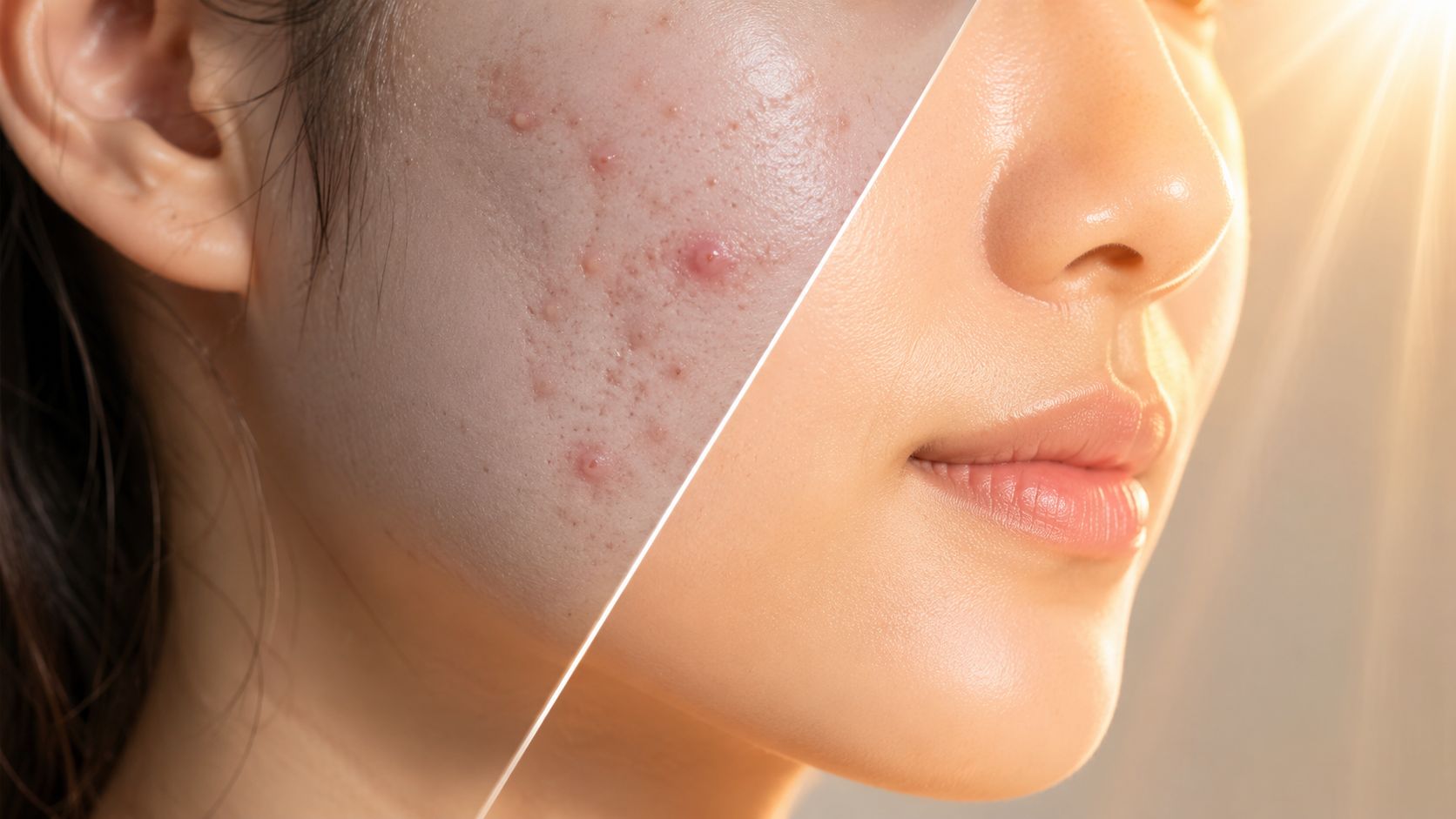
Vitamin D Deficiency Acne: Causes & Treatment
Acne can be exhausting. You try new skincare products, pay attention to your diet, and may even switch to products advertised as especially gentle or clarifying. And yet your skin remains unsettled, inflamed, or prone to flare-ups.
This is exactly when it is worth taking a different perspective. Not just looking at what you apply to your skin, but also at what may be contributing inside your body. When it comes to vitamin D deficiency acne, this is not about a miracle cure. It is about a possible contributing factor that is often overlooked and can be measured instead of merely suspected.
When Your Skin Simply Won’t Calm Down
Many people recognize this pattern. Their skin improves in the short term, then pimples, deep inflammation, or painful blemishes return. It is frustrating, especially when you feel that you have already tried everything.
A common misconception is to treat acne only as a surface issue. Skincare is important. But it is only part of the picture. Skin also responds to inflammatory processes, hormonal balance, nutrient status, and general stress on the body. If your skin looks persistently irritated, it may make sense to consider these internal factors as well.
Why We Often Fail to Look Beneath the Surface
Vitamin D is a good example. Many people first associate it with bones or sunlight. It is less well known that it is also important for processes that may play a role in blemished skin. That does not automatically make a low level the cause of your acne. But it does make it something worth taking seriously.
Persistent acne is often not a sign that you are taking “wrong” care of your skin. Sometimes you simply need to look at the bigger picture.
This perspective is especially valuable if you notice other symptoms alongside your acne. Even with skin inflammation, it often becomes clear that the surface is only part of the story.
What Can Really Help You
A measured approach is important. A link between vitamin D and acne does not automatically mean that every supplement will improve your skin. The key question is whether you yourself have a deficiency. Only then does a suspicion become a useful basis for a decision.
Data helps more than hope here. That’s why a test is often the more sensible next step than starting supplements blindly.
The Role of Vitamin D in Your Skin Health
In the body, vitamin D works more like a regulator than a single building block. This is interesting for the skin because several processes can become imbalanced at the same time in acne.

Putting inflammation into perspective
Acne is not just a matter of sebum and clogged pores. Inflammation plays a central role. Vitamin D is involved in regulating the immune response. Put simply, it helps the body avoid overreacting and allows processes to proceed in an orderly manner.
If this regulatory mechanism is not adequately supported, this can also become noticeable in the skin. This is one of the reasons why low vitamin D status is of interest in inflammatory acne.
Cell growth and skin renewal
Your skin is constantly renewing itself. Old cells are shed and new ones form. Vitamin D influences this cell division and the maturation of skin cells. If this process does not run smoothly, keratinization disorders may be promoted. These disorders are particularly relevant to acne because they can make pores clog more easily.
That is also why vitamin D is more than just a “sunshine vitamin.” Anyone who wants to better understand the connection will find a good introduction in the article what vitamin D is needed for in the body.
Why the connection is taken seriously
The clinical observation fits this biological picture. A meta-analysis of 13 studies, 1,362 acne patients, and 1,081 controls found that circulating 25(OH)D levels were on average 9.02 ng/mL lower in people with acne than in healthy individuals. Vitamin D deficiency occurred almost three times as often in people with acne, with a pooled OR of 2.97 and a 95% CI of 1.68–5.23. At the same time, heterogeneity was considerable at I² = 72%, showing that the evidence is not completely consistent (meta-analysis on the association between vitamin D and acne).
Important: Low vitamin D levels are associated with acne. This does not yet prove that the deficiency alone is the cause.
For you, this mainly means one thing: Vitamin D is not a peripheral issue when skin problems persist. It is a measurable factor that can be checked.
Vitamin D deficiency and acne: what the science says
The most interesting question is not whether there is any connection at all. The decisive question is how strong this connection is and what you can infer from it.
What studies show in severe acne
In a clinical study, the correlation between vitamin D levels and acne severity was strongly negative, with r = -0,910; p < .001. No vitamin D deficiency was found in mild acne. The deficiency rate was 93,8% in severe acne and as high as 100% in very severe acne (clinical interpretation of the data on vitamin D and acne severity).
This is remarkable. The more pronounced the acne, the lower the vitamin D levels were in this study. Data like this explain why dermatology and functional diagnostics do not simply dismiss this topic.
What these figures do not mean
Nevertheless, you should not draw a false conclusion from such results. An association is not the same as proof of cause and effect.
This is an important distinction:
| Statement | What it means |
|---|---|
| Association | Two things occur together with notable frequency |
| Causality | One thing directly causes the other |
If people with severe acne often have low vitamin D levels, there may be several reasons. The deficiency may contribute. It may result from other lifestyle factors. Or it may occur alongside other burdens that also affect the skin.
What you can practically take away from this
The message for everyday life is nevertheless clear. If your acne is persistent, inflammatory, or severe, testing makes more sense than guessing.
A lab result does not replace acne treatment. But it can explain why your skin does not become stable despite a good routine.
Especially when it comes to vitamin D deficiency acne, science does not offer a magical solution. It helps you follow the right order. Test first, then take targeted action.
Recognizing typical symptoms of vitamin D deficiency
Acne alone is not enough to conclude that you have a vitamin D deficiency. Many people with blemished skin are not deficient. Others have a deficiency and do not notice it for a long time. That is why it is worth looking at the bigger picture.

When multiple signals come together
Vitamin D deficiency is easily overlooked in everyday life because the symptoms are often nonspecific. You may simply feel tired, unfocused, or generally less resilient. At first, such signs do not seem related to a skin issue.
Pay particular attention to patterns like these:
- Persistent fatigue despite getting enough sleep
- Low energy in everyday life, especially during darker months
- Low mood or the feeling that you cannot really get going
- Frequent infections or the feeling of getting run-down more quickly
- Muscle weakness or general physical discomfort
- Skin problems that occur together with other symptoms
Acne as part of a bigger puzzle
What matters is not each individual symptom on its own, but the combination. If you have acne and recognize several of these points at the same time, it becomes more likely that checking your nutrient status would be worthwhile.
This does not mean that vitamin D is behind everything. Fatigue, mood, skin, and immune function can have many causes. That is precisely why self-diagnosis is often inaccurate. It can quickly lead to taking supplements blindly, without knowing whether you have even identified the right issue.
Helpful rule of thumb: The more symptoms occur together, the more worthwhile a blood test becomes instead of making further guesses.
Especially when your acne treatment has stalled, this step often makes more sense than trying the next cosmetic product.
Testing your vitamin D status: when does it make sense?
This is where things become practical. Not every blemish immediately requires a laboratory test. But there are situations in which testing makes considerably more sense than taking supplements indiscriminately.
These situations indicate that testing may be worthwhile
Testing for 25(OH) vitamin D is particularly sensible if one or more of these patterns apply to you:
- Persistent acne despite adjusted skincare and standard measures
- Inflammatory or severe cases where you need more clarity
- Several possible deficiency symptoms in addition to skin symptoms
- Little sunlight in everyday life, for example due to office work, shift work, or little time outdoors
- Symptoms during the winter half of the year, when the body's own production is often lower
This is particularly relevant in Germany. According to the Robert Koch Institute, many people in Germany are affected by vitamin D deficiency, especially during the winter half of the year. The deficiencies are particularly pronounced among young adults, a main risk group for acne (Robert Koch Institute FAQ on vitamin D).
Why guessing is of little benefit here
A vitamin D deficiency cannot be reliably identified by looking at the skin. Even if many signs point to it, it remains a suspicion until a laboratory result is available. That is precisely why testing is the most reliable approach before considering supplementation.
One option is an at-home test with laboratory analysis, such as a vitamin D home test. It can measure your 25(OH)D level and give you a concrete basis for action instead of acting solely on suspicion.

And when does supplementation really help?
The real key question is not: “Should I take vitamin D?” It is: “Do I have a deficiency for which vitamin D could be relevant to my skin?”
If a deficiency has been confirmed, targeted supplementation may be appropriate. In this context, the Vitamin D3 K2 Complex | Shield from mybody®x is also relevant. According to the product snapshot, it combines high-dose D3 with K2 for optimal calcium utilization, bone health, and immune system support, and is ideal after DNA or blood testing when a deficiency has been confirmed.
The crucial point remains the same. Only a test turns a general recommendation into a personal one.
Correcting a vitamin D deficiency: your next steps
If your test result actually shows a deficiency, you do not need to take drastic action. You need a sensible approach. Usually, this involves three complementary components.

Sunlight as a foundation
The body produces vitamin D through sunlight. In everyday life, however, this often works less effectively than many people think. Indoor spaces, working hours, the season, and sun protection significantly affect production. Nevertheless, spending regular time outdoors remains an important foundation.
The key is moderation. This is not about excessive sunbathing, but about a sensible approach to daylight and spending time outdoors in everyday life.
Diet as support
A significant deficiency often cannot be fully corrected through food alone. Nevertheless, diet is part of the solution. Fatty fish, egg yolks, or certain fortified products can make a contribution.
Diet is more of a supportive measure here than the main solution. That is reassuring in itself, because you do not have to feel that you need to solve everything through your diet alone.
Targeted rather than blind supplementation
When a deficiency has been confirmed, supplementation often becomes the decisive lever. It is no longer about indiscriminate self-optimization, but about a targeted measure based on a measured value.
The smart step is not simply taking it, but taking the appropriate amount based on clear findings.
For many people, it is helpful to read over the basics again at their own pace, for example in the guide on correcting vitamin D deficiency.
This order is particularly important when it comes to acne. You are not supplementing “against pimples”; you are correcting a proven deficiency that may be relevant to your skin.
FAQ: frequently asked questions about vitamin D and acne
Does vitamin D definitely help with acne
No. Although a controlled study showed a significant improvement in acne in patients with vitamin D deficiency after two months of supplementation compared with placebo, the general benefit of supplements for acne remains controversial. That is precisely why testing for a deficiency is the most important first step (controlled study on vitamin D, acne, and supplementation).
Should I simply take vitamin D as a precaution
Taking it blindly is not a good strategy. Without a baseline measurement, you do not know whether a deficiency exists at all or whether vitamin D is currently relevant to your skin.
What is the right dose
There is no single reliable answer to this. The appropriate amount depends on the measured level, your daily routine, and your individual situation. That is why a data-based decision is better than a general recommendation.
When you should seek medical evaluation
Please do not rely solely on self-help if your acne is painful, nodular, scarring, or suddenly becomes significantly worse. If you have additional symptoms or are uncertain, you should also seek medical evaluation.
If you no longer want to guess about your skin, a blood test may be the most sensible next step. At mybody x blood test, you can find at-home self-tests that allow you to check your nutrient status and make targeted decisions about vitamin D instead of taking it on suspicion.



Share now:
Sudden muscle weakness: which signs require calling emergency services immediately
Muscle weakness—what to do? Find the causes and build strength