
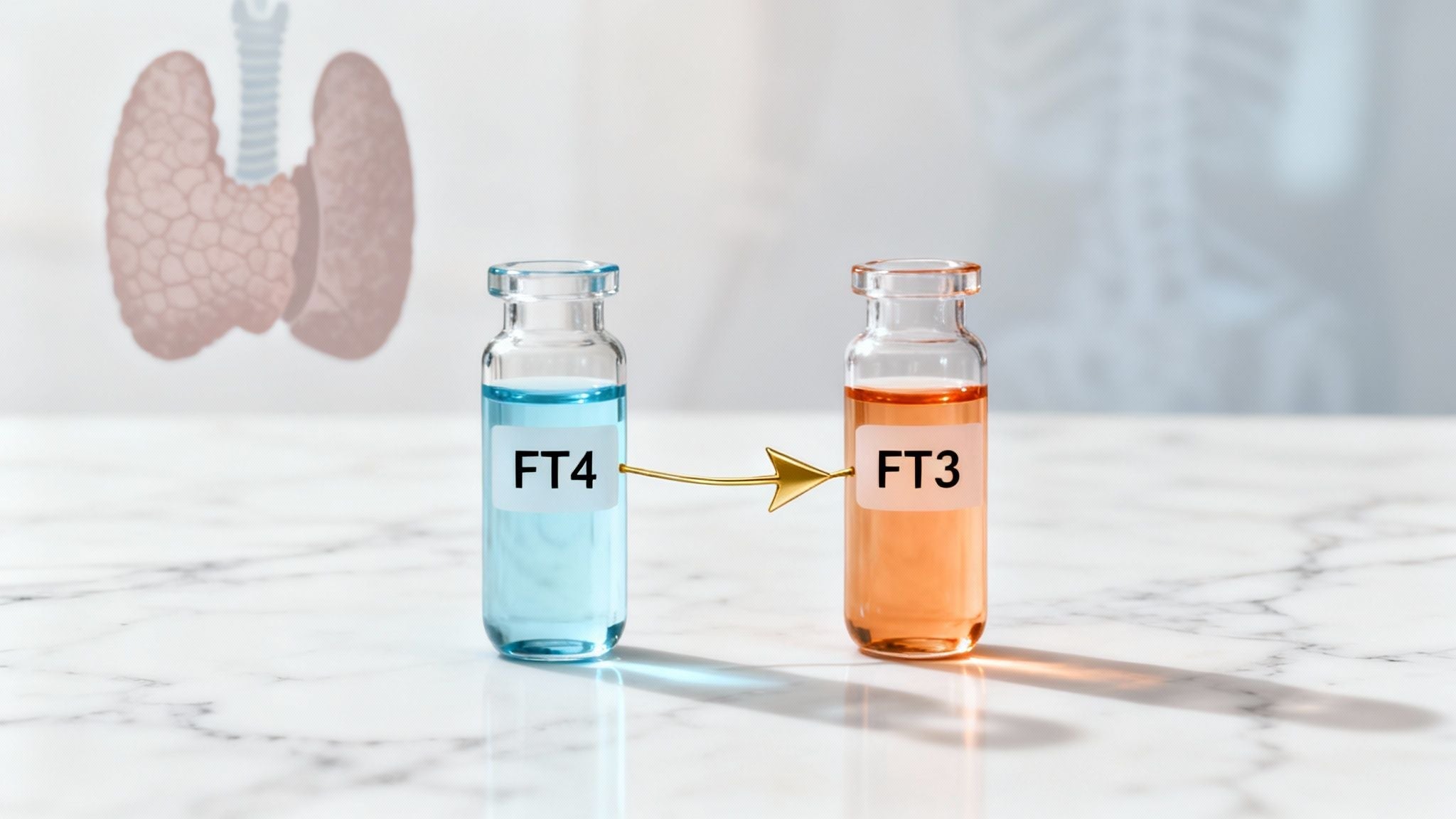
Optimal fT3-to-fT4 ratio: what the values do and do not indicate
The essentials at a glance
There is no established optimal fT3-to-fT4 ratio. No German institution specifies a target value for this quotient, and no reference range describes it. The two free thyroid hormones are assessed separately, each against the range of the laboratory that measured it.
This article explains what fT3 and fT4 describe, which reference ranges the Institute for Quality and Efficiency in Health Care provides for them, and why these ranges vary from one laboratory to another. Wherever a figure is documented, it is given here with the institution and year. Where no figure is documented, that is stated as well.
First, you will read what the quotient actually describes, followed by the role of the TSH level and the signs that warrant a visit to a doctor's office. Next come the reference ranges, the question of the missing target value, the prevalence of an underactive thyroid, and the factors that shift your values without the thyroid being diseased. The final section covers common misconceptions, preparing for a consultation, and the limitations.
What to expect in this article
1. What the fT3-to-fT4 ratio actually describes
2. Why TSH appears first in the laboratory report, not fT3 or fT4
3. When a thyroid issue belongs in a doctor's office
4. Which reference ranges apply to TSH, fT3, and fT4
5. Why there is no established target value for the quotient
6. How common an underactive thyroid actually is
7. What shifts free hormone levels without the thyroid being diseased
8. Three statements from the internet and what remains of them
9. How to interpret your own test result
10. Which tests actually cover these values
11. Who should have the measurement—and who should not
12. Limitations: what a single value cannot clarify
13. What matters in the end
Frequently asked questions
Sources
What the fT3-to-fT4 ratio actually describes
Anyone looking for an optimal fT3-to-fT4 ratio usually has a test result in front of them showing both values. The quotient is obtained by dividing one value by the other. It is a calculation anyone can perform with a calculator, and that is precisely what makes it appealing.
The two numbers that follow represent two different hormones. Free thyroxine, abbreviated fT4, is the storage form that circulates in large quantities in the blood. Free triiodothyronine, abbreviated fT3, is the more active form that acts in the cells.
The Institute for Quality and Efficiency in Health Care (IQWiG) describes both as thyroid hormones that influence various metabolic processes in the body, such as the heartbeat (2025). Regarding their ratio, the same source states that free thyroxine is less potent than free triiodothyronine and that thyroxine is converted into triiodothyronine in the body (IQWiG, 2025).
Key message
The quotient of fT3 and fT4 is a calculation, not a laboratory value. The two free thyroid hormones are assessed individually against the reference range of the laboratory that measured them because these ranges vary between laboratories (IQWiG, 2025).
Why the conversion matters at all
The idea behind the quotient is understandable. If fT4 is the precursor and fT3 is the active form, then their ratio should indicate how well the conversion takes place in the body.
In terms of the workplace metaphor: fT4 is the material in the warehouse, and fT3 is the tool in hand. A full warehouse, by itself, says nothing about how much reaches the construction site. That is precisely the gap the quotient is intended to close.
The difficulty lies in translating the idea into a number. For a quotient to mean anything, it needs a range against which it can be compared. Such ranges exist for fT3 and fT4 individually, but not for their ratio. Chapter 5 examines this gap.
Free means: not bound to protein
The small f before T3 and T4 stands for free. Most thyroid hormones in the blood are bound to transport proteins and are not active in this state. Only the unbound fraction reaches the cells.
This has a practical consequence for you when reading a test report. If it lists T3 or T4 without the f, it means the total value, which cannot be compared with a free value. Anyone calculating a quotient from a total value and a free value is comparing two different quantities.
Therefore, first check the designation on your report before doing anything with the numbers. fT3 goes with fT4, and T3 goes with T4.
Why TSH appears first in the lab report rather than fT3 or fT4
Many test reports do not contain any free hormones at all. They have a single line with three letters, and it reads TSH. This is not a cost-cutting measure but the usual sequence.
Documented source
“Disorders of thyroid function can be detected particularly early through a change in the TSH level. Therefore, only TSH is often measured initially.”
Institute for Quality and Efficiency in Health Care (IQWiG)
Understanding thyroid examinations, as of 2024
According to the same source, the thyroid hormones T3 and T4 are measured when the TSH level is abnormal (IQWiG, 2024). The free hormones therefore come after the control signal, not before it.
What TSH measures and why it responds first
According to IQWiG, TSH, also called thyrotropin, is a hormone produced by the pituitary gland and released into the blood (as of 2025). It is therefore not a thyroid hormone, but rather the signal instructing the thyroid gland which hormones to produce.
The pituitary gland adjusts this signal as soon as the hormone level in the blood deviates from its target value. It reacts more sensitively than the level itself, because a small deviation triggers a much stronger counter-regulation.
According to IQWiG, elevated TSH levels indicate an underactive thyroid, while low levels may indicate an overactive thyroid (as of 2025). The value therefore moves in the opposite direction to what one might initially expect.
What this sequence means for your question
Anyone who wants to calculate the ratio of fT3 to fT4 needs both values. They are often not included on a standard lab report when the TSH is unremarkable. This is the first, very simple reason why many people research this topic: they are simply missing the second number.
The objection is valid: An examination that initially measures only a regulatory signal can feel incomplete. Even so, something else is decisive. The sequence is not arbitrary; it follows the observation that abnormalities show up there earliest (IQWiG, 2024).
If you are mainly concerned about the TSH level itself, that is a separate topic with its own questions. It is described elsewhere: TSH Schilddrüse Werte. This article focuses on the two free hormones and their relationship to each other.
When a thyroid issue should be evaluated by a doctor
Before turning to numbers and ratios, it is worth comparing your situation with the following list. If any of these points applies to you, making an appointment with a doctor is the next step—not searching for the right calculation formula.
According to IQWiG, possible signs of an underactive thyroid include weakness and fatigue, problems with concentration and memory, dry skin, weight gain, constipation, and menstrual disorders (as of 2024). These symptoms are nonspecific on their own, which is precisely why assessing them requires an examination.
These signs should be evaluated by a doctor
A visible or palpable swelling in the neck
regardless of whether it causes pain
A feeling of pressure in the throat, difficulty swallowing, or persistent hoarseness
if it persists for weeks and does not follow an infection
A racing heart, palpitations, or a noticeably slow pulse
together with exhaustion, restlessness, or feeling unusually hot
A noticeable change in weight without intending to
even though you are neither eating nor exercising differently
exhaustion with concentration and memory problems lasting for weeks
when getting enough sleep does not change it
trying to conceive or pregnancy with a known thyroid condition
this needs to be handled by a doctor, not measured by yourself
This list is not a diagnostic framework and does not replace an examination. It marks the point at which a calculation using two laboratory values would be the wrong answer to the right question.
One point stands on its own: swelling in the neck. It should be examined regardless of any laboratory value, because this requires not a blood test but a physical examination and, if necessary, an ultrasound.
Many people researching this topic have already visited a doctor’s office and been told that their values were fine. What they are missing is a data point, not a promise. If this sounds familiar, a second appointment with a specific question often accomplishes more than the first one without one.
Which reference ranges apply to TSH, fT3, and fT4
The following table compares the three values according to the same five criteria. According to IQWiG, the ranges given apply to women and men over 18 and come from the institute’s laboratory values reference guide.
| Criterion | TSH | fT3 | fT4 |
|---|---|---|---|
| What the value describes | The signal that regulates the thyroid | The free, more potent thyroid hormone | The free, less potent thyroid hormone |
| Where it is produced | In the pituitary gland | In the thyroid and through conversion from thyroxine | In the thyroid |
| Reference range for adults aged 18 and over | 0.3–3.5 mU/l | 3.9–6.7 pmol/l or 0.2–0.52 ng/dl | 10–23 pmol/l or 0.8–2.0 ng/dl |
| When it is usually measured | First, often as the only value | When the TSH level is abnormal | When the TSH level is abnormal |
| What it does not show on its own | How much hormone is actually available in the blood | The cause of a deviation | How much of it reaches the cells |
A sentence from the same source applies to all the figures in this table: Reference ranges may differ from one laboratory to another because different testing methods are used (IQWiG, 2025). What always matters, therefore, is the range printed next to the value on your own test result.
Why two units appear side by side
For fT3 and fT4, IQWiG provides two values each, one in picomoles per liter and one in nanograms per deciliter (as of 2025). Both describe the same quantity, just in different units of measurement.
For a quotient, this is the first stumbling block. Dividing a value in picomoles per liter by a value in nanograms per deciliter produces a number with no meaning whatsoever. For the same reason, two results from two laboratories often cannot be compared directly.
So if you place two test results side by side, first check that the units match and then check the reference ranges. Only then does a difference between them mean anything.
Why there is no defined target value for the quotient
The honest answer to the original question is: An optimal ratio of fT3 to fT4 has not been established anywhere as a target value. Neither IQWiG nor any other institution reviewed here specifies a range for this quotient against which it could be calculated.
That is less than the search query hoped for. But it is the reliable answer, and it saves you from searching for a number that does not exist.
Where the quotient actually occurs
The ratio of the two free hormones does appear in research, but in a different context from everyday diagnosis. In the journal Frontiers in Endocrinology (2025), Ma and co-authors studied 402 people with heart failure to determine whether the ratio of fT3 to fT4 could provide an indication of the further course of the disease.
The authors refer to the quotient there as a surrogate marker of peripheral thyroid sensitivity, meaning a substitute measure for something that cannot be measured directly. At the same time, they note that thresholds for this marker still need to be defined (Ma and co-authors, Frontiers in Endocrinology, 2025).
Two things follow from this. First: The quotient is not an invention of advice websites, but a measure that is actually used in research. Second: The group studied was a selected group of patients in a clinic, not a sample from the general population.
What the lack of a target value means in practice
Without a defined range, a calculated quotient cannot be interpreted. A number such as 0.35 or 0.42 is neither good nor bad in itself because the benchmark is missing.
There is also a mathematical problem. Both values carry measurement uncertainty, and when they are divided, these uncertainties add up. The quotient therefore fluctuates more than either of the individual values from which it is derived.
More precisely: It is not the idea behind the quotient that is wrong, but the expectation that it will provide a number that can be assessed on its own. What you can do instead is explained in Chapter 9.
How common an underactive thyroid actually is
Behind many people’s question about the ratio of fT3 to fT4 lies another question: Do I have an underactive thyroid that no one has found so far? There are documented figures for this question.
Frequency in numbers
5 of 100
People in countries such as Germany have hypothyroidism. Women and older people are affected more often
2 to 5 in 100
People with subclinical hypothyroidism develop symptomatic hypothyroidism each year
1 in 3,400
One in 3,400 newborns is born with congenital hypothyroidism. That is why this age group is systematically screened
Source: Institute for Quality and Efficiency in Health Care (IQWiG), Hypothyroidism, as of 2024
Five in one hundred is a lot. This figure explains why the topic is so widespread and why so many people want to take a closer look at their own results.
What “subclinical” means in this context
Subclinical hypothyroidism describes an intermediate state: The control signal has already changed, while the hormone levels themselves are still within range. Symptoms are often completely absent.
The number in the strip above puts this state into context: Of one hundred people with subclinical hypothyroidism, two to five develop symptomatic hypothyroidism each year (IQWiG, 2024). For the rest, monitoring is initially all that is needed.
For you, this mainly means one thing: A single abnormal result is a reason for follow-up, not the end of the story. How often measurements are repeated is decided by the treating practice based on the overall picture.
What shifts free hormone levels without the thyroid being diseased
A laboratory value describes a point in time, not a state. A great deal can change between two blood draws without anything about the thyroid itself being different. That is the second reason why a calculated ratio is shakier than it looks.
The timing of the blood draw
Thyroid values are usually measured in the morning, and two results from the same time of day can be compared more reliably than two from different times. If you are planning follow-up testing, note the time of your blood draw.
The sources reviewed here do not provide a reliable figure for exactly how much the values fluctuate over the course of a day. That is why there is no figure here. An estimate would be the worse error.
Medications and supplements
Anyone already taking a thyroid hormone is no longer measuring the unaffected state, but rather the result of treatment adjustment. A ratio then says something about the dosage, not about your own conversion capacity.
Other medications and supplements can also affect laboratory values, including iodine-containing products and high-dose dietary supplements. Which ones matter in your individual case is something to discuss with the practice or pharmacy where you obtained them.
That is why you should bring a complete list of everything you take regularly to every appointment. It takes two minutes and can fundamentally change the interpretation of a test result.
Severe illness and acute stress
Severe acute illness can alter thyroid values without there being a thyroid disorder. It is precisely in such situations that the ratio is studied in research, for example in the aforementioned study of people with heart failure (Ma and colleagues, Frontiers in Endocrinology, 2025).
For everyday practice, this leads to a simple rule: Test results obtained during a febrile infection or shortly after a hospital stay should not be interpreted like routine results. They should be repeated once the acute phase has passed.
Diet acts more slowly than all of that, and it is a topic in its own right. The evidence on this is presented in another article: Diet for hypothyroidism.
Three statements from online sources and what remains of them
The following three statements appear in many articles on this topic, often in forums and comment sections. All three sound plausible, and all three withstand scrutiny only partially.
Checked against the evidence
Common belief
“There is an optimal target value for the fT3-to-fT4 ratio.”
Evidence-based
In research, the ratio is considered a surrogate marker of peripheral thyroid sensitivity; threshold values still need to be defined (Ma and colleagues, Frontiers in Endocrinology, 2025). There is therefore no target value for the general population.
Common belief
“A value outside the reference range means that I am ill.”
Evidence-based
A single laboratory value usually cannot be used to infer a disease (Institute for Quality and Efficiency in Health Care, as of 2025). An abnormal value is a reason for further interpretation, not a diagnosis.
Common belief
“I can compare my value with any reference table I find online.”
Evidence-based
Reference ranges may differ from one laboratory to another because different testing methods are used (Institute for Quality and Efficiency in Health Care, as of 2025). The range shown on your own test report is the relevant one.
Anyone looking for the optimal ratio is responding to something real: they feel tired even though their test results were unremarkable. The need is legitimate, but the calculation does not address it. A reliable approach is to look at the individual values, their reference ranges, and the doctor's interpretation.
How to interpret your own test results
Up to this point, we have focused on values and their meaning. Now it is about the order in which you read your own report. The following four steps prepare you for a conversation in a medical practice; they do not replace it.
Check the designation
Does the report list fT3 and fT4, or T3 and T4? Only free values belong together.
Copy down the unit and range
The value, unit, and range printed next to it by your laboratory—all three together.
Note the circumstances
Time of the blood draw, medications, supplements, and whether you had recently been ill.
Taking the list into the conversation
A page listing the values and circumstances shortens the medical history and sharpens the next question.
The order is not accidental. Anyone who calculates first and only afterward checks which unit was actually used ends up with a number whose origin they can no longer explain themselves.
If you have two reports from different years, place them side by side and compare each value with the range shown on the same report. A trend within your own ranges says more than any external table.
Chapter at a glance
A report is read from top to bottom, not from the invoice. First, check the designation: Only free values—that is, fT3 and fT4—belong together. Then record the value, unit, and reference range from the same laboratory together, because these ranges differ between laboratories (IQWiG, 2025). Only when the circumstances of the blood draw are noted alongside them does a series of numbers become a question that can be answered in a medical practice.
Which tests actually cover these values
If your report lists only TSH and you would like to have the two free hormones measured as well, mybody®x (MYBODY Lab GmbH) offers two very different options. They differ not in price, but in what they actually measure.
First, the limitation that applies to both: Neither test provides a diagnosis, and neither specifies a target value for an fT3-to-fT4 ratio, because no such target value exists. An abnormal result should be interpreted by a medical professional.
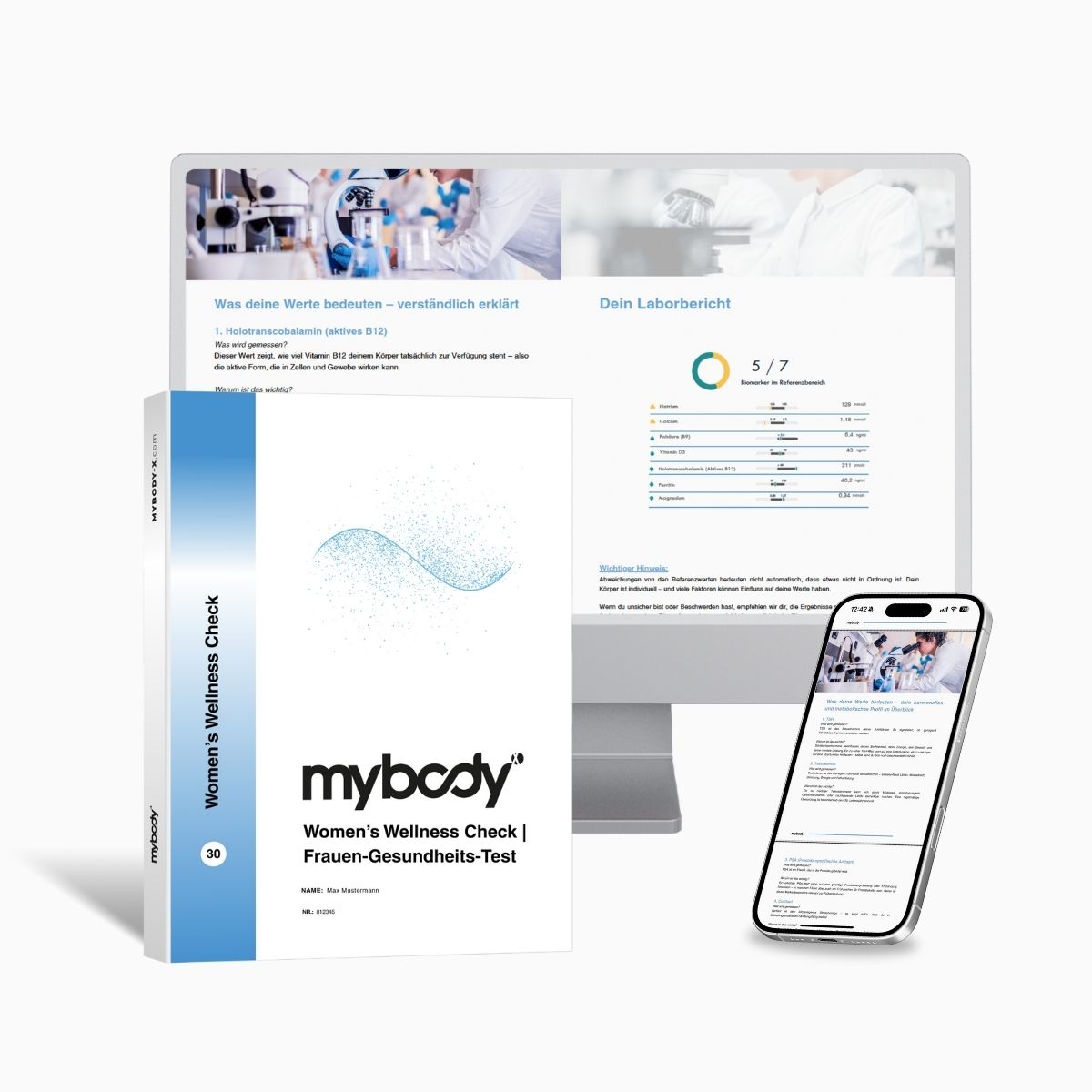
Capillary blood test
Women’s Wellness Check | Women’s Health Test
18 values from a blood sample, including the thyroid profile with TSH, fT3, and fT4, as well as ferritin, vitamin B12, and vitamin D3. The product page explicitly states that no other test in the range includes both free hormones. What the test does not do: According to the product page, it does not measure cycle hormones—neither estradiol, progesterone, nor FSH; for questions about menopause, the page refers to the Menopause Check. It does not provide a diagnosis or a target value for an fT3-to-fT4 ratio.
Laboratory analysis 3–5 business days after the sample is received
accessed 27 August 2026
The second option is considerably narrower, and for a reason that should be stated plainly: The following self-test measures only the control signal. The two free hormones discussed in this article are not included.
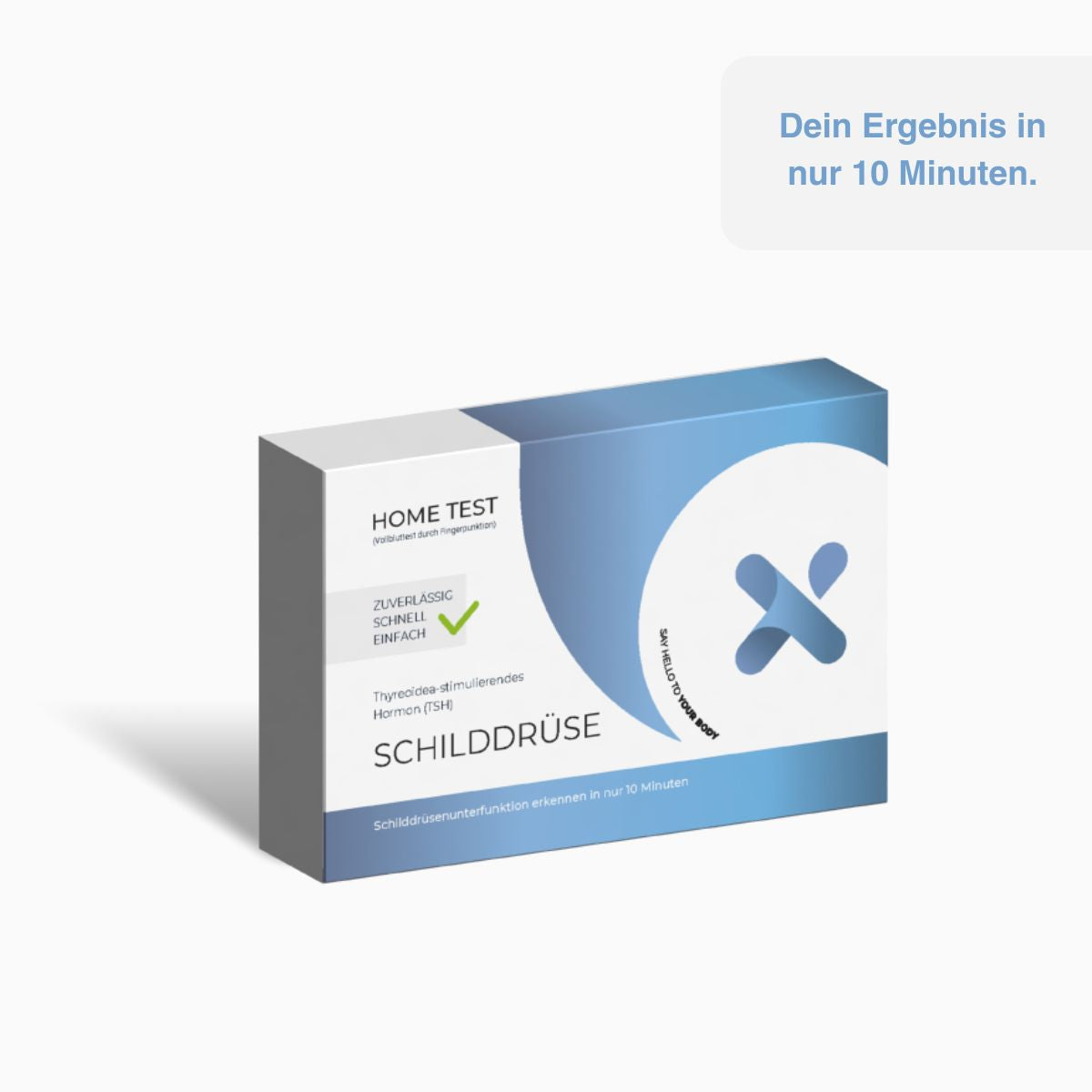
Rapid at-home test
Thyroid TSH level self-test
According to the product page, the current TSH level in the blood is shown in approximately 5 to 10 minutes using a sample from the fingertip. The kit contains a test cassette, lancets, and instructions. What the test does not provide: it measures TSH only. fT3 and fT4 are not included, so no ratio of the two free hormones can be calculated from it. It does not replace a laboratory test or medical interpretation.
Result in 5–10 minutes, no trip to a laboratory
Product page information, accessed 27 August 2026
The two tests therefore answer different questions. The self-test tells you whether the control signal is worth looking into. The blood test provides the profile with both free hormones, which otherwise requires a test order from your doctor’s office.
Who a measurement makes sense for—and who it does not
A measurement is worthwhile when it answers an open question. It is not worthwhile when it answers a question that has already been answered or one that it is not designed to answer.
Makes sense for you if …
your last report listed only a TSH value and you would like to have the two free hormones included.
you have been exhausted for weeks, have never had a thyroid value measured, and are looking for a starting point for a discussion with your doctor’s office.
you want to track a trend over several months and place values from the same test side by side for comparison.
Probably not if …
you notice one of the signs from Chapter 3 in yourself. In that case, arranging an appointment is the right course of action, not taking a measurement.
you are already taking a thyroid hormone. Monitoring the dosage belongs with your treating practice, because that is where the dose was determined.
you are hoping the result will give you a target value for the quotient. No measurement provides this value because it has not been defined.
you are pregnant or planning to become pregnant. Monitoring thyroid levels during this time should be carried out under medical supervision.
Limitations: what a single value cannot clarify
The first limitation is already stated in the source itself. A disease usually cannot be inferred from a single laboratory value alone (IQWiG, 2025). A value is a snapshot, and a snapshot by itself does not make a picture.
The second limitation concerns the cause. Even if fT3 or fT4 is outside the range, the number does not say why. Whether medication or a temporary strain is behind it is determined by the examination, not the report.
The third limitation is the most important for this topic. A quotient calculated from two values cannot provide an answer for which no reference range exists. It looks like insight because it has a decimal place.
There is also what blood tests generally cannot show. Swelling, a nodule, or a structural change is detected through palpation and ultrasound, not through markers.
And one limitation specific to this topic: Reference ranges depend on the laboratory, method, and age. The information on your own report is always decisive, not the figures from an article.
This is not an argument against testing, but against expecting a number to replace the conversation it was intended to support.
What ultimately matters
If you take away just one action from this article, let it be this: Write down your values with the unit and the reference range shown on the same report. Three details per value, nothing more.
The reason is unremarkable. Without the unit and the range used by your own laboratory, no number can be assessed, including a calculated one. With both alongside it, a sheet full of numbers becomes a question that can be answered in a medical practice within a few minutes.
It all began with the question of the optimal fT3-to-fT4 ratio. The most honest answer is: There is no officially established one. What we do have are two values, each with its own range, a control signal beforehand, and a conversation afterward. That is less than a formula promises, and more than a formula can deliver.
Frequently asked questions
What is the optimal fT3-to-fT4 ratio?
There is no established optimal ratio. None of the institutions reviewed here specifies a reference range for this quotient. In research, it is being studied as a surrogate marker of peripheral thyroid sensitivity, while the authors note that thresholds still need to be defined (Ma et al., Frontiers in Endocrinology, 2025). fT3 and fT4 are assessed separately against the range of the laboratory that measured them.
Which reference ranges apply to fT3 and fT4?
For women and men over 18, the Institute for Quality and Efficiency in Health Care gives a range of 3.9 to 6.7 picomoles per liter for fT3 and 10 to 23 picomoles per liter for fT4 (as of 2025). The same source notes that reference ranges may vary from one laboratory to another because different testing methods are used. The range on your own report is therefore decisive.
Why are fT3 and fT4 not listed on my report?
Because the control signal is measured first. Thyroid dysfunction can be detected particularly early through a change in the TSH level, which is why TSH is often determined first; if this value is abnormal, the thyroid hormones are also measured (IQWiG, 2024). A report without fT3 and fT4 is therefore not an incomplete report, but the usual first step.
Can a TSH self-test show the ratio of fT3 to fT4?
No. According to the product page, the Thyroid TSH Self-Test measures only the TSH level using a fingertip blood sample. It does not include fT3 and fT4, so no ratio can be calculated from it. According to the product page, only the Women’s Wellness Check in the range includes both free hormones. Neither test provides a diagnosis, and an abnormal result should be medically assessed.
Does an abnormal result mean that I have hypothyroidism?
Not automatically. A single laboratory value usually cannot be used to infer a disease (IQWiG, 2025). In countries such as Germany, approximately 5 in 100 people have hypothyroidism, according to the same institution (as of 2024). An abnormal value is therefore a reason to have it checked at a medical practice, where the overall picture of symptoms and progression determines the assessment.
Next step
Two values instead of a calculation
If your test report has so far listed only TSH, the Women’s Wellness Check provides the profile with both free hormones as well. If you initially want to look at only the control signal, the self-test is sufficient. Neither replaces medical evaluation.
Women’s Wellness Check Thyroid TSH self-testRead more
You might also be interested in
If your test report lists only the control signal and you are looking for help interpreting it.
What is established in everyday practice once hypothyroidism has already been medically diagnosed.
Sources
- Institute for Quality and Efficiency in Health Care (IQWiG): Understanding thyroid examinations (as of 2024) – gesundheitsinformation.de
- Institute for Quality and Efficiency in Health Care (IQWiG): Hypothyroidism (as of 2024) – gesundheitsinformation.de
- Institute for Quality and Efficiency in Health Care (IQWiG): Free triiodothyronine (fT₃) (as of 2025) – gesundheitsinformation.de
- Institute for Quality and Efficiency in Health Care (IQWiG): Free thyroxine (fT₄) (as of 2025) – gesundheitsinformation.de
The verbatim quotation about the order of measurement and the information on when T3 and T4 are additionally measured come from source [1]. The frequency figures, symptom list, and information on subclinical hypothyroidism are based on [2]. The reference range for fT3 and the note that a disease generally cannot be inferred from a single laboratory value come from [3]; the reference range for fT4, the information on its weaker potency, and the conversion of thyroxine to triiodothyronine come from [4]. The sentence concerning the laboratory dependence of reference ranges appears verbatim in [3] and [4]. The reference information on TSH and the interpretation of elevated or decreased values come from the laboratory values encyclopedia of the same institution (IQWiG: Thyroid-stimulating hormone (TSH), as of 2025); they are attributed in the text and therefore do not appear in this list. Information on the ratio of fT3 to fT4 as a surrogate marker comes from a study by Ma and co-authors in Frontiers in Endocrinology (2025); it is attributed in the main text with the authorship, journal, and year and therefore also does not appear in this list. Information on price, markers, sample type, and laboratory comes from the mybody®x product pages, accessed on 27/08/2026; processing times follow the central specification for blood tests. All sources were accessed and reviewed on 27/08/2026.

mybody®x editorial & expert team
Laboratory diagnostics Blood analysis interpretation Hormonal health Nutritional science
This article was created by the mybody®x editorial and expert team. The team combines laboratory diagnostics, blood analysis interpretation, and nutritional science. Those who contribute to it are listed on the authors’ page.
Published on 28/12/2025 · Last updated on 27/08/2026
The content is intended for general information and does not replace medical advice, diagnosis, or treatment. Reference ranges depend on the laboratory, method, and age; the information on your report is always authoritative.




Share now:
Magnesium for nerves: What’s proven and what the blood test shows
Meaning of food intolerance – ways to improve your diet