

TSH thyroid levels: Your guide to thyroid health
Do you often feel tired, lacking in energy, or notice unexplained changes in your body? One of the first steps in clarifying such symptoms is often to take a close look at your TSH thyroid levels. This single blood value is incredibly informative because it shows whether your thyroid is working in the right rhythm or has fallen out of sync.
What your TSH levels really mean
Think of the hormone TSH (thyrotropin) as the conductor of your metabolism. It is not produced in the thyroid itself, but in your pituitary gland. From there, it sets the pace for the thyroid: either it should produce more hormones to supply your body with energy, or less.
This feedback loop is a finely tuned system. When too few thyroid hormones circulate in your body, your brain releases more TSH to stimulate the thyroid. If, on the other hand, there is too much hormone in circulation, TSH production is reduced to slow it down.
TSH as the first indication
That is precisely why the TSH level is often the first and most important indicator of your thyroid health. It does not directly measure the thyroid’s hormone production, but rather your brain’s response to it. An abnormal level is therefore a clear signal that something is wrong in the system and that you should take a closer look.
In Germany, TSH levels from 0.4 to 4.0 mU/l are considered the normal reference range for most adults. If your level is above 4.0 mU/l, this often indicates an underactive thyroid (hypothyroidism). A level below 0.4 mU/l, on the other hand, suggests an overactive thyroid (hyperthyroidism). You can also find more detailed information on diagnosis at vorsorge-online.de, which provides further insights into thyroid diagnostics.
Important to understand: A high TSH level does not mean that your thyroid is overactive—in fact, quite the opposite. It is your brain’s loud call to a sluggish thyroid to finally work harder.
The following graphic shows you at a glance how the various TSH ranges are typically interpreted.
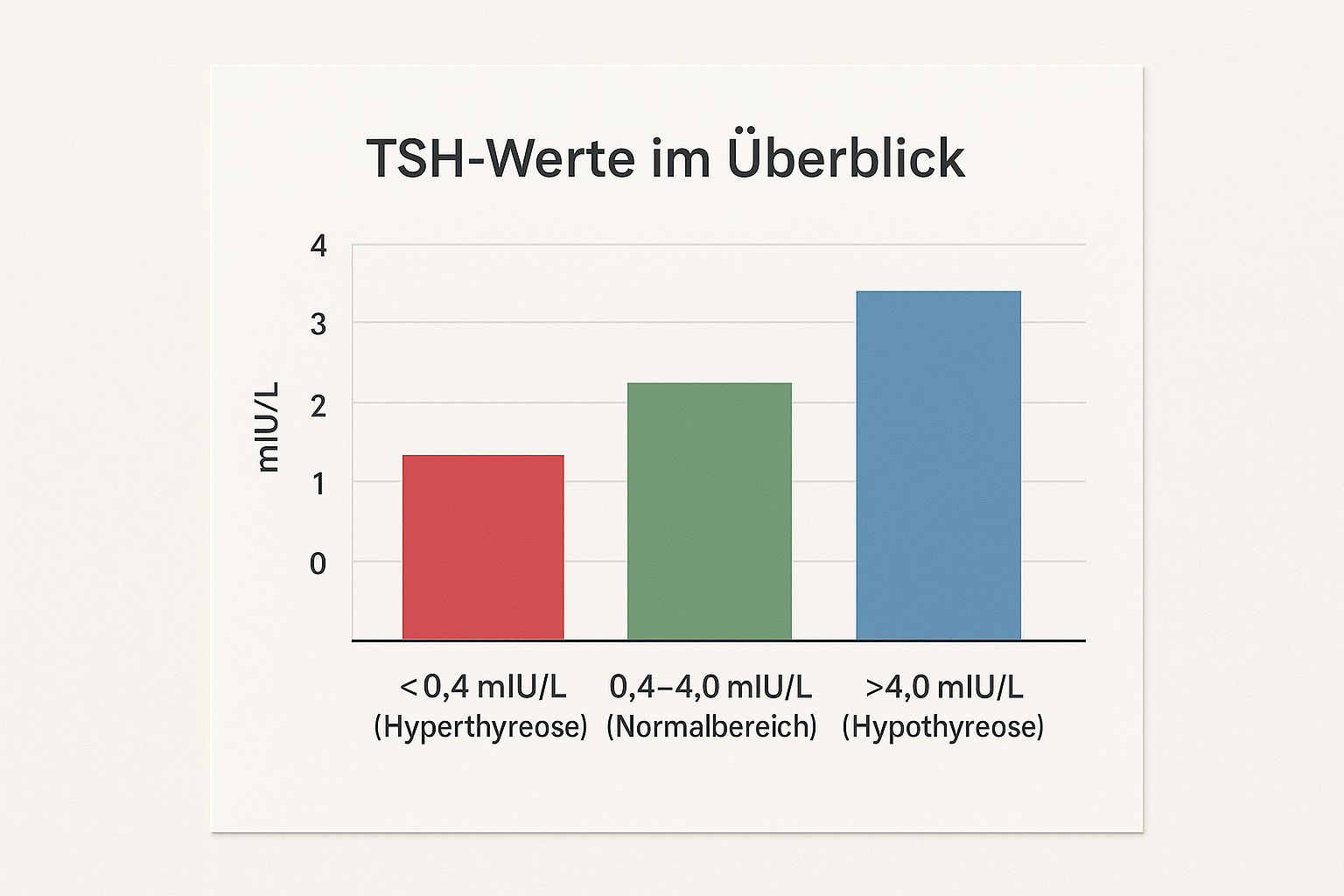
As you can see, a low TSH level indicates an overactive thyroid, while a high TSH level suggests an underactive thyroid.
TSH levels at a glance and what they mean
To make everything even clearer, this table summarizes how different TSH levels are typically interpreted and which thyroid function they may indicate.
| TSH level | Possible meaning | Typical thyroid function |
|---|---|---|
| < 0.4 mU/l | Your brain reduces TSH production because there are too many thyroid hormones in the blood. | Hyperthyroidism (overactive thyroid) |
| 0.4 – 4.0 mU/l | Communication between the brain and thyroid is in balance. | Euthyroidism (normal thyroid function) |
| > 4.0 mU/l | Your brain tries to stimulate an underactive thyroid to work by producing plenty of TSH. | Hypothyroidism (underactive thyroid) |
These levels serve as an initial guide. For an accurate diagnosis, further examinations and a medical assessment are always essential.
Would you like to get an initial indication yourself without going straight to the doctor? With our at-home thyroid TSH self-test, you can quickly and easily obtain an initial indication, which you can then discuss with your doctor.
Why TSH Levels Do Not Remain Constant Throughout Life
Did you know that a “normal” TSH level is not a one-size-fits-all value? Many people believe that the reference range on a lab report is set in stone and applies equally to everyone. However, this is a widespread misconception.
Your body changes throughout your life—and so do your TSH thyroid levels. Rigid limits, such as the frequently cited range of 0.4 to 4.0 mU/l, are therefore often far too narrow. They ignore the dynamic, entirely natural adjustments your body undergoes over the years. Factors such as your age and sex are crucial for interpreting the levels correctly.
The Role of Age and Sex
Your hormonal system is not a rigid clockwork mechanism. It is a flexible system that continually adapts to new stages of life. What is considered normal for a 30-year-old man may have a completely different meaning for a 65-year-old woman.
As we age, our metabolism changes, and this naturally affects TSH levels as well. For example, it is perfectly normal for TSH levels to gradually increase over the decades. A slightly elevated level in an older person does not necessarily indicate an underactive thyroid requiring treatment. It may simply be a sign of the natural aging of your hormonal system.
This knowledge is crucial: A TSH level must always be considered in the context of your individual stage of life to avoid misinterpretations and unnecessary treatments.
A large-scale study in Germany examined these differences and produced fascinating results. It clearly shows how normal TSH levels shift with age.
For women between 30 and 39 years of age, the average TSH level is approximately 1.5 mIU/L. For women between 60 and 69 years of age, this average already rises to 1.9 mIU/L. If you would like to explore the subject in greater depth, you can learn more here about the latest study findings on age-dependent thyroid levels.
What this means for you
Understanding that TSH levels are not static gives you greater confidence when dealing with your laboratory results. Instead of letting a single number unsettle you, you can put it into perspective much more effectively.
Here are the key points to take away:
- Don’t panic over slight deviations: A level that is just above the standard reference range is often no cause for concern, especially as you get older.
- Consider the bigger picture: Your levels should always be assessed together with your general well-being, possible symptoms, and your current stage of life.
- Be an informed conversation partner: When you understand that your age plays a role, you can ask your doctor more targeted questions and make an informed decision together.
Ultimately, this knowledge helps you interpret your body’s signals more accurately and view your health in the right context.
Recognizing symptoms of thyroid dysfunction
An abnormal laboratory result showing TSH thyroid levels is one thing—but what does a dysfunction feel like in everyday life? The thyroid is your body’s invisible engine. It sets the pace, determines how much energy is available to you, and controls the rate at which your metabolism runs.
When this engine sputters, you feel it everywhere. The tricky part is that the symptoms often creep unnoticed into everyday life and are easily dismissed as stress or the normal demands of daily life.
When the engine runs too slowly: hypothyroidism
An underactive thyroid (hypothyroidism), which is usually indicated by a high TSH level, is like your body’s engine running only in economy mode. The entire system slows down because the thyroid simply does not provide enough fuel—that is, hormones—to keep everything running.
This can manifest through a whole range of signs:
- Persistent fatigue: You constantly feel as though you’ve just run a marathon, even though you’ve slept enough. This type of exhaustion can also indicate nutrient deficiencies, as you can read in our article about nutrient deficiencies associated with fatigue and lack of energy.
- Unexplained weight gain: Even though you haven’t changed your eating habits, the number on the scale slowly but surely keeps rising.
- Sensitivity to cold: You’re the person who is always cold in the office, even when your colleagues are already complaining about the heat.
- Additional symptoms: These are often accompanied by dry skin, hair loss, sluggish digestion, or a low, melancholic mood.
When the engine overheats: hyperthyroidism
With an overactive thyroid (hyperthyroidism), which is indicated by a low TSH level, exactly the opposite happens. Your engine is constantly running at full speed because far too many thyroid hormones are racing through your bloodstream.
Imagine constantly putting your foot down without ever taking a break. This state consumes an enormous amount of energy and can leave you incredibly drained over time.
The typical symptoms are often the exact opposite of those of an underactive thyroid:
- Inner restlessness and nervousness: You constantly feel driven, shaky, or anxious for no apparent reason.
- Racing heart and high pulse: Your heart is pounding wildly, sometimes irregularly, even when you’re sitting completely relaxed on the sofa.
- Unexplained weight loss: You’re losing weight even though you may be eating more than usual.
- Additional signs: Heavy sweating, sleep problems, and extreme sensitivity to heat are also common accompanying symptoms.
Why TSH alone isn’t always enough
The TSH level is a fantastic first clue, but it doesn’t tell the whole story. Think of it as looking at the tachometer: it shows us how hard the brain is driving the thyroid. But it doesn’t tell us how much power the engine is actually putting onto the road.
That’s why doctors often also look at the free, active thyroid hormones fT3 (free triiodothyronine) and fT4 (free thyroxine). These values provide a much more accurate picture of what is happening directly in the thyroid and throughout the body. They help better understand the cause of the dysfunction and make the correct diagnosis.
Which factors can affect your TSH level
Your TSH level is not a fixed number set in stone. Think of it more as a dynamic snapshot that depends on a whole range of factors. Knowing these influences can help you interpret your lab results much better and avoid jumping to conclusions about your thyroid health.
It is perfectly normal for even small changes in your daily routine or environment to temporarily shift your TSH thyroid levels. This does not immediately mean that something is wrong. It simply shows how sensitively your hormonal system responds to external and internal stimuli.
The internal and external regulators
Your body is a highly complex system in which everything is interconnected. Certain lifestyle and environmental factors can disrupt the delicate communication between the brain and thyroid, directly affecting your TSH level.
Some of the most important players here include:
- Chronic stress: People who are constantly under pressure produce more of the stress hormone cortisol. This can suppress TSH release. The result? A falsely low TSH level, even though the thyroid actually needs more support.
- The time of day: Your TSH level follows a natural rhythm. It is highest at night and in the early morning, then falls over the course of the day. A blood sample taken in the afternoon can therefore produce a significantly lower reading than one taken in the morning.
- Certain medications: Various medications can directly distort the test results. These include corticosteroids, some antidepressants, and high-dose biotin, which is often found in hair and nail supplements.
Nutrients: The foundation for your thyroid
Healthy thyroid function depends on having an adequate supply of the right nutrients. If these important building blocks are missing, the entire regulatory system can falter—and you will see this directly in your TSH level.
A nutrient deficiency is like trying to drive a car without fuel. The engine may be powerful, but without the right energy source, it cannot get anywhere.
The nutrients that are particularly important for your thyroid are:
- Iodine: Without iodine, your thyroid cannot produce hormones. Period. A deficiency forces the brain to release more and more TSH in a desperate attempt to stimulate production—the TSH level rises.
- Selenium: This trace element is key to converting the storage hormone T4 into the active hormone T3. Without selenium, the thyroid runs on low power.
- Iron: Iron deficiency also slows the conversion of T4 to T3 and can significantly worsen the symptoms of hypothyroidism.
Our lifestyle and environment also play a role that goes far beyond genetics alone. How our bodies respond to such influences is part of an exciting field of research. You can learn more about what epigenetics is and how your lifestyle can influence your genes in our additional article.
To get a truly meaningful result, you should therefore always have your blood drawn at the same time of day (preferably in the morning). And this is very important: Inform your doctor about all medications and dietary supplements you take.
When treatment is truly necessary
A slightly elevated TSH level on your lab report can be alarming at first. Worrying that you will immediately become dependent on lifelong medication is often the first reaction. But here is some important reassurance: Not every deviation from the normal range requires immediate treatment.
Modern medicine now examines this much more closely. It is no longer just about correcting a number on a lab report, but about considering you as a whole person and taking your individual well-being into account.
Understanding latent or subclinical hypothyroidism
Slightly elevated TSH levels are often caused by what is known as latent or subclinical hypothyroidism. This sounds complicated, but it actually just means that your TSH level is elevated while your free thyroid hormones fT3 and fT4 are still within the normal range. You often experience no symptoms at all or only very mild ones.
In these cases, the guiding principle is often “Watchful Waiting”—that is, observing and waiting. Your doctor will check your levels at regular intervals to see whether they return to normal on their own or continue to rise.
Treatment is usually only seriously considered when the TSH level rises significantly above 10 mU/l or when you have clear symptoms that genuinely limit your quality of life.
This wait-and-see approach is particularly important for older people. As we already know, a slightly elevated TSH level can simply be part of the normal aging process. Rushing into treatment could do more harm than good in such a case.
Age-dependent thresholds as a new guide
The decision for or against treatment now depends much more strongly on age. The latest medical guidelines reflect this more nuanced understanding and provide clearer reference values graded by age.
For example, the current guideline from the German Society for General and Family Medicine (DEGAM) defines age-dependent upper limits for the first time.
- For adults up to age 70, a TSH level of up to 4.0 mU/l is considered normal.
- Between the ages of 70 and 80, the limit is already 5.0 mU/l.
- For people over 80, values up to 6.0 mU/l are even acceptable.
You can read more about this updated guideline on elevated TSH levels here.
Ultimately, the treatment decision is always an individual weighing of options that you make together with your doctor. Your symptoms, age, general state of health, and any desire to have children all play a decisive role. If treatment with hormone tablets becomes necessary, it is important to understand exactly how they work and how to take them correctly. You can find comprehensive information about this in our guide to L-Thyroxin and its use.
How you can naturally support your thyroid
Apart from any medical treatment that may be necessary, a large part of your thyroid health is literally in your hands. You can take action yourself and help your body find—and maintain—its sensitive hormonal balance. A conscious, thyroid-friendly lifestyle is your strongest tool in this process.
Your diet plays an absolutely crucial role. Think of your thyroid as a small hormone factory: To produce hormones at all, it needs very specific raw materials. If these are missing, production simply does not run smoothly.
Building blocks for a healthy thyroid
For your thyroid to function optimally, you should ensure an adequate supply of certain vitamins and trace elements. These four are particularly important:
-
Iodine: This is the fundamental building block for hormone production. Without iodine? No thyroid hormones. Good sources include marine fish, algae, and iodized table salt.
-
Selenium: This trace element is crucial for an important step: converting the storage hormone T4 into the active hormone T3. It acts like a spark and is found, for example, in Brazil nuts, fish, and eggs.
-
Zinc: Zinc also helps convert T4 into T3. It is also important for smooth communication between your brain and thyroid. You can find it in meat, legumes, and nuts.
-
Iron: Iron deficiency can seriously slow thyroid function and further worsen the symptoms of an underactive thyroid. Good sources of iron include red meat, lentils, and spinach.
A balanced lifestyle is key. Targeted stress management through yoga or meditation and sufficient restorative sleep help regulate your entire hormonal system—and thus also relieve your thyroid.
Whether you actually have a nutritional deficiency can be determined by a measurement, not by suspicion. For individual nutrients, the European Union has authorized health claims describing a contribution to the normal function of the thyroid; wording such as “contributes to” is permitted under EU Regulation 432/2012.
These statements describe a contribution to normal function, not an increase beyond that. What a test result means for you should therefore be discussed with a medical practice, not addressed through a general recommendation.
What basal TSH means
If your test result states basal TSH, this does not describe a different value from TSH, but rather the way it was measured. It refers to the baseline value measured in the blood without prior stimulation.
The addition dates back to a time when a stimulation test was also commonly used. A messenger substance was administered, and it was then checked how strongly the pituitary gland responded with TSH. Today, in the vast majority of cases, the basal level is sufficient.
The reason lies in the sensitivity of modern testing methods. According to the Institute for Quality and Efficiency in Health Care, thyroid dysfunction can be detected particularly early through a change in the TSH level (IQWiG, 2024). The basal level alone therefore already indicates whether something is out of balance.
What the basal level measures and what it does not
According to IQWiG, TSH is produced by the pituitary gland and released into the blood; it stimulates the thyroid to produce the thyroid hormones T3 and T4 (2025). The basal level therefore describes the regulation, not the thyroid itself.
This has a clear consequence for the order of the examination. If the TSH level is abnormal, the thyroid hormones T3 and T4 are also measured (IQWiG, 2024). The basal level is the starting point, not the end of the evaluation.
How to interpret the ratio of the free thyroid hormones to each other is explained in detail in our article Optimal fT3-to-fT4 ratio. This section focuses on TSH.
Why reference ranges differ
With TSH, it is noticeable that different sources give different limits. IQWiG specifies a range of 0.3 to 3.5 mU/l for adults (2025), while many laboratories in Germany set somewhat wider limits.
This difference is not a contradiction but a characteristic of reference ranges. They depend on the laboratory and the measurement method used, and are set so that 95 percent of healthy people fall within them (IQWiG, 2025).
Five percent of healthy people fall outside this range even though nothing is wrong with them. For you, this means that the relevant range is always the one shown next to the value on your own report, not a number from an article.
One more practical point: Two results are comparable only if they come from the same laboratory. So anyone who wants to monitor changes over several months should stick with the same provider.
Elevated TSH—what follows
An elevated TSH level initially appears to indicate too much thyroid hormone. In fact, it indicates the opposite, and this reversal is the most common misunderstanding about this value.
IQWiG states the connection clearly: Elevated TSH levels indicate an underactive thyroid; the free thyroid hormones fT3 and fT4 are then reduced (2025). A high TSH level is therefore the brain's signal to a thyroid gland that is producing too little.
What is examined next
A single elevated result rarely leads directly to treatment. The usual next step is a follow-up measurement because TSH fluctuates throughout the day and over the course of several weeks.
If the result is confirmed, the free thyroid hormones are measured next. Only the interaction between TSH and fT4 shows whether an underactive thyroid is present and how pronounced it is.
If necessary, the question of the cause is also addressed. Among other things, antibodies are measured because inflammation of the thyroid can cause an underactive thyroid. A medical practice will determine which of these tests is appropriate based on your symptoms.
What you can do to help interpret the results
Record the date and time of the blood draw. TSH fluctuates throughout the day, and without this information, it is difficult to compare a later result with the first one.
Also make a note of which medications and supplements you take. Some can affect the result, and this information saves you from having to answer an additional question during the consultation.
And describe your symptoms over time rather than as a snapshot. How long have they been present, how severe are they, and what has changed? In a conversation with your doctor, these three details carry more weight than the number alone.
When the appointment comes before the test
There are signs that determine the order of action. These include unintentional weight changes without an identifiable cause, persistent exhaustion lasting for weeks, a racing heart at rest, and visible swelling in the neck.
This list is not a diagnostic checklist. It indicates when medical evaluation is the right first step and a self-test would be the wrong order of action.
The most pressing questions about your TSH levels
Finally, we will clarify a few questions that come up again and again. With this knowledge, you will be well prepared for your next doctor’s appointment and better able to interpret your laboratory results.
Do I need to fast before the blood test?
No, generally not. If only your TSH level is being measured, you do not need to do anything special beforehand. However, the level naturally fluctuates throughout the day. To keep the results comparable, blood samples are therefore usually taken in the morning.
What does a very low TSH level like 0.1 mean?
A TSH level of 0.1 mU/l or even lower is a clear warning sign. It strongly suggests an overactive thyroid (hyperthyroidism). Think of it this way: Your brain has almost completely shut down TSH production because there are already far too many thyroid hormones circulating through your body. Your doctor will then immediately check additional levels such as fT3 and fT4 to get to the bottom of the issue.
Especially when trying to conceive, a low TSH level should always be evaluated by a doctor. Stable thyroid function is one of the most important foundations for successful conception and a healthy pregnancy.
What TSH level is ideal when trying to conceive?
If you are planning to become pregnant, most experts recommend a TSH level in the lower part of the normal range. A value between 0.4 and 2.5 mU/l is often considered optimal. A well-regulated thyroid can positively influence fertility while also reducing the risk of complications, especially during the sensitive early stages of pregnancy.
Are you ready to take the first step and finally gain clarity about your thyroid health? At mybody-x.com, you’ll find scientifically grounded self-tests to help you understand your body’s signals. Discover the possibilities now at https://mybody-x.com.



Share now:
What to do about estrogen deficiency? Ways to achieve greater balance and well-being
Nutrient analysis for your optimal health