
Understand the menstrual cycle—relieve symptoms
Your menstrual cycle is your body’s monthly masterpiece—an intricate interplay of hormones that prepares you for a possible pregnancy. But it is so much more than just your period. See it as a fundamental rhythm that significantly influences your well-being, energy, and moods.
Using your menstrual cycle as an internal compass
Welcome to a little journey of discovery into your own body. The menstrual cycle is far more than what we often simply refer to as “your period.” It is a finely tuned system that regulates your energy, mood, and overall well-being. Think of it as an internal compass that sends you subtle but valuable signals every day.
Far too often, we simply accept these signals—sometimes fatigue, sometimes skin problems or low moods—without really asking about their cause. This guide is for you if you no longer want to merely combat symptoms, but truly learn to understand the language of your body. It is aimed at health-conscious people like you who want to take charge of their vitality and understand their bodies better.
Why understanding your cycle is so important
Understanding your cycle essentially means regaining control over your well-being. It is the key to recognizing why you feel full of energy on some days while on others you would rather stay on the sofa.
With this knowledge, you can organize your daily life—from your nutrition and exercise routine to planning important appointments—much more effectively in harmony with your internal clock. Many women see their cycle as a burden, yet it can be an incredibly powerful tool for self-care. When you understand the connections between your hormones and how you feel, you can act proactively instead of always just reacting. Taking a holistic view of women’s health is crucial here, because your cycle is inextricably linked to every aspect of your health.
Your body sends you messages continuously. The menstrual cycle is one of the clearest messages it conveys to you month after month. When you learn to interpret this language, you transform uncertainty into confidence and control.
What you will learn in this guide
We want to demystify the cycle and translate complex biological processes into clear, practical information for everyday life. You’ll learn:
- The four phases: We’ll take you on a journey from menstruation through the follicular and ovulation phases to the luteal phase and explain what really happens in your body.
- The main hormonal players: You’ll understand the role hormones such as estrogen and progesterone play and how their delicate balance shapes your life.
- Interpreting signals correctly: We’ll show you which fluctuations are completely normal and when it’s worth taking a closer look at recurring symptoms.
- Practical solutions: You’ll learn how to track your cycle easily and how a simple hormone or nutrient test from mybody-x.com can finally help you gain clarity about your hormonal balance or possible deficiencies.
This knowledge is the foundation for uncovering the true causes behind recurring symptoms and taking targeted steps to improve your well-being.
The Four Phases of the Cycle: Your Personal Roadmap
Your menstrual cycle is a fascinating journey through four very different phases. Each stage is governed by a unique hormonal interplay that shapes your energy levels, emotions, and physical state. Instead of overwhelming you with dry biology, we’ll take you on an easy-to-understand tour of your body—your personal roadmap for every month.
Imagine these phases as the four seasons. Each has its own qualities and energy. When you learn to adapt to this rhythm, you can approach your daily life more mindfully and in harmony with your body. You’ll understand why you could move mountains on some days and simply need rest on others.
Phase 1: Menstruation (your winter)
The menstrual phase is the official starting point of your cycle and lasts an average of 3 to 7 days. It begins on the first day of your period, when the uterine lining that built up during the previous month is shed.
During this time, your hormone levels, especially estrogen and progesterone, are at their absolute lowest. That’s why you often feel tired, low on energy, and withdrawn. Think of this phase as your personal winter—a time for retreat, rest, and regeneration. Your body is working incredibly hard, so be gentle with yourself.
Phase 2: The follicular phase (your spring)
The follicular phase begins directly after your period, overlaps with menstruation, and lasts until ovulation. It is your inner spring—a time of new beginnings and renewed energy.
Your brain now releases follicle-stimulating hormone (FSH). This hormone stimulates your ovaries to allow several small sacs (follicles) to grow, each containing an egg. One of these follicles becomes dominant and produces increasing amounts of estrogen.
This rise in estrogen acts like a natural energy boost. You often feel more creative, optimistic, and sociable. Your skin may appear clearer, and you may feel more inclined to exercise. It is the perfect time to start new projects or schedule important appointments. If you would like to explore the role of this important hormone in greater depth, you can find everything you need to know about estrogen in our article.
The following infographic visualizes the menstrual cycle as your personal compass through phases of discomfort, energy, and clarity.
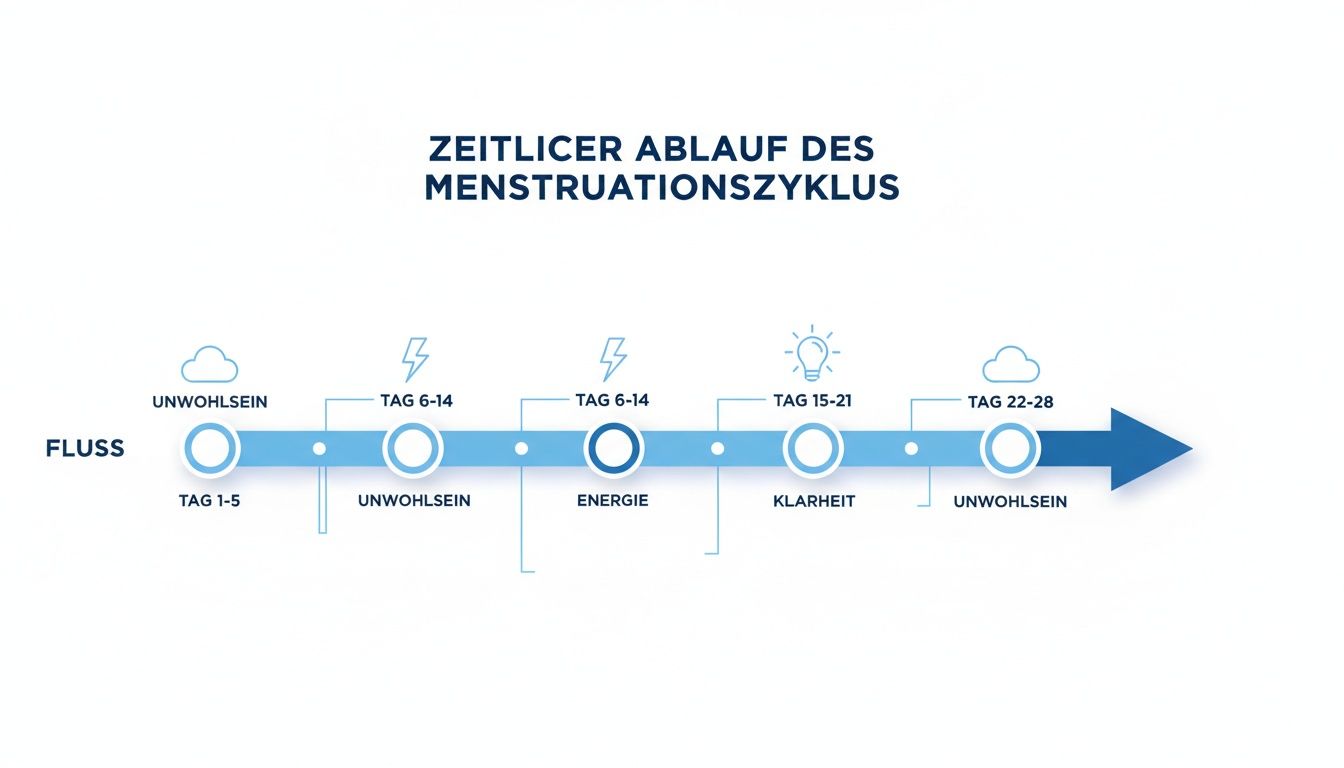
As you can see, your well-being follows a clear pattern that is directly linked to the hormonal changes in each phase.
Phase 3: Ovulation (your summer)
Ovulation is the peak of your cycle—your personal summer. It occurs around the middle of the cycle and is triggered by a sharp increase in luteinizing hormone (LH).
This LH peak causes the dominant follicle to rupture and release the mature egg. The egg then travels into the fallopian tube, where it can be fertilized for approximately 12 to 24 hours. Estrogen levels also reach their peak, which can give you maximum energy, confidence, and libido. You radiate from within and often feel at your most attractive.
Phase 4: The luteal phase (your autumn)
After ovulation, the luteal phase begins and lasts until your next period starts. It is your inner autumn. The empty follicle transforms into what is known as the corpus luteum and begins producing the hormone progesterone.
Progesterone prepares the uterine lining for the implantation of a fertilized egg. It has a calming effect and slows things down a little. While estrogen turns you outward, progesterone promotes nesting and introspection. Your energy level gradually declines, and you may have a greater appetite.
The second half of the luteal phase is often when premenstrual syndrome (PMS) occurs. If fertilization does not take place, both estrogen and progesterone levels drop sharply. This hormonal decline is responsible for typical PMS symptoms such as mood swings, irritability, or food cravings.
Although an average menstrual cycle lasts 28 days, fluctuations are completely normal. Studies show that for more than 80 percent of women, cycle length varies between 25 and 35 days. Worldwide, more than 300 million people have their period every day, underscoring the importance of this topic. Nevertheless, according to a survey, 31 percent view their period negatively, which is often attributable to a lack of knowledge and social taboos. You can find further insights on this topic in the 2024 Menstrual Health Report.
When you know the four phases of your cycle, you can better understand your body’s signals and consciously adapt your life accordingly. You learn when the best time is for intense workouts, creative work, or cozy evenings on the sofa.
Typical cycle symptoms and when you should take a closer look
Almost every woman knows it: The menstrual cycle brings not only your period but often a whole range of accompanying symptoms. From mild mood swings to nasty cramps, the range is huge and highly individual.
But where exactly is the line between “normal” and a sign that your body may be trying to tell you something more? Let’s be clear: You don’t have to simply “get through it” and grit your teeth every month.
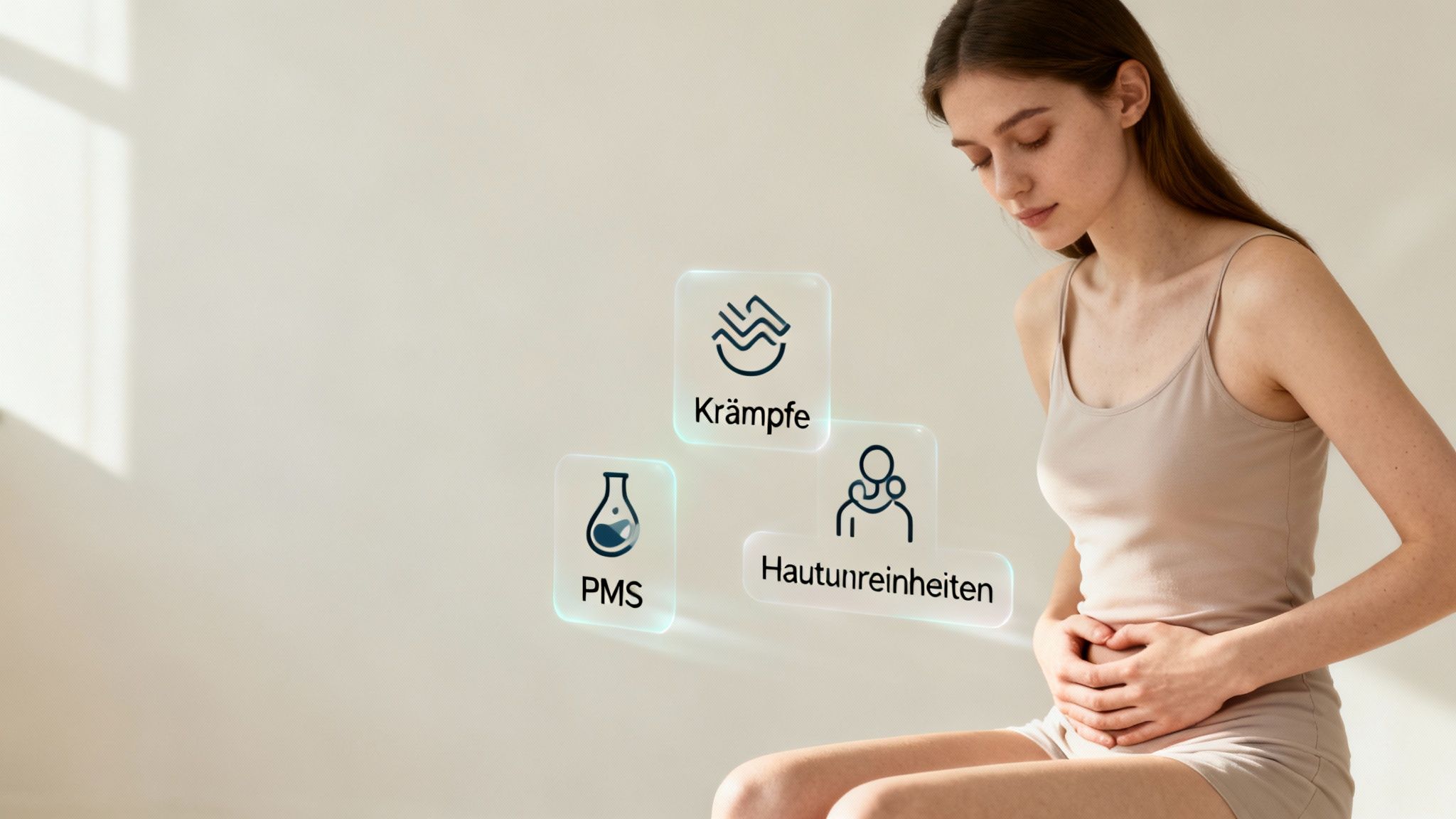
From period pain to PMS—what is considered normal
Mild to moderate discomfort around your period is extremely common and usually no cause for concern. It is generally simply the result of the natural hormonal roller coaster, especially the drop in estrogen and progesterone shortly before your period.
The most common symptoms classified as “normal” include:
- Lower abdominal cramps (dysmenorrhea): A pulling pain in the lower abdomen caused by your uterus contracting. Most people experience them.
- Mood swings: Mild irritability, tearfulness, or feelings of low mood in the days before your period.
- Fatigue: A feeling of exhaustion and reduced energy, especially during the second half of your cycle and during your period.
- Skin blemishes: Hormonal pimples that typically appear before your period.
- Breast tenderness: Your breasts may feel sensitive or swollen.
- Cravings: The sudden, uncontrollable desire for chocolate, chips, or both at the same time.
Of course, these symptoms can be annoying and affect your daily life, but they should not bring it to a complete standstill. Usually, they are only temporary and disappear once your period starts or ends.
When you should take your body’s signals more seriously
Sometimes symptoms are more than just an annoying side effect. They may indicate that your body is out of balance. It is time to take a closer look if any of these signs apply to you.
Severe and debilitating pain If your abdominal cramps are so severe that over-the-counter painkillers do not help and you regularly have to cancel work, university, or plans with friends, this is a clear warning sign. Extremely painful periods are not normal and may indicate conditions such as endometriosis—which affects as many as 10–15% of all women.
Extreme emotional distress Do you regularly feel severely depressed, hopeless, or so extremely irritable in the days before your period that it affects your relationships? This could indicate premenstrual dysphoric disorder (PMDD), a severe form of PMS that requires targeted treatment.
Persistent exhaustion Are you chronically tired and drained not only during your period but throughout the entire month? There could be more behind it than just your cycle. A deficiency in important nutrients such as iron or magnesium, or a hormonal imbalance, are often the undetected causes. Magnesium in particular plays an important role in muscle relaxation. Find out more in our article about Magnesium for period pain.
Highly irregular cycles Occasional fluctuations are okay, but if your cycle is consistently shorter than 21 days or longer than 35 days, or if your period does not occur for months, you should have this checked out. This can indicate hormonal disorders such as polycystic ovary syndrome or thyroid problems.
You are not alone with your symptoms. A 2022 survey shows that 96 percent of all women experience menstrual symptoms and that 54 percent even miss work or university because of them. It is time to take these symptoms seriously and investigate their causes.
The first step toward improvement: Listen and take action
The most important step? Listen to your body and do not simply ignore your symptoms. A cycle diary can help you identify patterns. Note when each symptom occurs and how severe it is.
When your symptoms go beyond what is “normal,” it is time to take action. Instead of merely masking the symptoms, you should look for the root of the problem. Hormonal imbalances or nutrient deficiencies are common but often overlooked causes of severe menstrual symptoms.
The good news is that you do not have to feel your way in the dark. A targeted blood test from mybody-x.com can provide valuable insights into your hormone or nutrient status and help you uncover the causes of your symptoms. This creates the basis for targeted measures to bring your body back into balance.
The role of hormones and how a blood test provides clarity
Imagine your menstrual cycle as a perfectly coordinated orchestra. The hormones estrogen and progesterone are the conductors. They set the rhythm, ensure harmonious transitions, and make sure everything runs smoothly behind the scenes. But what happens when this delicate interplay falls out of tune?
This hormonal balance is incredibly sensitive. Stress, an unhealthy diet, lack of sleep, or even environmental factors can seriously disrupt the inner harmony. The result? A constant feeling of fighting against your own body.
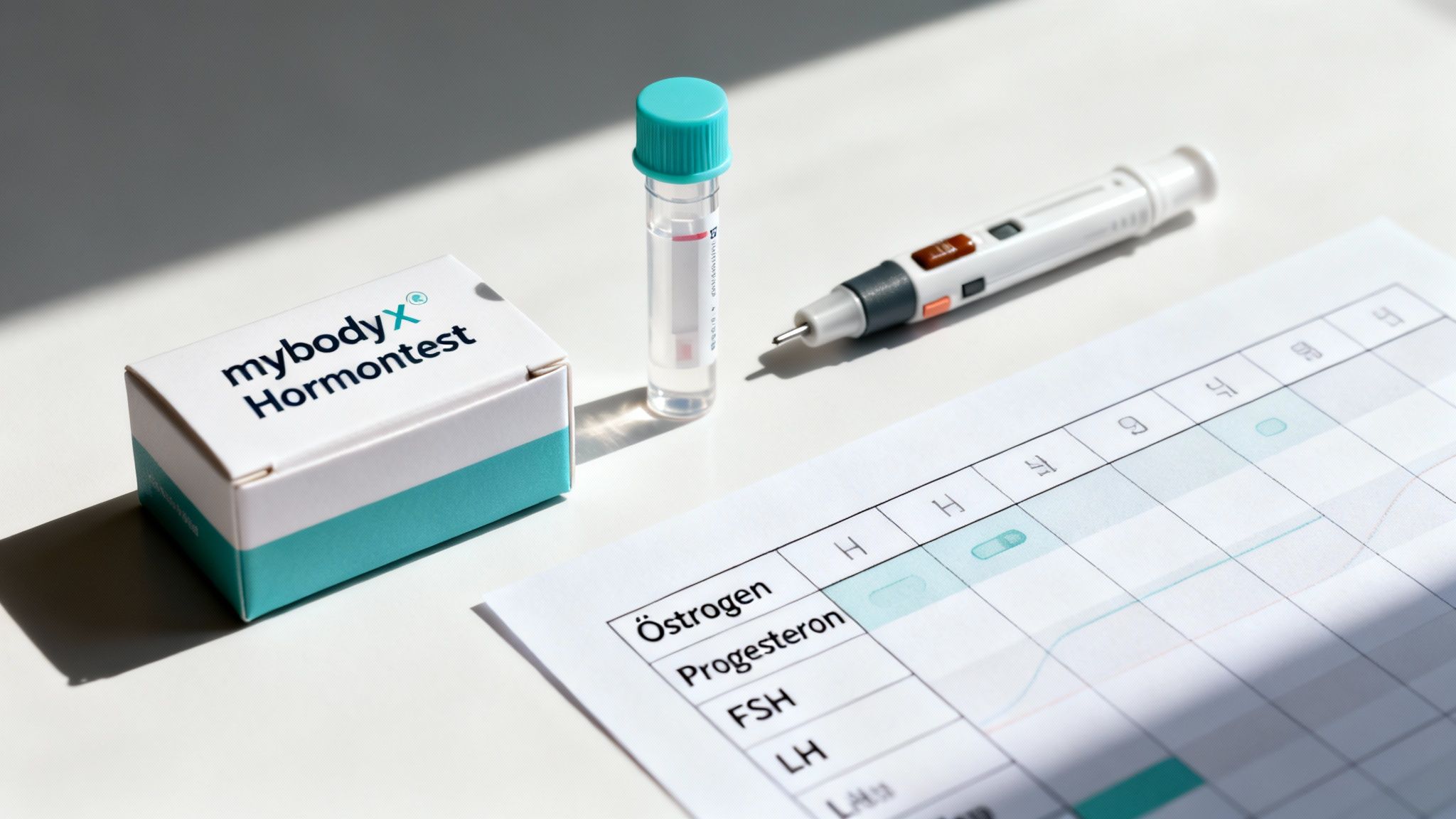
When the hormonal orchestra falls out of tune
Hormonal imbalance is not uncommon. It is the invisible force behind many symptoms that women experience month after month but often dismiss as “normal.”
Maybe one or two of these sound familiar:
- Menstrual irregularities: Your period comes irregularly, suddenly stops altogether, or is much heavier or lighter than usual.
- Intense PMS: During the second half of your cycle, you suffer from extreme mood swings, feel irritable or anxious, or feel depressed.
- Persistent lack of energy: Chronic fatigue sets in, no matter how much you sleep.
- Unexplained weight gain: Despite a healthy diet and exercise, you gain weight, especially around the abdomen.
- Skin problems: You struggle with acne, oily skin, or hair loss that worsen with your cycle.
- Sleep problems: You have trouble falling asleep or staying asleep, especially shortly before your period.
These symptoms are not imagined. They are clear signals from your body that your hormonal balance is disrupted. The cause almost always lies in the ratio between the key hormones.
A hormonal imbalance is like an instrument that is out of tune. It can still produce notes, but the melody sounds off and feels exhausting. Your body is trying to tell you exactly that.
The key players: estrogen and progesterone
To understand why an imbalance can cause so many problems, let’s take a look at the main roles of the two most important hormones in your cycle:
Estrogen The energy and growth hormone. It dominates the first half of the cycle, supports the development of the uterine lining, strengthens the bones, and boosts mood and libido. Too much estrogen in relation to progesterone (known as estrogen dominance) can, however, lead to PMS, water retention, and heavy bleeding.
Progesterone The calming and balancing hormone. It takes command during the second half of the cycle, prepares the body for a possible pregnancy, has a relaxing effect, and promotes sleep. A progesterone deficiency often leads to short cycles, anxiety, sleep problems, and PMS.
The balance between these two is therefore the key to your well-being. If one of the players is too dominant or too weak, the entire system becomes unstable.
How a mybody-x.com hormone test gives you clarity
You no longer have to grope in the dark and wonder what is going on in your body. Instead of merely treating symptoms, you can finally find the cause. This is exactly where the at-home tests from mybody-x.com come in. They are a simple yet remarkably effective tool that gives you precise insights into your hormone levels—from the comfort of your own home.
A blood test measures the exact concentrations of your key hormones. This is crucial because you can only take targeted action when you know your levels. A hormone test can tell you, for example, whether you have estrogen dominance or a progesterone deficiency.
Timing is crucial. Because hormone levels are constantly changing, the blood sample must be collected at a very specific time—generally during the luteal phase (around cycle days 19–21). Only then can the important progesterone-to-estrogen ratio be assessed accurately.
The results are far more than just numbers on a piece of paper. They’re the first step toward a better understanding of your body and help you identify the root cause of your symptoms. This enables you to take targeted action—whether by adjusting your diet, changing your lifestyle, or taking targeted nutritional supplements. If you’d like to learn more about how to test your hormone balance and restore it, you’ll find all the important information in our guide.
How mybody-x.com supports you on your path to hormonal balance
You’ve heard your body’s signals, recognized the patterns, and no longer want to simply treat the symptoms. Perhaps it feels as though your hormonal orchestra is no longer playing in the right rhythm. But what is the next truly concrete step? That’s exactly where we come in, supporting you on your path to greater clarity and balance.
At mybody®x, we know from experience that you’re looking for more than just a test result—you’re looking for a real solution. That’s why we’ve developed a process that not only provides you with data but also actively supports you in taking charge of your well-being again. For health-conscious people like you who focus on prevention and holistic approaches, that makes all the difference.
Your path to clarity in three simple steps
We understand that your everyday life is already busy enough. That’s why we’ve deliberately made the path to valuable insights into your hormone status simple and straightforward. You don’t need to make appointments or put up with long waiting times.
- Order your test and complete it conveniently at home: Choose the right hormone or nutrient test on our website. The test kit will be delivered straight to your home. Collecting the sample—a small prick in your finger—is easy, painless, and takes just a few minutes.
- Analysis in a certified laboratory: You send your sample free of charge in our prepaid return envelope to our ISO-certified partner laboratory in Germany. There, it is analyzed according to the highest quality standards.
- Receive easy-to-understand results: Your results will be ready after a short time. But don’t worry—we won’t leave you alone with confusing lab values.
The real added value lies not only in the “what,” but also in the “how.” We translate complex medical data into clear, understandable language and provide you with a concrete roadmap tailored precisely to your needs.
More than just a result: Your personal action plan
Your results report is the starting point of your journey, not the destination. Don’t think of it as merely a collection of numbers. You’ll receive a detailed, easy-to-understand report that shows you exactly where your values fall within the optimal range and where there may be imbalances.
But the heart of it all is the personalized action recommendations. Based on your individual results, we provide you with specific, practical tips in the following areas:
- Nutrition: Which foods can help you naturally regulate your hormones?
- Lifestyle: Which small adjustments to sleep, stress management, or exercise can make a big difference?
- Nutrients: Which vitamins or minerals could be particularly important for you to support balance?
These recommendations are your personal compass for specifically supporting your menstrual cycle and your body. The goal is to give you the knowledge you need to make informed decisions about your health.
You’re not alone on this journey
Knowing your own values is the first step, but putting that knowledge into practice is often the biggest hurdle. That’s why our support doesn’t end with the results report. We know that questions may arise or that you may be unsure how best to integrate the recommendations into your everyday life.
Exactly for this reason, we offer you free coaching with our health experts. In a personal conversation, you can ask all your questions and make sure you truly understand your results and can confidently take the next steps.
The female cycle is unfortunately still far too often a taboo subject. According to a representative survey, 85 percent of women believe that it is not discussed enough in public, causing many to suffer in silence. At the same time, 60 percent of women already actively track their cycles to better understand their bodies. An at-home blood test is the ideal way for health-conscious women to identify imbalances at an early stage. Learn more about the study results on women's health.
With more than 11,314 satisfied customers and a money-back guarantee, we build trust and show you that you’re not alone with your questions and your desire for greater well-being. We’re here to support you on your journey toward hormonal balance.
Your cycle compass: answers to the most frequently asked questions
So, we’ve now spent quite some time exploring the world of the menstrual cycle together. To wrap things up, I’d like to address the questions we’re asked again and again and that concern many women. Here you’ll find clear, concise, practical answers to clear up any remaining question marks and give you even more confidence when it comes to understanding your body.
Is an irregular cycle always a cause for concern?
Not necessarily. Occasional fluctuations of a few days are completely normal. Your body is not a machine, and things like stress, travel, or a change in diet can sometimes throw off its rhythm.
However, you should pay attention if your cycle remains irregular over time—meaning it is regularly shorter than 21 days or longer than 35 days. The same applies if your period simply fails to occur for several months (and you can safely rule out pregnancy). This is often caused by a hormonal imbalance, which can be managed effectively with the right information and measures.
What role does nutrition play in my cycle?
A huge one! Imagine your hormones are like a house—and your diet provides the building blocks. Without the right materials, no stable house can be built. A balanced diet rich in vitamins, minerals, healthy fats, and proteins is therefore essential for a healthy hormonal balance.
Nutrients such as magnesium, which can work wonders for cramps, or iron, which helps replenish blood lost during menstruation, are particularly important. A deficiency in these building blocks can lead to more severe PMS symptoms, low energy, or menstrual irregularities. A nutrient test from mybody-x.com can show you specifically whether you have a deficiency.
Can I improve my hormone levels without a blood test?
Absolutely! A healthy lifestyle is always the first and most important step and can already make a big difference. Things like good stress management (yoga or meditation are worth their weight in gold!), enough sleep, and a nutrient-rich diet provide the perfect foundation.
But honestly? Without a test, it's a bit like feeling around in the fog. You try general tips without knowing exactly where your body really needs support. A test is like a personal map of your body.
A blood test, such as the one from mybody-x.com, shows you in black and white whether and where there are issues with your hormone balance or whether a nutrient deficiency is causing your symptoms. This allows you to target the right areas effectively—tailored to your individual needs.
What is the difference between PMS and PMDD?
Good question, because the two terms are often lumped together, but they describe very different levels of severity.
-
PMS (Premenstrual Syndrome): This is the “classic.” It encompasses a wide range of physical and emotional symptoms that appear during the second half of the cycle. Mood swings, cravings, crushing fatigue, or breast tenderness—all of these are part of it. Many women experience these symptoms to varying degrees.
-
PMDD (Premenstrual Dysphoric Disorder): This is a significantly more severe form of PMS in which the psychological symptoms are so intense that they severely impair everyday life. Those affected experience extreme irritability, anxiety, outbursts of anger, or depressive moods that can seriously strain relationships and work.
While PMS can often be managed well with lifestyle adjustments, suspected PMDD should always be addressed by a medical or mental health professional. If you recognize yourself in the symptoms of PMDD, please don't hesitate to seek professional help.
Are you ready not only to hear your body's signals, but truly understand them? A blood test from mybody-x.com can give you the clarity you need to specifically support your menstrual cycle and well-being. Discover now how you can take your health into your own hands.

Share now:
Understanding women’s health: Your path to greater well-being
What not to eat with histamine intolerance: specifically avoid symptoms