
Understanding women’s health: Your path to greater well-being
Do you often feel tired, drained, or simply unlike yourself? You are not alone. Many women are familiar with this vague feeling that their body is trying to tell them something, but they cannot properly interpret the signals. Truly understanding women’s health means recognizing the subtle connections between hormones, nutrients, and your well-being, rather than merely combating symptoms.
Why understanding your body is the key to everything
Every female body is a unique system and communicates with you constantly—through your menstrual cycle, fluctuating energy levels, or your mood. Yet we have often never learned to understand this language. Instead, we accept constant fatigue, mood swings, or digestive problems as “normal” or “just typical for women.”
But it doesn’t have to be this way. Understanding your body is the most important step toward regaining control and taking an active role in your well-being. It is about moving from passively enduring things to actively shaping your health.
The hidden causes behind everyday complaints
Many everyday problems often have deeper causes than you might suspect at first glance. Persistent stress, an unbalanced diet, or the major hormonal changes in a woman’s life can seriously disrupt her inner balance.
Understanding your body enables you to ask the right questions and uncover the true causes of feeling unwell, rather than focusing only on the surface—the symptoms.
Your body is particularly sensitive during phases of hormonal change, such as puberty, after pregnancy, or in the years leading up to menopause. Although these changes are natural, nutrient deficiencies or a stressful lifestyle can intensify them to the point where they significantly affect your everyday life.
The figures show how relevant this topic is. In Germany, women are more frequently affected by incapacity for work than men. An AOK health report showed that the health rate among women was only 33.0 percent, compared with 39.8 percent among men. Days absent due to psychological stress have risen sharply, especially among women. However, these are often caused by very specific, treatable issues such as iron deficiency, hormonal imbalances, or other nutrient deficiencies. The full AOK health report provides more details.
Your compass to greater well-being
Think of this guide as your personal compass. It is designed to help you finally understand the complex yet incredibly fascinating processes taking place in your body. We will show you:
- How your cycle and hormones really work: Discover why your energy levels and mood go on a roller coaster ride throughout the month and what you can do about it.
- Which nutrients are essential for you: Learn how a deficiency in iron, vitamin D, or B vitamins directly affects your performance and well-being.
- How to gain clarity with mybody-x self-tests: Find out how easy it is to check your hormone or nutrient status from home, so you can get targeted answers instead of mere guesses.
A deep understanding of your health is also invaluable during special phases of life, such as pregnancy. Here you will find important rights and information during pregnancy. Get ready to take the reins again and finally get to know your body properly.
How your body functions as a finely tuned system
Imagine your body as a perfectly coordinated orchestra. Each instrument has its own unique role, but only when they all play in harmony does a harmonious melody emerge. Your hormonal system is the conductor—it sets the tempo and ensures that everything works together smoothly. Hormones are, so to speak, the secret messengers that control everything: your mood, your energy levels, your sleep, and of course your menstrual cycle.
This finely tuned system is incredibly powerful, but also sensitive. Even minor disruptions, such as ongoing stress or a simple nutrient deficiency, can throw the conductor completely off beat. Suddenly, the instruments no longer play together, and the melody of your well-being sounds discordant.
The heart of women's health: your cycle
The menstrual cycle is so much more than just your period. It is the central rhythm that determines women's health and, essentially, a reflection of your inner balance. This monthly dance is primarily controlled by two hormones: estrogen and progesterone.
It is best to think of the two as a dynamic duo that perfectly complements each other:
- Estrogen (the energizing hormone): During the first half of the cycle, this hormone provides energy and optimism and builds up the uterine lining. It is like spring in your body—everything awakens, grows, and blossoms.
- Progesterone (the calming hormone): After ovulation, progesterone takes over. It prepares the body for a possible pregnancy, has a calming effect, and promotes restful sleep. Think of it as the gentle late summer that provides peace and balance.
This interplay is absolutely crucial. When the balance between the two gets disrupted—for example, by a progesterone deficiency, which can often begin in the mid-thirties—a condition known as estrogen dominance develops. The consequences are usually the typical complaints that many women mistakenly dismiss as “normal”: severe PMS, mood swings, sleep disorders, or painful periods.
This infographic clearly illustrates the different hormonal stages of a woman's life.
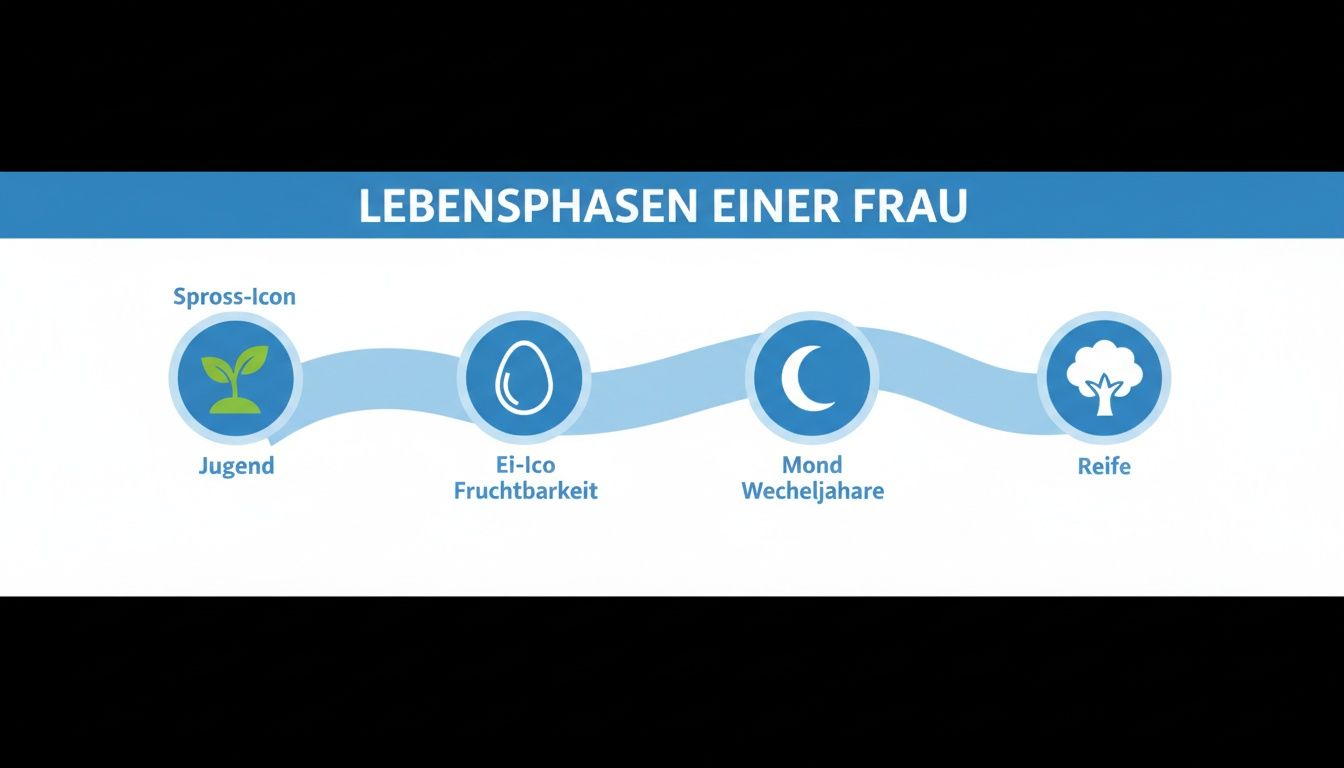
As the illustration shows, the female body goes through entirely natural cycles of change, each shaped by its own hormonal conditions.
More than just genes: the role of epigenetics
But your hormonal system does not respond only to signals from within. It is also heavily influenced by your lifestyle—including your diet, stress levels, sleep, and how much you exercise. And this is exactly where epigenetics comes in. It is a fascinating field of research that explains how our environment and behavior can control our genes without changing the DNA itself.
You are not helplessly at the mercy of your hormones. With the right information and targeted lifestyle adjustments, you can actively influence your hormonal balance.
Your body is constantly sending you signals. An irregular cycle, severe period pain, or unexplained fatigue are not whims of nature but valuable messages. They invite you to take a closer look and understand what is happening in your finely tuned system. To make truly well-informed decisions, it is helpful to understand what epigenetics is and how you can use it to your advantage.
A mybody-x hormone test can help you take the first crucial step and obtain objective data about your current hormone status. Instead of groping in the dark, you finally gain clarity about exactly where your inner orchestra has fallen out of tune.
Common complaints and what is really behind them
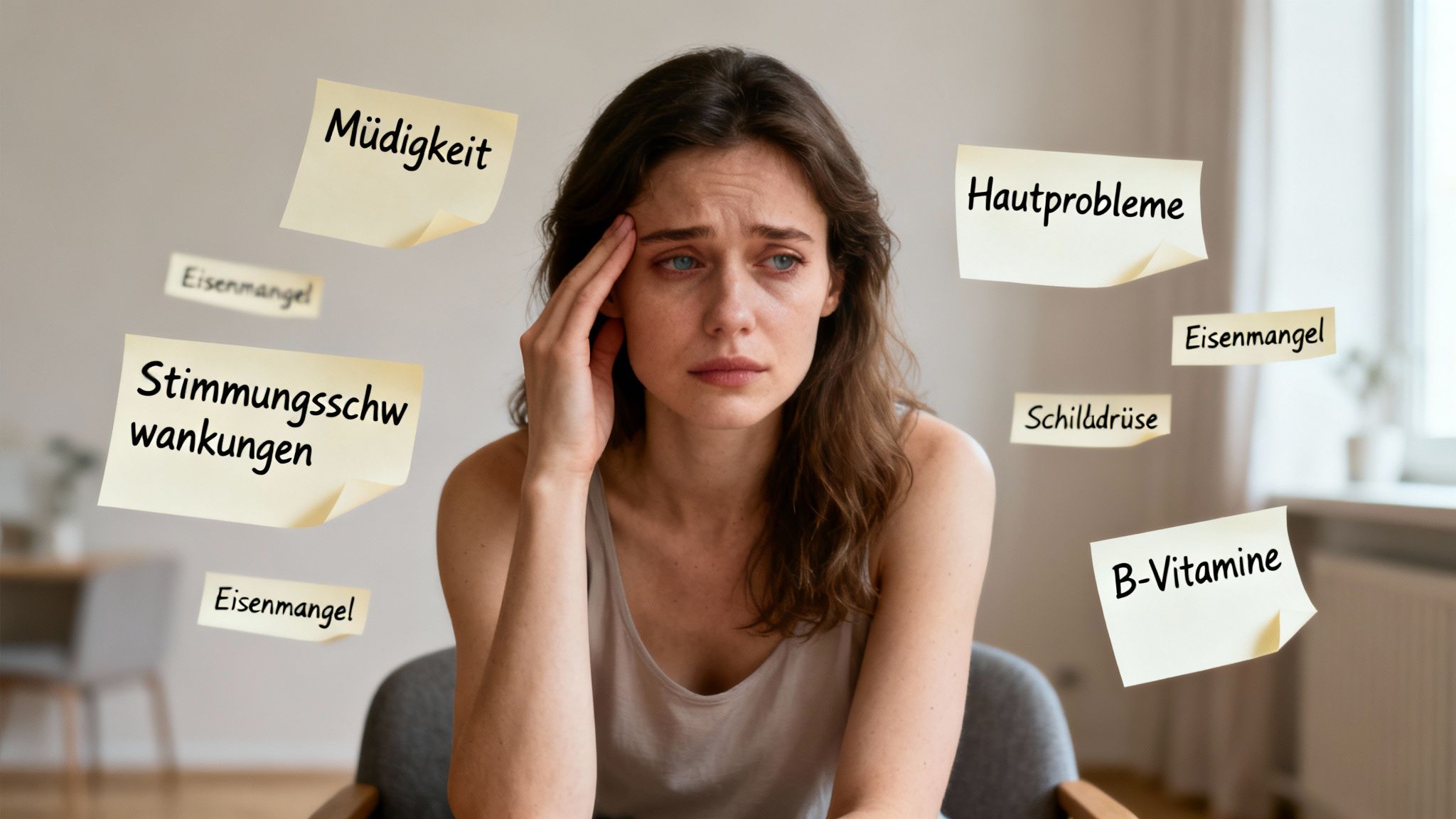
Does this sound familiar? You feel as though you go through every day with the handbrake constantly on. Fatigue that simply refuses to go away, unexplained mood swings, or skin problems—for many women, this is unfortunately everyday life.
We quickly attribute such symptoms to stress at work or personal worries. But these are often merely external triggers that bring a deeper imbalance to the surface. The true causes of your discomfort are often hidden in your hormone and nutrient balance.
Rather than simply fighting the symptoms, the goal is to decode your body’s language.
From fatigue to low moods: Investigating the clues in your body
When the finely tuned orchestra in your body falls out of rhythm, you experience it in many different ways. Let’s take a closer look at some of the typical complaints and uncover what may really be behind them.
Take constant exhaustion, for example. A true classic. Many women feel chronically tired even though they actually get enough sleep. The cause is often iron deficiency, one of the most common nutrient deficiencies among women before menopause. Monthly bleeding regularly causes iron loss, which slows the production of red blood cells and therefore the transport of oxygen throughout the body. The result: You feel weak, unfocused, and lacking in energy.
Your mood is also significantly influenced by your internal balance. Studies show that women are about twice as likely as men to experience depressive moods. Biological factors such as hormonal fluctuations play a central role here. For example, low progesterone levels can lead to inner restlessness and sleep problems, while an imbalance in thyroid hormones can bring your entire metabolism and mental energy to a standstill.
The following table shows how closely common symptoms can be connected to your internal balance. It serves as a guide to help you better interpret your body’s signals and find the right mybody-x test.
| Typical symptoms and their possible causes | | :--- | :--- | :--- | | Common symptom | Possible cause | Suitable mybody-x test | | Constant fatigue, paleness, difficulty concentrating | Iron deficiency, vitamin B12 deficiency, underactive thyroid | Nutrient test | | Mood swings, irritability, PMS | Estrogen dominance, progesterone deficiency, magnesium deficiency | Hormone test | | Hair loss, brittle nails, dry skin | Zinc deficiency, iron deficiency, biotin deficiency, thyroid problems | Nutrient test, hormone test | | Sleep problems, inner restlessness, anxiety | Cortisol imbalance (stress), progesterone deficiency | Hormone test | | Unexplained weight gain, sluggishness | Underactive thyroid, insulin resistance, excess cortisol | Hormone test | | Digestive problems (bloating, cramps) | Imbalance in the gut microbiome, food intolerances | Intolerance test |
This overview makes it clear: Your symptoms are rarely isolated. Most of the time, they are part of a larger puzzle.
The delicate interplay of hormones and nutrients
Your body is not a collection of individual parts, but a highly intelligent, interconnected system. Hormones and nutrients work hand in hand. If there is a deficiency in one area, it can trigger a chain reaction.
Don’t view your symptoms as a personal weakness, but as valuable clues. Your body is trying to tell you that something is missing for it to function optimally for you.
Let’s take a closer look at the hormone estrogen. An imbalance, such as estrogen dominance, can not only cause severe PMS but also significantly increase the need for B vitamins and magnesium. If these important nutrients are lacking, the symptoms can become even more pronounced. If you’d like to explore this topic in greater depth, you’ll find detailed information about the symptoms of estrogen deficiency in our article.
Heart health is also often underestimated in women. Yet cardiovascular disease is the leading cause of death among women in Germany and accounts for 37 percent of all female deaths. Risk factors such as high blood pressure often go undetected because the symptoms manifest differently than in men. The risk increases particularly during menopause, as hormonal changes also affect metabolism.
Your path to greater clarity
These examples show how complex the connections can be. Instead of groping in the dark and guessing what might be behind your symptoms, you can actively seek targeted answers.
A mybody-x nutrient or hormone test for home use is the first crucial step toward gaining clarity. It provides concrete data about your individual status and helps you identify the real causes of your symptoms.
With this knowledge, you can finally make informed decisions about your health—whether through an adapted diet or targeted supplements. It’s the direct path from guesswork to active self-care.
How to take an active, self-determined approach to menopause
Menopause is not an illness. It is one of the most powerful and natural transformations in a woman’s life. Yet many women feel unprepared or unsettled by myths. It’s time to demystify this stage of life and see it as an opportunity: your opportunity to consciously and actively reshape your health.
Menopause, also medically known as the climacteric, doesn’t only begin when your period stops. The transition often starts very gradually in your forties with what is known as perimenopause. During this transition, your body slowly reduces its production of the hormones estrogen and progesterone. This very hormonal fluctuation causes many of the typical symptoms.
What happens hormonally in your body
Imagine that your well-coordinated hormonal duo, estrogen and progesterone, which directed your cycle for decades, is slowly stepping off the stage. Progesterone levels usually decline first, which can lead to relative estrogen dominance. Later, estrogen production also steadily decreases until the ovaries eventually stop working altogether.
This decline is not a system error but a completely normal, planned transition. However, it affects far more than just your fertility.
The hormonal changes of menopause affect your entire body—from the brain and cardiovascular system to your bones.
The effects of this change can vary widely and differ in intensity from woman to woman. The best-known signs include:
- Hot flashes and night sweats: They occur because declining estrogen levels disrupt the temperature-regulating center in your brain.
- Sleep disturbances: Often a direct result of night sweats, but a lack of the calming hormone progesterone can also rob you of sleep.
- Mood swings: Hormones directly affect neurotransmitters in the brain, such as serotonin, our “feel-good hormone.”
- Dry skin and mucous membranes: Estrogen is essential for the moisture and elasticity of the skin and tissue.
- Changes in metabolism: Many women find that they gain weight more easily, even though they have not changed their eating habits.
The important thing is: You are not helplessly at the mercy of these changes. This is a huge issue, especially in Germany: Around 13 million women of working age are going through menopause, yet many feel left alone with their symptoms. One study shows that only about one-third of women feel sufficiently taken seriously by doctors, even though the symptoms send clear signals of an imbalance. If you would like to learn more about the current healthcare situation, you can find further insights into women's health in Bavaria here.
Take proactive control of your health
Menopause is the perfect time to reset the course for your long-term health. Because the protective effects of estrogen are no longer present, preventing osteoporosis (bone loss) and cardiovascular disease now take center stage.
A diet rich in calcium and vitamin D, along with regular strength training, is now essential for maintaining your bone density. Just as important is a heart-healthy diet with healthy fats and sufficient fiber.
But generic advice only goes so far. Understanding women’s health means knowing your own personal needs. Are you already noticing the first signs of perimenopause, or do you simply want to know where you stand? A mybody-x hormone test for home use gives you precise insights into your current hormone status. It provides the data you need to make the right decisions for yourself – and to navigate this stage of life actively and with energy. Learn more about how such a test works in our article on the at-home hormone test.
How to gain clarity with mybody-x self-tests
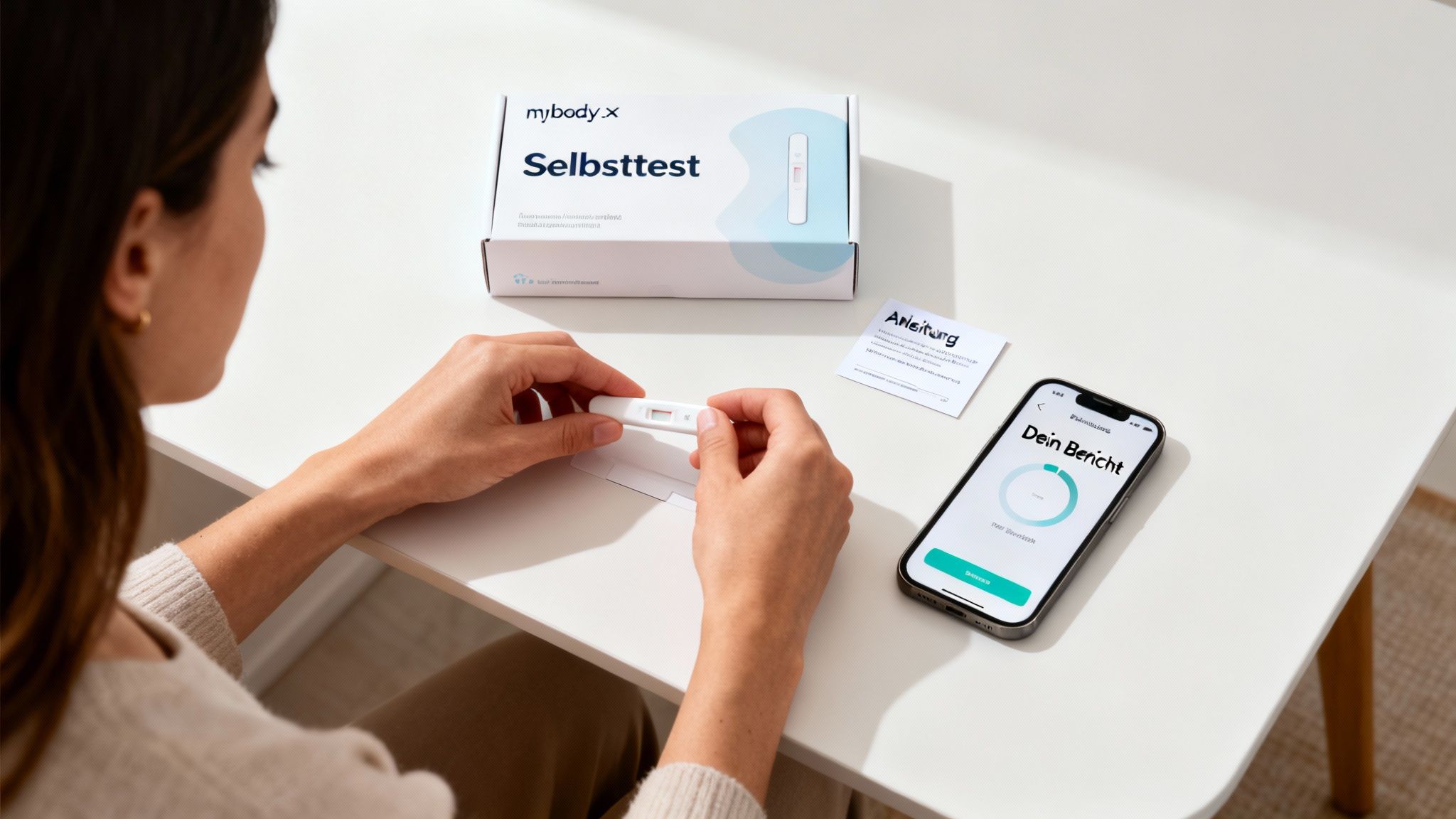
The constant uncertainty about your health can be exhausting. Do you really have to put up with unexplained fatigue, mood swings, or digestive problems? Definitely not. Modern at-home self-tests are now the easiest and most direct way to finally gain valuable insights into your body.
The tests from mybody-x were developed precisely for this purpose: They give you clarity – conveniently, discreetly, and based on science. Instead of continuing to guess, you get concrete data about your hormones, nutrients, or possible intolerances. This knowledge is the foundation for truly understanding women’s health and finally making informed decisions for yourself and your body.
The easy way to your personal answers
You may be thinking that a test for home use is complicated. But the opposite is true. The entire process is designed so that you can easily integrate it into your everyday life. Basically, there are just three simple steps that take you from a vague suspicion to concrete recommendations for action.
And here’s how it works in detail:
- Easy sample collection at home: Simply order the right test kit online. It contains everything you need. Depending on the test, all you need is a small blood sample from your fingertip, a saliva sample, or a stool sample. The instructions are incredibly easy to follow, so you can collect your sample safely and hygienically in just a few minutes.
- Professional laboratory analysis in Germany: You send your sample directly to our partner laboratories in the enclosed return envelope. These are the same ISO-certified German specialist laboratories that doctors and clinics also work with. Your sample is analyzed here using the most advanced methods.
- Your personal results report: Your results will be available shortly—clearly and understandably presented in your personal online portal. You can see at a glance which of your values are in the green range and where action may be needed.
The goal of mybody-x tests is not to leave you alone with raw data. It is about explaining the connections and giving you concrete, personalized recommendations that you can put into practice immediately.
Which test is right for your question?
Every woman is different, and every stage of life brings its own challenges. That is why it is so important to find the test that answers your specific question. mybody-x has developed tests that target the most common health concerns affecting women.
- Hormone test for cycle problems or menopausal symptoms: Do you suffer from severe PMS, irregular cycles, or notice the first signs of perimenopause? A hormone test provides a valuable snapshot of your key female hormones, such as estrogen and progesterone.
- Nutrient test for low energy or exhaustion: Do you constantly feel tired, have trouble concentrating, or struggle with hair loss? A nutrient test detects deficiencies in critical vitamins and minerals such as iron, vitamin D, or B12.
- Food intolerance test for digestive problems: Does your stomach rebel after eating with bloating or pain? A food intolerance test analyzes your reaction to many different foods and helps you identify the real culprits.
These targeted tests take you beyond general advice and provide insights that apply specifically to you. Understanding your own biological data is a huge step forward. If you would like to delve deeper into how your genes and lifestyle interact, read more in our article about the connection between menstrual cycles and DNA tests for women's health.
mybody-x tests are your tool for moving from passively enduring things to actively shaping your health. They give you back control and empower you to take charge of your health based on facts.
Take control of your health
Understanding your health is like learning a new language—the language of your own body. You have now seen how closely your hormones, nutrient levels, and daily well-being are interconnected. Every signal your body sends you—whether constant fatigue, an irregular cycle, or mood swings—is valuable information. It is an invitation to take a closer look.
Stop living with uncertainty or simply dismissing symptoms as “normal.” Now is the time to take action. Because it is your body, your health, and your life.
Your partner for greater clarity
The self-tests from mybody-x are your reliable partner. They are more than just a product—they are a tool that delivers precise data and personalized recommendations right to your home. Completely discreet, scientifically sound, and without the long waiting times at the doctor's office.
- Hormone tests give you clear insight into the delicate balance between estrogen and progesterone.
- Nutrient tests specifically reveal whether a deficiency in iron, vitamin D, or B vitamins is draining your energy.
- Intolerance tests can help you finally find the cause of recurring digestive problems.
This knowledge is the foundation for real change. It empowers you to make informed decisions at last and take responsibility for your health into your own hands.
You are the expert on your own body. mybody-x tests provide the facts you need to support your intuition and take targeted action.
Whether you want to improve your diet, adjust your lifestyle, or have an informed conversation with your doctor, you are now in control. You no longer have to guess—you can finally take action.
Start your journey toward more energy, inner balance, and joy in life today. Your body will thank you.
Your questions—our answers about women's health
There are many questions surrounding women's health—we hear them time and again. Here, we have collected and answered the most frequently asked questions for you. They are designed to help you gain clarity and confidently take the next steps toward your well-being.
When is an at-home hormone test relevant for me?
A hormone test is a great support when you finally want to understand what is behind certain symptoms. Does this sound familiar? Your cycle is out of sync, PMS is driving you up the wall, you are constantly tired, or perhaps you are already noticing the first signs of perimenopause, such as hot flashes and restless nights.
A test gives you a clear snapshot of your most important hormones, such as estrogen and progesterone. This lets you see in black and white whether there is an imbalance. This information is worth its weight in gold, because it finally allows you to address the causes instead of just treating the symptoms. It is the perfect foundation for taking targeted action for your well-being.
Which nutrients are particularly important for us women?
Your body accomplishes an enormous amount every month. Because of your menstrual cycle, pregnancies, and constant hormonal changes, as a woman you often have very different nutrient needs than men—needs that are unfortunately overlooked far too often. A deficiency can quickly show up as lower energy and reduced well-being.
Here are the “Big Five” for you as a woman:
- Iron: Absolutely crucial for blood formation. If you often feel exhausted, iron deficiency caused by menstruation could be the reason—one of the most common causes of chronic fatigue.
- Vitamin D: The sunshine vitamin is an all-rounder for strong bones, a fit immune system, and a good mood. Especially during the darker months, many of us quickly become deficient.
- Vitamin B12: Your personal powerhouse for energy production and strong nerves. Without enough B12, the engine simply doesn't run smoothly.
- Magnesium: The relaxation expert among the minerals. It relaxes your muscles (great for period cramps!) and calms your nervous system when everyday stress gets too much.
- Folic acid: Essential not only during pregnancy. Folic acid supports cell division and blood formation every day.
A mybody-x nutrient test shows you exactly where you have deficiencies. This allows you to tailor your diet or supplements precisely instead of groping in the dark.
How reliable are the results of mybody-x tests?
Let's be honest: The reliability of our results is our top priority. Your journey to understanding women's health starts with data you can rely on 100%. That's why we send every single sample to ISO-certified German specialist laboratories. These are the exact laboratories that doctors and clinics also work with, and they operate according to the highest quality standards.
Your health is deeply personal—and we treat your data accordingly. It is protected under strict German data protection regulations (GDPR) and treated with the utmost confidentiality.
With us, you get more than just precise, scientifically grounded laboratory results. We translate them into clear explanations and give you specific, actionable recommendations. A mybody-x test gives you the clarity you need to correctly interpret your results and plan your next steps.
Are you ready to decode your body's signals and take your health into your own hands? At mybody-x, you'll find the right test to finally get clarity. Discover how scientifically grounded insights can help you take your well-being to the next level in a targeted way.


Share now:
Iron deficiency and diffuse hair loss: What really helps
Understand the menstrual cycle – relieve symptoms