
Low progesterone symptoms: Recognizing them, causes & tests
Have you often felt inexplicably tired lately, become easily irritated before your period, or noticed that your cycle is irregular? These could be your body's early warning signs of low progesterone levels. Think of progesterone as your cycle's feel-good hormone—it promotes calm and stability and prepares everything for a possible pregnancy. When it is lacking, this delicate balance can quickly be disrupted.
Early signs to watch for if you have progesterone deficiency
If you feel that something is not right with your body, you are not alone. Many women experience symptoms they initially cannot identify, but a hormonal imbalance is often behind them. Progesterone deficiency can manifest through a wide range of physical and emotional signals that can significantly affect your everyday life.
Think of progesterone as the calming force in your cycle. It is the natural counterpart to stimulating estrogen and helps maintain balance. When this calming force weakens, estrogen can gain the upper hand—a state also known as estrogen dominance, which causes many of the typical symptoms.

Recognizing physical and emotional signals
The signs of progesterone deficiency are often nonspecific and gradually creep into everyday life. At first, you may notice only slight irritability before your period or more restless sleep. Over time, however, these signals can intensify and become a real burden on your well-being.
It is important to take these messages from your body seriously. They are not imagined, but often direct indications of an underlying hormonal imbalance.
A progesterone deficiency is one of the most common causes of menstrual irregularities and premenstrual syndrome (PMS). Studies suggest that up to 30% of women of childbearing age may be affected by undiagnosed progesterone deficiency.
To give you a better overview, we have summarized the most common physical and emotional symptoms of low progesterone in a table.
Common symptoms of progesterone deficiency at a glance
This table summarizes the most important physical and emotional signals that may indicate low progesterone levels.
| Symptom category | Typical signs | What happens in the body |
|---|---|---|
| Cycle & fertility | Irregular or short cycles, severe PMS symptoms, spotting, difficulty getting pregnant | Progesterone stabilizes the uterine lining. If it is lacking, the lining may shed prematurely. |
| Mood & Sleep | Mood swings, irritability, anxiety, depressive moods, sleep disturbances | Progesterone has a calming effect on the nervous system. A deficiency can lead to inner restlessness. |
| Physical well-being | Unexplained weight gain (especially around the abdomen), water retention, breast tenderness, headaches or migraines, fatigue | The hormone stimulates metabolism and has a diuretic effect. If it is lacking, the body may retain water. |
| Skin & Hair | Dry skin, brittle nails, hair loss | Progesterone supports collagen production and promotes healthy skin and hair. |
This overview serves as a first guide to help you better interpret your body’s messages. It can help you recognize whether it is time to take a closer look and gain clarity with an at-home hormone test from mybody-x. After all, you can only take targeted action and regain your well-being once you know the cause.
Progesterone and its role in your body: More than just a hormone
Imagine your hormonal system as a perfectly choreographed ballet. Estrogen is the dancer who provides energy for growth, development, and dynamism. Progesterone is her partner—the stabilizing force that ensures balance, equilibrium, and harmony in every movement. Without it, the dance would quickly fall out of step and become chaotic.

Progesterone, often also called the corpus luteum hormone, is produced mainly after ovulation during the second half of the cycle. Its name already reveals one of its most important functions: The Latin term “pro gestare” means something like “for pregnancy.” It prepares the uterine lining perfectly for the possible implantation of a fertilized egg and is crucial for maintaining a pregnancy.
Much more than just a pregnancy hormone
But progesterone’s effects are by no means limited to fertility. This hormone is a true multitasker and influences your daily well-being in many ways.
- Regulates your cycle: After ovulation, it slows the growth of the uterine lining and stabilizes it. This helps ensure a regular, healthy cycle.
- Promotes restful sleep: Progesterone has a calming effect on the central nervous system. Many women notice this because they sleep better and more deeply during the second half of their cycle.
- Stabilizes your mood: It is considered a natural mood booster, can relieve anxiety, and promote greater inner peace and calm.
- Has a diuretic effect: It helps your body get rid of excess fluid, thereby preventing uncomfortable water retention or feelings of tension.
Basically, progesterone is estrogen's direct counterpart. When this finely tuned balance tips because there is too little progesterone, estrogen dominance can occur. This imbalance is often the true cause behind many of the typical symptoms of low progesterone.
When hormonal balance is disrupted
So when the balancing dance partner progesterone falters, the stimulating estrogen takes sole control of the dance floor. You often feel the result immediately: from PMS and sleep disorders to unexplained weight gain. The harmony is disrupted.
That is precisely why it is so important to understand your body's messages. Through these symptoms, it is sending you clear signals that balance needs to be restored. If you would like to delve deeper into these connections, our article explains how you can regulate your hormone balance. A hormone test from mybody-x can help you gain clarity about your current status.
When cycle disorders and PMS dictate your everyday life
Irregular cycles, constant spotting, or premenstrual syndrome (PMS) that leaves you incapacitated every month—these are not normal side effects of being a woman. On the contrary: your body is sending you unmistakable signals that something has fallen out of balance. And often, a low progesterone level is behind it.
When the calming progesterone is lacking, its stimulating counterpart, estrogen, quickly gains the upper hand. This hormonal imbalance, also known as estrogen dominance, is one of the most common causes of many classic cycle problems.
Typical cycle symptoms of progesterone deficiency
You can often tell most clearly from the course of your cycle whether your progesterone is too low. Does one of these patterns sound familiar?
- Shortened second half of the cycle: The period after ovulation, known as the luteal phase, normally lasts around 12 to 14 days. If it is shorter than 10 days, this is referred to as luteal phase deficiency—an direct sign of insufficient progesterone.
- Spotting before your period: Progesterone keeps the uterine lining stable and ready for possible implantation. If progesterone levels drop too early, the lining begins to shed partially, which you notice as brownish spotting.
- Severe PMS: Irritability, mood swings ranging from low mood to depression, cravings, and sore breasts—all these symptoms are significantly intensified by the hormonal imbalance. Progesterone has a balancing effect on the psyche. When it is lacking, the days before your period feel much more intense and burdensome.
- Very heavy or painful periods: Without the dampening influence of progesterone, estrogen can allow the uterine lining to grow unchecked. The result: heavier bleeding and more painful cramps.
Low progesterone levels are not uncommon. According to data from the German Society for Gynecology and Obstetrics (DGGG), around 15–20% of women of reproductive age are affected by cycle problems. Progesterone deficiency plays a central role in up to 30% of these cases. A shortened luteal phase in particular can make it more difficult for a fertilized egg to implant. You can read more about the link between progesterone and fertility on fertilly.com.
Why you should take these signals seriously
These symptoms are far more than just annoying. They are a clear indication that the hormonal architecture of your cycle has become unstable. A stable progesterone level is crucial not only for pregnancy but also forms the foundation for a regular, symptom-free cycle and your overall well-being.
If you suspect that a hormonal imbalance is behind your symptoms, you should not wait any longer. To find out whether estrogen dominance could be the cause, also read our article about the estrogen dominance test. A simple hormone test from mybody-x can provide clarity and is the first, most important step toward regaining control over your hormonal health.
Progesterone deficiency: Why you lie awake at night and feel tired during the day
Do you wake up constantly during the night or feel in the morning as though you have not slept at all? This feeling of being completely exhausted is one of the most frustrating symptoms of low progesterone levels. This hormone is far more than just a cycle hormone—it acts like a natural sedative for our nervous system.
Think of progesterone as a gentle lullaby for your body. It stimulates the production of GABA, a neurotransmitter in the brain that helps us switch off and relax. When progesterone levels drop, this “lullaby” grows quieter and quieter. The result: you simply cannot settle down in the evening, your sleep is light and superficial, and the slightest noise jolts you awake.
The vicious cycle of hormone deficiency and fatigue
These constant nighttime interruptions almost inevitably lead to profound exhaustion during the day. It is a vicious cycle: During the day, you are incredibly tired and can barely concentrate, but at night you are awake again. Naturally, this also takes a toll on your nerves. Without progesterone’s calming effect, you react much more sensitively to stress, feel overwhelmed more quickly, and may also be more irritable than usual.
It is important to understand: This lack of energy is not a personal failure or a lack of discipline. It is a clear biochemical signal from your body that your hormonal balance has been disrupted. You are not fighting against a lack of willpower, but against a tangible physical imbalance.
Sleep problems and fatigue caused by progesterone deficiency are extremely common. Millions of women in Germany are affected, especially in the years before and during menopause. The German Menopause Society estimates that around 80% of women experience symptoms during perimenopause. Of these, around 35% suffer from severe sleep problems, which are very often attributable to a decline in progesterone.
Its calming effect on the brain is so strong that a deficiency can have serious consequences. A Bavarian study involving more than 5,000 participants showed that when progesterone levels are below 5 ng/ml, the risk of difficulty falling asleep increases by a full 50%. You can read more about these connections directly from the Bavarian State Ministry of Health, Care and Prevention.
What your body is trying to tell you
So if you constantly feel exhausted, restless, and stressed, you should take these signals seriously. They could be the crucial indication that your progesterone levels have become imbalanced.
A hormone test from mybody-x can quickly and easily provide clarity. Find out whether a hormonal imbalance is behind your fatigue so that you can take the right steps toward more energy and restorative sleep.
Unexplained weight gain and water retention
Do you know this feeling? You watch what you eat and exercise regularly, but the scales suddenly show more anyway. This feeling of seemingly gaining weight for no reason is incredibly frustrating and undermines your self-confidence. But often, it has nothing to do with a lack of discipline; instead, it is a clear sign from your body: symptoms of low progesterone could be behind it.
When the balancing effect of progesterone is missing, its counterpart, estrogen, has free rein. This imbalance is called estrogen dominance, and it can seriously disrupt your metabolism. Your body begins storing more water and fat—typically exactly where you least want it: around the abdomen, hips, and thighs.
Why your body suddenly retains water
Think of progesterone as a natural aid for eliminating excess water. It helps your body easily get rid of excess fluid and sodium. But when progesterone levels drop, this effect is lost. The result: You feel bloated, heavy, and simply uncomfortable in your own skin.
This water retention (edema) often becomes particularly noticeable shortly before your period:
- A feeling of tightness in the breasts and abdomen.
- Swollen fingers that suddenly make rings feel tighter.
- Heavy, tired legs and deep sock marks around the ankles.
Many women simply accept these symptoms as a “normal” part of their cycle. Yet they are often a clear indication that your hormonal system has become imbalanced.
Water retention and sudden weight gain are classic signs of progesterone deficiency. In PMS, which affects 20–30% of women in Germany, low progesterone levels often cause a weight gain of 1–3 kg from water alone—and this happens anew every month. You can find out more from the experts at frauenaerzte-im-netz.de.
When hormonal chaos triggers cravings
As if that weren’t enough, progesterone deficiency is often accompanied by agonizing cravings, especially for sweet or salty foods. The hormonal imbalance causes your blood sugar levels to fluctuate and disrupts the production of feel-good neurotransmitters. Your body then practically cries out for quick energy in the form of sugar or the soothing sensation of salty snacks.
This can quickly become a vicious cycle: Your hormones cause your body to store more, while simultaneously making you crave more calories. Understanding this is the first step toward improvement. It shows you that the cause isn’t on your plate but in your hormonal balance.
If you suspect that your weight gain could be hormone-related, it’s time to get some clarity. Progesterone deficiency almost always goes hand in hand with a relative excess of estrogen. In our in-depth article, you can learn more about the connection between estrogen deficiency and weight gain.
A mybody-x hormone test can show you exactly how balanced your hormones are and help you finally take back control.
How to find out whether your progesterone level is actually too low
Do you suspect that your symptoms may indicate a progesterone deficiency? Guesswork won’t get you any further, but a reliable test can finally give you clarity. But when is the best time to measure it, and how does the whole process work? Here you’ll learn how to determine your progesterone level easily and reliably.
The key to a meaningful result is choosing the right timing. Since progesterone mainly rises after ovulation, measuring it during the first half of the cycle is not very useful. To capture the peak level, you should take the test in the second half of your cycle (the luteal phase)—ideally between the 19th and 22nd day of your cycle.
Your path to clarity—simply from home
With a mybody-x hormone test, you can take your health into your own hands, conveniently from home. No waiting for appointments, no crowded waiting rooms. Our test kit provides everything you need for simple and painless sample collection.
The process is designed to be straightforward and completely safe:
- Simple blood collection: A small prick in your finger is all it takes to collect the few drops of blood required. Our detailed step-by-step instructions will guide you through the process.
- Sending your sample to the laboratory: You can send your sample free of charge to our ISO 15189-certified German specialist laboratory. There, your progesterone level will be analyzed with the highest precision.
- Secure results: Your data is safe with us. We strictly comply with GDPR guidelines. You will receive your results quickly and clearly presented directly in your personal mybody-x account.
This graphic clearly shows how low progesterone levels can trigger estrogen dominance, which is often accompanied by symptoms such as water retention.
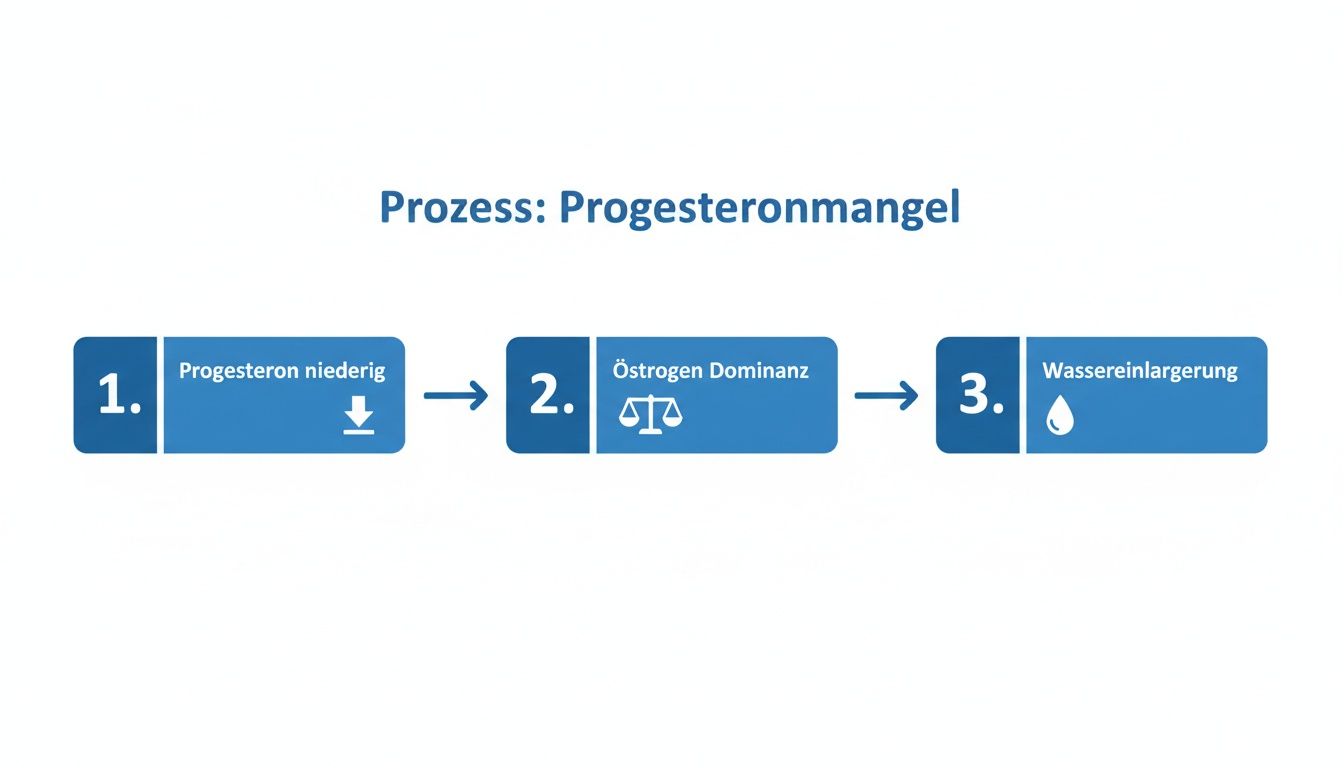
The visualization shows the chain reaction that a progesterone deficiency can trigger and emphasizes how important a balanced hormonal system is.
Your test result is much more than just a number—it is the starting point for your next steps. That’s why we offer you free coaching with our health experts. We’ll help you interpret your results correctly and develop a plan tailored precisely to you.
A test gives you the foundation you need to take targeted action against your symptoms. Find out more about how simple and informative a hormone test at home can be, and regain control of your hormonal health.
Answers to your most frequently asked questions
The same questions about progesterone deficiency come up again and again. We have collected the most important ones and answered them briefly and clearly so that no uncertainties remain.
Can I naturally increase my progesterone levels?
Yes, absolutely! You can actively support your body in producing more progesterone. A diet rich in vitamin B6 (e.g., in chickpeas and salmon), zinc (found in pumpkin seeds), and magnesium (in nuts or dark chocolate) provides a good foundation.
Stress is an often underestimated factor. The stress hormone cortisol is produced from the same precursor as progesterone. If you are constantly under pressure, your body uses up the building blocks for cortisol, leaving very little for progesterone. Methods such as yoga, meditation, or simply getting enough quality sleep can help lower your cortisol levels.
A targeted test can also show whether you have a nutrient deficiency, which you can then address specifically.
At what age is progesterone deficiency typical?
Progesterone deficiency can occur at any age after puberty. However, it is particularly common in women from their mid-30s onward and becomes more pronounced during perimenopause—that is, in the years before the final menstrual period, often beginning in the mid-40s.
During this phase of life, ovarian function gradually declines, and ovulation becomes less regular or stops altogether. Since progesterone is mainly produced after ovulation, levels naturally decrease. However, younger women who experience chronic stress, PCOS (polycystic ovary syndrome), or the effects of excessive exercise can also be affected.
Good to know: It is important to distinguish between progesterone and progestins. Progesterone is the body’s own, bioidentical hormone. Progestins, on the other hand, are synthetically produced substances with a similar effect. They are often found in contraceptives and can have very different side effects.
A test is the best way to understand your individual hormone levels—regardless of your age.
Are you ready to look beyond your symptoms and finally gain clarity about your hormones? The mybody-x hormone test offers you a simple, scientifically sound analysis at home. Find out what your body is trying to tell you and take charge of your well-being.



Share now:
What does a complete blood count tell you, and how do you interpret it?
Magnesium for nerves: What’s proven and what the blood test shows