
Iron deficiency and diffuse hair loss: What really helps
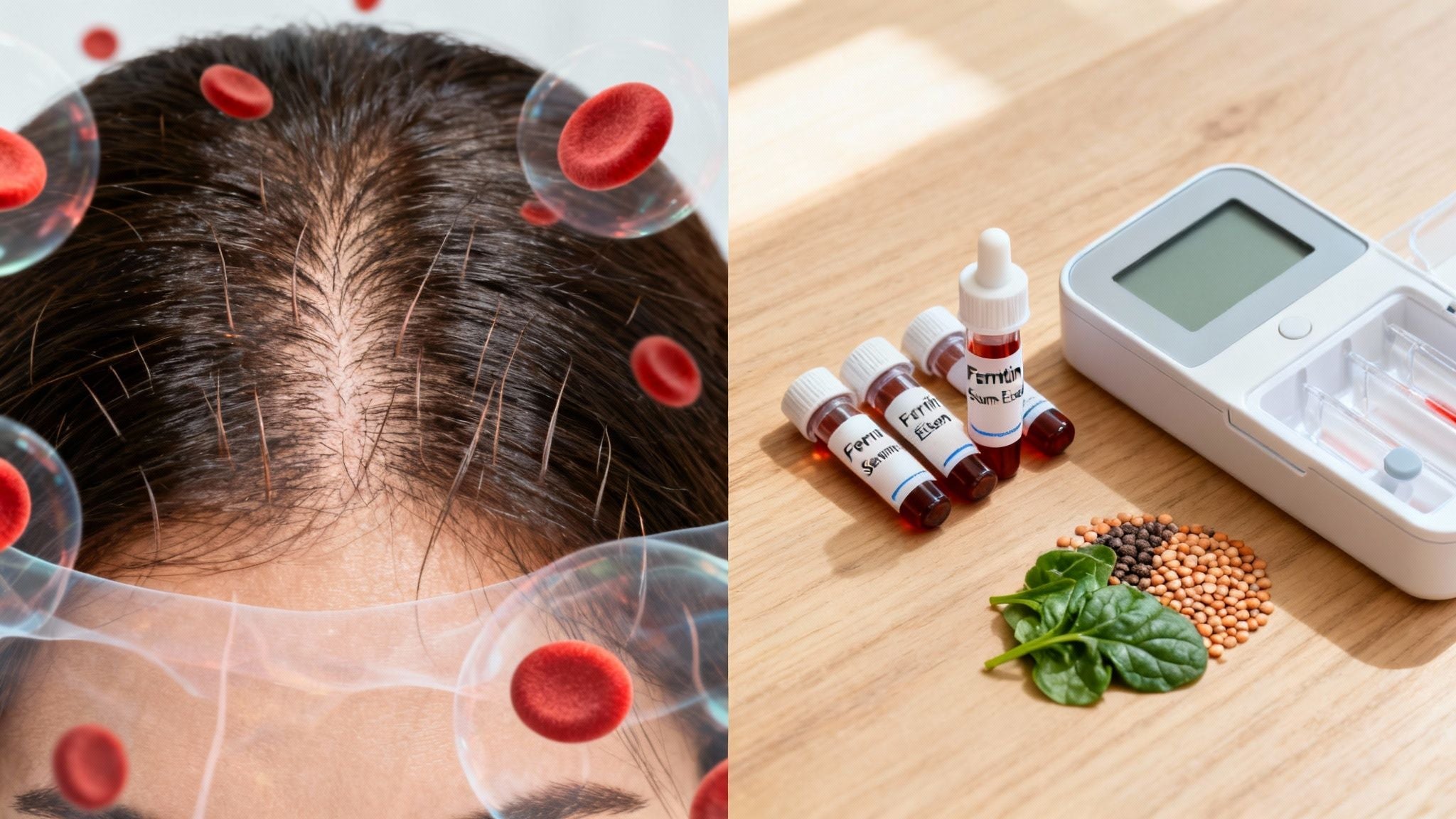
Yes, iron deficiency can directly cause diffuse hair loss. If your hair seems thinner overall rather than just in certain areas, this could be a clear warning sign. The reason is simple but significant: Your hair roots are no longer receiving enough oxygen and nutrients, which disrupts their growth and causes them to fall out sooner.
The hidden connection: How iron deficiency sabotages your hair growth
Have you been finding more and more hair in your brush or shower drain lately? Diffuse hair loss, in which your hair simply loses volume, is not only alarming—the search for its cause can also be truly frustrating. One of the most common, yet often overlooked, causes is a deficiency of the important trace element iron.
And this isn't mere speculation—it is well supported by scientific evidence. Imagine this: Your hair roots are among the most active and rapidly dividing cells in your entire body. They work nonstop to produce new, strong hair. But this energy-intensive job requires a constant supply of oxygen and nutrients. This is where iron comes in. It is the key building block for hemoglobin in red blood cells, which transports vital oxygen throughout your body—including to even the smallest hair root.
When the hair roots run out of supplies
When your body lacks iron, a kind of “supply crisis” develops right at the hair root. The cells receive too little oxygen, their rate of division slows dramatically, and the hair’s natural growth phase is shortened. As a result, far more hairs than usual enter the resting and shedding phase. The result: gradual but steady hair loss spread across the entire scalp.
Research confirms this, especially in women. A French study showed that almost 60 percent of women with severe hair loss had an iron level below 40 micrograms per liter. Even more alarming: In almost one in four affected women, the level was below 15 micrograms. You can read more about these study findings in this article about hair loss and iron deficiency on n-tv.de.
Low iron stores are like a phone battery that only has 10% left. Your body conserves energy in all systems that aren't vital for survival—and unfortunately, hair growth is one of them. Priority then goes to the vital functions.
Iron deficiency often goes unnoticed for a long time because the symptoms appear gradually. But in addition to hair loss, there are other signs that you should take seriously:
- Persistent tiredness and fatigue, even when you have actually had enough sleep.
- Pale skin and a general feeling of low energy.
- Brittle fingernails or cracked corners of the mouth.
- Difficulty concentrating and the feeling that you are no longer as resilient.
Do several of these symptoms sound familiar? Then a nutrient deficiency could be the cause. A simple at-home blood test, such as the mybody-x Nutrient Test, can quickly and easily provide clarity. It measures the key values and gives you a solid basis for taking targeted action against iron deficiency and diffuse hair loss.
Why your hair roots need iron to survive
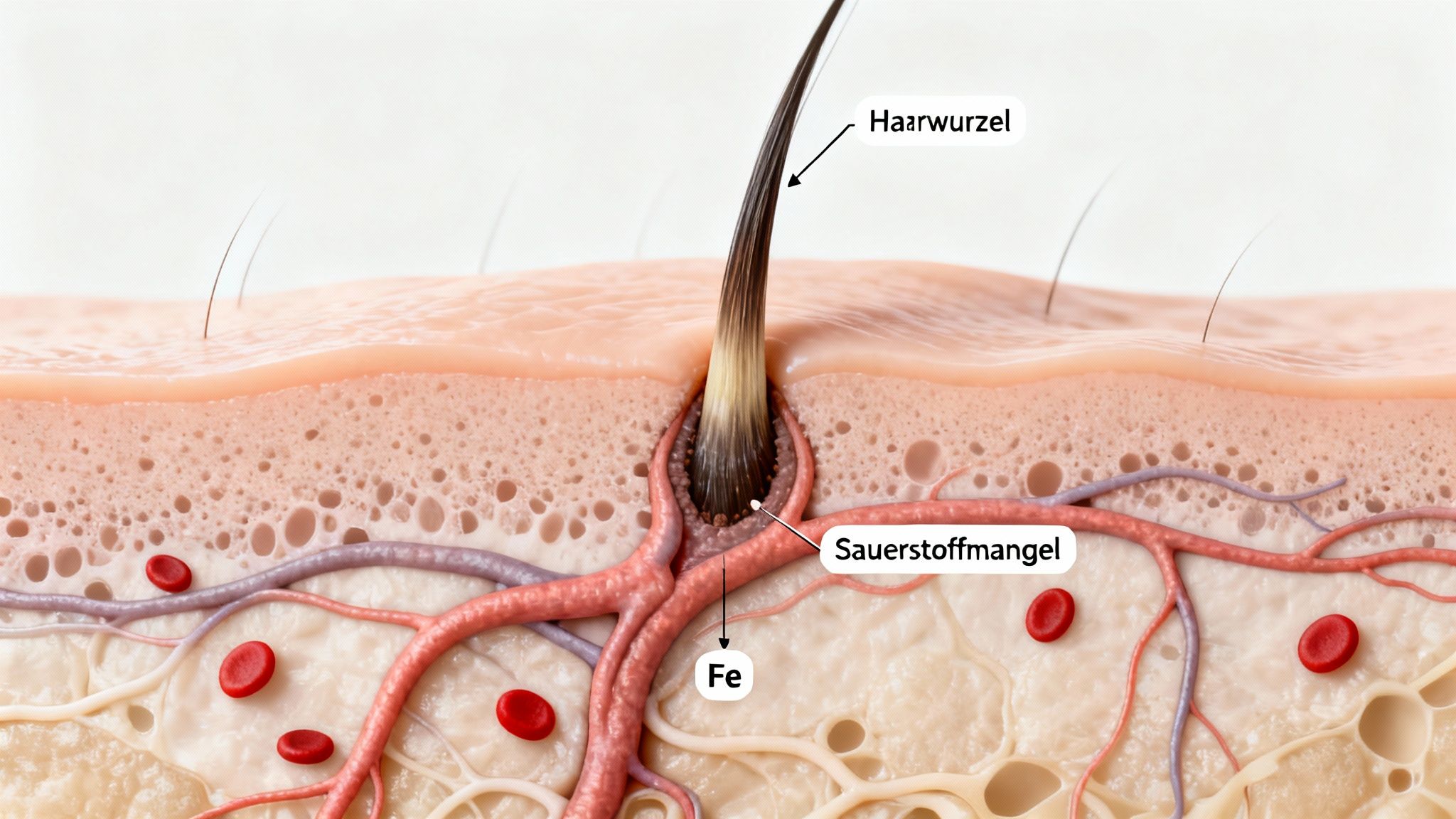
Just imagine your hair roots as tiny but extremely hardworking factories. Each one works around the clock to produce strong, healthy hair. And like any good factory, it needs two crucial things for this: energy and raw materials. This is exactly where iron comes in—and takes on one of the most important roles of all.
Iron is the central building block of hemoglobin, the protein in red blood cells. You can think of hemoglobin as a small oxygen taxi that tirelessly travels through your body’s bloodstream. Its mission? Pick up vital oxygen from the lungs and deliver it to every single cell. This naturally also applies to the tiny blood vessels that supply your hair follicles.
The oxygen crisis at the hair root
So what happens when you have an iron deficiency? Quite simply: The number of oxygen taxis available for transport decreases. This triggers a full-blown oxygen and energy crisis right at the hair root. The hair-forming cells, which are among the fastest-dividing cells in the entire body, suddenly no longer receive enough “fuel” for their demanding work.
This bottleneck triggers a chain reaction that you soon notice on your head:
- Cell division running on low: The production of new hair cells slows to a standstill. Hair growth noticeably slows down.
- Shortened growth phase: Every hair goes through a cycle of growth, rest, and shedding. Iron deficiency significantly shortens the active growth phase (anagen phase).
- Premature transition into the resting phase: Significantly more hairs than usual enter the resting phase (telogen phase) far too early. At the end of this phase, after approximately three months, they then fall out.
This exact process explains why iron deficiency causes diffuse hair loss: the loss does not occur in just one area but is evenly distributed across the entire scalp. This makes sense, because all the hair roots suffer from the inadequate supply at the same time.
Your body is a clever manager. When resources such as iron become scarce, it first reduces the supply to processes that are not essential for survival—such as hair growth. This protects vital organs. Your hair is, so to speak, the first casualty of this cost-cutting measure.
Why the right timing is crucial
These biological processes also make it clear why it is so important to respond early. The longer your hair roots remain undersupplied, the more hairs enter the shedding phase and the thinner your hair becomes overall. A nutrient deficiency is one of the most common causes of hair loss, as you can also read in our comprehensive guide on nutrient deficiencies and hair loss.
The good news, however, is that this process can be reversed. Once the hair roots are supplied with sufficient iron and oxygen again, they resume their work. However, it is absolutely crucial to identify the deficiency with certainty. The next logical step, therefore, is to take a close look at your blood values to finally gain clarity.
Which blood values really matter for hair loss
If you suspect that iron deficiency is behind your hair loss, you need to know which blood values matter. Many people mistakenly believe that a simple test of “iron in the blood” is enough. However, that is only a snapshot and is extremely unreliable—the value can fluctuate significantly depending on what you ate the day before.
The truly decisive value is ferritin. Simply think of ferritin as your body’s iron warehouse. While the iron in your blood (serum iron) only indicates the daily delivery, your ferritin level tells you how full your long-term reserves actually are. Iron deficiency and diffuse hair loss often begin unnoticed because your body empties its stores first—long before other blood values raise the alarm.
More than just a single value
Your ferritin level is therefore your most important early warning system. It indicates an impending problem even when your hemoglobin level (Hb), which is responsible for transporting oxygen, is still completely within the normal range. Your body is quite clever: It keeps vital functions going for as long as possible. To do so, it draws on its reserves—and this comes at the expense of less important things such as hair, skin, and nails.
For this reason, measuring serum iron alone is of little significance. To get a complete picture, you need several values, which are also measured by the mybody-x nutrient test.
The most important iron levels in a blood test explained
Here is a brief overview to help you better understand the connections. Together, these values reveal the state of your iron supply.
| Blood value | What it measures | Significance for hair loss |
|---|---|---|
| Ferritin | Your iron store. Shows how much iron the body has stored over the long term. | The most important value. If it is low, the reserves are being depleted and the hair roots are not receiving enough. |
| Serum iron | The transport iron that is currently actively circulating in the blood. | A mere snapshot. Not meaningful on its own, as the level fluctuates considerably. |
| Transferrin | The “iron taxi” (a protein) that transports iron to the cells. | A high level may mean that the body is desperately trying to mobilize more iron because little is available. |
| Transferrin saturation | How many of the “iron taxis” are currently loaded (in %). | Low saturation is a clear sign: There is not enough iron to load the taxis and supply the hair roots. |
Looking at these values together is key. This allows you not only to identify a deficiency but also to understand exactly where the problem lies—whether with storage or transport.
Your body prioritizes survival. When the iron stores (ferritin) run empty, the supply of “luxuries” such as full hair is cut off first. That is why a low ferritin level is often the earliest and most reliable sign.
What are the optimal levels for your hair
This is often where the biggest misunderstanding lies. In many lab reports, ferritin levels from 15 or 30 ng/ml are classified as “normal.” Medically, that may be enough to rule out severe anemia. But for healthy, strong hair growth, it is nowhere near enough.
Hair health experts agree: Ferritin levels should be significantly higher. To ensure optimal nourishment for the hair roots, a target level of at least 50 ng/ml, ideally even above 70 ng/ml, is recommended. If your level is below that, it may already contribute to hair loss, even if you are not officially considered “ill.”
We have summarized everything you need to know about ferritin levels and their significance for your health in a detailed article.
An at-home blood test quickly and conveniently gives you the clarity you need. You receive not only your laboratory values, but also an easy-to-understand interpretation to help you put the results into the context of your hair health. This knowledge is the foundation for all further steps—whether that means making targeted dietary changes or taking the right supplements. This way, you can make informed decisions and specifically tackle iron deficiency and diffuse hair loss.
Common causes of iron deficiency and who needs to be especially careful
Iron deficiency does not simply appear out of nowhere. It is usually a gradual process that affects some people much more often than others. If you know the causes and whether you belong to an at-risk group, you can take effective action much sooner—not only to correct a deficiency, but also to prevent iron deficiency and the associated diffuse hair loss from occurring in the first place.
Essentially, it always comes down to two scenarios: Either your body loses more iron than it can absorb, or your diet simply does not provide enough to replenish it. Often, it is an unfortunate combination of both.
Who is particularly at risk?
Certain stages of life, dietary habits, or health conditions can increase your iron needs or make it harder to absorb iron from food. See if any of these apply to you:
-
Women of childbearing age: Heavy menstrual bleeding is one of the main causes. Valuable iron is lost with the blood month after month, slowly but surely depleting the body's stores.
-
Vegetarians and vegans: Plant-based foods contain so-called non-heme iron. Our bodies absorb it significantly less efficiently than heme iron from animal products. Without a smart combination, such as with vitamin C-rich foods, a deficiency can quickly develop.
-
Pregnant and breastfeeding women: During pregnancy, the body is working at full capacity and iron requirements practically skyrocket—for both the mother and the growing baby need to be supplied. Requirements also remain high while breastfeeding.
-
Endurance athletes: Those who train regularly and intensely lose iron not only through sweat. Tiny bleeds in the gastrointestinal tract and an increased need to produce red blood cells can also deplete iron stores.
-
People with gastrointestinal diseases: Chronic inflammatory bowel diseases such as Crohn’s disease or celiac disease can severely impair iron absorption in the intestines.
A widespread problem
These risk factors make it clear why iron deficiency is the most common nutrient deficiency worldwide and is also a major issue in Germany. Women are particularly affected, often due to a combination of heavy menstruation, a plant-based diet, pregnancies, or digestive problems. You can find more about the most common causes of hair loss in women at fernarzt.com.
Understanding why your iron stores may be depleted is the first and most important step toward solving the problem. Think of it like a leaky bucket: You can keep refilling it with water (taking iron supplements), but as long as you do not find and patch the hole (address the cause), the bucket will never truly stay full.
If you recognize yourself in one of these groups, there is no reason to panic. But it is a clear signal to keep an eye on your iron levels. A mild deficiency can often still be corrected effectively through diet. But once your stores are truly depleted, it becomes much more difficult. You can also find more in-depth insights into how a deficiency develops and which symptoms it causes in our detailed guide on “What is iron deficiency?”.
A mybody-x nutrient test can give you the reassurance you need here. It shows you in black and white how your ferritin stores are doing. This allows you to take targeted, informed action before the deficiency becomes noticeable through more severe symptoms such as dreaded diffuse hair loss.
Your roadmap to fuller hair: test, understand, take action
Do you feel that an iron deficiency could be behind your hair loss, and want to finally get clarity? Very good, because mere guesswork has never helped anyone’s hair. This section is your practical guide for moving from suspicion to action. The very first step is always to establish a solid data foundation.
The best news first: You don’t have to wait weeks for a doctor’s appointment. With a self-test such as the mybody-x nutrient test, you can easily and discreetly check the key iron levels from home. The process is incredibly simple: You use a small lancet to collect a few drops of blood from your fingertip, fill the sample into the tube, and send it free of charge to our certified German laboratory.
Clarity through the right test
After just a few days, you’ll receive a results report that not only provides raw figures but also explains them clearly. Instead of technical jargon, you’ll receive a clear interpretation of your ferritin, transferrin, and iron levels and learn what they specifically mean for your hair health. This is the basis for every sensible next step.
To get to the bottom of the causes, an honest look at your own lifestyle is often enough.
This graphic summarizes the most common reasons for depleted iron stores.
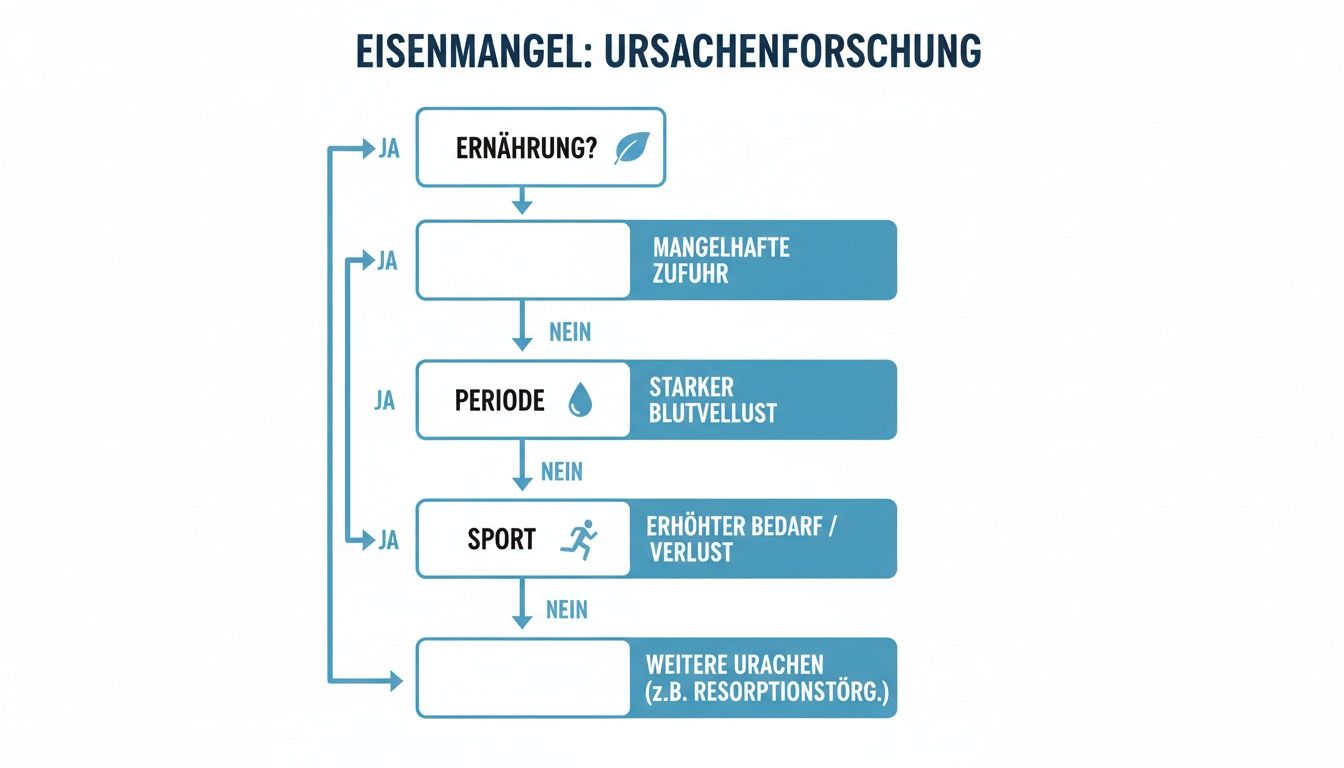
You can see immediately that diet plays a huge role, but heavy periods or intense exercise can also draw heavily on your reserves.
What should you do after receiving your test results?
As soon as you have your results, you can take targeted action. Which measures are right depends, of course, on how depleted your stores are.
1. In the case of borderline or slightly low levels
A conscious change in diet can often work wonders here. The goal is to gradually but reliably replenish your iron stores.
- Include iron-rich foods: Add lentils, chickpeas, pumpkin seeds, oats, and green vegetables such as spinach to your diet more often. For meat eaters, lean beef and liver are genuine iron boosters.
- Boost absorption intelligently: Always combine plant-based iron with vitamin C. A glass of orange juice with your muesli or a few strips of bell pepper with your lentil dish can improve absorption many times over.
- Avoid “iron robbers”: Coffee, black tea, and dairy products can block iron absorption. It’s best to enjoy them about an hour apart from your iron-rich meals.
2. In the case of a significant deficiency
If your ferritin level is extremely low, diet alone is usually no longer enough to quickly replenish your depleted stores. In this case, high-quality iron supplements are the most effective way to stop iron deficiency-related hair loss.
Important: You should only take high-dose iron supplements if a deficiency has actually been confirmed. Taking them “just in case” is not only pointless but, in the worst-case scenario, can lead to harmful iron overload.
The figures show how important this is: Approximately 65 percent of people with hair loss are found to have notably low ferritin levels. The standard treatment is then oral iron supplementation, with the dosage for an acute deficiency potentially amounting to 65–130 mg of elemental iron per day.
Patience is the key to success
Whatever path you choose, one thing is crucial: patience. The body needs time. It can take three to six months for your iron stores to become adequately replenished. Only afterward will your body have enough reserves left to invest in hair growth as well.
Visible results—in other words, noticeably denser and stronger hair—often appear only after six to twelve months.
Don’t let this discourage you! Every day you improve your nutrient supply is a good day for your hair. The at-home iron test is the perfect starting point for tackling this process with a clear strategy and full motivation.
Your path to stronger hair: What you can do now
Diffuse hair loss does not have to be a fate you simply accept. The cause is often hidden deep within your body—or, more precisely, in your blood values—and is therefore much easier to correct than you may think.
The connection between iron deficiency and diffuse hair loss is no longer mere speculation; it is well supported by scientific evidence. The most important insight for you is this: A simple blood test can be the first and decisive step toward addressing your hair problem at its root.
The point is to finally find the real cause instead of merely treating the symptoms. Do you feel constantly tired, is your hair getting thinner, and do you simply lack energy? These are clear signals from your body. Listen to them before you lose even more valuable time.
Stop guessing—take control yourself
With an at-home self-test such as the mybody-x nutrient test, you take control of your health. You don't just receive laboratory results, but an easy-to-understand evaluation that gives you a solid basis for your next steps. Knowing your ferritin and iron levels puts an end to the guesswork and finally enables you to take targeted action.
Imagine knowing exactly what's going on. You can adjust your diet, choose the right supplements, and stop the hair loss. You give your body and hair exactly what they've been missing.
Your journey to stronger hair doesn't start with an expensive shampoo or miracle treatment, but with understanding your own body. Analyzing your blood values is the key that opens this door for you.
Don't wait any longer. Take your body's signals seriously and give your hair roots back the nutrients they need for healthy, strong growth. Your journey to fuller hair begins right now—with a fact-based decision.
Your most frequently asked questions
Are there still a few questions left unanswered? Or are you simply looking for quick, clear answers about iron deficiency and hair loss? We've collected the most frequently asked questions for you here, so you can move toward healthy hair with confidence.
When will my hair grow back once my iron deficiency has been corrected?
Above all, one thing is needed here: patience. Once you start targeted iron therapy, whether through your diet or supplements, your body first needs time to replenish its depleted stores.
- Replenishing the stores: It usually takes three to six months for ferritin levels to return to a range that is optimal for hair growth.
- Visible results: Only once the stores are replenished can the body direct excess iron back into hair production. That's why it can take six to twelve months before you notice a visible improvement in hair density and strength.
The hair cycle is a marathon, not a sprint. But with consistency, you'll be rewarded with stronger hair in the end.
Can I get an iron deficiency under control through diet alone?
It all depends on the severity of the deficiency. In the case of a mild, developing deficiency or purely for prevention, an iron-rich diet can already make a big difference. Make a conscious effort to put foods such as red meat, lentils, spinach, or pumpkin seeds on your plate.
A small trick with a big impact: Always combine plant-based sources of iron with vitamin C. A glass of orange juice with your cereal or bell pepper in your lentil salad can increase your body's iron absorption several times over.
However, if you already have a confirmed iron deficiency with symptoms such as hair loss, changing your diet alone is often no longer enough. Your stores are then so depleted that replenishing them through food alone could take years. In this case, high-quality iron supplements—naturally based on a deficiency confirmed by a blood test—are significantly more effective.
What ferritin level is ideal for healthy hair?
This is where a widespread misconception lies. Many lab reports classify ferritin levels of 15 or 30 ng/ml and above as “normal.” Medically, that may be enough to rule out severe anemia, but it is nowhere near sufficient for full, healthy hair.
Hair health experts agree: For strong hair growth, ferritin levels should be at least 50 ng/ml, ideally even above 70 ng/ml. If your level is lower, it can already promote diffuse hair loss—even if you are still within the official “normal range.” A blood test gives you the clarity you need.
What else besides iron deficiency can trigger hair loss?
Iron deficiency may be a prime suspect in diffuse hair loss, but it isn't the only culprit. Other nutrients also play a crucial role in the health of your hair roots. So if your iron levels are excellent but the hair loss persists, it's worth looking into other possible deficiencies.
These include, above all:
- Zinc: A deficiency in this trace element can also significantly disrupt the hair cycle.
- Biotin (vitamin B7): It's known as the “beauty vitamin” for good reason and is essential for building healthy hair.
- Vitamin D: A deficiency is increasingly being linked to various forms of hair loss.
- Other B vitamins: A deficiency in vitamin B12 or folic acid in particular can negatively affect your hair health.
So if you want to be on the safe side, a comprehensive nutrient test can be useful to get a complete picture of your nutritional status and uncover all potential causes.
Are you ready to put an end to the guesswork and find out the exact cause of your hair loss? With a blood test from mybody-x, you can quickly and easily gain clarity about your iron levels and other important nutrients. Order your test conveniently for home delivery today and take the first crucial step toward healthier, stronger hair.



Share now:
What is testosterone level? Effects on men
Understanding women’s health: Your path to greater well-being