

Lower Cortisol Naturally – Your Guide to Inner Balance
Lowering your cortisol levels naturally is possible—for example, with relaxation techniques such as yoga, switching to whole foods, and getting restorative sleep. These three pillars are your most effective tools for bringing your stress hormone back into a healthy balance and sustainably improving your well-being.
What is cortisol, and why is it so important?

Let's clarify the most important point first: Cortisol is much more than just the notorious “stress hormone.” Think of it instead as your body's built-in engine. It is your natural timekeeper, getting you going in the morning, distributing your energy throughout the day, and preparing you for upcoming tasks.
This vital hormone, produced in the adrenal cortex, plays a role in almost every part of the body. It regulates blood sugar levels, keeps inflammation in check, and controls your metabolism. When things get stressful—whether it is an approaching deadline or an intense workout—cortisol ensures that you can immediately access the energy you need. It is a fundamental survival mechanism.
Your body's natural rhythm
Normally, your cortisol level follows a clear daily pattern known as the circadian rhythm. Shortly after waking, it reaches its peak, making you alert and ready to start the day. Throughout the day, the level then gradually declines until it reaches its lowest point late in the evening. This is your body's signal: time to switch off and regenerate.
But this finely tuned system is vulnerable. Ongoing stress, lack of sleep, or an unbalanced diet can completely disrupt this rhythm. The result? Your body constantly releases too much cortisol, even when you should actually be relaxing.
When the balance shifts
What happens when this natural rhythm is disrupted? The signs of chronically elevated cortisol levels often creep unnoticed into your everyday life. Perhaps one or two of these symptoms sound familiar:
- Constant fatigue: Even though you are getting enough sleep, you feel exhausted and can barely get out of bed in the morning.
- Evening cravings: The urge for sweet or salty snacks is particularly strong when your cortisol level should actually be low.
- Concentration problems: You often feel like you are in a “fog” and find it difficult to focus on one thing.
- Weight gain: You are gaining weight, especially around your abdomen, even though you have barely changed your diet.
- Sleep disturbances: You toss and turn in bed for hours before falling asleep, or wake up wide awake in the middle of the night.
The goal isn’t to get rid of cortisol completely. Rather, it’s to restore its natural rhythm and turn it from a source of stress into an ally for energy and well-being.
In the long term, consistently elevated cortisol levels can have serious health consequences—from a weakened immune system to a higher risk of cardiovascular disease. To truly understand what cortisol is and how it affects your body, it’s worth taking a closer look.
The first step toward regaining control is understanding your own body. A hormone test from mybody®x can show you exactly what your personal daily cortisol profile looks like. Instead of guessing, you’ll have clear data at your fingertips. This gives you the perfect foundation for taking targeted and effective countermeasures.
Modern stressors: How your everyday life is secretly sabotaging your cortisol levels
Not all stress is the same. Whether it’s an approaching work deadline, constant availability via smartphone, or social pressure, the biochemical reaction in your body is often the same. Let’s take a closer look at which modern stressors are quietly driving up your cortisol levels.
Often, it’s everyday habits that we consider completely normal where chronic stress hides. The problem is rarely acute, short-term stress; rather, it’s the exhausting, ongoing strain that leaves your body no chance to recover.
The “always online” culture as a driver of cortisol
One of the biggest sources of stress in our time? Constant digital availability. The boundaries between work and leisure are blurring, and our brains are exposed to stimuli nonstop—from push notifications and late-night emails to endless scrolling on social media.
This constant stimulation puts your body into a mild but persistent state of alarm and keeps cortisol production unnecessarily high. Your nervous system never truly gets to rest. This prevents the natural evening decline in cortisol and often leads to difficulty falling asleep or restless sleep.
Imagine a typical scenario: It’s 11 p.m., you’re lying in bed, and you’re still scrolling through your work emails. Your body interprets this as “unfinished tasks” and releases cortisol—exactly when its level should actually be at its lowest.
Psychological and social pressure in everyday life
Alongside digital overstimulation, psychological and social factors often gradually drive up your cortisol levels. We are barely consciously aware of many of them:
- Perfectionism: The constant urge to do everything flawlessly keeps your system under continuous strain.
- Social comparison: The “perfect” lives portrayed on social media create pressure and the feeling of not being good enough.
- Financial worries: Money worries are a major stress factor that can persist and take a toll over long periods.
- Relationship conflicts: Unresolved conflicts in a partnership or family act like a constant, underlying alarm in the background.
These stressors are often invisible and are socially accepted as a “normal” part of life. For your body, however, they mean chronic activation of the stress axis. Women in particular often react more sensitively to this type of stress because of their hormonal interactions. You can read more about the specific symptoms in women with high cortisol in our related article.
Your body does not distinguish between stress caused by an attacking saber-toothed tiger and stress caused by 100 unread emails. In both cases, the physiological response is the release of cortisol.
The insidious effects on your hormonal balance
When your body is permanently stuck in “fight-or-flight” mode, there are consequences. Persistently high cortisol release not only disrupts your sleep-wake cycle but can also throw other hormone systems out of balance—for example, thyroid function or the production of sex hormones.
This quickly creates a vicious cycle: Chronic stress leads to high cortisol, which in turn leads to poor sleep. The body also interprets sleep deprivation as stress, further fueling cortisol production. The result? You feel tired during the day while simultaneously feeling “wired” inside.
Recognizing these modern stressors is the most important first step toward lowering your cortisol naturally. It’s about developing awareness of your own habits and triggers. A study by Techniker Krankenkasse shows that more than 60% of Germans feel stressed at least sometimes. So it is a widespread phenomenon whose effects we need to take seriously. Read more about how you can lower your cortisol levels naturally at cerascreen.de.
To deliberately break this cycle, it is incredibly helpful to know your individual cortisol rhythm. A hormone test from mybody®x gives you a clear picture of your daily cortisol profile and shows you exactly where to start. With this data, you can turn mere assumptions into a well-founded strategy for greater balance and well-being.
How to specifically regulate your cortisol through diet
What ends up on your plate is far more than just a source of energy—it is a direct message to your hormonal balance. With the right diet, you can actively lower your cortisol levels and regulate your stress level. This is not about strict diets, but about smart choices that are easy to incorporate into your everyday life.

Your diet has the power to influence the exact biochemical processes responsible for cortisol release. Some foods calm your system, while others put it under unnecessary pressure.
The hidden cortisol triggers in your kitchen
Often, it is unconscious habits that sabotage your cortisol levels. A classic example is constantly reaching for sugary snacks or simple carbohydrates such as white bread and pastries. They cause your blood sugar to rise rapidly, only to send it crashing shortly afterward.
This blood sugar roller coaster means pure stress for your body. Every time your blood sugar drops, your body releases cortisol to counteract it and stabilize it again. This vicious cycle keeps your system in a constant state of alarm.
Excessive coffee consumption can also become a problem. Coffee stimulates the adrenal glands, which then produce cortisol. If you are already stressed, you are essentially adding fuel to the fire and driving your cortisol levels even higher.
Building blocks for hormonal balance
Fortunately, there are plenty of foods that provide your body with exactly the nutrients it needs for a healthy stress response. Think of them as your allies in the fight against an overactive stress system.
Magnesium: your personal relaxation mineral
This essential nutrient plays a central role in regulating the stress response. It helps calm the nervous system and reduce cortisol production. A deficiency, on the other hand, makes you significantly more susceptible to stress.
- Top sources: Dark leafy greens (spinach, kale), pumpkin seeds, almonds, avocado, and dark chocolate with a high cocoa content.
Omega-3 fatty acids as silent anti-inflammatory agents
Chronic stress often goes hand in hand with low-grade inflammation in the body, which further fuels cortisol release. Omega-3 fatty acids strongly counteract this and have been shown to lower cortisol levels. If you would like to learn more about the diverse effects of these valuable fats, read our detailed article about omega-3 fatty acids.
- Top sources: Fatty fish such as salmon, mackerel, or herring, flaxseeds, chia seeds, and walnuts.
Vitamin C: the protective shield for your adrenal glands
Did you know that the highest concentration of vitamin C in the body is found in the adrenal glands? Precisely where cortisol is produced. Under stress, the body consumes huge amounts of it. Ensuring an adequate supply therefore protects the adrenal glands and helps normalize the cortisol response.
- Top sources: Berries, bell peppers, broccoli, citrus fruits, and kiwis.
To make it easier for you to get started, we have summarized the most important nutrients and foods in a clear table.
Foods for your cortisol balance
This table shows you which nutrients and foods help regulate your cortisol levels and which ones you should avoid.
| Nutrient/active compound | Effect on cortisol | Examples of foods |
|---|---|---|
| Magnesium | Calm the nervous system and dampen cortisol production | Spinach, almonds, pumpkin seeds, avocado, dark chocolate |
| Omega-3 fatty acids | Have an anti-inflammatory effect and lower cortisol | Salmon, mackerel, flaxseeds, chia seeds, walnuts |
| Vitamin C | Protect the adrenal glands and normalize the cortisol response | Bell peppers, broccoli, berries, citrus fruits, kiwis |
| Complex carbohydrates | Promote serotonin release and support sleep | Sweet potatoes, oats, quinoa, whole-grain products |
| Tryptophan | Precursor to serotonin; has a calming effect | Turkey breast, cashews, bananas, legumes |
| Sugar & simple carbs | Cause blood sugar fluctuations and drive up cortisol | Sweets, white bread, soft drinks, pastries |
| Caffeine (in excess) | Stimulates the adrenal glands to release cortisol | Coffee, energy drinks, black tea |
Consciously incorporate these beneficial foods into your meal plan and try to gradually reduce the triggers. Every small step counts!
The evening carbohydrate myth
Many people avoid carbohydrates in the evening for fear of gaining weight. But for your cortisol balance, the exact opposite may be right. Complex carbohydrates, such as those found in sweet potatoes, quinoa, and oats, stimulate serotonin release.
Serotonin is our feel-good neurotransmitter, which promotes relaxation and is also the precursor to the sleep hormone melatonin. A moderate portion of these beneficial carbohydrates in the evening can therefore help you unwind more easily, sleep more deeply, and keep your nighttime cortisol levels low.
View your meals as a form of self-care. Every conscious choice in favor of nutrient-rich, cortisol-friendly foods is a direct contribution to your inner balance and resilience.
The change doesn’t have to happen overnight. Start with small, specific steps: Replace your sweet afternoon snack with a handful of nuts and berries. Or add a serving of leafy green vegetables to your dinner. You’ll see that these small adjustments add up and have a major impact on your well-being.
A hormone test from mybody®x can provide you with additional clarity. It shows not only your cortisol profile but also provides insight into other important hormones. This allows you to tailor your diet even more precisely to your individual needs and support your body in the best possible way.
Exercise and sleep as the foundation of your hormonal balance
Alongside nutrition, you have two extremely powerful tools at your disposal for naturally lowering your cortisol levels: exercise and sleep. The best part? They’re free, but unfortunately far too often underestimated. Yet, as with so many things in life, the dosage and the right timing matter here too. Not every type of exercise is relaxing, and not every night of sleep is truly restorative.
Let’s take a closer look at how you can use these two pillars of your health in a way that specifically supports your hormonal system—instead of putting it under additional strain.
The right exercise at the right time
Exercise has a clearly demonstrable positive effect on our stress regulation. It helps you release tension and releases feel-good hormones. So far, so good. However, the wrong workout at the wrong time can have exactly the opposite effect and put your body into an even greater state of stress.
Imagine this scenario: You come home after a long, exhausting day at work and then force yourself to do a high-intensity interval workout. For your body, that is pure stress. It releases adrenaline and cortisol to provide the energy needed for this peak performance. In the evening, when your cortisol levels should actually be on their way down, you artificially drive them back up. The result? Although you feel physically exhausted, you are completely “wired” inside and have trouble falling asleep. Sound familiar?
Choose moderate activities that calm your nervous system rather than overstimulating it. An intense workout is great—but ideally in the morning or early afternoon, when your cortisol is naturally higher.
The following forms of exercise are perfect for gently regulating your cortisol in the afternoon or evening:
- Brisk walks: A brisk walk, preferably in a green space, clears your head and has been shown to reduce stress levels.
- Yoga or Pilates: These practices combine moderate exercise with conscious breathing and mindfulness—a treat for your nervous system.
- Cycling at a moderate pace: A bike ride through the park can work wonders to help you wind down at the end of the day.
- Light strength training: Focus on controlled movements with lighter weights. This activates your muscles without overwhelming your system.
Simply listen to your body. On some days, an intense workout feels exactly right; on others, a gentle stretching session is what you really need. It’s not about breaking records, but about using movement as a tool for recovery.
Sleep: your most important recovery phase
Sleep is the time when your body cleans up, repairs itself, and recharges its batteries. A healthy sleep-wake rhythm is absolutely crucial for balanced cortisol levels. At night, your cortisol should be at a minimum so that the sleep hormone melatonin can do its job undisturbed.
Chronic sleep deprivation is a major stress factor for the body. Studies show that just a few nights of insufficient sleep are enough to significantly increase cortisol levels the following evening. This quickly creates a vicious cycle: High cortisol disrupts sleep, and poor sleep in turn raises cortisol. A representative survey by DAK-Gesundheit shows that around one in three Germans (36%) suffer from sleep problems. Learn more about these connections and how you can improve your sleep at zentrum-der-gesundheit.de.
The good news is that good sleep hygiene allows you to take control and set the stage for a restful night.
Practical tips for better sleep hygiene
It is often the small, everyday habits that make the biggest difference. Think of your evening routine as consciously “shutting down” your system.
- Establish consistent bedtimes: Try to go to bed and get up at the same time every day—even on weekends. This stabilizes your internal rhythm and trains your body to know when it is time to sleep.
- Introduce a screen-free hour: The blue light from smartphones, tablets, and televisions blocks melatonin production. Put your devices aside at least an hour before bedtime. Instead, read a book, listen to calm music, or take a warm bath.
- Create a cool, dark sleeping environment: A room temperature of around 18 degrees Celsius is ideal. Also ensure complete darkness so that your body can produce as much melatonin as possible.
- Avoid heavy meals and alcohol in the evening: A full stomach or alcohol can severely disrupt sleep quality. Your body is then busy digesting instead of focusing on deep, restorative sleep phases.
By strategically incorporating exercise and sleep into your daily routine, you create a strong foundation for hormonal balance. These adjustments cost you nothing but can have a huge impact on your well-being. If you still feel that your rhythm has gotten out of sync, a hormone test from mybody®x can provide valuable insights. A daily cortisol profile shows you in black and white how your levels fluctuate throughout the day and helps you tailor the measures even more precisely to your needs.
Understand and optimize your daily cortisol profile
Okay, you now have a whole range of strategies at your disposal—from nutrition and exercise to sleep. But honestly: How do you know what really makes the biggest difference for you? Trying things at random often leads to frustration. Measuring is much smarter.
This is exactly where the crucial point comes in—the one that turns general tips into your own personal, effective strategy: You need to get to know your individual cortisol rhythm. Instead of feeling around in the dark, you can see in black and white how your body handles stress throughout the day.
Why a single measurement often isn’t helpful
You may have considered having your cortisol level checked by a doctor. The problem is that a single measurement is like one photo from an entire film—a snapshot that reveals very little about the actual story. Your cortisol level is anything but static; it follows a natural daily rhythm.
With a healthy pattern, cortisol levels shoot up in the morning after you wake up, making you alert and ready to start the day. They then gradually but steadily decline throughout the day and reach their lowest point late in the evening. This is your body’s signal: time to relax and sleep.
A single measurement in the late morning could therefore show a high value that is completely normal. Likewise, a low value in the afternoon could be perfectly within the normal range. Only a daily profile, meaning several measurements at different times, shows you whether your internal clock is ticking properly or whether something is off.
Your path to greater clarity: The mybody®x hormone test
The mybody®x hormone test was developed specifically for this purpose. It provides exactly this comprehensive insight—conveniently, easily, and discreetly from home. Instead of waiting for a doctor’s appointment, you simply take a small saliva sample at specific times (morning, midday, and evening). This method is particularly informative because it measures free, or biologically active, cortisol.
Guesswork is a thing of the past. A daily cortisol profile gives you a clear data basis. It’s like a map of your stress system, showing you exactly where to start to regain balance.
You then simply send the samples to the laboratory and receive your personal results report after a short time. There, you can see at a glance how your cortisol levels develop throughout the day.
This infographic shows you what an ideal day for a healthy cortisol balance could look like:
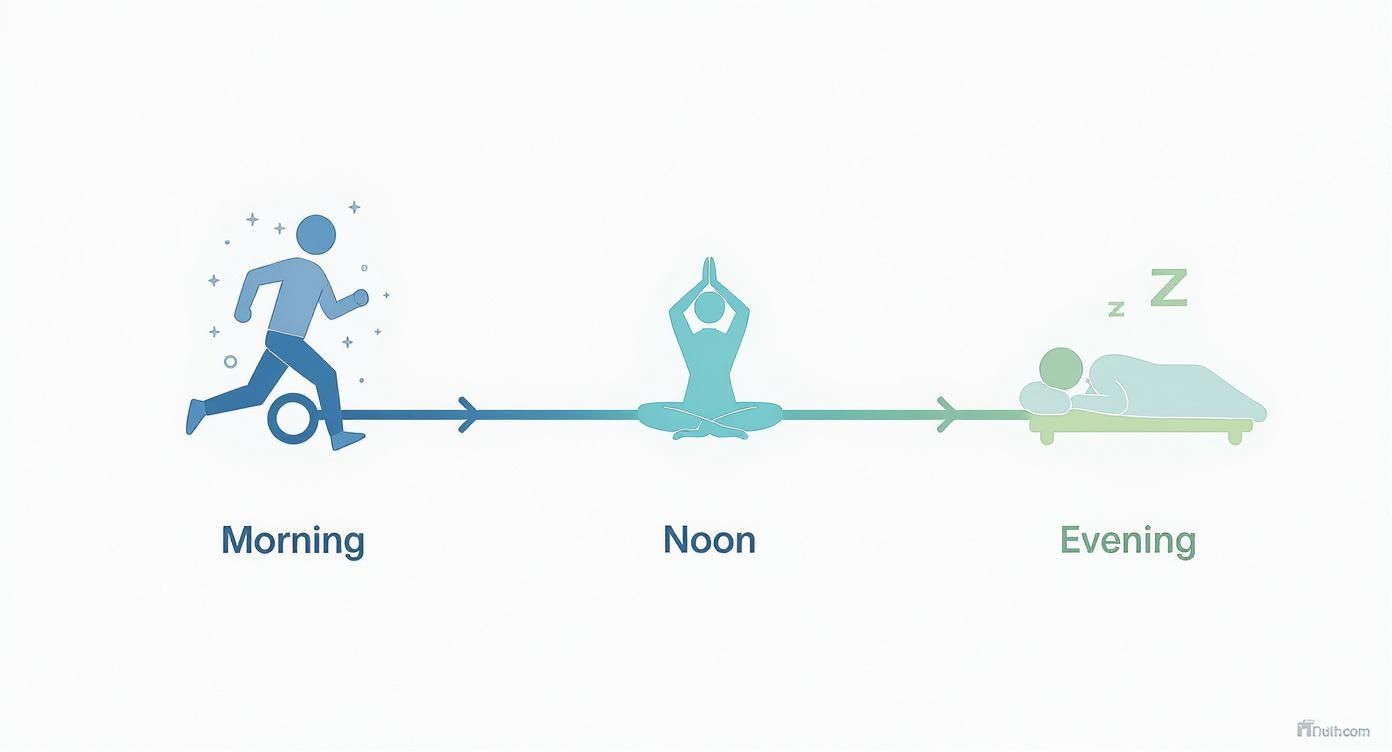
The graphic clearly shows how cortisol naturally declines from an active morning through a balanced midday to a restful evening. It’s a rhythm you can specifically support with the right measures.
What your results mean and what you can do
As soon as you have your report in your hands, the real work begins—optimization. The mybody®x report is designed so that you can easily understand the data. You can immediately see where your profile deviates from the ideal.
Here are a few typical scenarios and what they could mean for you:
- Too low in the morning: Can you barely get out of bed and feel sluggish? This may indicate exhausted adrenal glands. Measures such as getting a dose of daylight in the morning and eating a protein-rich breakfast could work wonders here.
- Too high in the evening: You’re in bed but wide awake and feeling restless inside? Your cortisol isn’t dropping properly. Evening relaxation exercises, avoiding blue light from screens, and a small portion of complex carbohydrates with dinner would be the right levers here.
- A sharp drop at midday: The classic afternoon slump hits with full force—including cravings and difficulty concentrating. The key here is a stable blood sugar level, which you can achieve through regular, balanced meals.
These insights are incredibly valuable. They enable you to choose exactly the strategies tailored to your specific problem. Instead of trying everything at once, you can focus on the measures with the greatest impact. If you want to delve deeper into the topic, our guide contains everything you need to know about measuring cortisol and how to use the results to your advantage.
The mybody®x hormone test takes the guesswork out of the process. It gives you back control and transforms you from a passive observer into an active driver of your health. You’ll get to know your body on an entirely new level and can actively support it in regaining its natural balance.
Frequently asked questions about cortisol
You now have a wealth of information and practical strategies at your disposal to bring your cortisol levels back into a healthy range. However, it’s understandable that very specific questions often arise along the way.
To help you clear up any remaining uncertainties and make the most of the tips in this article, we answer the most frequently asked questions here.
How quickly can I lower my cortisol naturally?
That’s a perfectly valid question—and of course, everyone hopes for quick results. However, the answer depends heavily on where you are right now and which methods you use. It’s important to distinguish between short-term relief and long-term balance.
- Immediate effects: Techniques such as deep breathing, a short meditation, or a walk in nature can often noticeably reduce acute stress—and therefore cortisol levels—within minutes. These are your perfect tools for taking immediate countermeasures in a stressful situation.
- Long-term balance: When it comes to sustainably regulating chronically elevated cortisol levels, your body needs a little more patience. With major adjustments to your diet, sleep, and exercise, you should realistically expect a period of four to twelve weeks before measurable improvements appear. The key here is consistency—so stick with it and firmly integrate the new habits into your daily routine.
What role do dietary supplements play in this?
Dietary supplements can be an absolutely valuable form of support, but they are never the sole solution or a substitute for a healthy lifestyle. Think of them instead as targeted helpers that adjust the right levers.
Adaptogenic plants such as ashwagandha or Rhodiola rosea, for example, help the body adapt better to stress and become more resilient. Sometimes a simple nutrient deficiency can also intensify the body’s stress response. Magnesium is a classic example—it’s called the “relaxation mineral” for good reason and is essential for a stable nervous system.
Before you simply start taking supplements, it’s essential to know your individual needs. A nutrient test, such as the one from mybody®x, can show you in black and white where you have a deficiency. This allows you to replenish exactly what is truly missing instead of groping in the dark.
Is a low cortisol level always a good thing?
No, absolutely not! That’s a widespread misconception. Cortisol is a vital hormone, and the goal is never to get rid of it completely. The aim is to restore a healthy balance and the natural daily rhythm.
Remember, cortisol performs essential functions:
- It wakes you up in the morning and gives you energy to start the day.
- It regulates your blood sugar levels and metabolism.
- It has a strong anti-inflammatory effect.
Chronically low cortisol levels, also known as hypocortisolism, can lead to serious problems such as extreme exhaustion, dizziness, muscle weakness, and low blood pressure. This is often a sign of exhausted adrenal glands.
That’s exactly why measuring a daily cortisol profile is so informative. It shows you not only whether your levels are too high, but also whether they may be too low or your natural rhythm is completely disrupted. You get the full picture and know whether you’re in the green, balanced range.
Are you ready to stop guessing and finally gain clarity about your cortisol levels? The mybody®x hormone test gives you the data you need to develop a targeted, personalized strategy. Find out what your body is trying to tell you and take control of your health again. Discover the right at-home self-tests now at https://mybody-x.com.



Share now:
Measuring cortisol at home: what a single result really tells you
Nutrient deficiency and hair loss: How to identify the true cause