
Measuring cortisol at home: what a single reading really tells you
The key points at a glance
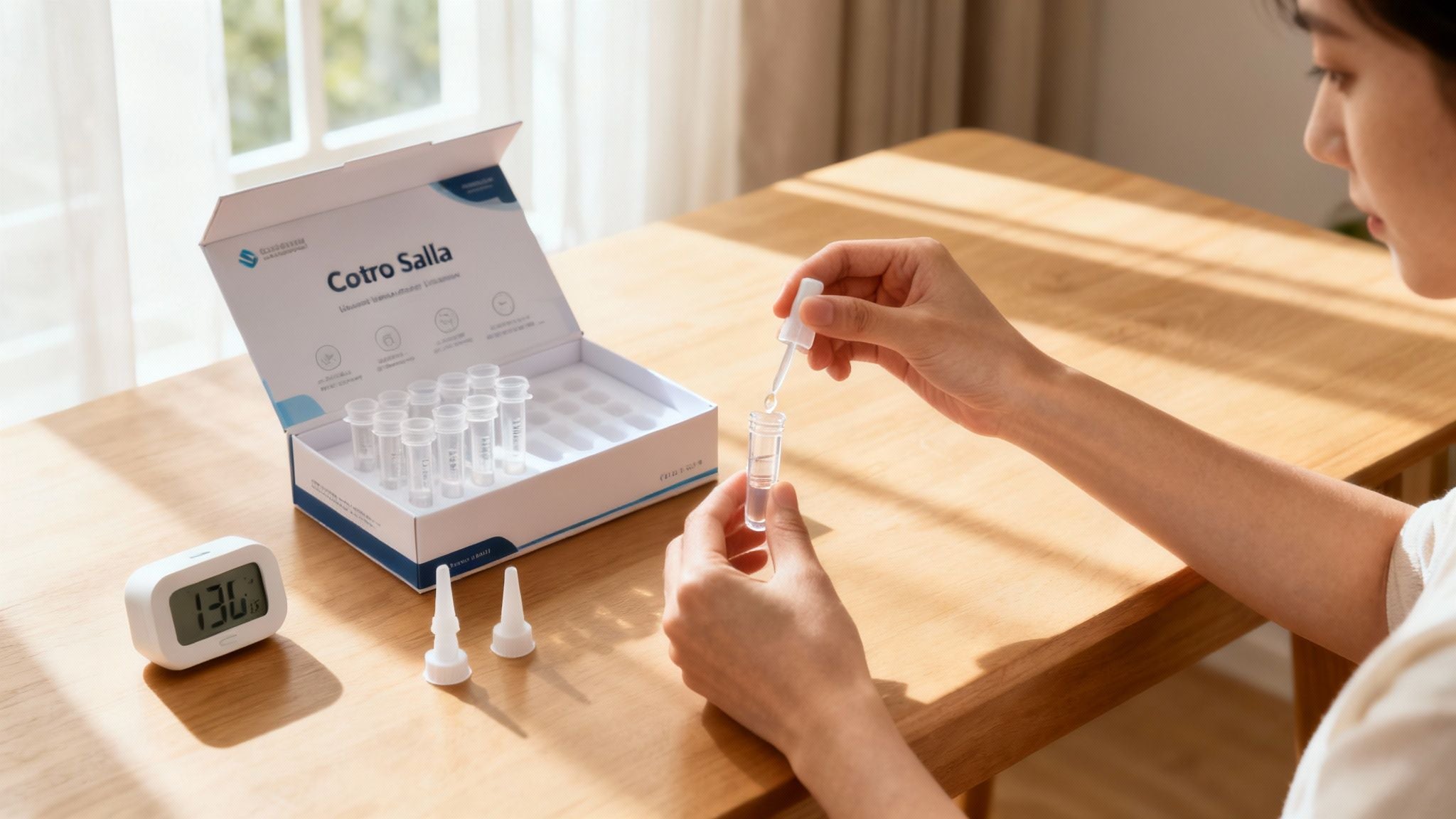
Cortisol can be measured at home using a small blood sample from the fingertip. The result is a reading for the time the sample was taken, not a profile over the course of the day. Because the hormone follows a pronounced daily rhythm, the time the sample is taken affects the result just as much as your stress level.
This article explains what a single cortisol reading can and cannot tell you. It distinguishes between the different sample types, identifies the reference values used in medical diagnosis, and shows why two measurements are comparable only when they are taken at the same time of day.
You will first learn what the hormone does in the body and why its level changes throughout the day. Then come the established figures, the differences between sample types, and the signs that warrant seeing a doctor. The latter part covers how to prepare for sample collection, how to interpret your result, and the limitations of testing at home.
What to expect in this article
1. What a cortisol level from an at-home test shows
2. Why the time of day determines the number
3. What the professional literature says about a single reading
4. Which figures guide medical diagnosis
5. Blood, saliva, and urine: what each sample measures
6. When a suspected problem belongs in a doctor’s office
7. Comparing the three ways to measure cortisol
8. How to prepare for collecting a sample at home
9. When two measurements differ
10. Which at-home tests include a cortisol measurement
11. How to interpret your result
12. Who may benefit from testing—and who may not
13. Limitations: what a cortisol level cannot clarify
14. What ultimately matters
Frequently asked questions
Sources
What a cortisol level from an at-home test shows
An at-home cortisol test measures how much of this hormone was circulating in your blood at the time the sample was taken. It is a snapshot. It says nothing about how high the level was two hours earlier or how it changes in the evening.
Cortisol is a hormone produced by the adrenal cortex. Among other things, it regulates blood sugar, blood pressure, and the body’s response to stress. In healthy adults, average daily production ranges from 8 to 30 milligrams (Kaur, Gandhi and Sharma, StatPearls, National Library of Medicine, 2025 edition).
The reason for seeking a test is rarely the hormone itself. Usually, there is an underlying set of symptoms: exhaustion that cannot be relieved by sleep, often accompanied by restless nights. According to the Robert Koch Institute, around 20 percent of respondents in the “Health in Germany” panel showed elevated stress levels (2024 survey).
Key takeaway
A home cortisol test provides a value for the time at which the sample was taken. Without the time of sampling, the number cannot be interpreted, and two numbers are comparable only if they were obtained at the same time of day.
Why a number alone is not yet an answer
Many readers expect a cortisol level to say something about their stress level. This expectation is understandable, but it overlooks the hormone’s biology. Cortisol rises within minutes during acute stress and then falls again. A high level could therefore reflect the journey to the appointment just as easily as ongoing stress.
The result only becomes useful when considered together with the time the sample was taken and the reference range used by the laboratory performing the analysis. Your own symptoms also matter. Without this context, a number is just a number.
The basics of the hormone itself are covered in our article What is cortisol and how does it control your body. This text addresses a different question: how to measure it.
Why the time of day determines the level
Cortisol is not released evenly. Secretion occurs in bursts approximately every 60 to 90 minutes (O’Byrne, Yuen, Butt and Liu, Current Opinion in Endocrine and Metabolic Research, 2021). A second, slower rhythm extends across the entire day on top of this short cycle.
The peak of this daily rhythm occurs at the transition from sleep to wakefulness. From there, the concentration declines throughout the day and reaches its lowest point in the late evening or early night (O’Byrne et al., 2021). This description is consistent with the account in StatPearls physiology, which places the rise in the final hours of sleep (Kaur et al., 2025).
For you, this has a very practical consequence. The difference between a sample taken at 7 a.m. and one taken at 5 p.m. is neither a treatment success nor a relapse, but simply the normal course of the day. If you want to compare the value from spring with the value from autumn, you must measure at the same time of day on both occasions.
What shifts the level in the short term
In addition to the time of day, other factors affect the level. Intense physical exertion raises cortisol levels, as does acute psychological tension. A sleepless night also shifts the starting point of the following morning.
One point is particularly relevant for women: Estrogen-containing preparations increase the amount of the transport protein in the blood to which cortisol binds. This can make the measured total value higher without changing the active fraction. If you take such preparations, this information should be included in the discussion of your results.
People who work shifts adjust their rhythm to their working hours. The reference point is then not the time on the clock but the time they wake up. This information should also be included on the report form.
What the specialist literature says about a single value
The difficulty with a single value is not a problem specific to self-tests. It also affects medical diagnosis and is explicitly acknowledged there.
A review article in Deutsches Ärzteblatt International describes how the hormone axis is monitored after a specific cancer treatment. The context is different from yours. However, the statement about assessing cortisol levels applies regardless of why the measurement is taken.
Documented source
“Diurnal fluctuations in cortisol can make it difficult to assess basal concentrations.”
Mai, Fassnacht, Führer-Sakel, Honegger, Weber and Kroiss
Deutsches Ärzteblatt International 118, pages 389 to 396, 2021
In the same section, the authors note that measuring in the morning at the practice will not always be possible. This is the sentence that can guide expectations for a home test: The time of day is the most important variable, and at home it is entirely in your hands.
That is precisely the real advantage of collecting a sample at home. You are not tied to office hours and can collect the sample immediately after waking up, rather than after traveling to the practice and waiting in the waiting room.
The figures used to guide medical diagnosis
For morning serum cortisol, the same review provides reference ranges. They come from the medical evaluation of underfunction of the hormone axis and are not a framework for interpreting a self-test. However, they give an idea of why specialists pay such close attention to the time of day.
Morning serum cortisol as a reference
< 100
Nanomoles per liter, equivalent to 3.6 micrograms per deciliter. In the medical evaluation, this indicates underfunction of the axis.
100–500
Nanomoles per liter. The range in which no decision can be made based on a single value and further tests are required.
> 500
Nanomoles per liter, equivalent to 18.1 micrograms per deciliter. This makes underfunction of the axis unlikely.
Source: Mai, Fassnacht, Führer-Sakel, Honegger, Weber and Kroiss, Deutsches Ärzteblatt International, 2021
The middle range is the most informative. It covers most of the scale and, in medical practice, does not lead to a conclusion but to further testing. A single value clarifies nothing here, and that is not a weakness of the method but a characteristic of the hormone.
Important for interpreting your own result: These figures are not your reference range. Reference ranges depend on the laboratory, the measurement method, and the time of measurement. The information on your own report is always decisive.
How often a genuine disorder is behind it
Adrenal cortex insufficiency is rare. For the primary form, a review article in Deutsches Ärzteblatt International reports a prevalence of around 100 affected people per 1 million and approximately 5 new cases per 1 million people per year (Quinkler, Beuschlein, Hahner, Meyer, Schöfl, and Stalla, 2013).
This rarity is both reassuring and a warning. It means that exhaustion is almost always caused by something other than a disease of the adrenal cortex. But it also means that an abnormal result should not be interpreted independently.
Blood, saliva, and urine: what each sample measures
Cortisol can be measured from various bodily fluids. However, the methods do not measure the same thing, and they answer different questions. Anyone who confuses them will later compare numbers that are not comparable.
Capillary blood from the fingertip
A blood sample measures total cortisol, meaning the bound and free fractions together. For at-home sampling, just a few drops from the fingertip are sufficient. The advantage is that cortisol can be measured together with other laboratory values from the same sample.
The disadvantage is that the result is affected by binding to transport proteins. When their amount increases, for example while using estrogen-containing preparations, the total value rises as well, without the active fraction having changed.
Saliva and urine
Saliva testing measures the free fraction of the hormone, while a 24-hour urine collection measures the amount excreted over an entire day. Both methods have a place in medical evaluation, for example when investigating possible overproduction.
This is where a clarification belongs—one that many older advice articles online describe differently. mybody®x (MYBODY Lab GmbH) does not offer a daily cortisol profile based on multiple saliva samples. Any text claiming otherwise is incorrect. We measure cortisol from capillary blood, which produces one value per sample.
This disclosure is uncomfortable and nevertheless correct. A test that promises something it does not deliver produces a result that no one can interpret.
When a suspicion belongs in a medical practice
Before ordering a test, it is worth comparing your situation with the following list. If any of the points apply to you, the next step is an appointment at a medical practice, not collecting a sample in your own bathroom.
These signs require medical evaluation
Circulatory collapse or severe dizziness when standing up
recurring episodes associated with low blood pressure
Unintentional weight loss over several weeks
without any change in diet, often accompanied by loss of appetite and nausea
Rapid weight gain around the torso with the arms and legs becoming thinner
often accompanied by broad reddish stretch marks on the abdomen or thighs
Darkening skin areas on scars or the creases of the hands
a change that is noticeable from the outside before symptoms appear
Ongoing treatment with cortisone preparations
it changes the measured value, which is why the assessment belongs with the treating medical practice
The reason for this order is simple. A self-test provides a number, but not an examination. With the signs mentioned, an examination is the faster route, and a test result would only delay the clarification.
Doctors are not an opposing force in this matter, but the point of connection. A result from a measurement at home can prepare for a conversation that you previously had to have without any numbers.
The three ways to measure cortisol compared
You have several options for determining a cortisol level. They differ in the type of sample, the effort involved, and above all in which question they can answer. The following overview compares them using the same criteria.
| Criterion | Capillary blood at home | Blood draw at the medical practice | Saliva or 24-hour urine collection through the medical practice |
|---|---|---|---|
| What is measured | Total cortisol in the blood at the time of sampling | Total cortisol in the blood at the time of collection | free cortisol in saliva or excretion over 24 hours |
| Who determines the time | you do it yourself, directly after waking up if desired | the office hours, often only after travel and waiting time | according to the doctor’s instructions, and for a 24-hour urine collection throughout the entire day |
| Shows the daily pattern | no, one value per sample | only with multiple appointments on the same day | the 24-hour urine collection reflects the total amount for the day, not the progression over time |
| Additional values from the same sample | yes, cortisol is listed there alongside thyroid, iron, and blood lipids | yes, depending on the doctor’s request | no, the procedure is focused on cortisol |
| Includes a medical assessment | no, the result provides context without a diagnosis | yes, that is the purpose of the appointment | yes, the procedure is ordered by a doctor |
| Fits the question | “Where do I stand right now, and what will it look like in six months?” | “I have specific symptoms and need a medical evaluation.” | “There is a medical suspicion of overactive or underactive function.” |
The table shows a clear division of responsibilities. The at-home option has the advantage when it comes to timing and the range of values. The clinical option is preferable wherever assessment and examination are part of the process.
How to prepare for collecting the sample at home
Preparation determines whether the result will be useful. The following four steps take little time and prevent the most common mistake: a sample that was collected correctly but cannot be meaningfully compared.
Set the time
The most informative time is in the morning, shortly after waking up. Write down the planned time before opening the kit.
Choose a calm day
No strenuous exercise the morning before, no sleepless night, and no appointment you have been dreading for days beforehand.
Note everything that may have an effect
Sleep duration, medications, estrogen-containing preparations, and the time you woke up. This note will make the report easier to interpret later.
Send it back promptly
The sample should be placed in the return envelope on the same day. A sample left over the weekend loses its value.
One issue that many people know from saliva testing does not apply to a blood sample: brushing your teeth and smoking do not affect the sample itself here. What remains important is being precise about the time.
If you plan to measure again in six months, record the time at the same time. It is the smallest effort with the greatest effect on comparability. Our article Collecting a blood cortisol sample: what time matters shows how important this point is.
When two measurements diverge
The difference between a reliable and an unusable trend measurement is easier to show with an everyday example than with a rule. The following scenario is fictional and is intended for illustration only.
Fictional scenario for illustration
Example: Anna, 41
Anna has been sleeping poorly for months and feels completely exhausted in the morning. She collects her first sample on a Saturday at 7:15 a.m., shortly after waking up. The value is in the upper range of her report. Six months later, she has changed her evening routine and wants to know whether anything has changed. This time, Sunday afternoon is the first opportunity, so she collects the sample at 4:30 p.m. The new value is significantly lower, and Anna interprets this as a success. In fact, she has only measured the normal decline over the course of the day. Only the third sample, again on a Saturday morning at 7:15 a.m., answers her question.
The mistake in this scenario is not the sample collection. Anna did everything correctly as instructed. The mistake lies in comparing two values obtained at different times of day.
This leads to a rule that is simpler than any reference table: A pattern emerges only from measurements taken at the same time of day. Everything else is merely a juxtaposition of snapshots.
Which at-home tests include a cortisol value
mybody®x does not offer cortisol as a standalone value, but as part of larger blood test packages. There is a substantive reason for this: exhaustion and poor sleep can have several possible causes, and a single hormone value narrows the search too early.
Both of the following tests are analyzed from capillary blood. Both provide one value per sample collection, not a daily pattern. The information comes from the product pages, accessed on 27 August 2026.

Blood test using capillary blood
Women’s Wellness Check | Women’s health test
18 values from one blood sample, including cortisol. The product page also lists a thyroid profile with TSH, fT3, and fT4, as well as ferritin, vitamin B12, and vitamin D3, along with values for the liver, kidneys, blood sugar, and blood lipids. What the test does not provide: It gives a single cortisol value at the time of sample collection and therefore no daily profile. According to the product page, it also does not measure cycle hormones or provide a diagnosis.
Laboratory analysis 3–5 business days after sample receipt
accessed 27 August 2026
For men, the Men’s Hormone Test is the obvious choice for lack of energy and poor sleep. It includes cortisol; the product page currently does not list all included values.

Blood test using capillary blood
HormoneCheck | Male Hormone Test
Important for this topic: This test includes cortisol; the product page currently does not list all included values. It also measures total and free testosterone, as well as SHBG, albumin, LH, FSH, prolactin, DHEA-S, estradiol, and TSH. This makes the test suitable for questions about testosterone and also covers cortisol levels. Here too, you get one value per sample collection, not a daily profile.
Laboratory analysis 3–5 business days after sample receipt
accessed 27 August 2026
We state this point openly because a product page does not always list every value included. Anyone who knows which values a test actually measures will not end up with the wrong product in their cart.
How to interpret your result
Once the result is available, the real work begins. The first thing to look at is not the number but the reference range beside it. This depends on the laboratory and method, and it is the only standard against which your value may be assessed.
A trend can only be established from measurements taken at the same time of day. Anything else is simply a collection of snapshots.
After that, it is worth reviewing the rest of the test report. In cases of fatigue, it is worth comparing ferritin, vitamin B12, and thyroid levels, because these causes are more common than a disorder of the adrenal cortex. A cortisol value within the reference range does not rule out an explanation for your symptoms; it merely shifts the focus elsewhere.
Finally, your daily life matters. Note how you slept in the week before the sample was taken and what was happening during that time. This note turns a laboratory value into an observation that can be acted on.
What to do with an abnormal result
A value outside the reference range is not a diagnosis. It is a reason to take the result to a medical practice, along with the time the sample was taken. Without that information, interpretation starts from scratch there.
Practical approaches to regulating stress belong on another page. What is and is not supported by evidence regarding magnesium is covered in our article Lowering Cortisol with Magnesium. This text focuses solely on measurement.
Who a measurement makes sense for—and who it does not
Whether measuring at home is worthwhile for you depends on your question. The following comparison lists genuine reasons on both sides, not watered-down benefits.
Makes sense for you if …
you want a baseline before changing anything about your sleep or daily routine, and plan to measure it again at the same time in six months.
your symptoms are unclear and you want to assess several possible causes in one go instead of looking at cortisol in isolation.
you want to measure in the morning and cannot find a practice that offers an appointment at that time.
you want to bring numbers to a doctor’s appointment that you did not have before.
Probably not if …
you need a daily profile. A single blood sample cannot provide one, and there is no test for this in the product range.
one of the warning signs from Chapter 6 applies to you. In that case, a medical examination is the faster option.
you expect a diagnosis. A self-test provides a laboratory value with context, not an assessment of your clinical picture.
you are taking corticosteroid medications. The measured value cannot then be interpreted without consulting the treating practice.
The right-hand column is meant seriously. Anyone who orders the test in one of these situations receives a number that does not answer their question and is more dissatisfied afterward than before.
Limitations: what a cortisol level cannot clarify
The most important limitation is stated above and is emphasized again here: A blood sample provides a value, not a trend. A daily cortisol profile from multiple saliva samples is not part of the mybody®x offering.
The second limitation concerns interpretation. A self-test is not designed to diagnose Cushing syndrome or adrenal insufficiency. For these questions, doctors use procedures involving stimulation or suppression tests that assess the response of the axis rather than a single resting value.
The third limitation concerns the connection with everyday stress. A high cortisol level is not a measure of perceived stress, and a normal level does not disprove it. The hormone responds to many stimuli, and psychological tension is only one of them.
The fourth limitation is methodological. The total blood level depends on the amount of transport proteins. With estrogen-containing preparations or during pregnancy, the total level therefore shifts without the active amount changing to the same extent.
What remains is still significant. You get a reliable baseline for your own observations, a basis for discussing the matter with a doctor, and the option to measure again in six to twelve months under the same conditions.
What ultimately matters
Measuring cortisol at home is straightforward. Interpreting the result correctly is not, and the difference between the two comes down to a single detail: the time the sample was collected. It determines whether your number can later become a trend.
In practical terms, this means your next step is to set the time before opening the kit, record it along with the time you woke up, and schedule the repeat measurement at the same time in your calendar. Without this note, you have a number. With it, you have a series of measurements.
And if you are unsure whether your question can be answered with cortisol at all: The consultation is free, and it does not try to sell you anything.
Frequently asked questions
Can I reliably measure cortisol at home?
Yes, using a blood sample from a fingertip that is analyzed in a laboratory. The time is crucial: cortisol follows a daily rhythm, peaking at the transition from sleep to wakefulness and reaching its lowest point late in the evening (O’Byrne, Yuen, Butt and Liu, Current Opinion in Endocrine and Metabolic Research, 2021). Therefore, record the time for every sample. Without it, the result can neither be interpreted nor compared later.
What time of day should I collect the sample?
The most meaningful time is in the morning shortly after waking, because the medical reference values are based on morning serum cortisol. A review article in Deutsches Ärzteblatt International notes that morning measurement will not always be possible in clinical practice (Mai, Fassnacht, Führer-Sakel, Honegger, Weber and Kroiss, 2021). This is precisely the point you can control at home. For shift work, use your own waking time as the reference.
Can I get a daily cortisol profile with a mybody®x test?
No. A daily cortisol profile based on several saliva samples is not available in the product range. Cortisol is measured using capillary blood, producing a value for the time of sample collection. Some older online guides claim otherwise; that is incorrect. If you need to track levels throughout the day, a medically ordered procedure is the right option.
At what level should I seek medical advice?
The reference range on your report is what matters, because it depends on the laboratory and method used. For orientation: In a medical evaluation, morning serum cortisol below 100 nanomoles per liter indicates possible insufficiency of the axis, while a value above 500 nanomoles per liter makes it unlikely; further tests are performed for values in between (Mai et al., Deutsches Ärzteblatt International, 2021). If you experience circulatory collapse, unintentional weight loss, or increasingly dark patches of skin, see a doctor regardless of the value.
Does the birth control pill distort my cortisol level?
It does not distort the result, but it shifts it. Estrogen-containing medications increase the amount of transport protein in the blood to which cortisol binds. Because a blood sample measures total cortisol, the measured value may therefore be higher without the active fraction having changed. Be sure to note your use of these medications when collecting the sample and mention it during your appointment with your doctor.
Next step
A baseline value with the time of measurement
If your concern is fatigue and sleep, the Women’s Wellness Check measures cortisol along with thyroid markers, iron, and vitamins. If you are interested in testosterone and regulatory hormones, the HormoneCheck is the right choice and also includes cortisol. Neither replaces a medical evaluation.
Women’s Wellness Check HormoneCheck | Male Hormone TestRead more
You might also be interested in
A deeper look at the key point of this article, focusing on shift work and trend measurements.
If your result is above the reference range and you want to know which symptoms have been described in connection with it.
Sources
- Mai K, Fassnacht M, Führer-Sakel D, Honegger JB, Weber MM, Kroiss M: Diagnosis and Management of Endocrine Side Effects of Immune Checkpoint Inhibitors. Deutsches Ärzteblatt International 118, 389–396 (2021) – aerzteblatt.de
- Quinkler M, Beuschlein F, Hahner S, Meyer G, Schöfl C, Stalla GK: Adrenal Cortex Insufficiency – A Life-Threatening Condition with Diverse Causes. Deutsches Ärzteblatt International 110, 882–888 (2013) – aerzteblatt.de
- Kaur J, Gandhi J, Sharma S: Physiology, Cortisol. StatPearls, NCBI Bookshelf of the National Library of Medicine (as of 2025) – ncbi.nlm.nih.gov
- Robert Koch Institute: Perceived Stress and Coping Among Adults in Germany. Journal of Health Monitoring, “Health in Germany” panel, 2024 survey – rki.de
The verbatim quotation on circadian fluctuations, the note on morning testing, and the three reference values for morning serum cortisol are taken from source [1]; the review article addresses endocrine side effects of cancer therapy, and the quoted sentence on assessing cortisol levels appears there independently of the reason for the measurement. The frequency figures for adrenal cortex insufficiency are taken from [2], while the information on daily cortisol production and the increase during the last hours of sleep comes from [3], and the figure on increased stress burden from [4]. The information on the secretion cycle of 60 to 90 minutes and on the peak and trough of the circadian rhythm comes from the review by O’Byrne, Yuen, Butt, and Liu in Current Opinion in Endocrine and Metabolic Research (2021); it is attributed in the main text with the authors, specialist journal, and year and therefore does not appear in this list. Information on price, range of values, sample type, and laboratory comes from mybody®x product pages, accessed on 27.08.2026; processing times follow the central specification for blood tests. All sources were accessed and reviewed on 27.08.2026.

mybody®x Editorial & Specialist Team
Blood test interpretation Laboratory diagnostics Hormone analysis Nutritional science
This article was created by the mybody®x editorial and specialist team. The team combines laboratory diagnostics, hormone analysis, and the interpretation of blood tests. Those who contribute to it are listed on the authors page.
Published on 07.11.2025 · Last updated on 27.08.2026
The content is for general information only and does not replace medical advice, diagnosis, or treatment. Reference ranges depend on the laboratory, method, and age—the information on your test report is always authoritative.



Share now:
Vitamin B6 deficiency: Recognize and address typical symptoms in women
Lower Cortisol Naturally – Your Guide to Inner Balance