

Blood test for food intolerance – Understand your body’s signals
Do you often feel tired or bloated, or struggle with skin problems without knowing the exact reason? A blood test for food intolerance could be precisely the key to finally getting to the bottom of the hidden causes. Instead of groping in the dark, it gives you a scientifically sound starting point for understanding your body better.
Why you sometimes feel unwell after eating
Imagine your body as a highly sensitive ecosystem. Every food you eat interacts with this system. Ideally, everything runs smoothly, and you feel fit and full of energy. But what happens when certain foods disrupt this delicate balance?
The consequences are often nonspecific symptoms that do not appear until hours or even days after a meal. These include not only digestive problems such as bloating and abdominal pain, but also symptoms such as persistent fatigue, headaches, or skin blemishes. These delayed reactions are precisely what make it so incredibly difficult to identify the true culprit on your plate.

The crucial difference from an allergy
Many people mistakenly lump these reactions together with a classic food allergy. But that is a misconception. A true allergy is an immediate, often severe, and potentially life-threatening immune response. An intolerance, on the other hand, is a delayed reaction. Although it can significantly affect your quality of life, it is generally not acutely dangerous.
Important: An intolerance is not an allergy. While allergies often strike within minutes, the symptoms of an intolerance develop slowly and almost imperceptibly over a longer period of time.
This table helps you quickly understand the fundamental differences between a classic food allergy and an intolerance.
Allergy vs. intolerance at a glance
| Characteristic | Food allergy (IgE-mediated) | Food intolerance (e.g., IgG reaction) |
|---|---|---|
| Reaction time | Immediate (minutes to 2 hours) | Delayed (hours to 3 days) |
| Symptoms | Often severe: itching, swelling, shortness of breath, circulatory collapse | Usually diffuse: bloating, fatigue, headaches, skin problems |
| Antibodies involved | Immunoglobulin E (IgE) | Often immunoglobulin G (IgG) |
| Severity | Can be life-threatening (anaphylactic shock) | Not life-threatening, but affects quality of life |
| Required amount | Even the smallest traces are enough | Often dependent on the amount consumed |
The distinction is therefore essential in order to draw the right conclusions and take appropriate action.
This is exactly where a targeted blood test comes in. It does not look for the classic allergy markers, but for specific antibodies that indicate a hidden immune reaction to certain foods.
The mybody-x food intolerance test was developed to provide you with exactly this clarity. Instead of randomly removing foods from your diet, you receive a solid basis for your decisions.
- Clarity instead of guesswork: Find out which foods could actually be affecting your well-being.
- Targeted measures: Adjust your diet based on facts, not mere assumptions.
- Take control: Take an active role in your health—simply and conveniently from home.
With this approach, you can finally interpret your body’s signals correctly and take targeted steps toward a better sense of well-being.
How your blood reveals intolerances
Have you ever wondered what actually happens after you send off your blood sample for an intolerance test? It is less mysterious than you might think and is based on a rather clever response by your own body. The key lies in your immune system and the way it reacts to certain foods.
Imagine your immune system as an extremely vigilant bouncer. Its job is to distinguish friend from foe. With a delayed food intolerance, however, a small mistake occurs: this bouncer mistakenly classifies certain protein components from perfectly normal foods as “foreign” or “threatening.”
In response, your body ramps up its defenses and produces specialized units: the so-called immunoglobulin G antibodies (IgG antibodies). These antibodies attach themselves to the food components that have been flagged as intruders. This very process can trigger subtle but chronic inflammatory reactions in the body—those silent inflammations often underlying diffuse symptoms such as fatigue, digestive problems, or skin irritation.
The IgG level as a key indicator
A blood test for food intolerance, such as the one from mybody-x, does nothing other than measure the concentration of these specific IgG antibodies for a whole range of foods. A high concentration of IgG antibodies against a particular food is a strong indication that your immune system is regularly in “combat mode” with that food.
However, an elevated IgG level does not mean that you have to ban a food from your life forever. Instead, see it as a valuable guide showing you where you can start giving your body a break and finally take control of your well-being again.
This infographic shows very clearly the different immune responses that can occur in the body.
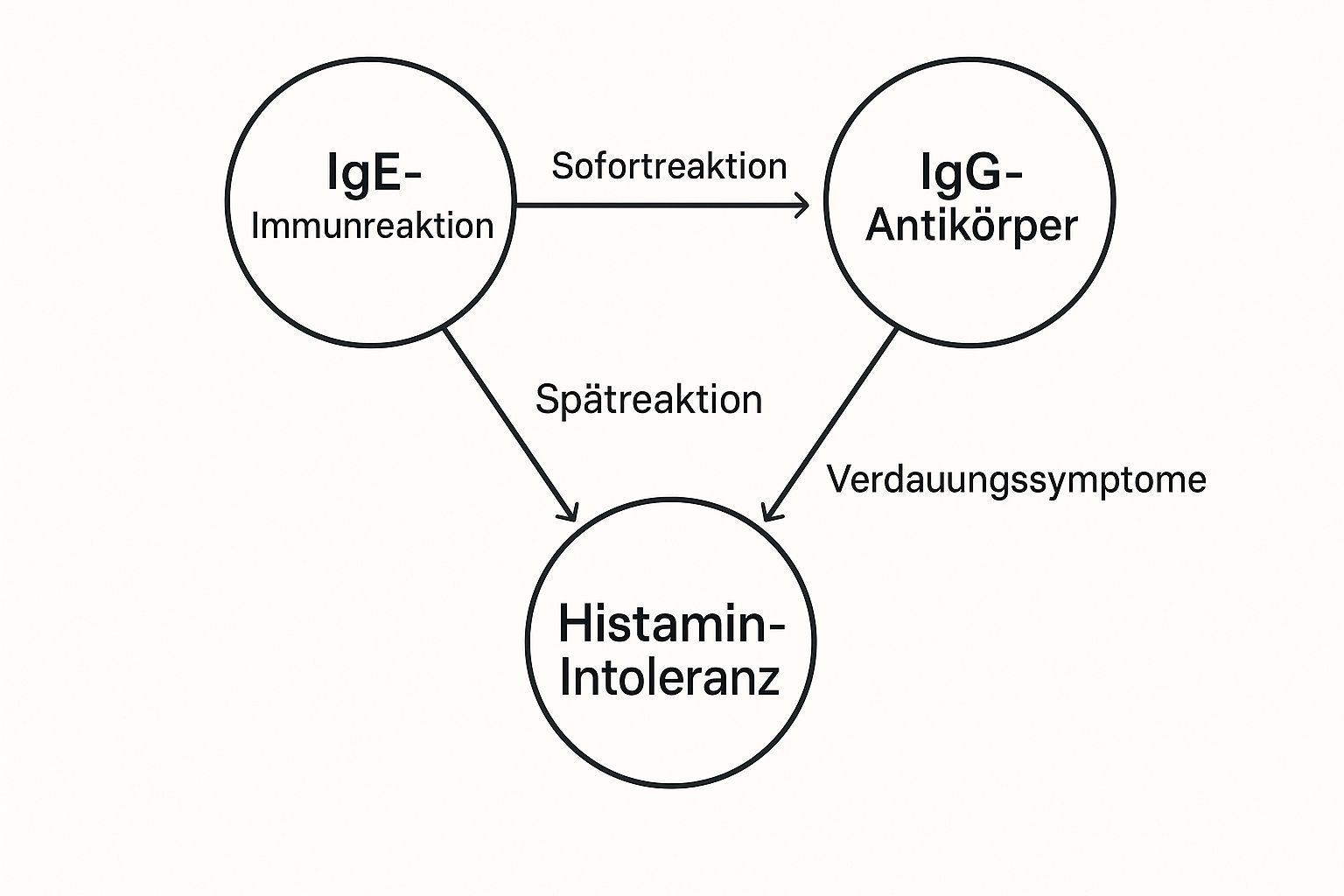
It is clear that IgE reactions are responsible for classic allergies with immediate reactions, while IgG antibodies play a role in delayed intolerances.
Avoiding false self-diagnosis
Interestingly, many people mistakenly interpret their symptoms as an allergy. In Germany, around 30 percent of people report suffering from a food allergy. However, scientific studies paint a very different picture: in fact, only about 3.7 percent of adults are affected by a genuine, immunologically detectable allergy. A large proportion of symptoms therefore have other causes—often intolerances that involve different mechanisms in the body.
The mybody-x blood test specifically analyzes these IgG reactions and translates the complex biological processes into an easy-to-understand report. This gives you a clear, data-based foundation for adjusting your diet. A vague feeling becomes concrete information that you can really work with.
If you would like to explore the topic in greater depth, read our article to find out how you can identify intolerances specifically. The test thus becomes your own personal tool for finally correctly interpreting your body’s signals.
The benefits of an at-home intolerance test
Do you know the feeling that something isn’t right, but the thought of crowded waiting rooms and the endless search for a suitable doctor’s appointment puts you off? This is exactly where modern at-home blood tests come in. They give you the opportunity to take control of your health yourself—simply, discreetly, and entirely at your own pace.
Perhaps the greatest benefit lies in this newfound autonomy. Instead of passively waiting for an appointment, you take action yourself. The mybody-x food intolerance blood test is designed to fit seamlessly into your everyday life without requiring you to turn everything upside down. You decide when and where to collect the sample.
Stress-free from sample to result
The entire process is designed to make getting started as easy as possible. Many people initially recoil at the word “blood draw,” but this test is completely different. A small, almost painless prick to the fingertip is all it takes to collect the few drops of blood needed. You can do this completely relaxed at the kitchen table or on the sofa, in your familiar surroundings.
This approach removes the biggest hurdle to testing. It’s no longer about organizing a complicated appointment, but about proactively taking an important step for your well-being—exactly when it suits you.
You then pack the sample securely in the enclosed return envelope and send it free of charge to our certified specialist laboratory in Germany. There, experts analyze your sample professionally. As soon as the report is ready, you receive a notification and can easily and securely view your results in your personal mybody-x customer account.
Your path to clarity begins here
This direct path from symptom to analysis to result allows you to gain valuable insights without detours or long waiting times. You are no longer merely a passenger on the road to better health—you are in the driver's seat.
The at-home food intolerance test (IgG) from mybody-x gives you a clear, structured way to identify hidden triggers.
The benefits at a glance:
- Maximum flexibility: You test yourself whenever and wherever you want, with no pressure to make an appointment.
- Easy sample collection: A small prick of the finger is all that is needed.
- No waiting times: You do not have to wait weeks for a doctor's appointment.
- Discreet process: The entire process is confidential and convenient from the comfort of your home.
- Fast results: Your results are available digitally after a short time.
This type of preventive healthcare is more than just a trend. It reflects a mindful lifestyle in which you take responsibility for your well-being and make informed decisions based on real data.
What you can do with your test results
You finally have your mybody-x report in your hands—a small but crucial step toward a new, more mindful life. But what do you do with all this information now? First and foremost: do not view this report as a list of prohibitions, but as your very own personal roadmap to greater well-being.
An elevated IgG level for a particular food does not mean that you have to eliminate it from your diet forever. Rather, it is a clear signal from your body that it is currently overwhelmed by this food and needs a break. Your test result is the ideal basis for a targeted dietary change, often implemented as an elimination or rotation diet.
From knowledge to action: the elimination phase
The first concrete step is to consistently eliminate the foods that cause the strongest reactions for a while. This usually means a period of four to six weeks. This phase gives your digestive system the urgently needed time to calm down and allows chronic inflammatory processes to gradually subside. The aim is to stop the constant overload of stimuli.
During this time, don’t focus on what you have to give up, but on the variety that remains available to you. See it as an opportunity to discover new foods and recipes. Many people notice remarkable improvements after only a short time—from having more energy in everyday life to clearer skin.
Keep a food diary
To track the changes precisely, a food diary is an invaluable tool. It helps you see, in black and white, the connection between what you eat and how you feel.
It is best to note the following points every day:
- What you ate: Be as precise as possible, including small snacks and drinks.
- When you ate: Sometimes the time of day also plays a role.
- How you felt: Record symptoms such as bloating, fatigue, headaches, or skin changes.
- Your general energy level: Rate it on a simple scale from 1 to 10.
This diary becomes your personal compass on the path to feeling better. It makes your progress visible and helps you interpret even the subtlest reactions from your body much more accurately.
Your test result is the starting point, and your food diary is the navigation. Together, they guide you toward a deeper understanding of your body and enable you to optimize your diet in a targeted and sustainable way.
It is important to understand that an IgG blood test like the one from mybody-x is specifically designed to detect delayed immune reactions. This clearly distinguishes it from tests for classic, “true” allergies. In Germany, tests used to diagnose genuine food allergies are based on detecting specific IgE antibodies. An IgE-mediated allergy can occur in up to 36 percent of the population over the course of their lifetime and, in the worst case, carries the risk of anaphylactic shock, whereas intolerances usually cause more diffuse symptoms. You can find more information about the laboratory diagnosis of allergies at Vorsorge-Online.
After the elimination phase, you begin carefully reintroducing the foods you avoided—one at a time and in small amounts. This allows you to determine your individual tolerance threshold and gradually turn the data from your food intolerance blood test into a better quality of life.
Who can benefit from a blood test for intolerances?
Are you wondering whether a blood test for food intolerances is the right step for you? The fact that you’re reading this already suggests that you’ve probably been struggling for a while with symptoms that simply have no clear explanation. This test was developed specifically for people like you.
Perhaps one of these scenarios sounds familiar: For months, you have been suffering from vague digestive problems such as constant bloating, irregular bowel movements, or irritable bowel symptoms. Or is it the unexplained, chronic fatigue that drags you through the day even though you actually get enough sleep? Persistent skin problems, joint complaints, or recurring headaches without an identifiable cause can also be clear warning signs.

A tool for self-help
A blood test such as the one from mybody-x is particularly worth considering if you have already tried various things but are still in the dark. It is a kind of snapshot of your body and shows you which foods your immune system responds to with increased production of IgG antibodies.
Do not view the test as a definitive diagnosis, but as a powerful tool. It gives you a data-based starting point for making targeted dietary adjustments and actively taking responsibility for your health.
Instead of continuing to speculate and eliminating foods at random, you receive a specific list of potential triggers. This well-founded approach helps you finally take targeted action.
Specific use cases for the test
A blood test can be a valuable guide for many different people. It can provide clarity if you:
- You suffer from nonspecific, chronic complaints: These include digestive problems, fatigue, headaches, skin rashes, or joint pain whose cause simply cannot be identified.
- You are looking for a sound basis for changing your diet: You want to optimize your diet without relying on mere guesswork.
- You want to improve your athletic performance: Unrecognized intolerances can slow recovery and noticeably impair your performance.
- You want to take proactive action for your health: You want to understand your body better and take preventive action before minor complaints develop into more serious problems.
Sometimes, these general symptoms are also mistaken for more specific intolerances. If, for example, you suspect a specific reaction to dairy products, our guide on how to identify and self-test for lactose intolerance can provide additional insights. However, a comprehensive IgG blood test gives you a much broader picture and also detects reactions to many other food groups.
The mybody-x test compared with other methods
When you are looking for answers to your symptoms, you will quickly come across a wide variety of testing methods. But not every path truly leads to the desired result. To make the right decision for you, it is extremely important to know the differences between the methods and understand when each test actually makes sense.
The mybody-x blood test for food intolerance focuses specifically on measuring IgG antibodies. These are suspected of triggering delayed immune reactions that only become noticeable hours or even days after eating. This is precisely the crucial difference from other common methods you may already know.
Distinction from conventional allergy tests
A conventional allergy test at the doctor's office usually measures IgE antibodies in the blood. These are responsible for immediate reactions—that is, typical allergy symptoms such as itching, swelling, or shortness of breath, which often occur within minutes. The mybody-x test is therefore not an alternative to this, but a supplement. It helps you get to the bottom of the causes of delayed and often nonspecific symptoms.
Other methods, such as breath tests, are very accurate but also extremely limited. They can specifically detect lactose or fructose intolerance, but provide zero information about how your body reacts to hundreds of other foods. An entirely intuitive elimination diet, on the other hand, is often pure guesswork without a solid, data-based foundation.
For diffuse, chronic symptoms, a broad IgG scan is often the most efficient first step. It provides you with a comprehensive overview of potential triggers and serves as a sound basis for a targeted dietary change.
It is well known that intolerances such as lactose intolerance are widespread in Germany and affect around 15 to 20 percent of the population. Diagnosis here is usually carried out using breath tests. Medical societies and allergists emphasize that IgG tests are not suitable for diagnosing true allergies (IgE-mediated). Other procedures recognized by health insurance providers, such as skin tests or blood tests for IgE antibodies, are available for this purpose. You can find further insights into the different diagnostic approaches at WiWo.
The mybody-x test is therefore intended as a self-help tool for greater well-being, not for the medical diagnosis of diseases. In our Guide to Food Intolerance Testing, you'll learn more about how to use the results as a valuable guidepost for yourself.
Still have questions about the blood test? Here are the answers
Finally, we'd like to answer some of the most common questions we keep receiving about blood tests for food intolerances. This way, you'll be fully informed and can start your personal health journey feeling completely at ease.
How long will I have to wait for my results?
As soon as your sample arrives at our laboratory, our experts get to work. The analysis itself usually takes just a few business days. We'll notify you immediately by email when your personal results report is ready for you in your mybody-x account—presented in a simple, easy-to-understand format.
Do I need to fast before the test?
No, this isn't necessary for the IgG antibody test. You can eat and drink normally, just as you always do. What's more, it's important not to restrict your diet in the weeks before collecting the sample. This is the only way we can get a representative picture of how your body reacts to your everyday diet.
What if I react to a lot of foods?
A result with many elevated reactions can feel overwhelming at first, which is understandable. But don't worry: This doesn't mean you have to eliminate all these foods from your diet forever.
Think of the result as a kind of guidepost. At first, focus on the foods with the strongest reactions and use them as a starting point for making gradual changes.
Often, the intestinal lining recovers once the main suspects are eliminated. After a while, you may well be able to tolerate other foods again without any problems.
Are you ready to finally gain clarity and take your well-being into your own hands? Discover the blood tests from mybody-x now and find out what your body is really trying to tell you. Just take a look at https://mybody-x.com.



Share now:
Get tested for nutrient deficiencies—made easy
What is examined in a complete blood count? Everything at a glance