
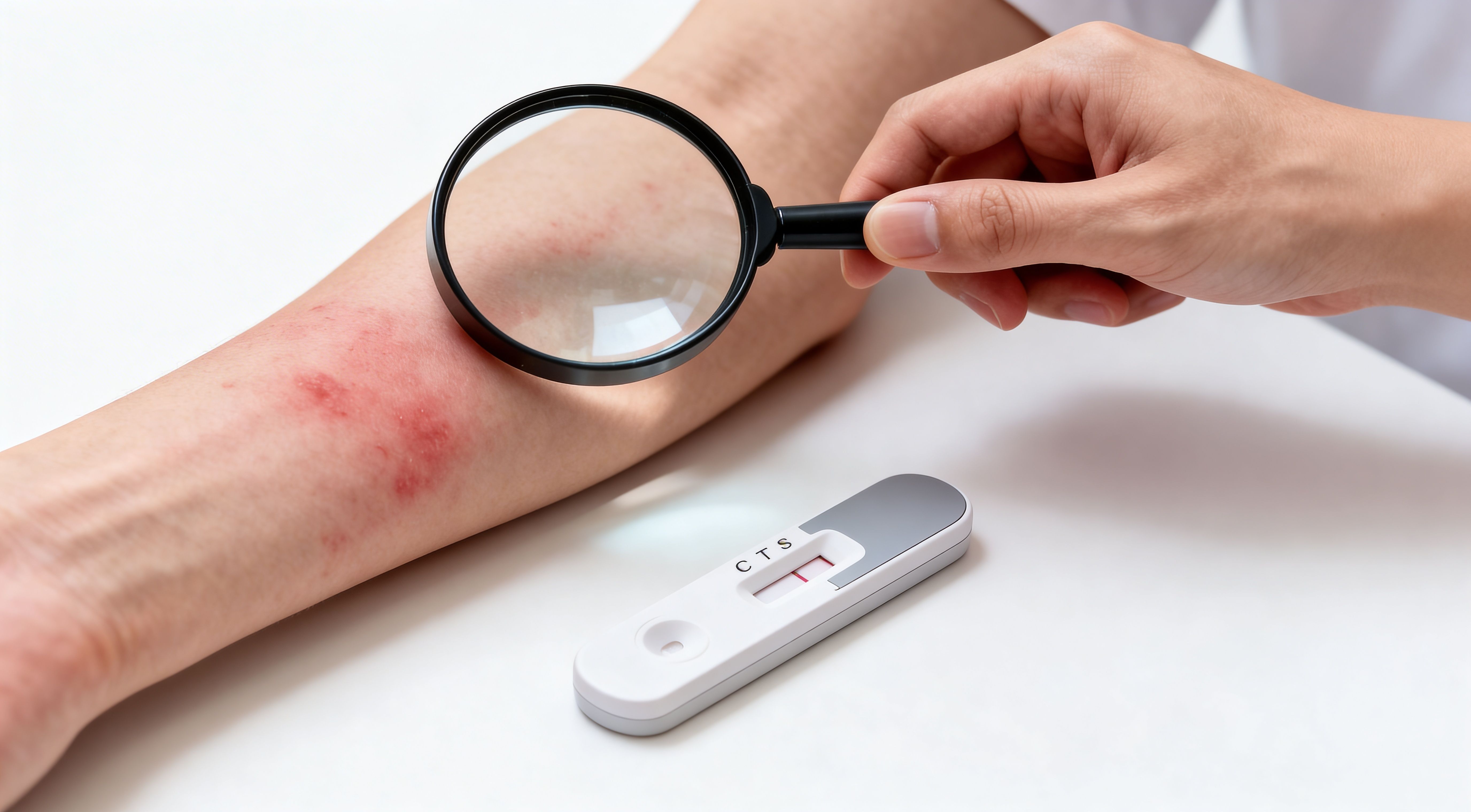
Allergic Rash: Finding Causes & Taking the Right Steps
You roll up your sleeve and there it is. A red patch. Maybe it itches, maybe it stings a little, maybe it's even spreading. Then the thought carousel begins. Was it the new detergent, a food, stress, pollen, or just dry skin?
Precisely this uncertainty makes skin rashes so distressing. You clearly see something on your skin, but the cause often remains invisible. And as long as you don't know the trigger, you quickly only treat the surface.
Red Skin and Itching – Is It an Allergic Rash?
Maybe it started quite innocently. A small itchy spot on the wrist after wearing a bracelet. Or red, rough patches of skin on the neck after a new cream. Some notice the rash only in the evening, others in the morning after waking up. Precisely because an allergic rash can look so different, it is often confused with dry skin, irritation, or intolerance.

Why So Many Are Initially in the Dark
Skin reacts visibly, but not always clearly. The same redness can have very different causes. This is frustrating, especially if you're already eliminating products, changing creams, or starting to puzzle over foods.
Moreover: allergies and skin reactions are not a fringe issue. Almost 20% of adults in Germany suffer from at least one allergy. Allergic skin reactions such as contact eczema affect approximately 8.1% of the population, according to DEGS1 data from the Robert Koch Institute, summarized by Springer Medizin.
The Most Important Question Isn't Just What You See
Crucially: What triggered the reaction? Because that determines what really helps you.
A few typical situations:
- After contact with something new, a fragrance, metal, or preservative might be involved.
- After eating, you might immediately think of a food allergy. Sometimes, however, something else is behind it.
- In certain seasons, pollen can play a role, also through cross-reactions with foods. If you want to better understand this topic, this overview of cross-allergies helps.
If a rash reappears, it's a signal. Not necessarily for something dangerous, but almost always that your body is reacting to something.
Not Just Soothing, but Understanding
Many first try to get rid of the itching. That's understandable. But if you only relieve without knowing the cause, the rash often reappears.
A good first step is therefore not activism, but observation. Where is the rash located? When does it appear? What was different just before? These questions often bring more clarity than quickly grabbing the next cream.
What Exactly Happens in the Body During an Allergic Rash
An allergic rash is not a whim of the skin. Behind it is a reaction of your immune system. You can imagine it like an overly cautious security system. It classifies an actually harmless substance as a threat and triggers an alarm.

Allergy Is Not the Same as Irritation
Here lies one of the most common confusions. Not every red or itchy spot on the skin is an allergy.
According to Techniker Krankenkasse, an allergic rash results from an immunological overreaction, often 24 to 72 hours after contact. Skin irritation, on the other hand, is a direct, non-immunological reaction. The clinical distinction is important because true allergies require systemic solutions like allergen avoidance, which can be narrowed down through tests. The explanation can be found at Techniker Krankenkasse regarding contact allergy.
How This Manifests in Everyday Life
Irritation is more likely to occur when the skin is directly attacked. For example, by aggressive cleaning agents, frequent hand washing, or harsh substances. The skin then reacts locally, often precisely where the contact occurred.
An allergy works differently. The immune system "remembers" a substance. The next time it comes into contact, it starts a defense reaction. Typical signs are:
- Redness and itching at or around contact points
- Wheals or small blisters
- Blurred edges instead of a clearly defined irritation
- Delayed onset, not always immediately after the trigger
Why This Is Important for Your Next Steps
If you treat an irritation like an allergy, you often look in the wrong place. And if you dismiss an allergy as just dry skin, the trigger remains active.
This also applies to symptoms after eating. Not everything that causes itching or redness after tomatoes, cheese, or wine is automatically a classic allergy. This is where the topic of histamine becomes interesting, because symptoms can feel astonishingly similar.
The best treatment doesn't start with the cream, but with the correct classification. Irritation, allergy, and intolerance often look similar but require different answers.
A Simple Rule of Thumb
If the skin reacts immediately after strong exposure, it suggests irritation. If the body responds to a specific substance with delay and repeatedly, an allergy becomes more likely.
This distinction sounds small. In practice, it often saves a lot of time, unnecessary prohibitions, and false self-diagnoses.
The Most Common Triggers for Allergic Skin Reactions
When it comes to an allergic rash, many immediately think of a specific food. That can be true. But it's only part of the picture. Skin reactions often arise from a mix of contact factors, environmental irritants, and internal processes.
The Usual Suspects in Everyday Life
Some triggers touch your skin directly. Others enter the body through airways or food. That's why tracing the cause is so tricky.
Commonly involved are:
- Metals and jewelry such as nickel-containing materials in earrings, buttons, or watches
- Cosmetics and personal care products with fragrances, preservatives, or dyes
- Washing and cleaning agents, especially for sensitive skin barriers
- Pollen and animal contact, which can trigger not only sneezing but also skin complaints
- Foods, either as true allergens or as triggers in existing sensitivity
Your environment also counts. Humidity, mold, and continuously polluted indoor air can additionally irritate skin and mucous membranes. If you live or work in humid rooms, a practical guide to removing mold in the bathroom is useful, as the living environment is often underestimated for sensitive skin.
The Often Overlooked Difference Between Allergy and Histamine
A turning point in clarifying the cause is the question: Is it really an allergy?
Many symptoms that appear like an allergic rash can also be caused by histamine intolerance. According to the provided data, this is estimated to affect 1 to 3% of the population in Germany, as described by the Apothekerkammer Kärnten regarding skin rashes. Unlike an IgE-mediated allergy, this suspicion can be narrowed down through home tests, for example, by checking the DAO enzyme.
Why It Is So Often Confused
After a glass of red wine, aged cheese, or certain convenience foods, redness, itching, or hives can occur. This often feels clearly "allergic" to those affected. Biologically, however, it can also be a histamine problem.
It is therefore helpful to ask not only "What do I react to?" but also "How do I react?". For everyday life, it is worth taking a look at histamine-rich foods, as patterns often emerge there.
If you generally avoid entire food groups, you quickly lose track. It is more precise to compare reactions in time with food, contact substances, and the environment.
A Realistic Look
Not every rash has only one trigger. Sometimes a contact allergen comes into contact with already irritated skin. Sometimes stress amplifies an existing sensitivity. And sometimes an intolerance looks like an allergy.
Precisely for this reason, guessing rarely gets you far. Patterns beat assumptions.
On the Trail of the Trigger – How to Find the Cause
Many people only go to the doctor when the rash becomes more frequent or more severe. That makes sense. At the same time, it helps enormously to be prepared for such a conversation. The clearer you can name patterns, the more targeted the diagnostics can be planned.

Classic Diagnostics in Practice
In a dermatologist's office, various tests may be considered depending on the suspicion. For contact allergies, a patch test is often used. For other suspected causes, further allergological procedures may follow.
The advantage is clear. Doctors directly observe the skin, can clinically classify rashes, and consider co-existing conditions. The disadvantage: You need appointments, often patience, and sometimes good preparation, for example, with symptom notes.
What Blood Tests Do Differently
Modern blood diagnostics can provide clues without you having to wait for a visible skin reaction during a skin test. This is particularly helpful if you have recurring symptoms but cannot clearly identify the trigger.
According to the provided data, modern blood tests like the ALEX-IgE profile can analyze specific antibodies against almost 300 allergens and achieve an detection rate of 99% of relevant triggers. This molecular precision also allows for the recognition of cross-reactions. This is described at IMD Berlin for the diagnosis of type I allergy.
Two Approaches Compared
| Method | What it does well | Where it has limitations |
|---|---|---|
| Doctor's visit with skin test | Visual diagnosis, clinical classification, direct follow-up questions | Appointment effort, not always immediately available |
| Home blood test | Structured initial overview, measurable clues for antibodies or other markers | Does not replace medical diagnosis in emergencies or severe cases |
How to Proceed Smartly
Instead of blindly eliminating everything, work in this order:
-
Note symptoms
When did the rash appear, exactly where, after which food, product, or contact? -
Take repetitions seriously
A one-time rash can be a coincidence. Recurring patterns usually are not. -
Narrow down with appropriate tests
For suspected allergy, IgE tests help. For suspected histamine or nutrient issues, other markers. -
Compare results with everyday life
A lab value only becomes useful when you connect it to real situations.
For this first step, an allergy test to do yourself can be interesting. In the area of home diagnostics, the mybody x blood test also offers options that, depending on the question, aim to classify allergens, intolerances, or accompanying nutrient issues.
The goal of a home test is not self-treatment based on suspicion. The goal is more clarity so that you can make more informed decisions about what to avoid, what to observe, and when you need medical help.
Why Your Skin Health Begins in the Gut
Many people search for the cause of an allergic rash only on the skin's surface. This is understandable because the symptoms are visible there. But the skin is not an isolated organ. It is in close communication with your immune system, your diet, and your gut.

The Gut-Skin Axis Explained Simply
A complex microbiome lives in your gut. This community of microorganisms influences how well your mucous membranes function, how your immune system reacts, and how stably inflammatory processes are regulated.
If this balance tips, it can have consequences that you don't first feel in your stomach, but on your skin. Then the skin barrier becomes more sensitive, and reactions can flare up more easily or last longer.
What Is Known About This
According to the provided data, studies indicate a strong correlation between skin and gut. Up to 25% of neurodermatitis patients show a disturbed gut microbiome, which can weaken the skin barrier and promote systemic inflammation. This information can be found in Helios' article on the connection between skin rash and gut.
This does not mean that every rash comes from the gut. However, it does mean that if you only treat externally, you may be overlooking part of the cause.
When This Perspective Is Particularly Useful
A look at the gut and nutrients can be particularly helpful if:
- the rash recurs, even though you have already avoided obvious contact substances
- additional digestive problems such as bloating, fluctuating bowel movements, or discomfort after eating occur
- your skin has generally become sensitive, without a single clear trigger being identifiable
Why Nutrients Play a Role Here
Nutrients also influence skin and immune responses. If your body lacks building blocks for regeneration, barrier function, or histamine breakdown, symptoms can worsen.
This is the holistic point that many guides omit. Not just "What don't you tolerate?" but also "What might your system be missing to react stably?"
Skin problems are sometimes not just a matter of contact. They can be an indication that your body needs more internal support than external.
Immediate Aid and Long-Term Strategies for Rash
When your skin is acutely itchy or burning, your first priority is relief. Understandable. At the same time, it's worth having a plan that not only soothes the current rash but also structures the coming weeks meaningfully.
What You Can Do Acutely
Keep it simple. Irritated skin doesn't like experiments.
-
Stop contact
Pause any new product, piece of jewelry, or suspicious food for now. -
Soothe the skin
Lukewarm water instead of hot showers. Avoid friction. Avoid heavily fragranced products if possible. -
Document symptoms
Take a photo, note the time, record potential triggers. This will be invaluable later. -
Take warning signs seriously
If swelling, breathing difficulties, circulatory problems, or rapidly worsening symptoms occur, you need immediate medical attention.
What Brings More in the Long Run
Long-term, the biggest list of eliminations isn't what helps, but a personalized plan. This can look very different depending on the cause.
Some benefit primarily from consistently avoiding a contact allergen. Others need more structure when it comes to high-histamine foods. Still others notice that their skin and digestion go awry together and that an intestinal or nutrient issue is more likely behind it.
A practical long-term plan
| Area | Relevant Question | Possible Consequence |
|---|---|---|
| Contact Substances | Does your skin react to jewelry, cosmetics, detergents? | Change products, avoid triggers |
| Nutrition | Do you experience reactions after certain meals? | Check patterns, test specifically instead of generally eliminating |
| Intestine and Nutrients | Do skin and digestive symptoms occur together? | Consider internal causes, adjust diet |
The body region also plays a role. Itching on the face, arms, or in the intimate area each has its own pitfalls. If you want to classify symptoms specifically there, this overview on itching in the intimate area is helpful for comparison, because not all itching is automatically allergic.
The most important change in perspective
Don't look for the one miracle solution. Look for the pattern. Skin often reacts only at the end of a chain. If you recognize the chain, the rash becomes much more predictable.
Frequently Asked Questions about Allergic Rashes
Can an allergic rash suddenly begin in adulthood?
Yes. Your immune system can react later to substances that you seemingly tolerated well before. Especially with repeated contact with cosmetics, metals, or environmental irritants, this often only becomes apparent gradually.
Should I consider anything before a home test?
Always read the instructions for the respective test carefully. Important are clean sample collection, correct labeling, and a realistic view of the result. A test helps to narrow things down, but does not replace a medical clarification for severe symptoms.
What should I do after a conspicuous result?
The most sensible thing is to compare the result with your symptom diary. Then you can more specifically decide what you will avoid for now and what you will have medically clarified further.
Can I just keep experimenting with a skin rash?
Better not for too long. If you constantly change products and eliminate foods at the same time, you quickly lose track. Clear steps bring more than hectic experimenting.
If you no longer want to guess about recurring skin rashes, a structured look at allergens, intolerances, or possible nutrient issues can be helpful. On mybody x Blood Test, you will find self-tests for home use with which you can gather initial clues and classify your symptoms more specifically.


Share:
Recognize vitamin deficiencies and act individually
Identify Vitamin Deficiency with a Self-Test: Instructions for Accurate Results