

What is epigenetics and how does it control your genes?
Simply put: Epigenetics is the director of your genes . It decides which parts of your genetic script (your DNA) are used and which are silenced – without changing the script itself. Your genes are therefore not a fate set in stone. Rather, they represent a vast potential that you can actively shape.
How to become the director of your genes
Imagine your DNA as a gigantic cookbook containing countless recipes for your body. Genetics describes the exact wording of these recipes – it's fixed and doesn't change. Epigenetics, on the other hand, is the chef who decides which dishes are served today.
The cook adds bookmarks, glues certain pages together, or marks others as particularly important for today's menu. The recipe itself always remains the same, but whether it's used or remains hidden in the book depends solely on his decisions. This is exactly what happens constantly in your cells: your genes are selectively switched on or off.
Your lifestyle writes the script.
This switching on and off doesn't happen arbitrarily, of course. Your body constantly reacts to signals from your environment and your daily routine. Every decision you make, from choosing what to have for lunch to how long you sleep, sends a message to your cells and influences which genes are currently active.
- Nutrition: Nutrient-rich foods can activate positive "switches", while highly processed products tend to promote unfavorable genes.
- Exercise: Regular exercise can positively regulate genes responsible for a healthy metabolism.
- Stress: Chronic stress can flip negative switches and thus, for example, fuel inflammatory processes in the body.
- Sleep: Sufficient and restful sleep is crucial for cellular repair processes and thus for healthy gene regulation.
Epigenetics shows us that we are not the puppets of our DNA. Instead, we largely hold the reins ourselves and can actively influence our health.
A striking example of this is the Dutch famine winter of 1944/45 . Research showed that children born under these extreme conditions of deprivation had a significantly higher risk of developing certain diseases later in life. These epigenetic imprints were even passed on to the next generation – strong evidence of the profound and long-lasting effects of environmental influences.
By optimizing your habits, you're essentially optimizing yourself at a cellular level. If you'd like to delve deeper into this fascinating topic, also read our article on what biohacking means .
Understanding the tools of epigenetics
Now that you understand the big picture, let's take a look at your body's molecular toolbox. Nature has developed three ingenious main mechanisms to direct your genetic script. They decide which genes should be active and which should take a break. This isn't abstract science; it's happening billions of times right now in your cells.
These epigenetic processes control how your genes are read and used. The following infographic gives you a quick overview of the three key tools.
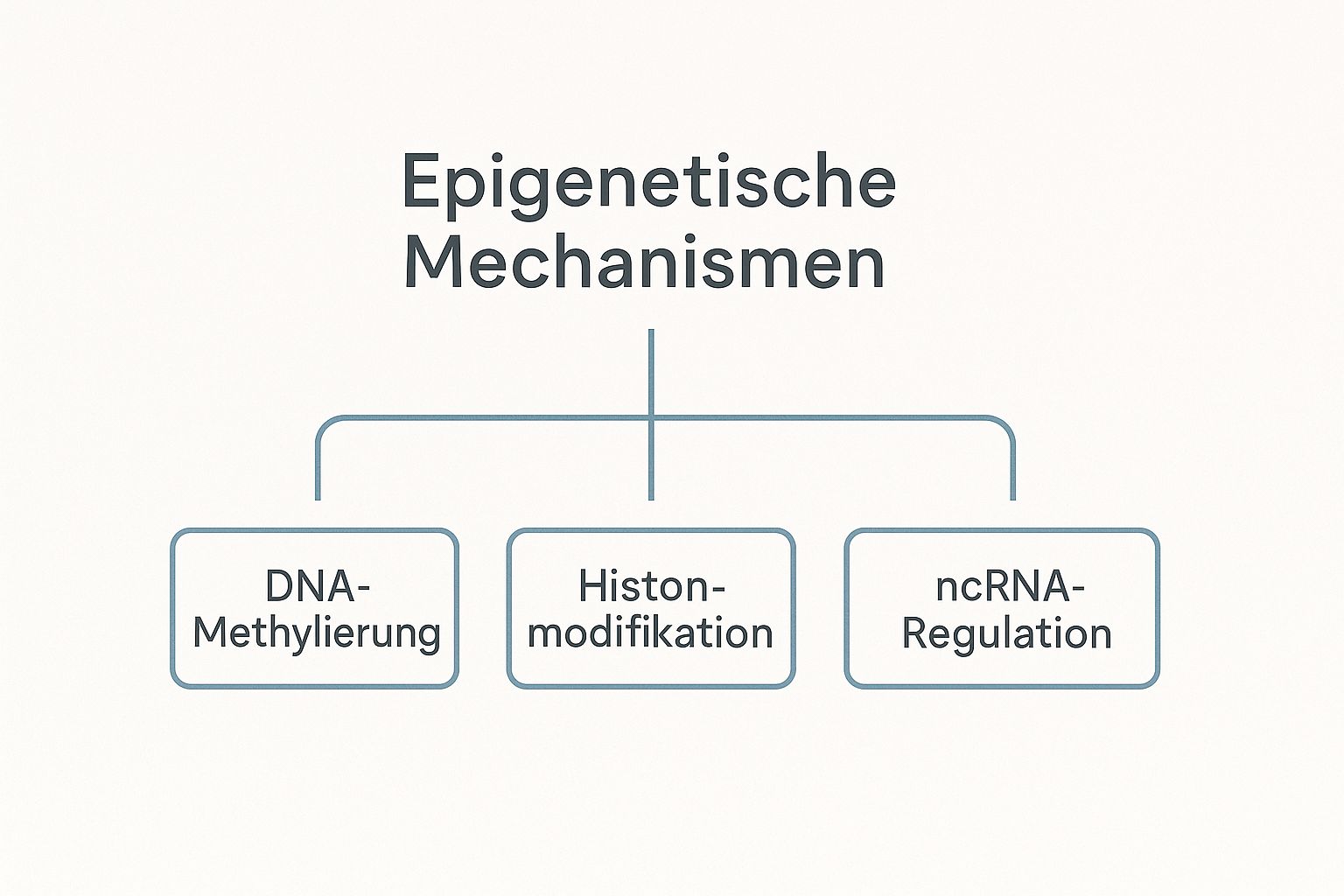
As you can see, there are three main pathways that jointly control gene expression: DNA methylation, histone modification, and regulation by ncRNAs. Let's take a closer look at these three mechanisms.
DNA methylation: The bookmark trick
DNA methylation is probably the best-known epigenetic process. Imagine it as tiny chemical bookmarks or stop signs attached directly to your DNA. These so-called "methyl groups" bind to specific sections of a gene, making it impossible for the cell to read the information stored there.
A highly methylated gene is like a recipe in your cookbook with a big "Do not use!" Post-it note stuck over it. Your body deliberately silences it because it's not needed at the moment. This process is fundamental to cell development and is extremely sensitive to external influences like your diet.
Histone modification: Opening and closing the gene book
Your DNA doesn't just float around loosely in the cell nucleus. It's incredibly long and needs to be packed in a space-saving way. To do this, it's tightly wound around specific proteins called histones . You can imagine it like a very, very long thread, neatly wound onto countless tiny spools.
This is precisely where histone modification comes into play: it alters these coils. Depending on how tightly the DNA strand is wound, the genes are accessible to the cell or not.
- Loosely wrapped (acetylation): The gene book is open. The recipes (i.e., the genes) can be easily read and used.
- Tightly wound (deacetylation): The book is closed. The genes are inaccessible and remain inactive.
Your lifestyle – especially exercise and diet – can directly influence how tightly your DNA is wrapped around these histones and which genes are activated as a result.
Non-coding RNAs: The clever fine-tuners
And then there are the non-coding RNAs (ncRNAs) . Unlike the more familiar RNA, which acts as a messenger, transmitting the instructions for building proteins, these molecules have a purely regulatory function. They are like precise managers in the background, fine-tuning the entire process of gene expression down to the smallest detail.
For example, they can block the reading of genes or ensure that already created gene copies are degraded more quickly. They thus represent another, highly dynamic level of control.
Overview of epigenetic mechanisms
This table summarizes the three main mechanisms of epigenetics and explains their function and their effect on gene activity.
| mechanism | function | Effect on genes |
|---|---|---|
| DNA methylation | Attachment of methyl groups to DNA | Blocks the reading of genes (mutes them) |
| Histone modification | It alters the packaging of DNA around histone proteins. | Makes genes accessible (loosely) or inaccessible (tightly) |
| Non-coding RNAs (ncRNAs) | They bind to RNA molecules and regulate their function. | Fine-tuning gene expression, e.g. by blocking it |
These three mechanisms form an incredibly complex network. They don't work in isolation, but hand in hand, reacting to the signals you send your body every day through your decisions. In this way, they dynamically adjust the activity of your genes.
While epigenetics controls the "software" of your genes, understanding the "hardware"—your DNA—is just as important. If you'd like to learn more about how your genes influence, for example, your nutrient processing, you'll find fascinating insights in our article "What is Nutrigenetics and How Does It Shape Our Lives?" . A DNA analysis from mybody-x can help you unlock your genetic predisposition so you can make the most of your epigenetic levers.
How your everyday life shapes your epigenetics
Now it gets personal, because this is where science directly impacts your everyday life. Every single decision you make—whether conscious or unconscious—sends tiny signals to your cells, giving your epigenetic director new instructions. It's a constant dialogue between your behavior and your biology.
You have the power to shape your life in a way that promotes your health and well-being. Your genes are the potential, but your daily life determines how that potential is actually used. This isn't just abstract theory, it's lived experience.
Nutrition as a powerful gene regulator
Your food is so much more than just fuel. Every single bite contains information that can directly influence your genes. Certain foods are true masters at flipping positive epigenetic switches, thus improving your well-being at a cellular level.
A great example of this is broccoli. Like other cruciferous vegetables, it contains a substance called sulforaphane , which has been shown to influence the activity of genes responsible for protecting our cells and detoxification. Berries, green tea, and turmeric are also packed with bioactive substances that can set positive epigenetic markers.
Your fork can be one of the most effective tools for positively influencing your gene expression. Every nutrient, every vitamin, and every mineral communicates with your DNA.
Conversely, a diet high in sugar, processed fats, and artificial additives can also send signals—unfortunately, the wrong ones. It can promote epigenetic patterns associated with chronic inflammation or metabolic problems. If you want to delve deeper, read our article on how you can influence your genes through epigenetics and nutrition .
Exercise and stress management as direct instructions
Besides diet, there are two other extremely influential factors: exercise and how you manage stress. Regular physical activity sends a strong signal to your body, triggering countless positive processes.
Exercise can, for example, alter DNA methylation in genes that control fat metabolism and insulin sensitivity. So you're not just optimizing your fitness, but also instructing your genes to work more efficiently and keep you healthy.
- Regular exercise: Optimizes genes for energy metabolism and can activate protective mechanisms.
- Mindfulness & meditation: Have been proven to downregulate the activity of stress and inflammation genes.
- Sufficient sleep: Is crucial for repair processes and the “resetting” of epigenetic markers overnight.
Chronic stress, on the other hand, acts like a constant alarm signal. It can lead to genes that promote inflammatory responses remaining permanently "switched on." Techniques such as meditation or breathing exercises are therefore not merely relaxation exercises, but active epigenetic interventions.
The dynamics of life and your epigenetic uniqueness
Your epigenetic pattern is as unique as your fingerprint – and it changes throughout your life. The best example of this comes from studies with identical twins, who start with identical DNA. However, as they age, their epigenetic patterns diverge significantly.
While differences are minimal in three-year-old twins, older twin pairs have been found to show a deviation of approximately 15% in key epigenetic markers. This development is a direct consequence of their differing lifestyles, environmental influences, and health histories.
This is precisely where mybody-x's approach comes in. A DNA analysis reveals your genetic predisposition – your personal blueprint. Knowing your individual strengths and weaknesses allows you to strategically utilize your epigenetic tools. Perhaps your genetic analysis indicates that your body needs more B vitamins for optimal methylation, or you have a predisposition for a particular metabolic type. With this knowledge, you can make conscious decisions perfectly tailored to your biology.
The role of epigenetics in health and disease
Have you ever wondered why one person develops diabetes while another with an almost identical genetic predisposition remains perfectly healthy? The answer often lies not only in the genes themselves, but in how they are controlled via epigenetics. Our lifestyle and environment can adjust the subtle switches on our DNA in such a way that the risk of developing certain diseases increases—or decreases.
Unfavorable epigenetic patterns often act as an accelerant for many lifestyle diseases. They are the missing piece of the puzzle that explains how certain factors lead to health problems in the first place.
When gene regulation gets out of sync
Imagine your genes as a perfectly tuned orchestra. If the conductor – epigenetics – falters and gives unclear instructions, the entire harmony is disrupted. Certain lifestyle factors, such as an unbalanced diet, chronic stress, or lack of sleep, can trigger precisely this. They promote epigenetic changes that, at the cellular level, fuel chronic inflammation or weaken the immune system.
These very dysregulations can then pave the way for diseases that are widespread today:
- Cardiovascular diseases: Epigenetic changes can influence genes that are partly responsible for blood pressure or cholesterol levels.
- Metabolic disorders: Dysregulation plays a major role in the development of insulin resistance and type 2 diabetes.
- Certain types of cancer: If protective tumor suppressor genes are silenced by DNA methylation, this can promote the development of cancer.
- Autoimmune diseases: Faulty gene regulation can cause the immune system to suddenly attack the body's own tissue.
Especially during sensitive phases like pregnancy or early childhood, environmental influences can leave deep epigenetic traces. German research projects, for example, show that early childhood trauma can alter the epigenetic profile of brain cells in the long term, thus increasing susceptibility to mental illness later in life. If you'd like to delve deeper, you can read the research findings on epigenetics here .
The good news: It's in your hands.
Perhaps the most important insight from epigenetics, however, is its dynamic nature. You are not helplessly at the mercy of these processes. Since many epigenetic marks are reversible, you have the chance to actively reduce your risk for many of these diseases.
Your decisions today can steer tomorrow's epigenetic patterns in a healthy direction. This makes epigenetics one of the most powerful tools in modern preventive medicine.
By consciously shaping your lifestyle, you actively write a healthier script for your cells. A nutrient-rich diet, regular exercise, and good stress management are not just suggestions, but concrete instructions you give your genes. A mybody-x blood test , for example, a nutrient or hormone test, can help you find specific starting points to optimally adjust your epigenetic pathways.
Unlock your personal genetic blueprint
Now that you know about the fascinating power of epigenetics, you're probably wondering: What does all this mean for me specifically? The knowledge is exciting, no doubt. But its true power only unfolds when you use it for yourself. So how do you find out which instructions are best for your body?
The answer lies in your very own personal blueprint – your DNA. It's the foundation upon which epigenetics can build. Your genes define your individual starting point, your strengths, and also your potential weaknesses. Only when you know this foundation can you truly and effectively adapt your lifestyle.
Your genetic blueprint as a guidepost
Imagine it like renovating a house. Before you tear down a wall or lay new pipes, you need the blueprint of the house. Without it, you're groping in the dark and, in the worst-case scenario, could damage load-bearing walls. Your DNA is this blueprint for your body. A DNA analysis from mybody-x gives you this blueprint.
A simple self-test at home will give you valuable insights, for example into:
- Your metabolic type: Do you process carbohydrates, fats, or proteins particularly well?
- Your nutritional needs: Do you perhaps have a predisposition for an increased need for certain vitamins or minerals?
- Possible intolerances: Are you naturally prone to lactose or gluten intolerance?
- Your athletic predisposition: Are you more of an endurance or a strength type?
A DNA analysis is not your destiny. It's a personal map that shows you the terrain you're navigating. This way, you can find the best path for your health.
For example, if you know that your genetic analysis shows your body particularly benefits from B vitamins for optimal DNA methylation, you can tailor your diet accordingly. This knowledge transforms general health tips into concrete, personalized action plans .
From knowledge to conscious decision
This step bridges the gap between theory and practice. You stop guessing and start making informed decisions for yourself. Instead of following generic dietary trends, you design your lifestyle in a way that's best for your unique body. You become the informed director of your own health – someone who knows the script and chooses the best scenes.
Do you want to delve deeper and understand how you can use the insights from your DNA to your advantage? In our knowledge portal, you'll find a comprehensive guide to better understand your genes and DNA analysis . With this knowledge in hand, you'll be perfectly equipped to fully unlock your epigenetic potential.
Your questions about epigenetics – answered briefly
Finally, we want to address the questions that frequently arise in connection with epigenetics. Here are the answers, presented concisely and to the point, to solidify your knowledge.
Is it possible to reverse epigenetic changes?
Yes, absolutely! And that's perhaps the most important and motivating message of epigenetics. Most of these epigenetic markers aren't set in stone, but are surprisingly flexible. This means that by consciously adjusting your lifestyle, you can actually weaken or even reverse unfavorable patterns.
Your body is a true marvel of adaptation and listens closely to the signals you send it. By eating more nutrient-rich food, exercising more, or managing stress effectively, you give it the chance to recalibrate the "script" for your genes and take control of your health.
What is the difference between genetics and epigenetics?
This question is crucial for truly understanding the whole picture. Think of genetics as the hardware of your body – the fixed, pre-existing features determined from birth. It's essentially unchangeable.
Epigenetics , on the other hand, is the software that runs on this hardware. It decides which programs (your genes) are started, dimmed, or switched off completely.
In short: Genetics is the script of your life, but epigenetics directs it. A mybody-x DNA analysis helps you decipher your personal script so you can direct it in the best possible way.
Genetics describes your pure DNA code, while epigenetics is the dynamic control level above it. And it is precisely this level that you can influence through your lifestyle, thus helping to determine which of your genetic potentials are allowed to unfold.
Can I influence my epigenetics through diet?
Absolutely! Your diet is one of the most powerful levers you can use in everyday life. Certain nutrients and plant compounds act like direct instructions to your genes and can specifically influence epigenetic processes.
Want a few well-known examples?
- Sulforaphane: This powerful substance from broccoli can help activate protective genes.
- Omega-3 fatty acids: These are found primarily in fatty fish and support a healthy balance in inflammatory processes within cells.
- B vitamins (especially folate): Green leafy vegetables are full of them and provide the fuel for DNA methylation – the targeted silencing of genes that are not good for you.
Every meal is therefore an opportunity to positively influence your gene activity. A mybody-x nutrient test can show you if you have any undetected deficiencies in important vitamins and minerals. This allows you to specifically adjust your diet to optimally promote your epigenetic health.
Are you ready to take control of your health? Discover how to perfectly tailor your diet and lifestyle to your unique biology with the scientifically based self-tests from mybody-x .
Share:
Epigenetics Definition: How you control your own genes
At-home gut health self-test: The ultimate guide to your gut health