
Epigenetics Definition: How You Control Your Genes Yourself
Perhaps you have also long believed that your genes were an unchangeable fate, set in stone for the rest of your life. The good news is that this is only half the truth. This is where epigenetics comes in, showing you how your lifestyle and environment can control the activity of your genes—without changing the DNA itself.
What Epigenetics Really Means
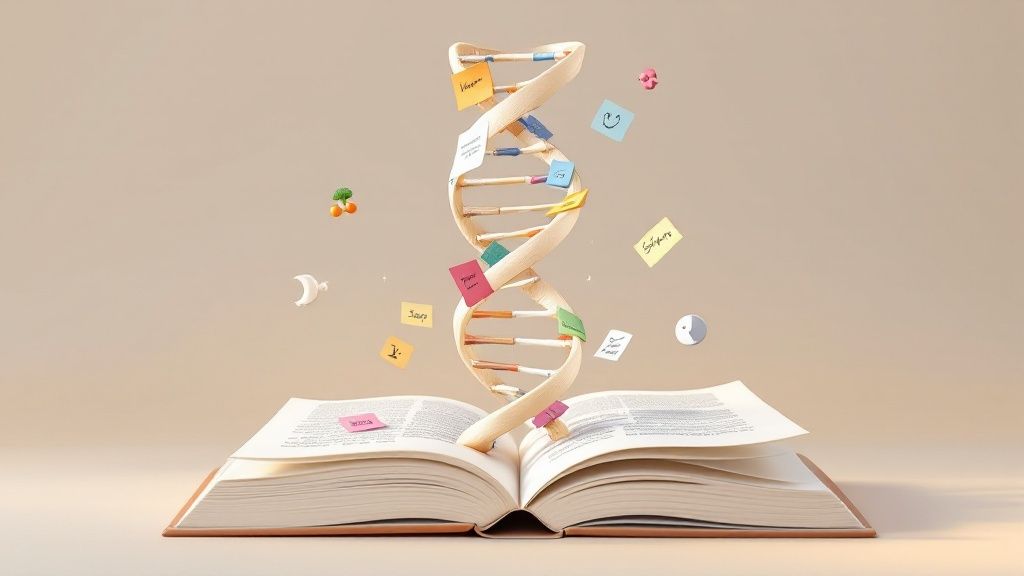
It is best to imagine your DNA as a huge library. The shelves contain countless books—these are your genes, the fixed blueprints for your body. The books themselves do not change. Epigenetics is like a clever librarian who decides which books are taken from the shelves and read at all.
This librarian uses bookmarks, notes, and highlighters for this purpose. And you create precisely these “markers” yourself through your daily life: What you eat, how well you sleep, how much stress you experience, and even your thoughts influence which genes are “activated” or “silenced.”
This is an incredibly important insight. It means that you are not merely a passenger, but the captain of your body. You are not helplessly at the mercy of your genes; you actively shape your health every day.
Genetics and epigenetics at a glance
To clearly distinguish between the two concepts, we have summarized the key differences in a table. This lets you see at a glance what it is all about.
| Aspect | Genetics | Epigenetics |
|---|---|---|
| Basis | The fixed, unalterable DNA sequence. | Changes that control gene activity. |
| Comparison | The “hardware” of your body. | The “software” that controls the hardware. |
| Changeability | Stable and unchanged throughout life. | Dynamic and influenced by lifestyle. |
| Function | Contains the blueprint. | Determines which instructions are read. |
This comparison makes it clear: While genetics sets the playing field, epigenetics determines how the game is actually played.
This means that while genetics determines your potential, epigenetics determines what is actually expressed. So every day, you have the opportunity to positively influence the instructions sent to your cells.
Even if the basics of genetics sometimes seem complicated, the underlying principle is actually quite simple. If you would like to delve even deeper into the fascinating world of DNA, you will find an easy explanation of genetics and how it works in our article.
This knowledge is the foundation for everything that follows. Once you understand that you can control your genes, the question of how becomes even more exciting. And this is precisely where targeted analyses come in, such as those made possible by mybody-x’s blood tests and self-tests.
How your body switches genes on and off
Okay, so you now know that you do not simply have to accept your genes as they are—you can actively influence them. But how exactly does your body do this? Think of it this way: your body has a kind of toolbox full of molecular switches that control the instructions in your DNA—without rewriting the code itself. This is how your lifestyle communicates directly with your cells.
The best-known of these switches is DNA methylation. In this process, tiny chemical attachments called methyl groups attach to specific areas of your DNA. It works like a dimmer switch on a lamp: the more methyl groups attached to a gene, the more strongly it is “dimmed” or even switched off completely.
How your DNA is packaged makes the difference
Another equally clever mechanism is histone modification. Your DNA does not simply lie loose inside your cells. It is neatly wrapped around small proteins called histones. This packaging can be looser or tighter.
When the winding is loose, your body can easily read and activate the genes. But when it is tightly wound, the genes are virtually inaccessible and remain silent. Here, too, epigenetic processes can use chemical attachments to control how tightly or loosely the packaging is wound.
The following infographic gives you another quick overview of how your body regulates gene activity.
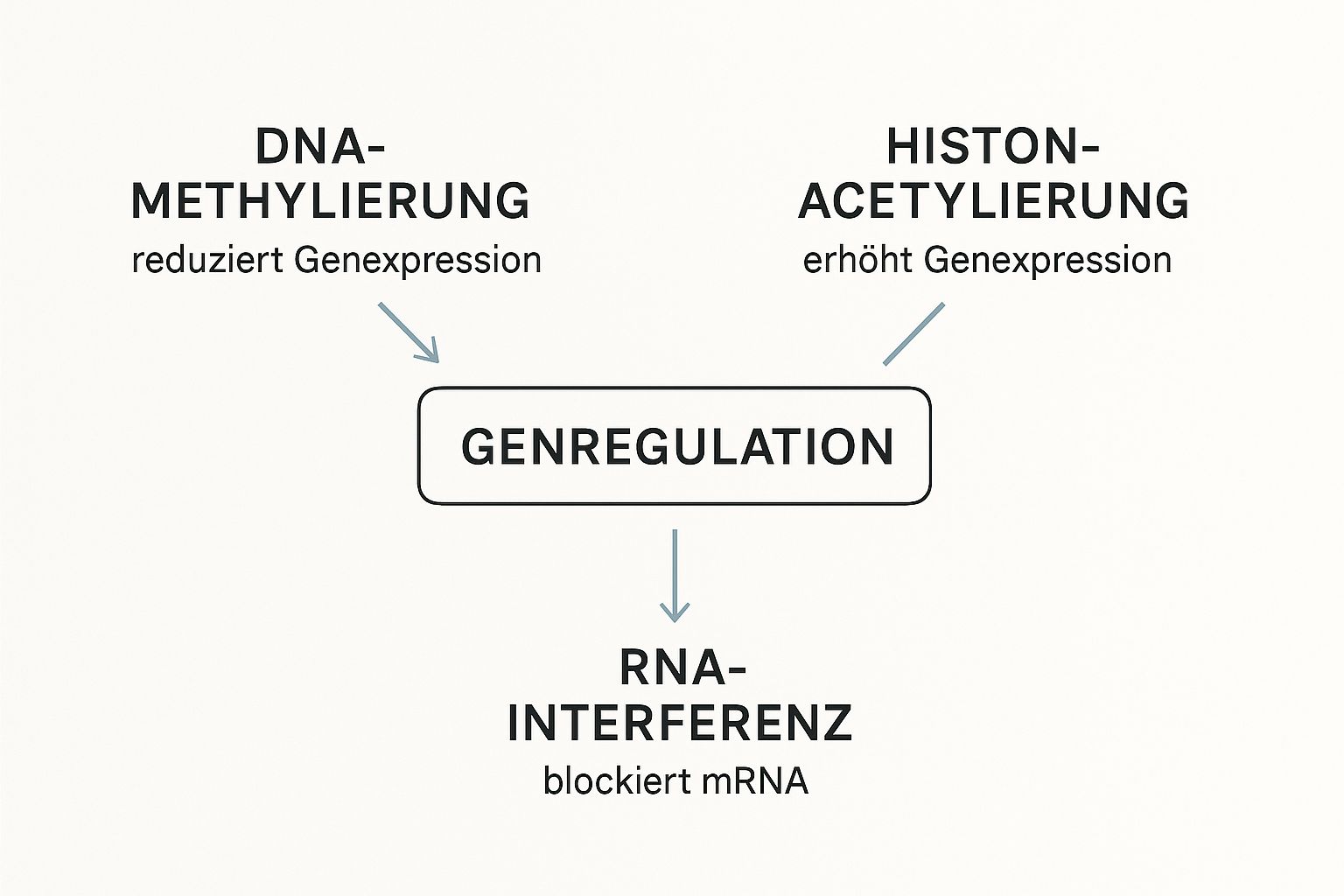
So, as you can see, mechanisms such as methylation and histone modification are like fine controls used to adjust the activity of your genes.
How about a very concrete example? Certain compounds found in broccoli can influence enzymes responsible for precisely this histone modification. So your diet can directly help “switch on” protective genes. This brilliant interplay is a central topic in the scientific study of DNA and proves just how profound your daily choices really are.
These mechanisms are not set in stone but incredibly dynamic. Every day is a new opportunity to use your diet and lifestyle to flip the right switches for your health.
All these processes are constantly running in the background and determine how your body responds to your environment and habits.
How to Become the Architect of Your Genes
The fascinating world of epigenetics has a clear message for you: You are not simply the result of your genes, but their most active architect. Your daily decisions are the tools you use to influence your genetic blueprints. Four pillars of your lifestyle play the greatest role.
These four areas reshape your epigenetic pattern day after day:
- Nutrition: You provide your body with the building blocks it needs to switch genes on or off.
- Exercise: You send signals to your cells that flip positive gene switches.
- Stress management: You determine whether stress hormones negatively affect your genes.
- Sleep quality: You enable your body’s nightly “maintenance” and repair of healthy gene patterns.
Each of these areas has a direct and measurable impact on the activity of your genes. Let’s take a closer look.
The Building Blocks of Your Health
Your diet is probably the most direct connection to your epigenetics. You can think of certain nutrients as the “ink” for the epigenetic notes on your DNA. If important vitamins are missing, your body can no longer write these annotations correctly.
B vitamins such as folic acid (vitamin B9) and vitamin B12 are particularly important here. They are essential for so-called DNA methylation—the exact process that selectively switches genes on or off. Ensuring an adequate supply of these nutrients helps your body silence the right genes, such as those that promote inflammation. If you would like to delve deeper into the topic, you can learn more in our article about the connection between epigenetics and nutrition.
Chronic stress, on the other hand, is like a standing order to your cells to prepare for an emergency. This can trigger negative epigenetic changes that increase the risk of lifestyle-related diseases.
Regular exercise is also a powerful epigenetic signal. For example, it can activate genes responsible for muscle growth and a healthy metabolism. Good sleep, in turn, is essential for epigenetic “maintenance.” While you sleep, your body repairs errors and ensures that the gene switches are optimally set for the next day.
A nutrient test from mybody-x can show you exactly whether you are supplied with all the important building blocks needed to optimally support your epigenetics. This is how you move from simply knowing to taking targeted action.
How to Use Epigenetics for Your Long-Term Health
Many modern lifestyle diseases are often driven by invisible factors: epigenetic changes. If your genes are no longer switched on and off properly, this can lead to low-grade inflammation, metabolic problems, or cardiovascular disease. Imagine the wrong genes being active at the wrong time—this can quickly disrupt your body's delicate balance.
This knowledge is precisely the key to taking preventive action before serious problems even emerge. It is not about waiting for diseases and then reacting, but about taking proactive control of your health.
Your epigenetic patterns act as an early warning system. They often reveal where your health vulnerabilities may lie long before the first symptoms appear.
Things become particularly fascinating when we look at aging. Your age on your passport—your chronological age—is only one side of the story. Much more informative is your biological age. It describes the actual condition of your cells and is significantly influenced by epigenetic markers.
What Your Genes Reveal About Your Biological Age
Today, researchers can determine your biological age fairly accurately based on certain epigenetic patterns—above all, DNA methylation. These so-called “epigenetic clocks” are a strong indicator of your overall health and even your life expectancy.
German research provides an impressive example of this. Scientists at the German Cancer Research Center (DKFZ) have developed an epigenetic score that can predict the risk of frailty in old age. As part of the large ESTHER study involving older adults, this score was able not only to assess their current condition but also to accurately predict the likelihood of future frailty. This underscores how important epigenetic mechanisms are to the biological definition of aging. You can find out more here: What epigenetics reveals about frailty.
This research shows how deeply the understanding of epigenetics has already become integrated into modern preventive healthcare. It is no longer just about treating diseases, but about setting the course early for a long and healthy life. A nutrient test or hormone test from mybody-x provides you with the data you need to adjust these crucial factors.
Supporting your epigenetics strategically with mybody-x tests

Theory is all well and good, but let’s get practical: What do you do with this knowledge? This is where we bridge the gap between the fascinating definition of epigenetics and what you can actually do in your everyday life. Because ultimately, you want to know which levers you can pull yourself.
Your epigenetic switches respond directly to what happens in your body. They are closely linked to your biochemical balance—that is, how well you’re supplied with nutrients, whether your hormones are balanced, or whether undetected intolerances are placing stress on your system.
This is exactly where mybody-x health tests come in. Instead of general advice, they provide concrete data about your body’s current state. A vague suspicion thus becomes a clear foundation for real change.
From knowledge to targeted action
Imagine a test showing that you’re deficient in important B vitamins. As you now know, these vitamins are crucial for methylation—that is, for precisely switching your genes on and off. Armed with this knowledge, you can tailor your diet and compensate for this specific deficiency.
Or perhaps a hormone test reveals an imbalance? That, too, is a strong epigenetic signal that influences the activity of countless genes.
mybody-x tests give you the opportunity to take a closer look:
- Nutrient tests: Reveal whether you’re lacking important “tools” for your epigenetic processes, such as folic acid or vitamin B12.
- Hormone tests: Give you insights into your hormonal balance, which has a direct impact on your gene activity.
- Intolerance tests: Help you identify hidden stress factors for your body that can lead to chronic inflammation and, consequently, negative epigenetic patterns.
You essentially get a data-based map of your body. Instead of groping in the dark, you can optimize your diet and lifestyle strategically to positively influence your epigenetics and strengthen your long-term health.
By using the results, you’re actively taking control. If you want to go one step further and understand how your genes fundamentally shape your nutritional needs, our Longevity & Nutrition DNA Analysis offers even deeper insights.
Questions and answers: What else you wanted to know about epigenetics
Finally, we want to address a few typical questions that repeatedly arise in connection with epigenetics. This will help you deepen your knowledge and clear up any remaining uncertainties.
Are epigenetic changes permanent?
No, and that is perhaps the most exciting insight. Unlike your DNA, which is fixed like a printed book, epigenetic markers are flexible. Think of them like Post-it notes that you can stick onto the pages and remove again.
In concrete terms, this means that through conscious decisions—whether better nutrition, more exercise, or smart stress management—you can positively influence unfavorable patterns. To a large extent, you have it in your own hands to give your cells new, healthier instructions.
Can I pass my epigenetics on to my children?
Yes, and this is a particularly fascinating area of research. There is increasing evidence that certain epigenetic imprints can be passed on to the next generation through germ cells—that is, sperm and egg cells.
This is known as transgenerational epigenetic inheritance. It highlights how important the parents’ lifestyle can be for their child’s health even before conception. Your decisions today may therefore already be laying the groundwork for the health of the next generation.
Your chronological age is just the number in your passport. Your biological age, on the other hand, shows how fit your cells really are—and this is largely determined by your epigenetics.
At what age does epigenetics play a role?
Epigenetic processes accompany you throughout your life. They begin during development in the womb and only end in old age. However, the early stages of life are particularly formative, as they lay the groundwork for your future health.
But the good news is that it’s never too late to start. Even as an adult, your lifestyle can trigger positive epigenetic changes every day and help you actively shape your health. Every healthy impulse counts, no matter when you begin.
Would you like to find out where your personal leverage points lie for positively influencing your epigenetics? The tests from mybody-x give you data-based insights into your nutrient levels, hormones, and potential intolerances—exactly the areas that control your gene activity. Discover the right tests for you now.



Share now:
What Influences Metabolism? A Comprehensive Understanding
At-home gut self-test: The ultimate guide to your gut health