
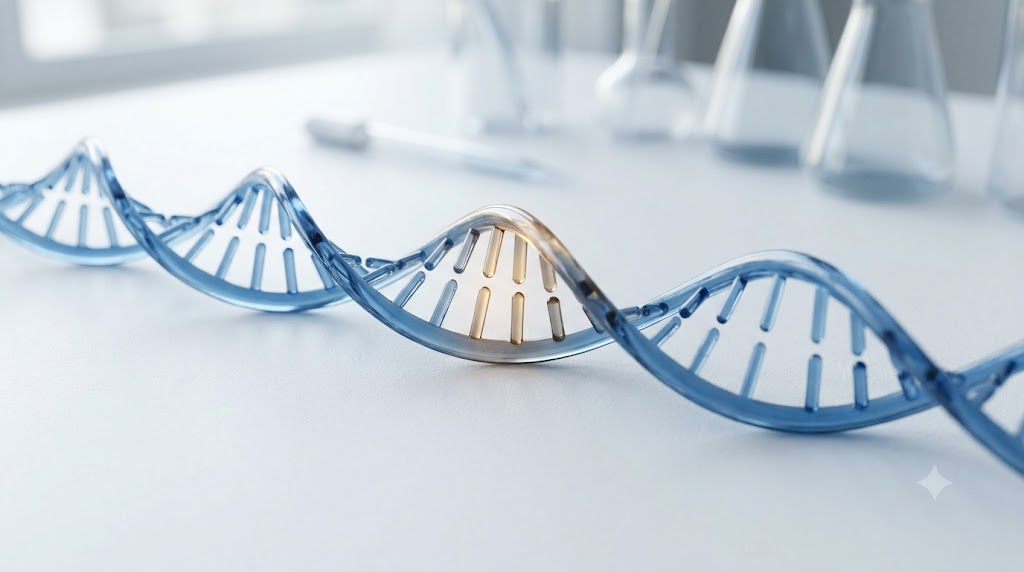
DNA and genes: What is the difference?
The difference between DNA and genes is a difference in size: DNA is the molecule, while a gene is a single section of it. The storage medium and the file on it are not the same thing. In everyday usage, however, the two words are still used synonymously—and this is where most misunderstandings arise.
Several other terms lie in between: A chromosome is a packaged DNA molecule, the genome is all the DNA in a cell, an allele is a variant of a gene, and an SNP is the replacement of a single letter.
This article organizes the hierarchy of terms from base to genome, shows how a gene becomes a trait, and explains what a gene variant says about an individual—and what it does not.
What to expect in this article
What exactly is a gene?
What is DNA made of and how is it structured?
How are chromosome, genome, and genetic material connected?
How does a gene become a trait?
DNA, gene, chromosome, genome, and allele compared
What are alleles and SNPs?
Genetics or epigenetics—which is the difference?
Which misconceptions about DNA and genes persist?
The most important terms, each in one sentence
How mybody® applies these terms in its DNA test
Context: What a genetic variant indicates—and what it does not
Conclusion
Frequently asked questions (FAQ)
Sources
What is the difference between DNA and genes?
DNA is a molecule; a gene is a piece of it. Thus, the two terms do not describe two things side by side, but two levels layered on top of each other. When someone says “DNA,” they mean the material; when they say “gene,” they mean a functional unit on that material. The text analogy goes a long way: DNA is the paper along with the letters, while a gene is a paragraph with its own message.
The difference in size is considerable. According to MedlinePlus Genetics of the U.S. National Library of Medicine (2024), human genes range in length from a few hundred base pairs to more than two million base pairs. All genes together account for only a small portion of the available DNA—the rest has other functions.
Key point: DNA and genes are not opposites but different levels: DNA is the carrier, and a gene is a functional section on that carrier. All genes consist of DNA—but by no means is all DNA a gene.
What exactly is a gene?
A gene is the section of DNA that contains the information for a specific product—in most cases, a protein or a protein component. It is also the smallest unit that is passed on as a whole. That is why the gene is considered the basic unit of inheritance in genetics.
“The gene is considered the basic unit of inheritance. Genes are passed from parents to offspring and contain the information needed to specify physical and biological traits. Most genes code for specific proteins, or segments of proteins, which have differing functions within the body.”
In other words: The gene is considered the basic unit of heredity; genes are passed from parents to offspring and contain the information that determines physical and biological traits. Most genes code for specific proteins or protein segments with different functions in the body.
How a gene is structured internally
A gene is not one continuous block. It consists of exons—the sections whose information ultimately ends up in the protein—and introns, which are read but cut out again before the protein is produced. In front of them is the promoter, a start region where the reading machinery docks. Farther away are enhancers, which amplify transcription, and silencers, which suppress it.
The location where a gene sits on a chromosome is called a locus. This location is the same in all people—the only difference is the sequence found there. That is the starting point for every genetic analysis.
What is DNA made of and how is it structured?
DNA—short for deoxyribonucleic acid, also known as DNS in German—is a long chain molecule made up of four building blocks. These four bases are called adenine (A), thymine (T), guanine (G), and cytosine (C). Their sequence is the actual information. MedlinePlus Genetics (National Library of Medicine, 2021) describes DNA as the genetic material in humans and nearly all other organisms.
Two such strands lie opposite each other and twist into the familiar double helix. A always pairs with T, and G always pairs with C. This fixed rule is why DNA can replicate at all: each strand contains the complete instructions for its complementary strand.
Base
The individual letter: A, T, G, or C. Two opposing bases form a base pair.
DNA
The text: a double helix made up of millions of base pairs arranged in sequence.
Gene
The paragraph: a defined section with its own function, usually instructions for building a protein.
Chromosome
The chapter: a single DNA molecule wrapped around proteins and tightly packaged.
Genome
The entire book: the complete DNA set of a cell, all chromosomes combined.
Why most DNA is not a gene
The proportion of DNA that actually codes for proteins is surprisingly small. According to MedlinePlus Genetics (National Library of Medicine, 2021), only about one percent of DNA consists of protein-coding genes; the remaining 99 percent is non-coding. The term “junk DNA,” which was used for this for a long time, is misleading.
According to the same source, non-coding DNA includes promoters, enhancers, silencers, and insulators; genes for tRNA, rRNA, and microRNA; and telomeres. Much of it controls when and how strongly a gene is read—in other words, the directing, not the text.
How are chromosome, genome, and genetic material connected?
A chromosome is not a separate substance but a form of packaging: a single, very long DNA molecule wrapped around histone proteins and thereby highly compacted. Without this packaging, the DNA of a single cell would not fit inside its nucleus.
These chromosomes occur in pairs—one from the father and one from the mother. According to MedlinePlus Genetics (National Library of Medicine, 2021), each human cell normally contains 23 pairs of chromosomes, 46 chromosomes in total. 22 pairs are autosomes; the 23rd pair consists of the sex chromosomes.
Source: MedlinePlus Genetics, U.S. National Library of Medicine (National Institutes of Health), 2021 and 2024
Anyone who equates “DNA” with “genes” overlooks around 99 percent of the material.
Genome and genetic material—what is the difference?
The genome is a cell’s complete DNA complement: all 46 chromosomes in the cell nucleus plus the small, circular DNA in the mitochondria. Genetic material is the everyday English term for it and essentially means the same thing, but emphasizes transmission to the next generation.
Key point: Base, DNA, gene, chromosome, and genome are five zoom levels of the same material—from a single letter to the complete library. No term replaces another.
How does a gene become a trait?
There are two translation steps between a sequence of letters and a visible trait. In the first, transcription, the gene segment is rewritten into a mobile working copy, messenger RNA. It leaves the cell nucleus. In the second step, translation, ribosomes read this copy and string amino acids together into a chain. Each set of three bases forms a code word for an amino acid.
Genotype and phenotype are two different things
The genotype is the genetic makeup at a particular site—in other words, which variant someone carries. The phenotype is what actually manifests: height, enzyme activity, hair color, or a laboratory value. Between the two lies everything that influences how it is read.
An everyday example is the digestion of milk sugar: According to MedlinePlus Genetics (National Library of Medicine, 2023), the LCT gene contains the instructions for the enzyme lactase. In many people, its activity decreases after infancy—the genotype remains the same, while the phenotype changes.
Two more concepts come into play: Penetrance describes the proportion of carriers in whom the expected trait actually appears, while expressivity describes how strongly it manifests. Both are rarely one hundred percent—this is why the leap from finding to prediction is so fraught.
DNA, gene, chromosome, genome, and allele compared
Five terms, four recurring questions: What is it, how large is it, where is it located, and why does it matter? The comparison shows that these are not competing concepts, but nested levels.
| Term | What is it? | Typical size | Where in the body | Why it matters |
|---|---|---|---|---|
| DNA | The molecule itself: a double helix made up of the bases A, T, G, and C | Approximately 3 billion bases per nuclear genome (NLM, 2021) | In the nucleus of nearly every body cell, and additionally in the mitochondria | Carrier of all genetic information; basis of every sequencing process |
| Gene | A functional segment of DNA containing an instruction set, usually for a protein | A few hundred to over 2 million base pairs (NLM, 2024) | At a fixed location (locus) on a specific chromosome | Smallest inherited functional unit; reference point in findings |
| Chromosome | A single DNA molecule wrapped around histones and tightly packaged | 23 pairs, 46 chromosomes in total per cell (NLM, 2021) | In the cell nucleus; visible under a microscope during cell division | Maps genes spatially; explains why traits are present in pairs |
| Genome | The complete DNA complement of a cell, comprising all chromosomes | Contains approximately 19,900 protein-coding genes (NLM, 2024) | Present identically in practically every body cell | Frame of reference for statements such as “one percent of DNA codes for proteins” |
| Allele | One of several possible versions of the same gene's sequence | The difference is often just a single base; two alleles per locus | At the same locus on the two chromosomes of a pair | Explains individual differences; what a DNA test determines |
This leads to a rule of thumb: a test does not “read” a gene but determines which allele is present at defined positions. The level at which people differ is the bottom line.
What are alleles and SNPs?
An allele is a variant of a gene. Because chromosomes occur in pairs, every person carries two alleles at each locus—one from the father and one from the mother. If both are the same, the person is said to be homozygous; if they differ, heterozygous.
Which allele prevails in the trait depends on the inheritance pattern. A dominant allele determines the trait even in a single copy, while a recessive allele does so only when present in two copies. In many traits, however, both alleles contribute proportionally—the strict dominance described in textbooks is more the exception than the rule.
SNPs: the substitution of a single letter
An SNP (single nucleotide polymorphism, pronounced “snip”) is the smallest conceivable form of a variant: at a particular position, some people have a different letter than others. A single character in a billion-letter text—but depending on its location, it may have noticeable consequences or none at all.
According to MedlinePlus Genetics (National Library of Medicine, 2022), SNPs are the most common form of genetic variation in humans; a person’s genome contains around four to five million SNPs, on average about one per 1,000 nucleotides. Most of them are located in non-coding regions.
In brief
An allele is a variant of a gene; every person carries two at each locus, one from each parent.
An SNP is the smallest variant possible: the substitution of a single base. Around four to five million SNPs are found in a person’s genome (National Library of Medicine, 2022).
SNPs are markers of statistical associations at the population level—they are neither a diagnosis nor a prediction for an individual.
Genetics or epigenetics—which is the difference?
Genetics deals with the text: which base sequence is present and how it is passed on. Epigenetics deals with the direction: which sections are read in a particular cell at a particular time. The crucial point is that the base sequence itself remains unchanged.
MedlinePlus Genetics (National Library of Medicine, 2021) defines the epigenome as the totality of modifications that regulate gene activity—that is, gene expression. Two mechanisms are particularly important.
In DNA methylation, methyl groups are attached to the DNA. According to the same source, a gene with methyl groups attached is switched off or silenced, so no protein is produced from that gene. In histone modification, the packaging proteins are chemically altered; this affects how tightly the DNA is wrapped around the histones—and therefore whether a gene can be switched on or off.
Key message: Genetics is the text; epigenetics is the stage direction. Lifestyle affects the stage direction, not the text—the base sequence itself remains the same throughout life.
Which misconceptions about DNA and genes persist?
Three ideas come up again and again. All three sound plausible but are overly simplistic—usually because they skip a level of the terminology ladder.
The most important terms, each in one sentence
A short genetics glossary
- ✓ Base – one of the four letters A, T, G, or C that make up DNA
- ✓ DNA – deoxyribonucleic acid, the molecule that carries genetic information
- ✓ Gene – a functional section of DNA, usually containing the instructions for building a protein
- ✓ Allele – one of several possible versions of the same gene
- ✓ SNP – a variant in which exactly one base is replaced
- ✓ Chromosome – a tightly packaged DNA molecule; humans have 23 pairs
- ✓ Genome – the complete DNA set of a cell
- ✓ Epigenetics – the regulation of gene activity without changing the base sequence
Where this article ends—and which one continues
This article explains the terms. It deliberately does not address what a test provides or costs—for that, there are two separate articles.
What an analysis specifically evaluates and how reliable the results are is explained in the article What Are the Benefits of a DNA Metabolism Test?.
The article DNA Analysis for Weight Loss: Costs explains how prices are composed and how offers differ. This article focuses on what the terms mean.
How mybody® applies these terms in its DNA test
In practice, a genetic analysis means exactly what the terminology suggests: DNA is extracted from a sample, the alleles present at defined loci are determined, and these genotypes are interpreted. mybody® (MYBODY Lab GmbH) offers the NutriCare | the INFINITY DNA Test.

NutriCare | INFINITY DNA Test
The test examines more than 140 genetic variations from a saliva sample and compiles them into 54 assessments in eight chapters across approximately 200 pages—supplemented by a personalized nutrition plan with recipes and more than 1,000 rated foods. Intended as guidance, not a diagnosis.
Price: €269.00 · Sample type: saliva sample (at home) · Processing time: approx. 20–25 business days · Laboratory: ISO 27001-certified analysis
NutriCare | View INFINITYImportant: The test examines individual, preselected variants—not the entire genome and not complete genes. Further analyses are shown in the DNA Metabolism Tests collection. The limitations of such a test are explained in the next chapter—and they are substantial.
Information on price, sample type, processing time, and scope is taken from the mybody® product page (as of July 2026) and may change.
Context: What a genetic variant indicates—and what it does not
A genetic analysis shows which alleles are present at the locations examined and which associations research has described for them. It is a snapshot—and, honestly, it is nothing more than that.
Gene variants represent probabilities at the group level, not diagnoses or individual predictions. A finding describes how frequently a trait was observed in people with that variant—not what will happen to a particular person. Between genotype and phenotype lie penetrance, expressivity, other genes, epigenetics, age, diet, and living conditions.
The evidence is particularly clear for genotype-tailored diets. The DIETFITS study followed 609 overweight adults for twelve months on either a low-fat or low-carbohydrate diet and also examined whether a genetic pattern predicted success.
According to Gardner et al. (JAMA, 2018), after twelve months, weight loss averaged 5.3 kilograms in the low-fat group and 6.0 kilograms in the low-carbohydrate group; no significant interaction between diet type and genotype pattern was found. An SNP finding therefore says nothing about an individual's weight-loss success.
A DNA test is therefore a source of information, not a control instrument—and it does not replace diagnostic testing. For symptoms such as persistent fatigue, unexplained weight changes, or digestive problems, the first step is a medical evaluation. Suspected lactose or gluten intolerance should also be medically assessed.
Conclusion
The difference between DNA and genes is easy to state but far-reaching: DNA is the molecule; a gene is a functional segment of it. Everything that genetically distinguishes people takes place at the level below this—among alleles and the individual exchanged bases.
The terminology ladder helps put statements into context: base, DNA, gene, chromosome, and genome are five zoom levels of the same material. Around three billion bases, approximately 19,900 protein-coding genes, and roughly one percent coding DNA (National Library of Medicine, 2021 and 2024) make the proportions easier to understand.
And for practical purposes, the most important point remains this: A gene variant describes a probability in a group, not a predetermined outcome for an individual. Keeping the terms separate makes it easier to recognize exaggerated promises—and to deal with a finding realistically.
Frequently asked questions (FAQ)
Understanding your genetic predispositions
The NutriCare | The INFINITY DNA test analyzes more than 140 gene variants in 54 assessments from a saliva sample. Intended as a guide—not a diagnosis or a prediction of success.
View NutriCare | INFINITY All DNA metabolism testsYou might also be interested in
→ What does a DNA metabolism test do?
What an analysis evaluates—and how reliable it is.
→ DNA weight-loss analysis: costs
What makes up the prices.
→ DNA metabolism test: lose weight healthily
How the analysis works.
Sources
- National Human Genome Research Institute (NHGRI), National Institutes of Health: Talking Glossary of Genomic and Genetic Terms, entry “Gene”. genome.gov
- MedlinePlus Genetics, U.S. National Library of Medicine (2021): “What is DNA?" medlineplus.gov
- MedlinePlus Genetics, U.S. National Library of Medicine (2024): “What is a gene?" medlineplus.gov
- MedlinePlus Genetics, U.S. National Library of Medicine (2021): “What is noncoding DNA?" medlineplus.gov
- MedlinePlus Genetics, U.S. National Library of Medicine (2021): “How many chromosomes do people have?" medlineplus.gov
- MedlinePlus Genetics, U.S. National Library of Medicine (2022): “What are single nucleotide polymorphisms (SNPs)?" medlineplus.gov
- MedlinePlus Genetics, U.S. National Library of Medicine (2021): “What is the epigenome?", (2021) “What are complex or multifactorial disorders?" and (2023) “LCT gene". Epigenome · Complex traits · LCT gene
- Yengo, L. et al. (2022): “A saturated map of common genetic variants associated with human height", Nature 610:704–712. nature.com
- Gardner, C. D. et al. (2018): “Effect of Low-Fat vs Low-Carbohydrate Diet on 12-Month Weight Loss in Overweight Adults and the Association With Genotype Pattern or Insulin Secretion" (DIETFITS), JAMA 319(7):667–679. jamanetwork.com
Gene definition [1] and [3], DNA structure [2], non-coding DNA [4], chromosome number [5], alleles and SNPs [6], epigenetics, complex traits, and LCT [7], height [8], genotype-adapted diets [9]. All sources were checked on July 28, 2026; the quotation in Chapter 2 appears in the original English, and the German version below is an editorial translation. Product information comes from mybody-x.com and may change.

mybody® Editorial & Expert Team
This article was created by the mybody® editorial and expert team, which brings together expertise in laboratory diagnostics, genetics, nutritional science, and nutrigenetics. Learn more about us on the editorial and author page.
Published on July 28, 2026 · Last updated on July 28, 2026
Medical notice: This article is intended for general information and does not replace medical advice, diagnosis, or treatment. If your symptoms persist, please consult a doctor.




Share now:
Gene Expression and Nutrition: What Your Meals Really Control
Macronutrients simply explained: What protein, fat, and carbohydrates really do