

Gene expression and diet: What your meals really control
Diet is defined as the strongest external regulator of human gene expression. This means that what you eat and when you eat it switches genes on or off without changing even a single nucleotide in your DNA sequence. Research at the German Institute of Human Nutrition (DIfE) and Charité shows that meal timing alone influences 1,386 genes in adipose tissue. This is not a minor effect. The connection between gene expression and diet explains why two people consuming the same number of calories can show completely different metabolic responses, and why personalized nutrition is far more than a trend.
Which molecular mechanisms connect diet with gene expression?
Diet primarily controls gene activity through epigenetic processes. The most important of these is DNA methylation: methyl groups are attached to specific sites on DNA, which silences or activates genes without changing the sequence. Epigenetic marks thus permanently alter the reading and activity patterns of genes.

The biochemical key to this is the so-called one-carbon metabolism. This metabolic pathway supplies methyl groups and cofactors for the entire methylation infrastructure that regulates gene expression. Specifically, nutrients such as folate, vitamin B12, and choline are the raw materials the body uses to produce S-adenosylmethionine (SAM). SAM is the universal methyl-group donor for DNA, proteins, and other molecules.
Pro tip: Folate, vitamin B12, and choline are not luxury nutrients. They are the biochemical prerequisites for your gene regulation to function at all.
This is also where an important distinction lies—one that many people overlook:
- Short-term gene regulation responds to meals within hours, for example through transcription factors that translate nutrient signals directly into gene activity.
- Long-term epigenetic marks build up over weeks to years and are considerably more stable. They reflect long-term nutritional status.
- Context dependence is central here: Which genes are influenced by a dietary change depends on the individual's initial metabolic status.
The MTHFR-folate axis model illustrates this connection particularly well. The MTHFR enzyme converts folate into its active form, which is then needed for SAM production. Reduced MTHFR activity lowers SAM levels and promotes DNA hypomethylation, meaning reduced methylation. The result: Genes that should actually be silent become active. People who carry genetic variants in the MTHFR gene are therefore particularly sensitive to folate deficiency.
How does the timing of your meals influence gene expression in adipose tissue?
Meal timing is at least as biologically significant as nutrient quality and quantity for gene expression in adipose tissue, according to Prof. Olga Ramich from DIfE and Charité. This statement sounds provocative. But it is not when you are familiar with the research.
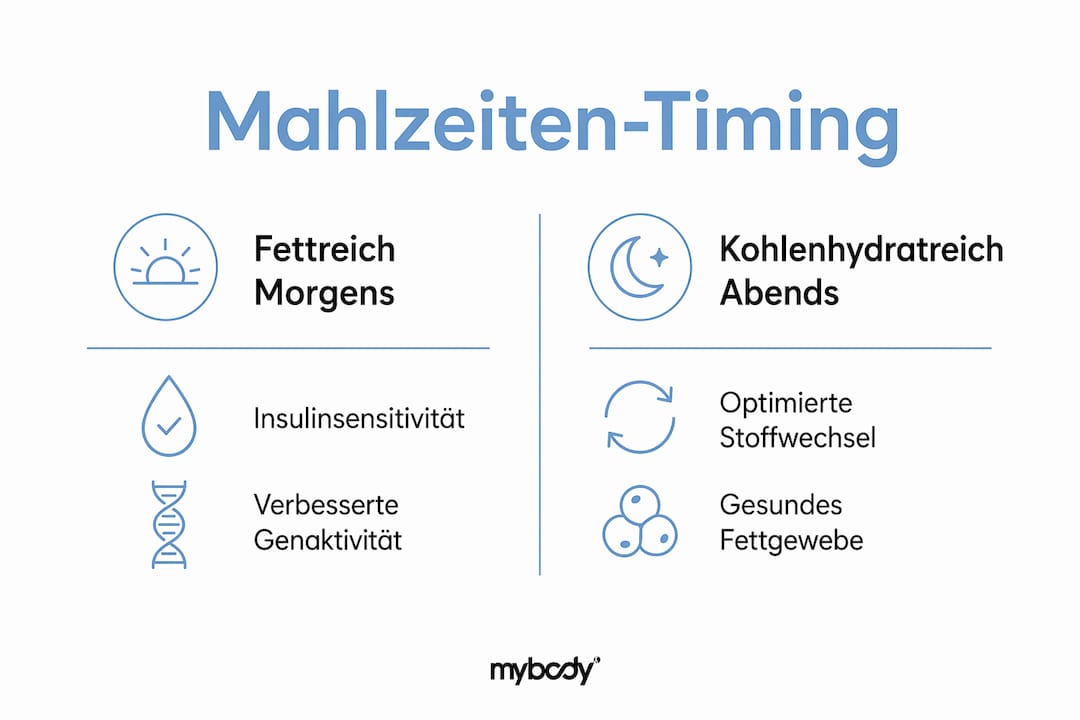
In a controlled study involving 29 participants, researchers from DIfE and Charité tested isocaloric diets in which only macronutrient timing was varied. Calories and nutrient proportions remained constant. Nearly one-third of the genes with diurnal oscillation were influenced by the timing of macronutrient intake. The study design is particularly valuable because keeping calories and macronutrient proportions constant makes it possible to clearly attribute the effects to timing.
| Dietary pattern | Effect on gene expression | Metabolic consequence |
|---|---|---|
| High-fat in the morning, carbohydrate-rich in the evening | Favorable gene activation | Better insulin sensitivity |
| High-fat in the evening | Activation of inflammatory genes | Increased risk of type 2 diabetes |
| Even distribution | Moderate effects | No clear direction |
Eating a high-fat diet in the morning combined with a carbohydrate-rich diet in the evening measurably improves insulin sensitivity. The reverse—consuming most of your fat in the evening—activates inflammatory genes and thereby increases risk factors for obesity and type 2 diabetes. This is not a theoretical risk. It is a measurable difference in the gene activity of the same person consuming the same number of calories.
Pro tip: If you eat eggs with avocado in the morning and rice with vegetables in the evening, you are following a pattern supported by research on meal timing. Not because of the calories, but because of gene expression.
For the prevention of metabolic diseases, this means that it is not only what is on your plate but also when it gets there that has direct consequences for gene activity in adipose tissue.
How does your individual nutrient status affect epigenetic gene regulation?
Nutrient deficiencies alter DNA methylation status in blood and tissue. This is not an abstract concept. Human studies show that methylation changes vary considerably depending on nutrient supply and the affected gene locus. Two people with the same folate deficiency can therefore develop different epigenetic profiles.
The most important nutrients for epigenetic gene regulation are:
- Folate (vitamin B9): Supplies the methyl groups for one-carbon metabolism. Deficiency leads to DNA hypomethylation and can deactivate tumor suppressor genes.
- Vitamin B12: A cofactor for converting homocysteine to methionine. Without sufficient B12, homocysteine accumulates and SAM production declines.
- Choline: Often overlooked, but it is an independent methyl donor. Particularly relevant during pregnancy for fetal brain development.
- Zinc and magnesium: Cofactors for DNA methyltransferases, the enzymes that attach methyl groups to DNA in the first place.
Genetic variants amplify these effects. Anyone carrying an MTHFR polymorphism, such as the C677T variant, has reduced enzyme activity and needs more active folate (5-methyltetrahydrofolate) to achieve the same methylation status as someone without this variant. Epigenetic effects of nutrition therefore depend heavily on individual nutrient status. Blanket recommendations fall short here.
This has a direct consequence: Anyone who does not know their nutrient status is making dietary decisions in the dark. A blood test measuring folate, vitamin B12, and homocysteine provides concrete indications of whether your methylation infrastructure is adequately supplied at all.
What practical recommendations can be derived from the influence of nutrition on genes?
Research on the link between gene expression and nutrition provides concrete areas for action. Here are the most important ones, ranked by the strength of the evidence:
-
Take meal timing seriously. Fat-rich meals in the morning and carbohydrate-rich meals in the evening. This pattern supports insulin sensitivity and reduces the activation of inflammatory genes. It costs nothing and requires no diet.
-
Consume methyl donors regularly. Green leafy vegetables (folate), eggs and meat (choline and B12), and legumes (folate and choline). These foods supply one-carbon metabolism with what it needs.
-
Avoid pro-inflammatory dietary patterns. High consumption of processed fats in the evening, highly processed carbohydrates, and alcohol demonstrably disrupts epigenetic regulation. This is not moralizing; it is biochemistry.
-
Check your nutrient status regularly. Knowing your folate, B12, and homocysteine levels allows you to take targeted action. This is particularly relevant for people with MTHFR variants, vegans, and older adults.
-
Use DNA-based nutrition recommendations. A genetic nutrition test shows which genetic variants influence how you process nutrients. This turns dietary recommendations from general guidelines into personal strategies.
The science is clear: General dietary recommendations are applied to individual genomes. The result is always a compromise. Anyone who truly wants to understand how their diet influences their genes needs data about themselves.
Key findings
The connection between nutrition and gene expression shows that not only the quality but also the timing of meals directly determines which genes are active in adipose tissue and which metabolic risks arise.
| Topic | Details |
|---|---|
| Meal timing | Nearly one-third of genes with circadian oscillations respond to the timing of macronutrient intake. |
| DNA methylation | Folate, vitamin B12, and choline are the key nutrients for effective epigenetic gene regulation. |
| MTHFR variants | Genetic polymorphisms in the MTHFR gene increase the need for active folate and make personalized nutrition necessary. |
| Inflammation risk | High-fat meals in the evening activate inflammatory genes and measurably increase the risk of type 2 diabetes. |
| Personalization | Epigenetic nutritional effects depend on context, which is why individual nutrient tests are more informative than general recommendations. |
What I truly believe after years of nutrition and genetic analyses
The debate about nutrition and genes is too often reduced to superfoods and dietary supplements. That falls short. After many years of working with personalized health analyses, what has truly surprised me is not that nutrition influences genes. That was to be expected. What is surprising is how strongly timing plays an independent role, completely regardless of calories or nutrient quality.
I regularly see people improve the quality of their diet but ignore timing. They eat high-fat meals in the evening because it is more convenient, then wonder about inflammatory markers or poor insulin levels. Prof. Ramich’s research at DIfE explains this. But most people are unaware of these studies.
At the same time, I caution against oversimplification. Epigenetic effects depend on the locus and context. A superfood that improves methylation in one person may have little effect in someone else with a different baseline status. Anyone who ignores this and makes sweeping promises is selling hope, not science.
The only approach that truly works is knowing your own nutrient status and genetic baseline. From there, you can derive dietary recommendations that genuinely fit your biology. Everything else is guesswork.
— mybody x
Support your gene expression in a targeted way with mybody x
Anyone who wants not only to understand but also actively use the connection between nutrition and gene expression needs concrete data about their own biology.

mybody x offers two direct approaches: The DNA Metabolism Tests analyze genetic variants that influence your nutrient utilization, fat metabolism, and epigenetic baseline. The Nutrient VitalCheck Complete measures your current status of folate, vitamin B12, homocysteine, and other key markers of methylation infrastructure. Both tests can be conveniently completed at home, are ISO-certified, and provide personalized nutrition recommendations. With more than 11,300 satisfied customers and a rating of 4.77 stars, mybody x stands for laboratory quality you can truly use.
FAQ
What is the connection between gene expression and nutrition?
Nutrition regulates gene expression through epigenetic mechanisms such as DNA methylation without altering the DNA sequence. Nutrients such as folate, vitamin B12, and choline provide the methyl groups that switch genes on or off.
How does meal timing affect gene activity?
The timing of macronutrient intake influences almost one-third of genes with circadian oscillation in adipose tissue. High-fat meals in the morning and carbohydrate-rich meals in the evening improve insulin sensitivity, whereas the opposite pattern activates inflammatory genes.
Which nutrients are most important for epigenetic gene regulation?
Folate, vitamin B12, and choline are the key nutrients for one-carbon metabolism, which drives DNA methylation. Zinc and magnesium are additional cofactors for methyltransferase enzymes.
Can I permanently change my gene expression through nutrition?
Short-term gene regulation responds to meals within hours. Long-term epigenetic markers develop over weeks to years and are more stable. Both levels can be influenced by dietary habits.
Why is personalized nutrition important for gene expression?
Epigenetic effects of nutrition depend heavily on individual nutrient status and genetic variants such as MTHFR polymorphisms. General recommendations therefore do not apply equally to everyone. A DNA or nutrient test provides the foundation for truly personalized nutrition strategies.



Share now:
Reference ranges in blood tests: Meaning and overview
DNA and genes: What’s the difference?