
fT3 and fT4 alongside TSH: what they add
The essentials at a glance
TSH measures the signal sent to the thyroid. fT3 and fT4 measure what the thyroid produces in response. These are two different sides of the same regulatory system.
The letter f at the beginning is the most important part of the name. Most thyroid hormones in the blood are bound to proteins, and only the free portion is active (IQWiG, as of March 20, 2025).
You will first read what the two values describe. This is followed by a comparison with TSH, the difference between free and total, the reference ranges from the key sources, and the question of when hormone levels are actually measured.
What to expect in this article
1. What fT3 and fT4 describe
2. Signal and output: two sides
3. The three values compared
4. Free and total are two values
5. The statement about the relationship between the two hormones
6. Why the free portion is measured today
7. The reference ranges from the key sources
8. Why the order matters
9. When hormone levels are measured
10. Three sentences in the fact-check
11. A documented special case
12. Who may benefit from a measurement
13. What a capillary blood test can show here
14. Limitations: what three values leave open
15. What matters about the hormone levels
Frequently asked questions
Sources
What fT3 and fT4 describe
Both values are thyroid hormones, and both describe something different from TSH.
IQWiG defines it as follows: Free thyroxine is a thyroid hormone, and only the unbound portion can exert its effects in the body and regulate various metabolic processes (as of March 20, 2025).
And the other one is defined as follows: Free triiodothyronine is a thyroid hormone that influences various metabolic processes in the body, such as the heartbeat (as of March 20, 2025).
Where the numbers in the name come from
The 3 and 4 do not indicate a ranking. They refer to the number of iodine atoms in the molecule: triiodothyronine has three, and thyroxine has four.
This explains the abbreviations T3 and T4 and therefore also the way they are written in a test report. An f before them stands for free.
Signal and output: two sides
The difference from TSH is fundamental and is rarely made clear.
According to IQWiG, TSH originates in the pituitary gland and stimulates the thyroid to produce thyroid hormones (as of March 20, 2025). It is therefore the signal.
fT3 and fT4 are what comes next. They are the response to this signal.
That is why the two sides run in opposite directions. For the hormone levels, IQWiG states: Elevated levels of free thyroid hormones in the blood may indicate an overactive thyroid; if they are too low, this may be a sign of an underactive thyroid (as of April 24, 2024). With TSH, it is exactly the opposite.
The three values compared
The table compares the three values using the same four questions. It provides context and does not make a diagnosis.
| Value | Where it comes from | What a high value suggests | Reference range for adults |
|---|---|---|---|
| TSH | From the pituitary gland—the signal to the thyroid gland | Usually hypothyroidism | 0.3 to 3.5 mU/l; from age 50, 0.3 to 4.5 mU/l |
| fT4 | From the thyroid gland—the free, active fraction of thyroxine | May indicate hyperthyroidism | 10 to 23 pmol/l, corresponding to 0.8 to 2.0 ng/dl |
| fT3 | From the thyroid gland—the free fraction of triiodothyronine, more potent than fT4 | May indicate hyperthyroidism | 3.9 to 6.7 pmol/l, corresponding to 0.2 to 0.52 ng/dl |
| Total T4 | The sum of free thyroxine and thyroxine bound to protein | Usually no longer used for assessment today | 5 to 12 µg/dl |
All reference ranges in this table are from IQWiG and apply to adults over 18; the TSH ranges are based on age (as of 20 March 2025). The range on your own test result remains authoritative because reference values may vary from one laboratory to another (IQWiG, as of 2 April 2025).
The sister article Normal TSH Level Despite Symptoms explains what a normal TSH means when symptoms persist.
Free and total are two values
The letter f before the abbreviation is the most important part of the name, and it is often overlooked when reading a test result.
IQWiG explains the background: Most thyroid hormones in the blood are bound to protein; only a small proportion is unbound, meaning free, in the blood (as of 20 March 2025).
Furthermore: These free thyroid hormones are active, meaning that they can exert their effects in the body only in this state (as of 20 March 2025).
What this means for the test result
According to the same source, total T4 is the sum of free thyroxine and T4 bound to protein (as of 20 March 2025). The same principle applies to total T3.
A total value and a free value therefore fall into completely different numerical ranges. Total T4 is reported in µg/dl, while free T4 is reported in pmol/l or ng/dl.
When comparing two test results, the assessment therefore begins with the name and the unit, not the number. T4 and fT4 are two different values.
The sentence about the relationship between the two hormones
There is a difference between fT3 and fT4 that the leading source mentions in half a sentence.
Documented source
“Free triiodothyronine (fT3) is therefore more effective than free thyroxine (fT4).”
Institute for Quality and Efficiency in Health Care
IQWiG, gesundheitsinformation.de, Free triiodothyronine (fT3), as of March 20, 2025
More effective does not mean more important here. It means that the same amount of fT3 has a greater effect in the body than the same amount of fT4.
This explains why the reference ranges of the two are so far apart. fT4 ranges from 10 to 23 pmol/l, while fT3 ranges from 3.9 to 6.7 pmol/l (IQWiG, as of March 20, 2025).
Comparing the two figures with each other therefore makes no sense. Each value is interpreted against its own range.
Why the free fraction is measured today
The fact that modern test reports list fT4 instead of T4 is a development with a clear rationale.
IQWiG describes it as follows: In the past, total T4 was measured to assess the thyroid; nowadays, only the thyroxine freely present in the blood is usually measured, because this allows thyroid function to be assessed more accurately than with total T4 (as of March 20, 2025).
The MSD Manual, professional edition, makes the same point from a clinical perspective: Free T4 in serum can be measured directly, avoiding the pitfalls of interpreting the total T4 concentration (as of February 2024).
For T3, IQWiG confirms the same practice: As a rule, the free fraction is measured to identify thyroid-function disorders (as of March 20, 2025).
The reference values from the key sources
Three values for adults over 18, each with a source and date. They provide context and do not constitute a diagnosis.
Documented reference ranges
10–23
pmol/l free thyroxine, corresponding to 0.8 to 2.0 ng/dl, for women and men over 18 (IQWiG, as of March 20, 2025)
3,9–6,7
pmol/l free triiodothyronine, corresponding to 0.2 to 0.52 ng/dl, for women and men over 18 (IQWiG, as of March 20, 2025)
5–12
µg/dl total thyroxine—a different value in a different unit (IQWiG, as of March 20, 2025)
The third figure is deliberately placed here alongside the first two. It shows how far a total value and a free value can differ, and why confusing them can be costly.
IQWiG adds the same principle for both free values: A single laboratory value usually cannot be used to infer a disease. And healthy people sometimes have values outside the reference range, too (as of March 20, 2025).
Why the order matters
This is where the relationship between the three values can be summed up in one sentence.
TSH answers whether a problem exists. fT3 and fT4 answer what it consists of.
This division of labor explains the usual sequence in diagnostics. TSH responds early and sensitively, while the hormone values describe the situation more precisely.
The MSD Manual, professional edition, clearly describes the role of TSH: It is the most sensitive parameter for evaluating thyroid function (as of February 2024).
This does not mean, however, that the hormone values are unnecessary. They answer a different question, and they answer it only once that question has been asked.
When the hormone values are measured
One point should be mentioned here that contradicts a widespread expectation.
The IQWiG describes the usual practice as follows: Thyroid dysfunction can be detected particularly early through a change in the TSH level, so often only TSH is measured first, and if this value is abnormal, the thyroid hormones T3 and T4 are also determined (as of 24 April 2024).
The two hormone values are therefore generally a second step, not a first one. Anyone who has them measured without an abnormal TSH receives figures that would not have been requested at all in the usual sequence.
Why they can still be useful
The order does not mean that the values are worthless at the first step. It follows from the question being asked.
If all three values are available from the same day, a second appointment is unnecessary if the TSH turns out to be abnormal. They also come from the same sample, meaning they were obtained under the same conditions.
What can be inferred from this in an individual case is determined by a medical practice. What can be established here is the practical advantage of having a complete set of figures with a date.
Three statements in a fact check
These three statements regularly come up when thyroid values are discussed.
Checked against the evidence
Common belief
“T4 and fT4 are the same thing.”
Supported
Total thyroxine is the sum of free thyroxine and T4 bound to protein (IQWiG, as of 20 March 2025). The reference ranges therefore differ considerably: 5 to 12 µg/dl versus 10 to 23 pmol/l.
Common belief
“If fT3 is higher than the fT4 range, something is wrong.”
Supported
The two values have their own reference ranges: fT4 10 to 23 pmol/l, fT3 3.9 to 6.7 pmol/l (IQWiG, as of 20 March 2025). Each is interpreted against its own range; comparing the numbers with one another says nothing.
Common belief
“Anyone who wants to have their thyroid checked always needs all three values.”
Supported
The usual order is different: often, only TSH is measured first, and if this value is abnormal, T3 and T4 are also determined (IQWiG, as of 24 April 2024). The practical advantage of having all three values is that they come from the same sample.
A documented special case
There is a situation in which the three values do not fit together, and it has its own name.
The professional edition of the MSD Manual lists this as low T3/low T4 syndrome, also called euthyroid sick syndrome. TSH may be normal, low, or high (as of February 2024).
This situation concerns seriously ill people and is therefore not an everyday case for a self-test. It is included here because it shows that even three values measured together cannot answer every question.
The same source also mentions circumstances in which TSH may be falsely low in people who are very ill, particularly when taking glucocorticoids or dopamine (as of February 2024). Ongoing treatment should therefore be discussed whenever reviewing a test result.
Who may benefit from a measurement
The comparison concerns the combined measurement of TSH, fT3, and fT4 from one sample.
Useful for you if …
You have only known your TSH so far and are missing the two hormone values.
Your old test result shows T4 instead of fT4 and you want to see the value commonly used today.
You want all three values from the same sample and with the same date.
You want to bring a complete set of numbers to a discussion at your medical practice.
Probably not if …
You want to monitor ongoing thyroid treatment. That belongs with the medical practice managing it.
You want to interpret something from the ratio between the numbers. Each value has its own range.
You are seriously ill at the moment. In that case, interpreting all three values is limited.
You expect a diagnosis. That is provided by a medical practice, not a self-test.
What a capillary blood test can show here
A capillary blood self-test does not provide a diagnosis and does not replace medical evaluation. What it can do is provide all three values together instead of spreading them across two appointments.
The Women's Wellness Check by mybody®x (MYBODY Lab GmbH) measures TSH, fT3, and fT4 from the same sample. This means the results and report are from the same day.
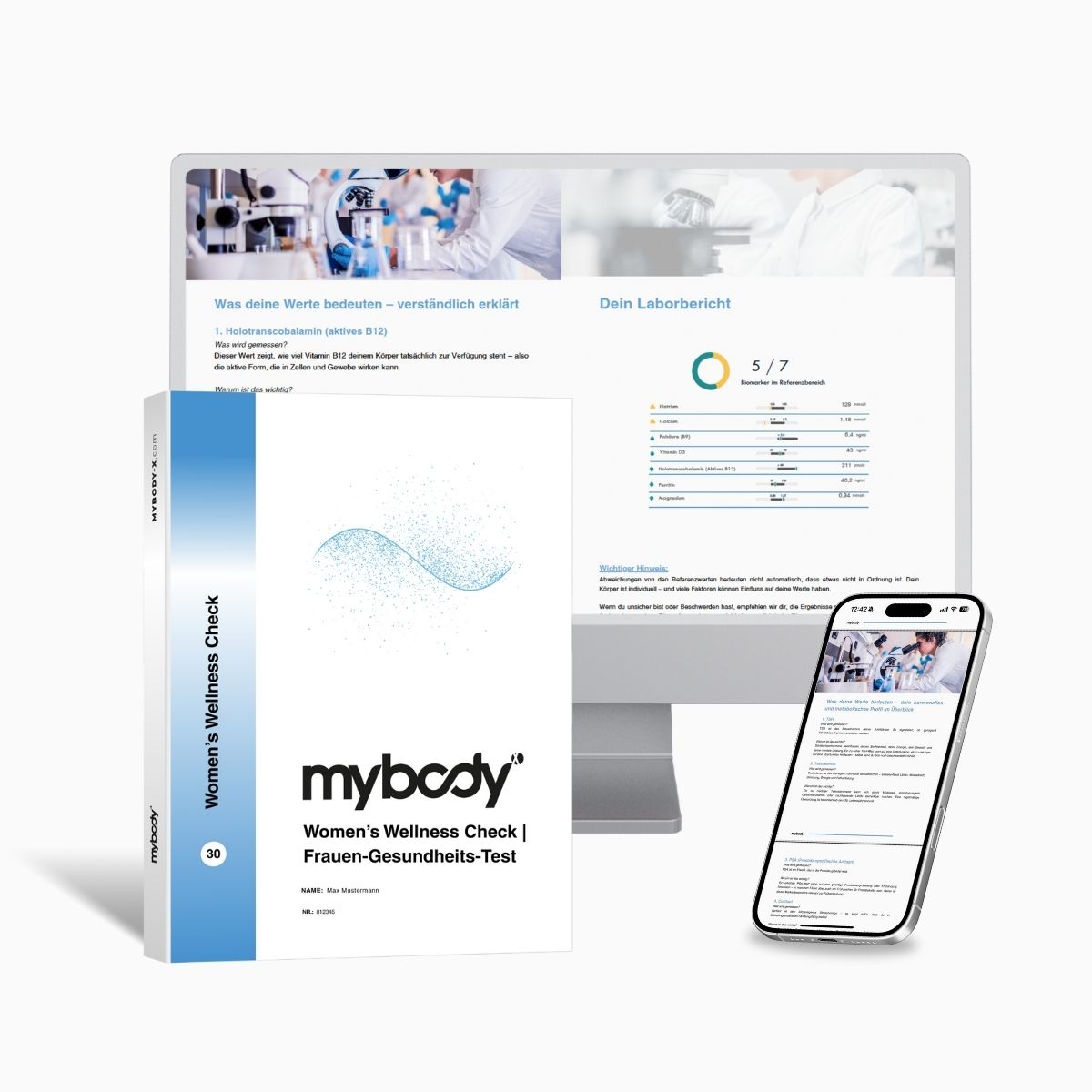
Capillary blood test
Women’s Wellness Check | Women’s Wellness Test
Includes 18 values, including TSH, fT3, and fT4 from the same sample. It also covers cortisol, prolactin, SHBG, ferritin, vitamin B12, vitamin D, gamma-GT, GPT, cystatin C, long-term blood sugar, CRP, as well as total cholesterol, HDL, LDL, and triglycerides. What the test does not do: It determines neither total T3 nor total T4, does not test for thyroid antibodies, does not provide a diagnosis, and does not replace a medical examination.
Laboratory analysis 3–5 business days after sample receipt
Product page information, accessed 15 August 2026
Four points determine whether three values become useful information.
Pay attention to the f
T4 and fT4 are two different values in two different units.
Read each value individually
fT3 and fT4 have their own reference ranges and are not compared with each other.
Note the direction
For TSH and the hormone levels, a high value points in different directions.
Report relevant circumstances
Severe illness and certain medications alter all three values.
Chapter at a glance
A capillary blood self-test provides TSH, fT3, and fT4 from the same sample and does not provide a diagnosis. Its benefit is that the signal and the sample collection come from the same day. Four points are crucial: pay attention to the f, read each value individually, note the direction, and report relevant circumstances.
Limitations: what three values leave unanswered
The first limitation is the cause. The three values describe a functional state and say nothing about what caused it. For the question of an autoimmune reaction, IQWiG mentions separate tests, namely thyroid antibodies (as of 24 April 2024).
The second limitation is the range found in healthy people. IQWiG notes that healthy people sometimes also have values outside the reference range (as of 20 March 2025).
The third limitation is the special case. In low T3/low T4 syndrome, TSH can be normal, low, or high (MSD Manual, professional edition, as of February 2024). Even a complete set of values is therefore not necessarily informative on its own.
The fourth limitation is diagnosis. All the classifications in this article provide context and do not constitute a diagnosis. A diagnosis is made in a medical practice based on several components, and no self-test can anticipate it.
What matters for the hormone levels
If you take away just one thing from this article, let it be this: TSH and the two hormone levels represent two different sides of the same regulatory system.
One is the signal from the pituitary gland, while the other two are what arrives in response. That is why a high level points in opposite directions for them, and why they complement each other.
It started with the question of what fT3 and fT4 add. The answer is: TSH answers whether a problem exists, while the hormone levels answer what that problem is. And the small f in front determines which value you are actually looking at.
Frequently asked questions
What is the difference between fT4 and T4?
Total thyroxine is the sum of free thyroxine and T4 bound to protein (IQWiG, as of 20 March 2025). Only the free fraction is active. Free thyroxine is typically measured today because it allows thyroid function to be assessed more accurately than total T4. The reference ranges differ accordingly: 5 to 12 µg/dl versus 10 to 23 pmol/l.
Which reference ranges apply to fT3 and fT4?
IQWiG gives the following values for women and men over 18: free thyroxine 10 to 23 pmol/l, corresponding to 0.8 to 2.0 ng/dl, and free triiodothyronine 3.9 to 6.7 pmol/l, corresponding to 0.2 to 0.52 ng/dl (as of 20 March 2025). The reference range on your own report remains decisive.
When are fT3 and fT4 measured at all?
IQWiG describes the usual sequence: Thyroid dysfunction can be detected particularly early through a change in the TSH level, which is why TSH alone is often measured initially; if this value is abnormal, the thyroid hormones T3 and T4 are also measured (as of 24 April 2024). If all three are available from the same sample, a second appointment is unnecessary.
Is fT3 more important than fT4?
IQWiG states: Free triiodothyronine is more potent than free thyroxine (as of 20 March 2025). More potent means that the same amount has a greater effect; it does not mean that the value is more informative. Each is interpreted against its own reference range.
Why do TSH and hormone levels point in different directions?
Because they describe two sides of the same regulatory system. Elevated TSH levels generally indicate an underactive thyroid, while low levels indicate an overactive thyroid (IQWiG, as of 20 March 2025). The opposite applies to free hormones: elevated levels may indicate an overactive thyroid, while levels that are too low may indicate an underactive thyroid (IQWiG, as of 24 April 2024).
Next step
Signal and delivery on the same day
A TSH measurement alone shows only one side. Only the two hormone levels alongside it show what the thyroid is actually producing. The Women’s Wellness Check measures all three together with 15 additional values from capillary blood. It does not provide a diagnosis and does not replace medical evaluation.
To the Women’s Wellness CheckRead more
You might also be interested in this
What a value within the reference range tells you—and what it leaves unanswered.
The background article on an isolated low fT3 level.
Sources
- Institute for Quality and Efficiency in Health Care (IQWiG): Free triiodothyronine (fT3), status as of 20 March 2025 – gesundheitsinformation.de
- IQWiG: Free thyroxine (fT4), status as of 20 March 2025 – gesundheitsinformation.de
- IQWiG: Total thyroxine (T4), status as of 20 March 2025 – gesundheitsinformation.de
- IQWiG: Total triiodothyronine (T3), status as of 20 March 2025 – gesundheitsinformation.de
- IQWiG: Thyroid-stimulating hormone (TSH), status as of 20 March 2025 – gesundheitsinformation.de
- IQWiG: Understanding thyroid examinations, status as of 24 April 2024 – gesundheitsinformation.de
- MSD Manual, Professional Edition: Assessment of thyroid function, Boucai L (full review February 2024) – msdmanuals.com
- IQWiG: Understanding laboratory values correctly, status as of 2 April 2025 – gesundheitsinformation.de
The verbatim quotation about the effectiveness of fT3, its definition, the reference range of 3.9 to 6.7 pmol/l, and the note that the free fraction is generally measured are taken from source [1]. The definition of fT4, the reference range of 10 to 23 pmol/l, and the note about values outside the reference range in healthy people are taken from [2]. The definition of total thyroxine, the reference range of 5 to 12 µg/dl, the explanation of protein binding, and the information about switching from T4 to fT4 are taken from [3]. The definition of total triiodothyronine is taken from [4]. The definition of TSH, the age-specific reference ranges, and the indication of direction are taken from [5]. The sequence of testing TSH first, followed by T3 and T4, the indication of direction for the free hormones, and the note about thyroid antibodies are taken from [6]. The statements about the most sensitive parameter, the direct measurement of free T4, and the low-T3/low-T4 syndrome are taken from [7]. The explanation of the reference range is taken from [8]. Information about price, values, sample type, and laboratory comes from the mybody®x product page, accessed on 15 August 2026; processing times follow the central specification for blood tests. All sources were accessed and checked on 15 August 2026.

mybody®x Editorial & Specialist Team
Laboratory diagnostics Blood analysis interpretation Nutritional science Nutrigenetics
This article was created by the mybody®x editorial and specialist team. The team combines laboratory diagnostics, nutritional science, and the interpretation of blood analyses. Contributors are listed on the authors page.
Published on 15 August 2026 · Last updated on 15 August 2026
The content is intended for general information and does not replace medical advice, diagnosis, or treatment. Reference ranges depend on the laboratory, method, and age; the information on your test report is always authoritative.




Share now:
Blood lipid levels: why only all four together provide a complete picture
Chromium, molybdenum, and manganese: three quiet trace elements